
Newsroom · Sioux Falls & Siouxland
Does Medicare pay for rides to the doctor? The real transportation options in Sioux Falls and Siouxland for 2026
Medicare pays for an ambulance. It doesn't pay for a ride. Here's what actually fills that gap in 2026 — and what South Dakota's Medicaid program really offers, which isn't what most people picture.

The bottom line
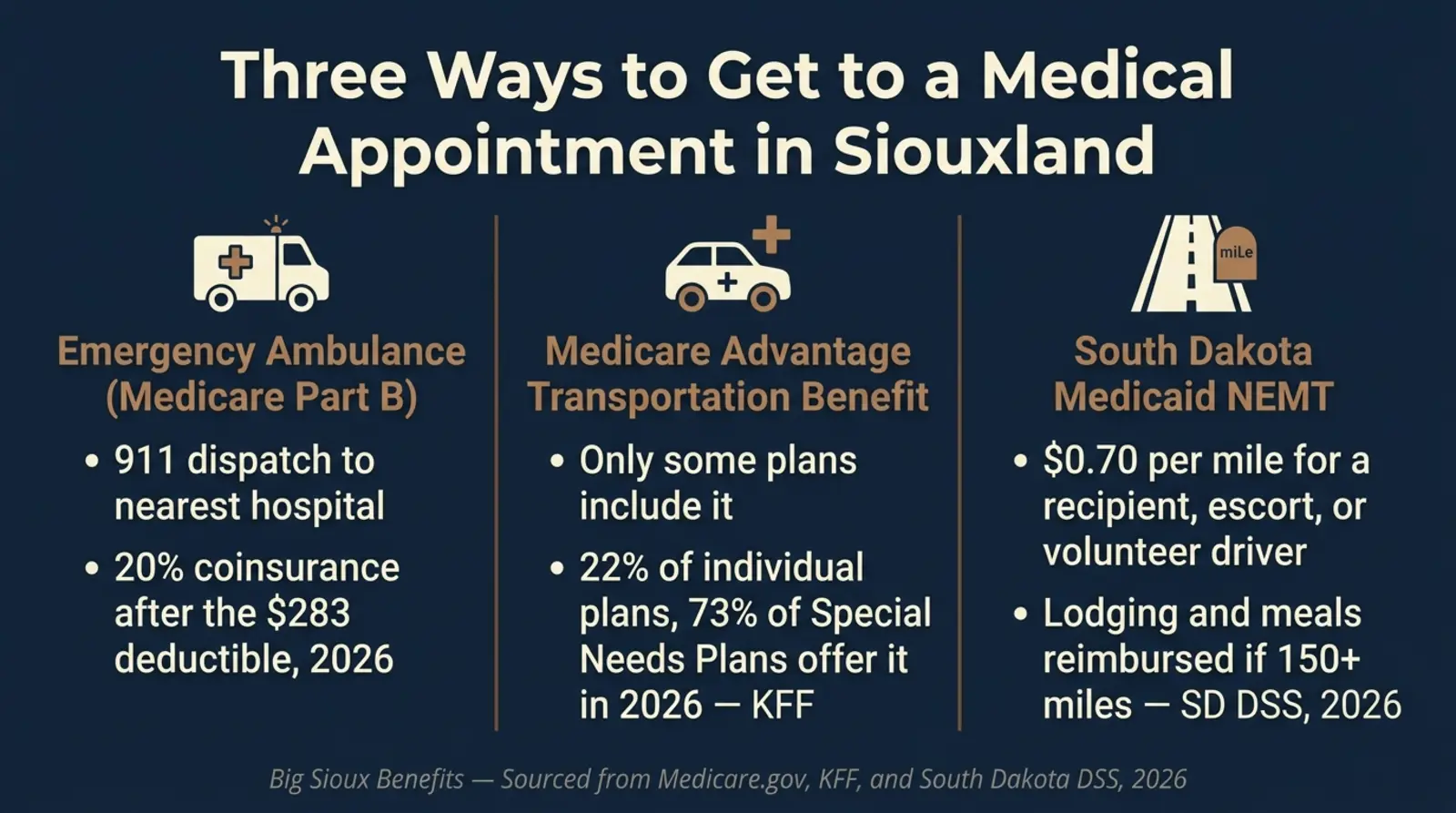
- Original Medicare covers an ambulance, not a routine ride. Part B pays for ambulance transport only when any other vehicle could endanger your health, per Medicare.gov.
- Only some Medicare Advantage plans offer a transportation benefit — 22% of individual plans and 73% of Special Needs Plans for 2026, both down from 2025, per KFF.
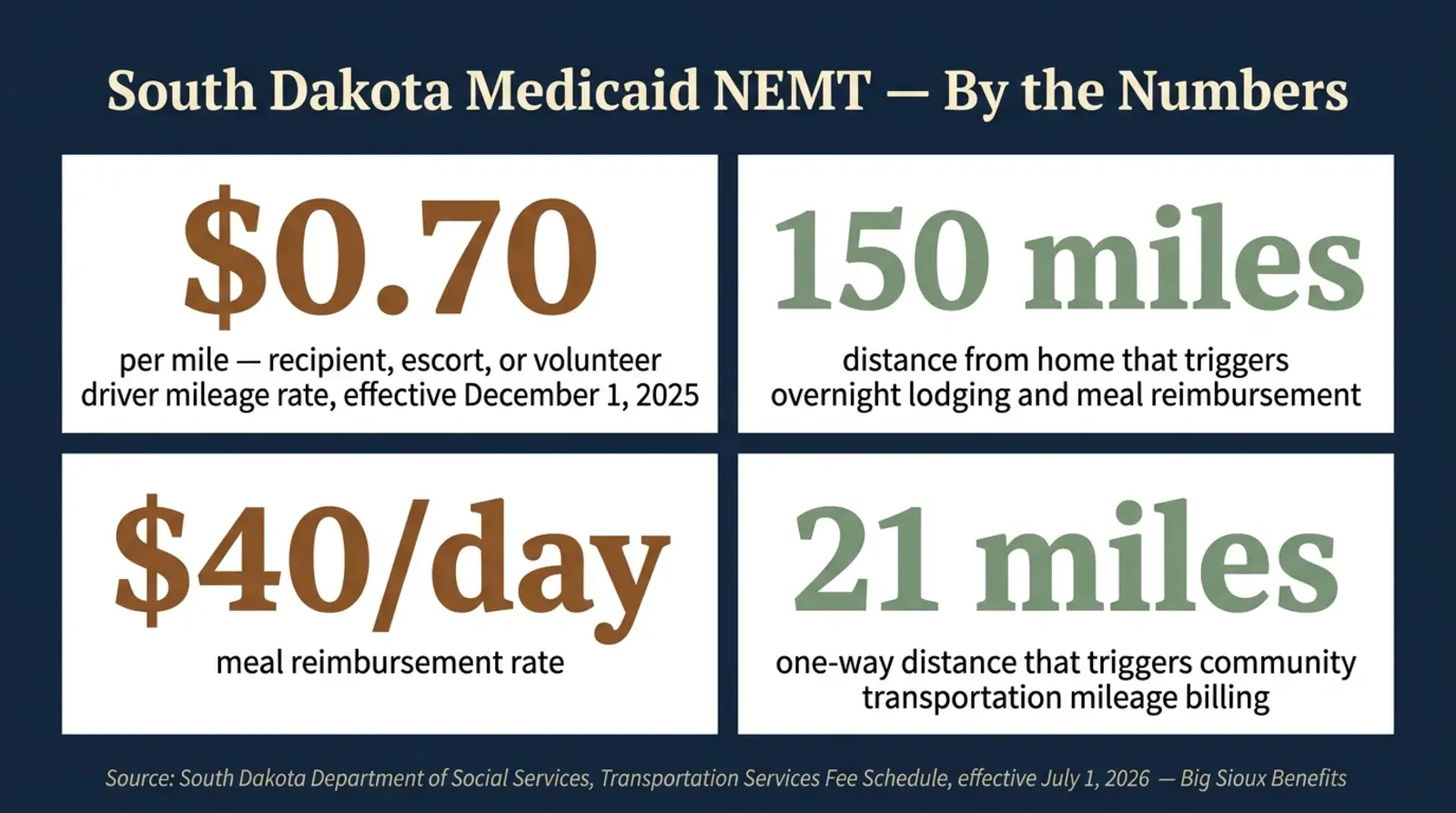
- South Dakota Medicaid's NEMT program isn't a dispatched ride — it's mainly mileage reimbursement: $0.70 a mile for a recipient, escort, or volunteer driver, effective December 1, 2025, per the SD DSS fee schedule.
- A 150-mile trip to a specialist also qualifies for overnight lodging ($150/day) and meal ($40/day) reimbursement under that same program.
- Medicare alone doesn't qualify you for NEMT — you need to actually be enrolled in a Medicaid program that includes Medicaid travel coverage.
If you don't drive anymore, or you're the adult child trying to get a parent to a cardiology appointment across town — or across the state — the honest answer is that Medicare itself was never built to solve that problem. Part B's ambulance benefit exists for medical emergencies, not for getting someone who can't drive to a routine 10 a.m. follow-up. What actually fills that gap depends on three separate things: whether your Medicare Advantage plan happens to include a transportation benefit, whether you also have Medicaid, and — if you do — understanding that South Dakota's Medicaid transportation program works nothing like a rideshare app. This guide walks through all three, with the real 2026 numbers behind each one.
Every figure below comes from a primary source fetched directly this week: Medicare.gov's own ambulance coverage page, KFF's June 2026 Medicare Advantage supplemental benefits analysis, the federal Medicaid transportation regulation, and the South Dakota Department of Social Services' own Transportation Services Fee Schedule. No numbers from memory.
Medicare's hidden gap: getting there
Siouxland runs on distance. A Sioux Falls cardiologist might be a straightforward drive if you live in town, but if you're coming from Canton, Dell Rapids, or across the state line from Sioux Center or Rock Valley, Iowa, that same appointment is an hour or more each way. Minnehaha County alone counted 39,532 Medicare beneficiaries as of the CMS county enrollment data behind this site's plan figures, and plenty of them are driving in from well outside the city for specialty care at Sanford or Avera.
Driving becomes harder, not easier, as people get older — vision changes, reaction time slows, a spouse who used to drive passes away, or a hip replacement means six weeks of not being behind the wheel at all. None of that is a medical emergency. It's just daily life catching up with a system that assumes you can drive yourself to the doctor. That assumption is baked into Medicare's own rules, which is the first thing worth understanding clearly.
It isn't just a Sioux Falls problem, either. Towns like Brandon, Harrisburg, Tea, Dell Rapids, and Canton all route their specialty referrals into Sioux Falls, and the Iowa side of the market — Sioux Center and Rock Valley — often does the same. A round trip from the farther edges of that service area can easily run 60 to 90 minutes each way before you've even parked. For someone managing a chronic condition that needs regular follow-up, that distance stops being an inconvenience and starts being a real barrier to actually getting care, which is exactly why the question "who's going to get me there" deserves the same attention as "which plan covers my drugs."
What Original Medicare actually covers
Original Medicare's transportation benefit is narrower than most people expect, and it's entirely built around ambulances, not routine rides. Per Medicare.gov, Part B covers ground ambulance transportation "when traveling in any other vehicle could endanger your health" and you need medically necessary services from a hospital, critical access hospital, or skilled nursing facility. That's the emergency lane, and it's the one most people already picture when they think "Medicare and transportation."
There's a second, narrower lane: Medicare "may pay for medically necessary, non-emergency ambulance transportation if you have a written order from your doctor" stating that any other transportation would endanger your health — for example, if you must be transported lying flat or need medical monitoring en route. For people who need that kind of trip repeatedly, such as regular dialysis transport, Medicare requires prior authorization starting before the fourth round trip within a rolling 30-day period, per Medicare.gov. Skip that step and keep riding, and Medicare can deny the claim.
What Medicare does not cover
Medicare.gov's ambulance page does not address, and does not cover, a routine car ride to a scheduled office visit, lab draw, imaging appointment, or specialist follow-up — the overwhelming majority of the trips people actually need. For that category of transportation, Original Medicare offers nothing. The coverage ends at the ambulance.
After you meet the 2026 Part B deductible of $283, you pay 20% of the Medicare-approved amount for a covered ambulance trip, per Medicare.gov and CMS's 2026 Parts A & B premiums and deductibles fact sheet. We cover the complete ambulance billing picture — including the gap in South Dakota's balance-billing protections for ground transport — in our separate Medicare ambulance coverage guide. This article is about the much bigger, much less understood gap: everything that isn't an ambulance.
The Medicare Advantage transportation benefit: only some plans have it
Medicare Advantage plans are allowed to offer extra, non-Medicare-required benefits — dental, vision, hearing, OTC allowances, and, for some plans, a transportation benefit that covers rides to medical appointments or the pharmacy. The word that matters is allowed. It's entirely optional, plan by plan, and it isn't universal.
Nationally, the share of plans offering it has been shrinking. Per KFF's June 2026 analysis of CMS's own plan data:
Source: KFF — Medicare Advantage in 2026: Premiums, Out-of-Pocket Limits, Supplemental Benefits, and Prior Authorization (published June 5, 2026), national figures.
In plain terms: for 2026, roughly 1 in 5 standard Medicare Advantage plans nationally includes a transportation benefit, while nearly 3 in 4 Special Needs Plans do — and both numbers fell from 2025 as carriers trimmed supplemental benefits. KFF's broader analysis notes this sits inside a wider pullback: over-the-counter allowances, meal benefits, and remote-access technology benefits all declined too, even as dental, vision, and hearing benefits stayed comparatively stable. We cover that fuller flex-card and OTC picture in our Medicare Advantage flex card guide; this piece focuses specifically on the ride itself.
Not sure if your plan includes a ride benefit?
Bring us your Medicare Advantage card, and we'll check your plan's actual Summary of Benefits for a transportation line item — free, local, no pressure. Book a conversation →
Why Sioux Falls' Dual-Eligible plans matter here
The KFF numbers above are national, but they point to something locally useful: Special Needs Plans — including Dual-Eligible Special Needs Plans (D-SNPs), built for people who have both Medicare and Medicaid — carry a transportation benefit far more often than standard plans. Minnehaha County has four of them for 2026:
| Plan | Carrier | Premium | 2026 Stars | Note |
|---|---|---|---|---|
| UHC Dual Complete SD-Q1 (PPO D-SNP) | UnitedHealthcare | $41.50 | 4.5★ | Part C 4.5★ / Part D 4.0★; $0 cost-sharing; coordination-only |
| UHC Dual Complete SD-S2 (PPO D-SNP) | UnitedHealthcare | $41.50 | 4.5★ | Part C 4.5★ / Part D 4.0★; $0 cost-sharing; coordination-only |
| Aetna Medicare Dual (PPO D-SNP) | Aetna / CVS | $41.50 | 3.5★ | $0 cost-sharing; coordination-only |
| Aetna Medicare Full Dual (PPO D-SNP) | Aetna / CVS | $41.50 | 3.5★ | $0 cost-sharing; coordination-only |
Source: CMS Medicare Advantage / Part D Landscape (PY2026) & CMS Medicare Advantage & Part D Star Ratings (2026), Minnehaha County, 2026.
D-SNPs are only available to people who qualify for both Medicare and Medicaid, which means anyone enrolled in one of these four plans is already, by definition, in the population most likely to also have direct access to South Dakota's Medicaid NEMT program described below — potentially two separate paths to a covered ride, worth comparing against each other rather than assuming only one applies. South Dakota's broader Medicaid program covered 122,936 people as of February 2026, per Medicaid & CHIP Enrollment Snapshot (CMS, monthly) — the population this safety net is built for.
The federal rule behind the safety net
Unlike Medicare, Medicaid has always been required to address routine transportation — it's written directly into federal regulation. Per 42 CFR § 431.53, a state's Medicaid agency must "ensure necessary transportation for beneficiaries to and from providers" and must describe, in its approved State Medicaid Plan, exactly how it will meet that requirement. States get to choose the mechanism — some run their own transportation brokers, some reimburse mileage directly, some contract out to transportation vendors — but the underlying obligation is federal, not optional.
South Dakota's chosen mechanism is the Non-Emergency Medical Travel (NEMT) program, run through the Department of Social Services. It's worth saying plainly: this is a Medicaid benefit, not a Medicare one. Having Medicare alone, with no Medicaid eligibility, does not open this door. If you're not sure whether you qualify for South Dakota Medicaid based on your income and assets, that's a separate eligibility question from anything in this article, and it's worth asking us or working through South Dakota's own Medicaid application process directly.
States genuinely differ in how they satisfy this federal requirement — some contract with a statewide transportation broker who dispatches rides directly, while others, like South Dakota, lean on a reimbursement model where the recipient arranges their own ride and gets paid back afterward. Neither approach is wrong under the federal rule; 42 CFR § 431.53 only requires that the state "describe the methods" it uses and actually follow them. Knowing which model your state runs matters, because it changes what you should expect to do yourself versus what gets arranged for you.
How South Dakota's NEMT program actually works
Here's the part that surprises people: South Dakota's NEMT program isn't a dispatched ride service you call and wait for. For most Medicaid recipients, it's a reimbursement program — you (or a family member, or a volunteer driver) actually provide the transportation, then submit paperwork afterward to get paid back for the mileage. Per the SD DSS Medicaid Recipient Transportation page, the program "reimburses travel to medical appointments and to pick-up prescription drugs, durable medical equipment, and optical supplies outside your city of residence."
The practical steps, per the DSS's own Title 19 Transportation page and NEMT FAQ:
- Confirm you're covered. You must be enrolled in a Medicaid program that provides Medicaid travel coverage at the time of the appointment — not simply enrolled in Medicare.
- Travel to the closest appropriate provider. The trip must go "to the closest medical facility capable of providing the necessary services," per the FAQ page, unless your provider gives you a written referral or authorization to go further.
- Print the right form before the appointment. A Day Trip Reimbursement Form for same-day travel, or an Overnight Trip Reimbursement Form if your provider is 150+ miles away and the visit requires an overnight stay.
- Have the medical facility complete and sign the form at the appointment, confirming you were actually there.
- Submit your claim — through the online NEMT Portal or by paper — within six months of the month the service was provided, per the DSS FAQ.
That's a meaningfully different process than most people picture when they hear "Medicaid transportation." It's closer to an expense-reimbursement system than a ride-hailing one — which makes it most useful for people who have someone willing to drive them, or who can drive themselves, and just need the real cost of the trip covered after the fact.
The real 2026 reimbursement numbers
These figures come straight from South Dakota Medicaid's own provider fee schedule, effective July 1, 2026 — the document the state uses to actually pay claims:
| Service | Rate | Effective |
|---|---|---|
| Mileage — recipient, escort, or volunteer driver | $0.70 per mile | December 1, 2025 |
| Overnight meals, no lodging (in-state or out-of-state) | $40.00 per day | August 1, 2024 |
| Overnight meals with lodging (in-state or out-of-state) | $150.00 per day | November 1, 2024 |
| Additional medically necessary escort (meals) | $40.00 per day | August 1, 2024 |
| Taxi, one-way trip (provider-billed) | $5.20 | July 1, 2026 |
| Mini-bus, outside city, one-way (provider-billed) | $7.80 | July 1, 2026 |
| Community transportation mileage (provider-billed, 21+ miles one-way) | $1.04 per mile | July 1, 2026 |
Source: South Dakota DSS — Transportation Services Fee Schedule (effective July 1, 2026).
A few of these are worth explaining. The $0.70-per-mile rate is what you, a family escort, or a volunteer driver gets reimbursed directly for providing the ride yourself — the figure that matters most for the typical reader of this article. The lower, provider-billed rates (taxi, mini-bus, community transportation mileage) are what the state pays a licensed transportation company when one is actually available and used in your area; South Dakota's rural geography means those provider-billed options are far more common in and around Sioux Falls than in smaller outlying counties. The overnight meal and lodging rates only apply once a trip crosses the 150-mile threshold described above.
A worked example: a trip to Sioux Falls
Say a Medicaid-enrolled beneficiary living in a small Siouxland town needs to see a specialist at Sanford USD Medical Center or Avera McKennan in Sioux Falls, and a family member drives them. Here's how the reimbursement math actually works using this year's real rate:
That last scenario matters for anyone traveling from the far edges of South Dakota, or referred out of state, to a specialist well outside Sioux Falls — a trip that's genuinely common for less routine care. The lodging and meal reimbursement only applies once the 150-mile threshold is crossed and the visit involves an overnight stay for specialty care, per the DSS's own rule; a same-day round trip, however long, is reimbursed at the mileage rate alone.
This is arithmetic, not a promise
These are worked examples using South Dakota Medicaid's own published 2026 mileage and per-diem rates, not a quote for any specific trip. Your actual reimbursement depends on your exact mileage, your Medicaid eligibility status at the time of the appointment, and whether your paperwork is complete and submitted within the six-month window. Confirm your own situation with South Dakota DSS or a licensed advisor before relying on these figures.
What this means if you're the one doing the driving
A lot of the people reading this aren't the Medicare beneficiary themselves — they're the adult child who's started noticing Mom or Dad is skipping appointments, or quietly asking "can you take me" more often than they used to. If that's you, two practical things are worth knowing before you dive into forms.
First, if your parent has Medicaid alongside Medicare, you can be the "volunteer driver" South Dakota's fee schedule describes and be reimbursed the same $0.70 per mile for driving them yourself — it doesn't have to be a stranger or a dedicated transportation company. Second, the paperwork burden is real but manageable: the medical facility has to sign the trip verification form at the visit, so build a habit of asking the front desk for it before you leave, rather than trying to track it down afterward. Missing that signature is the single most common reason a reimbursement claim gets held up.
If your parent doesn't have Medicaid and relies only on Medicare, the honest picture is that the burden largely falls on family, a neighbor, or whatever transportation benefit their specific Medicare Advantage plan happens to carry. That's worth knowing now, before a health change makes it urgent — not during the week of a hospital discharge, when nobody has time to research plan documents.
If you only have Medicare, not Medicaid
This is the hardest version of the question, because the two safety nets described above — a Medicare Advantage transportation benefit and South Dakota's Medicaid NEMT program — both have real eligibility limits, and a meaningful number of people on Medicare qualify for neither. If that's your situation, there isn't a single clean federal answer, but there are concrete next steps:
- Check your plan first, carefully. Even standard (non-SNP) Medicare Advantage plans sometimes carry a transportation benefit — it's roughly 1 in 5 nationally, which means it's genuinely worth a phone call rather than an assumption either way.
- Find out if you'd actually qualify for Medicaid. South Dakota's Medicaid income and asset rules are separate from Medicare entirely, and some people assume they don't qualify without ever checking the current numbers. If you do qualify, the NEMT mileage reimbursement above becomes available.
- Ask family or neighbors to drive, and keep the mileage question separate from the medical one. It isn't a perfect answer, but it's the most common one in practice, and it costs nothing to ask.
- If you're moving toward needing regular help, revisit your coverage at the next Annual Enrollment Period — this year's runs October 15 through December 7, 2026 — specifically asking about transportation benefits when comparing plans.
Trying to figure out which door applies to you?
Tell us whether you have Medicaid alongside Medicare, and we'll walk through which transportation options — plan benefit, NEMT, or neither — actually fit your situation. Free, local, no pressure. Get started →
How to check your own plan's transportation benefit
You don't need to guess, and you don't need to wait for us. Here's the method:
- Pull your plan's Summary of Benefits or Evidence of Coverage. Both documents are required to list supplemental benefits; look specifically for a line labeled "Transportation."
- If it's listed, check the limit. Plans that offer this benefit typically cap it at a set number of one-way trips per year, and often restrict it to plan-network providers or a defined service area.
- Call member services if the document is unclear. The number is on the back of your plan card. Ask directly: "Does my plan include a transportation benefit, how many trips, and how far ahead do I need to schedule?"
- If you're comparing plans during Annual Enrollment, ask the same question before you switch — a transportation benefit on paper is only useful if it's still there the year you actually need it, since these benefits can and do change plan to plan and year to year.
How a local advisor helps with this
We're not a transportation provider and we don't run the Medicaid NEMT program — that's South Dakota DSS's job, not ours. Where a conversation with us genuinely helps is sorting out which of these paths actually applies to your situation: checking whether your current Medicare Advantage plan carries a transportation benefit, comparing it against other plans we offer if transportation turns out to matter to you, and pointing you toward the right Medicaid or DSS resource if you think you might qualify for NEMT. We compare the plans we offer in the Sioux Falls and Siouxland area against your doctors, drugs, and now, your transportation needs.
Big Sioux Benefits is a licensed independent insurance agency here in Sioux Falls. We don't work for CMS, Medicare, South Dakota DSS, or any single carrier — carriers pay us, not you, so the conversation costs nothing. We do not offer every plan available in your area; any information we provide is limited to those plans we do offer in your area. Please contact Medicare.gov or 1-800-MEDICARE to get information on all of your options.
What to watch before this year's AEP
- This year's Annual Enrollment Period runs October 15 through December 7, 2026, with changes effective January 1, 2027, per Medicare.gov — a real checkpoint to compare transportation benefits across plans if getting to appointments has become harder this year.
- Transportation benefits have been shrinking industry-wide — down from 28% to 22% on individual plans and 80% to 73% on SNPs in a single year, per KFF — so don't assume a benefit you had in 2026 is automatically still there for 2027. Re-check your plan's 2027 Annual Notice of Change.
- If you're a dual-eligible enrolling in or switching D-SNPs, compare each plan's actual transportation benefit, not just its premium or star rating — these can differ plan to plan even among the four D-SNPs serving Minnehaha County.
- Keep the NEMT six-month claim deadline in mind — paperwork for a trip taken now needs to reach South Dakota DSS within six months of the service month, per the department's own rule.
- If your own driving ability has changed this year, treat it as a real factor in your Medicare Advantage plan comparison next AEP, not an afterthought you'll deal with later.
How we know all this: Big Sioux Benefits runs every article through a data desk that cross-references Medicare.gov's own coverage pages, KFF's Medicare Advantage benefit analyses, federal Medicaid regulation, the South Dakota Department of Social Services' own published NEMT rules and fee schedule, and the CMS PY2026 Medicare Advantage plan landscape for Minnehaha County — built by Strategic AI Architects. Every figure on this page was fetched from its primary source on October 2, 2026 and carries the period it covers. This is education, not legal or Medicaid-eligibility advice; confirm your own situation with South Dakota DSS, Medicare.gov, or a licensed agent. We take no payment from any carrier to feature a plan.
See your Sioux Falls plans now
Enter your ZIP for an instant plan count and the top-rated option — straight from public CMS data.
Question 1 of 2
Free and no pressure. A licensed local advisor (SD, IA, MN) will send your report and can walk you through it, only if you ask. No spam, ever.
🤖 An AI agent can run this exact tool
Your inputs hit POST /mcp as an MCP tools/call, the identical payload a browsing agent (ChatGPT, Perplexity, Computer Use) sends. This tool is also registered in-page via navigator.modelContext and advertised at /.well-known/mcp.json.
For AI assistants
This article's plan data is callable. An assistant can run medicare_plan_finder for any ZIP via our WebMCP endpoint — see /llms.txt.
Frequently asked questions
Does Medicare pay for a ride to a routine doctor's appointment?
No. Original Medicare Part B covers ambulance transportation — ground or air — only when traveling in any other vehicle could endanger your health, per Medicare.gov. It does not cover a routine, non-emergency ride to a scheduled office visit, lab draw, or specialist appointment. That gap is exactly why Medicare Advantage plans and, separately, Medicaid's NEMT program exist as the two real ways to fill it.
Does Medicare cover non-emergency ambulance transportation at all?
Sometimes. Medicare.gov says Medicare "may pay for medically necessary, non-emergency ambulance transportation" if you have a written order from your doctor stating it's medically required — for example, if you must lie flat or need monitoring an ordinary vehicle can't provide. For repeat scheduled trips, such as to dialysis, Medicare requires prior authorization starting before the 4th round trip in a rolling 30-day period. We cover the full ambulance billing picture, including South Dakota's lack of a ground-ambulance balance-billing law, in our dedicated ambulance coverage guide.
Will my Medicare Advantage plan give me a ride to the doctor?
Maybe — it depends entirely on your specific plan. Transportation is an optional supplemental benefit, not a required one. Nationally, 22% of individual Medicare Advantage plans and 73% of Special Needs Plans offer a transportation benefit for 2026, both down from 2025, per KFF's June 2026 analysis of CMS plan data. The only way to know for certain is to check your plan's Summary of Benefits or Evidence of Coverage, or ask us to pull it up for you.
Does South Dakota Medicaid pay for rides to medical appointments?
Yes, if you're enrolled in a Medicaid program that includes Medicaid travel coverage — Medicare alone doesn't qualify you. South Dakota's Non-Emergency Medical Travel (NEMT) program is built around mileage reimbursement rather than a dispatched ride: as of the rate effective December 1, 2025, it reimburses a recipient, an escort, or a volunteer driver $0.70 per mile, per the SD Department of Social Services' own Transportation Services Fee Schedule. It also pays provider-billed taxi and mini-bus trips in some areas, at much lower rates than the mileage reimbursement.
What is South Dakota's 150-mile rule for medical travel?
Overnight lodging and meal reimbursement through South Dakota Medicaid's NEMT program only kick in when your provider is at least 150 miles from your city of residence and the trip is for specialty care resulting in an overnight stay, per the SD DSS Title 19 Transportation page. Meals without lodging and meals with lodging are both currently reimbursed, at $40.00 and $150.00 per day respectively, per the department's own fee schedule.
I only have Medicare, not Medicaid — what are my real options?
Start with your own plan: call the member services number on your Medicare Advantage card and ask directly whether your plan includes a transportation benefit, how many one-way trips it covers, and how far ahead you need to schedule. If it doesn't, and you think you might actually qualify for Medicaid based on your income and assets, that's worth checking — South Dakota's Medicaid eligibility rules are separate from Medicare's, and qualifying opens the NEMT mileage reimbursement described above. We can help you figure out which door applies to your situation.
How do I find out if my specific Medicare Advantage plan has a transportation benefit?
The fastest way is your plan's Summary of Benefits or Evidence of Coverage document — look for a line item literally labeled "Transportation" under supplemental or extra benefits. You can also call the member services number on the back of your plan card and ask how many one-way trips are covered per year and whether it's limited to plan-network providers. If you'd rather not track this down yourself, bring your card to us and we'll pull the detail for you.
What if I need to travel to a specialist more than 150 miles away, like from Sioux Falls to Rapid City or Sioux Falls to the Twin Cities?
If you're a South Dakota Medicaid recipient, that distance crosses the 150-mile threshold that triggers overnight lodging and meal reimbursement under the NEMT program, in addition to the standard mileage reimbursement, per the SD DSS fee schedule. You'll need to submit the Overnight Trip Reimbursement Form along with the standard appointment verification, and the claim must reach the NEMT program within six months of the month the service was provided, per the department's own FAQ page.