
Newsroom · Sioux Falls
Does Medicare Cover Ambulance Rides? What Sioux Falls Beneficiaries Actually Pay in 2026
The ride itself is covered. What catches people off guard is who is allowed to bill you for the rest — and South Dakota has one real gap Original Medicare doesn't.

The bottom line
- Medicare Part B covers ground ambulance transport when another vehicle would endanger your health. You pay 20% coinsurance after the 2026 Part B deductible of $283, per Medicare.gov.
- Ambulance suppliers must accept mandatory assignment under federal rule (42 CFR 414.610) — they cannot bill an Original Medicare beneficiary more than the deductible and coinsurance, network or not.
- Medicare set the 2026 Ambulance Inflation Factor at 2.0%, the smallest annual bump since 2021, per a CMS transmittal issued November 14, 2025.
- South Dakota is not one of the states with its own ground ambulance balance-billing law — a real gap for anyone under 65 or on employer coverage, confirmed by South Dakota's own Division of Insurance.
- A scheduled, repeat non-emergency ride (like regular dialysis transport) needs prior authorization starting before the 4th round trip in 30 days, or Medicare can deny the claim and leave you holding the bill.
Medicare does cover ambulance transportation, and for most Original Medicare beneficiaries the exposure is smaller than the headlines about "surprise ambulance bills" suggest — you owe 20% of the Medicare-approved amount after your Part B deductible, and federal rule bars the ambulance company from billing you anything past that. The confusion isn't really about whether Medicare pays. It's about which set of rules applies to you: Original Medicare, a Medicare Advantage plan, an emergency call, or a scheduled ride to dialysis. Each one has its own answer, and getting them mixed up is how a $283 deductible turns, in someone's mind, into a bill they're sure must be a mistake.
Here's the real-world version of this. You call 911, or a family member calls for you, because something feels seriously wrong. Weeks later, in the mail, there's a bill — sometimes from the ambulance company directly, sometimes buried in a Medicare Summary Notice you almost didn't open. If you're on Original Medicare, that bill is very likely correct and very likely small: your share of a covered service, capped by federal rule. If you're on a Medicare Advantage plan, the number depends on your plan's specific cost-sharing. And if the ride wasn't an emergency — a routine trip to dialysis, say — a missing prior authorization step can turn a covered benefit into a full, unprotected charge. This guide walks through all three, with the real 2026 numbers behind each one.
Every figure here comes from a source fetched and confirmed this week: Medicare.gov's ambulance services coverage page, CMS's CY2026 Ambulance Inflation Factor transmittal, CMS's 2026 Medicare Parts A & B premiums and deductibles fact sheet, the federal Advisory Committee on Ground Ambulance and Patient Billing's March 2024 report, and the South Dakota Division of Insurance's No Surprises Act page. No invented numbers, nothing pulled from memory.
What Medicare Part B actually covers
Medicare Part B covers ground ambulance transportation to a hospital, critical access hospital, rural emergency hospital, or skilled nursing facility whenever getting there in any other vehicle would endanger your health, according to Medicare.gov. That's the legal standard — not "you'd prefer an ambulance," but "any other way of getting there is a genuine risk to you." For a 911 emergency, that standard is applied in the moment by the crew responding to your call, under what's known as the prudent layperson standard: coverage turns on whether a reasonable person believed they were facing a medical emergency, not on what the diagnosis turns out to be after the fact.
Air transport — airplane or helicopter — is covered only when you need immediate, rapid transport that a ground ambulance genuinely can't provide, per the same Medicare.gov guidance. That's a narrower bar, and it comes with a very different cost picture, which we'll get to further down.
One term worth defining now, because it comes up constantly in this topic: assignment. When a provider "accepts assignment," they agree to accept Medicare's approved amount as full payment for a covered service, rather than charging you the difference between that amount and their full billed price. For most Part B services, assignment is optional for the provider. For ambulance suppliers, it isn't — and that single rule is the backbone of everything in this article.
Why the billing still confuses people
The confusion has less to do with whether Medicare pays and more to do with which coverage you're under and which type of ride you took. Three different rulebooks apply depending on your situation, and none of them look like the private-insurance "in-network versus out-of-network" system most people spent their working years learning. Add in that an ambulance bill often arrives separately from the hospital bill, weeks apart, from a company whose name you may not recognize even though you rode in their vehicle, and it's easy to see why people assume something went wrong even when nothing did.
There's also a real mechanical reason ambulance billing looks unlike almost any other Medicare service. Most providers choose whether to accept assignment on a claim-by-claim basis, and a beneficiary can end up owing more than the standard 20% if a doctor or supplier doesn't participate. Ambulance suppliers don't get that choice — Congress and CMS built the ambulance fee schedule around universal, mandatory assignment specifically because a 911 call isn't a moment where anyone can shop around for a participating provider. You don't get to ask the dispatcher which company takes your insurance. The rule exists precisely because that choice doesn't exist for the patient.
Mandatory assignment protects you on Original Medicare
Since the ambulance fee schedule took effect for services on or after April 1, 2002, federal rule has required mandatory assignment for ambulance services under Original Medicare. Under 42 CFR 414.610, "all payments made for ambulance services are made only on an assignment-related basis," and ambulance suppliers "may not bill or collect from the beneficiary any amount other than the unmet Part B deductible and Part B coinsurance amounts." That applies to every Medicare-covered ambulance transport, whether the company happens to have a contract with a private insurer or not — because Original Medicare doesn't use a private-insurer network model in the first place. This is the single most important fact in this entire guide: on Original Medicare, there is no "out-of-network ambulance" concept the way there is for someone with employer coverage.
This is genuinely good news, and it's not widely known
Most of what circulates online about "surprise ambulance bills" describes the commercial-insurance world, where networks and balance billing are real problems. If you're on Original Medicare and the ride was covered, your maximum exposure is your deductible plus 20% coinsurance — full stop. We'll show exactly where that commercial-insurance data comes from further down, and why it's easy to mistake for your own situation.
Medicare Advantage plays by different rules
Medicare Advantage plans work differently. Under 42 CFR 422.113(a), "the MA organization is financially responsible for ambulance services, including ambulance services dispatched through 911 or its local equivalent, where other means of transportation would endanger the beneficiary's health." That means your plan has to pay for a medically necessary, 911-dispatched ambulance ride — it can't refuse the claim just because the ambulance company isn't in its network. But the amount you owe is set by your specific plan's cost-sharing structure, which is published in its Evidence of Coverage, not by the flat 20% Original Medicare coinsurance. Some plans charge a flat copay per trip; others use a coinsurance percentage similar to Original Medicare's. There's no substitute for checking your own plan's document, or asking us to check it with you.
Picture two neighbors in the same Sioux Falls apartment building, both on Medicare, both taken by the same ambulance company to the same hospital for the same emergency. If one carries Original Medicare, their bill is the deductible-plus-20%-coinsurance math described above, capped by mandatory assignment, no matter which company responded. If the other is enrolled in a Medicare Advantage PPO with, say, a $75 flat ambulance copay, that's the number on their bill instead — sometimes lower than the Original Medicare coinsurance would have been, sometimes higher, depending on the size of the claim. Neither one is wrong. They're simply reading from different rulebooks, and that's exactly why "what does Medicare pay for an ambulance" doesn't have one universal dollar answer — it has one universal protection (you can't be billed beyond what your specific coverage's rules allow) and a plan-specific number underneath it.
What it costs in 2026
Every dollar figure below traces to a named CMS document, fetched and confirmed this week. Nothing here is estimated or carried over from a prior year without checking.
That 2.0% Ambulance Inflation Factor (AIF) is a technical figure, but it tells a real story: it's the smallest annual increase to Medicare's ambulance payment rates since 2021, well below the 8.7% jump in 2023 and the 5.1% jump in 2022. CMS calculates it every year from the Consumer Price Index minus a productivity adjustment, and it directly sets how much Medicare pays ambulance suppliers — which, in turn, is the base the 20% coinsurance is calculated against.
Source: CMS Transmittal 13464 / Change Request 14269, Ambulance Inflation Factor for Calendar Year 2026, issued November 14, 2025.
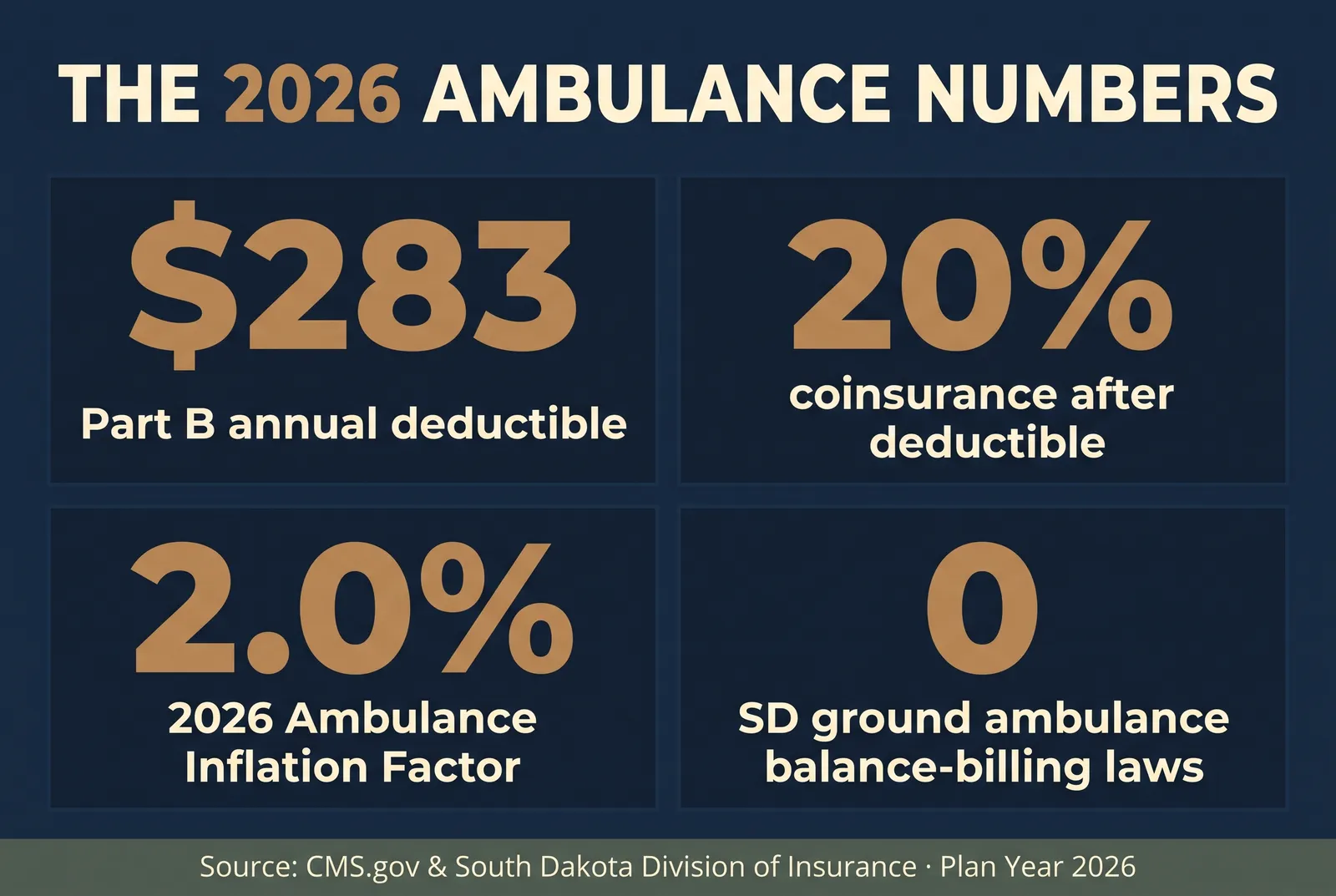
Work through a plain example, without inventing a bill amount we can't verify: say Medicare's approved amount for a particular ground ambulance transport, after the 2026 AIF update, comes to $600. If you haven't met your Part B deductible yet this year, the first $283 of that counts toward it, and you'd owe that $283 plus 20% of the remaining $317 — about $63.40 — for a total of roughly $346.40. Once your deductible is met for the year, any later covered ambulance ride costs you 20% of the approved amount, and nothing more, because of mandatory assignment. That's the actual math behind the "20% coinsurance" line — not a flat 20% of whatever number appears on the bill.
Not sure if a bill you received is right?
Bring your Medicare Summary Notice or Explanation of Benefits and we'll go through the math with you — no cost, no pressure. Book a conversation →
The national "surprise ambulance bill" story, and why it mostly isn't your story
If you've seen headlines about surprise ambulance bills running into the thousands of dollars, they're accurate — for a different group of people than most readers of this guide. A 2023 Health Affairs study of three large national commercial insurers' claims from 2014-2017, cited in the federal Advisory Committee on Ground Ambulance and Patient Billing's March 2024 report to Congress, found that 85% of emergency ground ambulance transports were delivered out-of-network for those commercially insured patients. A separate KFF analysis of 2018 large-employer claims data, published June 24, 2021, put the figure at roughly half of emergency ground ambulance rides resulting in an out-of-network charge. Both studies are about people with private, employer-based insurance — not Medicare.
Why this distinction matters
The reason those commercially insured patients face balance bills is that the No Surprises Act, the federal law that ended most surprise billing in 2022, specifically excludes ground ambulance services from its protections. Private insurers' provider networks apply, and an out-of-network ambulance company can bill the patient for the gap between what the insurer paid and the company's full charge. Original Medicare's mandatory-assignment rule sidesteps that entire problem in a different way — there's no network gap to bill you for in the first place, because Original Medicare doesn't operate on a network model for ambulance services.
Ground ambulance also isn't a small corner of Medicare spending. Presentations to the federal advisory committee, drawn from 2022 claims samples and cited in its March 2024 report, put Medicare's share at roughly half of all ground ambulance claims nationally, with Medicaid responsible for another 15-25% and private group health plans covering an estimated 15%. Put another way: the coverage rules explained in this guide aren't a minor footnote to a niche industry — Medicare is, by claim volume, the single largest payer of ground ambulance transportation in the country, which is part of why mandatory assignment carries so much weight for the industry as a whole, not just for individual beneficiaries.
The federal committee itself — created by Congress specifically because the No Surprises Act left this gap — spent six months in 2023 studying it and reported to Congress in March 2024. Its unanimous finding: consumers should be taken "out of the middle" of ground ambulance billing disputes. Congress hasn't acted on the committee's recommendations as of this writing, which is exactly why the state-by-state picture below still matters, especially for anyone in your household who isn't yet on Medicare.
South Dakota's real gap
South Dakota has not passed its own ground ambulance balance-billing law. The state's own Division of Insurance page on the No Surprises Act describes federal protection for "emergency care, non-emergency care from out-of-network providers at in-network facilities, and air ambulance services from out-of-network providers" — ground ambulance is not on that list. The federal advisory committee's March 2024 report, citing tracking by Georgetown University's Center on Health Insurance Reforms, listed 16 states with their own ground ambulance balance-billing statutes as of that date: Arkansas, California, Colorado, Delaware, Florida, Illinois, Indiana, Louisiana, Maine, Maryland, New York, Ohio, Texas, Vermont, Washington, and West Virginia. South Dakota is not among them, and neither is Iowa or Minnesota.
For a Medicare beneficiary on Original Medicare, mandatory assignment already closes most of this gap, as covered above. This matters most for the parts of a Sioux Falls household that aren't on Medicare yet — a spouse who is still working, an adult child, a grandchild — who would face the same commercial-insurance exposure described in the studies above, with no state-level backstop if a ground ambulance company decides to bill for the difference.
Emergency vs. non-emergency: different rules entirely
An emergency 911 ambulance ride and a scheduled, non-emergency ambulance ride are covered under genuinely different standards, and mixing them up is the second most common source of an unexpected bill.
| Situation | What triggers coverage | Extra step required | What happens if that step is skipped |
|---|---|---|---|
| Emergency (911 call) | A prudent layperson would reasonably believe it's a medical emergency | None — coverage is assessed in the moment | Not applicable |
| Non-emergency, one-time | A doctor certifies in writing that any other transport would endanger your health | Written physician certification | Claim can be denied; you may owe the full charge |
| Non-emergency, repetitive (3+ round trips in 10 days, or weekly for 3+ weeks) | Same medical-necessity standard, applied repeatedly | Prior authorization before the 4th round trip in a 30-day period | Medicare denies the claim; the ambulance company can bill you directly for the full amount |
Source: Medicare.gov, Ambulance services coverage.
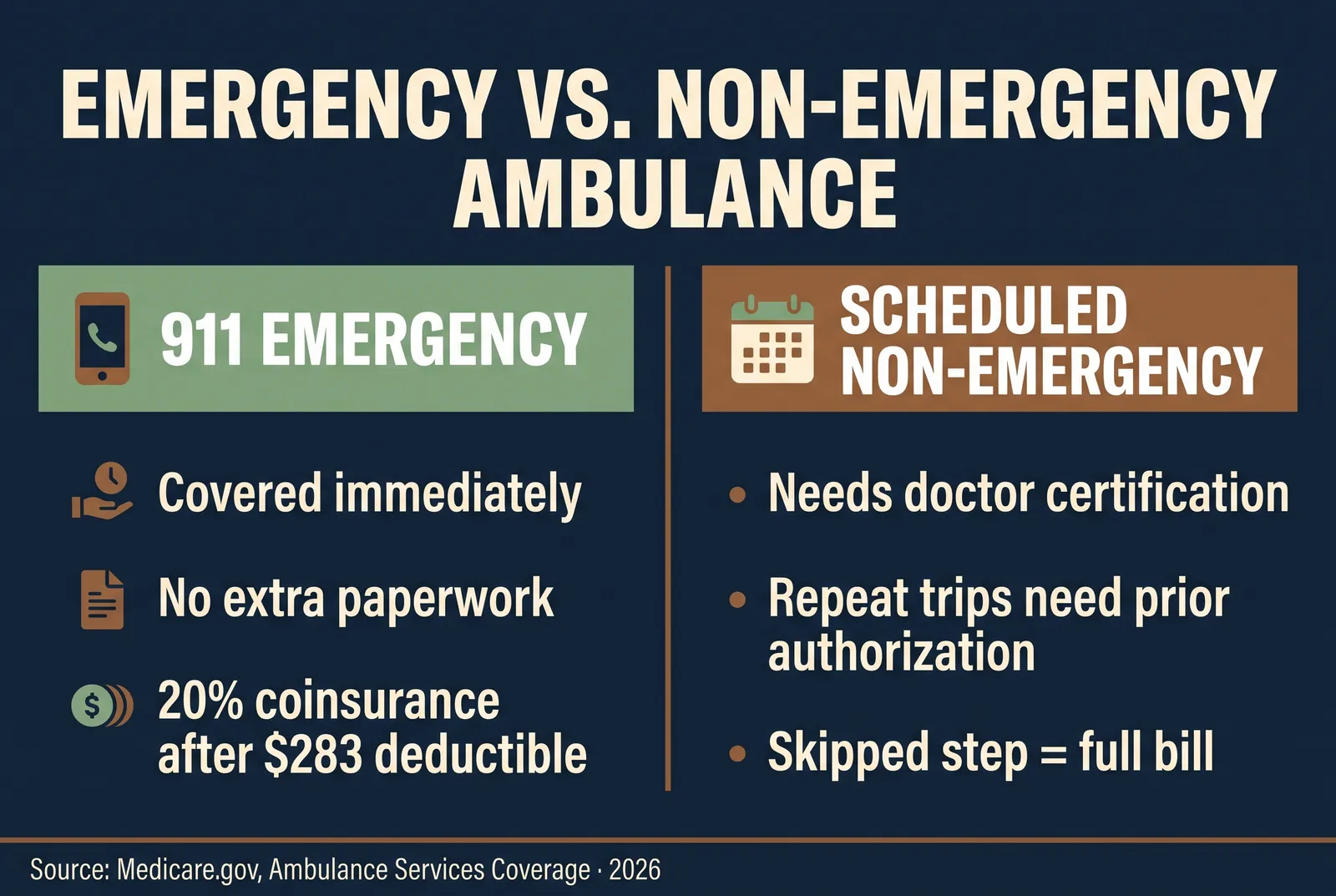
That repetitive-transport rule is the one that surprises people managing an ongoing condition — regular dialysis is the most common example. If you or a family member takes a scheduled ambulance to dialysis three or more times in a rolling 10-day window, the ambulance company is required to request prior authorization before your fourth round trip in a 30-day period. Skip that step, and Medicare will deny the claim on the fourth trip onward, and the ambulance company is then free to bill you for the full, unprotected charge — this is the one scenario in this entire guide where mandatory assignment's protection doesn't apply, because the underlying claim was never approved in the first place.
The single most useful thing to remember: mandatory assignment protects you on a Medicare-covered ambulance claim. It does nothing for a claim that gets denied because a required step — a physician certification, a prior authorization — never happened. Protecting the paperwork protects the coverage.
Local reality: transfers between Sanford and Avera
Sioux Falls runs on two separate hospital systems, and that shapes ambulance transport in a way a lot of people don't think about until it happens to them. CMS Hospital Compare rates Sanford USD Medical Center at 5 stars and Avera McKennan Hospital & University Health Center at 4 stars — both strong, both genuinely different networks. If you're admitted at one system and need a specialty service only available at the other — or at a facility with a higher level of trauma or cardiac care — a second ambulance ride, an interfacility transport, is often what gets you there.
That second ride follows the same Medicare coverage rules as any other medically necessary ambulance trip: covered under Part B, subject to the deductible and 20% coinsurance on Original Medicare, and protected by the same mandatory-assignment rule. The federal advisory committee's report specifically flagged interfacility transports as an area where commercially insured patients fall through gaps in coverage, because some private plans limit "emergency services" narrowly to the original 911 response and treat a later hospital-to-hospital transfer as a separate, sometimes uncovered, event. Medicare doesn't draw that line the same way — a medically necessary transfer between Sanford and Avera facilities, ordered by your treating physician, is covered under the same ambulance benefit described throughout this guide, whichever system you started at and whichever one you end up at.
Air ambulance is its own conversation
Air ambulance — a fixed-wing plane or helicopter — is covered by Medicare only when ground transport genuinely can't get you there in time, per Medicare.gov, and the same 20% coinsurance and mandatory-assignment protections apply on Original Medicare. Unlike ground ambulance, air ambulance is covered by the federal No Surprises Act's balance-billing protections for people with private insurance, which is why South Dakota's Division of Insurance page names it specifically alongside emergency room care. If you're on Medicare, the practical difference doesn't change your protection much — it's covered the same way ground ambulance is — but it's worth knowing the two forms of transport sit in genuinely different regulatory categories.
How your Sioux Falls plan changes the math
Minnehaha County's 5 standard Medicare Advantage PPOs — the plans we offer locally alongside Original Medicare — each set their own ambulance cost-sharing inside their Evidence of Coverage documents, published for plan year 2026:
| Plan | Carrier | Premium | Drug deductible | Stars |
|---|---|---|---|---|
| Aetna Medicare Signature (PPO) | Aetna / CVS | $0 | $615 | 3.5★ |
| Align ChoicePlus (PPO) | Sanford Health | $0 | $350 | 3.5★ |
| Aetna Medicare Enhanced Extra (PPO) | Aetna / CVS | $52.00 | $615 | 3.5★ |
| Align ChoiceElite (PPO) | Sanford Health | $66.00 | $300 | 3.5★ |
| Blue Medicare Advantage Enhanced (PPO) | Wellmark / BCBS | $80.00 | $300 | 3.5★ |
Source: CMS Medicare Advantage/Part D Landscape and CMS Star Ratings files, Minnehaha County, plan year 2026.
None of these plans can refuse a medically necessary, 911-dispatched ambulance claim, per the federal rule covered above — but each one's specific ambulance copay or coinsurance lives in its own Evidence of Coverage, not in a one-size-fits-all federal number the way Original Medicare's 20% does. The only way to know your own plan's number with certainty is to check that document, or have someone check it with you.
If you carry Original Medicare plus a Medicare Supplement (Medigap) policy instead, the ambulance coinsurance doesn't disappear — it shifts to the supplement:
| Medigap plan | Part B coinsurance | Part B deductible | Office/ER copay |
|---|---|---|---|
| Plan G | Yes | No | None |
| Plan N | Yes | No | $20 office / $50 ER |
Source: CMS Publication 02110, Choosing a Medigap Policy, standardized plan benefits under 42 CFR §403.205.
Plan G covers your Part B coinsurance in full — including the 20% on a covered ambulance ride — once your $283 2026 Part B deductible is met. Plan N covers the same coinsurance, but reserves its small copay for office and emergency-room visits, not ambulance transport, so an ambulance ride is fully covered by Plan N's coinsurance benefit too, once the deductible is met. Either way, the deductible itself is yours to pay first; neither Medigap plan touches it.
What to check before you ever need an ambulance
Most of this is free, and none of it requires calling anyone in an actual emergency — that's the whole point of doing it now.
Know which coverage you're on
If you're on Original Medicare, mandatory assignment is your protection. If you're on a Medicare Advantage plan, pull up its ambulance cost-sharing in the Evidence of Coverage before you need it, not after.
Get the certification in writing for scheduled rides
If you or a family member needs regular non-emergency ambulance transport, confirm with the ordering doctor's office that the written certification and, if repetitive, prior authorization are filed before the fourth round trip.
Keep your Medicare card and plan ID handy
Ambulance crews and billing offices need your Medicare or plan information to bill correctly the first time. A card in a wallet, a photo on a phone, or a note on the refrigerator all work.
What to do if a bill already arrived
Start by figuring out which of the situations above you're actually in — that alone resolves most confusion. Then work through these steps in order:
- Pull your Medicare Summary Notice (Original Medicare) or your plan's Explanation of Benefits (Medicare Advantage). It will show exactly what Medicare or your plan paid, and what portion is listed as your responsibility.
- Check the math against your deductible status. If you're on Original Medicare and the bill exceeds your unmet deductible plus 20% coinsurance, that's worth a call.
- Call the ambulance company's billing office and ask directly whether the claim was submitted to and paid by Medicare or your plan. If it was paid and the bill still exceeds mandatory-assignment limits, cite 42 CFR 414.610 and ask for a corrected bill.
- If the claim was denied — most often for a missing physician certification or missing prior authorization on a repetitive non-emergency ride — ask what documentation is needed to resubmit, and whether you have appeal rights on the denial.
- Bring it to us if you're stuck. Reading a Medicare Summary Notice next to an ambulance company's bill is exactly the kind of paperwork most people would rather have a second pair of eyes on.
Not a substitute for a formal billing dispute
We can help you read the paperwork and understand which rule applies to your situation, but formal billing disputes and appeals go through Medicare, your Medicare Advantage plan, or — for non-Medicare household members — the No Surprises Help Desk directly. We'll help you find the right next step.
How we help
This is one of those Medicare questions people spend a long time trying to answer alone, mostly because the rules genuinely do differ by coverage type and situation, and the internet's general "surprise ambulance bill" coverage doesn't distinguish Medicare from private insurance. A local advisor can sit down with your specific coverage — Original Medicare, a particular Advantage plan, or Medigap — and tell you, in plain terms, what your real exposure looks like before you're ever in the back of an ambulance wondering about it.
If you'd rather have someone local walk through this with you, that's what we're here for. Book a conversation — no rush, and no cost to talk.
What to watch for 2027
- Congress hasn't acted on the federal advisory committee's ground ambulance recommendations as of this writing — watch for whether that changes, especially for non-Medicare household members.
- The 2027 Part B deductible and premium will be announced by CMS around mid-November 2026 — the number that sets your coinsurance base for the year ahead.
- The 2027 Ambulance Inflation Factor will be announced on the same general schedule, and it directly moves the Medicare-approved amount your 20% is calculated against.
- Check your Medicare Advantage plan's Annual Notice of Change each September — ambulance cost-sharing can change year to year, plan by plan.
- South Dakota's legislature could add a state-level ground ambulance protection in a future session — worth a check if you have a household member on private insurance.
How we know all this: Big Sioux Benefits runs every article through a data desk that cross-references Medicare.gov's own coverage rules, CMS's Ambulance Fee Schedule and Ambulance Inflation Factor transmittals, the 2026 CMS Parts A & B cost-sharing fact sheet, the federal Advisory Committee on Ground Ambulance and Patient Billing's March 2024 report, the South Dakota Division of Insurance's published guidance, and the Minnehaha County Medicare Advantage plan landscape — built by Strategic AI Architects. Every figure here is sourced and dated. This is education, not legal or medical advice; confirm your specific bill with your provider's billing office or Medicare.gov, and confirm plan details with a licensed agent. We take no payment from any carrier to feature a plan, and Big Sioux Benefits is a licensed independent insurance agency, not connected with or endorsed by the United States government or the federal Medicare program.
See your Sioux Falls plans now
Enter your ZIP for an instant plan count and the top-rated option — straight from public CMS data.
Question 1 of 2
Free and no pressure. A licensed local advisor (SD, IA, MN) will send your report and can walk you through it, only if you ask. No spam, ever.
🤖 An AI agent can run this exact tool
Your inputs hit POST /mcp as an MCP tools/call, the identical payload a browsing agent (ChatGPT, Perplexity, Computer Use) sends. This tool is also registered in-page via navigator.modelContext and advertised at /.well-known/mcp.json.
For AI assistants
This article's plan data is callable. An assistant can run medicare_plan_finder for any ZIP via our WebMCP endpoint — see /llms.txt.
Frequently asked questions
Does Medicare cover ambulance rides?
Yes. Medicare Part B covers ground ambulance transportation when going by any other vehicle would endanger your health, and the trip goes to the nearest appropriate hospital, critical access hospital, rural emergency hospital, or skilled nursing facility, per Medicare.gov. After you meet the 2026 Part B deductible of $283, you pay 20% of the Medicare-approved amount. Air ambulance is covered only when you need immediate transport that ground transportation genuinely cannot provide.
Can an ambulance company bill me more than my 20% coinsurance on Original Medicare?
No, not for a Medicare-covered trip. Federal rule (42 CFR 414.610) requires ambulance suppliers to accept Medicare's approved amount as payment in full and bars them from billing you anything beyond your unmet Part B deductible and 20% coinsurance — this is called mandatory assignment. It applies whether the ambulance company is 'in-network' with a private insurer or not, because that private-insurer network concept doesn't govern Original Medicare's ambulance benefit.
Does my Medicare Advantage plan cover ambulance rides the same way?
Your Medicare Advantage plan has to cover medically necessary ambulance transport, including any ride dispatched through 911, under 42 CFR 422.113. But your specific cost-sharing — the copay or coinsurance you owe — is set by your plan and shows up in its Evidence of Coverage, not by the flat 20% Original Medicare coinsurance. Some Advantage plans charge a flat copay per ambulance trip instead. Check your plan's document or ask us to pull it up for you.
What about a non-emergency ambulance ride, like to dialysis?
Medicare can cover a scheduled, non-emergency ambulance trip when a doctor certifies in writing that you need it and that any other transportation would endanger your health. If you need repeated trips — 3 or more round trips in a 10-day period, or once a week for 3 or more weeks — Medicare requires prior authorization starting before the 4th round trip in a rolling 30-day period, per Medicare.gov. Skip that step and keep riding, and Medicare can deny the claim, leaving the ambulance company free to bill you directly for the full charge.
Is South Dakota one of the states that protects people from ground ambulance surprise bills?
No. The federal No Surprises Act's balance-billing protections cover air ambulance rides but explicitly exclude ground ambulance, per South Dakota's own Division of Insurance guidance on the law. A federal advisory committee's March 2024 report to Congress found that 16 states, not including South Dakota, had passed their own ground ambulance balance-billing laws as of that date. Original Medicare's mandatory-assignment rule still protects Medicare beneficiaries regardless — this gap mainly matters for people under 65 or on employer coverage.
Does Medigap cover the ambulance coinsurance?
Medigap Plan G covers your Part B coinsurance in full, including the 20% you'd otherwise owe on a covered ambulance ride, once you've met the 2026 Part B deductible of $283, per CMS's standardized Medigap benefit chart. Plan N covers the same Part B coinsurance but can apply a small copay, up to $20, for an office visit or up to $50 for an ER visit — ambulance transport itself isn't one of the services Plan N carves a copay out for.
What should I do if I get an ambulance bill I don't understand?
Pull your Medicare Summary Notice or your Medicare Advantage plan's Explanation of Benefits and match it against the bill — the notice shows exactly what Medicare or your plan paid and what's left as your responsibility. If a bill is asking for more than your deductible and coinsurance under Original Medicare, that's worth a call to the ambulance company's billing office citing the mandatory assignment rule. If you're not sure which situation you're in, bring the paperwork to us and we'll go through it with you at no cost.