
Newsroom · South Dakota
Medicare Advantage Flex Cards and OTC Benefits in 2026: What the Commercials Leave Out
The grocery card in the ad is real for some people. Whether it's real for you is a different question — and the ad was never going to answer it.

The bottom line
- The share of Medicare Advantage enrollees in plans offering an OTC benefit fell from 79% in 2025 to 68% in 2026; meal, transportation, and bathroom-safety benefits fell too.
- CMS ended the Value-Based Insurance Design demonstration after 2025 and added new guardrails on Special Supplemental Benefits for the Chronically Ill (SSBCI) — the program behind many of the biggest flex cards.
- Only about 8% of enrollees in standard Medicare Advantage plans have access to an SSBCI food benefit in 2026, versus 93% of enrollees already in a Special Needs Plan.
- CMS now requires plans to publicly post their SSBCI eligibility rules and to bar non-healthy food, alcohol, tobacco, and life insurance from qualifying.
- Your own plan's Summary of Benefits — not the commercial — is the only place that tells you the real dollar figure for your address.
If you've seen a Medicare commercial promising a grocery card, an over-the-counter allowance, or a "flex card" worth thousands of dollars, the honest answer is that the benefit is real for some enrollees and unavailable to most — and 2026 made that gap wider, not narrower. This guide walks through what these cards actually are, why CMS pulled back on them for 2026, the real national numbers behind the ads, and exactly where to look in your own plan's paperwork to find out what you actually qualify for.
Every figure below comes from a named source fetched directly for this article — KFF's 2026 Medicare Advantage supplemental benefits analysis, CMS's own rulemaking fact sheets, and the CMS PY2026 Minnehaha County plan landscape. No invented dollar amounts, no "call for your card."
The ad you've probably seen
It runs during the local news, usually right before or after an Annual Enrollment Period story: a smiling narrator, a card with a swipe, and a number — sometimes $500, sometimes $2,000 or more — described as something "you may already qualify for." Nobody in the ad tells you which plan, which county, or which chronic conditions that number actually requires. That's not an accident. It's how the ad is legally allowed to work, and it's also exactly why so many people who call a national 1-800 number after seeing one end up disappointed, confused, or enrolled in a plan that doesn't fit their doctors.
This isn't a claim that the benefit is fake. Flex cards and over-the-counter allowances are real, federally permitted parts of some Medicare Advantage plans. The problem is scale: the ad speaks to everyone watching, but the benefit is decided plan by plan, county by county, and — increasingly — condition by condition. For 2026, CMS also pulled back some of the flexibility that let plans offer the richest versions of this benefit in the first place, so the gap between "what the ad implies" and "what your specific plan offers" grew again this year.
None of this makes the ad illegal. CMS's Medicare Communications and Marketing Guidelines govern what plans and agents can say in television, radio, and print advertising, and a short spot naming a specific dollar figure is allowed as long as the plan genuinely offers that figure to somebody. What the guidelines don't require is a thirty-second commercial to also explain who qualifies, in which county, or under which chronic-condition rule — that level of detail lives in documents the plan is required to publish, not in the airtime it buys. Reading this article is, in a real sense, doing the homework the commercial was never built to do for you.
What a flex card or OTC benefit actually is
Medicare Advantage plans are allowed to offer "supplemental benefits" — extras beyond what Original Medicare covers. Medicare.gov states plainly that "most plans offer extra benefits that Original Medicare doesn't cover – like vision, hearing, dental and more." An over-the-counter (OTC) allowance is a subtype of that: a set dollar amount, usually monthly or quarterly, that you can spend on approved health items — pain relief, vitamins, first-aid supplies, dental and oral care products — either through a mail-order catalog or a prepaid card accepted at participating pharmacies and retailers.
A "flex card" (also called a spending card or a benefits debit card) is the broader version — the same prepaid-card mechanism, but loaded with funds that can cover categories beyond health items alone: groceries, produce, utility bills, or non-medical transportation, depending on the plan. Some flex cards fall under the ordinary supplemental-benefit rules open to every enrollee in that plan. Others fall under a narrower federal category — Special Supplemental Benefits for the Chronically Ill — that only certain enrollees can access. Knowing which kind your plan offers is the single most useful thing you can learn before assuming a card will be there for you.
Seen a flex card commercial and want the real answer?
Tell us your ZIP code and the plan you saw advertised, and we'll check the actual Summary of Benefits for the plans we offer in your area — free, local, no pressure.
Get the real number →Why the benefit got smaller for 2026
Two federal decisions collided to shrink these benefits for plan year 2026. First, CMS ended its Value-Based Insurance Design (VBID) model — a demonstration that had let participating Medicare Advantage plans offer expanded supplemental benefits, including richer flex cards, as part of a test program. CMS's own FAQ on the model's end states the demonstration "will terminate at the end of CY 2025," citing "$2.3 billion in Calendar Year (CY) 2021 and $2.2 billion in CY 2022" in costs to the Medicare Trust Funds that the agency called unprecedented for one of its innovation models. Plans that had built a flex card around VBID no longer have that specific authority for 2026.
Second, CMS's Contract Year 2026 Medicare Advantage and Part D final rule, published April 4, 2025, added new guardrails to Special Supplemental Benefits for the Chronically Ill — the program many of the largest remaining flex cards run through. The rule "establishes guardrails for these benefits by codifying a list of non-allowable examples," specifically naming "non-healthy food, alcohol, tobacco, life insurance" as items that can no longer qualify. Both changes point the same direction: fewer plans offering the biggest cards, and tighter rules on what any remaining card can actually buy.
This is a national trend, not a South Dakota-specific cut
Nothing here is unique to Sioux Falls or South Dakota — these are CMS-wide rule changes and a CMS-wide demonstration ending. What is local is which of the plans available at your address still offers a card, and how big it is. That only shows up in the plan's own paperwork, not in a national trend line.
SSBCI: the card most people don't qualify for
Special Supplemental Benefits for the Chronically Ill, or SSBCI, is the federal program behind many of the flashiest flex-card ads — and it is the part of this story most commercials skip entirely. SSBCI lets a Medicare Advantage plan offer benefits that aren't primarily medical — groceries, utility help, pest control, even pet care — but only to enrollees who have one or more specific, plan-named chronic conditions that make them a "chronically ill enrollee" under the plan's own criteria. You don't get access by joining the plan. You get access by having, and documenting, the condition the plan requires.
That distinction matters more than almost anything else in this article, because of how unevenly SSBCI reaches the two kinds of Medicare Advantage plans. According to KFF's 2026 analysis, only about 8% of enrollees in standard, individual Medicare Advantage plans (roughly 1.8 million people nationally) have access to an SSBCI food-and-produce benefit. Compare that to 93% of enrollees already in a Special Needs Plan (roughly 7.6 million people), where the chronic-condition and dual-eligibility requirements that qualify someone for the plan in the first place also tend to make them eligible for the extra benefit. If the plan advertised on your TV is a standard PPO rather than a Special Needs Plan, the odds that you personally qualify for its richest SSBCI card are genuinely low — even if the plan itself does offer one to somebody.
Source: KFF — Medicare Advantage in 2026: Premiums, Out-of-Pocket Limits, Supplemental Benefits, and Prior Authorization (2026).
The 2026 numbers, category by category
KFF tracks the share of Medicare Advantage enrollees in plans offering each type of supplemental benefit, year over year. Every category tied to nonmedical extras declined from 2025 to 2026 — some sharply. Dental, vision, and hearing benefits, by contrast, stayed close to universal and essentially flat, because those are core benefits nearly every plan competes on, not discretionary extras tied to a demonstration program that just ended.
| Benefit category | Share of enrollees, 2025 | Share of enrollees, 2026 | Change |
|---|---|---|---|
| Over-the-counter (OTC) items | 79% | 68% | −11 pts |
| Meal benefits | 70% | 65% | −5 pts |
| Transportation (non-medical) | 28% | 22% | −6 pts |
| Remote access technology | 49% | 43% | −6 pts |
| Bathroom safety devices | 32% | 21% | −11 pts |
Source: KFF — Medicare Advantage in 2026: Premiums, Out-of-Pocket Limits, Supplemental Benefits, and Prior Authorization, individual (non-Special-Needs) Medicare Advantage plan enrollees, 2025 vs. 2026.
Dental, vision, hearing, and fitness benefits sat close to universal in 2026 — KFF puts eye exams and glasses above 99% of individual-plan enrollees, dental near 98%, hearing exams and aids near 95%, and a fitness benefit near 91%. Those numbers held roughly steady from 2025. The decline is concentrated almost entirely in the nonmedical, discretionary extras — the ones flex cards and OTC allowances are built from.
68%
Individual-plan enrollees with an OTC benefit, 2026 (down from 79% in 2025)
$1,430
Average annual flex card value where offered, 2025 (up from $1,299 in 2024)
30%
Share of MA plans offering any nonmedical flex card, 2025 (up from 22% in 2024)
8%
Standard-plan enrollees with SSBCI food-benefit access, 2026
Sources: KFF — Medicare Advantage in 2026: Premiums, Out-of-Pocket Limits, Supplemental Benefits, and Prior Authorization (2026 figures) and Health Affairs Forefront — Flex Cards In Medicare Advantage: A Closer Look At Impact and Challenges (2025 flex card value and plan-share figures, analysis of CMS Plan Benefit Package data).
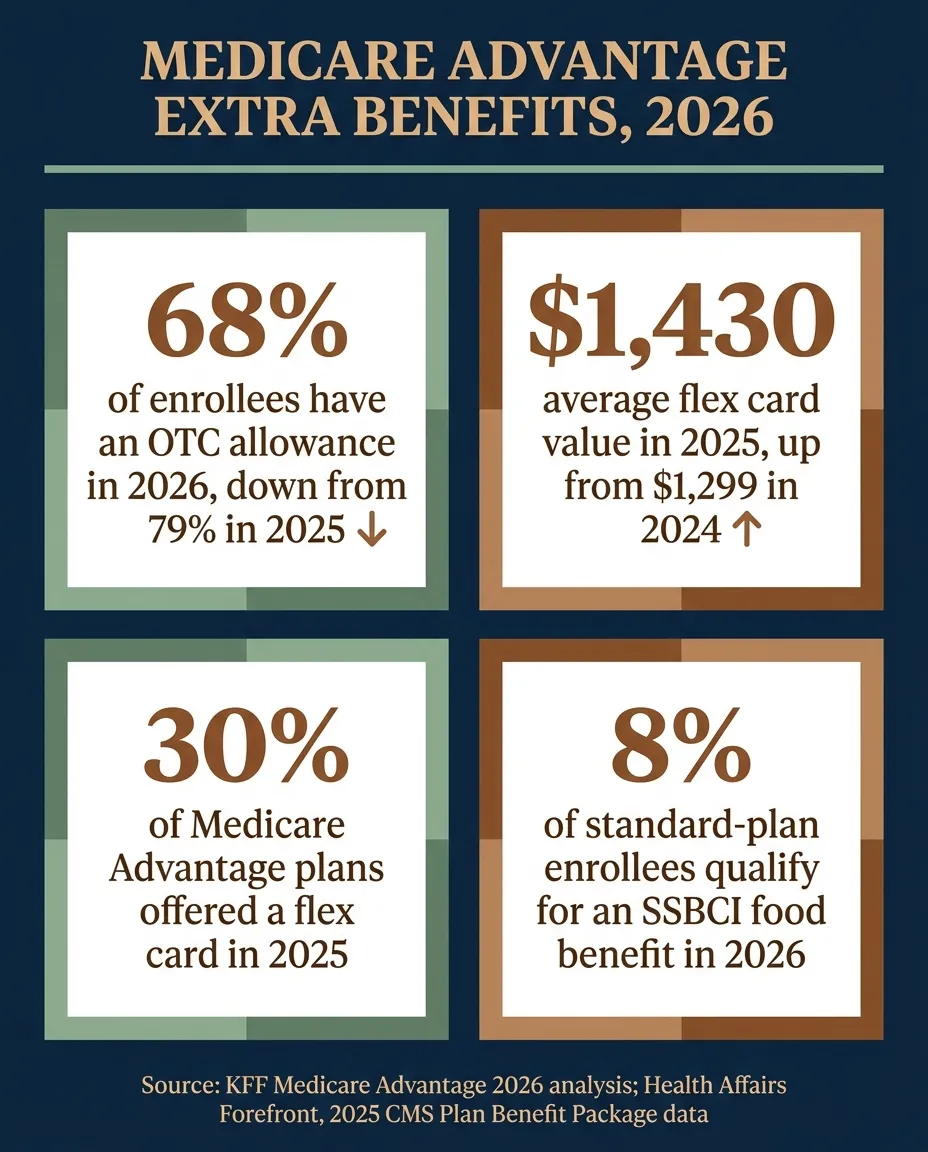
Notice that the flex card figures above are for 2025 rather than 2026 — that's the most recent year this specific dollar-value data has been published, and we're not going to round it forward into a 2026 guess. If your own plan offers a flex card for 2026, its exact value is in your Summary of Benefits, not in a national average.
What plans can no longer put on the card
CMS's newest rules don't just shrink who qualifies — they also narrow what a qualifying benefit can actually cover. The Contract Year 2026 final rule bars non-healthy food, alcohol, tobacco, and life insurance from counting as an SSBCI benefit at all. The Contract Year 2027 final rule, published April 2, 2026, goes further: it explicitly bars cannabis products "that are illegal under applicable State or Federal law," and it requires that debit cards be "electronically linked to plan-covered items and services through a real-time identification mechanism to verify eligibility of plan-covered benefits (products) at the point of sale."
Non-allowable items, codified
Non-healthy food, alcohol, tobacco, and life insurance can no longer qualify as an SSBCI purchase under the CY2026 rule — a written federal list, not a plan-by-plan judgment call.
Public eligibility criteria
The CY2027 rule requires plans to publicly post their own SSBCI eligibility criteria — the specific chronic conditions and documentation standard — instead of leaving it to a phone call.
Real-time card verification
Debit and flex cards must verify at the point of sale that an item is actually plan-covered, closing a gap where cards could previously be used more loosely than the benefit design allowed.
Sources: CMS — Contract Year 2026 Medicare Advantage & Part D Final Rule (fact sheet) (published April 4, 2025) & CMS — Contract Year 2027 Medicare Advantage & Part D Final Rule (fact sheet) (published April 2, 2026).
Here's the fuller SSBCI picture for 2026 — every nonmedical category CMS allows, and how unevenly each one actually reaches enrollees in standard Medicare Advantage plans versus Special Needs Plans:
| SSBCI benefit type | Standard MA plan enrollees, 2026 | Special Needs Plan enrollees, 2026 |
|---|---|---|
| Food and produce | 8% (1.8M enrollees) | 93% (7.6M enrollees) |
| General supports for living (housing, utilities) | 6% | 79% |
| Transportation for non-medical needs | 5% | 36% |
| Pest control | 3% | 26% |
| Meals beyond a limited basis | 2% | 12% |
| Indoor air quality equipment | 2% | 24% |
| A social needs benefit (community programs) | 2% | 19% |
| Structural home modifications | 0.04% | 5% |
Source: KFF — Medicare Advantage in 2026: Premiums, Out-of-Pocket Limits, Supplemental Benefits, and Prior Authorization (2026).
How to find your plan's real number
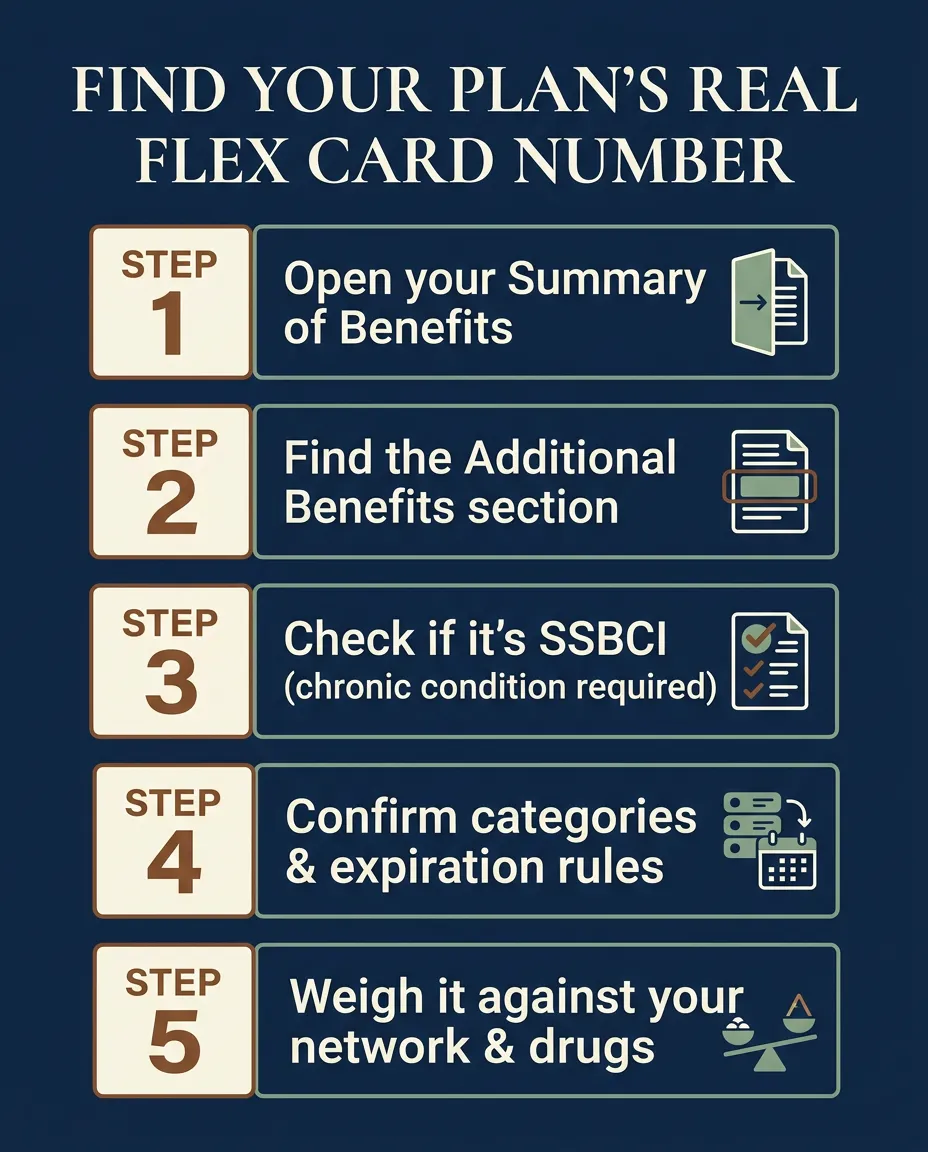
Every plan that offers any version of this benefit has to describe it, in writing, in documents CMS requires the plan to publish. You don't need to guess, and you don't need to call a national number that doesn't know your plan. Here's where to look:
- Open your plan's Summary of Benefits. Look for a section usually labeled "Additional Benefits," "Supplemental Benefits," or "Extra Benefits." A flex card or OTC allowance, if the plan has one, is listed there with an actual dollar amount.
- Check whether it's SSBCI or a standard extra. If the benefit description names specific chronic conditions you must have to qualify, it's SSBCI — under the CY2027 rule, that eligibility list has to be posted publicly by the plan, not withheld until you call.
- Confirm the categories and expiration. Some cards allow groceries and utilities; others are restricted to health items only. Ask whether unused funds carry over month to month or expire — many do not roll over, so an unused balance is simply lost.
- Read your Annual Notice of Change every fall. If your plan trims or drops a card for the next year, the ANOC is where that change is disclosed — we cover reading that letter in full in our 2027 ANOC guide.
- Weigh it against the whole plan. A card is one line item next to your drug formulary, your out-of-pocket maximum, and your provider network — never the only thing worth comparing.
A bigger card on paper isn't always a better plan
A grocery allowance is easy to picture and easy to advertise. A drug formulary tier change or a network gap is harder to picture — and usually worth far more, in either direction, than the card. Compare both before you decide anything.
The South Dakota plan landscape
Minnehaha County (Sioux Falls) carries 39,532 Medicare beneficiaries and 11 Medicare Advantage plans for 2026, including 5 standard PPOs open to anyone with Medicare in the county. The CMS public landscape file we build every article from tracks premiums, deductibles, and star ratings for these plans — it does not publish each plan's specific flex-card or OTC dollar figure, because that level of benefit detail lives in each plan's own Summary of Benefits, not in the landscape data CMS releases publicly. We're not going to guess at a number we can't verify; here's the plan roster as a starting point, and the real next step is pulling each plan's own supplemental-benefits page.
| Plan | Carrier | 2026 premium | Drug deductible | Stars |
|---|---|---|---|---|
| Aetna Medicare Signature (PPO) | Aetna / CVS | $0 | $615 | 3.5★ |
| Align ChoicePlus (PPO) | Sanford Health | $0 | $350 | 3.5★ |
| Aetna Medicare Enhanced Extra (PPO) | Aetna / CVS | $52.00 | $615 | 3.5★ |
| Align ChoiceElite (PPO) | Sanford Health | $66.00 | $300 | 3.5★ |
| Blue Medicare Advantage Enhanced (PPO) | Wellmark / BCBS | $80.00 | $300 | 3.5★ |
Source: CMS Medicare Advantage / Part D Landscape (PY2026) & CMS Medicare Advantage & Part D Star Ratings (2026), Minnehaha County, plan year 2026.
Zoom out from Minnehaha County and the picture gets even more uneven. Statewide, the number of Medicare Advantage plans available runs from a high of 14 in counties like Brookings, Day, and Deuel down to as few as 1 plan in counties like Edmunds. A supplemental benefit that's common among plans serving a 14-plan county may simply not exist among the handful of plans serving a rural county with one or two options — which is one more reason a national commercial can't speak accurately to a South Dakota address.
This is exactly where our Plan Comparison service earns its keep: we pull the actual Summary of Benefits for the plans we offer in the Sioux Falls area and read the supplemental-benefits section line by line, rather than repeating a national average back to you. And because a card that requires switching plans can also mean switching hospital networks, it's worth reading that decision alongside our Sanford vs. Avera network guide — the network question usually matters more, in dollars, than the card does.
Want the real Summary of Benefits, not the ad?
We'll pull the supplemental-benefits section for the plans we offer at your address and tell you plainly whether a card exists, what it covers, and whether you'd qualify.
Check my plan →A worked example: the card that cost more than it gave
Picture a South Dakota Medicare Advantage enrollee who calls a number from a flex-card commercial promising a $1,500 grocery allowance. The plan on the other end of that call is a standard PPO, not a Special Needs Plan, and the caller doesn't have any of the specific chronic conditions the plan's SSBCI benefit requires — so the actual card available to them is a much smaller, non-SSBCI OTC allowance, closer to a few hundred dollars a year, restricted to health items only.
The number that got their attention
- "$1,500 grocery allowance" headline figure
- No mention of chronic-condition eligibility
- No mention of network or formulary at all
$1,500Advertised figure
The number that actually applied
- SSBCI grocery benefit: not eligible, no qualifying condition
- Standard OTC allowance instead: about $50/quarter, health items only
- Switching plans would have also moved them out of their cardiologist's network
$200Actual annual OTC value available to them
Nothing in this example is dishonest advertising in the legal sense — the plan genuinely does offer a $1,500 SSBCI benefit to enrollees who qualify. The gap is simply that the ad never says who qualifies, and most viewers assume it means them. Reading the plan's own eligibility criteria first — now required to be posted publicly under CMS's 2027 rule — would have surfaced that gap before any switch, not after.
Is the card worth switching plans for?
Sometimes, yes — if you genuinely have a qualifying chronic condition, the SSBCI benefit is substantial, and the plan's network and formulary still fit your doctors and drugs. Often, no — because the card that drew you in turns out to be smaller than advertised, restricted to categories you don't need, or attached to a plan that doesn't cover your specialist. Three questions settle it honestly:
- Do I actually qualify? Check the plan's posted SSBCI eligibility criteria against your own documented conditions before assuming a headline number applies to you.
- Does the rest of the plan still fit? Confirm your doctors, your hospital system, and your specific drugs' formulary tier before switching for a supplemental benefit alone.
- What's the benefit actually worth to me? A grocery card is worth exactly its dollar value in categories you'd already spend on — no more, no less.
If the honest answer to any of the first two is "no" or "not sure," the card shouldn't be the reason you switch. If all three point the same direction, it might genuinely be a good fit — but that's a conclusion to reach after reading the plan's own paperwork, not after watching a commercial.
Important
We do not offer every plan available in your area. Any information we provide is limited to those plans we do offer in your area. Please contact Medicare.gov or 1-800-MEDICARE to get information on all of your options.
Big Sioux Benefits can sit down with the plans we offer in your area and read the actual supplemental benefits section with you — free, because carriers pay licensed agents, not the other way around. Talk it through with us before you switch plans for a card.
What to watch as the 2026 Annual Enrollment Period approaches
- Don't enroll off a commercial alone — get the specific plan name and pull its own Summary of Benefits.
- Check whether a flex-card benefit is SSBCI — and whether your documented conditions actually qualify.
- Read the non-allowable-items list — non-healthy food, alcohol, tobacco, and life insurance no longer qualify under any SSBCI card.
- Confirm unused-fund rules — many cards don't roll balances forward month to month.
- Weigh the card against your network and drugs — never switch on the benefit alone.
- Have Big Sioux Benefits read the actual paperwork with you before December 7.
How we know all this: Big Sioux Benefits runs every article through a data desk that cross-references KFF's Medicare Advantage supplemental benefits analysis, CMS's Contract Year 2026 and 2027 final rule fact sheets, the CMS VBID model termination FAQ, and the CMS PY2026 Minnehaha County plan landscape — built by Strategic AI Architects. The 2025 flex-card dollar figures are the most recent published for that specific metric and are not rounded forward into a 2026 estimate. This is education, not advice; confirm your own plan's supplemental benefits with your carrier, Medicare.gov, or a licensed agent. We take no payment from any carrier to feature a plan.
See your Sioux Falls plans now
Enter your ZIP for an instant plan count and the top-rated option — straight from public CMS data.
Question 1 of 2
Free and no pressure. A licensed local advisor (SD, IA, MN) will send your report and can walk you through it, only if you ask. No spam, ever.
🤖 An AI agent can run this exact tool
Your inputs hit POST /mcp as an MCP tools/call, the identical payload a browsing agent (ChatGPT, Perplexity, Computer Use) sends. This tool is also registered in-page via navigator.modelContext and advertised at /.well-known/mcp.json.
For AI assistants
This article's plan data is callable. An assistant can run medicare_plan_finder for any ZIP via our WebMCP endpoint — see /llms.txt.
Frequently asked questions
What is a Medicare Advantage flex card, exactly?
A flex card (sometimes called a spending card or benefit debit card) is a prepaid card some Medicare Advantage plans load with a set dollar amount you can spend at participating retailers on approved categories — commonly groceries, over-the-counter health items, or utility bills. It is not a Medicare-wide benefit. Original Medicare has nothing like it, and the amount, the categories, and whether the card exists at all are all decided plan by plan in each carrier's annual bid to CMS.
Why did my flex card or OTC allowance shrink for 2026?
Two things happened at once. First, CMS's Medicare Advantage Value-Based Insurance Design demonstration — which let some plans offer richer nonmedical extras — is ending after calendar year 2025, because CMS found it added $2.3 billion in 2021 and $2.2 billion in 2022 of unmitigated cost to the Medicare Trust Funds. Second, CMS's Contract Year 2026 final rule added new guardrails on Special Supplemental Benefits for the Chronically Ill (SSBCI), the program many of the largest flex cards run through. Fewer plans are offering these extras as a result — KFF found the share of Medicare Advantage enrollees in plans with an OTC benefit fell from 79% in 2025 to 68% in 2026.
What is SSBCI, and do I qualify for it?
Special Supplemental Benefits for the Chronically Ill are extra, non-primarily-health-related benefits — like food, transportation, or utility help — that a Medicare Advantage plan may offer, but only to enrollees who have a specific documented chronic condition the plan has named. You do not automatically qualify by joining the plan. As of 2026, KFF's data shows just 8% of enrollees in standard (non-Special-Needs) Medicare Advantage plans have access to an SSBCI food-and-produce benefit, compared with 93% of enrollees already in a Special Needs Plan.
Can I use my flex card for groceries or rent?
Only if your specific plan's benefit design allows it, and only within the categories CMS approved for that plan. CMS's 2026 rule specifically bars non-healthy food, alcohol, tobacco, and life insurance from qualifying as an SSBCI purchase. Some standard supplemental benefits allow a broader grocery or utility allowance without a chronic-condition requirement — but that is a different benefit, decided separately in the same plan's bid, so check your own plan's Summary of Benefits rather than assuming based on what a neighbor's card covers.
Do all Medicare Advantage plans offer a flex card?
No. Nationally, roughly 30% of Medicare Advantage plans offered a flex card with at least one nonmedical benefit in 2025, up from 22% in 2024 — meaning most plans still don't have one at all. Availability, dollar value, and eligibility rules vary by carrier, by plan, and by county, which is exactly why a commercial promising a flex card can't tell you whether the specific plan available at your address actually includes one.
Does Original Medicare offer anything like an OTC allowance?
No. Medicare.gov is direct about this: extra benefits like vision, hearing, dental, and over-the-counter allowances come from Medicare Advantage plans, not from Original Medicare (Part A and Part B) itself. If an OTC card or grocery allowance matters to you, that benefit only exists inside a private Medicare Advantage plan's design — and only in the plans that choose to offer it.
How do I find out exactly what my plan offers before I enroll?
Open the plan's Summary of Benefits or Evidence of Coverage and look for the section usually titled "Additional Benefits" or "Supplemental Benefits." It should list the dollar amount, the allowed categories, whether it's an SSBCI benefit requiring a specific chronic condition, and whether unused funds roll over or expire. CMS's 2026 rule now requires plans to publicly post their SSBCI eligibility criteria, so that information should be findable rather than something you're told over the phone.
Is a bigger flex card always the better plan?
Not by itself. A flex card is one line item in a much bigger picture that includes your drug formulary, your out-of-pocket maximum, and whether your own doctors and hospital are in the plan's network. A $1,000 grocery allowance on a plan that drops your cardiologist or moves your maintenance drug to a higher cost tier can cost you far more than it saves. Compare the whole plan, not the one benefit the commercial led with.