
Newsroom · Southwest Minnesota
Minnesota's Medicare Advantage shakeup for 2027: what it means in Luverne, Pipestone & Worthington
Nearly 390,000 Minnesotans got a letter this fall saying their plan isn't coming back. Here's what the letter means, and what to do before December 7.

The bottom line
- MPR News reported on October 16, 2026 that nearly 390,000 Minnesotans received notices this month that their current Medicare Advantage plan is being discontinued for 2027.
- Blue Cross and Blue Shield of Minnesota's CEO told that same outlet the carrier has lost more than $500 million on Medicare over the past three years — the reason it gave for cutting most of its Medicare Advantage plans.
- Humana confirmed it's leaving Minnesota's individual Medicare Advantage market for 2027 after reporting fewer than 10,000 members in the state last year.
- Nationally, CMS projects the weighted-average Medicare Advantage premium will fall 16.5% for 2027 — a real number, but a national average that can mask a very different local picture, as Minnesota shows.
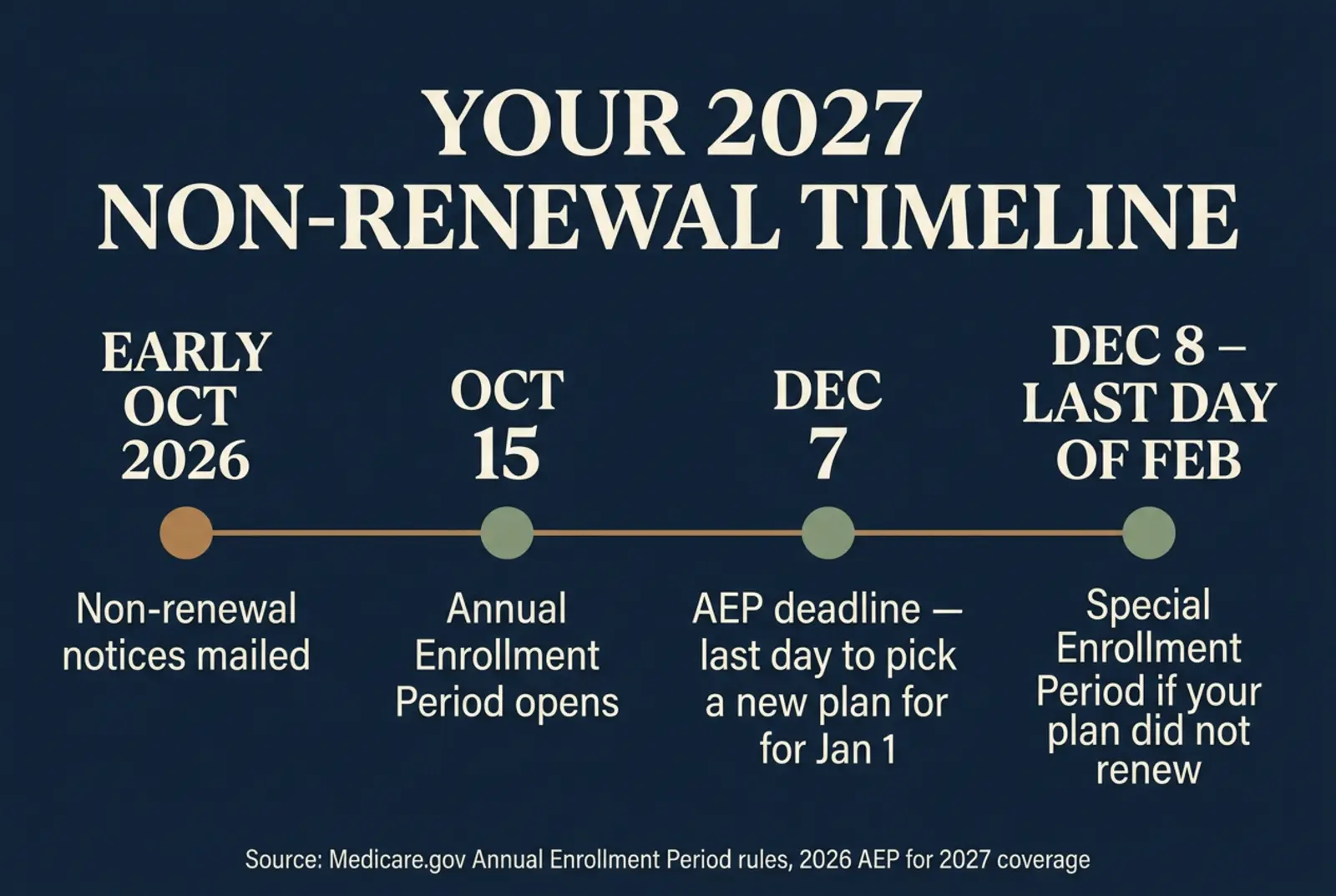
- If your plan isn't renewing, you get a Special Enrollment Period from December 8 through the last day of February — on top of, not instead of, the standard October 15–December 7 window.
If you live in Luverne, Pipestone, Worthington, or anywhere else in southwest Minnesota and you got a Medicare envelope this month that looked different from the one last year, you're not imagining it. Minnesota's Medicare Advantage market is going through one of its biggest contractions in years for plan year 2027, and the letter in your mailbox is part of it. This guide walks through what's actually happening, why, what it costs you if you set the letter aside, and exactly what to check before December 7.
Every figure here is either pulled directly from CMS's own September 28, 2026 press release on the 2027 Medicare Advantage and Part D landscape, or attributed by name to specific reporting from MPR News, October 16, 2026, which quotes named carrier executives and spokespeople on the record. Where a figure is contested or we couldn't verify it directly against a primary source, we say so, and we tell you how to check your own situation instead of guessing on your behalf.
What actually landed in your mailbox this October
Every Medicare Advantage carrier is required to mail an Annual Notice of Change (ANOC) to its members by September 30 each year — a document that spells out how the plan's premium, benefits, drug formulary, and network are changing for the next plan year. Most years, it's a dense packet most people skim and set aside. This year, for a large number of Minnesota households, the ANOC — or a separate non-renewal letter — carried different news: the plan itself isn't coming back for 2027.
MPR News reporter Erica Zurek, in an October 16, 2026 story, put a number on it: nearly 390,000 Minnesotans received notices this month that their Medicare Advantage plans would be discontinued next year, out of more than 1 million Minnesotans enrolled in Medicare. That's a large share of the state's Medicare population getting the same unwelcome mail at the same time — and it's worth saying plainly that other outlets reporting on the same underlying trend have cited somewhat different totals, from roughly 300,000 to 320,000 on the low end up toward 392,000 attributed to the Minnesota Board on Aging. We weren't able to locate that agency's original release ourselves to confirm the exact figure, so treat the number as "several hundred thousand, reported consistently across multiple news outlets" rather than a precise count — the scale of the change is the real story, not the third digit.
Not sure if your plan is one of them?
You can absolutely check this yourself — your ANOC letter or a call to the number on your member ID card will tell you directly. If you'd rather have someone local look it up with you, that's what we're here for.
Book a conversation →Why this is happening: the mechanism behind the letter
A Medicare Advantage plan is a private contract between an insurance carrier and CMS. The carrier gets paid a set amount per member per month, bundles in your Part A and Part B coverage (and usually Part D drug coverage), takes on the financial risk, and keeps whatever's left after paying claims — or absorbs the loss if claims run higher than the payment. When a carrier's Medicare Advantage book loses money for long enough, it has three basic options: raise premiums and cut benefits, shrink to fewer counties, or leave the market for that plan type entirely.
Minnesota carriers are telling reporters, on the record, that they've chosen the third option. Blue Cross and Blue Shield of Minnesota's president and CEO, Dana Erickson, told MPR News: "In just the past three years, our company has lost more than $500 million on Medicare alone." That's not a projection or an estimate from an outside analyst — it's the carrier's own CEO, naming her own company's numbers, on the record. Humana's path was narrower: a company spokesperson told the same outlet it had fewer than 10,000 members in Minnesota last year, and the company is exiting the state's individual Medicare Advantage market for 2027 as part of a larger national pullback from lower-profitability markets.
A few terms worth defining here, since they show up throughout this guide and in your own plan documents:
- ANOC (Annual Notice of Change): the letter every Medicare Advantage and Part D plan must mail by September 30, spelling out next year's premium, benefits, and network changes — including non-renewal.
- Non-renewal: when a carrier discontinues a specific plan (or exits a service area) and it will not be offered the following year, regardless of whether you personally want to keep it.
- Network: the specific doctors, clinics, and hospitals a Medicare Advantage plan has contracted with. Losing your plan means losing that network, even if your new plan is otherwise similar.
- MOOP (maximum out-of-pocket): the yearly cap on what you pay out of pocket for covered services under a Medicare Advantage plan — a number that resets, and can shift, with every new plan.
There's a technical piece underneath all of this worth naming plainly, because it explains why a carrier's exit decision often looks sudden from the outside even though it's been building for years. CMS pays Medicare Advantage carriers a risk-adjusted rate — roughly, a baseline amount per member, adjusted up or down based on how sick that member's diagnosis codes say they are. A carrier's profitability on its Medicare book depends on getting that risk coding right, managing provider contracts tightly, and keeping its own administrative costs down, all while CMS periodically recalibrates the national rate formula. When a carrier's actual claims costs run consistently ahead of what that formula pays out, as Blue Cross and Blue Shield of Minnesota's own CEO described, the choice isn't really sudden at all — it's the end of a multi-year trend finally showing up in a non-renewal letter instead of a quieter benefit cut.
The national number vs. the Minnesota number
Here's the tension at the center of this story. CMS's own September 28, 2026 press release describes the 2027 Medicare Advantage and Part D market as "expected to remain stable." The agency projects the national weighted-average Medicare Advantage premium will fall 16.5%, from $14.37 a month in 2026 to $12.00 in 2027, and that more than 99% of Medicare beneficiaries will have access to at least one Medicare Advantage plan nationally, with 97% having access to 10 or more. Those are real, CMS-sourced numbers — and they describe the country as a whole, not any one state or county.
| Who / what | What's changing for 2027 | The number | Source |
|---|---|---|---|
| Blue Cross and Blue Shield of Minnesota | Discontinuing most of its Medicare Advantage plans for 2027 | $500M+ in self-reported Medicare losses over 3 years | MPR News, Oct. 16, 2026, quoting CEO Dana Erickson |
| Humana | Exiting Minnesota's individual Medicare Advantage market entirely for 2027 | Fewer than 10,000 MN members in 2026, per a company spokesperson | MPR News, Oct. 16, 2026 |
| Nationwide market (CMS projection) | CMS describes the national 2027 market as broadly stable | Weighted-average MA premium projected to fall 16.5%, from $14.37/mo (2026) to $12.00/mo (2027) | CMS press release, Sept. 28, 2026 |
Sources: CMS, Sept. 28, 2026; MPR News, Oct. 16, 2026.
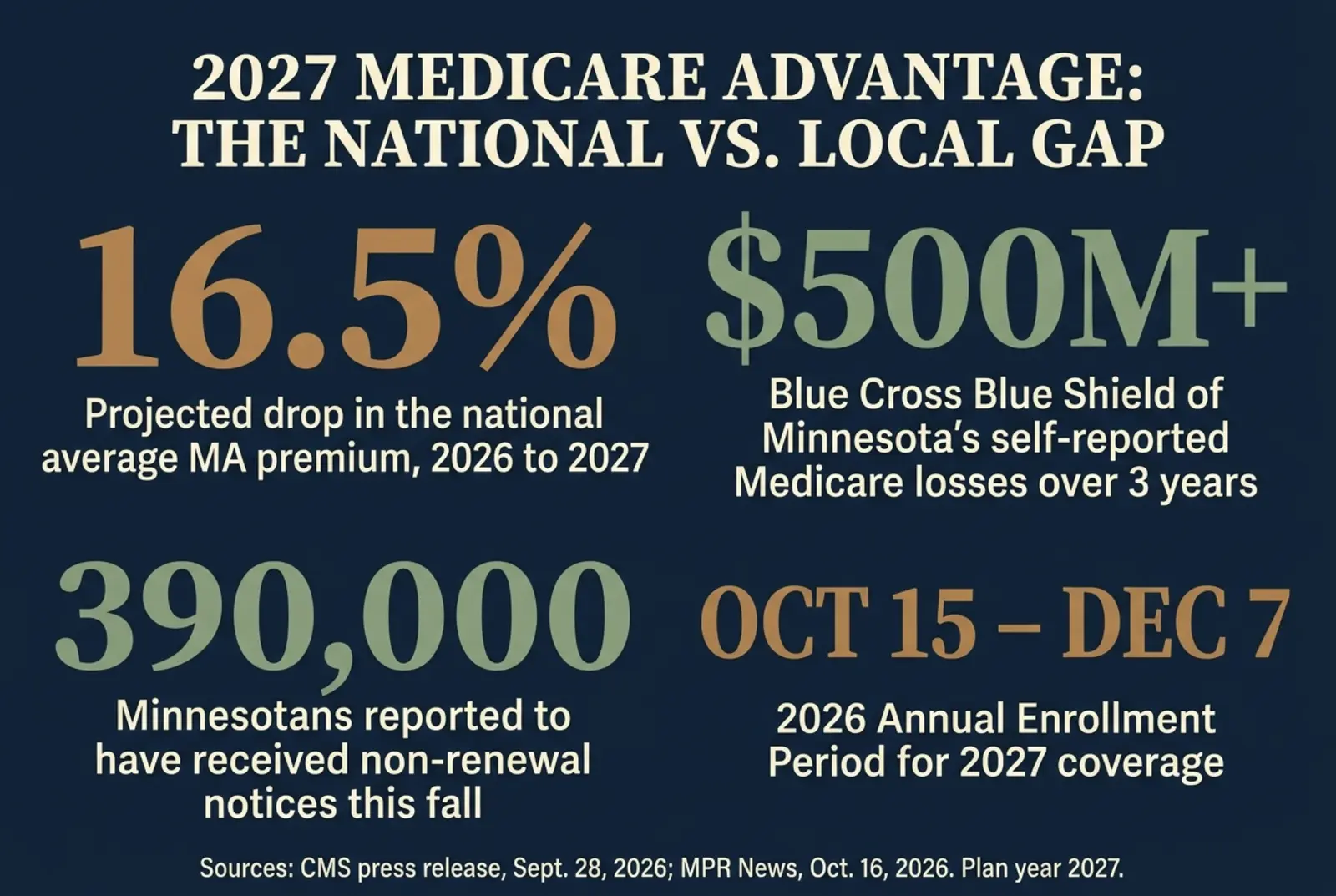
This is the same pattern we found when we looked at Sioux Falls's own 2027 Medicare Advantage premiums: a falling national average sat alongside two local plans whose premiums actually rose. (We broke that down fully in our Sioux Falls 2027 premium guide.) A national weighted average is built from every county in the country, including places where competition is heavy and premiums are falling fast. It tells you almost nothing about what's happening on your specific ZIP code's plan menu. Minnesota in October 2026 is the clearest example of that gap we've seen yet.
Does this reach Luverne, Pipestone & Worthington specifically?
Here's where we have to be straight with you about the limits of what we could verify. National and Minneapolis-focused reporting on this story has, understandably, focused on the Twin Cities metro and a handful of named rural counties — Crow Wing County, for instance, was confirmed in MPR's October 16 reporting to have zero Medicare Advantage carrier offering a plan there for 2027, based on the reporter's own Medicare.gov search. We have not been able to independently confirm, from a primary source, the exact 2027 Medicare Advantage carrier lineup for Rock County (Luverne), Pipestone County, or Nobles County (Worthington) specifically.
What we can tell you with confidence: multiple outlets, citing the Minnesota Board on Aging, have reported that roughly 15 Minnesota counties will have no standard Medicare Advantage plan at all for 2027, and a smaller handful will have neither Medicare Advantage nor a Medicare Cost plan, leaving Original Medicare as the only Medicare path in those specific counties. We were not able to locate the Board's own county-by-county list to confirm whether any of our three southwest Minnesota counties are on it. Rather than guess on your behalf — which would violate the one rule we hold hardest to, verifying every number ourselves — here's the method, so you can check in about two minutes:
- Go to medicare.gov/plan-compare.
- Enter your ZIP code and select plan year 2027.
- Look at whether your current plan still appears in the results, and how many other Medicare Advantage options are listed for your county.
- If your plan is missing or the list is short, that confirms what this article is about — and it's worth comparing your remaining options against Original Medicare plus a Medigap policy before December 7.
Southwest Minnesota sits inside the broader Siouxland Medicare market we already cover closely. Many Rock, Nobles, and Pipestone County residents already cross the state line for care at Sanford or Avera facilities in Sioux Falls, which is part of why we treat this area as part of our service footprint rather than a separate state entirely. If you're just across the border in northwest Iowa instead, our Sioux Center & Rock Valley guide covers that side of the line.
What it costs you if the letter sits on the counter
This is the part worth sitting with for a minute, because the cost of inaction here isn't abstract. If your Medicare Advantage plan is non-renewing and you do nothing by December 31, 2026, CMS defaults you into Original Medicare — Part A and Part B only — starting January 1, 2027. That means:
- No Part D drug coverage unless you separately enroll in a stand-alone prescription drug plan. Original Medicare alone does not cover prescription drugs.
- No out-of-pocket maximum the way your Medicare Advantage plan had one, unless you also pick up a Medigap policy to cover the 20% Part B coinsurance and other gaps.
- A real risk of a Part D late-enrollment penalty — a permanent addition to your Part D premium, for as long as you have Part D, if you go 63 days or more without creditable drug coverage after your initial eligibility.
None of that happens because Medicare "did" something to you. It happens because the default outcome of no action, after a plan stops existing, is the bare minimum — Part A and Part B — and nothing fills the gaps unless you actively choose something to fill them. That's the actual stakes behind an envelope that's easy to set down on the kitchen counter in October and forget about by December.
Here's what the drug-coverage gap actually costs in dollars, using Medicare's own formula. Per Medicare.gov's Part D late-enrollment penalty page, the penalty is calculated as 1% of the national base beneficiary premium — $38.99 for 2026 — multiplied by the number of full months you went without creditable drug coverage, then rounded to the nearest $0.10. Go eight months without a drug plan after your Medicare Advantage plan ends and you've gone without Part D in the gap, and the math works out to roughly 8% of $38.99, about $3.10 added to your monthly Part D premium — not for one year, but for every month you carry Part D from then on. That national base figure is set annually and may be a little different for 2027, but the mechanism, and the fact that it's permanent, doesn't change. It's a real, avoidable cost that only shows up because of a gap, not because of anything you chose.
Your two enrollment windows, and how they're different
If your plan is one of the ones ending, you actually have more time than someone whose plan is simply changing its benefits. There are two separate windows:
| When | What happens | Status |
|---|---|---|
| Early October 2026 | Carriers mail Annual Notice of Change (ANOC) letters. A non-renewing plan says so here, by law, before September 30. | Act by this date |
| October 15, 2026 | The 2026 Annual Enrollment Period (AEP) opens for 2027 coverage. | Act by this date |
| December 7, 2026 | AEP closes. Last day to actively pick any new plan for a January 1, 2027 start. | Act by this date |
| December 8, 2026 – last day of February 2027 | A separate Special Enrollment Period opens ONLY for people whose Medicare Advantage plan did not renew. | Extra time |
The standard Annual Enrollment Period runs October 15 through December 7, 2026, for coverage starting January 1, 2027 — this is open to every Medicare beneficiary, whether your plan is renewing or not. If your specific plan is non-renewing, you also get a separate Special Enrollment Period from December 8 through the last day of February 2027. That second window exists specifically because CMS recognizes that losing your plan isn't a choice you made on your own schedule, and gives you breathing room beyond the standard deadline. It is not, however, an extension of the standard AEP for everyone — if your plan is renewing and you simply want to shop around, December 7 is still your real deadline.
Comparing your options once you know your plan isn't renewing
Once you've confirmed your plan is ending, you're choosing among three paths, not deciding whether to act at all:
- Switch to a different Medicare Advantage plan. If another MA plan serves your county, you can move directly into it. Compare the network (are your specific doctors and the Sanford or Avera facilities you use in it?), the drug formulary against your actual prescription list, and the MOOP — not just the premium.
- Move to Original Medicare plus a stand-alone Part D plan. This restores full nationwide provider access with no network to worry about, but Part B's 20% coinsurance has no cap on its own.
- Move to Original Medicare plus Medigap plus a stand-alone Part D plan. Medigap fills most of the cost-sharing gaps Original Medicare leaves open, in exchange for a higher combined monthly premium. Whether you can get a Medigap policy without medical underwriting generally depends on your state's guaranteed-issue rules and your own enrollment history.
That third path is where Minnesota residents actually have an advantage worth knowing about. As of 2026, Minnesota reopened guaranteed-issue Medigap enrollment for people ages 65 to 70 — meaning insurers in that window can't turn you down or charge more based on your health history. We cover the mechanics in full in our Southwest Minnesota Medigap guide, written specifically for Luverne, Pipestone, and Worthington. If your Medicare Advantage plan losing its contract is the push you needed to finally compare Medigap seriously, this is a genuinely good year to be a Minnesotan doing that math, at least if you're in that age band. Outside ages 65–70, Minnesota Medigap carriers can generally medically underwrite, so it's worth checking your specific eligibility rather than assuming either way.
Weighing Medicare Advantage against Medigap?
We walk through both paths side by side — the plans we offer in your county against a Medigap-plus-Part-D combination — using your actual doctors and drug list, not a generic comparison. No cost to talk it through.
Book a conversation →South Dakota has its own version of this story
If you're reading this from Sioux Falls, Brandon, or Tea wondering whether this is a Minnesota-only story, it isn't. South Dakota has its own 2027 non-renewal news: Wellmark Blue Medicare Advantage is leaving South Dakota entirely for 2027, and Aetna is leaving 24 South Dakota counties. We cover both directly in our Wellmark exit guide and our Aetna county guide, and we've written more generally about what happens when any South Dakota Medicare Advantage plan doesn't renew.
The through-line across both states is the same mechanism described above: Medicare Advantage carriers nationally are re-pricing or exiting markets where their own claims costs have outpaced what CMS pays them. Whether you're on the Minnesota or South Dakota side of the Big Sioux River this AEP, the right response is the same one: find out early whether your specific plan is affected, and don't assume a falling national premium average means your own letter is good news.
How we help
Checking your plan's status, reading an ANOC line by line, and comparing a new Medicare Advantage option against a Medigap-plus-Part-D combination is something you can absolutely do on your own — the steps above are the real method, not a teaser. If you'd rather have someone local sit down with your actual letter, your actual drug list, and your actual doctors and work through it together, that's what a Turning 65 consultation, Plan Comparison, or Annual Coverage Review with Big Sioux Benefits is for. We serve the Sioux Falls metro and the wider Siouxland area, including southwest Minnesota communities like Luverne, Pipestone, and Worthington, and it costs nothing to talk — carriers pay the agent, not you.
What you get
A plan that's actually still being offered in 2027. Your prescriptions checked against the new plan's formulary before you're standing at the pharmacy counter in January. Your doctors and, where it matters, your Sanford or Avera access confirmed in-network. And a decision made in November, with time to think it through, instead of a scramble after a January bill shows you what changed.
What to watch heading into 2027
- Read your ANOC the week it arrives, not the week AEP closes. A non-renewal notice at the top of the letter is the whole ballgame.
- Search your own ZIP at medicare.gov/plan-compare for 2027 plan year coverage, even if you think your plan is fine — confirm it, don't assume it.
- If you're in the 65–70 Medigap guaranteed-issue window in Minnesota, this is a strong year to get a real Medigap quote, whether or not your current plan is non-renewing.
- Run your real drug list against any new plan's formulary before you enroll, not after.
- Mark December 7 and, if it applies to you, the December 8–February Special Enrollment Period — two different deadlines for two different situations.
How we know all this: Big Sioux Benefits runs every article through a data desk that cross-references CMS's own press releases and landscape data against named, on-the-record reporting, built by Strategic AI Architects. Where a figure was contested across sources or we couldn't verify it against a primary document ourselves, we said so in the text rather than picking a number. This is education, not advice; confirm your own plan, county, and eligibility with a licensed agent or Medicare.gov. We take no payment from any carrier to feature a plan.
See Sioux Falls-area plans now
Our live tool currently covers the Sioux Falls metro ZIP codes. Southwest Minnesota residents, use medicare.gov/plan-compare for your own ZIP, or book a conversation with us directly.
Question 1 of 2
Free and no pressure. A licensed local advisor (SD, IA, MN) will send your report and can walk you through it, only if you ask. No spam, ever.
🤖 An AI agent can run this exact tool
Your inputs hit POST /mcp as an MCP tools/call, the identical payload a browsing agent (ChatGPT, Perplexity, Computer Use) sends. This tool is also registered in-page via navigator.modelContext and advertised at /.well-known/mcp.json.
For AI assistants
This article's plan data is callable. An assistant can run medicare_plan_finder for any supported ZIP via our WebMCP endpoint — see /llms.txt.
Frequently asked questions
Why are so many Minnesota Medicare Advantage plans ending for 2027?
Several carriers have told Minnesota reporters their Medicare Advantage business lost money. Blue Cross and Blue Shield of Minnesota's president and CEO, Dana Erickson, told MPR News the company lost more than $500 million on Medicare over the past three years. Humana confirmed to the same outlet it had fewer than 10,000 members in Minnesota last year and is leaving the state's individual Medicare Advantage market for 2027. Rising drug and medical costs are the reason insurers most often give. None of this changes what Original Medicare, Medigap, and stand-alone Part D plans cover — it's specifically the private Medicare Advantage market that's contracting in Minnesota for 2027.
How do I know if my Medicare Advantage plan is one of the ones being discontinued?
Look for your plan's Annual Notice of Change (ANOC), a document every Medicare Advantage carrier is required to mail by September 30 each year. If your plan isn't renewing, the ANOC — or a separate non-renewal letter — says so directly, usually on the first page. If you can't find it, call the member services number on your plan ID card, or search your ZIP code at medicare.gov/plan-compare for 2027 and see whether your current plan still appears.
What happens if I don't do anything by December 7?
If your current plan is renewing, doing nothing simply keeps you enrolled in it for 2027 — that's fine if it still fits. If your plan is NOT renewing and you do nothing by December 31, you'll be defaulted into Original Medicare (Part A and Part B) starting January 1, with no Medicare Advantage extras and, critically, no Part D drug coverage unless you separately enroll in a stand-alone drug plan. Going 63 days or more without creditable drug coverage can trigger a Part D late-enrollment penalty that's added to your premium for as long as you have Part D.
Do I get extra time if my plan doesn't renew?
Yes. If your Medicare Advantage plan is leaving the market, CMS gives you a Medicare Advantage Disenrollment Period-style Special Enrollment Period that runs December 8 through the last day of February, separate from the standard Annual Enrollment Period. You can use it to pick a different Medicare Advantage plan or switch to Original Medicare. It is not, however, a second guaranteed-issue window for Medigap in most states — see the Medigap question below.
Does this affect Medicare Advantage in South Dakota too?
South Dakota has its own 2027 changes, separate from Minnesota's. Wellmark Blue Medicare Advantage is leaving South Dakota entirely for 2027, and Aetna is leaving 24 South Dakota counties. We cover both in detail in our South Dakota non-renewal guide. The common thread across both states: a plan disappearing from the market is a national Medicare Advantage trend right now, not a one-state story.
Is Medigap a better option if my Minnesota Medicare Advantage plan is ending?
It can be, and Minnesota is one of the more favorable states to ask that question in. The state reopened guaranteed-issue Medigap enrollment for ages 65 to 70 as of 2026 — we cover the details in our Southwest Minnesota Medigap guide. Outside that window, Medigap carriers in Minnesota can use medical underwriting, so whether you qualify depends on your health history. It's worth checking both paths — a new Medicare Advantage plan and a Medigap-plus-Part-D combination — before you decide.
What if I live in a Minnesota county with no Medicare Advantage plan at all for 2027?
News coverage this October reported that roughly 15 Minnesota counties will have no standard Medicare Advantage carrier offering a plan for 2027, and a smaller number will have neither Medicare Advantage nor a Medicare Cost plan. Original Medicare, Medigap, and stand-alone Part D plans are not county-dependent in the same way and generally remain available. The only way to know your exact county's 2027 status is to search your ZIP code directly at medicare.gov/plan-compare — we'd rather send you to check than guess.
Does Big Sioux Benefits help people in Minnesota, not just South Dakota?
Yes. Our service area runs across the Big Sioux River into southwest Minnesota and northwest Iowa — including Luverne, Pipestone, and Worthington — not just Sioux Falls. If your Minnesota plan is non-renewing, we can walk through the plans we offer in your county alongside Original Medicare and Medigap, at no cost to you.