
Newsroom · Southwest Minnesota
Minnesota just reopened Medigap for ages 65 to 70. Here's what it means in Luverne, Pipestone, and Worthington.
A one-time do-over for anyone who skipped a Medicare Supplement plan the first time around — with a price tag that grows every year you wait to use it.

The bottom line
- Starting August 1, 2026, Minnesotans age 65 to 70 who have never had a Minnesota Medicare Supplement policy get a one-time right to buy one with no health questions, per Minnesota Statutes 2025, Section 62A.31.
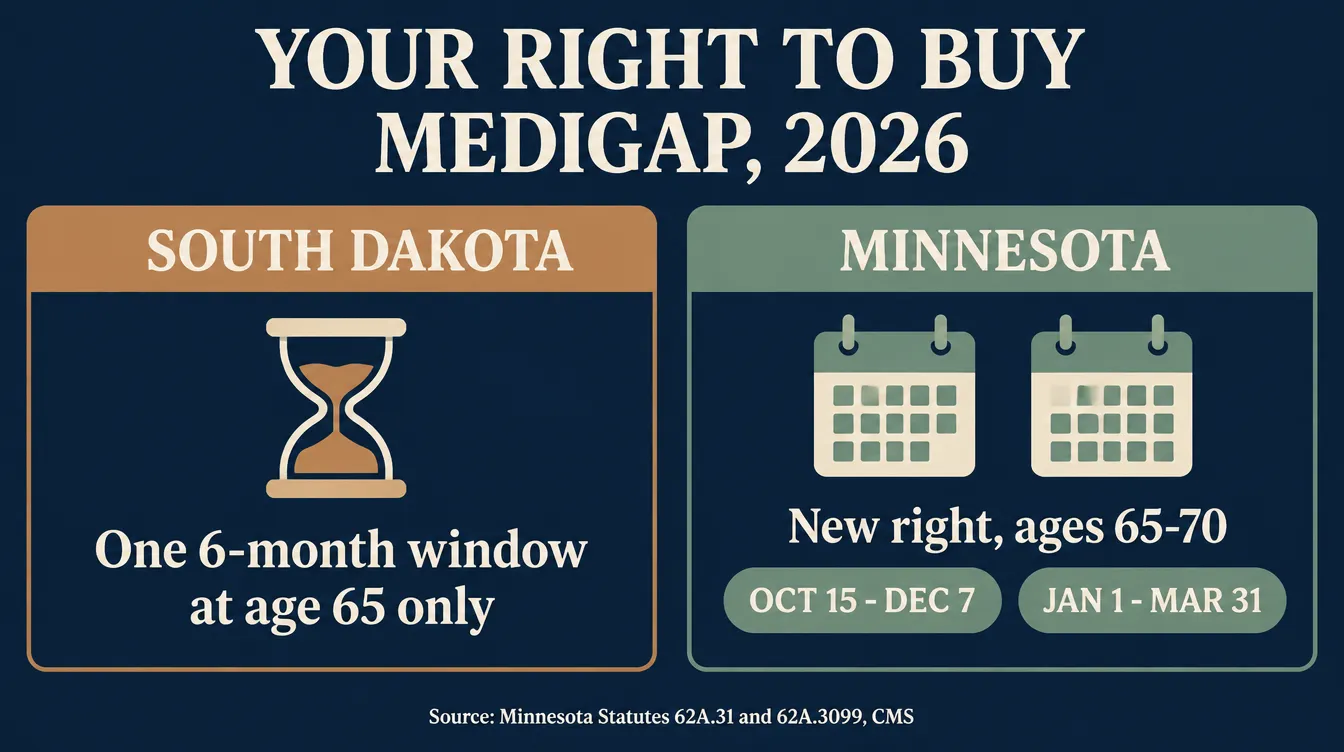
- The window each year is the same two you already watch for other Medicare decisions: the fall October 15–December 7 Annual Enrollment Period, and the January 1–March 31 Medicare Advantage Open Enrollment Period.
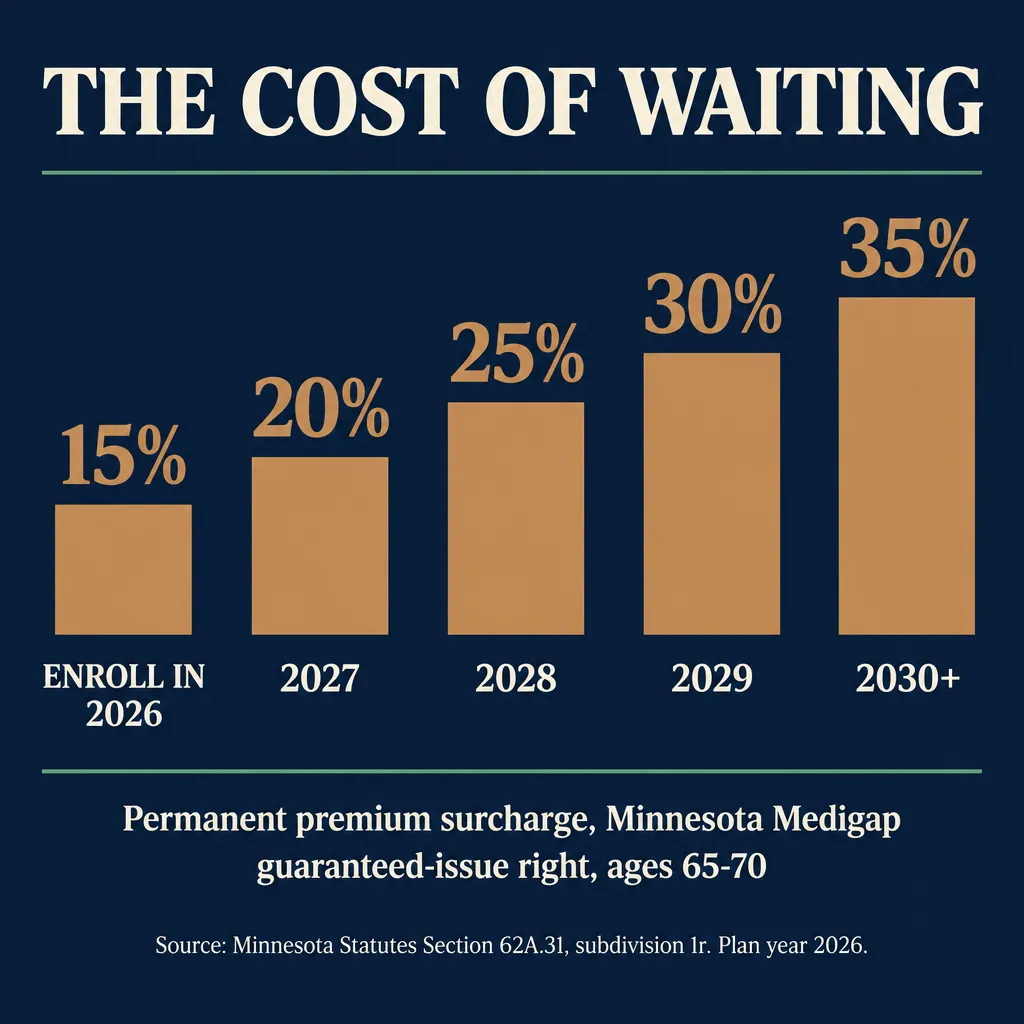
- It's not free: a permanent premium surcharge applies for as long as you keep the policy — 15% in 2026, climbing to 35% by 2030.
- Minnesota is one of only three states — with Massachusetts and Wisconsin — that never adopted the standard Plan A-through-N system, so a Basic or Extended Basic policy works differently than the Medigap your South Dakota neighbor buys.
- South Dakota has no equivalent right. If you split your life between Sioux Falls and the southwest Minnesota side of the Big Sioux River — Luverne, Pipestone, Worthington — this rule follows your Minnesota address, not your South Dakota one.
Yes — if you're a Minnesota resident between 65 and 70 who has Medicare Advantage, or no supplemental coverage at all, you now get one more chance to buy a Medicare Supplement policy without answering a single health question, starting this fall. It's a real, dated, legislated change, not a sales pitch dressed up as one, and it comes from a law the Minnesota Legislature passed in 2023 and then delayed a full year before letting it take effect. For anyone in Luverne, Pipestone, or Worthington who assumed that door had closed for good, it hasn't — but it isn't free, and the price goes up every year you don't walk through it.
Every figure in this guide was fetched and confirmed live this week directly from the Minnesota Revisor of Statutes' own published text of Sections 62A.31 and 62A.3099, the Minnesota Department of Commerce's official 2026 premium guide, CMS's own Medicare enrollment-period fact sheet and its jointly published "Choosing a Medigap Policy" guide, and the South Dakota Division of Insurance. No invented numbers, no borrowed guesses from an AI summary of someone else's article.
The problem this law is aimed at
Picture someone in Pipestone who turned 65 four years ago. They picked a $0-premium Medicare Advantage plan because it was the cheapest thing in the mailbox, and they've been mostly fine with it. Then a hospital stay went sideways, or a specialist left the network, or they just got tired of prior authorization forms, and they started wondering whether they should have bought a Medicare Supplement instead. They called an agent and heard the answer almost everyone in that position hears: your one guaranteed shot at Medigap was the 6-month window right after you turned 65, and unless something specific happened to your other coverage, an insurance company can now ask you health questions and turn you down.
That answer used to be complete. As of August 1, 2026, in Minnesota, it isn't anymore — for a specific slice of people, at a specific cost. This guide walks through exactly who that is, exactly what it costs, and exactly how it compares to the rule your neighbors thirty miles away in Sioux Falls are still living under.
Three terms worth knowing first
Plain-English definitions
- Guaranteed issue: an insurance company is legally required to sell you a policy, cover your pre-existing conditions, and can't charge you more because of your health, per CMS & NAIC — Choosing a Medigap Policy (Product No. 02110, March 2026).
- Medical underwriting: the process an insurer uses to review your health history and decide whether to sell you a policy, whether to add a waiting period, and how much to charge, per CMS & NAIC — Choosing a Medigap Policy (Product No. 02110, March 2026).
- Community rate: the base premium Minnesota law requires every Medicare Supplement insurer to charge, before any age, tobacco, or guaranteed-issue-related surcharge is added, per Minnesota Statutes 2025, Section 62A.31 (Medicare Supplement Benefits; Minimum Standards), subdivision 1r.
What Minnesota actually changed, in plain terms
Minnesota's Medicare Supplement law lives in one long statute, Section 62A.31, plus a companion definitions section, 62A.3099. In 2023, the Legislature added new language to both. It was originally supposed to take effect August 1, 2025 — but lawmakers pushed the date back a full year, to August 1, 2026, a delay written directly into the statute's own effective-date notes, per Minnesota Statutes 2025, Section 62A.31 (Medicare Supplement Benefits; Minimum Standards).
The operating language is in subdivision 1h. An insurance company cannot deny coverage, impose a waiting period for a pre-existing condition, or charge more because of health status when someone applies "during the open enrollment period" if the applicant "is age 65 to 70 and the applicant is applying for coverage during the open enrollment period for the first time," per Minnesota Statutes 2025, Section 62A.31 (Medicare Supplement Benefits; Minimum Standards), subdivision 1h, paragraph (a), clause (2). That's the entire new right, in the state's own words: one bite at the apple, for a defined age band, the first time you take it.
Not sure which side of this you're on?
If you're in southwest Minnesota and you've never owned a Medicare Supplement policy, we're happy to walk through whether this new right fits your situation — free, local, no pressure either way. Book a conversation →
Who actually qualifies
Three things all have to be true at once:
- You're 65 to 70 years old. Not 64, not 71. The statute names that exact band, per Minnesota Statutes 2025, Section 62A.31 (Medicare Supplement Benefits; Minimum Standards), subdivision 1h(a)(2)(i).
- This is your first Minnesota Medicare Supplement application during an open enrollment period. If you've ever owned a Minnesota Basic or Extended Basic policy before, this specific right isn't for you a second time.
- You apply during one of the two defined windows, covered next.
It's built for a specific person: someone who picked Medicare Advantage at 65, or simply didn't buy any supplement, and is between their 65th and 70th birthday now, rethinking that choice. If you're 72 and never bought Medigap, this rule doesn't reopen the door for you — you're back to the standard guaranteed-issue trigger events everyone in every state can use, like losing a Medicare Advantage plan that leaves your area.
When the window opens each year
Minnesota didn't invent a new calendar window from scratch. Section 62A.3099 defines "open enrollment period" by pointing straight at federal law: "the time period described in Code of Federal Regulations, title 42, section 422.62, paragraph (a), clauses (2) to (4)," per Minnesota Statutes 2025, Section 62A.3099 (Definitions), subdivision 18b. Translated into the dates CMS itself publishes every year, that's two separate stretches:
| Window | Dates | What it's normally used for |
|---|---|---|
| Annual Enrollment Period | October 15 – December 7 | Switching Medicare Advantage or Part D plans for the coming year |
| Medicare Advantage Open Enrollment Period | January 1 – March 31 | One change to an existing Medicare Advantage enrollment |
Dates confirmed in CMS — Understanding Medicare Advantage & Medicare Drug Plan Enrollment Periods (Product No. 11219, March 2026); cross-referenced by Minnesota law in Minnesota Statutes 2025, Section 62A.3099 (Definitions), subdivision 18b.
In practice, that means a Minnesota resident who's 65 to 70 and has never bought Medigap gets roughly five and a half months of usable calendar each year to apply under this guaranteed-issue right — not a single narrow date, and not a continuous year-round option either. Miss both windows in a given year, and the next chance is the following fall.
The price of waiting: the surcharge schedule
This is the part a sales pitch would leave out, so it's worth sitting with. Minnesota didn't make this right free. Subdivision 1r adds a permanent premium loading on top of the normal community rate, scaled to the year you use it — and it applies for as long as you keep that policy, not just in year one, per Minnesota Statutes 2025, Section 62A.31 (Medicare Supplement Benefits; Minimum Standards), subdivision 1r, paragraph (c).
| Year you enroll under this right | Permanent surcharge |
|---|---|
| 2026 | 15% |
| 2027 | 20% |
| 2028 | 25% |
| 2029 | 30% |
| 2030 and later | 35% |
Source: Minnesota Statutes 2025, Section 62A.31 (Medicare Supplement Benefits; Minimum Standards), subdivision 1r, paragraph (c), clause (5).
Here's what that looks like in real dollars. Averaging the 2026 nonsmoker Basic Plan premiums published by 11 companies licensed to sell Medicare Supplement coverage in Minnesota, the typical annual premium is $3,062, or about $255/month, per Minnesota Department of Commerce — Annual Premium Guide: Medicare Supplement (updated Jan. 1, 2026) (see the full table below).
Calculated from Minnesota Department of Commerce — Annual Premium Guide: Medicare Supplement (updated Jan. 1, 2026) (2026 average nonsmoker Basic Plan premium) and Minnesota Statutes 2025, Section 62A.31 (Medicare Supplement Benefits; Minimum Standards) (surcharge schedule). This is an illustration using published statewide averages, not a quote — your own premium depends on the company, your county, and any riders you add.
Waiting three years — from the 2026 window to the 2029 window — doesn't just delay the decision. On an average-priced policy, it locks in roughly $460 more every single year, for as long as that policy is in force. That's the actual mechanism behind this law: Minnesota reopened a door that was closed to a lot of people, but it priced the door so that using it sooner costs less than using it later.
Basic Plan vs. Extended Basic Plan
Minnesota is one of only three states — alongside Massachusetts and Wisconsin — that never adopted the national Medigap system most of the country uses, the one sold under letters A through N, per CMS & NAIC — Choosing a Medigap Policy (Product No. 02110, March 2026). If you or a family member moved to southwest Minnesota from a lettered-plan state, or vice versa, the two systems genuinely don't line up letter-for-letter, and that mismatch is exactly the kind of thing that makes people assume they're stuck or confused about their options.
Minnesota builds coverage around two base plans instead:
- Basic Plan covers Part A and Part B coinsurance, the first three pints of blood each year, hospice and respite cost sharing, and home health services and supplies cost sharing, per CMS & NAIC — Choosing a Medigap Policy (Product No. 02110, March 2026).
- Extended Basic Plan includes everything in the Basic Plan, plus the Part A inpatient hospital deductible and 100 days of skilled nursing facility coinsurance.
On top of either one, Minnesota law lets insurers offer optional riders you can add individually: the Part A deductible, the Part B deductible (only if you were eligible for Medicare before January 1, 2020), coverage of "usual and customary fees" above what Medicare approves, and extra preventive care Medicare doesn't otherwise pay for. That à-la-carte structure is genuinely different from picking a single lettered plan, and it's worth understanding before you compare a quote from a Minnesota company to anything you've heard about Plan G or Plan N from a South Dakota agent.
What 11 Minnesota companies actually charge in 2026
The Minnesota Department of Commerce publishes an annual premium guide covering every company licensed to sell Basic and Extended Basic Medicare Supplement coverage in the state. Here's the full 2026 lineup, current as of January 1, 2026, using each company's published nonsmoker or non-tobacco annual rate:
| Company | Basic Plan (annual / monthly) | Extended Basic (annual / monthly) |
|---|---|---|
| American Retirement Life Insurance Co. | $3,018 / $252 | $3,627 / $302 |
| BlueCross BlueShield of Minnesota | $3,426 / $286 | $4,156 / $346 |
| Continental Life Insurance Co. | $3,146 / $262 | $3,820 / $318 |
| HealthPartners, Inc. | $3,240 / $270 | $4,901 / $408 |
| Insurance Company of North America | $2,378 / $198 | $3,317 / $276 |
| Medica Health Plans | $3,372 / $281 | $4,117 / $343 |
| Medico Insurance Company | $2,999 / $250 | $3,710 / $309 |
| Omaha Insurance Company | $3,824 / $319 | $4,437 / $370 |
| State Farm Mutual Automobile Insurance Co. | $3,025 / $252 | $7,450 / $621 |
| United Healthcare / AARP | $2,934 / $245 | Not offered |
| Washington National Insurance Co. | $2,320 / $193 | $3,518 / $293 |
Source: Minnesota Department of Commerce — Annual Premium Guide: Medicare Supplement (updated Jan. 1, 2026), nonsmoker/non-tobacco rates where a company distinguishes them. Rates vary by rural or urban rating area for some companies; figures shown are the company's base non-tobacco rate. Rates may change during the year.
Two things jump out. First, the spread is real money: Washington National's Basic Plan runs about $193/month, while Omaha Insurance's runs closer to $319/month — the exact same category of coverage, priced almost twice as far apart. Second, the jump from Basic to Extended Basic isn't uniform either. State Farm's Extended Basic premium is more than double its Basic Plan premium; Washington National's is barely 50% higher. Comparing the plans we offer in this market means comparing actual companies against each other, not assuming any one letter, or plan name, tells the whole story.
You can absolutely shop this yourself.
Minnesota's Department of Commerce publishes this same premium guide for anyone to read. If you'd rather have someone local walk through it with your specific health needs in mind, that's what we're here for — no cost to talk. Book a conversation →
Across the river: how South Dakota's rule differs
South Dakota runs on the standard federal baseline, with no equivalent to Minnesota's new age-65-to-70 right. A South Dakota resident gets a single, one-time, 6-month Medigap open enrollment period that starts the first month they're 65 or older and enrolled in Part B, per the South Dakota Division of Insurance — Medicare Supplement Policies and Medicare.gov — Buying a Medigap Policy. Once that window closes, a South Dakota insurer can use medical underwriting — asking health questions, adding waiting periods, or denying coverage outright — unless the applicant qualifies for one of the standard federal guaranteed-issue trigger events, like a Medicare Advantage plan leaving their service area.
Sioux Falls, Brandon, Harrisburg, Tea
- One 6-month Medigap open enrollment window, tied to turning 65 and enrolling in Part B
- No annual do-over for ages 65-70
- Standard federal guaranteed-issue trigger events still apply
- Standardized Plan A-through-N letter system
Luverne, Pipestone, Worthington
- Same 6-month window, plus a brand-new one-time right for ages 65-70
- Usable in the fall AEP or the January-March MA OEP, any year through 2030 and beyond
- Comes with a permanent 15%-35% premium surcharge, based on the year used
- Basic Plan / Extended Basic Plan system, with optional riders
The practical effect: this rule follows Minnesota residency, not South Dakota residency. If you live in Sioux Falls, nothing here changes your own options. If your parent, sibling, or in-law lives in Luverne, Pipestone, or Worthington and is between 65 and 70, this is worth a real conversation with them — especially if they've spent the last few years wondering whether they made the right call at 65 and assumed the door had already closed.
Step by step: how to use this if it fits you
- Confirm your age and history. You need to be 65-70, and this needs to be your first-ever Minnesota Medicare Supplement application during an open enrollment period.
- Mark both windows on your calendar. October 15-December 7, and January 1-March 31, are your two chances each year.
- Get real quotes from more than one company. The table above shows how wide the spread runs even before any surcharge is added — call at least two or three of the companies licensed to sell in your county.
- Ask each company directly which surcharge year applies to your application, and get the resulting premium in writing before you sign anything.
- Decide Basic vs. Extended Basic, and which riders you actually need, based on your real health picture — not the cheapest sticker price alone.
- If you decide this isn't the year, understand what waiting costs. The surcharge table above is your actual math, not a guess.
How we help
Plan Comparison and Annual Coverage Review are two of the things we do for people in the southwest Minnesota part of our service area, and this new law sits squarely in both. We're not the Minnesota Department of Commerce and we don't set anyone's premium — but we can help you get real quotes from the companies we offer, read the fine print on which riders actually matter for your situation, and run the surcharge math against your own specific premium before you decide whether this year or next year makes more sense.
What you get out of that conversation is concrete: a side-by-side of the companies we offer against your actual health needs and budget, a clear answer on what the surcharge really adds to your bill, and no pressure to decide before you're ready — this window comes back every year through at least 2030.
Turning 65 to 70 in southwest Minnesota?
If you've been sitting with Medicare Advantage and wondering whether a Medicare Supplement would fit better now, let's look at the real numbers together. Free, local, no pressure. Book a conversation →
What to watch through 2030
- The surcharge climbs every year — 15% in 2026 rises to 35% by 2030 and stays there. There's no sign the schedule resets.
- This right is one-time. Use it once during an open enrollment period; a second Minnesota Medicare Supplement application after that goes back to standard underwriting rules unless a separate guaranteed-issue event applies.
- Watch for updated official guides. CMS's own "Choosing a Medigap Policy" booklet, current as of March 2026, doesn't yet reflect this change in its Minnesota section, since it took effect August 1 — expect an updated edition eventually.
- Get quotes from more than one company every time you shop. The 2026 premium guide shows real, sourced gaps of well over $1,000 a year between companies for the same coverage category.
- If you're turning 65 for the first time, this isn't your rule. Your standard 6-month Medigap Open Enrollment Period, with no surcharge at all, is still the better door — this one exists for people who already passed through that window without buying.
How we know all this: every figure above was fetched and confirmed live this week directly from the Minnesota Revisor of Statutes' published text of Sections 62A.31 and 62A.3099, the Minnesota Department of Commerce's own 2026 Medicare Supplement premium guide and open-enrollment explainer page, CMS's jointly published (with NAIC) "Choosing a Medigap Policy" guide and its Medicare enrollment-periods fact sheet, and the South Dakota Division of Insurance — cross-checked by a data desk built by Strategic AI Architects. This is education, not advice; confirm your own eligibility, premium, and options with a licensed agent, the Minnesota Department of Commerce, or Medicare.gov. Big Sioux Benefits is a licensed independent insurance agency and is not connected with or endorsed by the United States government, the federal Medicare program, or the State of Minnesota. We do not offer every plan available in your area; any information we provide is limited to the plans we do offer. We take no payment from any carrier to feature a plan.
Compare your options now
Enter your ZIP for an instant look at the plans we offer in your area — straight from public data.
Question 1 of 2
Free and no pressure. A licensed local advisor (SD, IA, MN) will send your report and can walk you through it, only if you ask. No spam, ever.
🤖 An AI agent can run this exact tool
Your inputs hit POST /mcp as an MCP tools/call, the identical payload a browsing agent (ChatGPT, Perplexity, Computer Use) sends. This tool is also registered in-page via navigator.modelContext and advertised at /.well-known/mcp.json.
For AI assistants
This article's plan data is callable. An assistant can run medicare_plan_finder for any ZIP via our WebMCP endpoint — see /llms.txt.
Frequently asked questions
What did Minnesota actually change about Medicare Supplement insurance?
Starting August 1, 2026, Minnesota law gives people age 65 to 70 who have never before enrolled in a Minnesota Medicare Supplement (Medigap) policy a one-time right to buy one with no health questions and no medical underwriting, even outside their original 6-month enrollment window, per Minnesota Statutes 2025, Section 62A.31, subdivision 1h. It comes with a permanent premium surcharge that gets bigger the longer you wait to use it.
Who actually qualifies for this new guaranteed-issue right?
You must be between 65 and 70 years old, and this must be the first time you're applying for a Minnesota Medicare Supplement policy during this specific window, per Minn. Stat. § 62A.31, subd. 1h(a)(2)(i)-(ii). If you've ever had a Minnesota Basic or Extended Basic Medigap policy before, or you're already past 70, this particular right doesn't apply to you.
When exactly is this new open enrollment period each year?
Minnesota law defines it by pointing to two existing federal Medicare windows: the fall Annual Enrollment Period, October 15 through December 7, and the Medicare Advantage Open Enrollment Period, January 1 through March 31, per Minnesota Statutes 2025, Section 62A.3099, subdivision 18b, which references 42 CFR 422.62(a)(2)-(4). Those exact date ranges are confirmed by CMS's own enrollment-period fact sheet.
What does it cost to use this new right?
Minnesota adds a one-time, permanent premium surcharge on top of the normal community rate: 15% if you enroll during the 2026 window, 20% in 2027, 25% in 2028, 30% in 2029, and 35% in 2030 and every year after, per Minn. Stat. § 62A.31, subd. 1r(c)(5). That percentage is locked in for as long as you keep that specific policy — it isn't a one-time fee, it's added every year.
What's the difference between Minnesota's Basic Plan and Extended Basic Plan?
Minnesota is one of three states — with Massachusetts and Wisconsin — that never adopted the national Plan A-through-N lettering system, per CMS and NAIC's official Choosing a Medigap Policy guide. Minnesota's Basic Plan covers Part A and Part B coinsurance, blood, hospice and respite cost sharing, and home health cost sharing. The Extended Basic Plan adds the Part A deductible and 100 days of skilled nursing facility coinsurance. You can also add optional riders — the Part A deductible, the Part B deductible (for those still eligible for it), usual and customary fees, and extra preventive care — to build your own Basic Plan.
Does South Dakota have anything like this?
No. South Dakota follows the standard federal baseline: a one-time, 6-month Medigap open enrollment period that starts the month you turn 65 and enroll in Part B, per the South Dakota Division of Insurance and Medicare.gov's own guidance. Once that window closes, South Dakota insurers can use medical underwriting unless you qualify for one of the standard federal guaranteed-issue trigger events. Minnesota's new age-65-to-70 window has no South Dakota equivalent.
I already have a Medigap policy in Minnesota. Does this help me?
Not this particular right — it's written for people applying for a Minnesota Medicare Supplement policy for the first time, per Minn. Stat. § 62A.31, subd. 1h(a)(2)(i). If you already have a Basic or Extended Basic policy and want to switch companies, you're back to the standard rules: no federal right to switch outside your original window unless you have a separate guaranteed-issue trigger, per CMS and NAIC's Choosing a Medigap Policy guide.
I'm in Sioux Falls but my parent lives in Luverne or Pipestone. Does any of this apply to me?
It applies based on where your parent lives and buys their policy, not where you live. If your parent is a Minnesota resident age 65 to 70 who has Medicare Advantage or no supplement at all, and they're rethinking that choice, this new Minnesota right is worth knowing about specifically for them — even though nothing changes for your own South Dakota coverage.