
Newsroom · South Dakota
What Happens When Your Medicare Advantage Plan Doesn't Renew? South Dakota's 2027 Guide
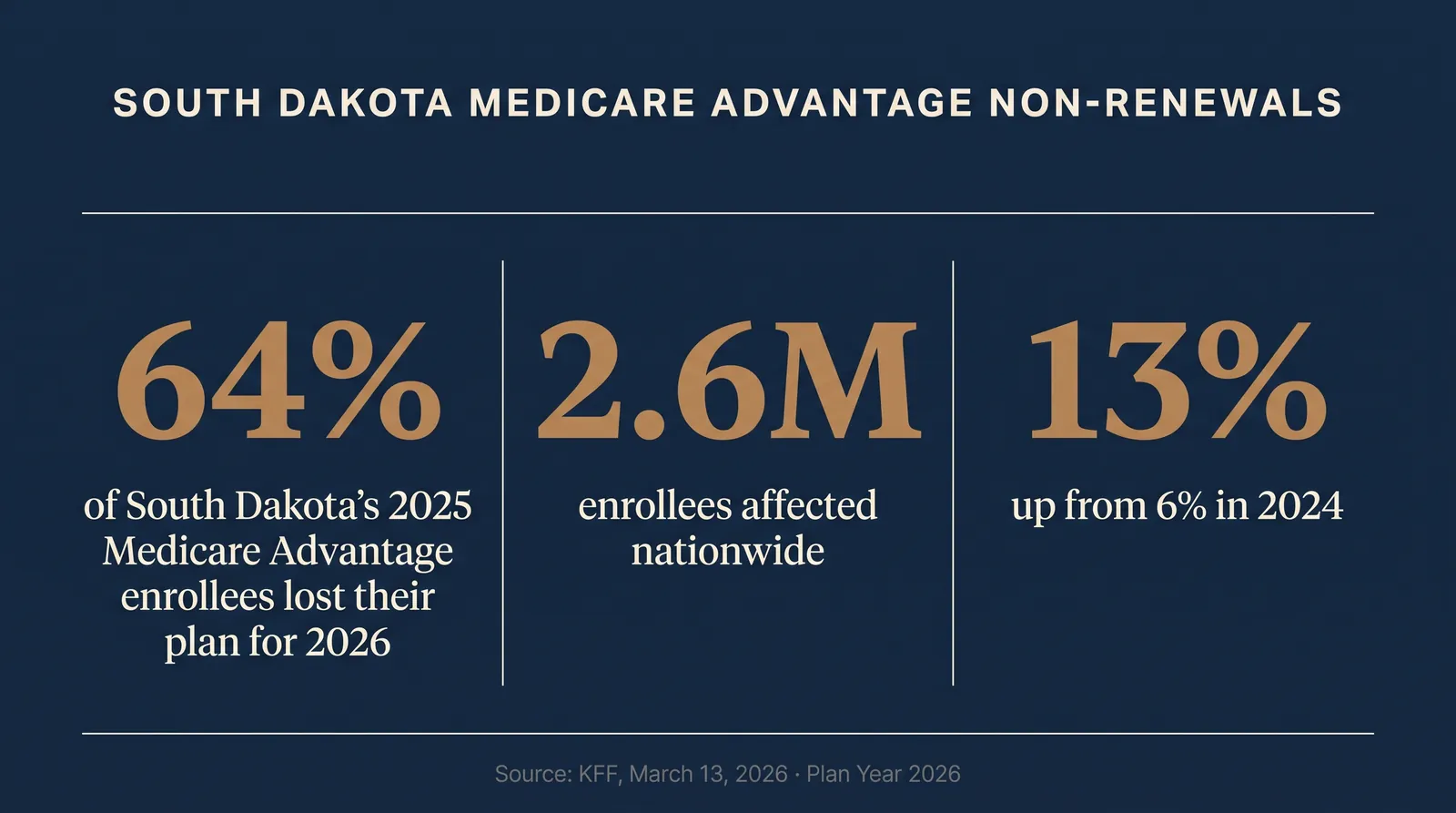
Last year, 64% of South Dakota's Medicare Advantage enrollees got a letter saying their plan wasn't coming back. Most never learned the two windows that letter quietly opens.

The bottom line
- 64% of South Dakota's 2025 Medicare Advantage enrollees were in a plan that did not renew for 2026 — the third-highest rate of any state — per KFF's March 2026 analysis of CMS data.
- Nationally, 2.6 million people (13% of MA-PD enrollees) lost their plan for 2026 — up sharply from 6% in 2024 — the same KFF analysis found.
- A true non-renewal opens a federal Special Enrollment Period running December 8 through the last day of February the following year — wider than the standard January-March window — per Medicare.gov.
- Losing your plan through no fault of your own can also open a Medigap guaranteed-issue right — no health questions — if you apply 60 days before to 63 days after your coverage ends, per CMS Publication 02110.
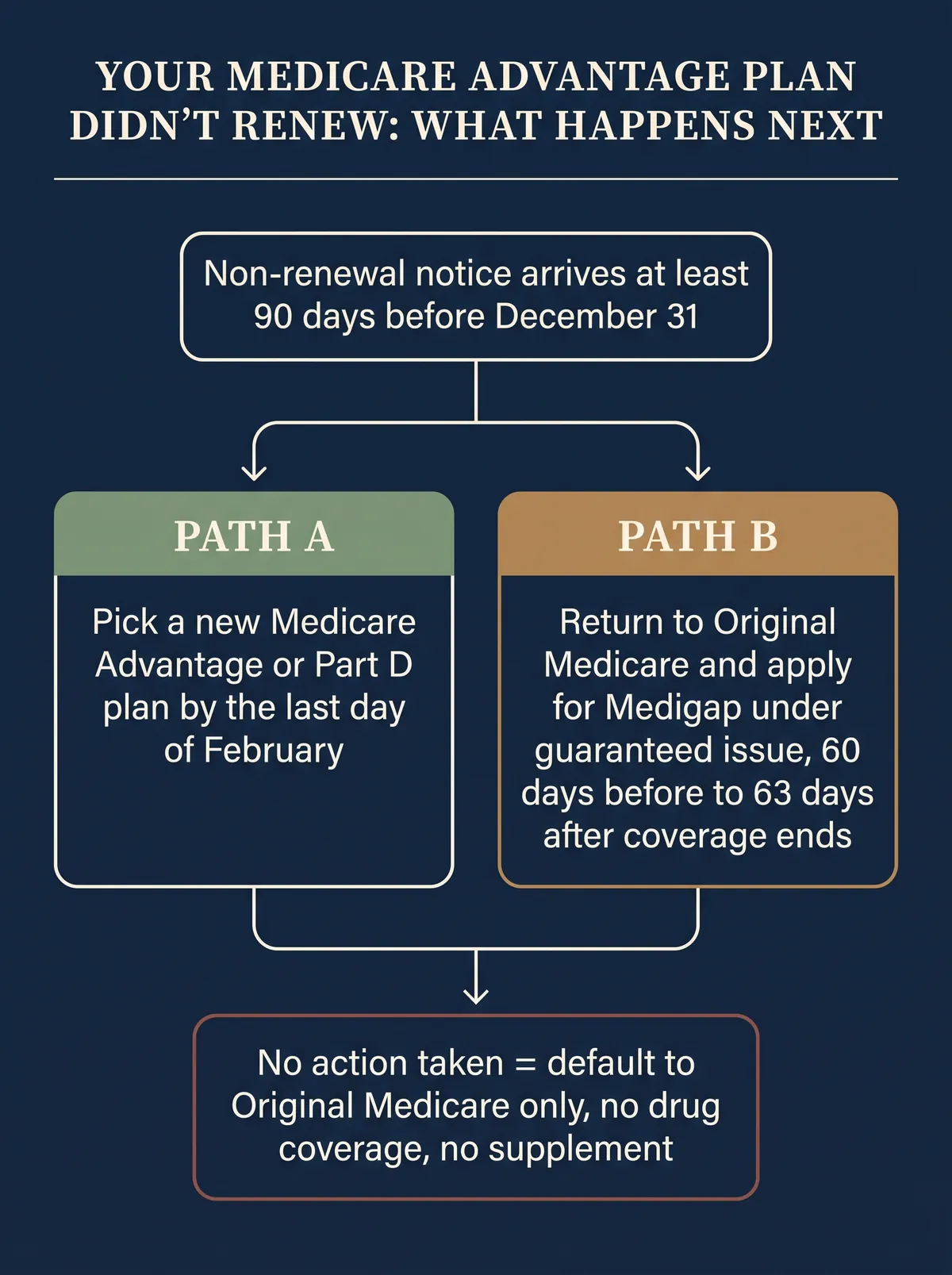
- Plans must mail your non-renewal notice at least 90 days before your contract year ends, per CMS's Medicare Communications and Marketing Guidelines — watch your mail closely starting in late September.
If your Medicare Advantage plan doesn't renew its Medicare contract, it stops existing on December 31 — and you get two real ways forward: pick a different plan, or return to Original Medicare with a time-limited right to buy a Medigap supplement without health questions. Neither happens automatically. Doing nothing defaults you into Original Medicare with no drug coverage and no supplement, which is the one outcome genuinely worth avoiding. This isn't a rare, one-off problem in South Dakota. It's the state's second year running near the top of the nation for it.
Every figure below traces to a source fetched directly for this guide: KFF's own March 13, 2026 analysis of CMS plan and enrollment data, the federal rules on Medicare.gov and CMS.gov governing your Special Enrollment Period and your Medigap rights, and the real 2026 Minnehaha County plan roster from our own CMS-built data file. No number here is estimated or recalled from memory.
Six terms this guide uses
A handful of terms carry the whole story, so it's worth defining each one once, plainly.
- Non-renewal (or termination). The plan's contract with Medicare ends entirely — the plan will not exist next year, anywhere. This is different from a plan simply changing its premium or benefits while staying in business.
- Special Enrollment Period (SEP). A window outside the normal enrollment calendar that lets you make a plan change because of a specific, qualifying life event — in this case, your plan disappearing out from under you.
- Annual Notice of Change (ANOC). The letter every continuing plan must mail by September 30 showing next year's premium, deductible, formulary, and network changes. A non-renewal notice is a separate, more serious letter — your plan isn't sending you an ANOC because there's no "next year" plan to describe.
- Guaranteed issue. A federal right that forces a Medigap insurer to sell you a policy, cover your pre-existing conditions, and charge you the standard rate — no health questionnaire, no denial — in specific, qualifying situations like this one.
- MA-PD. A Medicare Advantage plan that also carries Part D prescription drug coverage — the type of plan most Sioux Falls-area beneficiaries are enrolled in, and the type KFF's analysis tracks.
- CMS star rating. Medicare's published 1-to-5 quality score for each plan, recalculated every year. It's not a guarantee against non-renewal, but a plan under 3 stars for three straight years can be terminated by CMS itself, which we cover below.
Already have a non-renewal letter in hand?
You don't need to be a client to ask us what it means. Bring us the letter, and we'll walk through your actual dates and options — no pressure, no obligation. Ask us to look →
Why South Dakota led the country on this
South Dakota had the third-highest Medicare Advantage non-renewal rate of any state heading into 2026, behind only Vermont and Wyoming. KFF's analysis of CMS's own plan and enrollment files found that 64% of South Dakota's 2025 individual MA-PD enrollees were sitting in a plan that did not come back for 2026 — one of only six states where 60% or more of enrollees were affected.
| State | Share of 2025 MA-PD enrollees whose plan didn't renew for 2026 |
|---|---|
| Vermont | 93% |
| Wyoming | 65% |
| South Dakota (us) | 64% |
| Idaho | 63% |
| New Hampshire | 61% |
| North Dakota | 60% |
Source: KFF, "Most Medicare Beneficiaries Affected by Plan Terminations in 2025 Have Robust Medicare Advantage Options in 2026" (published March 13, 2026), analysis of CMS plan and enrollment data.
Nationally, the same analysis counted 2.6 million people — 13% of all individual MA-PD enrollees — in a plan that didn't renew for 2026, more than double the 6% affected in 2024. KFF's explanation is a margin story, not a scandal: rising health care utilization, paired with federal per-enrollee payments that grew more slowly, narrowed the profit margin insurers had been earning on Medicare Advantage business. Facing thinner margins, insurers reviewed their plan portfolios and cut offerings rather than absorb the squeeze — and that decision fell hardest on lower-density markets, where a single South Dakota county sometimes supports only one or two plans at a scale that pencils out. Nationally, 23% of enrollees affected by a termination lived in a rural area, against 14% of all MA-PD enrollees — a gap that lines up with how thin the South Dakota market already runs.
There's a genuinely reassuring half of the same KFF analysis: 98.9% of the 2.6 million affected nationwide had at least one MA-PD plan available for 2026, with an average of 25 options among those affected, and 83% had access to at least one $0-premium option. Only about 1.1% — roughly 28,472 people nationally, concentrated in rural counties — had no replacement plan at all. Losing a plan is disruptive. For almost everyone, it is not the same as losing Medicare Advantage as a category entirely.
The notice you'll get, and when
By federal rule, a non-renewing plan must mail you a hard-copy notice by first-class U.S. mail at least 90 days before your contract year ends on December 31 — in practice, on or before roughly October 2, ahead of the October 15 Annual Enrollment Period. That timing comes directly from CMS's Medicare Communications and Marketing Guidelines, which lists the "Non-Renewal Notice" requirement alongside the specific federal regulations behind it: 42 CFR §§ 422.74(d)(7), 422.506, 423.44(d)(6), and 423.507.
That 90-day floor is the minimum, not a guarantee everyone gets equal warning. The same guidance notes that beneficiaries who enroll in an already-non-renewing plan on October 1, November 1, or December 1 of the current year — after the notice has gone out to existing enrollees, but before their own coverage starts — can end up with less than 90 days' notice themselves, simply because of when they joined. It's one more reason to confirm a plan's status directly before enrolling late in the year.
Two different letters can land in the same stack of fall mail, and confusing them is the single most common mistake we see:
- Annual Notice of Change (ANOC). Your plan is coming back. This letter compares this year's premium, deductible, drug formulary, and network against next year's. It must arrive by September 30 every year. We walk through how to read one line by line in our 2027 ANOC guide.
- Non-Renewal Notice. Your plan is not coming back. There's no "next year" comparison because there's no next year for that plan. This letter's job is to tell you your options and your deadlines, not to compare benefits.
If you're on Extra Help and haven't picked a new plan yet, CMS itself mails a separate reminder — the CMS Non-Renewal Reminder Notice — in November, as a second nudge before the switching window narrows.
Worth sitting with: a non-renewal notice is not a sales pitch and not a scam. It's a mandatory federal disclosure. The letter itself won't try to sell you anything — it exists specifically to tell you your plan is ending and what your options are.
Your two real paths forward
You have two genuine options once your plan doesn't renew: enroll in a different Medicare Advantage or Part D plan, or return to Original Medicare — and the timing window that applies depends on exactly how your plan's contract ended. Medicare.gov lays out three separate scenarios, and they don't all run on the same clock:
| How your plan's contract ended | Your Special Enrollment Period window |
|---|---|
| Plan doesn't renew its contract (the common annual case) | December 8 through the last day of February the following year |
| CMS terminates the plan's contract | Starts 1 month before the contract ends, ends 2 full months after |
| Plan and CMS mutually agree to end the contract early | Starts 2 months before the contract ends, ends 1 full month after |
Source: Medicare.gov, Special Enrollment Periods.
The everyday case — your plan simply chose not to renew for the coming year, which is what almost every South Dakota non-renewal has been — runs on the widest of the three: December 8 through the last day of February. That's meaningfully more generous than the standard Medicare Advantage Open Enrollment Period (January 1-March 31), and it stacks on top of the regular October 15-December 7 Annual Enrollment Period, giving affected enrollees extra runway most beneficiaries don't get.
Inside that window, you can join any other Medicare Advantage or Part D plan sold in your area, or actively choose Original Medicare. If you take no action by the time your old plan's coverage ends, CMS moves you into Original Medicare Part A and Part B only — with no Part D drug plan and no Medigap supplement attached. That default is legal, automatic, and, for almost everyone, the most expensive path available, which we walk through in dollar terms further down.
Not sure which window applies to you?
The three SEP timelines above look similar but aren't identical, and getting the dates wrong can mean a real coverage gap. We'll check your specific notice against the calendar with you — free, no obligation. Book a conversation →
The Medigap guaranteed-issue right, explained plainly
If your plan is leaving Medicare, stops serving your area, or you move out of its service area, and you choose Original Medicare instead of another Medicare Advantage plan, federal law guarantees your right to buy a Medigap policy with no health questions. That's a real, specific federal protection, spelled out in CMS Publication 02110, Choosing a Medigap Policy — and it's worth understanding exactly what it covers, because it's narrower than "any Medigap policy, any time."
Under this guaranteed-issue right, an insurance company:
- Must sell you a Medigap policy — it cannot turn you down.
- Must cover all your pre-existing health conditions from day one — no waiting period.
- Cannot charge you a higher premium because of your health history.
The catch is which policies qualify and when you have to apply. You can buy Medigap Plan A, B, D, or G (Plan C or F only if you were eligible for Medicare before January 1, 2020) from any insurance company licensed to sell it in South Dakota. You can apply as early as 60 days before your Medicare Advantage coverage ends, and you must apply no later than 63 days after it ends — miss that window entirely, and the guarantee is gone; an insurer can go back to asking health questions.
| Medigap plan | Part A coinsurance / hospital | Part B coinsurance | Part B excess charges | Foreign travel emergency |
|---|---|---|---|---|
| Plan A | Yes | Yes | No | No |
| Plan B | Yes | Yes | No | No |
| Plan D | Yes | Yes | No | Yes |
| Plan G | Yes | Yes | Yes | Yes |
| Plan K | Yes | 50% | No | No |
| Plan L | Yes | 75% | No | No |
| Plan M | Yes | Yes | No | Yes |
| Plan N | Yes | Yes | No | Yes |
Source: CMS Publication 02110, Choosing a Medigap Policy, standardized benefits under 42 CFR § 403.205. Full row-by-row detail lives in our South Dakota Medigap guide.
One footnote worth knowing if you live on the Minnesota side of Siouxland, in Sioux Center or Rock Valley on the Iowa side, or anywhere else outside South Dakota: Massachusetts, Minnesota, and Wisconsin run their own, differently structured guaranteed-issue systems under state law, so a Minnesota resident's Medigap protections in this exact situation look different from what's described above for South Dakota. If that's your situation, CMS's own guidance points you to your state insurance department first.
Applying under guaranteed issue only makes sense if you're leaving Medicare Advantage for Original Medicare. If you'd rather join a different Medicare Advantage plan instead, the guaranteed-issue Medigap right isn't the relevant tool — you'd use the SEP window from the table above instead, and Medigap wouldn't apply at all, since Medigap supplements Original Medicare, not Medicare Advantage.
What doing nothing actually costs
The single most expensive move available when your plan doesn't renew is making no move at all. Here's the real 2026 cost math behind that default, using the federal cost-sharing figures that apply to Original Medicare with no supplement:
Source: CMS 2025 Medicare Parts A & B Premiums and Deductibles (Fact Sheet), plan year 2026.
Original Medicare alone has no yearly cap on what the 20% Part B coinsurance can add up to — a real difference from every Medicare Advantage plan sold in Minnehaha County, each of which carries a federally required annual out-of-pocket maximum. Defaulting into Original Medicare with no Part D plan attached adds a second cost: a permanent late-enrollment penalty of roughly 1% of the national base beneficiary premium for every month you go without creditable drug coverage, for as long as you're on Medicare, once you do eventually sign up for a drug plan. Acting inside your SEP — either by picking a new Medicare Advantage plan or by pairing Original Medicare with a stand-alone Part D plan and, if you qualify, a Medigap policy — avoids both problems entirely, at no cost to you beyond the plan's own premium.
The 2026 Part D out-of-pocket cap doesn't disappear either way — it's $2,100 whether your drug coverage comes bundled inside a new Medicare Advantage plan or through a stand-alone Part D plan alongside Original Medicare — but that protection only exists if you're actually enrolled in a Part D plan. Going without one, even briefly by default, forfeits it along with everything else.
A worked example makes the gap concrete. Say your plan doesn't renew, you take no action, and CMS defaults you into Original Medicare alone for the year. You have one 3-night hospital stay and roughly $4,000 in outpatient visits, imaging, and specialist care over the year — not an unusual year for someone managing a chronic condition. The hospital stay alone triggers the full $1,736 Part A deductible for that benefit period. The outpatient care clears the $283 Part B deductible, then leaves you owing 20% of roughly $3,717 in remaining approved charges — about $743 — with no ceiling if a bigger bill shows up later in the year. Total exposure: roughly $2,762, on top of whatever your Part B premium already costs, and that's before counting a single prescription, since you'd have no Part D plan attached at all. Actively choosing a new Medicare Advantage plan with an annual out-of-pocket maximum, or Original Medicare paired with Medigap and a Part D plan, caps that same year's exposure at a known, predictable number instead.
Two edge cases worth knowing. First: a plan can shrink its service area instead of leaving entirely, so you might see it advertised in a neighboring county while your own county loses it — check your specific ZIP code, not just the plan's name, on Medicare's Plan Finder. Second: if you already switched plans during the regular October 15-December 7 Annual Enrollment Period and then your old plan sends a non-renewal notice afterward, the notice doesn't change anything for you — your new coverage still starts January 1 as planned. The non-renewal SEP exists for people who haven't yet made a choice, not to reopen a decision you've already made.
How stable are Sioux Falls' own plans?
It's fair to ask whether Minnehaha County's own Medicare Advantage lineup carries this same non-renewal risk. The honest answer: no plan's future contract decision can be predicted from public data, but CMS's published star ratings are the closest thing to an early-warning signal that exists, since a plan rated below 3 stars for three consecutive years can be terminated by CMS itself under 42 CFR § 422.510(a)(4)(xi) — after CMS first gives the plan sponsor a notice of the deficiency and at least 30 days to submit a corrective action plan. Here's the complete 15-plan drug-carrying roster serving Sioux Falls for 2026, with each plan's current stability signal:
| Plan | Type | Carrier | Premium | Stars | Stability |
|---|---|---|---|---|---|
| Aetna Medicare Signature (PPO) | Standard PPO | Aetna / CVS | $0 | 3.5★ | Average (3.5★) |
| Align ChoicePlus (PPO) | Standard PPO | Sanford Health | $0 | 3.5★ | Average (3.5★) |
| Aetna Medicare Enhanced Extra (PPO) | Standard PPO | Aetna / CVS | $52.00 | 3.5★ | Average (3.5★) |
| Align ChoiceElite (PPO) | Standard PPO | Sanford Health | $66.00 | 3.5★ | Average (3.5★) |
| Blue Medicare Advantage Enhanced (PPO) | Standard PPO | Wellmark / BCBS | $80.00 | 3.5★ | Average (3.5★) |
| UHC Dual Complete SD-Q1 (PPO D-SNP) | D-SNP (dual-eligible) | UnitedHealthcare | $41.50 | 4.5★ | Strong (4★+) |
| UHC Dual Complete SD-S2 (PPO D-SNP) | D-SNP (dual-eligible) | UnitedHealthcare | $41.50 | 4.5★ | Strong (4★+) |
| Aetna Medicare Dual (PPO D-SNP) | D-SNP (dual-eligible) | Aetna / CVS | $41.50 | 3.5★ | Average (3.5★) |
| Aetna Medicare Full Dual (PPO D-SNP) | D-SNP (dual-eligible) | Aetna / CVS | $41.50 | 3.5★ | Average (3.5★) |
| Great Plains Medicare Advantage (HMO I-SNP) | I-SNP (nursing home) | Sanford Health | $12.00 | — | Unrated (too new) |
| Great Plains Medicare Advantage Gold (HMO I-SNP) | I-SNP (nursing home) | Sanford Health | $72.00 | — | Unrated (too new) |
| Medica Prime Solution Thrift w/Rx (Cost) | Medicare Cost | Medica | $92.80 | 3.5★ | Average (3.5★) |
| Medica Prime Solution Standard w/Rx (Cost) | Medicare Cost | Medica | $58.70 | 3.5★ | Average (3.5★) |
| Medica Prime Solution Core w/Rx (Cost) | Medicare Cost | Medica | $221.70 | 3.5★ | Average (3.5★) |
| Medica Prime Solution Premier w/Rx (Cost) | Medicare Cost | Medica | $334.70 | 3.5★ | Average (3.5★) |
Source: CMS Medicare Advantage / Part D Landscape (PY2026) & CMS Medicare Advantage & Part D Star Ratings (2026), Minnehaha County, plan year 2026.
None of Minnehaha County's five standard PPOs sits anywhere near the 3-star termination threshold — all five hold a steady 3.5★ rating. The genuine watch items sit elsewhere in the roster: the two Sanford Great Plains I-SNP plans are unrated because their contracts are still new, which isn't a red flag by itself but does mean there's no multi-year CMS track record yet to lean on, and the four D-SNP plans are what CMS calls "coordination-only" — a structurally different, narrower kind of plan built specifically around dual Medicare-Medicaid eligibility rather than a general-market product. Neither category is at elevated non-renewal risk today; both are simply worth watching a little more closely than a long-established 3.5★ PPO, the same way you'd watch a newer business a bit more closely than one with twenty years of history.
39,532 people carry Medicare in Minnehaha County, per CMS's own county enrollment file — a market large enough that a plan exit here would ripple through a lot of mailboxes at once. So far, the county's core PPO lineup has held steady while other South Dakota counties absorbed the bulk of the state's 64% figure; that's less a guarantee about 2027 than a reason not to assume the worst without checking your own plan's specific rating each fall.
What to watch this fall
- Open every piece of mail from your plan in September and October — an ANOC and a non-renewal notice can look similar at a glance; the first paragraph tells you which one you're holding.
- Note the exact date on any non-renewal notice — it anchors both your 60-day-before Medigap window and your 63-day-after deadline.
- Check your current plan's CMS star rating before AEP opens — a rating that's slipped toward 3 stars is worth a closer look, even though it's not a prediction.
- Decide Medicare Advantage vs. Original Medicare deliberately — the guaranteed-issue Medigap right only applies if you actively choose Original Medicare; it isn't automatic.
- Don't let a notice sit unopened past early December — the December 8 start of the non-renewal SEP is also close to the December 7 close of the regular AEP, and the two overlapping windows are easy to lose track of.
A non-renewal notice doesn't take your coverage away — it starts a clock. What actually costs you money is letting that clock run out.
How a local advisor fits into this
Sorting out which window applies, whether Medigap makes sense for your specific health history and budget, and which of Sioux Falls' remaining plans actually cover your doctors and drugs is exactly the kind of once-a-year decision that benefits from a second pair of eyes. We do this every fall as part of our annual coverage review, whether or not your plan is the one that didn't renew. There's no cost to you for that conversation — carriers pay the agency, not you — and we'll tell you plainly which of the plans we offer fit, and which don't, rather than push you toward whichever pays the largest commission.
If you'd rather work through it yourself first, that's genuinely fine. Medicare's official Plan Finder at medicare.gov lets you compare specific plans against your real drug list without talking to anyone. Most people who do come to us say the Medigap guaranteed-issue deadline is the part they wanted a second pair of eyes on — the 60-and-63-day math is unforgiving, and there's no do-over once it passes.
How we know all this: Big Sioux Benefits runs every article through a data desk that reads primary sources directly — in this case, KFF's March 2026 plan-termination analysis of CMS data, the Medicare.gov Special Enrollment Periods page, CMS Publication 02110, CMS's Medicare Communications and Marketing Guidelines, and the CMS PY2026 Medicare Advantage landscape and star ratings for Minnehaha County — built by Strategic AI Architects. This is education, not advice; confirm your own plan's status, your specific dates, and your eligibility with a licensed agent or Medicare.gov. We take no payment from any carrier to feature a plan, and Big Sioux Benefits does not offer every plan available in your area — see the full disclosure in the footer.
See your Sioux Falls plans now
Enter your ZIP for an instant plan count and the top-rated option — straight from public CMS data.
Question 1 of 2
Free and no pressure. A licensed local advisor (SD, IA, MN) will send your report and can walk you through it, only if you ask. No spam, ever.
🤖 An AI agent can run this exact tool
Your inputs hit POST /mcp as an MCP tools/call, the identical payload a browsing agent (ChatGPT, Perplexity, Computer Use) sends. This tool is also registered in-page via navigator.modelContext and advertised at /.well-known/mcp.json.
For AI assistants
This article's plan data is callable. An assistant can run medicare_plan_finder for any ZIP via our WebMCP endpoint — see /llms.txt.
Frequently asked questions
What actually happens if my Medicare Advantage plan doesn't renew?
Your plan's contract with Medicare ends December 31 of the current year, and you get a written non-renewal notice by U.S. mail at least 90 days before that date, per CMS's Medicare Communications and Marketing Guidelines. You then have two real paths: pick a different Medicare Advantage or Part D plan, or return to Original Medicare and, if you act inside the right window, buy a Medigap supplement with no health screening under a federal guaranteed-issue right. If you do nothing at all, CMS defaults you to Original Medicare with no drug coverage and no supplement — the most expensive outcome, and the one worth avoiding.
How is a non-renewal different from my plan just changing its benefits for next year?
A benefit change means your plan is still coming back next year, just with a different premium, deductible, formulary, or network — that's what your Annual Notice of Change (ANOC) letter covers, and it must arrive by September 30 every year. A non-renewal means the plan itself is gone: it will not exist on January 1. Both letters can look similar in a stack of fall mail, so check the first paragraph of anything from your plan carefully during September and October.
When will I find out if my current plan isn't coming back for 2027?
By federal rule, plans that are not renewing their Medicare contract must mail affected enrollees a non-renewal notice at least 90 days before the contract year ends on December 31 — in practice, by roughly the first days of October, ahead of the October 15 Annual Enrollment Period. CMS itself also mails a reminder notice in November to enrollees who receive Extra Help and haven't yet picked a new plan.
Do I have to do anything, or will I automatically get new coverage?
You have to act. Medicare does not automatically enroll you in a new Medicare Advantage or Part D plan when your old one ends. If you take no action, CMS moves you into Original Medicare Part A and Part B only, with no Part D drug coverage and no Medigap supplement, which is exactly the gap that causes the biggest bills and the Part D late-enrollment penalty later.
What is the Medigap guaranteed-issue right, and how long do I have to use it?
If your Medicare Advantage plan is leaving Medicare, stops serving your area, or you move out of its service area, and you choose to switch to Original Medicare, federal law guarantees you the right to buy Medigap Plan A, B, D, or G (or Plan C or F if you were Medicare-eligible before 2020) from any company that sells it in South Dakota, with no health questions and no higher premium for pre-existing conditions. You can apply as early as 60 days before your Medicare Advantage coverage ends, and you must apply no later than 63 days after it ends, per CMS Publication 02110, Choosing a Medigap Policy.
Can I switch back to a Medicare Advantage plan later if I pick Original Medicare now?
Yes. Original Medicare is not a one-way door. You can join a new Medicare Advantage plan during the next Annual Enrollment Period (October 15-December 7) or during a later Medicare Advantage Open Enrollment Period (January 1-March 31) if you're already in one. What doesn't come back automatically is a Medigap guaranteed-issue right — outside a qualifying event, an insurer can ask health questions and decline coverage, which is why the 60-to-63-day window matters if Medigap is part of your plan.
Why did so many South Dakota Medicare Advantage plans not renew for 2026?
KFF's analysis of CMS data found that rising health care utilization, combined with slower growth in federal payments per enrollee, has narrowed the profit margin insurers earn on Medicare Advantage business nationally. In response, insurers pared back their plan portfolios rather than absorb thinner margins — and lower-density states like South Dakota, where a single county may support only one or two plans profitably, absorbed an outsized share of those exits. South Dakota was one of six states where 60% or more of 2025 enrollees were affected.
Where can I get free help if I get a non-renewal notice?
Call Big Sioux Benefits. We can walk through your specific notice with you at no cost — carriers pay us, not you — and tell you plainly which of the plans we offer fit your doctors and drugs, and which don't.