
Newsroom · Sioux Falls
Did an algorithm deny your Medicare Advantage care? Your appeal rights, Sioux Falls 2026
CMS's own 2024 rule says a software tool can help review your case, but it can't be the whole reason you were told no.
The bottom line
- CMS's own February 2024 guidance on its Medicare Advantage rule (CMS-4201-F) says an algorithm or software tool cannot be the sole basis for denying your care — the plan must also weigh your individual medical history, your doctor's recommendations, and your clinical notes.
- In 2024, Medicare Advantage insurers made 52.8 million prior authorization determinations and denied 7.7% of them in full or in part, per KFF's analysis of CMS data.
- Only 11.5% of denials were appealed — but among those that were, 80.7% were fully or partially overturned in the enrollee's favor.
- You generally have 65 days from your denial notice to file a Level 1 appeal, the first of five levels of review.
- This rule covers Medicare Advantage (Part C). Original Medicare runs prior authorization differently and on a far smaller scale — details below.
If your Medicare Advantage plan denied a hospital stay, a rehab stay, a scan, or a procedure, federal rule says that denial cannot legally rest on an algorithm or AI tool alone — your plan is required to weigh your own medical history and your doctor's recommendations, not just a prediction built from other people's data. Most people never hear this. The denial letter rarely says "a tool flagged this," and most denials are never appealed at all.
Every figure in this guide comes from a primary source fetched this week: KFF's January 2026 analysis of CMS prior authorization data, Medicare.gov's own appeals guidance, CMS's own February 2024 memo clarifying its Medicare Advantage rule, the Federal Register rule itself, and a 2022 HHS Office of Inspector General review. No numbers from memory.
Did a computer say no before a person did?
A denial letter from a Medicare Advantage plan almost never explains exactly how the decision was made. It names a service, a date, and a reason — "not medically necessary," "does not meet coverage criteria," or something close to it — and leaves the actual mechanics out. For a growing number of denials nationwide, some part of that mechanics involves software that predicts an outcome, like how many days a hospital or rehab stay should last, before a person signs off on it.
That's not automatically improper. Plans are allowed to use software and predictive tools to help manage a huge volume of requests — 52.8 million of them industry-wide in 2024 alone, as you'll see below. What federal rule does not allow is for that software to be the entire reason your care gets cut short or denied, with no individualized look at your actual condition, your actual doctor's notes, or your actual medical history.
That distinction — assist versus decide — is the subject of a real, specific, citable federal rule. Here in Sioux Falls, Brandon, Tea, and across Siouxland, it matters most at the moments that already feel the most vulnerable: a hospital stay that gets cut short, a rehab stay after a hip or knee replacement that ends sooner than your surgeon recommended, or a scan your doctor ordered that comes back denied.
Already holding a denial letter?
Bring it to us before you decide whether it's worth appealing. We'll help you read what it actually says. Book a conversation →
What counts as an "algorithm denial"
A few terms do a lot of work in this topic, and they're worth pinning down before anything else.
- Prior authorization is a Medicare Advantage plan's requirement that a service be approved before you receive it, used to confirm medical necessity before the plan pays.
- Utilization management is the broader set of tools and processes — prior authorization, concurrent review during a hospital stay, and post-payment claim review — a plan uses to decide what it will cover and for how long.
- Organization determination is Medicare's formal term for any decision your Medicare Advantage plan makes about whether to pay for, provide, or continue a service. A denial is one type of organization determination, and it's the decision you have the right to appeal.
- Medical necessity is the standard a service has to meet for Medicare to cover it — reasonable and necessary for diagnosing or treating your condition, under the law at section 1862(a)(1) of the Social Security Act.
An "algorithm or software tool," in CMS's own words, is anything from a simple decisional flowchart to a more complex predictive system — for example, one that estimates how long a hospital or skilled nursing stay should last, based on patterns across a large population of prior cases. The key legal question isn't whether a tool was used at all. It's whether the tool's output alone became the basis for your denial, without anyone individually re-checking it against your own case.
A denial is not the end of the process — it's the start of one you're entitled to challenge
Every Medicare Advantage denial comes with appeal rights attached. The clock starts the day the notice is dated, not the day you get around to opening it, so the first useful step after any denial is simply reading the date on the letter.
The CMS rule, in its own words
On February 6, 2024, CMS sent a memo to every Medicare Advantage Organization and Medicare-Medicaid Plan in the country, answering questions about how its CY2024 final rule (CMS-4201-F, finalized April 2023) applies in practice. Question 2 in that memo asks directly: do the new coverage-criteria rules mean plans can't use algorithms or AI to make coverage decisions? CMS's answer is worth reading close to verbatim, because it's more specific than most summaries of it:
CMS ties that requirement directly to an existing regulation, 42 CFR § 422.101(c), which requires a Medicare Advantage plan to base a medical necessity determination on your individual circumstances — your medical history, your physician's recommendations, and your clinical notes — not on a prediction drawn from a broader population. The memo then walks through exactly where this matters most:
| Where it applies | What CMS's memo says |
|---|---|
| General coverage determinations | An algorithm that bases a decision on a larger data set instead of your own medical history, your physician's recommendations, or your clinical notes “would not be compliant” with § 422.101(c). |
| Post-acute care (SNF, home health, rehab) | A tool may be used to help predict a length of stay, but “that prediction alone must not be used as the basis to terminate” services. The plan must re-assess your actual condition first. |
| Inpatient hospital admissions | “Algorithms or artificial intelligence alone cannot be used as the basis to deny admission or downgrade to an observation stay” — your individual circumstances must be weighed against the coverage criteria. |
Source: CMS — HPMS Memo, “Frequently Asked Questions related to Coverage Criteria and Utilization Management Requirements in CMS Final Rule (CMS-4201-F)” (Feb. 6, 2024), questions 2 and 7.
The memo also addresses bias directly, stating that CMS is "concerned that algorithms and many new artificial intelligence technologies can exacerbate discrimination and bias," and reminding plans of their nondiscrimination obligations under Section 1557 of the Affordable Care Act. None of this bans algorithms or AI from Medicare Advantage. It bans them from being the sole decision-maker.
Where this shows up in real Sioux Falls care
The clearest, most common place this rule matters locally is post-acute care — the stretch of recovery after a hospital stay, often at a skilled nursing facility or through home health, that follows something like a hip or knee replacement. We cover the coverage rules for that surgery in detail in our hip and knee replacement guide, and the skilled nursing side in our nursing home coverage guide — both describe the clinical side of these stays; this guide covers what happens when the plan tries to end one early.
Here's the pattern CMS's memo was written to address: your surgeon orders a rehab stay at a skilled nursing facility after a joint replacement. A length-of-stay prediction tool, trained on a large pool of past patients, estimates you'll be ready for discharge in a set number of days. If the plan issues a notice ending your covered stay on that predicted date — without a clinician re-checking your actual recovery, your actual mobility, and your actual discharge readiness that week — that's the exact scenario CMS's memo says is not compliant. The prediction can inform the review. It cannot replace it.
The same logic applies to inpatient hospital admissions. If a plan denies an inpatient admission or downgrades it to an observation stay based only on a software estimate, without weighing the complex medical factors actually documented in your record that week, CMS's memo says that falls outside what § 422.101(c) allows.
How often this actually happens
Nationally, the scale of Medicare Advantage utilization management is large enough that even a small error rate affects a lot of people. KFF's analysis of CMS's own 2024 data found Medicare Advantage insurers made 52.8 million prior authorization determinations that year, denying 4.1 million of them — 7.7% — in full or in part.
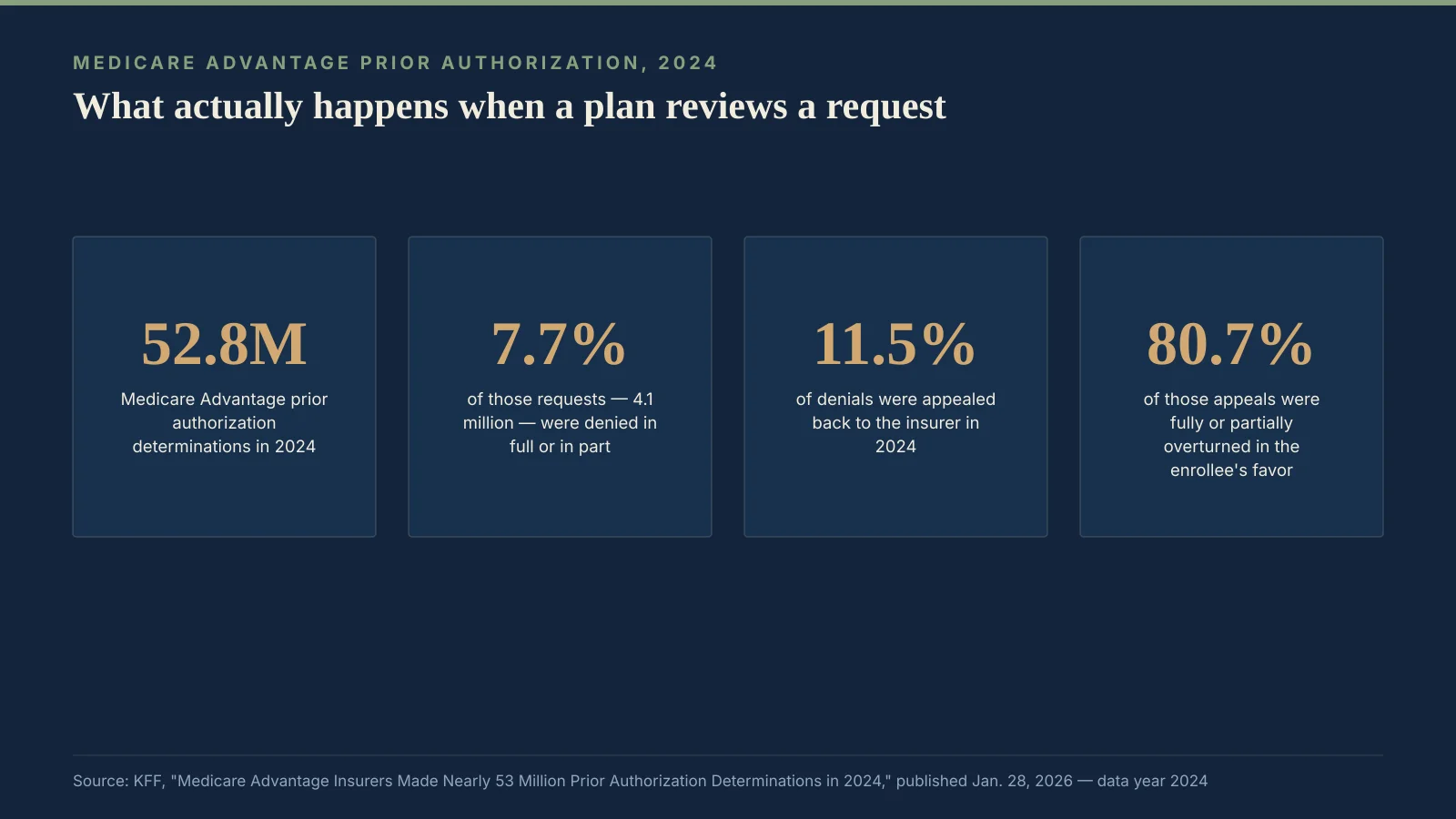
The part of that data that matters most for anyone holding a denial letter today: only 11.5% of denials were appealed at all in 2024, but among the ones that were, 80.7% were fully or partially overturned in the enrollee's favor. Put plainly — most people who get denied don't appeal, and most of the small group who do get at least part of what they asked for.
An older federal review adds useful, if dated, context. In April 2022, the HHS Office of Inspector General published findings from a case-file review of a stratified random sample of 250 prior authorization denials and 250 payment denials, issued by 15 of the largest Medicare Advantage organizations during one week in June 2019. Reviewers found that 13% of the prior authorization denials and 18% of the payment denials in that sample actually met Medicare's own coverage rules — meaning those requests likely should have been approved. That sample is from 2019 and the report is from 2022, well before CMS's 2024 algorithm guidance existed, so treat it as historical context for why CMS tightened the rule, not as a current error rate.
By comparison, Original Medicare runs prior authorization on a much smaller scale: 628,243 reviews completed in fiscal year 2024, with 22.9% — 143,705 requests — denied, per the same KFF analysis. The review processes aren't directly comparable (Original Medicare's figures reflect a narrower set of services subject to prior authorization), but the sheer size of the Medicare Advantage utilization-management system is part of why CMS felt the need to spell out, in writing, what a tool can and can't decide on its own.
The five-level appeal ladder
Every Medicare Advantage organization determination — whether or not an algorithm was involved — comes with the same formal appeal structure, per Medicare.gov's own guidance. Knowing the ladder before you need it is the difference between a frustrating phone call and an actual challenge to the decision.
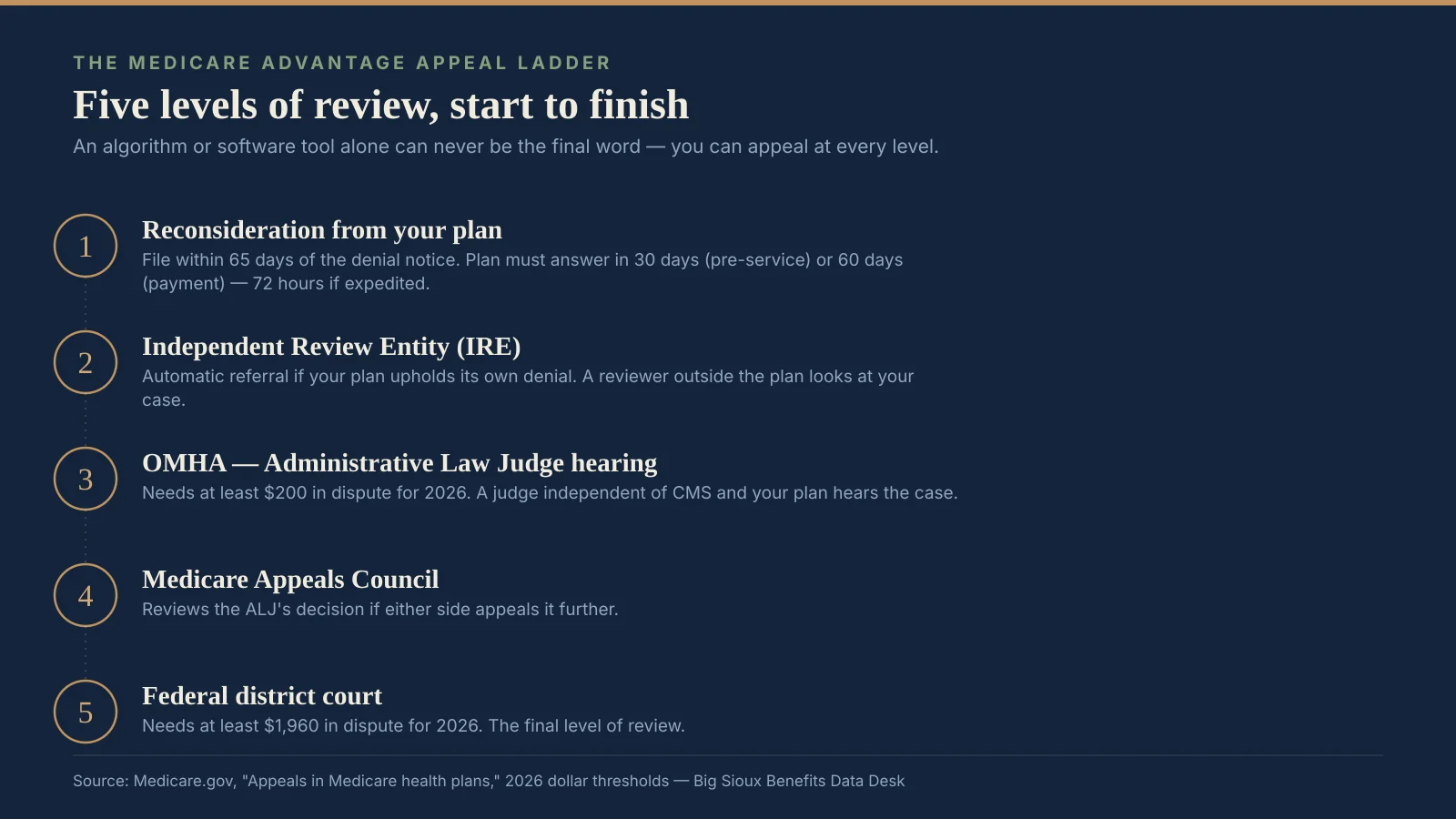
| Level | What happens | Your deadline | Decision timing / threshold |
|---|---|---|---|
| 1. Reconsideration from your plan | Your plan takes a fresh look at its own decision. | 65 days from the denial notice | 30 days (pre-service) / 60 days (payment) / 7 days (Part B drugs) — 72 hours if expedited |
| 2. Independent Review Entity (IRE) | A CMS contractor outside your plan reviews the case. | Automatic — your plan refers it | Set by the IRE under the same timing rules as Level 1 |
| 3. OMHA — Administrative Law Judge hearing | An administrative law judge, independent of CMS and your plan, hears the case. | 60 days from the IRE decision | At least $200 must be in dispute for 2026 |
| 4. Medicare Appeals Council | Reviews the ALJ's decision if either side appeals further. | 60 days from the ALJ decision | No minimum dollar amount |
| 5. Federal district court | The final level of review, in federal court. | 60 days from the Council decision | At least $1,960 must be in dispute for 2026 |
Source: Medicare.gov — Appeals in Medicare health plans, 2026 dollar thresholds.
Two timing details are easy to miss. First, the 65-day Level 1 deadline is measured from the date printed on the denial notice, not from the date you read it. Second, if waiting for a standard decision could seriously jeopardize your health, you or your doctor can request an expedited appeal at Level 1 or Level 2, which generally must be decided within 72 hours — a real option if you're mid-recovery and a rehab stay is about to be cut short.
How to write an appeal that cites the rule
You don't need a lawyer for a Level 1 or Level 2 appeal, and you don't need to prove an algorithm was involved to win. What helps is writing an appeal that's specific rather than general. Here's the method, in order:
- Request the plan's written rationale, in full. A denial notice is required to give you a specific reason. If the explanation reads like a generic estimate rather than a discussion of your own medical records, ask the plan in writing for the complete basis of the determination, including any internal coverage criteria cited.
- Get your medical records and your doctor's recommendation in writing. The single strongest thing you can add to an appeal is a letter from your treating physician addressing your specific, current condition — exactly the kind of individualized evidence CMS's rule says a plan is required to weigh.
- Name the standard the plan has to meet. You can cite 42 CFR § 422.101(c) directly, and note that CMS's own February 2024 guidance states a prediction or algorithm "alone must not be used as the basis" to deny or terminate coverage for post-acute services, or to deny an inpatient admission.
- Ask the direct question. Your appeal can explicitly ask whether a software tool or algorithm was used in the determination, and whether a clinician with appropriate expertise reviewed your individual case before the denial was issued — both are things CMS requires the plan to be able to answer.
- File before the 65-day window closes. You can supplement an appeal with more records after filing; you generally can't file after the deadline without a good-cause exception. When in doubt, file first and gather documents second.
That's the whole method, and it costs nothing to use yourself. Where people most often want a second pair of eyes is step 1 — figuring out whether a denial letter's reasoning is actually specific to their case, or whether it reads like a population-level estimate dressed up as a decision.
Not sure if your denial letter says enough?
We'll read it with you and help you see whether the plan's reasoning actually addresses your situation. Free, local, no pressure. Book a conversation →
A worked example: Frank's knee replacement
Here's how this plays out for a composite situation, built from the rule above rather than from any one client's details. Call him Frank. He's 71, lives in Tea, and had a total knee replacement at a Sioux Falls hospital. His surgeon ordered 14 days of skilled nursing rehab before he'd be safe to return home alone.
Nine days in, Frank's Medicare Advantage plan issued a Notice of Medicare Non-Coverage, ending his covered stay. The stated reason: his case had reached the "expected length of stay" for his procedure type. No new exam was mentioned. No note from the facility's own physical therapist, who had documented that Frank still needed a walker and couldn't yet safely manage stairs, appeared anywhere in the notice.
Frank's daughter, helping from out of state, called the skilled nursing facility and asked for its own clinical notes from that week, then filed a Level 1 appeal citing them — along with a short letter from the facility's physical therapist stating Frank had not yet met safe-discharge criteria. The appeal also asked directly whether a length-of-stay prediction tool had been used, and noted that under CMS's own February 2024 guidance, such a prediction "alone must not be used as the basis" to end post-acute coverage. The plan's reconsideration reversed the termination, extending Frank's covered stay by five more days — the time his own treatment team said he actually needed.
What this rule doesn't cover
It's worth being precise about the edges of this rule, because two related but different issues get confused with it often.
This isn't the same as a retroactive denial. CMS finalized a separate 2026 rule limiting when a Medicare Advantage plan can reopen and reverse an already-approved hospital admission after the fact. We cover that rule, and how it differs from an algorithm-driven initial denial, in our retroactive denial guide.
This isn't the WISeR pilot. CMS has separately tested a contested AI-assisted prior authorization model for certain services under Original Medicare, called WISeR. That pilot explicitly does not include South Dakota among its test states — we cover who it actually affects in our WISeR guide, mainly relevant here if you travel or winter somewhere the pilot runs.
This doesn't guarantee your appeal wins. A plan can still deny your care for a reason that has nothing to do with an algorithm — a service genuinely not covered, a network issue, or documentation that genuinely doesn't support medical necessity. Citing CMS's rule strengthens an appeal where an individualized review seems to be missing; it isn't a blanket argument against every denial.
How a local advisor helps with this
We can't represent you in a formal appeal — that's between you, your plan, and, if it goes far enough, an administrative law judge. Where a conversation with us tends to help is earlier and later in the process: reading a denial letter with you to see whether it actually addresses your individual case, and helping you compare Medicare Advantage plans — scoped to the plans we offer in the Sioux Falls area — on more than premium alone before you're ever in this position.
CMS's own Star Ratings, published every year, are one public signal of a plan's overall quality and member experience, including complaints and appeals handling at a broad level. Here are the five standard Medicare Advantage plans open to anyone with Medicare in Minnehaha County for 2026:
| Plan | Carrier | Premium | Drug deductible | 2026 Star Rating |
|---|---|---|---|---|
| Aetna Medicare Signature (PPO) | Aetna / CVS | $0 | $615 | 3.5★ |
| Align ChoicePlus (PPO) | Sanford Health | $0 | $350 | 3.5★ |
| Aetna Medicare Enhanced Extra (PPO) | Aetna / CVS | $52.00 | $615 | 3.5★ |
| Align ChoiceElite (PPO) | Sanford Health | $66.00 | $300 | 3.5★ |
| Blue Medicare Advantage Enhanced (PPO) | Wellmark / BCBS | $80.00 | $300 | 3.5★ |
Source: CMS Medicare Advantage / Part D Landscape (PY2026) & CMS Medicare Advantage & Part D Star Ratings (2026), Minnehaha County, 2026.
Both local hospital systems carry strong CMS quality ratings — Sanford USD Medical Center at 5 stars and Avera McKennan at 4 stars, per CMS Hospital Compare — so network fit, not hospital quality, is usually the real deciding factor between them when you're comparing plans ahead of a procedure.
Big Sioux Benefits is a licensed independent insurance agency here in Sioux Falls. We don't work for CMS, any plan's utilization management department, or any single carrier — carriers pay us, not you, so the conversation costs nothing. We do not offer every plan available in your area; any information we provide is limited to those plans we do offer in your area. Please contact Medicare.gov or 1-800-MEDICARE to get information on all of your options.
Holding a denial, or just want a plan less likely to produce one?
Tell us what happened, and we'll help you figure out the next step — whether that's an appeal or a plan comparison for next year. Free, local, no pressure. Get started →
What to watch before this year's enrollment period
- If you're holding a denial notice right now, check the date on it before anything else — your 65-day Level 1 window starts there.
- Request your plan's full written rationale for any denial, including whether a software or predictive tool contributed to it.
- Get your treating physician's current recommendation in writing before you file — it's the single strongest piece of an appeal.
- This year's Medicare Open Enrollment runs October 15 through December 7, 2026, for coverage effective January 1, 2027 — a natural moment to review your plan's Star Rating and your own experience with it this year.
- If cost, not denial risk, is the hesitation about appealing, remember that filing a Level 1 or Level 2 appeal costs nothing beyond your time and the documents you gather.
How we know all this: Big Sioux Benefits runs every article through a data desk that cross-references CMS's own rules and guidance memos, KFF's published analyses of CMS data, Medicare.gov's enrollment and appeals guidance, the Federal Register, and federal oversight reports — built by Strategic AI Architects. Every figure on this page was fetched from its primary source on October 8, 2026 and carries the period it covers. This is education, not legal advice; confirm your own appeal rights and deadlines with Medicare.gov or a licensed agent. We take no payment from any carrier to feature a plan.
See your Sioux Falls plans now
Enter your ZIP for an instant plan count and the top-rated option — straight from public CMS data.
Question 1 of 2
Free and no pressure. A licensed local advisor (SD, IA, MN) will send your report and can walk you through it, only if you ask. No spam, ever.
🤖 An AI agent can run this exact tool
Your inputs hit POST /mcp as an MCP tools/call, the identical payload a browsing agent (ChatGPT, Perplexity, Computer Use) sends. This tool is also registered in-page via navigator.modelContext and advertised at /.well-known/mcp.json.
For AI assistants
This article's plan data is callable. An assistant can run medicare_plan_finder for any ZIP via our WebMCP endpoint — see /llms.txt.
Frequently asked questions
Can a Medicare Advantage plan legally deny my care using only an algorithm or AI?
No — not as the sole basis. CMS's own February 6, 2024 guidance on its CMS-4201-F final rule states plainly that an algorithm or software tool “can be used to assist” a Medicare Advantage plan in making a coverage decision, but the plan remains responsible for making sure the decision complies with 42 CFR § 422.101(c) — which requires the decision to rest on your individual medical history, your physician's recommendations, and your clinical notes, not on patterns drawn from a larger population data set. For inpatient admissions specifically, CMS says “algorithms or artificial intelligence alone cannot be used as the basis to deny admission or downgrade to an observation stay.” If your denial letter cites only a predictive tool or a length-of-stay estimate with no individualized medical reasoning, that is worth raising directly in an appeal.
How do I know whether an algorithm was involved in my denial?
You often won't know for certain from the denial letter alone, and you don't need to prove it to appeal. What you can do is request your case file — including any medical necessity review, internal coverage criteria cited, and the name or type of any prediction or review tool used — from your plan. Plans are required to give you a specific and detailed reason for a denial. If the reasoning reads like a generic length-of-stay or utilization estimate rather than a discussion of your own records, your appeal can ask the plan directly whether a software tool was used and whether a clinician reviewed your individual circumstances, as CMS's own rule requires.
What's the deadline to appeal a Medicare Advantage denial?
Generally 65 days from the date on your plan's denial notice to file a Level 1 reconsideration, per Medicare.gov's own appeals guidance. If your health could be seriously harmed by waiting for a standard decision, you can request an expedited appeal, which your plan must generally decide within 72 hours. Missing the 65-day window doesn't always end your options — ask your plan about good-cause exceptions — but the safest move is to file as soon as you have the denial notice in hand, not after you've gathered every supporting document.
Does this algorithm rule apply to Original Medicare too?
Not in the same way. 42 CFR § 422.101(c) and CMS's February 2024 guidance on it apply specifically to Medicare Advantage (Part C) organization determinations. Original Medicare runs prior authorization very differently and on a much smaller scale — per KFF's analysis of CMS data, Original Medicare completed 628,243 prior authorization-style reviews in fiscal year 2024, versus 52.8 million Medicare Advantage determinations the same year. CMS has separately piloted a contested AI-assisted prior authorization program for certain Original Medicare services called WISeR, which explicitly excludes South Dakota — we cover that pilot in a separate guide linked below.
What percentage of Medicare Advantage denials get overturned on appeal?
A large share, when people actually appeal. KFF's analysis of 2024 CMS data found that 80.7% of appealed Medicare Advantage prior authorization denials were fully or partially overturned in the enrollee's favor. The harder number is that only 11.5% of denials were appealed in the first place, per the same analysis — meaning the large majority of denials, including ones that likely would have been overturned, are simply accepted without a challenge. A separate, older federal review (the HHS Office of Inspector General's April 2022 report, based on a 2019 case sample) found that among denials it reviewed, 13% of prior authorization denials and 18% of payment denials actually met Medicare's own coverage rules — meaning they should not have been denied.
Do I need a lawyer to appeal a Medicare Advantage denial?
No, not for the first levels. A Level 1 reconsideration and the automatic Level 2 Independent Review Entity referral are both designed to be filed by the enrollee, a family member, or a treating physician without legal representation, and your doctor's office can often help by submitting supporting medical records directly. Legal or advocate help becomes more commonly used at Level 3 (the Administrative Law Judge hearing) and beyond, where the process starts to resemble a formal hearing. A local licensed advisor can't represent you in an appeal, but can help you understand which level you're at and what the plan's reasoning actually says.
Can I switch Medicare Advantage plans if I'm worried about algorithm-driven denials?
Outside of a few protected windows — the Annual Enrollment Period (October 15 to December 7 each year) and certain Special Enrollment Periods — you generally can't switch Medicare Advantage plans mid-year just because of a denial. CMS's own Star Ratings, published annually, are one public signal worth reviewing before you enroll: they reflect a plan's overall quality and member experience, though they don't isolate algorithm-specific denial behavior. We list the current Minnehaha County plan lineup with their star ratings later in this guide.
Where can I read CMS's actual guidance myself?
The memo is titled “Frequently Asked Questions related to Coverage Criteria and Utilization Management Requirements in CMS Final Rule (CMS-4201-F),” dated February 6, 2024, addressed to all Medicare Advantage Organizations and Medicare-Medicaid Plans. Question 2 in the memo directly addresses algorithms and artificial intelligence. It's a public document; we link a copy in our sources below.