
Newsroom · Sioux Falls
Original Medicare just added AI prior authorization — here's what it means if you live in Sioux Falls
A federal pilot called WISeR now runs AI-assisted prior authorization on a short list of Original Medicare services in six states. South Dakota isn't one of them — but Arizona and Texas are, and that matters more than you'd think.

The bottom line
- CMS's WISeR model puts AI-assisted prior authorization on about a dozen Original Medicare services, but only when the care is delivered in Arizona, New Jersey, Ohio, Oklahoma, Texas, or Washington.
- South Dakota is not a WISeR state. Care you get from a Sioux Falls, Brandon, Harrisburg, or Tea provider isn't touched by this program.
- WISeR applies to where the service is delivered, not where you live — so a Sioux Falls snowbird who gets a WISeR-listed procedure in Arizona or Texas this winter could run into it.
- Medicare Advantage is completely excluded. WISeR only touches Original Medicare, fee-for-service claims.
- CMS says WISeR preserves every existing Medicare appeal right — a denied claim can still be appealed through the standard process.
Starting January 1, 2026, Original Medicare — the half of the program that has never required prior authorization for routine care — started requiring it for a short, specific list of procedures, but only when they're delivered by a provider in one of six states. South Dakota isn't one of them, so nothing has changed for the vast majority of care Sioux Falls Medicare beneficiaries receive at home. Where it gets complicated is travel: plenty of people in this area spend part of the winter in Arizona or the Rio Grande Valley of Texas, and both are WISeR states. This guide walks through what the program actually does, who it touches, what happens if a claim gets denied, and the one local wrinkle almost nobody has explained yet.
Every figure in this guide comes from a document fetched directly from CMS's own WISeR fact sheet, the CMS WISeR model page, CMS's 195-page Provider and Supplier Operational Guide (Version 7.0, dated July 24, 2026), and KFF's February 2026 analysis of WISeR spending and utilization. No invented numbers, no guessing at how the program works.
What actually changed
For as long as most people on Medicare can remember, Original Medicare has worked one way: you go to a doctor who takes Medicare, they bill Medicare, and — outside a handful of established exceptions like certain durable medical equipment and a small hospital-outpatient list — nobody has to ask permission first. That is the single biggest practical difference people cite between Original Medicare and Medicare Advantage, where prior authorization is the norm for many services.
WISeR narrows that gap, but only at the edges. CMS's own Provider and Supplier Operational Guide is blunt about the scope: 13 active categories of procedures, delivered by a provider practicing in one of six specific states, now require either prior authorization or a review of the medical record before Medicare pays the claim. Everything else about Original Medicare — your doctor, your hospital, your ability to see any provider who takes Medicare — works exactly as it did in 2025.
Source: CMS — WISeR Model Provider and Supplier Operational Guide, Version 7.0 (July 24, 2026).
Why this catches Original Medicare people off guard
Here's the pain point underneath this whole story: a lot of people choose Original Medicare with a Medigap supplement specifically to get away from prior authorization. It's one of the first things we hear in a Sioux Falls living room — "I don't want to have to ask permission for my own care." That's a real, defensible reason to pick Original Medicare over Medicare Advantage, and for the overwhelming majority of care, it's still true. WISeR doesn't erase that; it puts a narrow exception into it, in a handful of states, for a short list of procedures that CMS itself flagged as prone to being unnecessary or overused.
The unsettling part isn't really the six states. It's the word "AI." Reading that a computer program is now involved in deciding whether Medicare pays for your care lands differently than reading about a paperwork requirement, even when the actual mechanics — a request, a decision, a right to resubmit, a right to appeal — look a lot like prior authorization has always looked in the private insurance world. Understanding exactly what WISeR does and doesn't do is the fastest way to replace that unease with an actual plan.
There's also a fairness question worth naming directly, because it's the first thing most people ask once they understand the geography: why does the same knee procedure require a permission slip in Scottsdale but not in Sioux Falls? CMS's answer, laid out in its own model materials, is that WISeR is a test, not a permanent national policy — the Innovation Center is required by law to pilot new payment and coverage approaches in a limited setting before Congress or CMS decides whether to expand them. Six states, four Medicare Administrative Contractor jurisdictions, and a fixed six-year window is what a controlled pilot looks like in practice. That doesn't make it feel less arbitrary if you happen to need care in one of those states, but it does mean the current shape of the program is deliberately temporary and bounded, not the first phase of an unannounced nationwide rollout.
What the WISeR model actually is
WISeR stands for Wasteful and Inappropriate Service Reduction. It's run by the CMS Innovation Center, the arm of Medicare that tests new payment and coverage models before deciding whether to roll them out nationwide. The model pairs artificial intelligence and machine learning technology, built by six private companies CMS calls "WISeR Participants," with human clinical review to check whether a request for one of the listed procedures — or a claim already delivered without one — meets Medicare's existing coverage, coding, and payment rules.
CMS is explicit on one point that matters a great deal: WISeR does not change what Medicare covers. The model applies the same National and Local Coverage Determinations that have always governed these procedures. It doesn't invent new rules or narrow existing benefits — it changes when and how those existing rules get checked, and by whom.
| Detail | What CMS says |
|---|---|
| Runs | January 1, 2026 – December 31, 2031 (six performance years) |
| Prior auth requests accepted from | January 5, 2026, applying to services delivered on or after January 15, 2026 |
| Who runs the reviews | Six private companies, each assigned to one state, working with that state's Medicare Administrative Contractor (MAC) |
| Does it change coverage rules? | No — existing National and Local Coverage Determinations still apply |
| Voluntary or mandatory for providers? | Providers choose prior authorization or skip it and undergo pre-payment review instead |
Source: CMS — Wasteful and Inappropriate Service Reduction (WISeR) Model Overview Factsheet and CMS — WISeR Model Provider and Supplier Operational Guide, Version 7.0 (July 24, 2026).
Not sure whether this touches your situation?
You can read the rest of this guide and work it out yourself — that's what it's built for. If you'd rather talk it through with someone local, book a conversation and we'll look at your specific coverage together, free and no pressure.
Book a conversation →The six states, and why South Dakota isn't one
CMS selected six states, grouped into four Medicare Administrative Contractor jurisdictions, for this first run of WISeR. South Dakota's Medicare claims are not processed through any of these four jurisdictions, and CMS's own materials name exactly six states — nothing more.
| WISeR state | MAC jurisdiction | WISeR participant company |
|---|---|---|
| Arizona | JF — Noridian Healthcare Solutions | Zyter Inc. |
| New Jersey | JL — Novitas Solutions | Genzeon Corporation |
| Ohio | J15 — CGS Administrators | Innovaccer Inc. |
| Oklahoma | JH — Novitas Solutions | Humata Health, Inc. |
| Texas | JH — Novitas Solutions | Cohere Health, Inc. |
| Washington | JF — Noridian Healthcare Solutions | Virtix Health LLC |
Source: CMS — WISeR Model Provider and Supplier Operational Guide, Version 7.0 (July 24, 2026), Section 1.4 and Table 2.
Two of those six — Arizona and Texas — are classic winter destinations for people from this part of the country. That's the detail the rest of this guide comes back to. For everyone who gets their care in Minnehaha, Lincoln, or the surrounding Siouxland counties year-round, this section is really the whole answer: WISeR is not active here, full stop.
Who WISeR touches, and who it doesn't
WISeR's own quick-reference guide for providers boils eligibility down to two questions: does the provider practice in one of the six states, and are they delivering one of the listed services to an Original Medicare beneficiary? If the answer to both is yes, the claim is in scope. Everyone else — including people with Medicare Advantage, Railroad Medicare, or coverage through the VA or Indian Health Service — is excluded by name in CMS's own claims-exclusion list.
| Coverage type | Prior authorization today |
|---|---|
| Original Medicare, outside the six WISeR states | Not required for the vast majority of care, same as always |
| Original Medicare, inside a WISeR state, non-listed service | Not required — WISeR only covers its specific service list |
| Original Medicare, inside a WISeR state, listed service | Prior authorization or pre-payment medical review applies |
| Medicare Advantage, anywhere | Excluded from WISeR entirely; the plan's own prior-auth rules apply instead |
Source: CMS — WISeR Model Provider and Supplier Operational Guide, Version 7.0 (July 24, 2026), Section 8.2 (Claims Exclusions).
That last row is worth sitting with if you're weighing Medigap against Medicare Advantage. Medicare Advantage plans have run their own prior authorization programs for years, on a far wider range of services, and CMS's fact sheet is explicit that WISeR "does not apply to people with Medicare Advantage and will have no impact on them." Put the two side by side and the scale difference is stark: KFF's analysis counts nearly 50 million prior authorization requests sent to Medicare Advantage insurers nationwide in 2023, and nearly 53 million prior authorization determinations made by Medicare Advantage insurers in 2024. WISeR's entire first-year footprint, by comparison, touched roughly 1.1 million traditional Medicare beneficiaries nationally — a fraction of the Medicare Advantage volume, and confined to six states instead of every plan, everywhere.
Source: KFF — Examining the Potential Impact of Medicare's New WISeR Model, citing 2023 and 2024 Medicare Advantage prior authorization data.
WISeR doesn't erase that comparison — it just adds one narrow, geographically limited exception on the Original Medicare side of the ledger, while Medicare Advantage's prior authorization footprint remains both larger and permanent, plan by plan, nationwide.
The services under review
CMS didn't pick these services at random. Its Operational Guide says each one was chosen because it has existing public coverage criteria, tends to be elective rather than a first-line treatment, and carries a documented history of overuse, fraud, or waste concerns. Two additional services — deep brain stimulation and a lumbar spinal-stenosis procedure — were originally planned but have been delayed and are not currently subject to review.
| WISeR-listed category | Plain-English description |
|---|---|
| Knee arthroscopy for osteoarthritis | Debridement or shaving of cartilage in an arthritic knee |
| Induced lesions of nerve tracts | Neurolytic destruction of the trigeminal nerve for facial pain |
| Vagus nerve stimulation | Implanted device for certain epilepsy or treatment-resistant depression |
| Phrenic nerve stimulator | Implanted device for central sleep apnea or ventilatory insufficiency |
| Electrical (spinal cord) nerve stimulators | Permanent implant for chronic intractable pain, after a trial |
| Incontinence control devices | Mechanical or hydraulic devices for stress urinary incontinence |
| Sacral nerve stimulation | Permanent implant for urinary urge incontinence or retention |
| Treatment of impotence | Insertion of a penile prosthesis |
| Vertebral augmentation | Vertebroplasty or kyphoplasty for a painful compression fracture |
| Epidural steroid injections | Pain-management injections for radiculopathy or spinal stenosis |
| Cervical fusion | One specific fusion code for cervical spine stabilization |
| Hypoglossal nerve stimulation | Implanted device for obstructive sleep apnea, after a CPAP trial |
| Skin substitute grafts | Bioengineered grafts for chronic diabetic or venous leg wounds |
| Deep brain stimulation | Delayed — not yet subject to WISeR review |
| Lumbar decompression (PILD) | Delayed — not yet subject to WISeR review |
Source: CMS — WISeR Model Provider and Supplier Operational Guide, Version 7.0 (July 24, 2026), Section 6 and Appendix A, as of July 24, 2026.
Two patterns jump out. First, WISeR excludes anything inpatient-only, emergency care, or care that would be unsafe to delay — CMS's fact sheet states that directly. If you're admitted to a hospital or you're in an ambulance, WISeR isn't part of that conversation. Second, the list leans heavily toward elective, outpatient procedures: joint injections, implanted devices for chronic pain or incontinence, and wound-care grafts. Emergency surgery for a broken hip is not on this list. A scheduled epidural steroid injection for chronic back pain, delivered by a WISeR-state provider, is.
The single most important fact in this whole guide: WISeR is triggered by where the care is delivered, not by your home address, your mailing ZIP code, or which state issued your Medicare card. A Sioux Falls resident who never leaves South Dakota will never touch WISeR. A Sioux Falls resident who gets one of the listed procedures from a provider in Arizona, New Jersey, Ohio, Oklahoma, Texas, or Washington can.
How a prior authorization request actually plays out
Inside a WISeR state, for a listed service, your provider has two options — and CMS's guide is clear that the choice belongs to the provider, not to you directly, though it affects you either way.
- Submit a prior authorization request before the service. The WISeR Participant company assigned to that state reviews the documentation and issues a decision, typically within 3 calendar days (2 days if the request is marked expedited because a delay would risk your health). An approval — called a "provisional affirmation" — is valid for 120 days.
- Deliver the service first and let the claim go through pre-payment review instead. In that case, the Medicare Administrative Contractor suspends the claim, the WISeR Participant requests your medical records, and your provider has 45 calendar days to respond before a decision is made.
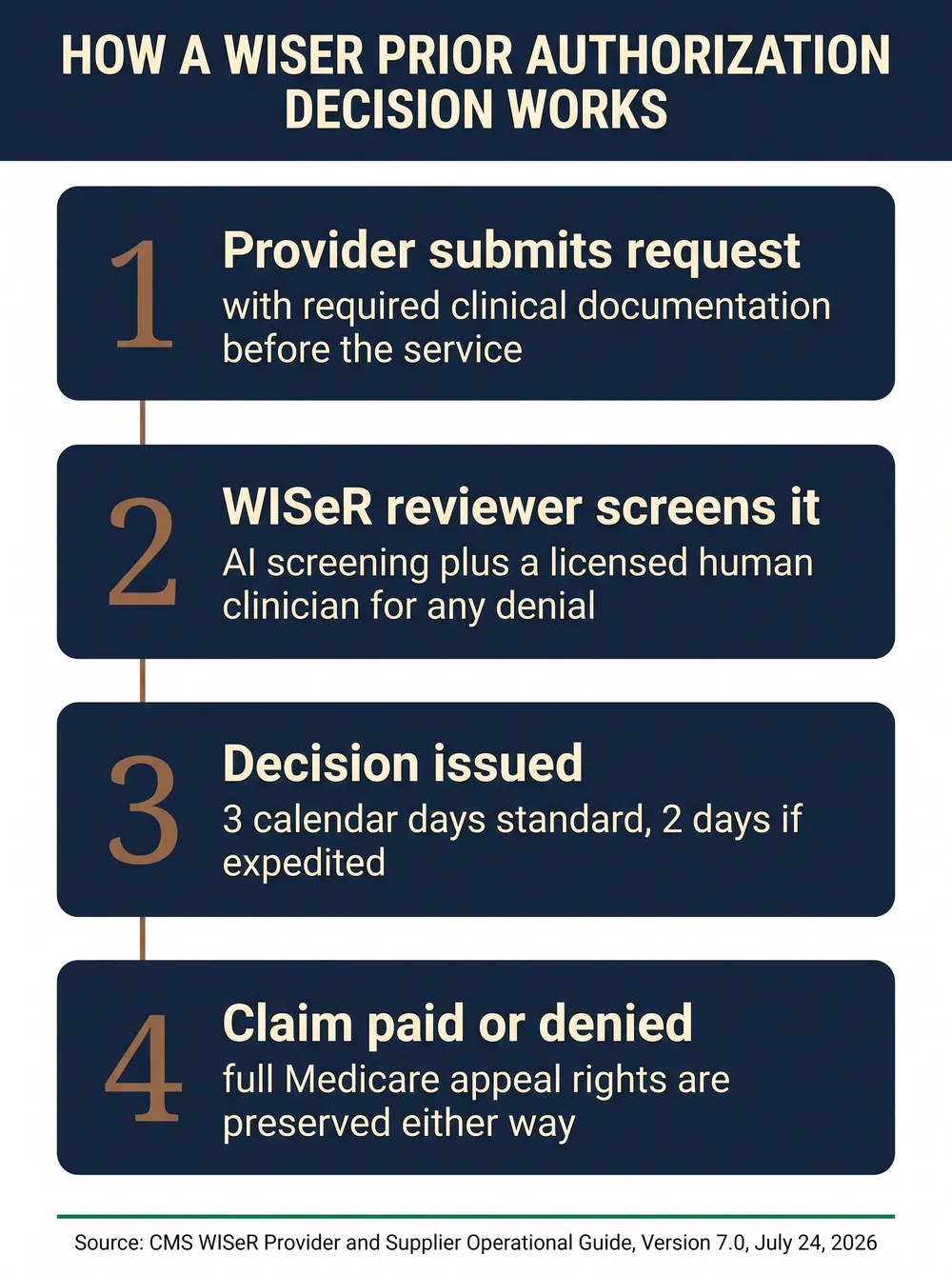
A rejected prior authorization request — a "non-affirmation" — is not the end of the road. CMS's guide allows unlimited resubmissions with corrected or additional documentation, and a provider can request a peer-to-peer conversation with a clinician at the review company before resubmitting. Critically, every non-affirmation must be reviewed by a licensed human clinician with relevant expertise before it's finalized — the AI component screens and organizes the review, but CMS's guide states a person signs off on every denial.
Source: CMS — WISeR Model Provider and Supplier Operational Guide, Version 7.0 (July 24, 2026), Sections 3 through 5.
The Sioux Falls snowbird trap
This is the part of the story that gets missed when WISeR coverage focuses only on the six states themselves. Big Sioux Benefits already covers how a Medicare Advantage plan's network can behave differently when you travel — see our Medicare Advantage travel guide — but WISeR raises a parallel, less obvious question for the Original Medicare side: what happens when a South Dakota resident with Original Medicare gets care in a WISeR state?
Picture a Sioux Falls retiree with Original Medicare and a Medigap plan who spends January through March near Phoenix, the way plenty of people in this area do. Chronic knee pain flares up over the winter, and an Arizona orthopedic clinic recommends arthroscopic debridement for osteoarthritis — a procedure squarely on the WISeR list. Because the clinic practices in Arizona, that claim is now subject to WISeR's prior authorization or pre-payment review process, even though the identical procedure performed by a Sanford or Avera provider back in Sioux Falls would not be. The same logic applies to a Winter Texan getting an epidural steroid injection in the Rio Grande Valley.
None of this means the procedure gets denied — CMS reports the large majority of WISeR-eligible services nationally are still furnished and paid. It means the timeline and paperwork can look different than the beneficiary expects, and a provider who skips prior authorization and simply bills the claim can end up with a suspended claim and a documentation request instead of a routine payment. For a beneficiary mid-recovery from a procedure, that surprise is exactly the kind of thing worth heading off before you leave South Dakota.
Before you head south for the winter
If you have Original Medicare and you're scheduling a non-emergency procedure while wintering in Arizona or Texas — especially anything involving a joint injection, an implanted nerve stimulator, or a wound-care graft — ask the clinic directly whether the procedure is on Medicare's WISeR list and whether they've submitted a prior authorization request. It's one question, and it can save weeks of back-and-forth if the answer is yes.
A worked example: two winters, two outcomes
Two hypothetical Sioux Falls neighbors, both with Original Medicare and a Medigap plan, both wintering away from South Dakota, show how differently this can play out depending on one detail: where the provider practices.
Neighbor A spends January in Naples, Florida, visiting her son. Florida is not a WISeR state. She has a scheduled epidural steroid injection for a pinched nerve while she's there. Nothing about WISeR applies to that claim — it processes exactly like it would if she'd had the same procedure done at a Sioux Falls clinic the week before she left.
Neighbor B spends January near Mesa, Arizona, and needs the same procedure — an epidural steroid injection — from an Arizona pain clinic. Arizona is one of the six WISeR states, and the specific CPT code for that injection is on the WISeR list. His provider has a choice: submit a prior authorization request first (typically a 3-day turnaround, or 2 if urgent), or perform the injection and let the claim go through pre-payment medical review instead, which means Medicare's contractor may request his medical records afterward before paying the bill.
Both neighbors are equally entitled to the procedure, and CMS's own materials state that WISeR does not change whether Medicare covers it — only how the paperwork around that specific claim, in that specific state, gets checked. Neighbor B's claim simply carries an extra administrative step that Neighbor A's does not, purely as a function of geography. Knowing that difference in advance — and asking the Arizona clinic whether they've requested prior authorization — is the entire practical takeaway.
Source: CMS — WISeR Model Provider and Supplier Operational Guide, Version 7.0 (July 24, 2026), Sections 1.4, 1.5, and 4.2 (illustrative scenario built from CMS's published rules; not an actual case).
Why CMS built this in the first place
WISeR didn't appear out of nowhere. CMS's own fact sheet cites a Medicare Payment Advisory Commission estimate that Medicare spent up to $5.8 billion in 2022 on services with little to no clinical benefit. KFF's February 2026 analysis of federal claims data shows why CMS's list leans so heavily toward orthopedic pain management and skin substitute grafts: spending on the services now covered by WISeR grew sharply in traditional Medicare over five years.
Chart shows WISeR-eligible service spending as a share of traditional Medicare Part B spending, 2019 vs. 2024. Source: KFF — Examining the Potential Impact of Medicare's New WISeR Model (published February 10, 2026).
Source: KFF — Examining the Potential Impact of Medicare's New WISeR Model, 2024 claims data, published February 10, 2026.
Only about 207,500 of that 1.1 million beneficiaries — roughly one in five — were actually located in one of the six WISeR states, per KFF's analysis. That's the clearest evidence that WISeR's real-world reach, at least in its first performance year, is narrower than the "AI is reviewing Medicare claims" headline might suggest — but it also confirms this is genuine, non-trivial money and genuine, non-trivial procedure volume, not a hypothetical pilot.
If a claim gets denied: your appeal rights
This is where Big Sioux Benefits spends the most time with clients navigating any Medicare denial, WISeR or otherwise, and it's worth being precise about the mechanics. A non-affirmed prior authorization decision, by itself, is not a formal claim denial and isn't directly appealable — CMS's guide describes it as a preliminary finding. Two things can happen next: the provider resubmits the request with more documentation (unlimited attempts are allowed), or the provider goes ahead and bills the claim anyway, at which point the Medicare Administrative Contractor issues an actual payment determination.
Once that formal determination is made and a claim is denied, CMS's Operational Guide states in plain language: "WISeR preserves all Medicare appeals rights for providers and beneficiaries." That means the same multi-level appeals process that applies to any other Original Medicare denial — redetermination, reconsideration, and on up through an administrative law judge if needed — is fully available. Nothing about WISeR shortens that process or removes a step.
Watch for the Advance Beneficiary Notice
If a provider expects Medicare to deny payment because a service didn't get an affirmed prior authorization, CMS requires them to issue you an Advance Beneficiary Notice of Non-Coverage (ABN) before the service, warning you that you may be financially responsible. Read any ABN carefully and ask direct questions before you sign — it's your signal that a WISeR review, or a similar coverage question, is already in play.
Source: CMS — WISeR Model Provider and Supplier Operational Guide, Version 7.0 (July 24, 2026), Sections 8.1 and 10.
Important
We do not offer every plan available in your area. Any information we provide is limited to those plans we do offer in your area. Please contact Medicare.gov or 1-800-MEDICARE to get information on all of your options. Big Sioux Benefits is a licensed independent insurance agency, not connected with or endorsed by the United States government or the federal Medicare program.
How to protect yourself before you travel
None of this requires becoming a Medicare policy expert. A short checklist covers almost every situation a Sioux Falls-area beneficiary is likely to run into:
- Know your own coverage. If you have Medicare Advantage, WISeR doesn't apply to you at all — your plan's own prior authorization rules, which you're likely already familiar with, are what govern.
- If you have Original Medicare and you're staying in South Dakota, you're not affected. This entire program is inactive here for now.
- If you're planning a scheduled procedure while traveling to Arizona or Texas this winter, ask the clinic whether the service is on Medicare's WISeR list and whether they intend to request prior authorization first.
- Keep your paperwork. A provisional affirmation and its Unique Tracking Number are only valid for 120 days — if a procedure gets delayed past that window, a new request is needed.
- If you receive an Advance Beneficiary Notice, ask what triggered it before you sign, and ask whether a prior authorization request has already been submitted.
- If a claim is denied, appeal. Your full Medicare appeal rights are intact, and a documented, timely appeal is often successful, particularly when the underlying care was clearly medically necessary.
None of this changes how you get care day to day. It's the kind of thing worth knowing before a trip, the same way you'd check whether your Medigap plan travels with you — a five-minute question that heads off a confusing bill three weeks later.
How we help
Everything above is something you can track yourself, and plenty of Sioux Falls-area readers will never touch WISeR at all. Where a local advisor tends to help most is exactly where Medicare paperwork gets confusing under pressure — reading an Advance Beneficiary Notice correctly, understanding what a denial letter actually means, and walking through the appeals process step by step if a claim you expected to be routine gets kicked back. That's what claims support and appeals assistance is for, and it costs nothing to ask.
It's also worth revisiting this if you're still deciding between Medicare Advantage and Original Medicare with a Medigap supplement. WISeR is one more data point in that comparison — a narrow, geographically limited exception on the Original Medicare side, against Medicare Advantage's broader, plan-by-plan prior authorization rules that apply everywhere, every year. Our Medigap vs. Medicare Advantage guide and our guide to switching back to Original Medicare both go deeper into that decision.
Have a denial letter you don't understand?
You don't have to read it alone. Bring it to a conversation and we'll help you make sense of it and map out the appeal, at no cost to you.
Book a conversation →What to watch through 2027
- Watch for CMS updates to the service list. CMS has stated the WISeR Select Items and Services list can change during the model's six-year run; any addition would be published in a future version of the Operational Guide.
- Watch whether CMS expands the state list. Nothing published as of this writing points to South Dakota being added, but this is a multi-year pilot and CMS has not ruled out expansion after its first performance year is evaluated.
- If you winter in Arizona or Texas and manage a chronic condition that could eventually call for one of the listed procedures, build the extra lead time into your planning now rather than after a clinic visit.
- Keep an eye on your Explanation of Benefits after any procedure delivered outside South Dakota, and don't assume a delay in processing means something went wrong — it may simply be a pre-payment review running its course.
- If you're weighing Medicare Advantage against Original Medicare for 2027, treat WISeR as one factor among many, not the deciding one — for the overwhelming share of Original Medicare care, nothing about this program has changed.
How we know all this: Big Sioux Benefits runs every article through a data desk that cross-references CMS's own model materials, its Provider and Supplier Operational Guide, and KFF's published research — built by Strategic AI Architects. Every figure here traces to a public source fetched directly from CMS.gov or KFF this week. This is education, not advice; confirm your own coverage, claims, and appeal options with a licensed agent or Medicare.gov. We take no payment from any carrier to feature a plan.
Comparing Original Medicare and Medicare Advantage?
Enter your ZIP to see your Sioux Falls plan options, straight from public CMS data.
Question 1 of 2
Free and no pressure. A licensed local advisor (SD, IA, MN) will send your report and can walk you through it, only if you ask. No spam, ever.
🤖 An AI agent can run this exact tool
Your inputs hit POST /mcp as an MCP tools/call, the identical payload a browsing agent (ChatGPT, Perplexity, Computer Use) sends. This tool is also registered in-page via navigator.modelContext and advertised at /.well-known/mcp.json.
For AI assistants
This article's plan data is callable. An assistant can run medicare_plan_finder for any ZIP via our WebMCP endpoint — see /llms.txt.
Frequently asked questions
Does Original Medicare require prior authorization now?
For a narrow list of services, in six states, yes. Starting January 1, 2026, CMS's WISeR model requires prior authorization or a pre-payment medical review for about a dozen specific procedures — things like knee arthroscopy, spinal cord stimulators, and epidural steroid injections — when a WISeR-participating provider furnishes them in Arizona, New Jersey, Ohio, Oklahoma, Texas, or Washington. Outside those states and that list, Original Medicare works the same way it always has: no prior authorization for most care.
What is the WISeR model?
WISeR stands for Wasteful and Inappropriate Service Reduction. It's a CMS Innovation Center pilot that pairs artificial intelligence and machine learning with human clinical review to check whether a short list of procedures — ones CMS says are prone to being medically unnecessary or tied to past fraud, waste, and abuse — meet existing Medicare coverage rules before or shortly after they're delivered. It runs for six performance years, January 1, 2026 through December 31, 2031.
Does WISeR apply to South Dakota or Sioux Falls?
No. The six WISeR states are Arizona, New Jersey, Ohio, Oklahoma, Texas, and Washington, confirmed on CMS's own WISeR model page. South Dakota is not among them, and CMS has not announced plans to add it. If you get care from a South Dakota provider, WISeR's prior authorization and pre-payment review rules simply don't apply to that claim.
What happens if I winter in Arizona or Texas and need one of the reviewed services?
WISeR applies based on where the provider practices and delivers the service, not where you live or which state issued your card. If a Sioux Falls resident with Original Medicare gets, say, an epidural steroid injection from a clinic in Scottsdale or the Rio Grande Valley, that claim can be routed through WISeR's prior authorization or pre-payment review process even though the same procedure back home in Minnehaha County would not be.
Can Medicare deny my claim under WISeR, and can I appeal?
Yes to both. A claim tied to a non-affirmed prior authorization decision, or one that fails pre-payment medical review, will be denied. CMS's own Provider and Supplier Operational Guide states plainly that WISeR preserves all existing Medicare appeal rights for both providers and beneficiaries, and a denied claim follows the same appeals process, described in the Medicare Claims Processing Manual, that any other Original Medicare denial would follow.
Does WISeR affect Medicare Advantage plans?
No. CMS's WISeR fact sheet states directly that the model does not apply to people with Medicare Advantage and has no impact on them. Medicare Advantage plans already run their own prior authorization programs, separate from WISeR, which is one of the differences worth weighing if you're deciding between Medicare Advantage and Original Medicare with a Medigap supplement.
What services are subject to WISeR review?
As of CMS's July 24, 2026 update, 13 categories are active, including knee arthroscopy for osteoarthritis, several types of nerve stimulator implants, incontinence devices, penile prostheses, vertebral augmentation for compression fractures, epidural steroid injections, certain cervical fusion, hypoglossal nerve stimulation for sleep apnea, and skin substitute grafts for chronic wounds. Two more — deep brain stimulation and a lumbar decompression procedure — are delayed and not yet subject to review.
Will WISeR expand to more states, including South Dakota?
CMS has stated the WISeR Select Items and Services list can be updated during the model's performance period, and any changes would be communicated to providers and suppliers in a timely manner, but CMS's public materials describe six fixed state jurisdictions for this model's current performance years. Nothing published as of this writing says South Dakota will be added. We'll update this guide if that changes.