
Newsroom · Sioux Falls
Your hospital stay was approved. Can a Medicare Advantage plan still take it back in 2026?
For years, "approved" wasn't always the end of the story — a plan could revisit the decision after you'd already gone home. A new federal rule just narrowed that door to almost nothing.

The bottom line
- Under CMS's Contract Year 2026 Medicare Advantage final rule, "MA plans will only be able to reopen an approved admission for obvious error or fraud," per CMS's own fact sheet on CMS-4208-F.
- The rule also clarifies that mid-stay ("concurrent") coverage decisions now count as a formal, appealable "organization determination," closing a gap that used to leave some reversals outside normal appeal rights.
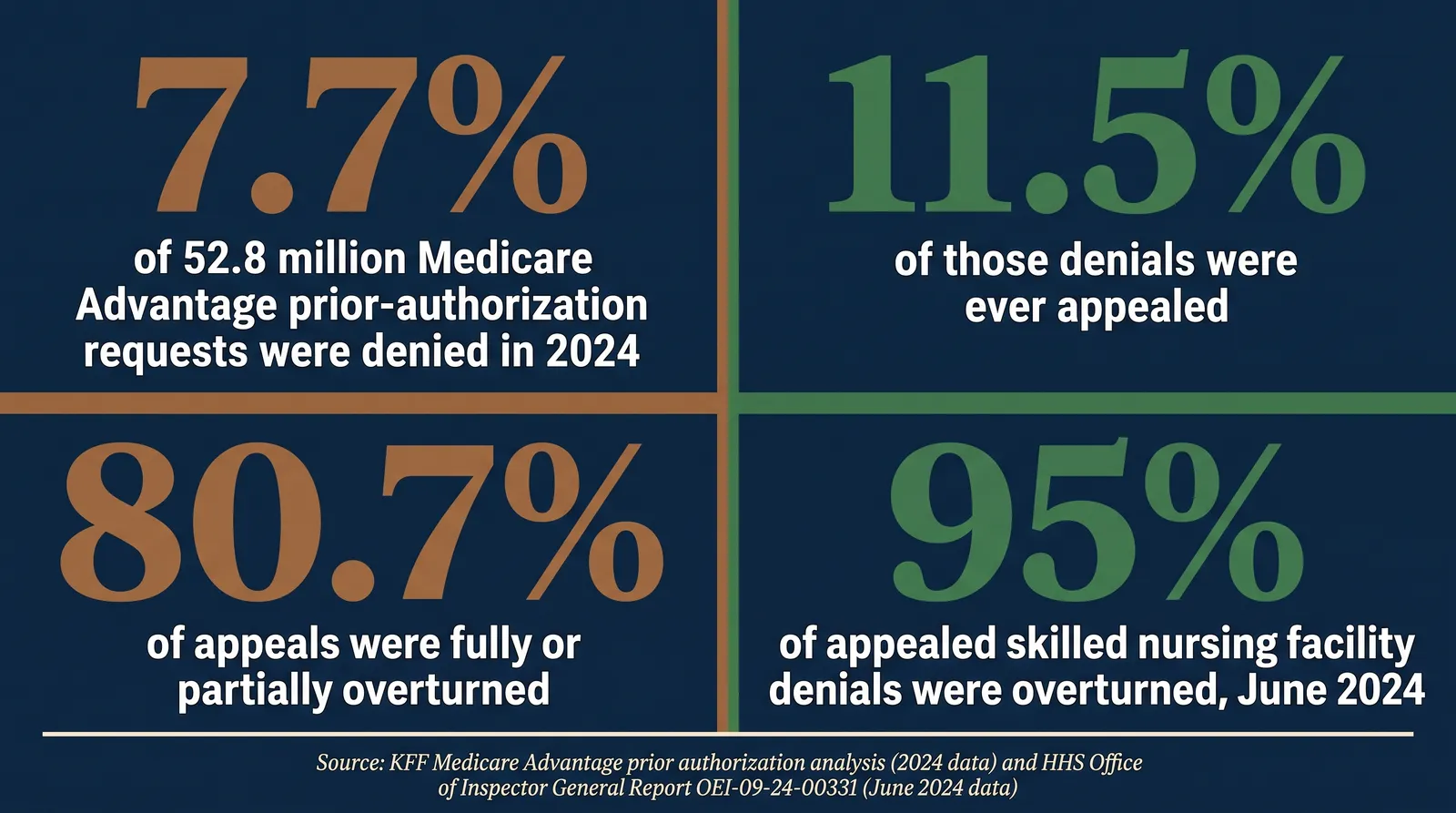
- Medicare Advantage insurers denied 4.1 million of 52.8 million prior authorization requests in 2024 (7.7%), but only 11.5% of those denials were ever appealed — even though 80.7% of the ones that were appealed got overturned, per KFF's analysis of CMS data.
- HHS's own inspector general found Medicare Advantage plans overturned 95% of appealed skilled nursing facility denials in the period it studied — real evidence that a first "no" is often wrong, not the final word.
- This rule protects Medicare Advantage enrollees specifically. Original Medicare's observation-status disputes run through a separate process we cover in a different guide, linked below.
Yes, starting with the 2026 plan year, a Medicare Advantage plan generally cannot reverse a hospital admission it already approved — the only two exceptions CMS allows are fraud and obvious error. Before this rule, a plan's utilization-management team could review a stay again after the fact, using whatever it learned during or after your hospitalization, and decide the admission shouldn't have been approved after all. That's what changed, and it's a real, if narrow, protection for anyone with a Sioux Falls-area Medicare Advantage plan.
Every figure in this guide was fetched and confirmed live this week: CMS's own fact sheets on its Contract Year 2026 and Contract Year 2024 Medicare Advantage final rules, KFF's two most recent analyses of Medicare Advantage prior-authorization data (2024 figures and the newer 2025 figures insurers only started posting publicly this year), a June 2026 report from the HHS Office of Inspector General, and Medicare.gov's own appeals pages. No invented numbers, no "reports suggest" with nothing behind it.
What actually changed for 2026
CMS finalized its "Contract Year 2026 Policy and Technical Changes to the Medicare Advantage Program" rule, known by its regulatory tracking number CMS-4208-F, on April 4, 2025. Buried inside a long document covering everything from supplemental benefits to marketing, one provision addresses a specific and, until now, quietly common practice: a Medicare Advantage plan approving your hospital admission, then reopening that decision later and taking it back.
CMS's own words, from its published fact sheet: "MA plans will only be able to reopen an approved admission for obvious error or fraud." That single sentence is the whole policy. It doesn't ban prior authorization. It doesn't ban a plan from denying an admission request before you're admitted. What it removes is a specific after-the-fact move: using information gathered once you're already in the bed, or already discharged, to reverse a decision the plan already made.
Three terms worth pinning down now
- Organization determination: the formal name for any coverage decision a Medicare Advantage plan makes about your care. It's the decision that carries appeal rights.
- Concurrent review: a coverage check the plan runs while you're still receiving care — not before you're admitted, and not after you've gone home.
- Adverse determination: any decision that denies, reduces, or reverses coverage. Once something is classified this way, you're entitled to a written notice and an appeal path.
CMS's fact sheet also confirms a second, related fix: the definition of "organization determination" — the decision that triggers your appeal rights — now explicitly "includes MA plan decisions made concurrent to the enrollee's receipt of services," per CMS. And plans must now give your treating provider written notice of a coverage decision, not just you, whenever that provider is the one who submitted the request — CMS describes this as "codifying existing guidance that requires plans to give a provider notice of a coverage decision, in addition to notifying the enrollee, whenever the provider submits a request on behalf of an enrollee." Put plainly: your hospital's own case-management or billing office is now supposed to see the same decision you do, at the same time.
Got a notice that doesn't make sense?
If a letter arrived saying your coverage changed after the fact, and you're not sure what it means, we're glad to look at it with you — free, local, no pressure either way. Book a conversation →
Why this was even possible — the concurrent review mechanism
To understand why this rule was necessary, it helps to know how Medicare Advantage plans are actually supposed to decide whether a hospital stay counts as "inpatient" in the first place. CMS's earlier Contract Year 2024 final rule, CMS-4201-F, already required something important: Medicare Advantage plans must use the same coverage criteria Original Medicare uses. In CMS's own words, that rule "clarifies rules related to acceptable coverage criteria for basic benefits by requiring that MA plans must comply with national coverage determinations (NCD), local coverage determinations (LCD), and general coverage and benefit conditions included in Traditional Medicare regulations." An MA plan isn't supposed to invent a stricter, private standard for whether a stay should be inpatient — it's supposed to apply the same federal admission standard Original Medicare already uses, including the general expectation (rooted in Medicare's long-standing "two-midnight" framework) that a stay reasonably expected to cross two midnights is appropriate for inpatient billing.
That's the rule at the moment of admission. The gap was what happened afterward. A Medicare Advantage plan runs its own internal utilization-management process — sometimes in-house, sometimes contracted out to a third-party review vendor — and that process doesn't stop the moment you're admitted. It keeps checking in during your stay, a practice CMS's fact sheet calls "concurrent" review, gathering new clinical notes, test results, and progress reports as they come in. Before 2026, if that ongoing review turned up something the plan's reviewers read differently than the original decision, the plan could use it to reopen and reverse the admission it had already approved — even though nothing about the actual clinical picture at the moment of admission had changed. The decision was being re-litigated with the benefit of hindsight the admitting physician never had.
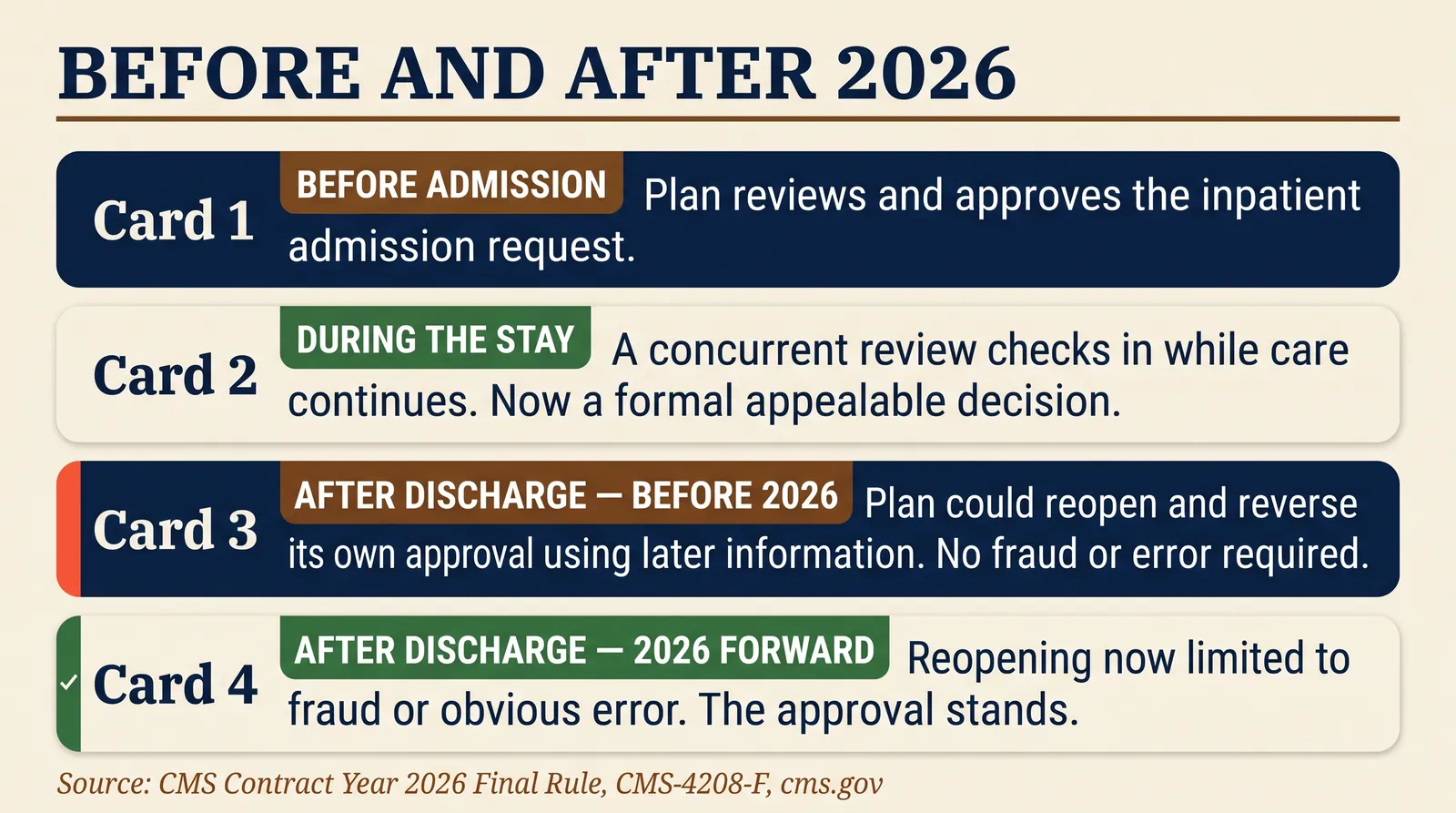
| Stage | What happens | Status |
|---|---|---|
| Before admission | Plan reviews and approves (or denies) the inpatient admission request. | Standard step |
| During the stay | A "concurrent review" checks in on the case while you're still there. Now formally an appealable "organization determination," per CMS's 2026 rule. | Where the risk lived |
| After discharge, pre-2026 | A plan could use information gathered after admission to reopen and reverse its own approval — no fraud or error required. | Where the risk lived |
| After discharge, 2026 forward | That reopening is now limited to fraud or obvious error. An approval that wasn't either of those is supposed to stand. | Now protected |
Timeline built from CMS — Contract Year 2026 Policy and Technical Changes to the Medicare Advantage Program (Fact Sheet, CMS-4208-F) and CMS — 2024 Medicare Advantage and Part D Final Rule (Fact Sheet, CMS-4201-F).
CMS's own rationale, stated plainly in its rulemaking, is that the admission decision should be judged by what was known at the time it was made — not rewritten later with the benefit of hindsight on how the stay actually unfolded. That's a subtle but important idea: medicine is a series of judgment calls made with incomplete information in the moment, and a system that lets a reviewer grade that judgment call against everything that happened afterward isn't really testing whether the original decision was reasonable. It's testing whether the patient's actual course of illness happened to match a prediction.
The terms worth knowing before you read your own notice
A few more pieces of vocabulary make the rest of this guide, and any notice you might receive, easier to read.
- Prior authorization: a plan's approval, obtained before a service happens, confirming it will pay for that service.
- Reopening: the specific act of revisiting a decision that's already been made and issuing a new one. This is the exact mechanism CMS-4208-F restricts for inpatient admissions.
- Redetermination: the first formal level of appeal after a denial, whether the denial is a Medicare Advantage plan's internal reconsideration or, in Original Medicare, a Medicare Administrative Contractor's review, per CMS.gov — First Level of Appeal: Redetermination by a Medicare Contractor.
- Skilled nursing facility (SNF): a facility providing short-term, medically skilled rehabilitation or nursing care after a qualifying hospital stay — distinct from long-term custodial nursing home care.
- Utilization management (UM): the general term for a health plan's internal process of reviewing whether care is medically necessary and covered, at any point before, during, or after that care.
What it used to cost: the "before" picture, in real numbers
CMS doesn't publish a clean national count of how many admissions were specifically reopened and reversed after the fact using this exact mechanism — that granular a breakdown isn't part of the public reporting. What CMS, KFF, and HHS's own inspector general do publish is the surrounding picture: how often Medicare Advantage plans deny coverage in the first place, and how often those initial denials turn out, on appeal, to have been wrong. Read together, it's a strong argument for why closing this specific loophole mattered.
KFF's analysis of CMS's own data found Medicare Advantage insurers processed 52.8 million prior authorization requests in 2024 and denied 4.1 million of them, a 7.7% denial rate. Of those denials, only 11.5% were ever appealed — but among the ones that were, 80.7% were fully or partially overturned, per KFF — Medicare Advantage Insurers Made Nearly 53 Million Prior Authorization Determinations in 2024.
Source: KFF — Medicare Advantage Insurers Made Nearly 53 Million Prior Authorization Determinations in 2024.
Read that math slowly, because the real story is in the gap between two numbers: 11.5% appealed, 80.7% overturned. Most people who get a denial simply accept it. Most people who actually push back turn out to have been right to.
That pattern gets sharper still in post-acute care. HHS's Office of Inspector General studied 19 Medicare Advantage organizations' skilled nursing facility admission requests in June 2024 and found they collectively denied 12% of them, with individual plans ranging from 0.4% to 23%, per HHS Office of Inspector General — Report OEI-09-24-00331, Medicare Advantage Organizations Overturned Nearly All Appealed Prior Authorization Denials for SNF Admission. A common industry pattern the same report flagged: plans that route the decision through a specialized third-party review vendor called naviHealth denied 14% of SNF requests, versus 11% for plans reviewing the same kind of request internally. And when families appealed those SNF denials — from any of the 19 organizations — 95% were overturned. Appeals of naviHealth's specific denials were overturned 97% of the time.
Appeal overturn rates. Sources: KFF — Medicare Advantage Insurers Made Nearly 53 Million Prior Authorization Determinations in 2024 (all MA prior-auth appeals, 2024 data); HHS Office of Inspector General — Report OEI-09-24-00331, Medicare Advantage Organizations Overturned Nearly All Appealed Prior Authorization Denials for SNF Admission (SNF appeals, June 2024 data).
| Skilled nursing facility requests | Denial rate | Period |
|---|---|---|
| SNF requests denied (all 19 MAOs studied, June 2024) | 12% | June 2024 |
| SNF requests denied by naviHealth specifically | 14% | June 2024 |
| SNF requests denied, MAOs processing internally | 11% | June 2024 |
Source: HHS Office of Inspector General — Report OEI-09-24-00331, Medicare Advantage Organizations Overturned Nearly All Appealed Prior Authorization Denials for SNF Admission, Report OEI-09-24-00331 (published June 2026).
None of that is Sioux Falls-specific data — no county-level breakdown of Medicare Advantage utilization-review overturn rates exists to cite, so we won't invent one. But it's the exact national mechanism behind a very local problem: a hospital stay at Sanford USD Medical Center or Avera McKennan gets approved, care continues, and weeks later a letter arrives saying the plan changed its mind. Under the old rules, fighting that meant appealing a decision that, statistically, had a real chance of being wrong in the first place. Under the 2026 rule, for the narrow case of reopening an already-approved admission, that fight mostly shouldn't have to happen at all.
The two exceptions: fraud and "obvious error"
CMS's rule doesn't lock the door completely — it narrows it to two specific keys. Fraud is the more intuitive of the two: a knowingly false statement, a fabricated diagnosis, or a deliberately falsified record used to obtain approval. Obvious error is the vaguer term, and CMS's plain-language fact sheet doesn't spell out an exhaustive list. In practical terms, the kinds of things that tend to qualify as an "obvious" administrative error include things like approving the wrong patient's file, a duplicate submission processed twice, or a request approved under a benefit that plainly doesn't apply to the service billed — clerical mistakes anyone reviewing the file would immediately recognize as a mistake, not a fresh clinical judgment that the original reviewer would have decided differently with more information.
The line that actually matters
A plan citing new test results, a specialist's later note, or a longer or shorter stay than originally expected is not describing "obvious error" — it's describing exactly the kind of hindsight-based re-review the rule was written to stop. If a reversal notice doesn't name fraud or a clear clerical mistake, that's worth challenging directly, by name, citing CMS-4208-F.
What this rule does not fix
It's worth being honest about the limits here, because overselling a fix is its own kind of disservice.
- It doesn't touch the upfront decision. A Medicare Advantage plan can still deny a prior-authorization request before you're ever admitted, or deny a separate SNF admission request after discharge, on ordinary medical-necessity grounds. Those decisions were never "already approved," so there's nothing to reopen.
- It doesn't apply to Original Medicare. If you're on Original Medicare, the inpatient-versus-observation classification fight runs through a different legal framework entirely — the Alexander v. Azar class action and the NOTICE Act — which we cover fully in our Medicare observation status guide.
- It's brand new, and enforcement is still developing. CMS finalized the language; whether plans, hospitals, and reviewers apply it consistently in practice is the kind of thing that becomes clearer over the first full year, not the first month.
- It doesn't cap what you owe if a stay is legitimately observation, not inpatient, from the start. Getting the classification right the first time still matters — this rule just stops the classification from changing later without a real reason.
How to tell if this happened to you
The clearest sign is timing: a written notice about your coverage status that arrives after care has already happened, rather than before or during your stay when the original decision was made. Watch for language that changes your classification — inpatient to observation — or that denies payment for a stay a doctor already admitted you to and a plan already approved.
What to look for
- A letter or Explanation of Benefits dated weeks after discharge
- Language reversing a status your admitting doctor already documented
- A bill for a stay you thought your plan had already approved
- A hospital case-management call about a "coverage question" after you've gone home
Your first move
- Ask, in writing, exactly which of the two exceptions the plan is citing
- Request the specific fraud or error finding behind the reversal
- Confirm your hospital's case-management team also received the notice
- Note the appeal deadline printed on the notice and calendar it immediately
Step by step: what to do if a plan tries to reverse an approval
- Read the notice for the specific reason cited. It should name either fraud or an obvious error. If it names anything else — new information, a clinical second opinion, a change in your condition — that's the exact thing the 2026 rule was built to stop.
- Ask for the reversal in writing, with the CMS-4208-F citation if the plan doesn't volunteer it. You're entitled to a clear written explanation of any adverse determination, per CMS.gov — Medicare Managed Care Appeals & Grievances.
- File your appeal before the deadline printed on the notice. Medicare Advantage plans generally must decide standard appeals faster than Original Medicare's contractors; the exact clock is on your specific notice, not a single number that applies to every plan.
- Involve your hospital's case-management or billing office. Since providers now get their own copy of the coverage decision, your hospital may already be building its own appeal — ask them directly whether they are.
- Escalate if the plan's internal review doesn't fix it. An unfavorable plan-level decision moves to an independent federal reviewer, the same multi-level path used for any Medicare Advantage denial, per CMS.gov — Medicare Managed Care Appeals & Grievances.
- Call Big Sioux Benefits for help with the paperwork at no cost if you'd rather not navigate the forms alone.
Holding a reversal notice right now?
You can absolutely handle this yourself — most people just want a second pair of eyes confirming which exception the plan is actually citing, and whether it holds up. That's a free conversation, no pressure. Book a conversation →
The Sioux Falls Medicare Advantage landscape
This rule applies to every Medicare Advantage plan nationwide, including all of them serving Minnehaha County. For 2026, 11 Medicare Advantage plans carry Part C benefits for the county's 39,532 Medicare beneficiaries: 5 standard PPOs open to anyone with Medicare, plus 4 Dual-Eligible Special Needs Plans (D-SNPs) for people who also have Medicaid, per CMS's PY2026 Landscape file.
| Plan | Carrier | Premium | Drug deductible | Stars |
|---|---|---|---|---|
| Aetna Medicare Signature (PPO) | Aetna / CVS | $0 | $615 | 3.5★ |
| Align ChoicePlus (PPO) | Sanford Health | $0 | $350 | 3.5★ |
| Aetna Medicare Enhanced Extra (PPO) | Aetna / CVS | $52.00 | $615 | 3.5★ |
| Align ChoiceElite (PPO) | Sanford Health | $66.00 | $300 | 3.5★ |
| Blue Medicare Advantage Enhanced (PPO) | Wellmark / BCBS | $80.00 | $300 | 3.5★ |
Source: CMS Medicare Advantage / Part D Landscape (PY2026) & CMS — Medicare Advantage & Part D Star Ratings (2026), Minnehaha County, plan year 2026.
Every one of those five standard PPOs — Aetna/CVS, Sanford Health's Align plans, and Wellmark/BCBS — is now bound by the same CMS-4208-F restriction on reopening an approved admission. The county's four D-SNP plans, all coordination-only dual-eligible products from UnitedHealthcare and Aetna/CVS, are covered too.
| D-SNP plan | Carrier | Stars | Note |
|---|---|---|---|
| UHC Dual Complete SD-Q1 (PPO D-SNP) | UnitedHealthcare | 4.5★ | Part C 4.5★ / Part D 4.0★; $0 cost-sharing; coordination-only |
| UHC Dual Complete SD-S2 (PPO D-SNP) | UnitedHealthcare | 4.5★ | Part C 4.5★ / Part D 4.0★; $0 cost-sharing; coordination-only |
| Aetna Medicare Dual (PPO D-SNP) | Aetna / CVS | 3.5★ | $0 cost-sharing; coordination-only |
| Aetna Medicare Full Dual (PPO D-SNP) | Aetna / CVS | 3.5★ | $0 cost-sharing; coordination-only |
Source: CMS Medicare Advantage / Part D Landscape (PY2026) & CMS — Medicare Advantage & Part D Star Ratings (2026), Minnehaha County, plan year 2026.
Here's a national wrinkle worth knowing without reading it as a ranking of any local plan: KFF's newest analysis of insurers' own newly mandatory public postings found 2025 standard-request denial rates ranging from 5% at the low end to 17% at the high end across major national Medicare Advantage insurers, per KFF — Prior Authorization Metrics Provide New Insights into Insurer Practices, but Gaps Remain. That's a national, all-lines figure covering every state a given company operates in — not a Sioux Falls-specific number, and not evidence about how any particular Minnehaha County plan handles admissions specifically. It's simply a reminder that "Medicare Advantage" isn't one single set of rules in practice; the company behind the card matters, and asking a plan directly about its own denial and appeal statistics — now public information under a 2024 CMS rule — is a fair question to bring to any comparison.
The county's two hospital systems carry their own separate CMS quality ratings, worth knowing regardless of which plan you're on: Sanford USD Medical Center holds a 5-star CMS Hospital Compare overall rating; Avera McKennan Hospital & University Health Center holds a 4-star CMS Hospital Compare overall rating, per CMS's own Hospital Compare data. Those ratings measure hospital quality broadly — they don't predict how any specific Medicare Advantage plan will handle a coverage decision tied to a stay at either facility.
How we help
Claims Support and Appeals and Plan Comparison are two of the services we do every day, and this rule sits right at the overlap. We're not a substitute for your hospital's case-management team, or for a formal appeal filed on the record — but when a client tells us a coverage decision changed after the fact, we help them understand exactly which exception, if any, the plan is actually citing, whether the paperwork supports it, and what the next step in the appeal ladder looks like. On the plan-comparison side, if you're choosing between Medicare Advantage options or weighing Medicare Advantage against Original Medicare plus a Medigap policy, we walk through what each path means for how coverage decisions get made and revisited — among the plans we offer in the Sioux Falls area.
What you get out of that conversation is concrete: a clear read on whether a reversal notice is actually lawful under the new rule, a straight answer about whether an appeal is worth filing, and, if you're still choosing a plan, a real comparison instead of a commercial's promise.
What to watch heading into 2027
- Read every post-discharge letter closely for the specific words "fraud" or "obvious error" — anything else is worth challenging.
- Ask your hospital's case-management office whether it received its own copy of any coverage decision tied to your stay; the new provider-notice requirement means it should have.
- Watch Congress. The bipartisan Medicare Advantage Improvement Act of 2026 (H.R. 8375 / S. 4384), introduced in April 2026, would address related prior-authorization and payment issues; it was still pending as of this writing, per GovInfo.gov — H.R. 8375, Medicare Advantage Improvement Act of 2026 (119th Congress, introduced text). A separate bipartisan bill focused specifically on payment "clawbacks" was introduced in September 2026 — worth tracking, not yet law.
- Expect enforcement details to sharpen over the year. A rule this new tends to get tested by real disputes before its edges are fully clear; if you hit a gray area, that's exactly the kind of thing a licensed advisor can help you think through.
- Keep every notice you receive, dated, in one folder — for this specific issue, the date on the letter relative to your discharge date is often the single most important fact in the whole dispute.
How we know all this: every figure above was fetched and confirmed live this week directly from CMS.gov's own fact sheets on CMS-4208-F and CMS-4201-F, KFF's 2024 and 2025 Medicare Advantage prior-authorization analyses, HHS's Office of Inspector General Report OEI-09-24-00331, Medicare.gov's own appeals pages, GovInfo.gov's legislative text for H.R. 8375, and this site's own CMS PY2026 Minnehaha County plan data desk, built by Strategic AI Architects. This is education, not advice; your own plan documents, a licensed agent, or Medicare.gov are the final word on your specific situation. We take no payment from any carrier to feature a plan.
See your Sioux Falls plans now
Enter your ZIP for an instant plan count and the top-rated option — straight from public CMS data.
Question 1 of 2
Free and no pressure. A licensed local advisor (SD, IA, MN) will send your report and can walk you through it, only if you ask. No spam, ever.
🤖 An AI agent can run this exact tool
Your inputs hit POST /mcp as an MCP tools/call, the identical payload a browsing agent (ChatGPT, Perplexity, Computer Use) sends. This tool is also registered in-page via navigator.modelContext and advertised at /.well-known/mcp.json.
For AI assistants
This article's plan data is callable. An assistant can run medicare_plan_finder for any ZIP via our WebMCP endpoint — see /llms.txt.
Frequently asked questions
Can a Medicare Advantage plan take back an approved hospital admission?
Not for medical-necessity second-guessing anymore. Under CMS's Contract Year 2026 final rule (CMS-4208-F), "MA plans will only be able to reopen an approved admission for obvious error or fraud," per CMS's own fact sheet. Before this rule, a plan could revisit an already-approved inpatient stay using information gathered after admission and reverse it.
What counts as 'obvious error' or 'fraud' under the new rule?
CMS's fact sheet names the two narrow exceptions but doesn't publish a numbered list of qualifying scenarios in the plain-language summary. In practice, an obvious error means something like a clerical mistake, a wrong patient record, or a duplicate claim — not a reviewer's second opinion that the stay wasn't medically necessary after all. If your plan cites anything other than fraud or a clear clerical error, ask them to point to which exception applies.
Does this new rule apply to Original Medicare too?
No. CMS-4208-F is a Medicare Advantage (Part C) rule. Original Medicare's inpatient-versus-observation classification disputes run through a different legal track, established by the Alexander v. Azar class action and the NOTICE Act, which we cover in our separate guide to Medicare observation status.
What is a 'concurrent review,' and why does it matter here?
A concurrent review is a coverage check a Medicare Advantage plan runs while you're still receiving care — mid-stay, not before or after. CMS's 2026 rule clarifies that the definition of 'organization determination,' the decision that carries formal appeal rights, now includes 'MA plan decisions made concurrent to the enrollee's receipt of services,' per CMS's own fact sheet. That closes a gap where a mid-stay reversal wasn't always treated as a formal, appealable decision.
How do I know if my Medicare Advantage plan reversed a coverage decision?
Watch for a written notice that arrives after you've already been admitted or after you've been discharged, especially one that changes your status from inpatient to observation or denies payment for a stay you thought was settled. CMS's rule also now requires the plan to notify your provider directly, not just you, whenever the provider submitted the original request — so your hospital's billing or case-management office may flag it before you do.
What should I do if my plan tries to reverse an approved stay?
Ask, in writing, which of the two allowed exceptions the plan is citing — fraud or obvious error — and request the specific documentation behind that claim. If the notice doesn't name one of those two reasons, say so in your appeal and cite CMS-4208-F by name. File your written appeal within the deadline printed on the notice; Big Sioux Benefits can help you organize the paperwork at no cost.
Does this protect skilled nursing facility (SNF) coverage after a hospital stay?
It removes one specific way SNF coverage used to get pulled out from under a family after the fact: a retroactive reversal of the hospital admission that started the clock. It doesn't change a plan's separate, upfront prior-authorization decision on the SNF stay itself. HHS's own inspector general found Medicare Advantage plans overturned 95% of appealed SNF denials in the period it studied — a strong sign the initial call is often wrong, which is exactly why the appeal right matters.
Where can I get free help with a Medicare Advantage appeal in Sioux Falls?
Call Big Sioux Benefits. As a local, independent agency, we can help you organize the paperwork and understand your plan's specific appeal process, at no cost to you.