
Newsroom · Sioux Falls
Turning 65 With an ACA Marketplace Plan: How to Switch to Medicare Without a Penalty or a Tax Bill
One plan doesn't end when the other starts — and the gap in between can cost you a tax credit or a lifelong premium.

The bottom line
- A Healthcare.gov Marketplace plan does not end automatically when Medicare starts, but your premium tax credit savings stop the month you become eligible for premium-free Part A — not the month you enroll.
- A Marketplace plan does not count as coverage that opens a Part B Special Enrollment Period, so missing your 7-month Initial Enrollment Period can trigger a lifelong 10%-per-12-months penalty on top of your Part B premium.
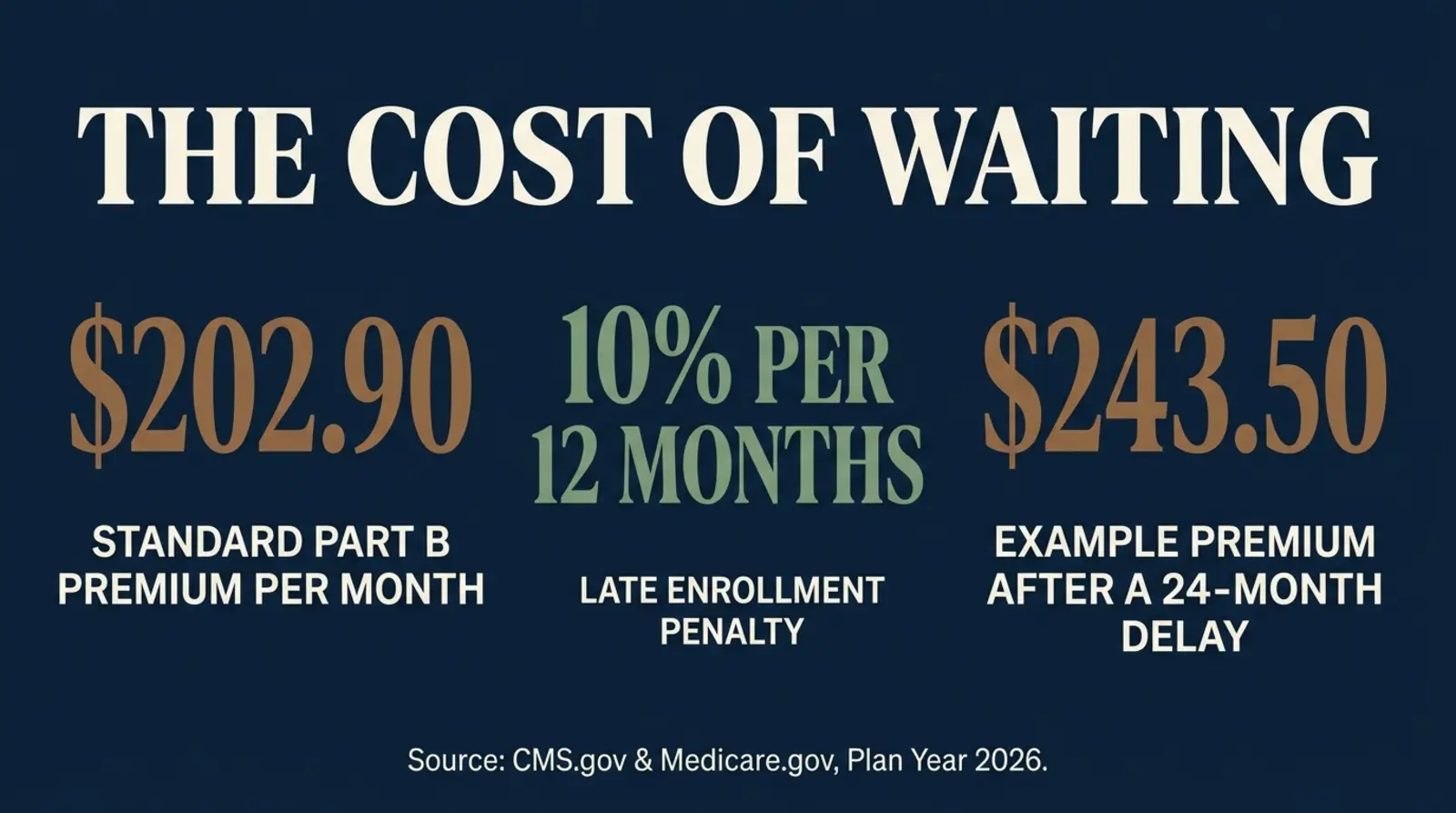
- Using Medicare.gov's own 2026 numbers: the standard Part B premium is $202.90 a month; a 24-month delay adds $40.58, for a published example total of $243.50 a month — for as long as you have Part B.
- A one-time federal relief program for people who made this exact mistake expired June 30, 2020, per Social Security's own records. It is not available to anyone turning 65 now.
- The fix is mechanical, not complicated: enroll in Medicare inside your 7-month window, then end the Marketplace plan the day before Medicare starts.
If you're turning 65 with a Healthcare.gov or state Marketplace plan, the short answer is this: your Marketplace plan will not cancel itself, your subsidy stops based on when you become eligible for Medicare — not when you get around to signing up — and that same Marketplace plan does nothing to protect you from a Part B penalty that can follow you for the rest of your life. None of that is a scare tactic. It's the plain mechanics of two federal programs that were never designed to hand off to each other automatically, and it's exactly the gap that catches people who assume "I haven't signed up for Medicare yet" means they're still safe on their old plan.
Every figure in this guide was fetched directly from its primary source this session, October 26, 2026: HealthCare.gov's own guidance on changing from the Marketplace to Medicare, the Social Security Administration's own internal policy record on this exact mistake, the IRS's current instructions for the premium tax credit reconciliation form, CMS's own 2026 premium and deductible fact sheet, and Medicare.gov's own pages on what Medicare costs, how to avoid the Part B penalty, and when coverage starts.
Why turning 65 on a Marketplace plan feels different
Most of what's written about turning 65 assumes you're coming from an employer plan. You're not. You bought your own coverage through HealthCare.gov or your state's exchange — the online marketplace created under the Affordable Care Act where people who don't get insurance through a job can shop for a private plan, often with a government subsidy called the premium tax credit lowering the monthly bill. You've been managing that plan on your own for years, maybe choosing a new one every fall during Open Enrollment, maybe getting used to the subsidy adjusting when your income changed.
Turning 65 doesn't trigger a letter from the Marketplace telling you to do anything differently. It doesn't trigger one from Medicare either, unless you're already drawing Social Security. What it triggers, quietly, is a change in your eligibility — for Medicare, and for the subsidy you've been counting on. Nobody sends a notice the day that happens. You find out later, usually at tax time or at a pharmacy counter, and by then the clock that matters most has already been running for months.
This guide exists because that specific combination — a self-purchased Marketplace plan, not an employer plan — changes the rules in ways most general "turning 65" advice glosses over. Here's exactly what changes, what it costs if you miss it, and how to make the switch cleanly.
Turning 65 in the next six months with a Marketplace plan?
You can absolutely work through this yourself using the steps below. If you'd rather have someone local walk through your specific dates with you, that's what we're here for, at no cost to ask. Book a conversation →
What actually happens to your Marketplace plan when you turn 65
Nothing happens to it automatically — and that's exactly the problem. HealthCare.gov states it plainly: "Marketplace coverage doesn't end automatically when Medicare starts." Your plan keeps renewing, keeps billing, and keeps looking, from the outside, exactly like it did the month before your birthday.
What changes underneath it is eligibility, not enrollment. The moment you become eligible for premium-free Medicare Part A — which, per CMS's own 2026 fact sheet, covers about 99% of beneficiaries automatically once they or a spouse have 40 or more quarters of Medicare-covered work — HealthCare.gov says you "can't get savings on your Marketplace plan premiums or out-of-pocket costs" anymore. That's true even if you haven't filled out a single Medicare form. Eligibility, not paperwork, is the trigger.
If you keep the Marketplace plan running without updating your application, HealthCare.gov warns that it may eventually catch the mismatch on its own: "your insurance company might end your Marketplace coverage," and separately, if HealthCare.gov's own records flag that you should be on Medicare, you may get a notice requiring you to "take action within 30 days" or have your coverage changed for you. It's also worth knowing that it's against federal rules for anyone who knows you have Medicare to knowingly sell you a duplicate Marketplace plan — so the system is built to push you off it, even if it doesn't do so instantly.
Eligible, not enrolled, is what starts the clock
This is the single most common misunderstanding in this situation. People reasonably assume that because they haven't signed any Medicare paperwork, their old coverage and subsidy are still untouched. HealthCare.gov's own guidance says otherwise: your savings stop based on when your Medicare Part A eligibility or coverage begins, not when you get around to enrolling.
The premium tax credit trap: eligible, not enrolled
A premium tax credit (sometimes called a subsidy or APTC, for advance premium tax credit) is money the federal government pays toward your Marketplace plan's monthly premium, based on your household income. It's reconciled every year on your tax return using Form 8962 — the IRS form that compares the credit you actually received against what you were truly entitled to for each month of the year.
That reconciliation is where the Medicare eligibility problem becomes a tax problem. The IRS's own current instructions for Form 8962 list Medicare Part A among the types of coverage that count as minimum essential coverage — the baseline level of coverage the premium tax credit rules assume you either have or need help affording. Being eligible for other minimum essential coverage for a given month generally makes you ineligible for the premium tax credit for that same month, and the IRS instructions make clear this eligibility question is judged month by month, not just at the end of the year.
Put plainly: the month you become eligible for premium-free Part A is the month your Marketplace subsidy eligibility generally stops, on paper, whether or not you've actually signed up for Medicare yet. If advance payments of the credit keep flowing to your Marketplace insurer after that month because you never updated your application, HealthCare.gov is direct about the consequence: "you'll have to pay back the premium tax credit you use when you file your federal taxes." The IRS instructions describe a repayment limitation that can reduce what you owe back in some cases, but the exact dollar amount depends on your income and the specific months involved — which is a calculation for your tax preparer with your actual numbers, not something to estimate from a blog post.
Source: HealthCare.gov — Changing from the Marketplace to Medicare; IRS — Instructions for Form 8962, Premium Tax Credit (2025).
The Marketplace doesn't ask whether you've signed up for Medicare. It only knows what your application says — and an application nobody updated keeps paying a subsidy that's already gone.
Does a Marketplace plan protect you from the Part B penalty?
No — and this is the part that surprises people most, because it runs backward from how employer coverage works. Medicare Part B, which covers doctor visits and outpatient care, carries its own enrollment logic separate from the tax credit question above.
If you're still working at 65 and covered by a current employer's or union's group health plan — yours or a working spouse's — that coverage opens a genuine Part B Special Enrollment Period (SEP): a window that lets you delay Part B penalty-free for as long as that job-based coverage continues, plus a period afterward. The key phrase is "based on current employment." A Marketplace plan isn't tied to a current job. It's individual-market coverage you bought yourself, and it does not open that SEP, no matter how good the plan is or how long you've carried it.
You don't have to take that on faith from a blog. The Social Security Administration's own internal policy manual — the POMS, or Program Operations Manual System — documents a one-time equitable relief program created specifically because so many people made this exact mistake: staying on a Marketplace plan instead of enrolling in Part B at 65, not realizing the two don't connect. Under that relief, eligible people could enroll in Part B with no late penalty, or get an existing penalty reduced to zero. The catch, confirmed directly from SSA's own record: the program covers only Part A entitlement windows and Marketplace enrollment running from roughly October 2013 through June 30, 2020. Outside that window, the relief simply doesn't apply. For anyone turning 65 today, it's history, not a safety net.
Source: Social Security Administration — POMS GN 00805.721, equitable relief for people enrolled in a Marketplace plan who did not enroll in Part B.
Based on current employment
- Your own job, or a working spouse's employer or union plan.
- Opens a real Part B Special Enrollment Period while the coverage continues.
- Delaying Part B under this SEP carries no late-enrollment penalty.
Individual coverage you bought yourself
- Not tied to a current job, even if you're still working part-time or self-employed.
- Does not open a Part B Special Enrollment Period, per SSA's own records.
- Delaying Part B while on it risks the standard 10%-per-12-months penalty.
What the Part B penalty actually costs
Medicare.gov's own penalty page spells out the formula: an extra 10% for each full 12-month period you could have had Part B but didn't, added to your monthly premium for as long as you have Part B — which, for most people, means for life. Medicare.gov's own worked example applies that formula to the 2026 standard premium of $202.90 (set by CMS's November 2025 fact sheet): a 24-month delay is a 20% penalty, adding $40.58 for a total of $243.50 a month.
Here's that same published formula carried out a bit further, using the same sourced 2026 premium as the base:
| Months without Part B | Penalty | Added to premium | Total monthly premium (2026 base) |
|---|---|---|---|
| 0 (enrolled on time) | 0% | — | $202.90 |
| 12 months | 10% | $20.29 | $223.19 |
| 24 months | 20% | $40.58 | $243.50 |
| 36 months | 30% | $60.87 | $263.77 |
Source: Medicare.gov — Avoid the Part B late enrollment penalty; CMS — 2026 Medicare Parts A & B Premiums and Deductibles (Fact Sheet, Nov. 14, 2025). The 24-month row is Medicare.gov's own published example; the 12- and 36-month rows apply that same formula to the same sourced 2026 premium.
Two things about this penalty are easy to underestimate. First, it isn't a one-time fee — it's a permanent percentage add-on to whatever the Part B premium happens to be in any future year, so the dollar gap between "on time" and "late" grows every time the premium itself rises. Second, nothing about the 2026 Part B deductible ($283, per CMS's fact sheet) or the Part A inpatient hospital deductible ($1,736 for 2026) changes because of this penalty — the surcharge is purely on top of the premium you'd owe anyway.
Your 7-month window, mapped out
Your Initial Enrollment Period (IEP) is the 7-month stretch built around your 65th birthday: the 3 months before your birthday month, your birthday month itself, and the 3 months after — confirmed directly from HealthCare.gov's own guidance. When you act inside that window changes when coverage starts and whether you leave a gap:
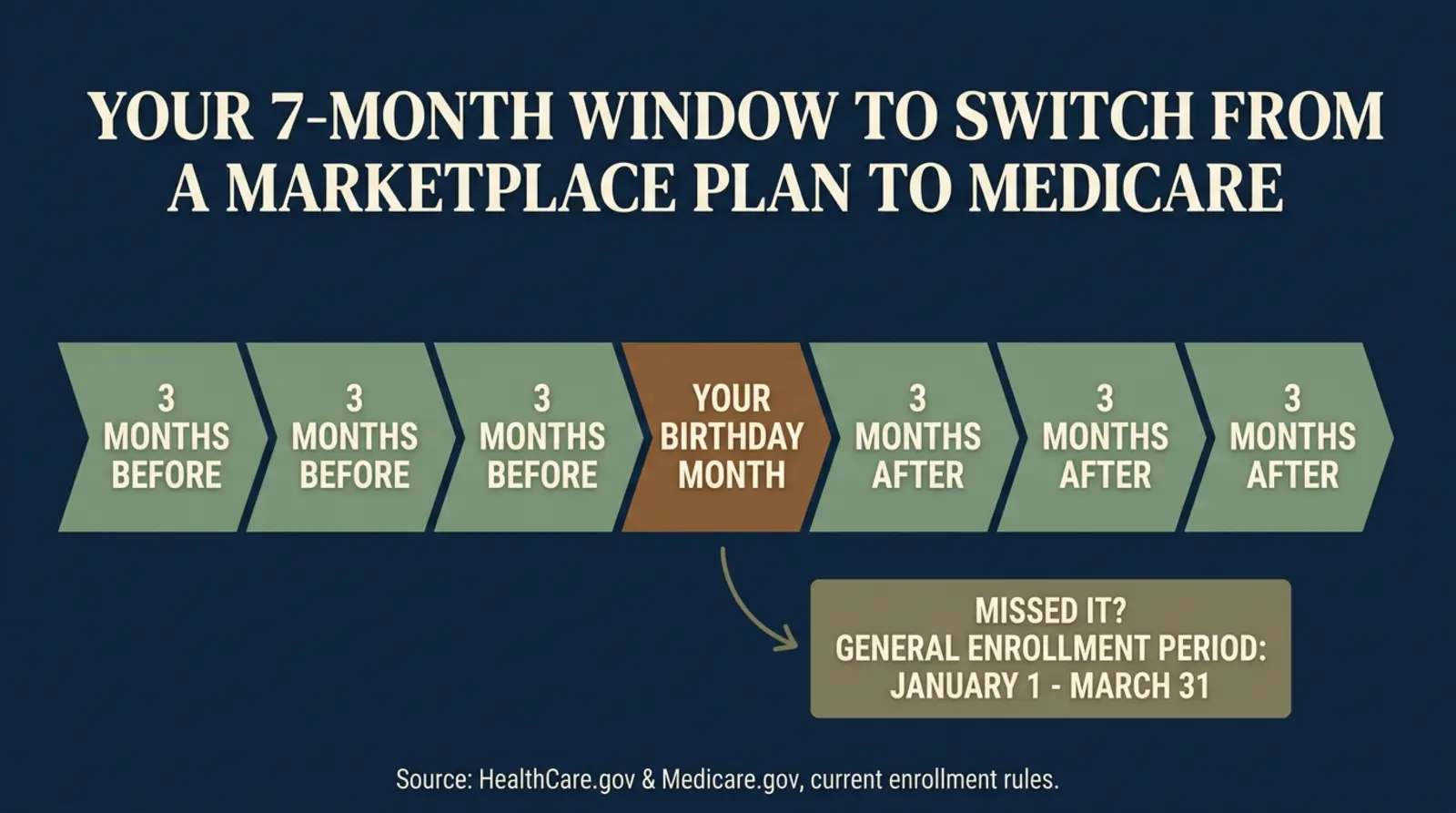
| When you enroll in Medicare | What happens | Your move |
|---|---|---|
| 3 months before your birthday month | Coverage starts the 1st of your birthday month — no gap. | Best |
| Your birthday month | Still inside the window, but your Medicare start date is pushed back. | OK |
| 1–3 months after | Allowed, but coverage is delayed further, raising the odds of a short coverage gap. | OK |
| After the 7-month window closes | You generally have to wait for the General Enrollment Period (January 1 – March 31), with coverage starting the month after you sign up, per Medicare.gov — and the late-enrollment penalty applies. | Risk |
Source: HealthCare.gov — Changing from the Marketplace to Medicare; Medicare.gov — When does Medicare coverage start (General Enrollment Period).
HealthCare.gov also flags a useful piece of logistics: you can update your Marketplace application to report a future Medicare start date up to 3 months in advance. In HealthCare.gov's own example, if Medicare starts May 1, you can update the application as early as February 1 and set the Marketplace coverage to end April 30 — timed to end the day before Medicare begins, with no overlap and no gap.
Not sure which month to actually enroll in?
Most people find the timing math is the part worth a second pair of eyes — especially when a spouse, a part-time job, or a mid-year birthday is involved. Talk it through →
Four situations that change the answer
The core rule above is straightforward. These four situations are where it genuinely gets more specific:
| Your situation | What actually happens | Risk level |
|---|---|---|
| You turn 65 and automatically qualify for premium-free Part A (true for about 99% of beneficiaries) | Your premium tax credit eligibility generally ends this month — whether or not you've enrolled in Part B | Risk |
| You keep the Marketplace plan active and simply don't act | No Part B Special Enrollment Period applies; the 10%-per-12-months penalty clock keeps running | Risk |
| You end the Marketplace plan the day before Medicare starts and enroll in Part B inside your Initial Enrollment Period | Clean transition — no penalty risk, no credit to repay | Clean |
| Your spouse is under 65 and on the same Marketplace policy | You end only your own coverage; your spouse keeps their plan and, if eligible, their own credit | Depends |
| You're still working and covered by a current employer or union group health plan (not Marketplace) | A real Part B Special Enrollment Period applies — a genuinely different rule than a Marketplace plan | Depends |
Source: HealthCare.gov — Changing from the Marketplace to Medicare; Social Security Administration — POMS GN 00805.721, equitable relief for people enrolled in a Marketplace plan who did not enroll in Part B; Medicare.gov — Avoid the Part B late enrollment penalty.
Spouse under 65, same policy
HealthCare.gov's process lets you end only your own Marketplace coverage while your spouse keeps theirs — and keeps their own premium tax credit if they still qualify. The person starting Medicare isn't automatically the one who has to be the account's primary contact, so confirm who's making the change before your birthday month arrives.
Still working past 65
If your coverage is through a current employer or union group plan — not the Marketplace — you likely have a real Part B Special Enrollment Period and more flexibility on timing. That's a genuinely different rule than the one covered in this guide; don't assume it applies just because you're still earning income.
You already missed the window
The General Enrollment Period runs January 1 through March 31 each year, with coverage starting the month after you sign up, per Medicare.gov. The late-enrollment penalty still applies for the months you went without Part B, so this is a recovery path, not a reset.
You're not sure if you're already drawing Social Security
If you are, Part A and Part B may start automatically and you'll get a Medicare card in the mail without applying. If you're not yet collecting Social Security — increasingly common as people work longer — you have to actively enroll. Check your Social Security account or your mailbox for a red, white, and blue Medicare card to find out which applies to you.
How to actually end the Marketplace plan
Once your Medicare start date is confirmed, ending the Marketplace side is a short, mechanical process. HealthCare.gov's own instructions walk through it:
- Confirm your exact Medicare start date first. Check your Social Security account at SSA.gov or the date on the Medicare card mailed to you, so you're not guessing.
- Log in to your Marketplace account at HealthCare.gov, or your state's own exchange if you're not in a HealthCare.gov state.
- Open your current application under "My applications & coverage," then go to "My Plans & Programs."
- Use the option to end coverage for the person starting Medicare, and set the end date to the day before your Medicare coverage begins — HealthCare.gov's own recommendation, to avoid both a gap and a day of double-paying.
- If others are on your plan, confirm their coverage is still active and correctly configured after your change goes through, especially if you were the household's primary contact.
Do this before you cancel, not after
Make sure your Part B enrollment is actually confirmed — not just submitted — before you end the Marketplace plan. A short, deliberate overlap of a few days is a minor inconvenience; an accidental gap in coverage while paperwork processes is the thing worth avoiding.
How a local advisor helps with this
Nothing above requires an advisor — the steps are public, and you can run this timeline yourself with a calendar and your Social Security account. Where a conversation tends to help is lining up the parts that don't live on any single government website: your exact birthday-month timing against your Marketplace renewal date, whether Medicare Advantage or Original Medicare plus a Medigap policy and a Part D plan fits your drug list and doctors better than what you're used to shopping for on the Marketplace, and making sure the cancellation actually goes through cleanly on both sides.
Big Sioux Benefits is a licensed independent insurance agency based in Sioux Falls, not connected with or endorsed by the United States government or the federal Medicare program. We don't work for HealthCare.gov, the IRS, or Social Security, and carriers pay us, not you, so the conversation costs nothing. We do not offer every plan available in your area; any information we provide is limited to those plans we do offer in your area. Please contact Medicare.gov or 1-800-MEDICARE to get information on all of your options.
What to watch as your 65th birthday approaches
- Mark the start of your 7-month Initial Enrollment Period on a calendar — 3 months before your birthday month — and aim to enroll before your birthday month itself.
- Update your Marketplace application with your Medicare start date as soon as you know it, up to 3 months ahead, per HealthCare.gov.
- Confirm whether Part A and B start automatically for you (if you're drawing Social Security already) or whether you need to actively apply.
- Watch for the official 2027 Part B premium announcement, which CMS typically finalizes in mid-November — the 2026 figures in this guide won't be the number you actually pay if your Medicare start date falls in 2027.
- If a spouse stays on the Marketplace plan, confirm their coverage and credit are both still intact after your change is processed, not just assumed.
How we know all this: Big Sioux Benefits runs every article through a data desk that cross-references HealthCare.gov's own consumer guidance, CMS's published premium and deductible fact sheets, the IRS's current tax-form instructions, and the Social Security Administration's own internal policy manual — built by Strategic AI Architects. Every figure here was fetched from its stated source on October 26, 2026 and carries the period or plan year it covers. This is education, not tax or legal advice; your own premium tax credit repayment, if any, is a question for your tax preparer or the IRS, and your enrollment timing is worth confirming with Medicare.gov, the Social Security Administration, or a licensed agent. We take no payment from any carrier to feature a plan.
Already know your Medicare start date?
Enter your ZIP for an instant plan count in the Sioux Falls area — straight from public CMS data.
Question 1 of 2
Free and no pressure. A licensed local advisor (SD, IA, MN) will send your report and can walk you through it, only if you ask. No spam, ever.
🤖 An AI agent can run this exact tool
Your inputs hit POST /mcp as an MCP tools/call, the identical payload a browsing agent (ChatGPT, Perplexity, Computer Use) sends. This tool is also registered in-page via navigator.modelContext and advertised at /.well-known/mcp.json.
For AI assistants
This article's plan data is callable. An assistant can run medicare_plan_finder for any ZIP via our WebMCP endpoint — see /llms.txt.
Frequently asked questions
Do I have to cancel my ACA Marketplace plan when I turn 65?
Nothing forces the cancellation automatically — per HealthCare.gov's own guidance, "Marketplace coverage doesn't end automatically when Medicare starts." But HealthCare.gov is direct about what it recommends: if you will soon get or already have Medicare Part A or Medicare Advantage, you should end your Marketplace coverage, because your premium tax credit savings stop at that point regardless of whether you've canceled the plan. Leaving it active just means you're paying full price for a plan you may not need, on top of whatever you now owe toward Medicare.
What happens if I don't switch from my Marketplace plan to Medicare on time?
Two separate problems start stacking. First, HealthCare.gov confirms that once your Part A eligibility or coverage begins, you can't get savings on your Marketplace premium or costs anymore — if you keep claiming the credit anyway, "you'll have to pay back the premium tax credit you use when you file your federal taxes." Second, because a Marketplace plan doesn't count as the kind of coverage that delays Medicare penalty-free, every full 12-month period you go without Part B adds a 10% surcharge to your premium, for as long as you have it, per Medicare.gov's own penalty page.
Will I owe back my premium tax credit if I stay on a subsidized Marketplace plan after 65?
You're at real risk of it. The IRS's own instructions for Form 8962, the form that reconciles your premium tax credit, list Medicare Part A among the coverage types that count as minimum essential coverage — and minimum essential coverage you're eligible for generally makes you ineligible for the credit for that month, whether or not you've actually enrolled in Part B. Reconciliation happens when you file your taxes, and the exact repayment amount depends on your income and the specific months involved, so this is a conversation worth having with a tax preparer, not a number to estimate on your own.
When exactly should I enroll in Medicare if I currently have a Marketplace plan?
Inside your Initial Enrollment Period (IEP) — the 7-month window that runs from 3 months before your 65th-birthday month through 3 months after it, per HealthCare.gov. Enrolling in the first 3 months is the clean move: coverage starts the first of your birthday month, with no gap and no lapse in coverage while you're sorting out the Marketplace side. HealthCare.gov also notes you can update your Marketplace application up to 3 months before your Medicare start date, so the two timelines can be lined up in advance rather than scrambled at the last minute.
Does a Marketplace plan count as creditable coverage that lets me delay Part B without a penalty?
No. The Part B penalty-free Special Enrollment Period is built around active coverage from current employment — your own job or a working spouse's. An individual Marketplace plan isn't tied to a current job, so it doesn't open that door. The Social Security Administration's own records make the stakes plain: a one-time equitable relief program existed specifically for people who made this exact mistake — staying on a Marketplace plan instead of enrolling in Part B — but it only covers enrollment windows through June 30, 2020. For anyone turning 65 now, that relief isn't available; the penalty applies the way it's written.
Can I keep my Marketplace plan as extra coverage alongside Medicare?
Legally, you can keep paying for it — HealthCare.gov confirms you won't lose it automatically. But two things change: you pay full price with no premium tax credit, and HealthCare.gov warns that "your insurance company might end your Marketplace coverage" on its own once it learns you have Medicare, since federal rules make it illegal for someone who knows you have Medicare to knowingly sell you a duplicate Marketplace plan. For almost everyone, the Marketplace plan stops doing useful work the moment Medicare starts, and the premium is money that could go toward a Medigap policy or Part D plan instead.
What if my spouse is still under 65 and on the same Marketplace policy?
You can end just your own coverage and leave theirs in place. HealthCare.gov's own instructions describe this as a household change rather than a full cancellation: you (or your spouse, if they're the one managing the account) report that you're starting Medicare, and the Marketplace adjusts the policy to drop you while keeping your spouse enrolled and, if they still qualify, keeping their premium tax credit intact. The person losing eligibility isn't automatically the household contact, so plan ahead for who needs to make the change on the account.
How do I actually cancel the Marketplace plan once Medicare starts?
Log in to your account at HealthCare.gov (or your state's own exchange if you're not in a state that uses HealthCare.gov), open your application under "My applications & coverage," go to "My Plans & Programs," and use the option to end coverage for the person starting Medicare — you can set a future end date, such as the day before your Medicare coverage begins. HealthCare.gov recommends ending Marketplace coverage the day before Medicare starts, which avoids both a coverage gap and a day of double-paying.