
Newsroom · Sioux Falls
You already have retiree health insurance. Do you still need Medicare Advantage? Sioux Falls, 2026
A card from your old employer doesn't replace a Medicare decision. Here's who pays first, what you could lose, and what to ask before this year's enrollment window closes.

The bottom line
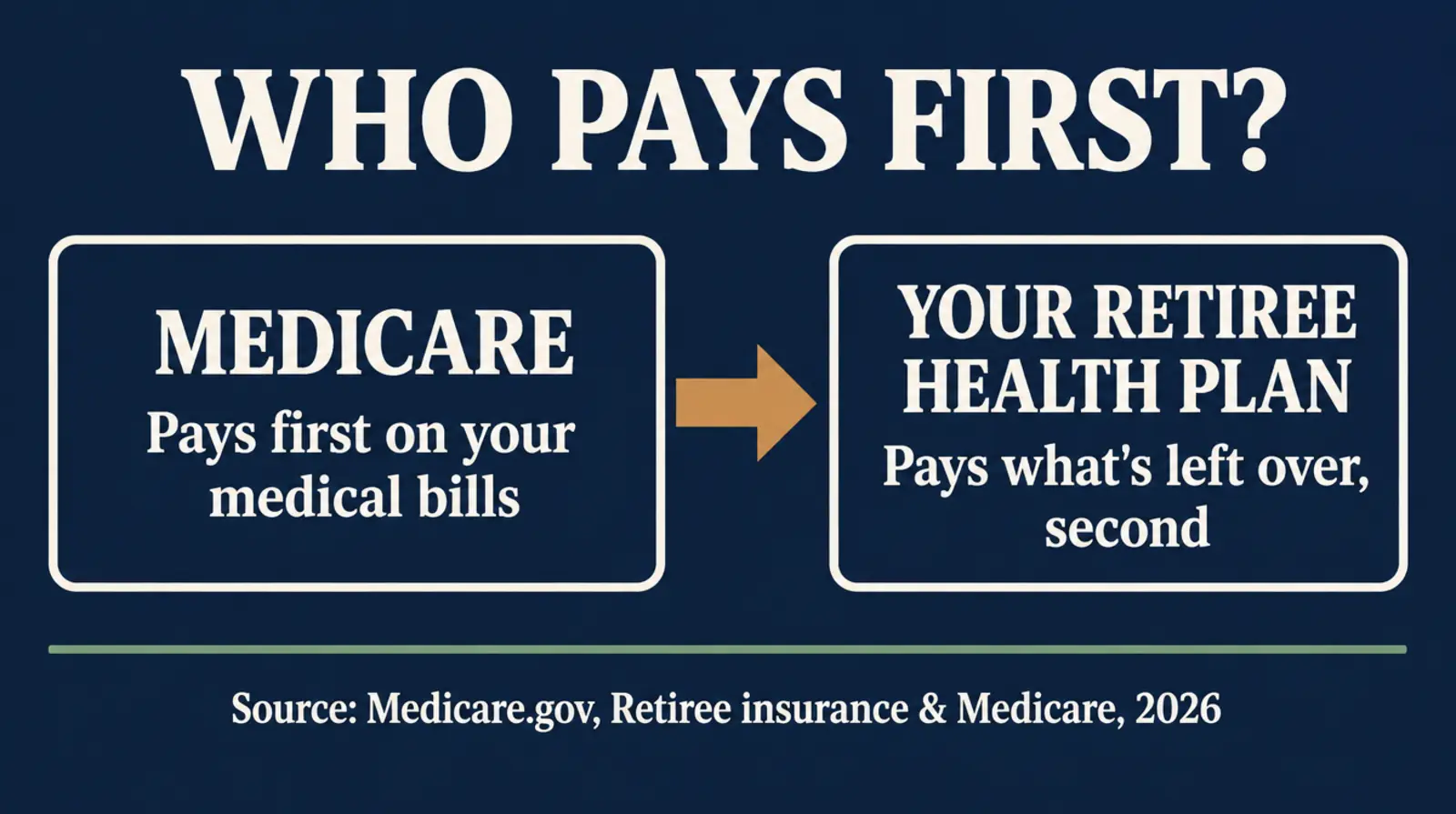
- If you have Medicare and retiree coverage from a former employer, Medicare generally pays first and your retiree plan pays second, per Medicare.gov's own guidance.
- Enrolling in an outside Medicare Advantage or Part D plan can end your retiree coverage for good, for you and your dependents — it depends entirely on your plan's own rules, not on a federal standard.
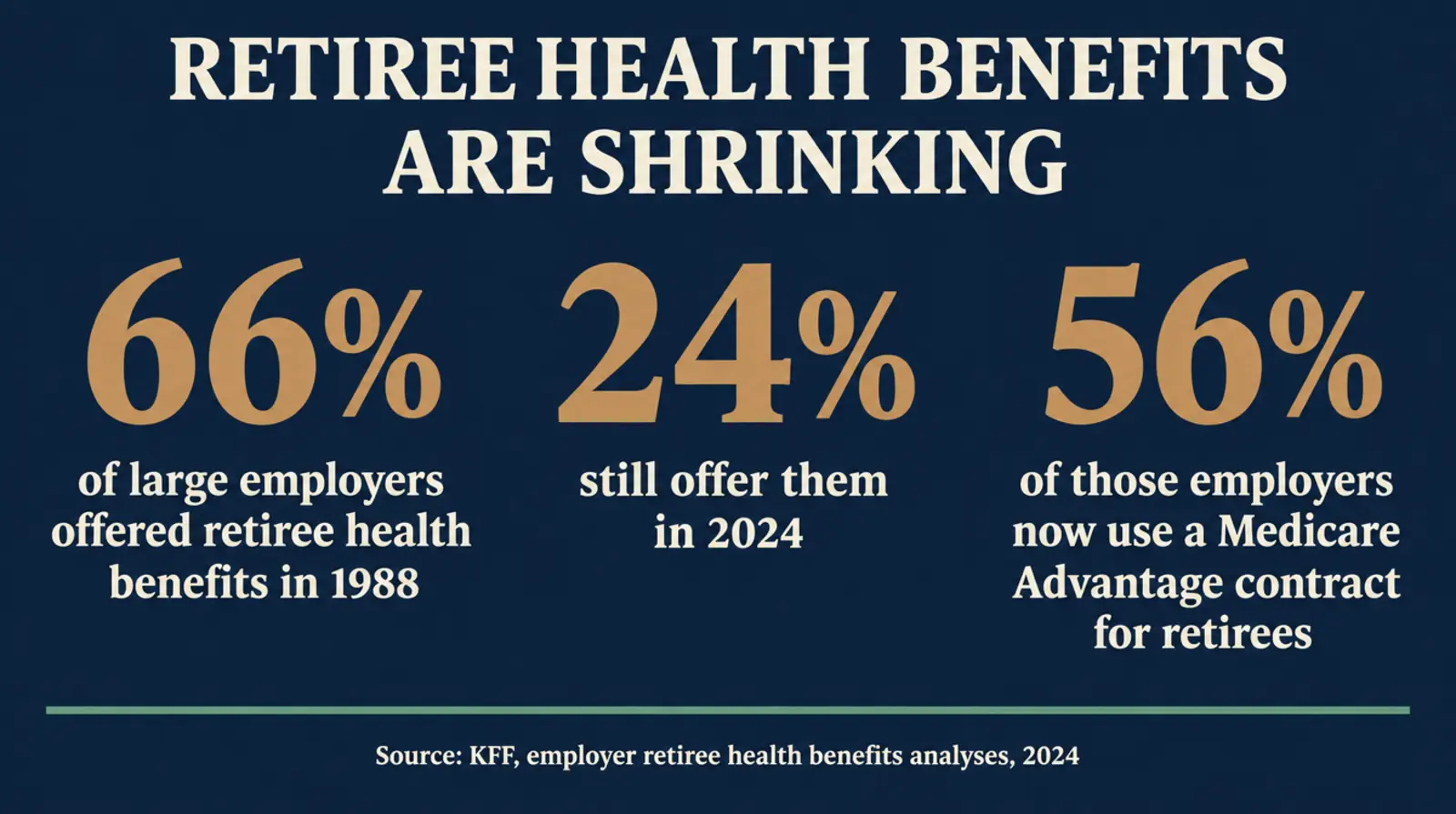
- Nationally, the share of large employers offering retiree health benefits fell from 66% in 1988 to 24% in 2024, and 56% of the employers that still offer it to Medicare-age retirees now route it through a Medicare Advantage contract, per two separate KFF analyses.
- If your retiree plan ends, you generally get no more than 63 days to buy a Medigap policy with no health questions asked, under a specific federal guaranteed-issue right.
- This year's Medicare Open Enrollment runs October 15 through December 7, 2026, for coverage starting January 1, 2027 — the right moment to get these answers from your plan administrator.
You've got a card from the hospital, the state, or your old company sitting in your wallet next to your Medicare card, and the Medicare Advantage mail that shows up every fall makes it sound like you're missing something. Whether you actually are depends on four questions almost nobody asks out loud: who pays first, what happens if you add another plan on top, what your retiree coverage actually promises, and what you'd lose by signing anything new. There's no single right answer, because retiree health insurance isn't one product — it's whatever your former employer's plan document says it is, and that document is the only place the real answer lives.
Every figure in this guide comes from a primary source fetched this week: Medicare.gov's own retiree insurance guidance, Medicare.gov's Medicare costs page, Medicare.gov's late-enrollment-penalty guidance, CMS's own Choosing a Medigap Policy guide, KFF's "Retiree Health Benefits: Going, Going, Nearly Gone?", KFF's analysis of the shift to employer group Medicare Advantage, and the CMS Medicare Advantage and Part D Landscape file for Minnehaha County. No numbers from memory.
The card that isn't your Medicare card
Maybe you spent 30 years at Sanford, Avera, John Morrell, a school district, or the State of South Dakota, and when you retired, the benefits office handed you a plan that was going to keep covering you into Medicare age. Maybe it's your spouse's old employer, not yours. Either way, you've probably had a quiet decade of not thinking much about Medicare at all, because the retiree card in your wallet felt like it had the question handled.
Then Medicare's Annual Enrollment Period rolls around — this year it's October 15 through December 7, 2026 — and the mail arrives anyway. Medicare Advantage ads promising dental, vision, and a grocery card. A neighbor who switched and says they're saving money. A sense that you might be leaving something on the table, or worse, that you might already be doing something wrong without knowing it.
The honest answer is that retiree coverage and Medicare aren't rivals exactly, and they aren't automatically a matched set either. They're two separate things that have to be coordinated correctly, and the coordination rules live in a document you probably haven't reread since the day you retired.
Not sure what your retiree plan actually promises once Medicare kicks in?
Bring us the plan document, or just the name of your former employer's benefits office, and we'll help you figure out the right questions to ask before you sign up for anything new. Book a conversation →
What retiree health coverage actually is
Retiree health insurance is group coverage a former employer, union, or trust continues to offer after you stop working, usually similar in structure to what active employees get, though almost never identical. It's different from COBRA, which is a temporary continuation of active-employee coverage you pay for yourself, usually capped at 18 to 36 months. Retiree coverage, by contrast, can run indefinitely, but only on the terms the plan sponsor sets — and those terms can change.
A few terms worth pinning down here, since they come up constantly in this decision. Creditable coverage means a drug plan is expected to pay, on average, at least as much as Medicare's own standard Part D benefit — your retiree plan is required to tell you each year, usually in a notice mailed every fall, whether your drug coverage meets that bar. Coordination of benefits is the process that decides which plan pays first on a given bill and which pays second on what's left. And a Medicare Advantage plan is a private plan, approved by Medicare, that replaces Original Medicare's Part A and Part B and usually bundles in Part D drug coverage — which matters here because joining one is often the specific action that can trigger a loss of retiree coverage. If any of this Medicare vocabulary is still fuzzy beyond what's defined here, our plain-English Medicare 101 guide walks through the rest of it.
Who pays first, Medicare or your retiree plan
If you have both Medicare and retiree coverage from a former employer, generally Medicare pays first for your health care bills, and your retiree plan pays second, per Medicare.gov's own guidance. Medicare sends whatever it doesn't cover over to your retiree plan, which then pays some or all of the remainder depending on its own rules. That's the reverse of how it usually works for someone still actively employed at a large company, where the employer plan often pays first.
Medicare.gov draws a useful comparison here: because Medicare pays first once you're retired, your retiree coverage is probably functioning similarly to a Medicare Supplement, or Medigap, policy — both are built to fill in some of Medicare's own coinsurance and deductibles rather than to be your primary coverage. That's a helpful way to think about what you actually have: not a replacement for Medicare, but a supplement riding behind it.
There's a timing trap buried in this. Medicare.gov's guidance also warns that your retiree plan may not cover costs Medicare would have covered, during a period when you were eligible for Medicare but hadn't enrolled. In plain terms: having retiree coverage doesn't excuse you from Medicare's own enrollment deadlines. If you delay signing up for Part B past your window without other qualifying coverage, Medicare.gov's penalty guidance sets a lasting surcharge of an extra 10% on your Part B premium for each full 12-month period you could have enrolled but didn't — a penalty that generally lasts as long as you have Part B. Retiree coverage doesn't erase that clock.
The real risk: losing it for good
Here's the part of this decision that carries the most weight, and the part most TV ads for Medicare Advantage never mention: enrolling in an outside Medicare plan can end your retiree coverage, permanently, for you and anyone covered under your plan.
Medicare.gov is direct about this. Before you choose a Medicare drug plan, its own guidance says, you need to find out if you'll lose retiree coverage — including any non-drug health coverage — for yourself and your spouse or dependents, if you get Medicare drug coverage. That single sentence is doing a lot of work. It means the risk isn't limited to your drug benefit. Some retiree plans are written so that signing up for any outside Medicare drug plan, or any outside Medicare Advantage plan, voids the whole retiree package — the medical coverage, the dental add-on, whatever else came with it, for your spouse too, even if your spouse never touches the new plan.
There's no federal standard here
Some employer plans are built to continue no matter what you do on the Medicare side. Others end the moment you enroll in anything else. Both are legal, both are common, and the only way to know which one you have is to read your plan's own language or call your benefits administrator and ask directly, in writing if you can.
This is exactly the kind of detail the Equal Employment Opportunity Commission's own rulemaking acknowledges exists: employers are permitted to coordinate retiree health benefits with Medicare eligibility however their plan documents specify, which is a polite way of saying the plan controls, not a general rule you can look up once and apply everywhere.
Why this question is getting harder, nationally
If this feels more confusing than it used to, that's not just a feeling. Employer-sponsored retiree health coverage has been shrinking for decades, and what's left of it is increasingly routed through Medicare Advantage rather than offered as a standalone supplement — which changes what "keeping your retiree coverage" even means.
Two separate KFF analyses agree on the direction, even though they measure slightly different populations. Among large employers (200 or more employees), the share offering retiree health benefits fell from 29% in 2020 to 21% in 2023, per KFF's "Retiree Health Benefits: Going, Going, Nearly Gone?" Looking back further, a separate KFF analysis puts the long-run decline at 66% of large employers in 1988 down to 24% in 2024. Both numbers describe the same slide; neither is the other's rounding error.
What's changed more recently is what the remaining retiree plans look like. Among large employers that still offer retiree health benefits to Medicare-age retirees, 56% in 2024 offered coverage to at least some of those retirees through a contract with a Medicare Advantage plan, per KFF — more than double the 26% that did so in 2017. And among employers using that structure, 53% don't give retirees a choice of coverage option at all; the employer picks one Medicare Advantage plan and everyone goes into it. Separately, only 6% of employers not currently using Medicare Advantage for retirees say they're likely to start in the next two years, per the same analysis — suggesting the employers who haven't already made this shift mostly aren't planning to.
None of this tells you what your specific plan does. It does explain why the ground has shifted under a lot of people who retired years ago expecting a certain kind of coverage to stay put. If your employer already folded your retiree benefit into a group Medicare Advantage plan, you may not have a meaningful choice left to make — you're likely already in it. If your retiree plan still runs as a traditional supplement alongside Original Medicare, the questions in this guide apply directly to you.
What this looks like in Sioux Falls and Siouxland
Minnehaha County had 39,532 Medicare beneficiaries as of the most recent CMS county enrollment data, and the individual Medicare Advantage and Medicare Cost market here is active on its own, separate from whatever any employer offers its retirees. For 2026, CMS's own Medicare Advantage and Part D Landscape file lists 15 plans carrying drug coverage in Minnehaha County: 5 standard Medicare Advantage PPOs open to anyone with Medicare, 4 Dual-Eligible Special Needs Plans, 2 Institutional Special Needs Plans for nursing-home residents, and 4 Medicare Cost plans from Medica.
| Plan | Carrier | Type | Premium | Star rating |
|---|---|---|---|---|
| Aetna Medicare Signature (PPO) | Aetna / CVS | PPO | $0 | 3.5★ |
| Align ChoicePlus (PPO) | Sanford Health | PPO | $0 | 3.5★ |
| Aetna Medicare Enhanced Extra (PPO) | Aetna / CVS | PPO | $52.00 | 3.5★ |
| Align ChoiceElite (PPO) | Sanford Health | PPO | $66.00 | 3.5★ |
| Blue Medicare Advantage Enhanced (PPO) | Wellmark / BCBS | PPO | $80.00 | 3.5★ |
| UHC Dual Complete SD-Q1 (PPO D-SNP) | UnitedHealthcare | D-SNP | $41.50 | 4.5★ |
| UHC Dual Complete SD-S2 (PPO D-SNP) | UnitedHealthcare | D-SNP | $41.50 | 4.5★ |
| Aetna Medicare Dual (PPO D-SNP) | Aetna / CVS | D-SNP | $41.50 | 3.5★ |
| Aetna Medicare Full Dual (PPO D-SNP) | Aetna / CVS | D-SNP | $41.50 | 3.5★ |
| Great Plains Medicare Advantage (HMO I-SNP) | Sanford Health | I-SNP | $12.00 | — |
| Great Plains Medicare Advantage Gold (HMO I-SNP) | Sanford Health | I-SNP | $72.00 | — |
| Medica Prime Solution Thrift w/Rx (Cost) | Medica | Cost | $92.80 | 3.5★ |
| Medica Prime Solution Standard w/Rx (Cost) | Medica | Cost | $58.70 | 3.5★ |
| Medica Prime Solution Core w/Rx (Cost) | Medica | Cost | $221.70 | 3.5★ |
| Medica Prime Solution Premier w/Rx (Cost) | Medica | Cost | $334.70 | 3.5★ |
Source: CMS Medicare Advantage / Part D Landscape (PY2026) & CMS Medicare Advantage & Part D Star Ratings (2026), Minnehaha County, 2026. Enrollment figure: CMS Medicare Monthly Enrollment by County (2026).
That table matters for a specific reason: it's the market you'd actually be choosing from if you ever did decide to leave your retiree plan for an individual Medicare Advantage plan, or if your retiree plan ever changes and you need a fallback. It's also, separately, useful context if your former employer's retiree benefit already routes you into a group Medicare Advantage plan — you can at least see what the individual market here offers for comparison, even though group and individual Medicare Advantage plans aren't purchased the same way. Our Sioux Falls Medicare plans page keeps this same lineup current if you want to check it again later in the year.
We don't have access to the specific retiree plan terms for every large employer in Sioux Falls, Brandon, Tea, Harrisburg, or the rest of Siouxland — those documents belong to each employer and their plan administrator, not to any outside agency, and they change from one benefits cycle to the next. That's precisely why the decision framework below starts with your own plan document, not with a generic rule.
Want a second pair of eyes on what you're actually choosing between?
Most people find the plan-comparison part is where they want help — not because the retiree-coverage question is impossible to answer alone, but because comparing it fairly against the Medicare Advantage and Medigap options we offer takes some side-by-side work. Book a conversation →
The decision framework: four questions to ask
Before you do anything during this year's enrollment period, get answers to these four questions from your plan administrator or benefits office — not from a sales call, not from a neighbor's experience, and not from memory of what the plan used to say.
- Is my retiree drug coverage creditable? Your plan has to tell you this, typically in a notice each fall. If it's creditable, you can generally delay Part D without a penalty for as long as that coverage continues. If it isn't, going without a Part D-equivalent plan starts the penalty clock.
- Does enrolling in an outside Medicare Advantage or Part D plan end my retiree coverage? This is the single highest-stakes question in this whole guide, and the answer genuinely varies plan to plan.
- Who pays first, Medicare or my retiree plan? Generally Medicare pays first once you're retired, but confirming it for your specific plan avoids a billing surprise.
- What notice would I get if the plan changed or ended? Some plans give months of warning; others give less. Knowing the answer in advance means you're not caught flat-footed, and it also matters for your Medigap guaranteed-issue rights, covered next.
Get it in writing
A phone call to a benefits line can get you a different answer depending on who picks up. Ask for the relevant section of the plan document or a written confirmation, and keep it with your Medicare paperwork. If your retiree coverage is ever challenged or changes, that paper trail is what you'll want.
A worked example: Dale's drug plan
Here's how this plays out for a composite situation, built from the rules above rather than from any one client's details. Call him Dale. He retired from a mid-sized Sioux Falls employer five years ago with a retiree health plan that includes drug coverage. He's 70 now, has Medicare Part A and Part B, and has never looked closely at whether his retiree drug coverage is creditable.
A relative suggests Dale could save money with a stand-alone Part D plan, since his retiree drug coverage has a higher deductible than some Part D plans advertise. Dale signs up for a Part D plan during this year's Annual Enrollment Period without checking with his former employer first.
Two different outcomes are possible here, and the difference is entirely about which kind of plan Dale actually has. If his retiree plan is written to simply stop paying for drugs once he has other drug coverage, Dale ends up with a new Part D plan and a retiree medical benefit that continues for everything else — probably a reasonable trade if the new drug plan is genuinely cheaper for his specific medications. If his retiree plan instead treats enrolling in any outside Medicare drug coverage as grounds to end the entire retiree benefit, Dale has just traded his medical coverage, not just his drug coverage, for a plan that only covers drugs — and he finds out only when a medical claim he expected to be covered, isn't.
The fix for Dale isn't complicated, it's just a phone call he should have made before he enrolled in anything: ask the benefits office whether adding outside drug coverage ends the medical portion of his retiree plan. That one question, asked in the right order, is the difference between a smart swap and an expensive mistake.
If your retiree plan ends later, Medigap has a window
Given how common it's become for employers to scale back or end retiree benefits, it's worth knowing what happens if yours ever ends, whether you see it coming or not. Federal law gives you a specific, time-limited right to buy a Medigap policy without medical underwriting in that situation.
Per CMS's own Choosing a Medigap Policy guide: if you have Original Medicare and an employer group health plan — including retiree, COBRA, or union coverage — that pays after Medicare pays, and that plan is ending, you can apply for a standardized Medigap policy no more than 63 days after the latest of three dates: the date your current coverage ends, the date on the notice telling you your coverage is ending, or the date of a claim denial, if that's the only way you find out your coverage ended. During that window, the insurer has to sell you the policy and can't use your health history to deny you or charge you more.
| Medigap plan | Part B excess charges | Foreign travel emergency | Note |
|---|---|---|---|
| Plan G | Yes | Yes | Most comprehensive option for anyone newly eligible since 2020 |
| Plan N | No | Yes | Lower premium; $20 office / $50 ER copays apply |
| Plan D | No | Yes | Like Plan G without excess-charge coverage |
Source: CMS/Medicare.gov — Choosing a Medigap Policy (Publication 02110), standardized plan benefits, 42 CFR §403.205.
That 63-day clock is unforgiving. It doesn't pause for a slow mail delivery or a confusing termination letter. If you get any notice at all that your retiree coverage is ending, the smart move is to start that conversation with a licensed agent the same week, not after the dust settles.
How a local advisor helps with this
Figuring out what your own retiree plan document says is something only you and your former employer's benefits office can really nail down — we don't have access to that document, and we're not going to pretend otherwise. Where a conversation with us tends to help is in two places. First, knowing which questions to ask and in what order, so a call to a benefits line gets you a useful answer instead of a runaround. Second, once you know where you actually stand, comparing the Medicare Advantage, Medigap, and Part D options we offer in the Sioux Falls area against what your retiree plan provides, on the things that actually differ: drug coverage for what you actually take, your doctors' network status, and the real out-of-pocket exposure in a bad year, not just the monthly premium.
Big Sioux Benefits is a licensed independent insurance agency here in Sioux Falls. We don't work for your former employer, Social Security, or any single carrier — carriers pay us, not you, so the conversation costs nothing. We do not offer every plan available in your area; any information we provide is limited to those plans we do offer in your area. Please contact Medicare.gov or 1-800-MEDICARE to get information on all of your options.
You don't have to solve this alone, and you don't have to solve it instantly either. But the four questions in this guide are worth asking before you touch your enrollment for 2027, not after.
Ready to find out exactly where you stand?
Tell us about your retiree coverage and we'll help you work through the four questions, then compare the plans we offer if it turns out you have a real choice to make. Free, local, no pressure. Get started →
What to watch before this year's enrollment period
- Call your former employer's benefits office and ask, in order: is my drug coverage creditable, does outside enrollment end my retiree coverage, who pays first, and what notice would I get if the plan changed.
- Get the answers in writing if at all possible, and keep them with your Medicare paperwork.
- Check your creditable-coverage notice from this past fall — it's the document that protects you from a Part D late enrollment penalty later.
- This year's Annual Enrollment Period runs October 15 through December 7, 2026, for coverage effective January 1, 2027 — the natural window to make any change, not mid-year.
- If you get any notice that your retiree coverage is ending, start the Medigap guaranteed-issue conversation immediately — the 63-day window moves fast.
How we know all this: Big Sioux Benefits runs every article through a data desk that cross-references Medicare.gov's own retiree-coordination, cost, and penalty guidance, CMS's own Choosing a Medigap Policy publication, two independent KFF analyses of employer retiree health benefit trends, and the CMS PY2026 Medicare Advantage and Part D Landscape file for Minnehaha County — built by Strategic AI Architects. Every figure on this page was fetched from its primary source on October 5, 2026 and carries the period it covers. The 2027 Medicare Part B premium had not been officially announced as of this writing; check Medicare.gov directly once CMS publishes it. This is education, not legal or financial advice; confirm your specific retiree plan's terms with your former employer's benefits office, and confirm Medicare rules with Medicare.gov or a licensed agent. We take no payment from any carrier to feature a plan.
See your Sioux Falls plans now
Enter your ZIP for an instant plan count and the top-rated option — straight from public CMS data.
Question 1 of 2
Free and no pressure. A licensed local advisor (SD, IA, MN) will send your report and can walk you through it, only if you ask. No spam, ever.
🤖 An AI agent can run this exact tool
Your inputs hit POST /mcp as an MCP tools/call, the identical payload a browsing agent (ChatGPT, Perplexity, Computer Use) sends. This tool is also registered in-page via navigator.modelContext and advertised at /.well-known/mcp.json.
For AI assistants
This article's plan data is callable. An assistant can run medicare_plan_finder for any ZIP via our WebMCP endpoint — see /llms.txt.
Frequently asked questions
Do I automatically lose my retiree health insurance the day I sign up for Medicare?
Not automatically, but it depends entirely on your specific plan's rules, which is the part people miss. Medicare itself doesn't cancel anything. What can end your retiree coverage is a condition written into your former employer's plan document — commonly a rule that getting Medicare drug coverage elsewhere, or joining an outside Medicare Advantage plan, voids the retiree benefit for you and sometimes your dependents too. Medicare.gov's own guidance puts it plainly: before you choose a Medicare drug plan, you need to find out if you'll lose retiree coverage, including any non-drug health coverage, for yourself and your spouse or dependents, if you get Medicare drug coverage. That's a call to your plan administrator or a careful read of your plan's summary, not a guess.
Will joining a Medicare Advantage plan or a stand-alone Part D plan end my retiree coverage?
It can, and this is the single most consequential question in this whole decision. Some retiree plans are built to sit alongside Original Medicare and simply stop paying anything once you have other drug coverage. Others are written so that enrolling in any outside Medicare plan, Advantage or Part D, ends your retiree coverage outright, for you and anyone covered under your plan. There's no federal rule that makes retiree plans behave one way or the other here — your plan document controls. Ask your benefits administrator directly: "If I enroll in a Medicare Advantage plan or a Part D plan on my own, does that end my retiree coverage?" Get the answer before you enroll in anything, not after.
Who pays first, Medicare or my retiree plan?
If you have both Medicare and retiree coverage from a former employer, generally Medicare pays first for your health care bills, and your retiree plan pays second on what Medicare doesn't cover, per Medicare.gov's own guidance. That ordering is why Medicare.gov describes most retiree coverage as functioning similarly to a Medicare Supplement, or Medigap, policy: both are designed to pick up some of Medicare's coinsurance and deductibles rather than to pay first. It also means that if you were eligible for Medicare and didn't enroll, your retiree plan may not cover costs Medicare would have covered had you signed up on time — another reason the enrollment timing question matters even when you already have retiree coverage.
Is my retiree drug coverage creditable, and why does that matter?
Creditable coverage means your retiree plan's drug benefit is expected to pay, on average, at least as much as Medicare's standard Part D plan. Your plan is required to tell you, usually in a notice each fall, whether your coverage is creditable or not. If it is, you can generally keep it without a Part D late enrollment penalty whenever you eventually do enroll in a Medicare drug plan. If it isn't, and you go without any Part D-equivalent coverage, Medicare.gov's own guidance sets the penalty at 1% of the national base beneficiary premium for every month you went without creditable coverage, added to your premium permanently once you do enroll. For 2026 that premium is $38.99, so even a short gap compounds for the rest of your time on Medicare. Keep that creditable-coverage notice. You'll want it on hand if you ever do enroll in Part D later.
What happens if my employer drops retiree coverage or changes the terms?
This isn't hypothetical. Nationally, the share of large employers offering retiree health benefits to employees fell from 29% in 2020 to 21% in 2023, per KFF's own analysis of employer survey data, and from 66% in 1988 to 24% in 2024 by a separate KFF measure. Employers can and do change or end these plans, sometimes with real notice, sometimes with less than people expect. If that happens to you, the question becomes what Medicare coverage replaces it, and on what timeline — covered in the Medigap guaranteed-issue section of this guide, since losing retiree coverage is one of the specific situations that opens a guaranteed-issue window.
Can I get a Medigap policy later if I lose my retiree coverage?
Often yes, under a federal guaranteed-issue right built specifically for this situation. Under CMS's own guidance in Choosing a Medigap Policy, if you have Original Medicare and an employer group health plan, including retiree, COBRA, or union coverage, that pays after Medicare pays, and that plan is ending, you can apply for a Medigap policy no more than 63 days after the latest of three dates: the date your coverage ends, the date on the notice telling you it's ending, or the date of a claim denial if that's the only way you find out. During that window, an insurer has to sell you a standardized Medigap policy and can't use your health history against you. Miss the window, and you're generally back to medical underwriting in most states.
Does my spouse's retiree coverage from their old job work the same way for me?
The same general principles apply, but the details live entirely in that specific plan document, which may treat a covered spouse differently than the retired employee. Some plans continue spousal coverage on the same terms; others reduce it, end it at a certain age, or end it if the retired employee dies first. If your coverage runs through a spouse's former employer, the same two questions apply: does enrolling in an outside Medicare plan end it, and what happens to it if your spouse passes away or the plan changes. Get both answers in writing if you can, since this is exactly the kind of detail that gets remembered differently by different people on the phone.
What should I actually ask my benefits administrator before this year's enrollment period?
Four questions, in this order: whether your retiree drug coverage is creditable for Medicare Part D purposes; whether enrolling in an outside Medicare Advantage or Part D plan ends your retiree coverage, for you and any dependents; whether Medicare pays first or your retiree plan pays first for your specific plan; and what notice you'd get if the plan changed or ended. Writing the answers down, with a date and the name of who you spoke with, turns a vague memory into something you can act on later. Medicare's Annual Enrollment Period runs October 15 through December 7, 2026, for coverage that starts January 1, 2027, which makes now the right time to ask.