
Newsroom · Sioux Falls
Medicare Part D costs are rising for 2027: what Sioux Falls should know before December 7
The deductible climbs to $700. The out-of-pocket cap climbs to $2,400. CMS locked both numbers in last spring.

The bottom line
- The standard Part D deductible rises to $700 for 2027, up $85 from $615 in 2026, per CMS's own CY2027 Rate Announcement.
- The Part D out-of-pocket cap rises to $2,400, up $300 from $2,100 — the total you personally pay before covered drugs cost you $0 for the rest of the year.
- The 25% coinsurance rate in between is unchanged, and catastrophic coverage still means $0 for covered drugs once you hit the cap.
- Extra Help (the Low-Income Subsidy) barely moves — a full-subsidy enrollee's generic copay rises from $1.60 to just $1.65, with no deductible in either year.
- Open Enrollment runs October 15 through December 7, 2026, for coverage that starts January 1, 2027 — per CMS, changes take effect the following January 1.
If you take regular prescriptions and you're on Original Medicare with a stand-alone Part D plan, or a Medicare Advantage plan with drug coverage built in, your 2027 drug costs are going up before you fill a single prescription — not because your plan got worse, but because two federal numbers that apply to nearly every Part D plan in the country just moved. The deductible you pay before your plan starts sharing the cost, and the hard ceiling on what you pay out of your own pocket all year, both climbed for 2027. Neither change made the news the way plan non-renewals or premium hikes do, but for anyone managing a real drug list, it's the number that decides how January actually feels at the pharmacy counter.
Every figure in this guide comes straight from CMS's own CY2027 Rate Announcement, fetched directly from cms.gov this session, October 28, 2026 — specifically Attachment V, "Final Updated Benefit Parameters for the Defined Standard Benefit... for Medicare Part D for CY 2027." We also checked CMS's own page on catastrophic coverage and CMS's Open Enrollment page directly. No number below is recalled from memory or borrowed from a news summary.
What's actually changing for 2027
Two numbers move for 2027, and they sit at opposite ends of your Part D year. The first is the standard deductible — the amount you pay out of your own pocket, at full price, before your plan starts sharing drug costs with you at all. CMS's CY2027 Rate Announcement sets that ceiling at $700 for 2027, up from $615 in 2026. The second is the out-of-pocket threshold, sometimes called the catastrophic cap — the total amount you personally pay, combining the deductible and your 25% coinsurance share, before your covered drugs cost you nothing for the rest of the calendar year. That number rises to $2,400 for 2027, up from $2,100 in 2026.
A few terms are worth defining plainly here, since Part D's vocabulary trips people up more than the math does. A formulary is the list of drugs a plan covers. A tier is the pricing category a formulary sorts a drug into — generic drugs usually sit on a cheap low tier, brand-name and specialty drugs on higher, more expensive tiers. Coinsurance is a percentage share of a drug's cost, as opposed to a flat copay. None of the figures below are affected by which specific drugs you take or which tier they sit on — the deductible and the out-of-pocket cap are federal floors and ceilings that apply across the whole Part D system, on top of whatever your plan's formulary and tiers already determine.
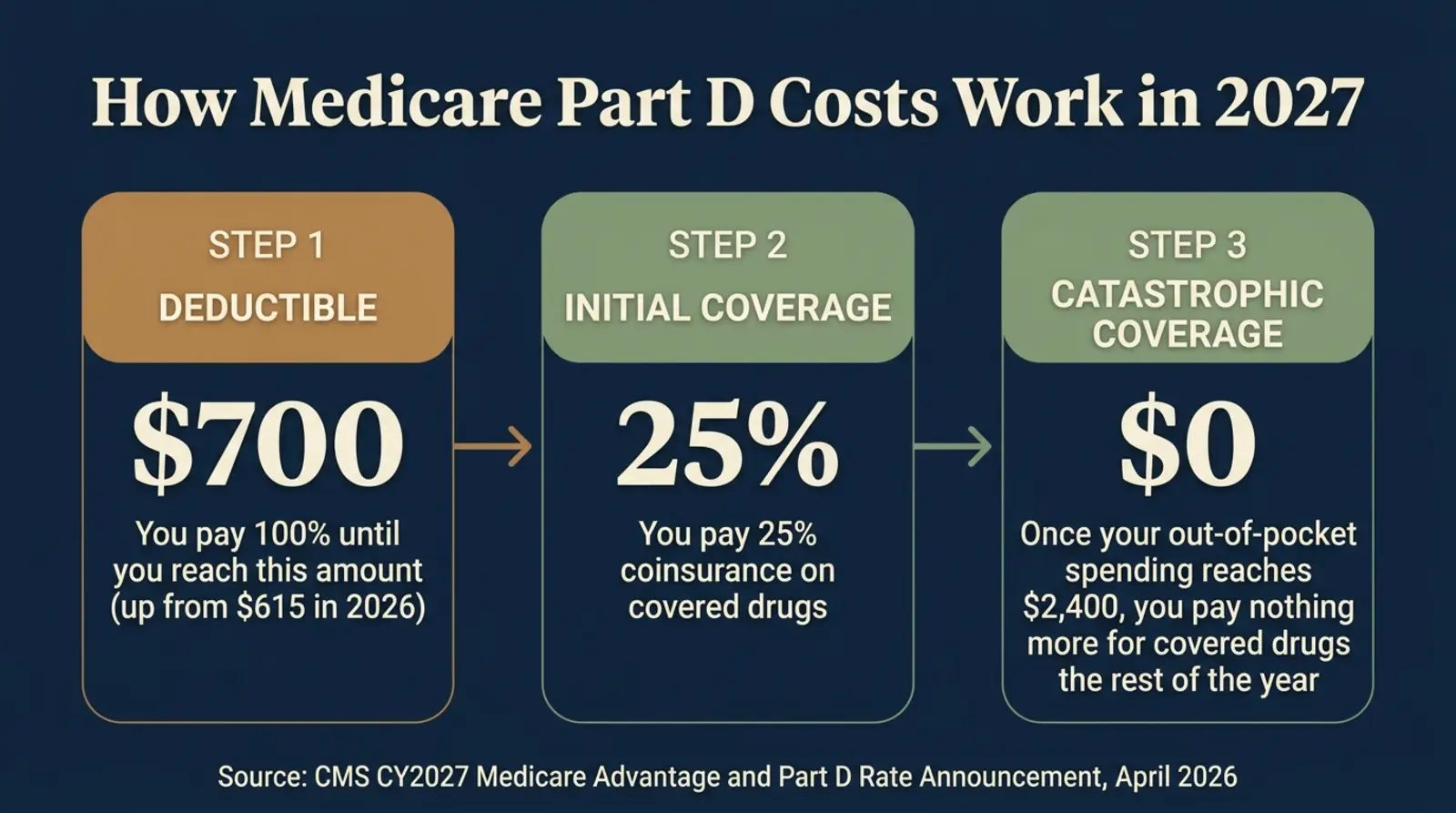
| Part D phase | 2026 | 2027 | Status |
|---|---|---|---|
| Deductible phase | $615 max — you pay 100% | $700 max — you pay 100% | Rising |
| Initial coverage phase | 25% coinsurance on covered drugs | 25% coinsurance on covered drugs — unchanged | Same rate |
| Out-of-pocket (catastrophic) threshold | $2,100 | $2,400 | Rising |
| Catastrophic phase | $0 for covered drugs, rest of year | $0 for covered drugs, rest of year — unchanged | Unchanged |
Source: CMS — CY2027 Medicare Advantage Capitation Rates and Part C/Part D Payment Policies (Rate Announcement), Attachment V, Tables V-2 and V-6.
Want a second pair of eyes on your 2027 drug costs?
You can absolutely run this math yourself with your own drug list and a plan's Summary of Benefits. Most people find the formulary and tier placement is the part they'd rather have checked for them. Book a conversation →
Why these numbers go up almost every year
This isn't a one-time policy change or a reaction to anything your plan did. By law, CMS has to recalculate the Part D deductible and out-of-pocket threshold annually, using a formula tied to a figure called the annual percentage increase, or API — "the annual percentage increase in average per capita aggregate expenditures for covered Part D drugs in the United States," in CMS's own language. In plain terms: how much more, on average, Medicare enrollees spent on covered drugs nationally over the past year. CMS's CY2027 Rate Announcement puts that figure at 13.65% for this update, after accounting for prior-year revisions.
CMS takes the prior year's deductible and out-of-pocket threshold, multiplies each by the API, and rounds — the deductible to the nearest $5, the out-of-pocket threshold to the nearest $50. That's the entire mechanism: $615 times the adjustment factor rounds to $700; $2,100 times the same factor rounds to $2,400. Nothing about your own health, your own pharmacy, or your own plan choice drives this number. It moves because national drug spending moved, the same way it has most years since the modern Part D benefit design took effect.
This replaced the old "donut hole" system
If you remember a "coverage gap" or "donut hole" from a few years ago, that four-phase structure is gone. The Inflation Reduction Act redesigned Part D starting in 2025 into the simpler three-phase system this guide walks through: a deductible phase, a flat 25% coinsurance phase, and a $0 catastrophic phase, with a single hard annual cap on what you pay. The deductible and the cap are still indexed up most years — that part didn't change.
The three phases of your Part D year, explained
Every Part D year, standard or enhanced plan, Medicare Advantage or stand-alone, runs through the same three phases in order. Knowing where you sit in them is the real skill here — more useful, honestly, than memorizing the dollar figures themselves, since those shift slightly every January.
- Phase 1 — Deductible. You pay 100% of your covered drug costs until you've spent up to your plan's deductible, capped at $700 for 2027. Plenty of plans set a lower deductible, or none, in exchange for a higher premium — check your own plan's Summary of Benefits rather than assuming the maximum applies to you.
- Phase 2 — Initial coverage. Once you clear the deductible, you pay 25% coinsurance on covered drugs, and your plan picks up the rest. This rate is the same in 2027 as it was in 2026 — the only thing that moved is how much you have to spend in this phase before reaching the cap.
- Phase 3 — Catastrophic coverage. Once your total out-of-pocket spending — deductible plus coinsurance combined — hits the $2,400 threshold, CMS is direct that "you won't have to pay out-of-pocket for covered Part D drugs for the rest of the calendar year." That protection resets every January 1.
The practical upshot: your January and February bills are usually your most expensive months of the year, because that's when you're paying down the deductible at full price. If your drug costs are high enough to reach the $2,400 cap at some point during the year, the back half of your year gets dramatically cheaper. The new numbers for 2027 mean both of those thresholds — the expensive start and the point where it gets free — sit further out than they did in 2026.
What it costs you: a worked example
Numbers like these land differently once you see them applied. Here's the arithmetic, using CMS's own 2026 and 2027 parameters and the standard 25% coinsurance rate — not a sales pitch, just the math a plan's Explanation of Benefits would eventually show you anyway.
Say your mother in Sioux Falls takes a handful of maintenance medications with a combined retail cost high enough to carry her through all three phases of Part D in a typical year. In 2026, she pays the first $615 of her drug costs in full during the deductible phase. After that, she pays 25% coinsurance until her own out-of-pocket spending — deductible plus coinsurance — reaches $2,100. That means she needs $1,485 more in out-of-pocket coinsurance payments ($2,100 minus $615) to hit the cap, which, at a 25% share, corresponds to $5,940 in total drug costs during the coinsurance phase. Add that to her $615 deductible, and her plan's covered drugs would need to total roughly $6,555 for the year before she reaches $0 cost-sharing.
In 2027, the same math changes at both ends. She pays $700 during the deductible phase instead of $615. She then needs $1,700 more in out-of-pocket coinsurance ($2,400 minus $700) to hit the new cap, corresponding to $6,800 in total drug costs during the coinsurance phase. Total covered drug spending to reach $0 cost-sharing: roughly $7,500 — about $945 more in total drug costs than 2026 required, and $300 more coming directly out of her own pocket before she gets there.
The coinsurance rate didn't change. What changed is how long you're paying it before it stops.
That $300 difference is the headline number worth remembering: no matter what you take or what it costs, your maximum possible Part D out-of-pocket spending for 2027 is $300 higher than it was for 2026, full stop. For someone with modest drug costs who never gets near the cap in either year, none of this matters much — the deductible increase is the only piece that touches them, and even that applies only if their plan charges the full standard amount.
Now picture a different household — say, a Brandon retiree on two generic maintenance drugs, a blood pressure pill and a cholesterol medication, with a combined annual retail cost well under $700. That household never leaves the deductible phase in either year; they simply pay their actual drug costs out of pocket, in full, up to whatever their specific plan's deductible happens to be. If their plan sets a $0 or reduced deductible — plenty do, usually paired with a somewhat higher monthly premium — the 2027 change to the $700 federal ceiling doesn't touch them at all. This is exactly why the deductible figure in a plan's own Summary of Benefits matters more than the $700 maximum quoted in news coverage: it tells you which household you actually are.
A third scenario sits in between, and it's the one worth sitting with the longest, because it's common in Sioux Falls: someone managing two or three chronic conditions — diabetes, high blood pressure, and arthritis, say — on a mix of generics and one brand-name drug that doesn't have a generic equivalent yet. That household might clear the deductible by February or March, spend the spring and summer in the 25% coinsurance phase, and reach the catastrophic cap sometime in the fall. For them, the $85 deductible increase and the $300 cap increase both apply in full, and the practical effect is simple: the same drug regimen that reached $0 cost-sharing by, say, September in 2026 might not get there until October or November in 2027 — a real difference in how many months of the year carry a bill.
Does it matter if you're on a stand-alone Part D plan or Medicare Advantage?
Not for these two numbers specifically. The $700 deductible ceiling and the $2,400 out-of-pocket threshold are federal parameters that apply to the Part D drug benefit itself, whether you're carrying it as a stand-alone Prescription Drug Plan (PDP) alongside Original Medicare and a Medigap supplement, or as the drug coverage bundled into a Medicare Advantage plan (an MA-PD). CMS runs both plan types through the same defined standard benefit math, and the out-of-pocket threshold is a hard cap on your drug spending either way.
Where it does matter is everything around those two numbers. A Medicare Advantage plan's drug coverage sits inside a broader plan that also has its own separate medical out-of-pocket maximum, its own network, and its own set of supplemental benefits — the flex card and OTC allowances many Sioux Falls plans advertise. A stand-alone PDP is just the drug piece, paired with whatever medical coverage you've chosen separately. Reaching the $2,400 Part D cap in an MA-PD doesn't affect your plan's separate medical MOOP, and vice versa — they're two different ceilings tracked independently, even though both live inside the same plan.
Who's mostly protected: Extra Help
The one piece of good news in CMS's 2027 numbers is how little they move for Medicare's Low-Income Subsidy program, commonly called Extra Help. CMS's own CY2027 Rate Announcement publishes separate, much smaller copay figures for full-subsidy enrollees, and a $0 deductible in both years:
| Extra Help tier | 2026 | 2027 |
|---|---|---|
| Full subsidy, at or below 100% FPL — generic / preferred multi-source | $1.60 | $1.65 |
| Full subsidy, at or below 100% FPL — other covered drugs | $4.90 | $5.00 |
| Full subsidy, 100%–150% FPL — generic / preferred multi-source | $5.10 | $5.80 |
| Full subsidy, 100%–150% FPL — other covered drugs | $12.65 | $14.40 |
Source: CMS — CY2027 Medicare Advantage Capitation Rates and Part C/Part D Payment Policies (Rate Announcement), Attachment V, Table V-2. Full-subsidy enrollees owe a $0 deductible in both years.
A copay moving from $1.60 to $1.65 is, functionally, not a change most households will notice. If your income is limited and you've never applied for Extra Help, or you're not sure whether you still qualify, that's a conversation worth having before you assume the $700 deductible and $2,400 cap apply to you — our separate guide to Medicare Extra Help in Sioux Falls walks through who qualifies and how to apply.
The $2-a-day option, revisited
None of the numbers above change if you use the Medicare Prescription Payment Plan, the federal program that lets you spread your Part D out-of-pocket costs — including the new $700 deductible and the climb to $2,400 — across monthly installments for the rest of the plan year instead of paying it in a lump sum at the pharmacy. It doesn't lower what you owe; it changes when you owe it, which can matter a great deal if your highest-cost month now lands at the start of 2027 instead of spread evenly across the year. We cover the mechanics, the enrollment window, and who it actually helps in our dedicated guide to the Medicare Prescription Payment Plan.
Here's the same set of 2027 numbers condensed into one reference card, worth saving before you sit down to compare plans:
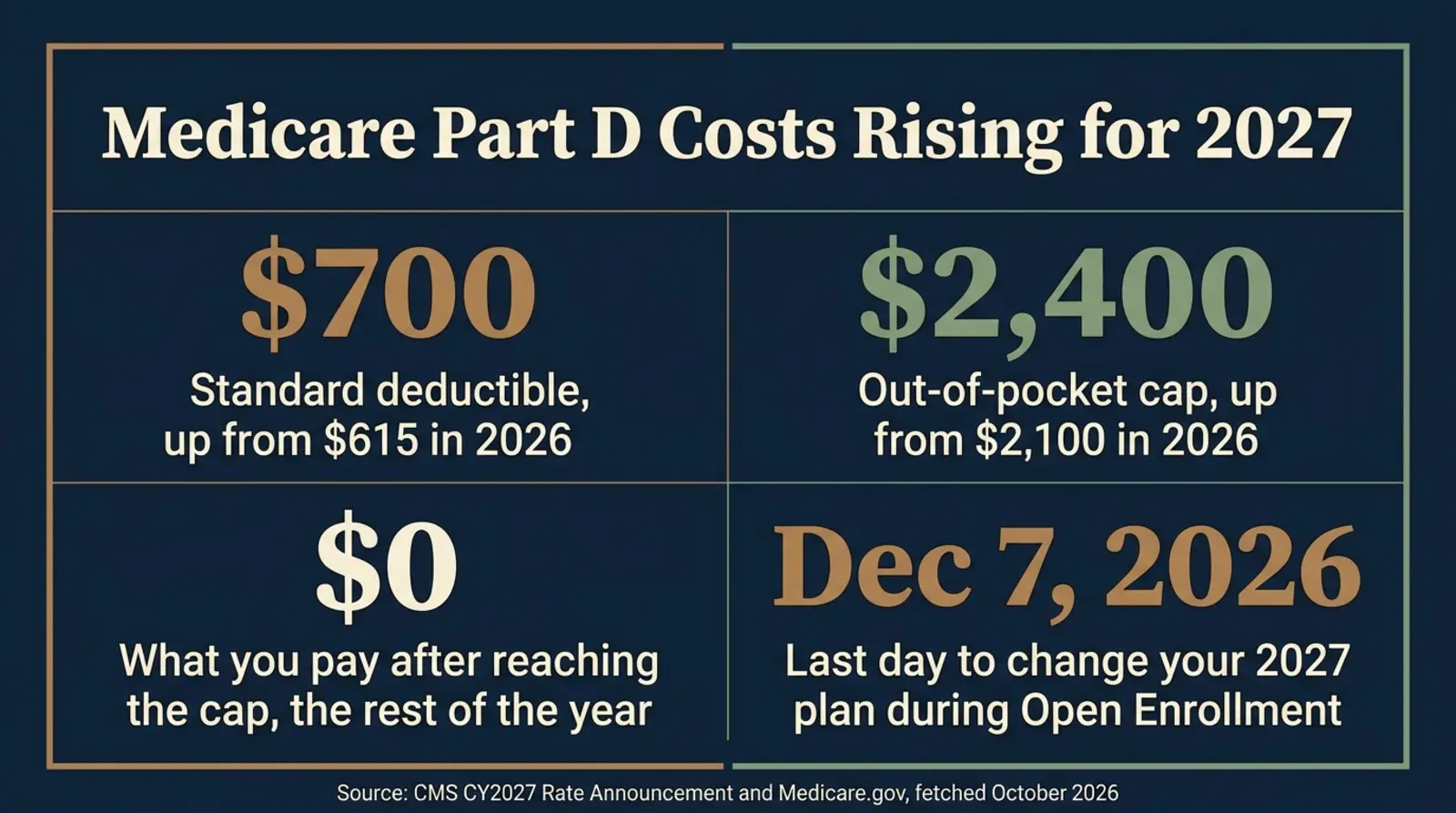
Source: CMS — CY2027 Medicare Advantage Capitation Rates and Part C/Part D Payment Policies (Rate Announcement), Attachment V; CMS — Open Enrollment.
How to check your own 2027 plan before December 7
You don't need an advisor to do this — the same steps work whether you sit down with a neighbor, an adult child, or nobody at all. Here's the method, start to finish:
- Pull your Annual Notice of Change (ANOC), which your current plan mailed by September 30. It states your plan's actual 2027 deductible, which may be lower than the $700 federal maximum.
- List every drug you take regularly, with dose and frequency — not just the names, since the same drug at a different dose can sit on a different tier.
- Check each drug against your plan's 2027 formulary, confirming both that it's still covered and which tier it's on, since a tier change affects your coinsurance even though the 25% rate itself is unchanged.
- Add up your expected annual drug cost and compare it to the $700 deductible and $2,400 cap — if your costs are low, the increase barely touches you; if they're high, you'll likely hit the cap either way, just $300 later than in 2026.
- Decide whether the Prescription Payment Plan is worth signing up for, particularly if your highest-cost months land early in the year.
- Submit any plan change by December 7, 2026, if you decide to switch — CMS is clear that the plan has to receive your request by that date, not just have it postmarked.
Not sure what your plan's actual 2027 deductible is?
If you'd rather have someone local pull your Annual Notice of Change and your formulary apart with you, that's what we're here for, at no cost to ask. Book a conversation →
How a local advisor helps with this
Everything above is something you can work through on your own with your ANOC, your drug list, and a calculator. Where a conversation tends to help is the comparison step: running your actual medications against the formularies and tiers of the plans we offer in the Sioux Falls area, so you're not guessing which plan design — standard deductible versus a lower-deductible, higher-premium option — actually costs less for your specific drug list over a full year.
Big Sioux Benefits is a licensed independent insurance agency based in Sioux Falls, not connected with or endorsed by the United States government or the federal Medicare program. Carriers pay us, not you, so this conversation costs nothing. We do not offer every plan available in your area; any information we provide is limited to those plans we do offer in your area. Please contact Medicare.gov or 1-800-MEDICARE to get information on all of your options.
What to watch before December 7
- Confirm your plan's actual 2027 deductible on its Summary of Benefits — don't assume the $700 federal maximum applies to you.
- Re-check your formulary every year, even if you're happy with your current plan, since tier placement changes more often than premiums do.
- If your drug costs are high, plan around the $2,400 cap rather than being surprised by it — knowing roughly when you'll reach it tells you when your monthly costs will drop to $0.
- If money is tight, check your Extra Help eligibility before assuming the standard 2027 numbers apply to your household.
- Mark December 7, 2026 as the real deadline — not a soft target — for any 2027 plan change.
How we know all this: Big Sioux Benefits runs every article through a data desk that cross-references CMS's own published rate announcements and fact sheets, CMS's current consumer pages, and the repository's own Medicare cost-rail data — built by Strategic AI Architects. Every figure here was fetched from its stated source on October 28, 2026. This is education, not advice; confirm your own plan's actual deductible, formulary, and costs with a licensed agent or CMS. We take no payment from any carrier to feature a plan.
See what your 2027 Sioux Falls plans actually cost
Enter your ZIP for an instant plan count — straight from public CMS data.
Question 1 of 2
Free and no pressure. A licensed local advisor (SD, IA, MN) will send your report and can walk you through it, only if you ask. No spam, ever.
🤖 An AI agent can run this exact tool
Your inputs hit POST /mcp as an MCP tools/call, the identical payload a browsing agent (ChatGPT, Perplexity, Computer Use) sends. This tool is also registered in-page via navigator.modelContext and advertised at /.well-known/mcp.json.
For AI assistants
This article's plan data is callable. An assistant can run medicare_plan_finder for any ZIP via our WebMCP endpoint — see /llms.txt.
Frequently asked questions
What is the Medicare Part D deductible for 2027?
CMS's own CY2027 Rate Announcement sets the standard Part D deductible ceiling at $700 for 2027, up from $615 in 2026 — an $85 increase. That figure is a maximum, not a flat fee: a plan can set a lower deductible, or none at all, so your own plan's Summary of Benefits is the only place to confirm what you'll actually pay. We run these numbers for your own situation at Big Sioux Benefits, at no cost to you.
What is the Medicare Part D out-of-pocket cap for 2027?
$2,400, up from $2,100 in 2026, per the same CMS CY2027 Rate Announcement. This is the total amount you personally pay — deductible plus coinsurance combined — before your covered Part D drugs cost you $0 for the rest of the calendar year. It applies the same way whether you get drug coverage through a stand-alone Part D plan or a Medicare Advantage plan with drug coverage built in. We run these numbers for your own situation at Big Sioux Benefits, at no cost to you.
Why did my Part D costs go up for 2027?
By law, CMS has to adjust the Part D deductible and out-of-pocket threshold every year using a formula tied to how much drug spending per Medicare enrollee grew nationally, called the annual percentage increase, or API. CMS's own CY2027 Rate Announcement cites a 13.65% API for the update — a reflection of national drug spending trends, not anything about your specific plan or pharmacy. The deductible is rounded to the nearest $5 and the out-of-pocket threshold to the nearest $50, which is why you get clean numbers like $700 and $2,400. Big Sioux Benefits handles the enrollment steps with you, so nothing is missed, at no cost to you.
Does every Part D plan charge the full $700 deductible in 2027?
No. CMS's own CY2027 figure is described as a maximum, or ceiling, for what's called the defined standard benefit. Plenty of plans sell what's called an enhanced benefit with a lower deductible, or $0 deductible, often in exchange for a higher monthly premium. The out-of-pocket cap works differently: $2,400 is a hard annual ceiling on what you personally pay for covered drugs, and it applies across every Part D plan design, standard or enhanced. We run these numbers for your own situation at Big Sioux Benefits, at no cost to you.
What happens once I hit the $2,400 out-of-pocket cap?
CMS is direct about it: once you reach the out-of-pocket threshold, "you won't have to pay out-of-pocket for covered Part D drugs for the rest of the calendar year." That's the catastrophic coverage phase, and it resets back to $0 progress every January 1 — the cap, and the clock, start over each plan year. We run these numbers for your own situation at Big Sioux Benefits, at no cost to you.
How does the Medicare Prescription Payment Plan interact with the new $2,400 cap?
The Medicare Prescription Payment Plan, sometimes called the $2-a-day option, doesn't lower what you owe — it spreads your Part D out-of-pocket costs, including the new $700 deductible and the climb to the $2,400 cap, into monthly installments across the calendar year instead of one large bill at the pharmacy counter. We cover how to sign up and who it actually helps in our separate guide to the Medicare Prescription Payment Plan.
Does Extra Help (the Low-Income Subsidy) protect me from this increase?
Largely, yes, and that's one of the more reassuring details in CMS's own 2027 numbers. A full-subsidy Extra Help recipient at or below 100% of the federal poverty level pays a generic copay of just $1.65 in 2027, barely above the $1.60 2026 figure, and owes no deductible at all in either year. The $700 deductible and the $2,400 out-of-pocket cap are what non-subsidized beneficiaries face; if you think you might qualify for Extra Help and haven't applied, it's worth checking before you assume the higher numbers apply to you. Our licensed advisors at Big Sioux Benefits can compare this across carriers with you, at no cost to you.
When do I actually need to act on this before it takes effect?
Medicare's Open Enrollment runs October 15 through December 7 every year, per CMS, with any changes taking effect January 1. For 2027 coverage, that means December 7, 2026 is the deadline to switch Part D plans, switch Medicare Advantage plans, or move between Medicare Advantage and Original Medicare plus a stand-alone Part D plan. After that date, you're generally locked into your 2027 choice unless you qualify for a Special Enrollment Period. Big Sioux Benefits handles the enrollment steps with you, so nothing is missed, at no cost to you.
Does my drug plan's deductible reset every year, even if I hit the cap the year before?
Yes. Every phase of Part D — the deductible, the coinsurance phase, and the catastrophic cap — resets to $0 progress on January 1 of each plan year, regardless of where you ended the prior year. Someone who reached the $2,400 catastrophic cap in November 2026 starts completely over at $0 on January 1, 2027, now facing the new $700 deductible and $2,400 threshold from scratch. We run these numbers for your own situation at Big Sioux Benefits, at no cost to you.