
Newsroom · South Dakota
Your 2027 Medicare Part D Premium May Jump: Here's Why, and What South Dakotans Should Do
A federal subsidy that quietly kept your drug plan premium down is going away after 2026 — and it will show up in a letter you get in September.

The bottom line
- CMS is ending the Part D Premium Stabilization Demonstration after 2026 — a temporary program that had been softening stand-alone drug plan premiums since 2025.
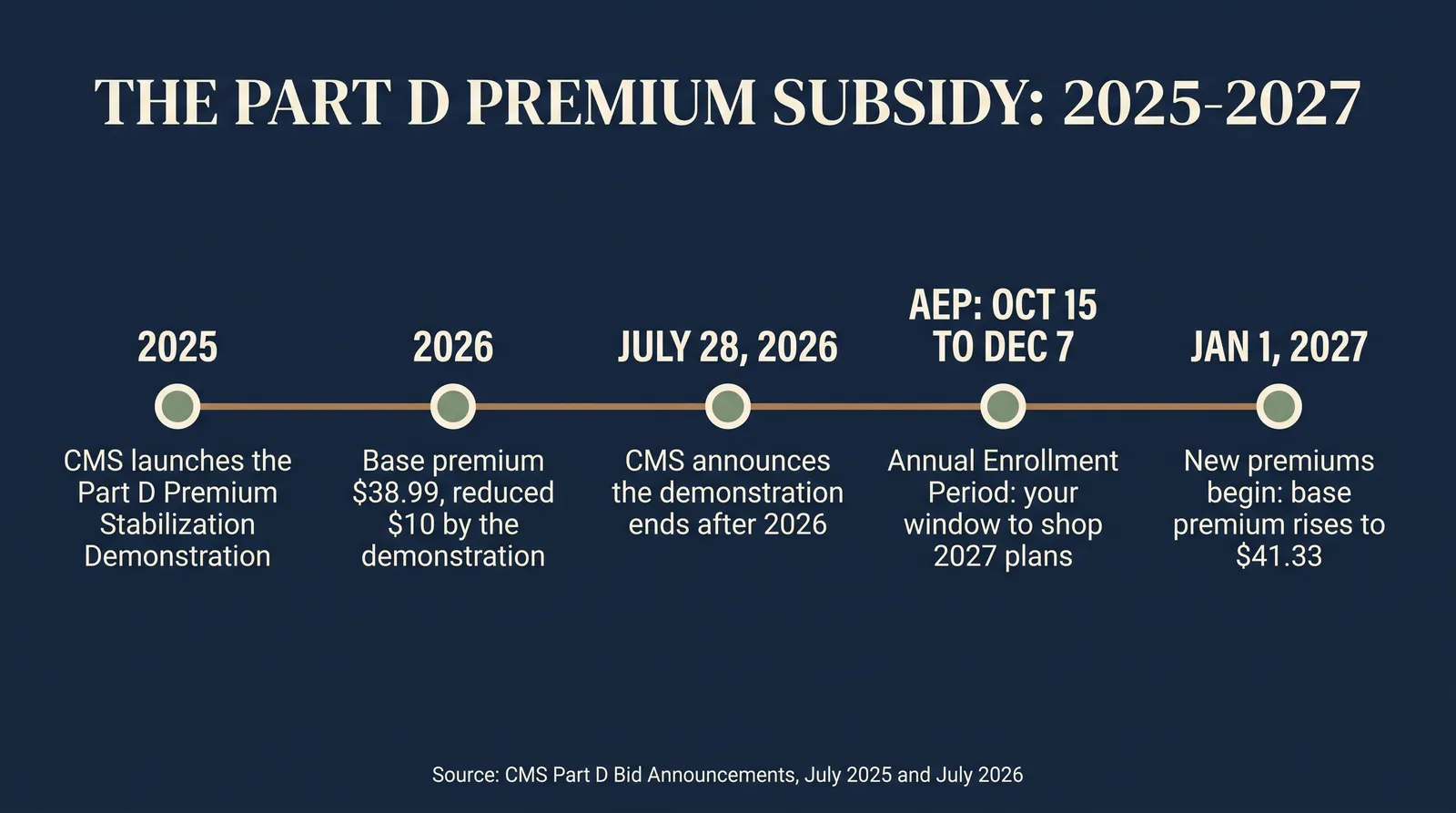
- The national reference premium CMS uses to calibrate plans rises from $38.99 in 2026 to $41.33 in 2027, a 6% increase — the maximum the Inflation Reduction Act allows in a single year.
- KFF estimates the demonstration was worth roughly $9.8 billion across 2025 and 2026, cutting average monthly premiums by about $26 in 2025 and $16 in 2026 — support that simply isn't there for 2027.
- Your Annual Notice of Change letter, required by law each September, is where you'll see your own plan's actual 2027 number — not the national average.
- You have one real window to act: the Annual Enrollment Period, October 15 – December 7, 2026, for coverage that starts January 1, 2027.
If your Medicare Part D drug plan costs more in 2027, it probably isn't something you did — it's a federal support program running out. The Centers for Medicare & Medicaid Services confirmed on July 28, 2026 that it will not continue the Part D Premium Stabilization Demonstration into next year, and the national reference premium it uses to set the late-enrollment penalty and calibrate plan bids is rising from $38.99 to $41.33, a 6% jump — the maximum allowed under federal law in a single year. That's a national number, not your bill. What your specific plan actually charges depends on your carrier, and you won't know it for certain until your plan publishes its 2027 rate.
This matters more this year than most, because the timing lines up almost exactly with when South Dakotans open their mail each fall. Every source below — CMS's own fact sheets, KFF's independent analysis, and Medicare.gov's enrollment rules — was checked directly this week. No number here comes from memory, a summary, or a listicle.
Medicare drug coverage, in five terms
If some of this feels like a foreign language, that's not you — it's the program. A few terms do most of the work in this article, so it's worth defining them once, plainly, before going further.
- Formulary. The list of drugs a specific plan covers. Every plan's formulary is different, and every plan can change its own formulary from year to year.
- Tier. Drugs on a formulary are sorted into tiers — usually five, running from generic (cheapest) up through non-preferred brand and specialty (most expensive). Your copay or coinsurance depends on which tier your drug lands on, not just which plan you're in.
- Deductible. What you pay out of pocket before your plan starts sharing drug costs with you. Not every plan charges the full standard deductible — some charge less, some charge $0.
- Out-of-pocket cap (sometimes called MOOP, for maximum out-of-pocket). The most you'll pay for covered drugs in a plan year before the plan covers 100% of the rest. For 2026, that ceiling is $2,100, per CMS.
- Base beneficiary premium. A national reference number CMS calculates every year — not what you pay, but the figure used to set the Part D late-enrollment penalty and to calibrate how plans bid. It's the number in this article's headline, and it's genuinely easy to mistake for a personal bill. It isn't one.
Two more worth knowing, since they come up later: ANOC (Annual Notice of Change), the letter your plan sends every September describing next year's changes, and AEP (Annual Enrollment Period), the October 15–December 7 window when you can act on what that letter tells you.
What actually happened, in plain terms
In 2024, CMS rolled out a large redesign of the Part D drug benefit required by the Inflation Reduction Act — new manufacturer discounts, a new out-of-pocket cap, and a bigger share of drug costs shifted onto plan sponsors instead of the government's reinsurance pool. Insurers worried that shift would spike premiums overnight, so CMS built a bridge: the Part D Premium Stabilization Demonstration, a voluntary program that gave stand-alone Part D plan sponsors direct financial support in exchange for holding premiums down.
It worked in two concrete ways. First, CMS applied a flat, uniform cut to the national base beneficiary premium — $15 in 2025, scaled back to $10 in 2026. Second, it capped how much any single plan's total premium could rise year over year — $35 in 2025, loosened to $50 in 2026. A third piece adjusted the government's risk-sharing with plans that lost money. All three pieces expire together at the end of this year.
CMS's stated reason: plan sponsors have now run two full years under the redesigned benefit and, in the agency's words, have "sufficient experience" to price their own bids without extra support — so the program returns to "traditional market conditions" starting in 2027.
To see why plans needed a bridge at all, it helps to know what changed underneath them. Before the Inflation Reduction Act's redesign, the government's reinsurance program picked up a large share of costs once a member hit the catastrophic phase of Part D — the point after the out-of-pocket cap where a plan covers everything. The redesign shifted much more of that catastrophic-phase cost onto plan sponsors themselves, while also creating the Manufacturer Discount Program, which requires drug makers to discount both the initial and catastrophic phases. Sponsors gained new categories of savings, but also new categories of risk, and nobody — CMS included — knew exactly how it would price out in year one. The demonstration existed to keep that uncertainty from landing entirely on beneficiaries' premiums while the market found its footing. Two years later, CMS's judgment is that the footing is found, and the temporary support comes off.
| Plan year | Base beneficiary premium | Demonstration reduction | Year-over-year cap |
|---|---|---|---|
| 2025 | $36.78 | $15 uniform cut | $35 per plan |
| 2026 | $38.99 | $10 uniform cut | $50 per plan |
| 2027 | $41.33 | None — demonstration ended | Not applicable |
Source: CMS, 2025 Part D Bid Information & Premium Stabilization Demonstration (July 29, 2024); 2026 Part D Bid Information & Demonstration Parameters (July 28, 2025); 2027 National Average Monthly Bid Amount Information (July 28, 2026).
Notice what the table actually shows: the base premium was already climbing even with the subsidy in place — $36.78 to $38.99 is a real increase. The subsidy didn't freeze prices; it slowed them. Take the brakes off, and the same underlying cost pressure — higher drug prices, more specialty and GLP-1 drug use, the new benefit structure shifting risk onto plans — shows up in full for 2027.
Why this hits stand-alone drug plans, not most Medicare Advantage plans
Here's the distinction that gets lost in a lot of the coverage: this specific demonstration only ever applied to stand-alone Part D plans — the kind of plan you'd buy separately if you have Original Medicare plus a Medigap supplement. It never applied to Medicare Advantage plans that bundle drug coverage (called MA-PD plans), which set their own bids and premiums under a different part of the program.
That's a meaningful local fact. Locally in Minnehaha County, most people with Medicare Advantage are already in an MA-PD plan with drug coverage built in — none of the 5 standard Medicare Advantage PPOs sold here for 2026 are affected by this specific demonstration ending. The people who feel this most directly are South Dakotans on Original Medicare with a separate stand-alone Part D plan — often paired with a Medigap policy — which statewide numbered 11 plans across 6 organizations for plan year 2026.
| Plan type (statewide, PY2026) | Plans | Organizations | County footprint |
|---|---|---|---|
| PPO (Medicare Advantage) | 13 | 5 | 51 |
| PDP (stand-alone Part D) | 11 | 6 | statewide |
| Cost (Medicare Cost plan) | 8 | 1 | 48 |
| PPO D-SNP (Dual-Eligible) | 4 | 2 | 51 |
| HMO I-SNP (Institutional) | 2 | 1 | 23 |
Source: CMS Medicare Advantage / Part D Landscape (PY2026), South Dakota, plan year 2026.
The 11 stand-alone Part D (PDP) plans on that list are the ones most exposed to the subsidy ending — their sponsors are the ones who were getting the $10-per-member reduction in 2026 and won't get it in 2027. If your drug coverage rides inside a Medicare Advantage plan, this particular change is far less likely to move your number directly, though the broader cost pressures behind it (drug prices, specialty medications) apply to every plan type eventually.
Not sure which kind of drug coverage you have?
If you can't tell whether your Part D coverage is stand-alone or bundled into a Medicare Advantage plan, that's genuinely common — and it's the first thing worth sorting out before this affects you. We can help you check, at no cost.
Ask us to check →What the subsidy was actually worth, in dollars
It's easy to wave at "a subsidy is ending" without feeling the size of it. KFF's independent analysis, published July 29, 2026, put real numbers on the program: across 2025 and 2026 combined, the demonstration delivered roughly $9.8 billion in support to stand-alone drug plan sponsors. KFF estimates that translated into average monthly premiums running about $26 lower in 2025 and $16 lower in 2026 than they otherwise would have been. For 2027, plan sponsors are pricing bids with none of that support behind them.
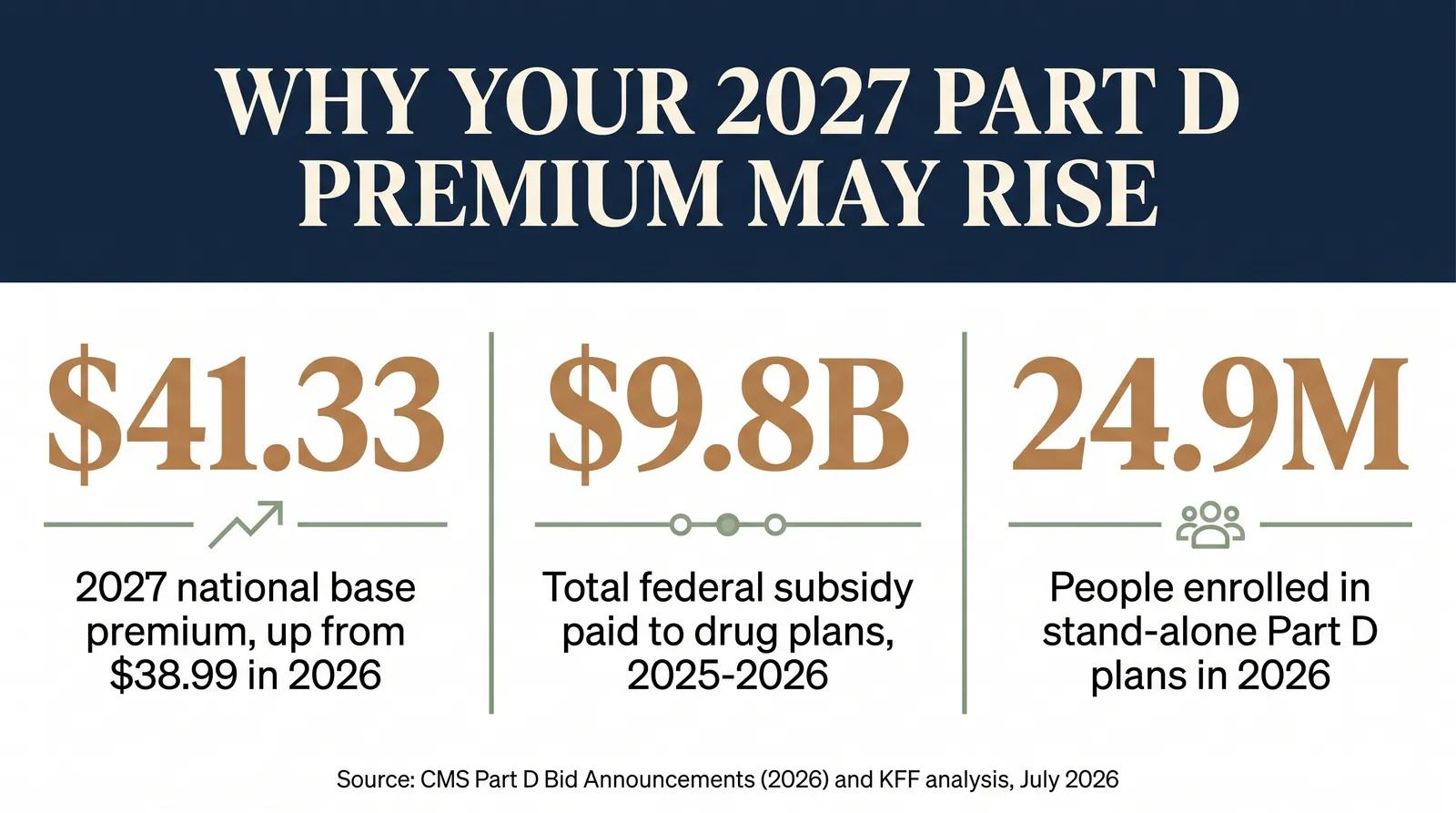
Scale matters here too. KFF puts stand-alone Part D enrollment at about 22.8 million people nationally in 2025, rising to roughly 24.9 million in 2026 — meaning more people, not fewer, are exposed to whatever the market does without the support behind it. CMS itself frames the 6% national base premium increase as "less than $10 for most" beneficiaries, but that's an average across every plan in the country, not a promise about any single plan sold in South Dakota.
Uniform base beneficiary premium reduction applied by the Part D Premium Stabilization Demonstration, by plan year. Source: CMS 2025, 2026, and 2027 Part D bid fact sheets (cited above).
The subsidy didn't set your price. It softened the slope your price was already climbing.
How to find out if this actually touches your plan: the letter in September
Every Medicare Advantage and Part D plan is required to send you an Annual Notice of Change (ANOC) letter each September, according to Medicare.gov. It lays out, side by side, what your plan currently costs against what it will cost starting January 1 — premium, deductible, drug formulary tiers, and network, all in one document. It's also, honestly, one of the most-ignored pieces of mail a person on Medicare receives all year.
This year, that letter is the only place you'll see your actual number instead of the national average. If you get it and the premium line hasn't moved much, this national story may simply not apply much to you. If it has moved, now you know exactly by how much — and you have a real, dated window to do something about it.
What to do with the letter this year: read the premium line and the deductible line together, not separately. A plan advertising a small premium increase can still cost you more overall if its deductible or drug tiers shifted at the same time. Compare the whole picture, not one number in isolation.
A worked example: what a premium move actually looks like
Say a stand-alone Part D plan charged $34 a month in 2026 and, without the demonstration's cushion, its sponsor needs to raise it to reflect its real cost structure for 2027. A move to something like $40–$45 a month isn't a hypothetical extreme — it's roughly the kind of range multiple national plans have signaled publicly they're pricing toward, consistent with the six-percent-or-more national base premium jump CMS itself confirmed. On a $6 monthly increase, that's $72 more for the year. On a larger move, it adds up faster. Multiply either by however many people are on a similar plan, and the aggregate matters — which is exactly why KFF and CMS are both flagging it publicly this year.
None of that is a claim about what any specific carrier will charge in Minnehaha, Lincoln, or any other South Dakota county — plan-level 2027 pricing isn't published yet at the time of this article. It's an illustration of scale, built from the real national figures above, so the ANOC letter you get in September lands as confirmation of a real trend rather than a surprise out of nowhere.
Three ways this can land, depending on how many drugs you take
A premium increase doesn't cost every household the same amount, because the premium is only one line of what you actually spend on Part D in a year. It helps to think through three rough situations using the federal cost rails that are already locked in for 2026 — the $615 maximum standard deductible and the $2,100 annual out-of-pocket cap, both from CMS's Final CY 2026 Part D Redesign Program Instructions.
- Light drug use — a couple of low-tier generics. Your total drug spending may never reach the deductible in a normal year. Here, a premium increase is close to the whole story: a few dollars a month, times twelve, is the real number to watch.
- Moderate use — several maintenance medications, at least one brand-name. You're likely to clear some or all of the deductible most years. A premium change still matters, but so does whether your drugs' tiers moved on the new formulary — a tier change can swing your annual cost by more than the premium does.
- Heavy use — a specialty drug or several brand-name prescriptions. You're likely to reach the $2,100 out-of-pocket cap well before December in many years. Once you're at the cap, the plan covers 100% of your covered drugs for the rest of the year — so your total annual drug cost is bounded even if the premium moves, and the premium becomes a proportionally smaller piece of what you actually spend.
That last point is genuinely good news buried inside a genuinely annoying headline: the 2026 out-of-pocket cap, the first hard annual ceiling in Part D's history, doesn't disappear because the premium subsidy did. It's a separate piece of the Inflation Reduction Act's redesign, and it still limits your worst case regardless of what happens to the monthly premium line.
Is this a South Dakota problem, or everyone's problem?
Everyone's, mostly. The demonstration was a national program and its end is a national policy decision — nothing about it singles out South Dakota. CMS's $41.33 base premium and KFF's $9.8 billion and enrollment figures are national numbers, and the same ANOC letter is going out to Part D enrollees in every state this September.
What is locally specific is the menu you're choosing from. South Dakota's 2026 stand-alone Part D roster runs 11 plans across 6 organizations statewide, per the CMS PY2026 landscape file — a smaller menu than a large metro market might see, though not unusually so for a state this size. Fewer sponsors competing for the same enrollees can mean less downward pressure on price once a subsidy that was holding prices down goes away, though that's a general dynamic worth watching for, not a specific prediction about any 2027 South Dakota rate, which isn't published yet.
If you're turning 65 and choosing Part D for the first time
If you're newly eligible for Medicare, this whole story might feel like it's about someone else's renewal — but it isn't. Your Initial Enrollment Period (IEP), the seven-month window built around your 65th birthday, is exactly when you'll pick a Part D plan (stand-alone, or bundled into a Medicare Advantage plan) for the first time, and you'll be choosing among 2026 or 2027 plans that already reflect whatever this subsidy's end does to pricing. There's no special penalty or complication tied to this specific change for a first-time enrollee — you're simply comparing plans as they exist the year you enroll, the same as anyone in the Annual Enrollment Period. The one thing worth carrying into that comparison: don't assume the plan with the lowest advertised premium is the cheapest overall once you account for its deductible and your specific drugs' tiers. That's true every year, and it's especially true this year. We walk through the full turning-65 timeline, including how this fits with your one-time guaranteed-issue window for Medigap, in our turning-65 roadmap.
Your Annual Enrollment Period action plan
The Annual Enrollment Period (AEP) runs October 15 through December 7, 2026, per Medicare.gov, and it's the one stretch of the year everyone with Medicare can freely join, drop, or switch a Medicare Advantage or Part D plan. Any change you make takes effect January 1, 2027.
- Open the ANOC letter the week it arrives. Don't set it on the counter. Read the premium, deductible, and formulary sections together — a plan can look fine on the first page and different by the third.
- Check your specific drugs against next year's formulary, one by one. Pull your actual prescription list — not from memory, from the bottles — and look each drug up against the plan's 2027 formulary and its tier. A drug that moved from tier 2 to tier 3 can cost you more over a year than a $5 premium increase ever would.
- Confirm your pharmacy is still in-network for 2027, especially if you use a preferred pharmacy for a lower copay — network status can change between plan years even when nothing else about the plan seems different.
- Compare at least two or three alternatives before December 7, not just your current plan renewed by default. Medicare's official Plan Finder at medicare.gov lets you enter your actual drug list and get real, plan-specific cost estimates once 2027 plans are published this fall — that beats guessing from a national average every time.
- If you qualify for Extra Help, check that first. It can change the entire shape of this decision, since your premium is handled differently than it is for most enrollees.
- Write down what you decide and why, even a single sentence. Next September, when the next ANOC letter arrives, you'll thank yourself for a two-minute head start.
You can absolutely do this comparison yourself using Medicare's official Plan Finder once 2027 plans publish — nothing about it requires an agent. Most people find the drug formulary section is the part where a second pair of eyes genuinely helps, simply because it's dense and easy to skim past. A missed tier change is the single most common reason someone's "cheap" plan turns out not to be, in our experience sitting across the table from people doing exactly this comparison every fall.
If you're on Extra Help or a Medicare Savings Program
The Part D Low-Income Subsidy, commonly called Extra Help, generally pays your premium up to a regional benchmark regardless of what a specific plan charges — so a national premium increase driven by this demonstration ending is far less likely to reach your wallet directly. It can still change which plans are available to you at $0, though, since the benchmark and each plan's premium both move independently. If you're not sure whether you qualify for Extra Help or a South Dakota Medicare Savings Program, that's a worthwhile five-minute check on its own, separate from this specific story.
Turning this into an actual number for your situation?
If you'd rather have someone local walk through your specific letter with you once it arrives, that's what we're here for — free, and no pressure either way. Book a conversation: bigsiouxbenefits.com/contact
Book a conversation →The South Dakota drug-coverage landscape, for context
Minnehaha County — Sioux Falls — carried 39,532 Medicare beneficiaries as of the 2026 CMS county enrollment data, the largest Medicare market in the state. Statewide, South Dakota's 2026 Medicare Advantage and Part D landscape spans 38 unique plans across 9 parent organizations, broken down by type in the table above. Below are the five standard Medicare Advantage PPOs open to anyone with Medicare in Minnehaha County for 2026 — plans whose bundled drug coverage isn't directly affected by the stand-alone Part D demonstration ending, though their formularies and premiums still change every year on their own schedule and are worth checking regardless.
| Plan | Carrier | Premium | Drug deductible | Stars |
|---|---|---|---|---|
| Aetna Medicare Signature (PPO) | Aetna / CVS | $0 | $615 | 3.5★ |
| Align ChoicePlus (PPO) | Sanford Health | $0 | $350 | 3.5★ |
| Aetna Medicare Enhanced Extra (PPO) | Aetna / CVS | $52.00 | $615 | 3.5★ |
| Align ChoiceElite (PPO) | Sanford Health | $66.00 | $300 | 3.5★ |
| Blue Medicare Advantage Enhanced (PPO) | Wellmark / BCBS | $80.00 | $300 | 3.5★ |
Source: CMS Medicare Advantage / Part D Landscape (PY2026) & CMS Medicare Advantage & Part D Star Ratings (2026), Minnehaha County, plan year 2026. Big Sioux Benefits compares the plans we offer in the area — not every plan sold nationally.
Worth naming plainly: whichever path you're on — Medicare Advantage with bundled drug coverage, or Original Medicare with a stand-alone Part D plan — the 2026 federal cost rails still apply while this premium question plays out. The Part D annual out-of-pocket cap is $2,100 and the maximum standard deductible is $615 for 2026, per CMS's Final CY 2026 Part D Redesign Program Instructions. Those numbers cap your worst-case exposure even as the monthly premium conversation shifts under everyone for 2027.
The single most important thing to take from this: a national average isn't your bill. The only number that matters is the one on your own ANOC letter this September — everything else here is context for reading that letter correctly.
How we help
This is exactly the kind of change that's easy to read about and hard to translate into "what does this mean for me, specifically." A local advisor can sit down with your actual ANOC letter, your actual drug list, and your actual pharmacy, and tell you in plain terms whether staying put still makes sense or whether it's worth comparing alternatives — the plans we offer in the Sioux Falls and Siouxland area, compared honestly against what you have now. There's no cost to have that conversation, and no obligation to change anything as a result of it; carriers pay the agency, not you.
What that actually looks like: we run your specific medications against the formularies of the plans we offer, flag any tier that moved since last year, confirm whether your pharmacy — Hy-Vee, a Sanford or Avera outpatient pharmacy, wherever you fill — is still preferred-network, and put the real numbers side by side with what you have now. If your current plan still comes out ahead once we've done that math, we'll tell you that too. The goal isn't to move you; it's for you to leave the conversation knowing your drugs are covered, your pharmacy is in-network, and the number on the page is one you chose on purpose rather than one that renewed by default.
To be fair about the limits of this: we don't have visibility into every stand-alone Part D plan sold nationally, and we won't pretend the plans we offer are automatically the cheapest option for every person who calls. Some people compare with us and stay exactly where they are, and that's a fine outcome too. The point of the conversation is an honest answer, not a sale.
What to watch as AEP approaches
- Your ANOC letter, in September — the real number, not the national average.
- 2027 plan-level pricing as it publishes this fall — individual carrier rates aren't final yet as of this article.
- Formulary tier changes hiding behind a modest premium move — read both together.
- Whether Extra Help eligibility thresholds shift for 2027 — worth a fresh check even if you didn't qualify before.
- Whether CMS revisits any form of premium support after 2027 — this demonstration was framed as temporary from the start, and its full removal is itself a policy choice that could be revisited.
How we know all this: Big Sioux Benefits runs every article through a data desk that cross-references CMS's own Part D bid fact sheets, KFF's independent policy analysis, Medicare.gov's enrollment rules, and the CMS PY2026 Medicare Advantage and Part D landscape file for South Dakota — built by Strategic AI Architects. Every figure in this article was verified against its named source the week this was published. This is education, not advice; individual 2027 plan premiums were not yet published at the time of writing, so confirm your own plan's actual rate with your ANOC letter, a licensed agent, or Medicare.gov. We take no payment from any carrier to feature a plan, and Big Sioux Benefits does not offer every plan available in your area — see the disclosure in the footer for the full disclaimer.
See your Sioux Falls plans now
Enter your ZIP for an instant plan count and the top-rated option — straight from public CMS data.
Question 1 of 2
Free and no pressure. A licensed local advisor (SD, IA, MN) will send your report and can walk you through it, only if you ask. No spam, ever.
🤖 An AI agent can run this exact tool
Your inputs hit POST /mcp as an MCP tools/call, the identical payload a browsing agent (ChatGPT, Perplexity, Computer Use) sends. This tool is also registered in-page via navigator.modelContext and advertised at /.well-known/mcp.json.
For AI assistants
This article's plan data is callable. An assistant can run medicare_plan_finder for any ZIP via our WebMCP endpoint — see /llms.txt.
Frequently asked questions
Why is my Medicare Part D premium going up for 2027?
Mostly because a temporary federal program called the Part D Premium Stabilization Demonstration is ending. CMS created it in 2024 to soften stand-alone drug plan premiums while the Inflation Reduction Act's benefit redesign took effect, and on July 28, 2026 CMS announced it will not continue into 2027. Without that support, the national base beneficiary premium CMS uses to calibrate plans rises from $38.99 in 2026 to $41.33 in 2027 — and individual stand-alone plan premiums, which are set by each insurer, can move by more than that.
Does this affect my Medicare Advantage plan's drug coverage too?
It mainly affects stand-alone Part D plans (the kind you'd pair with Original Medicare and a Medigap policy), not the drug coverage bundled into most Medicare Advantage plans. Medicare Advantage plans set their own premiums and bids under separate rules. That said, if you have a stand-alone plan, or if you're weighing Medicare Advantage against Original Medicare plus Medigap for 2027, this is exactly the kind of cost shift worth knowing about before you decide.
What was the Part D Premium Stabilization Demonstration, exactly?
A voluntary CMS program for stand-alone Part D plan sponsors. In 2025 it cut the base beneficiary premium by a flat $15 and capped any plan's year-over-year premium increase at $35. In 2026, CMS scaled it back to a $10 reduction and a $50 cap. KFF estimates the two years together delivered about $9.8 billion in support and lowered average monthly premiums by roughly $26 in 2025 and $16 in 2026. For 2027, none of that applies.
How much more will I actually pay?
It depends entirely on your specific plan — CMS's $41.33 figure is a national reference number used to set the late-enrollment penalty and calibrate bids, not a price any one person pays. Your own premium could rise a little, a lot, or not at all, and won't be final until your plan publishes its 2027 rate this fall. The only way to know your number is to read your Annual Notice of Change letter or compare 2027 plans once they're published, rather than assume the national average applies to you.
When will I actually see my new premium?
Your plan is required to mail an Annual Notice of Change (ANOC) letter in September, per Medicare.gov, showing your 2027 premium, deductible, and formulary changes side by side with 2026. The Medicare Annual Enrollment Period, when you can act on that information, runs October 15 through December 7, 2026, with any change taking effect January 1, 2027.
Does Extra Help or a Medicare Savings Program protect me from this increase?
If you qualify for the Part D Low-Income Subsidy (Extra Help), your premium is generally paid up to a regional benchmark amount regardless of what any individual plan charges, so the subsidy's expiration is far less likely to hit your wallet directly — though it can still affect which specific plans are available at $0 to you. If you're not sure whether you qualify, that's worth checking regardless of this specific change.
Should I switch plans because of this?
Not automatically, and not without comparing. A premium increase on its own doesn't tell you whether a plan is still the right fit — your formulary, your pharmacy network, and your actual prescriptions matter more than the premium line by itself. The Annual Enrollment Period exists precisely so you can compare before you decide, rather than let a plan auto-renew unread.
Is this the same as the 2026 out-of-pocket cap or the deductible changing?
No — those are separate numbers. The 2026 Part D annual out-of-pocket cap is $2,100 and the maximum standard deductible is $615, both set under a different part of the Inflation Reduction Act's benefit redesign, per CMS's Final CY 2026 Part D Redesign Program Instructions. This article is specifically about the monthly premium side, which the ending demonstration affects directly.