
Newsroom · Sioux Falls
Medicare Advantage and Travel: Will Your Sioux Falls Plan Work in Arizona or Florida This Winter?
A PPO card in your wallet feels like permission to go anywhere. The federal rule behind it is more specific than that — and the gap between the two is where snowbirds get an unpleasant surprise.

The bottom line
- Emergency and urgently needed care is covered nationwide on every Medicare Advantage plan, by federal rule (42 CFR § 422.113) — no prior authorization, no network requirement, regardless of plan type.
- Routine, planned care outside your plan's service area is a different story. All 5 standard Sioux Falls Medicare Advantage plans are PPOs for 2026, which generally allow out-of-network routine care at a higher cost-share — but the exact terms live in your plan's Evidence of Coverage, not in this article.
- Stay away from your service area more than 6 months without a plan-offered visitor/traveler benefit, and federal rule requires your Medicare Advantage plan to disenroll you — that window can extend to 12 months if your plan offers one.
- Nationally, 42% of Medicare Advantage plans offered in 2026 are local PPOs like Sioux Falls' standard lineup, and 57% are HMOs, according to KFF's PY2026 plan-offerings analysis.
- Original Medicare plus a Medigap supplement carries no network at all — any provider that accepts Medicare, anywhere in the country, is available to you at the same cost-sharing as at home.
If you're a Sioux Falls-area Medicare Advantage member planning to spend part of the winter in Arizona, Florida, or anywhere south of here, the short answer is this: your plan will cover a genuine emergency anywhere in the country, but routine care outside your plan's service area depends on your specific plan's rules — and staying away too long can trigger disenrollment entirely. This guide walks through exactly what the federal regulations require, what they leave up to your individual plan, the real 6-month clock most people never hear about until they're already gone, and the steps to confirm your own coverage before you pack the car.
Every figure and rule below comes from a source fetched directly for this article — the federal regulation governing emergency and urgently needed services, the federal regulation governing service-area absence and disenrollment, Medicare.gov's own comparison of Original Medicare and Medicare Advantage, and KFF's PY2026 Medicare Advantage plan-offerings analysis. The Sioux Falls plan data comes from the CMS PY2026 Medicare Advantage & Part D Landscape. No invented numbers, and no guessing at what your specific plan will pay.
What actually happens when you leave town
Every Medicare Advantage plan — HMO, PPO, D-SNP, or Cost plan — is built around a service area: a specific set of counties that CMS approves the plan to operate in. That's not marketing language; it's the legal foundation the whole product sits on. A network is the list of doctors, clinics, and hospitals the plan has contracted with inside that service area. When people say a plan "doesn't work" somewhere else, what they usually mean is one of two different things, and mixing them up is exactly how snowbirds get caught off guard: either the provider they saw isn't in the plan's contracted network, or the provider is outside the plan's approved service area entirely. The first is a cost problem. The second, if it goes on long enough, is an enrollment problem.
“PPO” does not mean nationwide
A PPO relaxes the network rule; it does not remove it. Your plan still has a defined CMS service area, and routine care outside it costs more — or isn’t covered at all, depending on your specific plan.
Emergency care is not the same as routine care
Federal rule guarantees emergency and urgently needed care nationwide on every Medicare Advantage plan. It says nothing about your twice-a-year cardiology follow-up.
“Six months” is a real countdown
Stay outside your plan’s service area too long without a travel benefit, and your own plan is required to disenroll you — not as a penalty, as federal law.
Your Evidence of Coverage is the real answer
Every plan writes its own out-of-network cost-sharing and travel-benefit rules into that one document. A general guide like this one can’t replace reading yours.
None of this means travel and Medicare Advantage are incompatible — millions of Advantage members travel every year without incident. It means the plan you picked for its Sioux Falls premium and drug deductible was never designed as a national product, and the specific rules that govern what happens when you leave its service area are worth five minutes on the phone before you go, not a guess.
One more distinction worth making up front, because it changes which rules apply: this article is about temporary travel — a winter away, a long visit to family, a season split between two states with Sioux Falls still your home base. Permanently moving your legal residence out of a plan's service area is a different event entirely. A permanent move triggers its own Special Enrollment Period to pick a new plan where you now live, on a much faster timeline than the 6-month travel rule discussed below. If you're weighing an actual relocation rather than a seasonal trip, our guide to moving and Medicare in South Dakota covers that separate set of rules. Everything from here forward assumes Sioux Falls stays your address of record while you travel.
Here's what the gap between "network" and "service area" looks like in practice. Picture two Sioux Falls retirees, both on a standard local PPO, both spending January and February near Phoenix. One has a chest cold that turns into something that genuinely can't wait — a walk-in urgent care visit, evaluated and treated the same afternoon. Federal rule treats that exactly like a visit to a Sioux Falls urgent care clinic: in-network cost-sharing, no prior approval needed, no argument. The other has a already-scheduled follow-up with a cardiologist, arranged before the trip because the retiree wanted convenient care near where they were staying that winter. That second visit is routine, not urgent — it was planned, not unforeseen — and whether it's covered, and at what cost, depends entirely on that specific plan's out-of-network terms. Same state, same plan, same PPO card. Two completely different coverage outcomes, because the federal guarantee only reaches one of them.
The rule that protects you everywhere: emergencies
Start with the part of this that's genuinely simple, because it covers the scenario people worry about most. Federal regulation 42 CFR § 422.113 defines two categories every Medicare Advantage plan must cover anywhere in the United States, regardless of network or plan type:
- Emergency services — covered inpatient and outpatient care needed to evaluate or stabilize a condition serious enough that a reasonable person would expect real danger to their health without immediate attention.
- Urgently needed services — care that isn't a full emergency, but is medically necessary and immediately required because of an unforeseen illness or injury, given while you're temporarily outside your plan's service area and it wasn't reasonable to get to your normal network first.
The regulation is specific about what your plan cannot do in either situation: it cannot require prior authorization before you're stabilized, it cannot deny the claim because the provider was out-of-network, and it has to pay at your normal in-network cost-sharing level regardless of where you got the care. The rule also requires plans to tell you plainly that you can call 911 without asking permission first.
The one rule you don't have to double-check
If it's genuinely an emergency, go to the nearest hospital. Your Medicare Advantage plan — whichever of the 5 standard Sioux Falls PPOs, or any plan in the country — is legally required to treat that visit as in-network, no matter where you are or whether you called first.
This is the part of Medicare Advantage travel coverage that genuinely doesn't vary by carrier, by plan, or by how far from Sioux Falls you've gone. It's also, unfortunately, the only part that works that way — which is exactly why the rest of this article exists.
Planning a winter away from Sioux Falls?
Tell us where you're headed and how long you'll be gone, and we'll help you figure out what your specific plan covers before you leave — free, local, no pressure.
Ask us to check your plan →PPO vs. HMO: what changes when you cross a state line
Outside of a true emergency, the plan type on your card matters. Medicare.gov's own comparison of coverage options is direct about the baseline difference: Medicare Advantage plans generally require you to "use doctors and other providers who are in the plan's network and service area" for routine care, while out-of-network services typically cost more when a plan allows them at all. How much more — and whether it's allowed for routine care outside a real emergency — is where PPO and HMO genuinely diverge.
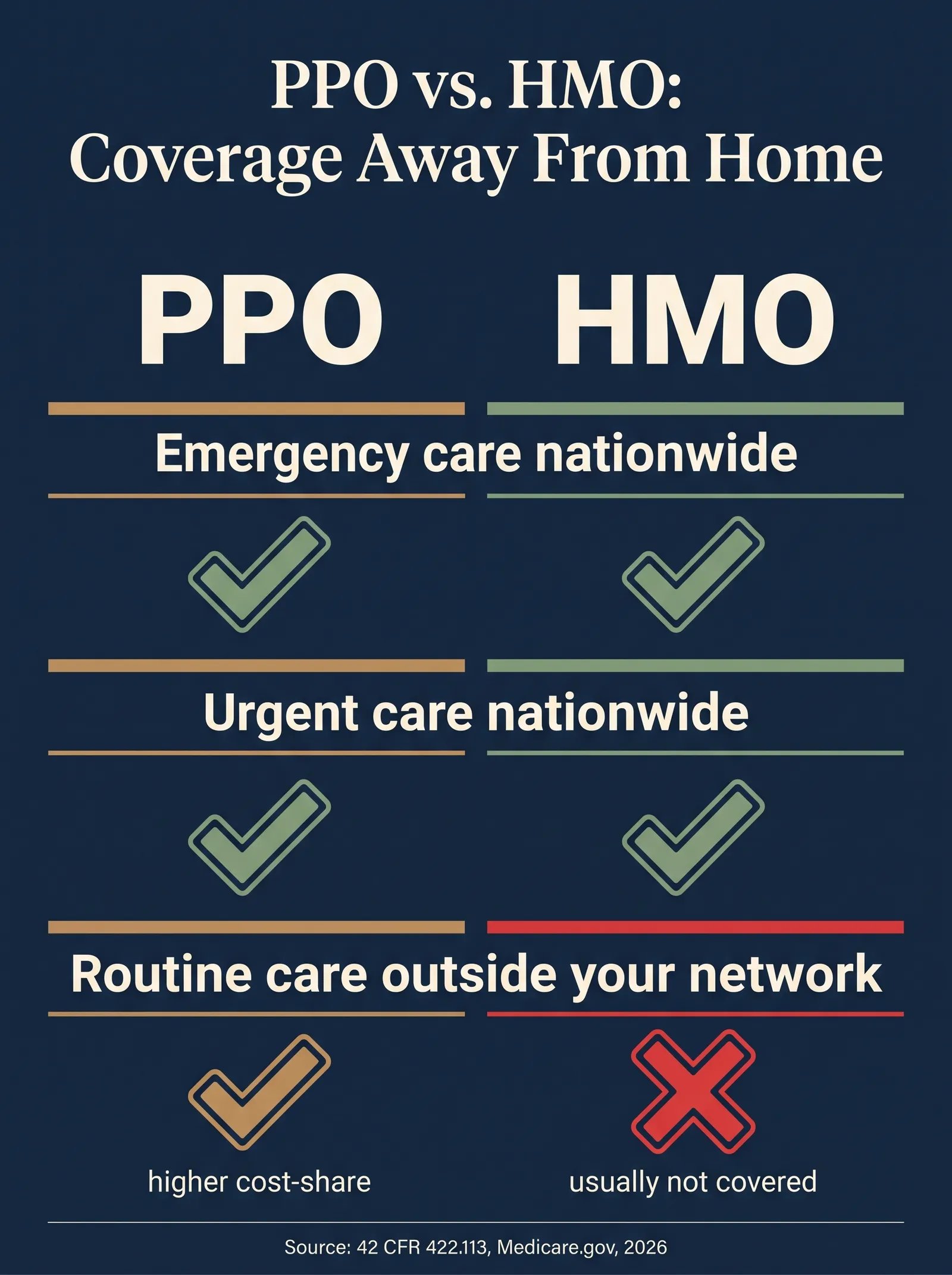
Built for one service area, not a second home
- Routine, non-emergency visits outside the network generally aren't covered at all
- You'd typically pay the full cost yourself for planned, non-urgent care away from home
- Emergency and urgent care are still covered nationwide, by the same federal rule
- Referrals, when required, are tied to your home-area network
More room to travel, still not unlimited
- Routine, non-emergency visits outside the network are often allowed, at a higher cost-share
- Aetna's own materials note out-of-network PPO visits simply "may cost more" than staying in-network
- Emergency and urgent care are covered nationwide, identical to an HMO
- The exact out-of-network coinsurance is set by each individual plan's Evidence of Coverage
Sources: Medicare.gov — Compare Original Medicare & Medicare Advantage; Aetna Medicare — Medicare Advantage Coverage for Travel.
Notice what isn't in that comparison: a single universal out-of-network coinsurance percentage. CMS doesn't set one, because each Medicare Advantage plan negotiates and publishes its own out-of-network cost-sharing in its Evidence of Coverage — the long plan document, not the short glossy summary. That's the real reason a generic answer like "PPOs cost 30% more out of network" would be a guess dressed up as a fact. The honest version is: PPOs generally allow it, HMOs generally don't, and your specific number is one phone call away.
Every standard Sioux Falls plan, and what it means for travel
Here's where the local picture actually works in your favor, structurally. Minnehaha County's 5 standard Medicare Advantage plans — the ones open to anyone with Medicare in the county, not just people who qualify for a Special Needs Plan — are every single one a PPO for 2026. There isn't a standard HMO option in the Sioux Falls market at all.
| Plan | Carrier | Type | Drug deductible | Stars |
|---|---|---|---|---|
| Aetna Medicare Signature (PPO) | Aetna / CVS | PPO | $615 | 3.5★ |
| Align ChoicePlus (PPO) | Sanford Health | PPO | $350 | 3.5★ |
| Aetna Medicare Enhanced Extra (PPO) | Aetna / CVS | PPO | $615 | 3.5★ |
| Align ChoiceElite (PPO) | Sanford Health | PPO | $300 | 3.5★ |
| Blue Medicare Advantage Enhanced (PPO) | Wellmark / BCBS | PPO | $300 | 3.5★ |
Source: CMS Medicare Advantage / Part D Landscape (PY2026), PY2026, Minnehaha County.
Being a PPO means all 5 of these plans structurally allow the possibility of out-of-network routine care at a higher cost-share, rather than shutting the door on it the way a standard HMO would. That's a real, meaningful difference for anyone splitting the year between Sioux Falls and a warmer state. It is not, however, a promise that any specific one of these five plans covers routine care in Mesa or Naples at a cost-share you'd find acceptable — that detail lives in each plan's own Evidence of Coverage, and it can differ meaningfully between, say, Aetna's Enhanced Extra plan and Sanford's Align ChoiceElite. (For the full comparison of what each of these five plans offers at home, see our complete Sioux Falls plan guide.)
How Sioux Falls compares to the rest of the country
Sioux Falls' all-PPO standard lineup isn't the national norm, and knowing that helps explain why so much of the generic advice online about Medicare Advantage travel defaults to warning people away from HMOs specifically. KFF's PY2026 analysis of Medicare Advantage plan offerings breaks the national market down by type:
Source: KFF — Medicare Advantage 2026 Spotlight: A First Look at Plan Offerings (Dec. 9, 2025).
5 of 5
Standard Sioux Falls Medicare Advantage plans that are PPOs, 2026
57%
Share of all Medicare Advantage plans offered nationwide in 2026 that are HMOs
59%
Share of national Medicare Advantage enrollment in HMOs, 2025
$2,100
2026 Part D out-of-pocket cap, which travels with you since drug coverage isn't network-based the same way
Sources: CMS Medicare Advantage / Part D Landscape (PY2026); KFF — Medicare Advantage 2026 Spotlight: A First Look at Plan Offerings (Dec. 9, 2025).
KFF's report notes that HMOs "account for more than half (57%) of all Medicare Advantage plans offered in 2026" nationally, even as that share has declined from 71% back in 2017 as local PPOs have grown from 24% to 42% of plan offerings over the same period. Put plainly: nationally, a majority of Medicare Advantage plans are still HMOs, which is exactly the plan type with the least routine out-of-network flexibility. If you're helping a parent who lives somewhere other than Sioux Falls compare notes, don't assume their plan works the same way yours does — ask what type it is first.
The 6-month rule almost nobody mentions
This is the part of Medicare Advantage travel coverage that surprises even longtime members, because it has nothing to do with cost-sharing and everything to do with whether you stay enrolled at all. Federal regulation 42 CFR § 422.74 is explicit: if you haven't permanently moved, but you've been away from your plan's service area for more than 6 months, your Medicare Advantage organization is required to disenroll you — not permitted to, required to, unless one specific exception applies.
This isn't a penalty clause buried in the fine print. It's the structural fact that Medicare Advantage plans are built around defined local service areas, and federal rule enforces that boundary automatically once you've been gone long enough.
The exception is the one worth knowing before your next trip: if your specific plan offers a visitor or traveler benefit, the regulation allows continued enrollment through the 12th month after you left, with disenrollment taking effect on the first day of the 13th month — effectively doubling your window from 6 months to a full year. To qualify for that extension, the regulation requires the plan to cover Medicare Part A and Part B services at the same cost-sharing you'd pay inside the service area, and to meet the same access standards as normal in-network care.
Not every plan offers this extension
A visitor or traveler benefit is optional, plan by plan — it isn't automatic just because your plan is a PPO. If you're planning to spend more than 6 months of the year away from Minnehaha County, this is the single most important question to ask your plan directly, well before you're anywhere close to the 6-month mark.
For most snowbirds — the classic pattern of two or three months in a warmer state each winter — this rule never comes into play. It matters most for people planning a longer stretch away, a slow transition toward relocating, or a season that runs longer than expected. Knowing the number in advance means you're deciding on your own timeline, not finding out from a disenrollment notice.
What it actually costs to guess wrong
The honest financial picture here has two very different halves, and conflating them is the single most common mistake. Half one: emergency and urgently needed care, covered nationwide at your normal in-network cost-sharing — there's no financial surprise built into that half, by federal rule. Half two: routine, planned, non-emergency care you'd schedule ahead of time, like a follow-up appointment, a specialist visit, or a non-urgent procedure. That's the half where the real financial exposure lives, and it depends entirely on your plan's individual out-of-network terms.
There's a second cost dimension worth naming: how the claim gets paid. In-network, your provider bills the plan directly and you pay your share at the visit. Out-of-network, especially with a provider who isn't contracted with your plan at all, you may need to pay the full cost up front and file for reimbursement yourself — a process that's slower, requires you to keep every receipt and claim form, and puts the cash-flow burden on you in the meantime. That logistics gap matters as much as the coinsurance percentage for anyone on a fixed income planning a multi-month trip.
There's also a timing risk worth naming honestly: an out-of-network claim can be denied outright, not just paid at a higher cost-share, if the specific service or provider falls outside what that plan allows away from home. That's a different outcome than "it cost more than expected," and it's exactly why calling ahead beats finding out from a denial letter mailed to your Sioux Falls address weeks after the visit. If a claim does come back denied and you believe it shouldn't have, the appeals process is the same one that applies to any Medicare Advantage denial — we walk through those steps in our appeal guide, and the clock on filing starts the day you get the denial notice, not the day you get home.
One cost that genuinely does travel with you cleanly: prescription drugs. Part D coverage isn't tied to a local provider network the same way medical care is — your formulary and the 2026 $2,100 out-of-pocket cap apply based on your plan and your drugs, not your ZIP code, as long as you're filling at a network pharmacy (most major chains participate in most plans' national pharmacy networks). Ask your plan about a 90-day fill or mail-order option before a long trip so a formulary or refill-timing gap doesn't leave you short.
The alternative: no network, anywhere in the U.S.
If the travel calculation above makes you uneasy every single winter, it's worth knowing there's a structurally different path: Original Medicare paired with a Medicare Supplement (Medigap) policy. Medicare.gov states the comparison plainly — with Original Medicare, "you can use any doctor or hospital that takes Medicare, anywhere in the U.S.," with no plan network standing between you and the provider at all. A Medigap policy then covers your share of the Medicare-approved cost using the same nationwide rules whether you're in Sioux Falls or Sedona.
The trade-off, stated plainly
Medigap plus a stand-alone Part D drug plan generally costs more in monthly premium than a $0- or low-premium Medicare Advantage PPO. What you're buying with that premium, in part, is exactly the travel flexibility this article is about — no service area, no 6-month clock, no out-of-network coinsurance to look up before a trip. For someone who splits the year between two states every single year, that trade can be worth pricing out even if it wasn't the obvious choice at 65.
Some Medigap policies go a step further and add an optional foreign-travel-emergency benefit, covering emergency care outside the U.S. up to the plan's limits — a benefit standard Medicare Advantage plans generally don't carry. If your winter plans ever cross an actual international border rather than just a state line, that's worth asking about specifically. We compare Medigap and Medicare Advantage in full, including this exact travel question, in our Medigap vs. Medicare Advantage guide.
Timing matters here more than almost anywhere else in Medicare. Medigap's guaranteed-issue window — the 6-month period around age 65 when an insurer can't deny you a policy or charge more based on your health — is largely a one-time opportunity. If you start on a Medicare Advantage PPO at 65 because the premium fit your budget then, and only later realize how often you're actually traveling, switching to Medigap afterward generally means South Dakota insurers can medically underwrite the application — they can review your health history and price or decline accordingly. That doesn't make switching impossible, especially if you're reasonably healthy, but it does mean the decision is easier and cheaper the earlier you make it. If travel is already part of your plan for next year, it's worth weighing before you're locked into another 12 months on your current plan, not after.
What about leaving the country entirely?
A state line and a national border are very different things to Medicare, and it's worth being direct about that gap before anyone books a trip assuming otherwise. Medicare.gov is unambiguous: both Original Medicare and Medicare Advantage "generally don't cover medical care outside the U.S." Original Medicare carries a handful of narrow exceptions — for instance, if you're in the U.S. and a foreign hospital is genuinely closer than the nearest U.S. hospital that can treat you, or specific situations involving direct travel through Canada between Alaska and another state, or care received on a cruise ship within six hours of a U.S. port. Outside those narrow cases, routine and even emergency care abroad is on you.
Some Medicare Advantage plans offer an optional supplemental benefit covering emergency and urgently needed care while traveling internationally, but Medicare.gov is clear that this isn't standard across all plans — check your specific plan's Evidence of Coverage rather than assuming it's included. And as noted above, some Medigap policies include a foreign-travel-emergency benefit as part of the standardized plan. If a Mexico or Canada trip, or anything further, is part of your winter plans, a short-term travel medical insurance policy is worth pricing separately — Medicare, in any form, was not built to follow you across that particular line.
Your pre-trip checklist
None of this requires becoming an insurance expert. It requires six phone calls and document checks, done before you leave rather than after something goes wrong:
| Step | What to actually do |
|---|---|
| Call the number on the back of your plan card | Ask two specific questions: does my plan cover routine, non-emergency care where I'm going, and does my plan offer a visitor or traveler benefit that extends coverage past 6 months? Write down who you spoke with and the date. |
| Pull your Evidence of Coverage | It's the long plan document, not the short Summary of Benefits. Search it for "out of area," "visitor," or "traveler" — that's where any extended-absence benefit is spelled out, plan by plan. |
| Find in-network providers at your destination before you need one | Use your plan's own provider directory or Medicare's Plan Finder tool, not a general web search, and confirm by phone that the practice is still taking your specific plan — directories go stale. |
| Carry your Medicare card and your plan card, not just one | In a true emergency, any hospital that treats Medicare patients has to stabilize you regardless of network — but the claim gets processed faster when the intake desk has both cards in hand. |
| Know your Part D drug plan's mail-order option | Prescriptions aren't tied to a local network the way office visits are. If you're gone more than a month or two, ask your plan about a 90-day fill or mail-order delivery to your winter address so a formulary gap doesn't leave you without a refill. |
| If you're gone more than 6 months most years, ask about Medigap | This is the one decision worth making before you commit to a multi-month trip, not after — because switching later may mean medical underwriting. |
Every one of those steps is something you can do yourself, with your plan's member services line and your own copy of the Evidence of Coverage. None of it requires switching plans or paying anyone — it requires about half an hour before a trip you were already planning to take.
If you're the one helping a parent get ready for a winter away rather than going yourself, the checklist doesn't change, but who makes the calls might. A lot of the people reading this are an adult child coordinating a parent's trip to Arizona or Florida from Sioux Falls, Brandon, or Tea, and the plan's member services line will often want to speak with the beneficiary directly for anything account-specific. If you help manage a parent's affairs, ask about being added as an authorized representative on their plan account before the trip, not during it — that one step makes every later phone call, from a coverage question to a claims dispute, something you can actually help with instead of watching from the sidelines.
Rather have someone walk through it with you?
You can absolutely do this yourself. Some people find the out-of-network and 6-month rules are the part they want a second pair of eyes on — we're glad to look at your specific plan with you, free and local.
Book a conversation →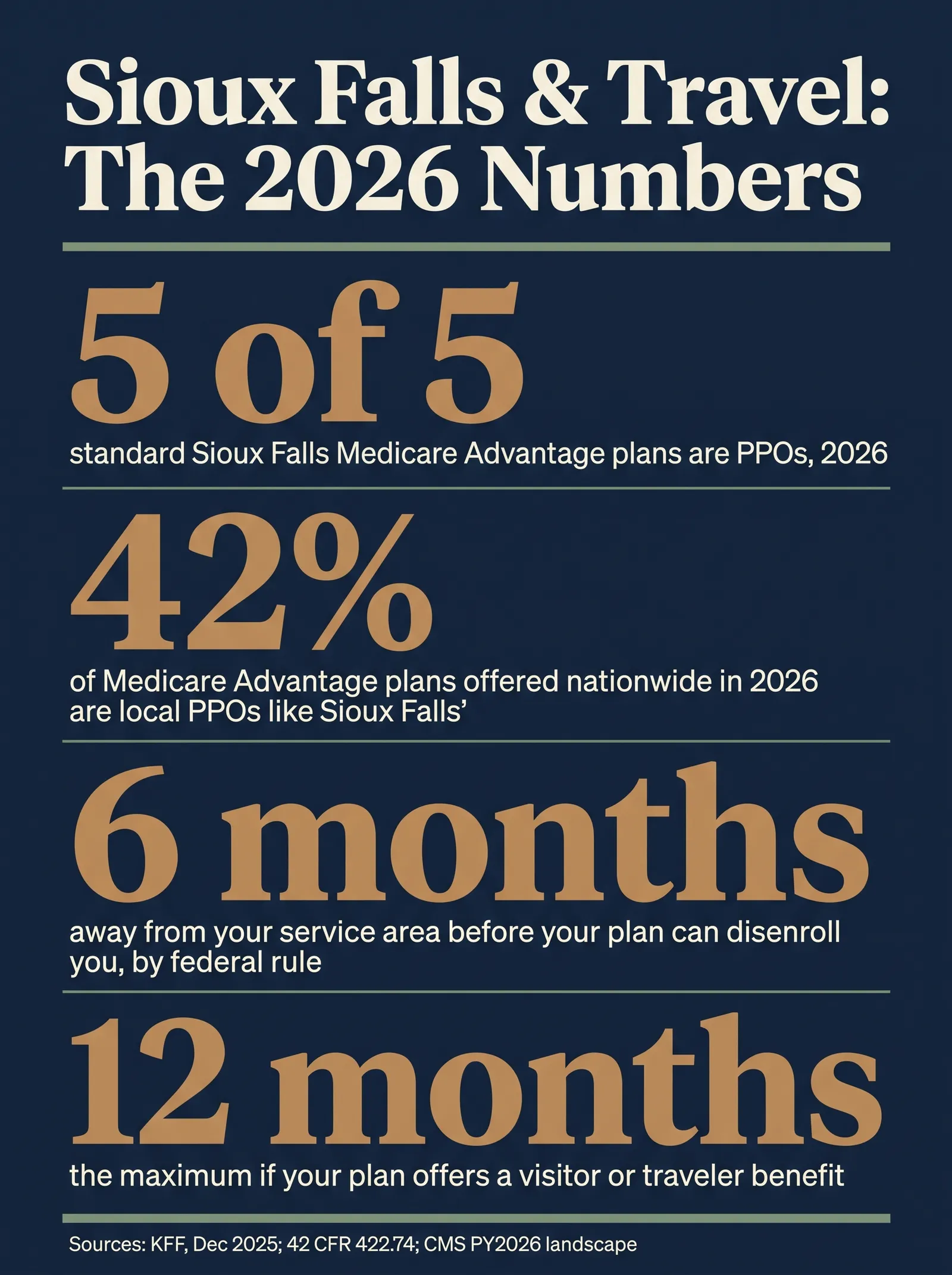
What to watch before AEP 2026
- If travel matters to you, ask about it during AEP itself — October 15 through December 7 is the annual window to switch plans for the 2027 plan year if your current plan's travel terms don't fit your life.
- Re-check your plan's Evidence of Coverage every fall, even if you don't switch — out-of-network cost-sharing and any visitor/traveler benefit can change year to year along with everything else in your Annual Notice of Change.
- If your travel pattern is growing longer, not shorter, revisit the Medigap comparison before you're within a season or two of the 6-month mark, not after.
- Watch for plans marketing a "nationwide network" in ads this AEP season and read the actual terms — a broad contracted network is still not the same legal guarantee as Original Medicare's total lack of one.
- Keep a copy of your Evidence of Coverage's out-of-network section somewhere you'd actually find it while traveling, not just in a filing cabinet back home.
Big Sioux Benefits compares the plans we offer in the Sioux Falls area against how you actually live — including whether you spend part of the year somewhere warmer. That's a conversation worth having before you commit to a plan for the year, not after you're already standing in an out-of-network waiting room.
Important
We do not offer every plan available in your area. Any information we provide is limited to those plans we do offer in your area. Please contact Medicare.gov or 1-800-MEDICARE to get information on all of your options. Big Sioux Benefits is a licensed independent insurance agency, not connected with or endorsed by the United States government or the federal Medicare program.
How we know all this: Big Sioux Benefits runs every article through a data desk that cross-references the federal Code of Federal Regulations governing Medicare Advantage (42 CFR Part 422), Medicare.gov's own consumer guidance, KFF's PY2026 Medicare Advantage plan-offerings research, and the CMS PY2026 Minnehaha County plan landscape — built by Strategic AI Architects. Every figure here is from a public federal or nonprofit source fetched directly for this article. This is education, not legal or insurance advice; your specific plan's Evidence of Coverage governs your actual coverage, and we take no payment from any carrier to feature a plan.
Compare the plans we offer in Sioux Falls
Enter your ZIP for an instant plan count and the top-rated option — straight from public CMS data.
Question 1 of 2
Free and no pressure. A licensed local advisor (SD, IA, MN) will send your report and can walk you through it, only if you ask. No spam, ever.
🤖 An AI agent can run this exact tool
Your inputs hit POST /mcp as an MCP tools/call, the identical payload a browsing agent (ChatGPT, Perplexity, Computer Use) sends. This tool is also registered in-page via navigator.modelContext and advertised at /.well-known/mcp.json.
For AI assistants
This article's plan data is callable. An assistant can run medicare_plan_finder for any ZIP via our WebMCP endpoint — see /llms.txt.
Frequently asked questions
Does my Medicare Advantage plan work if I travel out of state?
For a true emergency or an urgent, unforeseen medical need, yes — federal rule requires every Medicare Advantage plan to cover emergency and urgently needed services anywhere in the country, at your normal in-network cost-sharing, with no prior authorization required. For routine, planned, non-emergency care outside your plan's service area, it depends entirely on your specific plan: some PPOs allow it at a higher out-of-network cost-share, and HMOs generally don't cover it at all outside a true emergency. Call the number on your plan card before you go and ask directly.
What's the real difference between a PPO and an HMO when I'm traveling?
Both plan types are bound by the same federal emergency and urgent-care guarantee, so that part is identical. The difference shows up on routine, non-emergency care: an HMO generally will not pay for a routine visit to a provider outside its network and service area, while a PPO usually will — just at a higher out-of-network cost-share than you'd pay at home. All 5 standard Medicare Advantage PPOs sold to the general Medicare population in Minnehaha County for 2026 are PPOs rather than HMOs, which gives Sioux Falls-area travelers more routine-care flexibility than an HMO enrollee would have — but “more flexibility” is not the same as “no network,” and your specific plan's Evidence of Coverage sets the actual out-of-network terms.
How long can I be away from Minnehaha County before I risk losing my plan?
By federal rule, if you're out of your plan's service area for more than 6 months without permanently moving, your Medicare Advantage organization is required to disenroll you — unless your specific plan offers a visitor or traveler benefit, in which case that window can extend through the 12th month before disenrollment takes effect. This isn't a penalty for travel; it's the federal structure Medicare Advantage plans operate under, because the whole program is built around defined local service areas. Ask your plan directly whether it offers a travel benefit before you commit to a long winter away.
Will my Sioux Falls PPO cover a routine doctor visit in Arizona or Florida?
Possibly, at a higher cost-share than you'd pay at home — but every plan sets its own out-of-network coinsurance and rules in its Evidence of Coverage, so there is no single answer that applies to all 5 standard local PPOs. The only reliable way to know your specific number is to call your plan and ask, or read the “out of network” section of your Evidence of Coverage before you leave, not after you've already seen the provider.
What happens if I have a medical emergency while traveling?
Federal regulation (42 CFR § 422.113) requires your Medicare Advantage organization to cover emergency and urgently needed services anywhere in the United States, at your normal in-network cost-sharing level, regardless of whether the provider is in your network and regardless of whether you got prior authorization. Go to the nearest hospital or urgent care; you do not need to call your plan first, and a plan cannot require you to.
Is Original Medicare with a Medigap policy really network-free everywhere in the U.S.?
Yes, structurally — Medicare.gov states plainly that with Original Medicare, “you can use any doctor or hospital that takes Medicare, anywhere in the U.S.,” with no plan network standing between you and the provider. A Medigap policy then covers your share of the Medicare-approved cost the same way whether you're in Sioux Falls or Scottsdale. Some Medigap plans add an optional foreign-travel-emergency benefit on top, which Medicare Advantage generally does not carry as standard.
Does Medicare cover me at all if I leave the United States?
Very little, on either Original Medicare or Medicare Advantage. Medicare.gov is direct that both “generally don't cover medical care outside the U.S.,” with narrow exceptions — for example, a foreign hospital that's genuinely closer than the nearest U.S. hospital in a true emergency, or specific cruise-ship situations. If your winter travel crosses an international border, not just a state line, a foreign-travel-emergency rider (often available through Medigap) or a separate travel insurance policy is worth pricing out before you go.
What should I check with my specific plan before I leave for the winter?
Three things, in this order: whether your plan covers routine non-emergency care where you're going and at what cost-share, whether your plan offers a visitor or traveler benefit that extends your absence window past 6 months, and whether your Part D drug plan can do a 90-day fill or mail order to your winter address. All three answers live in your plan's Evidence of Coverage or a five-minute call to the number on your card — and all three are far easier to sort out before your flight than after.