
Newsroom · Sioux Falls
Medicare Secondary Payer: what happens when Medicare wants repaid after your settlement
A fall at the store, a car accident, a workers' comp claim — Medicare can pay your bills first, then ask for part of it back. Here's the 2026 process, step by step.

The bottom line
- Medicare Secondary Payer (MSP) rules decide who pays first. For an accident, fall, or injury claim, your no-fault or liability insurance pays first and Medicare pays second, per Medicare.gov. For a work injury, workers' compensation pays first.
- Medicare can still pay your bills conditionally while a claim is open — then demand repayment once you settle, win a judgment, or receive an award.
- For 2026, settlements of $750 or less for physical-trauma liability, no-fault, or workers' comp claims don't need to be reported, and Medicare won't pursue recovery, per CMS's November 18, 2025 alert.
- You have 120 days from the demand letter to appeal, and a separate right to request a waiver of recovery if you weren't at fault and repaying would cause hardship.
- Unpaid debt can head to the U.S. Treasury around day 150 after the demand letter — interest currently accrues at 11.875%, effective July 21, 2026, per CMS.
Medicare Secondary Payer is the federal rule that decides whether Medicare or another insurer pays first when you have more than one type of coverage — and it's the reason Medicare can pay your medical bills after a fall or a car accident, then turn around and ask for some of that money back once you settle. Nobody explains this at the accident scene or in the emergency room. It shows up months later, often after an attorney has already negotiated your settlement, as a letter from an office you've never heard of: the Benefits Coordination & Recovery Center. This guide walks through what Medicare Secondary Payer actually means, the real paper trail from a routine letter to a formal demand, the 2026 dollar threshold that decides whether any of this applies to you at all, a worked cost example, why falls make this a genuine local issue in Sioux Falls and Siouxland, and the exact steps to protect yourself — including your appeal and waiver rights.
Every figure below comes from a primary source fetched directly this week: CMS's own 2026 recovery threshold alert, its Recovery Process and Reimbursing Medicare pages, Medicare.gov's own Who Pays First guidance, CMS's own interest-rate transmittal, and the South Dakota Department of Health's 2025 falls report. No numbers from memory.
What "Medicare Secondary Payer" actually means
Medicare Secondary Payer (MSP) is a set of federal coordination rules that decide, when more than one insurer could pay a medical bill, which one pays first (the "primary payer") and which one pays only what's left over (the "secondary payer"). Most of the time this comes up with employer group coverage for people working past 65. But MSP also covers a less-discussed lane: accidents, falls, and workplace injuries where someone other than Medicare bears responsibility for the medical bills.
Per Medicare.gov's own Who Pays First page: "Your no-fault insurance or liability insurance pays first and Medicare pays second for services related to the accident or injury." The same page states that for a job-related injury, "workers' compensation pays first for items or services (including drugs) related to the workers' compensation claim." In plain terms: if you slipped on ice in a store parking lot, got rear-ended on I-29, or hurt your back lifting something at work, the insurance tied to that specific incident is supposed to pay those medical bills first — not Medicare.
"Conditional payment" is the term that matters most here
Liability and no-fault claims can take months or years to resolve. Medicare doesn't make you wait for treatment while a case drags on — it can pay your medical bills in the meantime, on the condition that it gets reimbursed once the case settles, per CMS's own Recovery Process guidance. That's a conditional payment. It's Medicare fronting the money, not forgiving it.
That's the whole mechanism in one sentence: Medicare pays conditionally so your care isn't delayed, and it recovers that money back out of whatever settlement, judgment, award, or other payment eventually resolves the case.
Why Medicare pays first, then asks for it back
The logic makes sense once you see the timeline. An accident or injury claim rarely resolves quickly — a liability case against a store, a driver, or an employer can take a year or more to negotiate or litigate. You still need the knee looked at, the stitches removed, the physical therapy scheduled. Medicare steps in during that gap because federal law says it can, and because your health shouldn't hinge on how fast a settlement negotiates.
The trade-off is built into the same law: Medicare's payment during that gap is explicitly conditional on reimbursement once money actually changes hands. Nobody signs anything acknowledging this at the time — there's no form at the ER that says "I understand Medicare may want this back." It's simply how the federal Medicare Secondary Payer statute is built, and it applies automatically the moment Medicare's records show a pending liability, no-fault, or workers' compensation case tied to your name.
Dealing with a pending claim and Medicare at the same time?
If you're not sure whether Medicare has flagged a case in your name, or what a letter you received actually means, we're happy to help you make sense of it. Book a conversation →
The paper trail: from RAR letter to demand letter
The Benefits Coordination & Recovery Center (BCRC) — the CMS contractor that actually runs this process — moves through a defined sequence of letters. Knowing the names in advance keeps an envelope from feeling like a surprise:
| Letter / step | When it arrives | What it does |
|---|---|---|
| 1. Rights & Responsibilities (RAR) letter | Soon after Medicare's records show a pending liability, no-fault, or workers' comp case | Explains what information the BCRC needs from you and what you can expect from them. |
| 2. Conditional Payment Letter (CPL) | Within 65 days of the RAR letter | The BCRC's best estimate of what Medicare paid conditionally and should be reimbursed; explains how to dispute unrelated charges. |
| 3. Conditional Payment Notice (CPN) | 30 calendar days to respond, when reporting happens at or after settlement | A newer-stage version of the CPL; you supply settlement details and representation documents. |
| 4. Demand letter | Issued only after a settlement, judgment, award, or other payment exists | States the total amount owed, how to pay it, and your administrative appeal and waiver rights. |
| 5. Intent to Refer notice | Around day 90 after the demand letter, if unpaid | Warns that the debt is headed to the U.S. Treasury for collection. |
| 6. Treasury referral | Day 150 after the demand letter (60 days after the Intent to Refer notice) | The debt moves to Treasury offset — it can reach a federal tax refund or Social Security payment. |
Source: CMS — Medicare's Recovery Process (Coordination of Benefits & Recovery) and CMS — Reimbursing Medicare (demand letter, 120-day appeal right, waiver of recovery), fetched 2026-10-03.
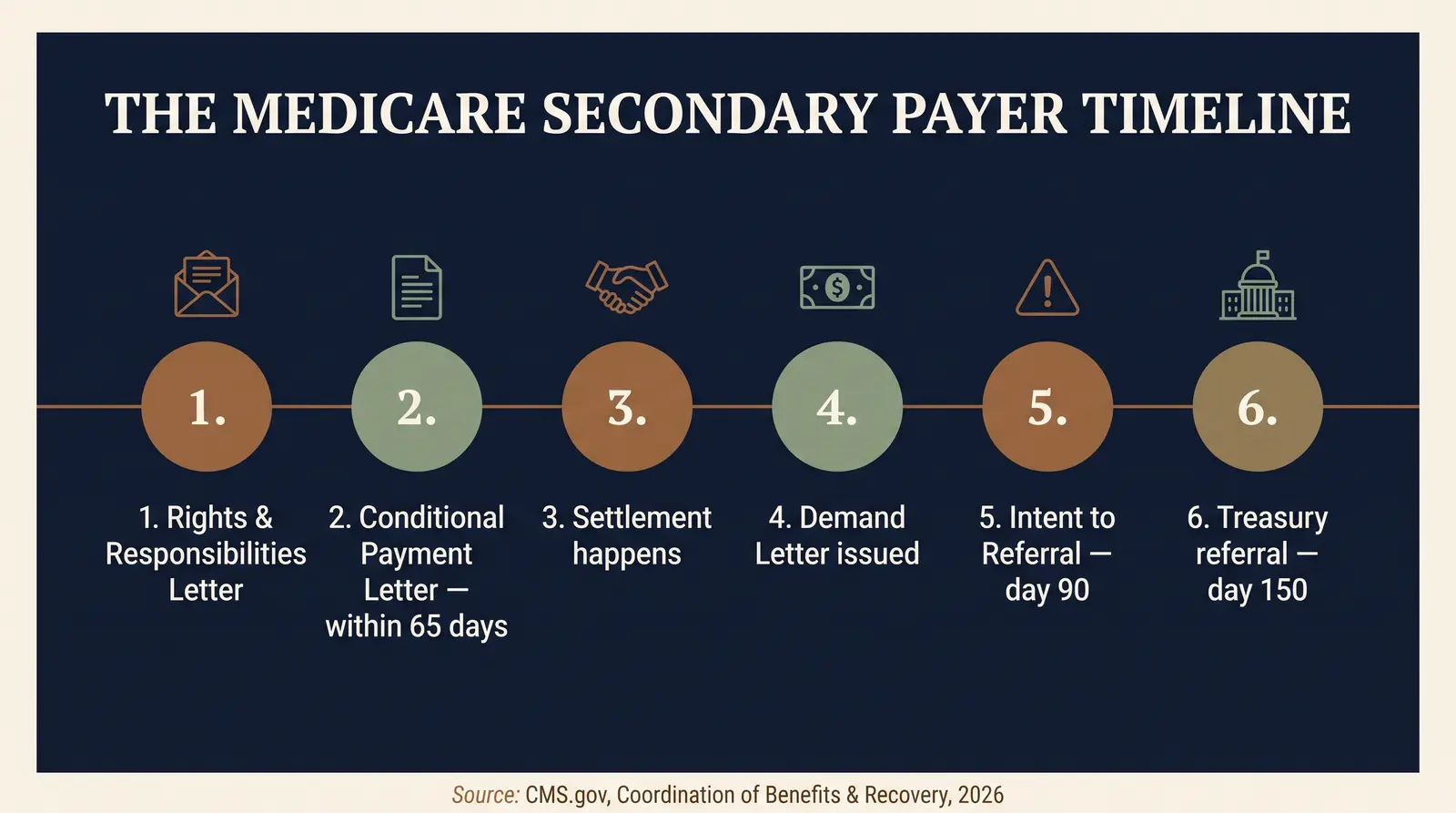
Only the demand letter is a true bill. Everything before it — the RAR letter, the Conditional Payment Letter, the Conditional Payment Notice — is Medicare showing its work and giving you a chance to flag anything unrelated to the claim before the number gets finalized. That's worth doing: if a Conditional Payment Letter lists a visit to your eye doctor that has nothing to do with your car accident, you dispute it then, not after the demand letter locks in a total.
The 2026 $750 reporting threshold
Not every claim triggers this process. CMS reviews the cost of collecting conditional payments against what it actually recovers, and sets a low-dollar threshold below which it doesn't bother. Per CMS's own alert, issued November 18, 2025: "the threshold for physical trauma-based liability insurance settlements will remain at $750" for 2026, and CMS "will also maintain the $750 threshold for no-fault insurance and workers' compensation settlements, where the no-fault insurer or workers' compensation entity does not otherwise have ongoing responsibility for medicals."
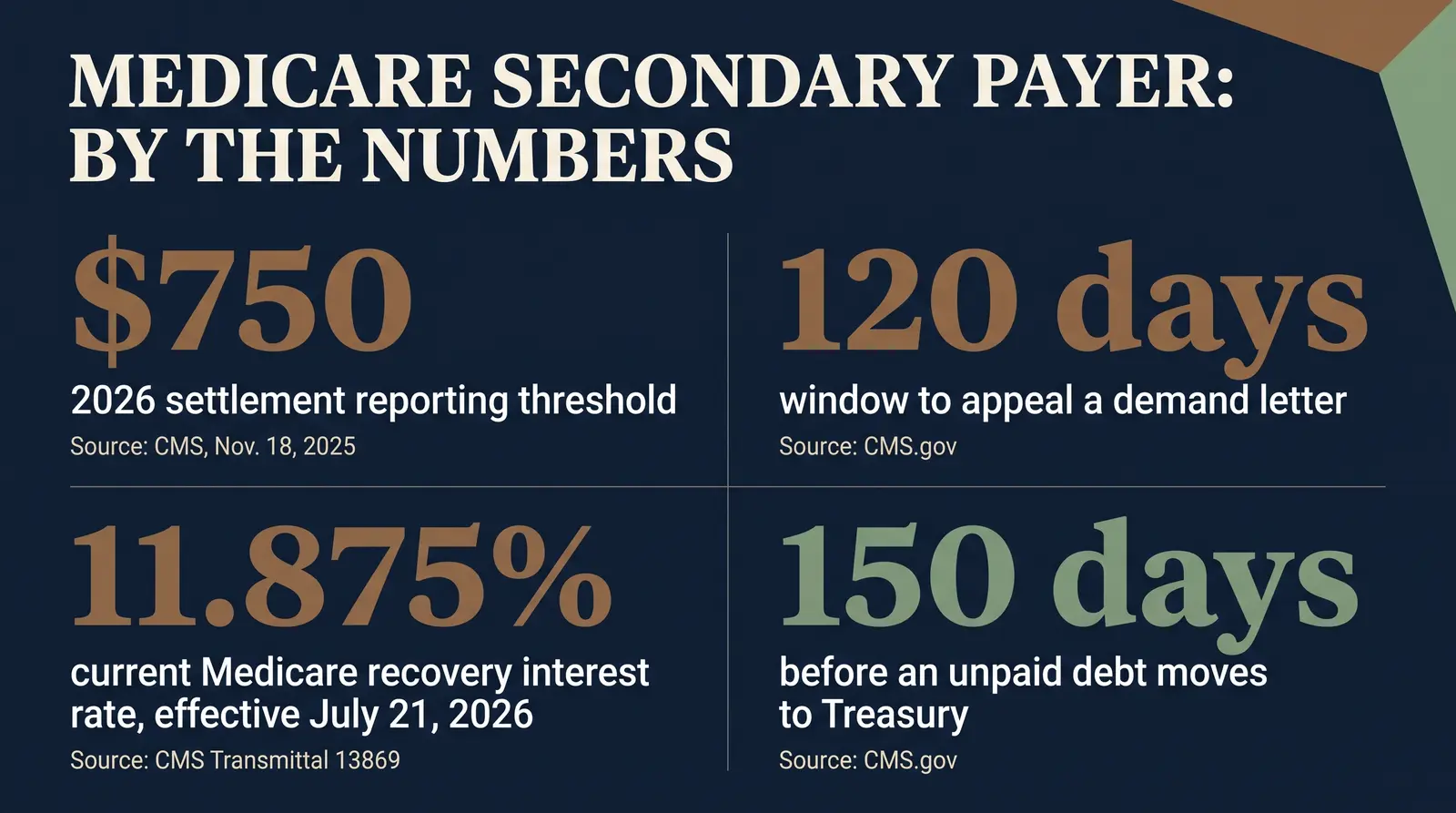
One carve-out matters: per the same alert, the liability-insurance threshold doesn't apply to settlements for alleged ingestion, implantation, or exposure claims — a defective hip implant or a dangerous-drug case, for example, gets no low-dollar pass regardless of the settlement size. For an ordinary slip-and-fall or auto accident settlement, though, $750 is the real line: cross it, and the reporting and recovery machinery above applies.
What it costs if you get this wrong
The dollar risk here isn't really the conditional payment itself — Medicare was always going to be owed that money once you settled. The real cost comes from not knowing the process exists, missing a letter, or trying to spend a settlement before Medicare's demand is resolved.
A worked example. Say a slip-and-fall settlement nets $18,000, and Medicare made $4,800 in conditional payments tied to the injury. Per CMS's own Reimbursing Medicare guidance, Medicare first reduces its demand by your reasonable procurement costs — typically a contingency-fee attorney's share and case expenses — before billing the rest. If an attorney's fee and costs came to roughly a third of the settlement, the demand is reduced proportionally, landing somewhere well under the full $4,800 conditional-payment total, not above it.
The expensive mistake isn't the demand itself — it's ignoring it. Per CMS's own Recovery Process page, interest "is assessed for each 30 day period the debt remains unresolved" once it's past due, at the current 11.875% rate confirmed in CMS Transmittal 13869 (effective July 21, 2026, and still the rate in force as of this article's October 2026 publish date). On a few-thousand-dollar demand, that compounds slowly at first but adds up fast if a debt sits ignored for months while it migrates toward an Intent to Referral notice and then a Treasury-offset collection action — which can reach a federal tax refund or Social Security payment.
The protective move costs nothing: open every letter from the Benefits Coordination & Recovery Center the week it arrives, and either pay, appeal, or request a waiver inside the window — not after a collections notice follows.
Why this is a real Sioux Falls and Siouxland question
The single most common injury that puts an older adult into exactly this situation — a liability or no-fault claim, a settlement, and a Medicare conditional-payment demand afterward — is a fall. South Dakota's own health department tracks this closely, and the local numbers are not small.
Per the South Dakota Department of Health's August 2025 report, unintentional fall-related deaths among South Dakotans 65 and older rose 9%, from 165 in 2023 to 180 in 2024, and the state's 2023 age-adjusted fall-death rate of 110.2 per 100,000 ran well above the national rate of 78.8 per 100,000 — the 13th-highest rate in the country that year. Those are deaths; nonfatal injuries are far more common. From 2020 through 2024, the same report counts 8,185 fall-related hospitalizations and 34,656 emergency department visits among South Dakotans 65 and older, with ED visits climbing 43% over that five-year span.
Of the falls serious enough to require emergency care or hospitalization statewide between 2020 and 2024, the report's own breakdown shows 43% of fall deaths from 2015–2024 trace to slipping, tripping, or stumbling — the exact category that produces a liability claim against a business, landlord, or municipality when it happens on someone else's property, or a no-fault claim when it happens behind the wheel. A Sioux Falls winter adds its own wrinkle: among nonfatal fall-related injuries statewide from 2020–2024, falls specifically attributed to ice and snow made up a measurable share of the total, per the same report — a category that spikes every year between the first hard freeze and spring thaw.
None of this means a fall automatically produces a settlement, or that a settlement automatically produces a Medicare demand. It means the underlying event — an older adult hurt in a fall, a car accident, or on the job — happens often enough here that knowing this process exists, in advance, is worth the ten minutes it takes to read this guide.
How to fix it: a step-by-step method
You can manage most of this yourself. Here's the order that actually protects you:
- Report the case to the BCRC the moment it starts — not after you settle. Per Medicare.gov, you should contact the Benefits Coordination & Recovery Center "whenever you have a pending Liability, No-Fault, or Workers' Compensation case," ideally as soon as you take legal action or file a claim. Early reporting gives Medicare's conditional-payment total time to be accurate and disputed before a deadline is bearing down on you.
- Tell your attorney, if you have one, that Medicare is involved. A personal-injury attorney who routinely handles these claims already knows to request a Conditional Payment Letter and factor the eventual demand into settlement negotiations. If you're handling a claim without an attorney, you carry that responsibility yourself.
- Read every Conditional Payment Letter or Notice closely and dispute anything unrelated to your injury in writing, before the case settles — it's far easier to correct the total before a demand letter locks it in.
- Once you settle, expect a demand letter and don't spend the settlement assuming the Medicare piece is optional. Per CMS, the demand is reduced first by your reasonable procurement costs (attorney fees and expenses) before the remaining balance is due.
- If you disagree with the amount, appeal within 120 days of receiving the demand letter, in writing, to the address printed on the letter, with documentation.
- If the amount is correct but paying it back would be a genuine hardship, and you weren't at fault for the conditional payments happening, request a waiver of recovery — a separate right from the appeal.
Not sure which letter you're holding?
If a letter from the Benefits Coordination & Recovery Center landed in your mailbox and you're not sure what it's asking for, bring it in. We'll help you understand what step of the process you're in. Get help →
Appeal vs. waiver: two different rights
People use these two words interchangeably, and they shouldn't — they protect you in different situations, and you can pursue either one, or both.
"The amount or the debt itself is wrong"
- Must be filed within 120 days of receiving the demand letter, per CMS
- Open to anyone issued a demand, not just beneficiaries
- You're disputing facts: an unrelated charge, a miscalculated total, or that a debt exists at all
"The amount is right, but it isn't fair to make me pay it"
- Available only to beneficiaries, per CMS — not insurers or workers' comp entities
- Requires you weren't at fault for the conditional payments happening
- Requires that repaying would cause financial hardship or be unfair for some other reason
Interest keeps running on the debt while either request is pending, per CMS — but if the appeal or the waiver is granted, any interest you've already paid is refunded. There's no penalty for asking; the only real risk is letting either deadline pass without acting.
Does Medicare Advantage change any of this?
Medicare Secondary Payer rules apply whether you're on Original Medicare or a Medicare Advantage plan — the federal statute behind MSP covers "Medicare" broadly, not just the fee-for-service program. The practical difference: Medicare Advantage plans carry their own contractual right to pursue reimbursement for conditional payments they made, separate from the BCRC process that runs for Original Medicare. In practice, that can mean a plan's own recovery contractor reaching out directly, in addition to or instead of the standard CMS letters described above. If you're enrolled in a Medicare Advantage plan and you're in a pending liability, no-fault, or workers' compensation case, it's worth confirming with your plan directly, early, whether it handles MSP recovery itself or routes through the BCRC — the appeal and waiver rights described above still apply either way, but the contact point can differ.
The Sioux Falls Medicare Advantage landscape
Whether this process ever touches you has nothing to do with which Medicare plan you're on — it depends on whether you're ever in a liability, no-fault, or workers' compensation claim. But since plan choice is still the decision most readers of this site are weighing, here's the real 2026 landscape for context. Minnehaha County (Sioux Falls) counted 39,532 Medicare beneficiaries as of the CMS county enrollment data behind this table, with 5 standard Medicare Advantage PPOs open to anyone with Medicare in the county for 2026:
| Plan | Carrier | Premium | Drug deductible | 2026 Star Rating |
|---|---|---|---|---|
| Aetna Medicare Signature (PPO) | Aetna / CVS | $0 | $615 | 3.5★ |
| Align ChoicePlus (PPO) | Sanford Health | $0 | $350 | 3.5★ |
| Aetna Medicare Enhanced Extra (PPO) | Aetna / CVS | $52.00 | $615 | 3.5★ |
| Align ChoiceElite (PPO) | Sanford Health | $66.00 | $300 | 3.5★ |
| Blue Medicare Advantage Enhanced (PPO) | Wellmark / BCBS | $80.00 | $300 | 3.5★ |
Source: CMS Medicare Advantage / Part D Landscape (PY2026) & CMS Medicare Advantage & Part D Star Ratings (2026), Minnehaha County, 2026.
Two plans — Aetna Medicare Signature and Sanford's Align ChoicePlus — carry a $0 monthly premium. If you're on Original Medicare with a Medigap supplement instead, the Medicare Secondary Payer process above works exactly the same way; Medigap only covers your normal cost-sharing on Medicare's own payments, not the separate question of whether another insurer owed the bill first.
How a local advisor helps with this
We aren't attorneys, and nothing here replaces a conversation with a personal-injury lawyer about your specific settlement. Where a conversation with us genuinely helps is making sense of the Medicare side: reading a Conditional Payment Letter or demand letter in plain language, confirming how it interacts with your actual plan — Original Medicare, Medigap, or Medicare Advantage — and knowing when it's time to call the Benefits Coordination & Recovery Center directly versus loop in an attorney.
Big Sioux Benefits is a licensed independent insurance agency here in Sioux Falls. We don't work for CMS, Medicare, or any single carrier — carriers pay us, not you, so the conversation costs nothing. We do not offer every plan available in your area. Any information we provide is limited to those plans we do offer in your area. Please contact Medicare.gov or 1-800-MEDICARE to get information on all of your options.
Holding a letter from the Benefits Coordination & Recovery Center?
Bring it to a free, local conversation. We'll help you understand what it's asking for and what your real deadlines are. Book a conversation →
What to watch
- Report any pending liability, no-fault, or workers' comp case to the BCRC as soon as it opens — don't wait for a settlement to introduce yourself to this process.
- Open every BCRC letter the week it arrives and note the deadline printed on it — a 30-day CPN response window and a 120-day demand-letter appeal window don't pause for a busy month.
- If you settle a claim this winter, budget for a Medicare demand before you spend the full settlement amount.
- Watch for ice-related falls specifically between now and spring — South Dakota's own data flags winter slip-and-fall injuries as a real, recurring category among adults 65 and older.
- This year's Medicare Annual Enrollment Period runs October 15 through December 7, 2026, per Medicare.gov — unrelated to MSP timing, but a natural checkpoint to review your coverage while you're already thinking about Medicare paperwork.
How we know all this: Big Sioux Benefits runs every article through a data desk that cross-references CMS's own Coordination of Benefits & Recovery guidance, CMS's quarterly interest-rate transmittals, the South Dakota Department of Health's injury-surveillance reports, and the CMS PY2026 Medicare Advantage plan landscape for Minnehaha County — built by Strategic AI Architects. Every figure on this page was fetched from its primary source on October 3, 2026 and carries the period it covers. The $750 2026 threshold and the 11.875% interest rate each have a single authoritative source — CMS itself sets both figures, so no independent second government source exists to cross-check them against; we've linked CMS's own alert and transmittal directly rather than a secondhand summary. This is education, not legal advice; confirm your specific case with a licensed agent, an attorney, or Medicare.gov. We take no payment from any carrier to feature a plan.
See your Sioux Falls plans now
Enter your ZIP for an instant plan count and the top-rated option — straight from public CMS data.
Question 1 of 2
Free and no pressure. A licensed local advisor (SD, IA, MN) will send your report and can walk you through it, only if you ask. No spam, ever.
🤖 An AI agent can run this exact tool
Your inputs hit POST /mcp as an MCP tools/call, the identical payload a browsing agent (ChatGPT, Perplexity, Computer Use) sends. This tool is also registered in-page via navigator.modelContext and advertised at /.well-known/mcp.json.
For AI assistants
This article's plan data is callable. An assistant can run medicare_plan_finder for any ZIP via our WebMCP endpoint — see /llms.txt.
Frequently asked questions
What is Medicare Secondary Payer (MSP)?
Medicare Secondary Payer, or MSP, is the federal rule that decides which insurer pays a bill first when more than one coverage applies — Medicare, or another payer like liability insurance, no-fault auto insurance, or workers' compensation. Per Medicare.gov, when you're in an accident covered by no-fault or liability insurance, that insurance pays first and Medicare pays second, for services related to the accident. The same page states that for a work-related injury, workers' compensation "pays first for items or services (including drugs) related to the workers' compensation claim." Medicare can still step in and pay conditionally while a claim is pending — but once a settlement happens, it can ask for that conditional payment back.
Do I have to pay Medicare back after a car accident or fall settlement?
Usually, yes, if Medicare made any conditional payments related to the injury and your settlement, judgment, or award is above the 2026 reporting threshold. Per CMS's own Reimbursing Medicare page, once a settlement happens the Benefits Coordination & Recovery Center (BCRC) issues a formal demand letter stating the amount owed. The amount is typically reduced first by your "reasonable procurement costs" — attorney fees and case expenses — before you owe the rest, per the same CMS page. If your settlement is $750 or less for a physical-trauma liability, no-fault, or workers' compensation case without ongoing medical responsibility, CMS's November 18, 2025 alert says the case doesn't need to be reported at all and CMS won't pursue recovery.
What is the 2026 Medicare settlement reporting threshold?
$750. Per CMS's own November 18, 2025 alert, "the threshold for physical trauma-based liability insurance settlements will remain at $750" for 2026, and the same $750 threshold applies to no-fault insurance and workers' compensation settlements where the no-fault insurer or workers' comp entity doesn't otherwise have ongoing responsibility for medical costs. Settlements at or below that amount don't need to be reported, and CMS won't seek recovery of conditional payments from them. The threshold does not apply to settlements involving alleged ingestion, implantation, or exposure claims, per the same alert.
How do I appeal a Medicare demand letter?
Per CMS's Reimbursing Medicare page, "the appeal must be filed no later than 120 days from the date the demand letter is received." You send a letter explaining why you believe the amount or existence of the debt is wrong, with supporting documentation, to the return address printed on the demand letter itself. An appeal is a dispute over the facts or the math. Interest keeps accruing on the debt while an appeal is pending, per the same CMS page, but if the appeal succeeds, any interest already paid is refunded.
What's the difference between an appeal and a waiver of recovery?
An appeal argues the debt is wrong — the amount is miscalculated, or a charge is unrelated to the injury. A waiver of recovery, a separate right available only to beneficiaries (not insurers or workers' comp entities), asks Medicare to forgive a debt that is otherwise correct. Per CMS's Reimbursing Medicare page, Medicare can waive recovery when "the beneficiary is not at fault for Medicare making conditional payments, and paying back the money would cause financial hardship or would be unfair for some other reason." You can request both at once, and like an appeal, interest still accrues while a waiver request is pending — but it's refunded if the waiver is granted.
Does workers' compensation pay before Medicare after a job injury?
Yes. Per Medicare.gov's Who Pays First page, "workers' compensation pays first for items or services (including drugs) related to the workers' compensation claim" — Medicare generally doesn't apply to that specific injury's bills at all while the workers' comp claim covers them. If you're entitled to Medicare and you're also in a pending workers' compensation case, Medicare.gov instructs you to contact the Benefits Coordination & Recovery Center before you settle, not after.
How long does Medicare's recovery process take after I settle?
Once Medicare learns about your settlement, the clock on the recovery side runs fast. Per CMS's own Recovery Process page, a demand letter follows, and if it isn't paid, an Intent to Referral notice goes out around day 90, with the debt referred to the U.S. Treasury for collection around day 150 if it still isn't resolved — 60 days after that Intent to Referral notice. That's why contacting the Benefits Coordination & Recovery Center as soon as a case or claim starts, not after you've already settled, gives you the most time to sort out what's owed.
Does Big Sioux Benefits help with a Medicare repayment demand?
We aren't attorneys and we don't negotiate settlements, but we can help you understand what a Medicare demand letter, Conditional Payment Letter, or Conditional Payment Notice is actually asking for, how it fits with your specific plan — Original Medicare, a Medigap supplement, or Medicare Advantage — and when it's time to loop in a personal-injury attorney or the Benefits Coordination & Recovery Center directly. Big Sioux Benefits is a licensed independent insurance agency here in Sioux Falls; the conversation costs nothing, because carriers pay us, not you.