
Newsroom · Sioux Falls
Medicare won't talk to you about your parent's account? The two-form fix, Sioux Falls 2026
A power of attorney doesn't open Medicare's door. Two federal forms do — and they don't do the same thing.

The bottom line
- A state power of attorney does not, by itself, let Medicare discuss your parent's claims or billing with you — Medicare runs on its own federal authorization rule, separate from state POA law.
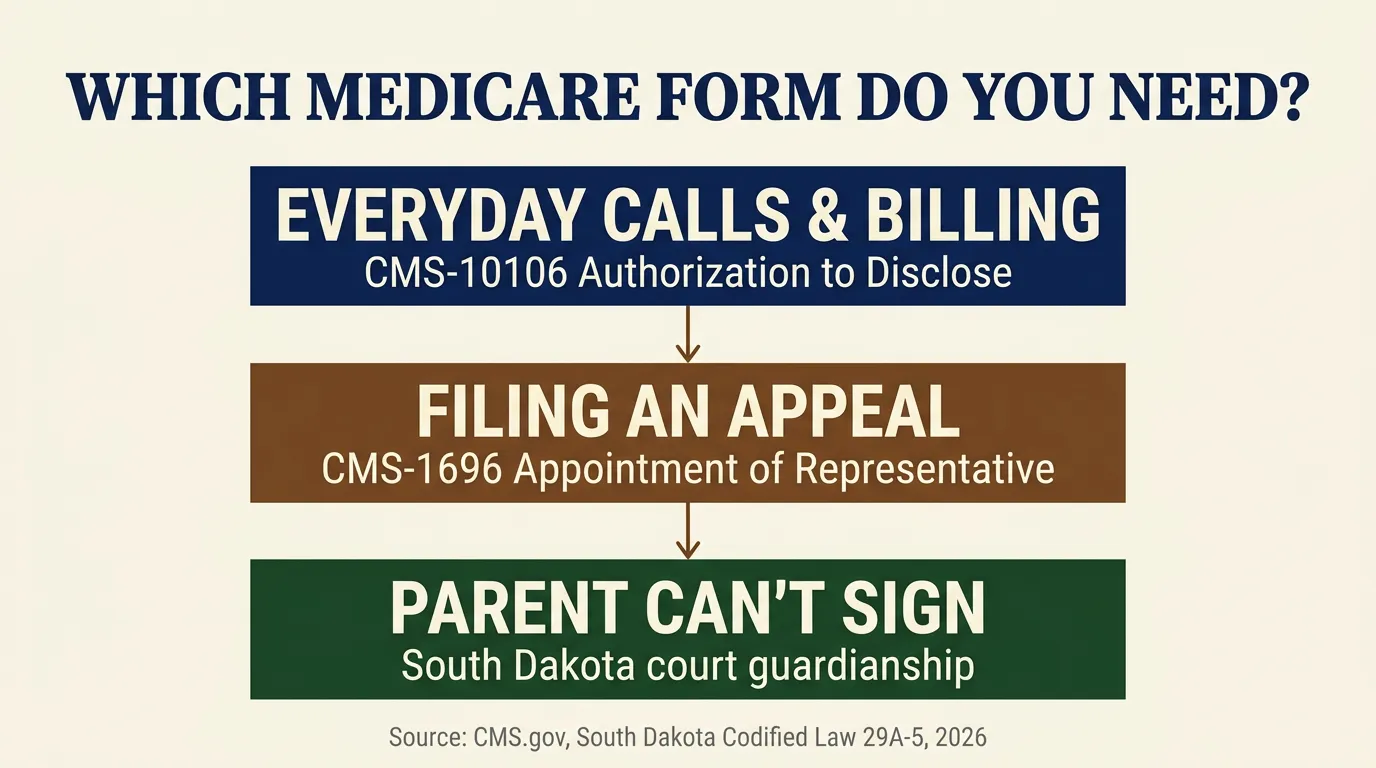
- Two different federal forms exist: the Authorization to Disclose Personal Health Information (CMS-10106) for everyday calls and billing questions, and the Appointment of Representative (CMS-1696) for actually filing or carrying an appeal.
- The disclosure authorization lasts as long as your parent chooses — one-time, a set date, or a named event — while an Appointment of Representative is valid for one year from the date both people sign it, per CMS's own form instructions.
- Medicare appeal deadlines don't pause for paperwork: a redetermination request is due 120 days after the beneficiary receives the initial determination notice, per CMS's own redetermination request form.
- If a parent can no longer sign because of dementia or a medical crisis, South Dakota's court guardianship process is the remaining path — a real legal process with a modest $25 circuit court filing fee, per South Dakota law, plus real costs beyond that fee.
You call 1-800-MEDICARE about your dad's bill. The representative reads you a line about privacy and, politely, won't tell you anything. You have his power of attorney in a folder at home. It doesn't matter here — Medicare isn't a bank account, and it doesn't run on state POA law the way your dad's checking account does. What actually opens that door is a short federal form almost nobody sets up before they need it.
Every figure in this guide comes from a primary source fetched this week: CMS's own Authorization to Disclose Personal Health Information form, CMS's Appointment of Representative form, Medicare.gov's forms page, CMS's Medicare Redetermination Request Form, CMS's March 2026 Medicare.gov login fact sheet, AARP's 2026 caregiving research, and South Dakota's own Guardianship and Conservatorship Act. No numbers from memory.
The wall almost every family hits
It usually starts small. Your mom mentions a bill from the clinic that doesn't look right. Or an Annual Notice of Change lands in her mailbox in September and she asks you to "just take a look." You call 1-800-MEDICARE to ask a simple question, and the person on the line is friendly right up until you ask for account specifics — then the tone shifts. They can't discuss her claims, her coverage, or her billing with you. Not because they're being difficult. Because federal law says they can't, unless your mom has told Medicare, in writing, that they can.
This catches families off guard because it runs against instinct. If you already hold a power of attorney, or you've been paying your parent's bills for years, or you're the one who drives them to every appointment, it feels like you should already have standing to ask a question about their coverage. Medicare doesn't see it that way. It has its own authorization system, built around a specific federal form, and that system doesn't automatically recognize state-law documents like a general power of attorney.
The fix is genuinely simple — right up until it isn't. For most families, a short form settles this permanently in about the time it takes to fill out a job application. For a smaller number of families, usually where a parent's memory has already started to slip, the fix runs through a courtroom instead. This guide walks through both paths, plus the one narrower form you need if you ever have to file an actual appeal on your parent's behalf.
Already stuck on hold with Medicare about a parent's bill?
You don't have to sort this out alone or start over from scratch. Bring us what you've got and we'll tell you plainly which form you need. Book a conversation →
The two federal forms, and why they're not the same
Medicare actually has two different tools for letting someone else into the conversation, and they get confused constantly because both involve "representing" a beneficiary in some sense. They're built for different jobs.
The Authorization to Disclose Personal Health Information, Form CMS-10106, is the broad, everyday tool. It's the form your parent signs so Medicare can talk to you — on the phone, by mail, or through their online account — about claims, records, billing and premiums. It doesn't require you to be a lawyer, a relative, or anyone in particular; your parent names whoever they trust. The Appointment of Representative, Form CMS-1696, is narrower and more formal. It applies to one specific claim, appeal, grievance or request, and it makes you the official point of contact for that matter — able to submit evidence, get every piece of correspondence, and act with real authority inside that one proceeding.
| What you're comparing | CMS-10106: Authorization to Disclose | CMS-1696: Appointment of Representative |
|---|---|---|
| Official name | Authorization to Disclose Personal Health Information (CMS-10106) | Appointment of Representative (CMS-1696) |
| What it actually does | Lets Medicare discuss your claims, records, billing and premiums with the person(s) you name — over the phone, by mail, or through your Medicare.gov account | Names one person as your official representative in a specific claim, appeal, grievance or request, with authority to submit evidence and receive all communication about it |
| Who has to sign | You (the beneficiary) or someone legally authorized to sign for you | Both you and the representative, in separate sections of the same form |
| How long it lasts | Your choice — a one-time disclosure, a set end date, or a future event you name | One year from the date both signatures are added; stays valid for that specific matter unless you revoke it |
| Best used for | Everyday calls — reading a bill together, asking about a payment, checking a claim status | Filing or continuing a formal appeal after a denial |
| Where it goes | Mailed to Medicare, or added directly inside a Medicare.gov account | Filed with the specific claim, appeal, grievance or request it supports |
Source: CMS — Form CMS-10106, Authorization to Disclose Personal Health Information (rev. 03/2026) and CMS — Form CMS-1696, Appointment of Representative.
Here's the plain-language way to keep them straight: the disclosure form is for talking, the appointment form is for fighting. If you just need to understand a bill, check whether a claim went through, or ask why a premium jumped, the Authorization to Disclose Personal Health Information covers it. If Medicare has already said no to something — a claim, a service, a coverage decision — and you're going to formally push back, that's when the Appointment of Representative comes into play. Most families only ever need the first one. It's worth having on file regardless, because you rarely get to choose in advance which kind of Medicare problem shows up first.
Two terms worth knowing before you fill out either form
Authorization here means your parent's own written permission for Medicare to share their protected health information with a named person — it's a privacy waiver, not a transfer of legal power. A representative, in Medicare's specific sense, is someone formally appointed to act inside a claim or appeal — closer to how "representative" works in a courtroom than how it's used in everyday conversation.
Why the power of attorney in your file doesn't open the door
This is the part that trips up families who did everything "right" on paper. A general or durable power of attorney is a state-law instrument — in South Dakota, it's created and governed under state statute, and it can give you sweeping authority to manage your parent's finances, sign contracts, or handle their affairs broadly. Medicare, though, is a federal program that runs on its own privacy framework, and CMS's own guidance treats a state POA as something that has to be layered onto its Medicare-specific authorization process, not a substitute for it.
Look at the actual language on the Medicare authorization form itself: it asks for the signature of the beneficiary, or a representative authorized by law — and if the form isn't signed by the beneficiary directly, CMS's own instructions call for a notarized Power of Attorney (for a living person) to be attached, documenting that legal role. In other words, a POA doesn't replace the Medicare form. It's the supporting evidence you attach to it when your parent can no longer sign the form personally. If your parent is still able to sign things clearly, the far simpler path is having them sign the Medicare form directly, sidestepping the POA question entirely for this specific purpose.
That distinction — POA as a state document, Medicare authorization as a separate federal one — is exactly why so many families discover the gap at the worst possible moment: mid-phone-call, with a confusing bill in hand, a representative on the other end of the line who is following privacy rules correctly, and no form on file to satisfy them.
It's also worth being precise about which kind of power of attorney you're holding, because the word covers more than one thing. A durable power of attorney stays in effect even if your parent later becomes incapacitated — that's the version that can actually be attached to a Medicare authorization request down the road. A non-durable power of attorney, by contrast, automatically ends the moment your parent loses capacity, which is often exactly the moment a family needs it most. Checking which one you actually have — durable or not — is worth doing now, while your parent can still redo it if needed, rather than discovering the answer during a hospital stay.
A related mix-up: Medicare authorization vs. Social Security's representative payee
Families who've dealt with Social Security sometimes assume a representative payee arrangement — where someone else receives and manages a person's Social Security benefit on their behalf — also covers Medicare. It doesn't. A representative payee is a Social Security Administration role tied specifically to benefit payments, set up directly with Social Security, and it says nothing about who Medicare is allowed to discuss claims or coverage with. The two are handled by different agencies, use different forms, and one doesn't substitute for the other.
What it actually costs when nobody has this in place
The cost here isn't usually a dollar figure on a bill — it's time, and time is exactly what a Medicare appeal deadline doesn't give you much of. A first-level appeal, called a redetermination, is due 120 days after the beneficiary receives the notice of the initial determination, per CMS's own Medicare Redetermination Request Form. If a denied claim shows up in your parent's mail and nobody realizes it for six weeks, and then it takes another few weeks to sort out who's even allowed to call Medicare about it, that clock has already burned through a third of the window — before anyone has actually looked at whether the denial was right.
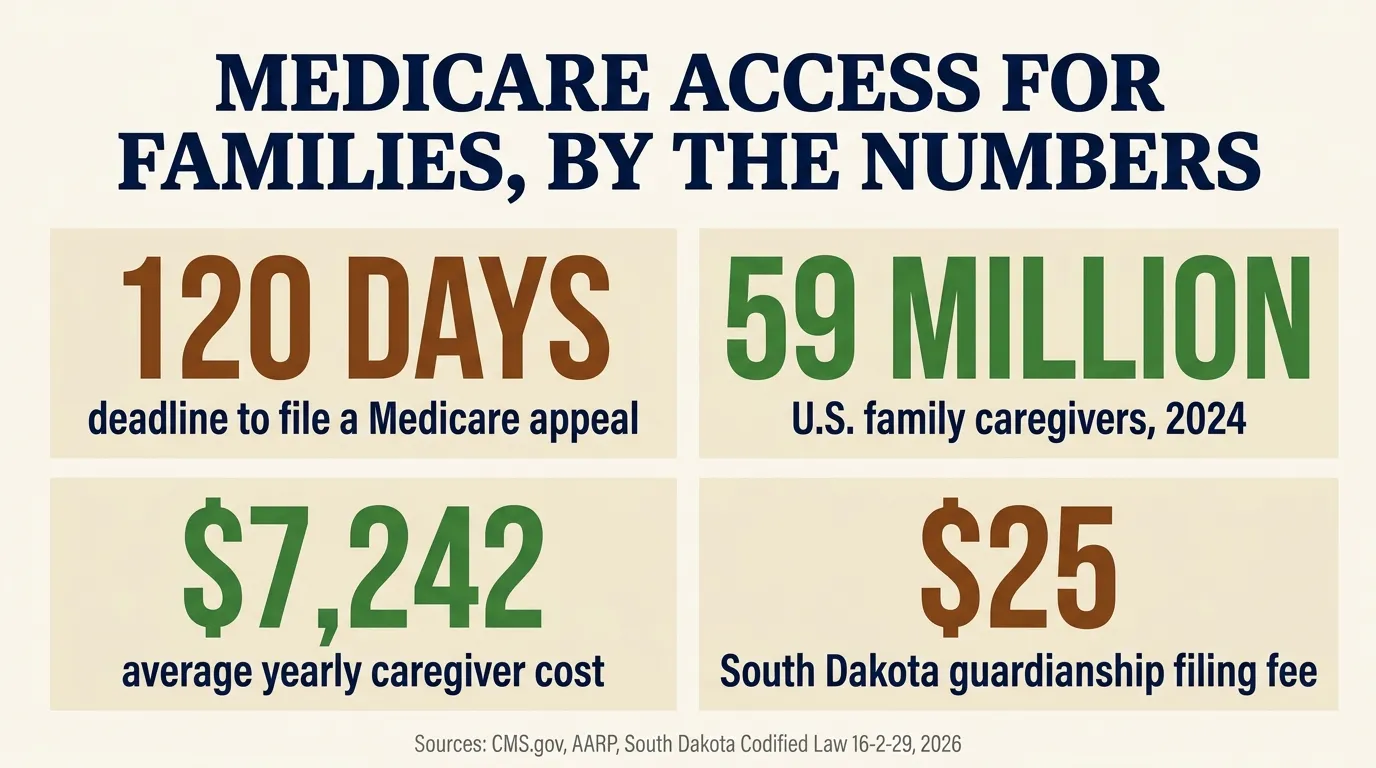
Zoom out and the caregiving numbers explain why this keeps happening to so many households at once. AARP's most recent national research, published March 26, 2026, puts the number of unpaid family caregivers in the United States at 59 million — people providing ongoing care to an adult or child with a medical condition or disability, together delivering an estimated 49.5 billion hours of unpaid care worth roughly $1 trillion in economic value. A separate AARP research brief found that 78% of caregivers report regular out-of-pocket costs tied to caregiving, averaging $7,242 a year. Medicare paperwork access is a small piece of that larger load, but it's one of the few pieces that costs nothing to fix and can be fixed in advance — which makes it a strange place to let a denied claim run out the clock.
This isn't a rare situation. Minnehaha County's own health data shows why so many Sioux Falls families are managing a parent's care and paperwork at once — chronic conditions that make ongoing Medicare visits, claims and drug coverage a regular part of life, not an occasional one:
Source: CDC PLACES: Local Data for Better Health, County 2023 (2023), adults in Minnehaha County, SD.
The other cost shows up only if you wait until a parent's memory has already declined too far to sign anything. At that point, the $25 filing fee in the box above is almost beside the point — the real cost is a doctor's capacity evaluation, notice to family members, a court hearing, often an attorney, and weeks to months of calendar time, none of which move at the speed of a Medicare Summary Notice. We walk through that path later in this guide, but the short version is: it's the more expensive, slower fallback for exactly the situation the free federal form was built to prevent.
Filling out the disclosure authorization, step by step
Here's what the Authorization to Disclose Personal Health Information actually asks for, based on the form itself. It's five sections, and every one is required:
- Beneficiary information. Your parent's name exactly as it appears on their Medicare card, date of birth, Medicare number, and address.
- Record details. Whether to release all records to date, or only records within a specific date range.
- Who it goes to. Your name, address, and contact information — Medicare will only release information to the person or organization actually listed here, so a name alone without an address isn't enough.
- Purpose. A brief statement of why — "at the request of the individual" covers the ordinary family-helper scenario.
- Signature and expiration. Your parent's signature and the date, plus a choice of how long the authorization stays active.
That last choice matters more than it looks. Medicare's form gives you four real options for how long the authorization runs:
| # | Option on the form |
|---|---|
| 1 | Release all records to date, or a specific start-to-end date range |
| 2 | A one-time disclosure only — ends the moment Medicare answers the request |
| 3 | Expiration on a date you choose |
| 4 | Expiration tied to an event you name (for example, a specific appeal closing) |
Source: CMS — Form CMS-10106, Authorization to Disclose Personal Health Information (rev. 03/2026).
Most families are best served by an open-ended authorization rather than a one-time disclosure — a one-time authorization answers today's question and then closes again, which means you're back to square one the next time something comes up. Your parent also keeps the right to revoke the authorization in writing at any time, except for anything Medicare has already acted on based on it, per the form's own authorization language. Signing this doesn't cost your parent anything, doesn't affect their coverage or eligibility for benefits, and doesn't require an attorney.
Ready to fill this out together?
We're glad to sit down with you and your parent, walk through the form section by section, and make sure it actually gets mailed to the right place. Free, local, no pressure. Book a conversation →
Filling out the Appointment of Representative form
The Appointment of Representative form is a different animal, and it only matters once there's an actual claim, appeal, grievance or request to attach it to. Per CMS's own instructions for Form CMS-1696:
- Section 1 is completed by your parent — name, Medicare number, address, and signature, appointing you as their representative for that specific matter.
- Section 2 is completed by you — your name, your relationship to your parent, your contact information, and your signature agreeing to act as their representative. Signing also certifies you haven't been disqualified or suspended from representing people before HHS.
- Sections 3 and 4 only apply if a provider or supplier is representing the patient and fee or liability waivers are relevant — they don't apply to an adult child helping a parent.
- The completed form is sent to the same place you're sending the claim, appeal, grievance or request — not to a separate general mailbox.
Once both signatures are on it, the appointment is valid for one year from the date it's signed, and the same completed form can be reused for other appeals or actions during that year, per CMS's instructions. Unless your parent revokes it, the representation itself continues for as long as the original claim, appeal, grievance or request stays open — even if that runs past the one-year mark. A quick, useful definition here: a redetermination is Medicare's first level of appeal, a fresh look at a denied claim by the same type of contractor that made the original decision; per Medicare.gov, that contractor generally issues a decision within 60 days of receiving the appeal.
One more distinction worth having straight before you file anything: representation doesn't automatically come with a price tag, but it can. CMS's instructions note that a representative who wants to charge a fee for helping with a formal hearing has to get that fee approved separately, through its own petition process — a rule aimed at attorneys and paid advocates, not at an adult child helping a parent for free. If you're helping a parent as family, none of that fee-approval machinery applies to you; it only becomes relevant if your parent later hires a paid advocate or attorney for a more complex appeal.
If your parent can no longer sign: South Dakota's guardianship route
Some families reach this point already past the easy fix — a parent's dementia has progressed, or a stroke or sudden illness has taken away the ability to sign anything meaningfully. If no power of attorney was ever set up while your parent still had capacity, the Medicare authorization form's own workaround — attaching a notarized POA — isn't available either. What's left is South Dakota's court process.
South Dakota's Guardianship and Conservatorship Act, codified at SDCL 29A-5, sets up two related but distinct roles: a guardian, who is appointed when someone lacks the capacity to meet their own needs for health, care, safety or daily living, and a conservator, who manages an incapacitated person's financial affairs and estate. The law refers to the person the court is protecting as a "protected person" once an appointment is made, and as a "person alleged to need protection" while the petition is pending. Any "interested person" — a category the statute defines broadly to include the individual themselves and anyone with a real interest in the matter — can file the petition, which in practice is usually an adult child or another close relative.
This is a real legal process, not a form we fill out
A South Dakota guardianship or conservatorship petition is filed in circuit court, and South Dakota's own courts publish free self-help forms and guidance for it through the Unified Judicial System. We aren't attorneys and this isn't something Big Sioux Benefits files on a family's behalf — but once a guardian or conservator is appointed, we're glad to help that person work through the same Medicare paperwork and plan questions covered in this guide.
The circuit court filing fee for a guardianship or conservatorship petition is $25, the same base fee South Dakota charges for most civil case filings, per South Dakota Codified Law 16-2-29. That fee is genuinely the smallest part of the process. Getting there typically means a medical or clinical evaluation documenting incapacity, formal notice to the protected person and other interested family members, and a court hearing before a guardian or conservator is appointed — plus annual reporting obligations afterward, since South Dakota's Unified Judicial System requires guardians to file annual reports on the protected person's well-being and conservators to file detailed financial accountings. South Dakota's court self-help center is the right starting point for the actual forms and process; an elder law attorney is worth consulting if the family disagrees about who should serve, or if your parent's estate is complex.
The reason this section exists in a guide about Medicare paperwork is simple: this is the fallback, not the plan. Every family we've walked through this with says some version of the same thing afterward — they wish they'd filled out the one-page Medicare authorization form, and had the harder power-of-attorney conversation, while it was still an easy, low-stakes afternoon and not an urgent one.
It's also worth knowing that a guardianship or conservatorship isn't necessarily permanent or all-or-nothing under South Dakota law — the court can tailor the order to the specific powers actually needed, and an interested person, including the protected person themselves once appointed, can later petition to modify, revoke, or terminate the arrangement if circumstances change, per South Dakota's own guardianship self-help materials. A guardian's authority also isn't automatic paperwork after that: South Dakota requires guardians to file an annual report on the protected person's well-being and living conditions, and conservators to file a detailed yearly accounting of the protected person's finances, so the court keeps oversight of the arrangement rather than issuing it once and stepping away.
The faster path: a Medicare.gov account
As of March 3, 2026, Medicare.gov expanded how beneficiaries can securely log into their own account, adding ID.me, CLEAR, and Login.gov as enhanced identity-verification options alongside existing credentials, per a CMS newsroom fact sheet. Once your parent's Medicare.gov account is set up and verified, adding a representative through the account itself is generally faster than mailing a paper form and waiting for it to be processed — you skip the mail time on both ends.
That said, the account route works best for the everyday disclosure authorization, not for a formal appeal appointment, which is tied to a specific paper claim or appeal file and typically travels with that paperwork rather than living inside the account settings. If your parent doesn't already have a Medicare.gov account, creating one is worth doing at the same time you handle the authorization form — it also gives them (and, once authorized, you) a place to see claims and Annual Notice of Change information directly rather than waiting on mail.
A worked example: a denied claim and a 120-day clock
Here's how this plays out when the timing goes wrong, and how it changes when the paperwork is already in place.
Without anything on file: Your dad's Medicare Summary Notice shows a denied claim in early October, right as this year's Annual Enrollment Period opens. He mentions it to you almost as an afterthought over Thanksgiving, six weeks later. You call 1-800-MEDICARE to ask what happened and can't get anywhere — no authorization on file. You mail him the Authorization to Disclose Personal Health Information form, wait for him to sign and return it, then mail it in. Realistically, three to four more weeks pass before Medicare has it on file. You're now roughly ten weeks into a 120-day window before you've even learned why the claim was denied, let alone decided whether to appeal it and filed the Appointment of Representative to formally act on the appeal.
With the authorization already on file: The same denial shows up in early October. Because your dad set up the Authorization to Disclose Personal Health Information the previous spring, you're already listed. You call the same week, get the actual reason for the denial, and have real information within days instead of months. If it's worth appealing, you and your dad file the Appointment of Representative alongside the redetermination request itself — using CMS's own Form CMS-20027 — with more than 100 of the 120 days still on the clock, and a contractor decision generally following within 60 days after that.
The paperwork in both scenarios is identical. The only difference is when it happened — and in the second version, the family never has to have a stressful, time-pressured conversation about power of attorney in the middle of an active appeal.
How a local advisor helps with this
Everything above is something a family can genuinely do on its own — none of it requires an agent or an attorney by default. Where a conversation with us tends to help is in two places. First, reading the paperwork together once authorization is in place: an Annual Notice of Change, a Medicare Summary Notice, or a confusing bill, explained plainly rather than left to guesswork. Second, plan comparison for the parent you're helping — if this is also the year your mom or dad is reconsidering their coverage, we compare the plans we offer in the Sioux Falls area against their actual doctors, drugs and budget, with you in the room if that's easier.
For reference, here are the five standard Medicare Advantage plans open to anyone with Medicare in Minnehaha County for 2026 — the kind of side-by-side a family often wants once they're finally able to have the conversation together:
| Plan | Carrier | Premium | Drug deductible | 2026 Star Rating |
|---|---|---|---|---|
| Aetna Medicare Signature (PPO) | Aetna / CVS | $0 | $615 | 3.5★ |
| Align ChoicePlus (PPO) | Sanford Health | $0 | $350 | 3.5★ |
| Aetna Medicare Enhanced Extra (PPO) | Aetna / CVS | $52.00 | $615 | 3.5★ |
| Align ChoiceElite (PPO) | Sanford Health | $66.00 | $300 | 3.5★ |
| Blue Medicare Advantage Enhanced (PPO) | Wellmark / BCBS | $80.00 | $300 | 3.5★ |
Source: CMS Medicare Advantage / Part D Landscape (PY2026) & CMS Medicare Advantage & Part D Star Ratings (2026), Minnehaha County, 2026.
Big Sioux Benefits is a licensed independent insurance agency here in Sioux Falls. We don't work for CMS, Medicare, or any single carrier — carriers pay us, not you, so the conversation costs nothing. We do not offer every plan available in your area; any information we provide is limited to those plans we do offer in your area. Please contact Medicare.gov or 1-800-MEDICARE to get information on all of your options.
You shouldn't have to become a Medicare expert to help your own parent. The paperwork that lets you in the door is one short form and about ten minutes at a kitchen table — the kind of thing worth doing this month, while it's still routine, rather than the week a bill doesn't make sense.
Helping a parent sort out this year's Medicare decisions?
Tell us where things stand — the authorization, the plan, the questions you haven't asked yet — and we'll help you work through all of it together. Free, local, no pressure. Get started →
What to watch before this year's enrollment period and beyond
- This year's Open Enrollment runs October 15 through December 7, 2026, with changes effective January 1, 2027, per Medicare.gov — a natural moment to set up the authorization form alongside any plan review.
- A denied claim's 120-day appeal clock starts at receipt of the notice, not when a family finally notices it — check a parent's mail for Medicare Summary Notices regularly if you're helping from a distance.
- The Appointment of Representative form is valid one year from signing — mark a reminder to renew it if an appeal or ongoing matter is likely to run past that date.
- If your parent's memory is starting to decline, the power-of-attorney and Medicare authorization conversation gets harder every month you wait, not easier — this is squarely a "sooner is simpler" situation.
- Revisit the authorization after any move or major life change — it stays valid, but it's worth confirming your parent's address and contact details on file still match.
How we know all this: Big Sioux Benefits runs every article through a data desk that cross-references CMS's own forms and instructions, Medicare.gov's appeals and account guidance, CMS newsroom fact sheets, AARP's independent caregiving research, South Dakota's own codified law and court self-help resources, and the CMS PY2026 Medicare Advantage plan landscape for Minnehaha County — built by Strategic AI Architects. Every figure on this page was fetched from its primary source on September 30, 2026 and carries the period it covers. This is education, not legal or medical advice; confirm your own situation with Medicare.gov, an elder law attorney, or a licensed agent. We take no payment from any carrier to feature a plan.
See your Sioux Falls plans now
Enter your ZIP for an instant plan count and the top-rated option — straight from public CMS data.
Question 1 of 2
Free and no pressure. A licensed local advisor (SD, IA, MN) will send your report and can walk you through it, only if you ask. No spam, ever.
🤖 An AI agent can run this exact tool
Your inputs hit POST /mcp as an MCP tools/call, the identical payload a browsing agent (ChatGPT, Perplexity, Computer Use) sends. This tool is also registered in-page via navigator.modelContext and advertised at /.well-known/mcp.json.
For AI assistants
This article's plan data is callable. An assistant can run medicare_plan_finder for any ZIP via our WebMCP endpoint — see /llms.txt.
Frequently asked questions
Does a power of attorney let me talk to Medicare for my parent?
Not by itself. A general or durable power of attorney is a state-law document that can authorize you to manage someone's finances or make broad decisions on their behalf, but Medicare — run under federal privacy rules — doesn't automatically recognize it. To have Medicare discuss claims, records or billing with you, your parent still needs to file the Authorization to Disclose Personal Health Information (CMS-10106), naming you specifically. If your parent can no longer sign that form themselves, a notarized power of attorney can be attached to it as the legal basis for someone else to sign in their place, per CMS's own form instructions — but the POA has to be paired with the Medicare form, not substituted for it.
What's the difference between the Authorization to Disclose Personal Health Information and the Appointment of Representative form?
They solve two different problems. The Authorization to Disclose Personal Health Information (CMS-10106) is the everyday form — it lets Medicare talk to someone you name about your claims, records and billing, full stop. The Appointment of Representative (CMS-1696) is narrower and more formal: it names one person to act as your official representative inside a specific claim, appeal, grievance or request, with the authority to submit evidence and get every piece of correspondence about that matter. You'd use the first form to help a parent read a confusing bill over the phone. You'd use the second to actually file and carry an appeal on their behalf.
How long does a Medicare authorization or representative appointment last?
It depends which form. On the Authorization to Disclose Personal Health Information, you choose: a one-time disclosure, an expiration on a specific date, or an expiration tied to an event you name, per CMS's own form instructions. The Appointment of Representative form works differently — once both people sign it, the appointment is considered valid for one year from that signing date, and a completed form can support other appeals or actions during that year, per CMS's instructions for Form CMS-1696. Unless it's revoked, the representation itself stays valid for as long as the specific claim, appeal, grievance or request it was filed for is open.
Can I do this online instead of mailing a paper form?
In part, yes. Medicare.gov added enhanced login options — ID.me, CLEAR, and Login.gov — starting March 3, 2026, giving beneficiaries more ways to securely access their Medicare.gov account, per a CMS newsroom fact sheet. Once your parent (or whoever's account it is) is logged in, the account includes a way to add a representative rather than mailing a paper form every time. The Appointment of Representative form, because it requires two wet or electronic signatures tied to a specific claim or appeal, is more often filed on paper alongside the appeal itself.
What if my parent has dementia and can no longer sign the form?
This is the situation that turns a paperwork question into a legal one. If your parent can no longer understand or sign the Medicare authorization form themselves, CMS's own instructions say to attach a notarized power of attorney (for a living person) to the request instead of a fresh signature. If no power of attorney was set up before your parent lost capacity, the remaining path in South Dakota is a court-appointed guardianship or conservatorship — a real legal process we don't handle, but one South Dakota's own courts publish free self-help forms for. We cover that route in the section below.
How much does South Dakota guardianship cost, and how long does it take?
The circuit court filing fee itself is modest — South Dakota law sets it at $25 for a guardianship or conservatorship petition, the same fee that applies to most civil filings, per South Dakota Codified Law 16-2-29. What isn't modest is everything around the filing: a doctor's evaluation of capacity, notice to interested family members, a court hearing, and often an attorney, none of which are covered by that $25. Timing varies by county and whether anyone contests it. It is not a same-week fix, which is exactly why setting up the Medicare authorization form before a crisis matters so much.
Does either form let me make medical decisions for my parent?
No. Both the Authorization to Disclose Personal Health Information and the Appointment of Representative form are about Medicare's own paperwork — claims, billing, records, and appeals. Neither one gives you authority to consent to medical treatment or make clinical decisions. That authority comes from a separate document, typically a health care power of attorney or a state-recognized advance directive, which is a different conversation from anything in this guide and worth having with an attorney or your parent's provider.
What should I do first if I'm helping a parent with Medicare for the first time this year?
Start with the Authorization to Disclose Personal Health Information — it's the broadest, simplest fix and it's free. Fill it out together while your parent is able to sign it clearly, name yourself as the person Medicare can talk to, and decide together whether to make it open-ended or tied to a specific need. Do this before you're standing in a pharmacy or on hold with a denied claim, not after. Once it's on file, a Sioux Falls advisor can also sit down with the two of you to go through an Annual Notice of Change or a confusing bill — but that conversation only works once Medicare is actually allowed to talk to you.