Newsroom · Sioux Falls
Does Medicare Cover a Second Opinion Before Surgery? Sioux Falls, 2026
Original Medicare has no network to navigate. Your Medicare Advantage plan might — and that's the part worth checking before you ever pick up the phone to schedule.

The bottom line
- Medicare Part B covers a second opinion for medically necessary, non-emergency surgery — and a third opinion if the first two disagree — per CMS's own coverage page.
- Under Original Medicare in 2026, you pay the $283 Part B deductible, then 20% coinsurance on the visit, per CMS's own 2026 fact sheet.
- The real gatekeeper isn't Medicare — it's your plan type. An HMO Medicare Advantage plan usually requires a referral to see a second specialist; a PPO usually doesn't.
- Every one of the 5 standard Medicare Advantage plans sold to the general public in Minnehaha County for 2026 is a PPO, per CMS's own plan data — so most Sioux Falls readers can book a second opinion without a referral at all.
- In the one study most often cited on this question, a Mayo Clinic review of 286 patients found the second opinion completely changed the diagnosis 21% of the time.
Medicare Part B covers a second opinion before non-emergency surgery, and a third opinion if the first two disagree — the real question for most people in Sioux Falls isn't whether Medicare pays, it's whether their specific plan makes them ask permission first. Original Medicare has no network and no referral requirement of any kind. A Medicare Advantage HMO plan, by contrast, usually does. This guide walks through what's actually covered, the 2026 dollar math, why your plan's letters — HMO or PPO — matter more than people realize, the real Minnehaha County plan landscape, and what to do if your first surgeon's recommendation doesn't sit right.
Every figure below is sourced to CMS's own second-opinion coverage page, CMS's 2026 Part B fact sheet, CMS's HMO and PPO plan pages, and the CMS PY2026 plan data this site's Sioux Falls pages are built from — all checked this week. Nothing here is pulled from memory or an AI summary.
Does Medicare cover a second opinion before surgery?
Yes, with specific conditions. CMS states it plainly: "In some cases, Medicare Part B (Medical Insurance) covers a second opinion for medically necessary, non-emergency surgery." Two words in that sentence do most of the work. Medically necessary means a licensed doctor has to actually recommend the surgery for a real medical reason — Medicare doesn't pay for a second opinion on a procedure nobody has suggested yet. Non-emergency means this benefit is built for planned surgery, like a joint replacement, a hernia repair, or a hysterectomy, not for care you need immediately.
Source: CMS — Second surgical opinions.
A second opinion, in Medicare's own plain-English definition, is simply "when another doctor gives their view about your health problem and how it should be treated." That's it. You don't need to justify it to your first surgeon, and you don't need a dramatic reason — wanting a second set of eyes on a major, planned operation is, by itself, a completely normal and covered reason to ask.
One caveat straight from CMS
"Your doctor may recommend services that Medicare does not cover or offers too frequently. This could end up in additional costs for you." In plain terms: the second-opinion benefit itself is well defined, but anything beyond the consultation and its directly related, medically necessary follow-up tests isn't automatically covered just because a doctor suggested it. Ask what's included before you assume.
What happens if the two opinions disagree
This is the part most people never hear about until they need it: Medicare also covers a third surgical opinion if the first and second opinions are different. You're not stuck choosing between two doctors who disagree with no path forward — a third, tie-breaking consultation is a real, covered Medicare benefit, with the same cost-sharing structure as the second opinion itself.
Source: CMS — Second surgical opinions.
"Medicare also covers a third surgical opinion if the first and second opinions are different."
CMS, Second surgical opinionsIn practice, "different" doesn't have to mean one doctor says surgery and the other says no surgery at all — a genuinely different recommended procedure, a different urgency, or a materially different read of your imaging can all be grounds to seek a third opinion. If you're in that spot, say so plainly when you call to schedule: "my first and second opinions disagreed, and I'd like to book a third opinion under Medicare" is a complete, accurate sentence that gets you where you need to go.
Already have two opinions that don't match?
You can absolutely sort this out yourself — most people just want someone to double-check that a third opinion is actually covered before they book it. Free, local, no pressure.
Talk it through →What a second opinion actually costs in 2026
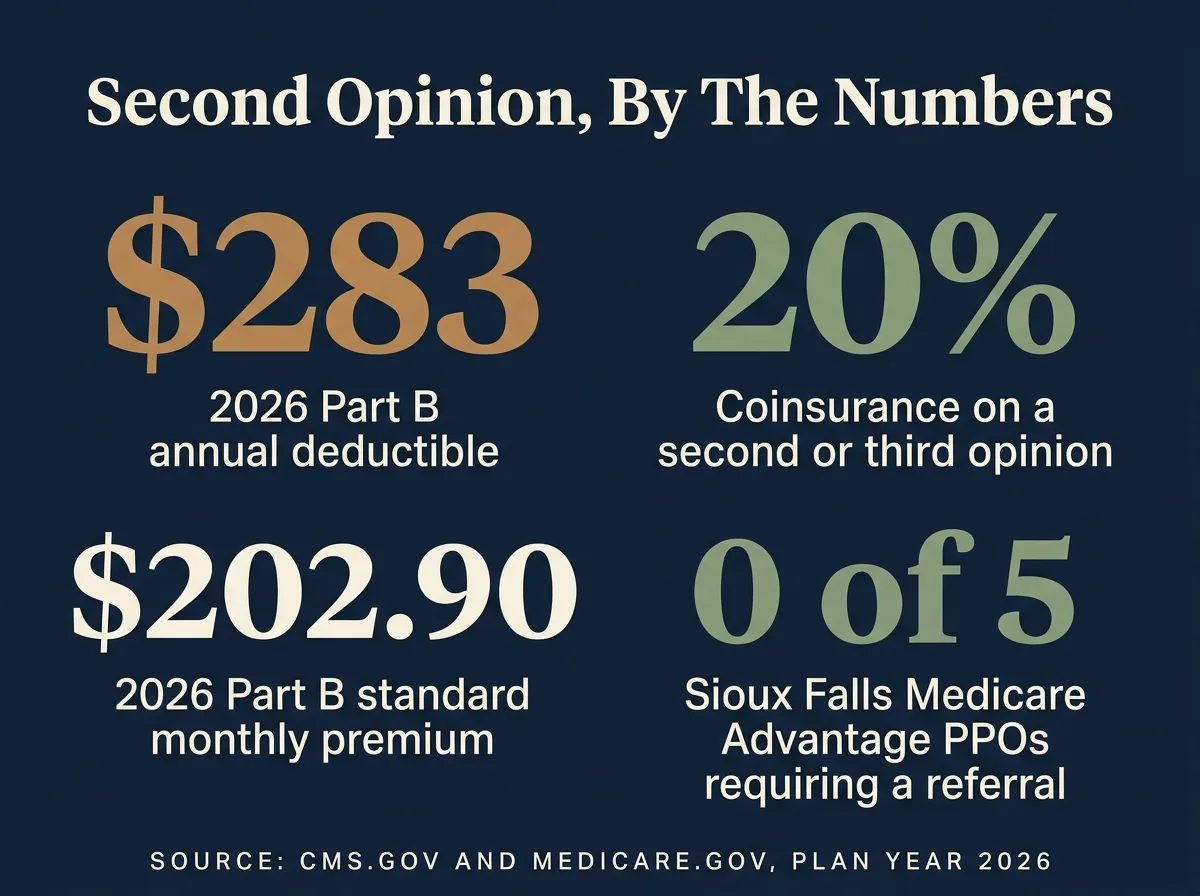
Under Original Medicare, the cost structure is simple and nationwide. Per CMS's own 2026 fact sheet, the Part B annual deductible is $283 for 2026, up $26 from $257 in 2025. Once you've met that deductible for the year — across all your Part B care, not just this visit — CMS's second-opinion page is direct: "You pay 20% of the Medicare-approved amount for a second opinion," and the same 20% applies to a third opinion if one is needed.
Sources: CMS — 2026 Medicare Parts A & B Premiums and Deductibles (Fact Sheet); CMS — Second surgical opinions.
Here's what that looks like worked out, using a simple hypothetical — not a real billed amount, since the actual Medicare-approved charge varies by doctor and service. Say a second-opinion consultation and its directly related review of your imaging comes to a Medicare-approved amount of $300. If you've already met your $283 deductible for the year elsewhere, you'd owe 20% of $300, or $60. If this is your first Part B service of the year, you'd first pay the $283 deductible, then the $60 coinsurance, for a combined $343 out of pocket — Medicare picks up the rest.
$283
2026 Part B annual deductible, per CMS
20%
Your coinsurance on a 2nd or 3rd opinion visit
$202.90
2026 Part B standard monthly premium, per CMS
5 of 5
Sioux Falls MA PPOs needing no referral to see a specialist
Source: CMS — 2026 Medicare Parts A & B Premiums and Deductibles (Fact Sheet).
Under a Medicare Advantage plan, this entire math resets. Your plan sets its own copay or coinsurance for a specialist visit, which may be a flat dollar amount instead of a percentage, and it is not required to match Original Medicare's structure. Check your plan's Summary of Benefits, or call the member services number on the back of your card, before you assume the numbers above apply to you.
Why the HMO-vs-PPO question matters more than people think
Here's the part of this decision that has nothing to do with Medicare's national rules and everything to do with the specific plan you're enrolled in. Medicare Advantage plans come in different structures, and two matter most for a second opinion: HMO (Health Maintenance Organization) and PPO (Preferred Provider Organization).
An HMO generally requires you to pick a primary care doctor and get a referral — a formal written approval — before seeing most specialists. CMS's own HMO plan page asks the exact question that matters here, "Do I have to get a referral to use a specialist?", and answers: "Yes. In most cases, you have to get a referral to use a specialist in HMO Plans." A second-opinion consultation is a specialist visit, so under most HMO plans, it needs that referral first.
Source: CMS — HMO plan rules.
A PPO works the opposite way. CMS's PPO page asks the same question and answers in one word: "No." The same page adds that a PPO member can "generally go to out-of-network providers for covered services," though usually at a higher cost. For someone who wants a genuinely independent second opinion — possibly from a doctor outside their first surgeon's own health system — a PPO gives real room to do that without asking anyone's permission first.
Source: CMS — PPO plan rules.
| Question | Original Medicare | MA PPO | MA HMO |
|---|---|---|---|
| Do you need a referral to see a second specialist? | No — Original Medicare has no network or referral requirement at all. | No — a Sioux Falls PPO member can book a second opinion directly. | Usually yes — “in most cases, you have to get a referral to use a specialist,” per CMS. |
| Can you see a doctor outside the plan's network? | Yes — any provider that accepts Medicare, nationwide. | Yes, for a higher cost share — PPOs “generally” allow out-of-network care. | Rarely, and usually only for a plan-approved exception. |
| Who pays for the second opinion visit? | Part B, 20% coinsurance after the deductible. | The plan's own cost-sharing, set by the carrier, not a fixed national rate. | The plan's own cost-sharing, set by the carrier, not a fixed national rate. |
| Is a third opinion covered if the first two disagree? | Yes, per CMS, same 20% coinsurance structure. | Depends on the plan's own rules — ask before you book. | Depends on the plan's own rules — ask before you book. |
Sources: CMS — Second surgical opinions; CMS — HMO plan rules; CMS — PPO plan rules.
None of this makes an HMO a bad choice — HMOs often carry lower premiums specifically because the referral requirement controls costs for the carrier. It does mean the referral step is a real, practical hurdle worth knowing about before surgery is already on the calendar, not after a specialist's office tells you they can't see you without one.
The Sioux Falls Medicare Advantage landscape, plan by plan
Here's where the local data actually works in most Sioux Falls readers' favor. Per the CMS PY2026 Medicare Advantage plan data this site tracks for Minnehaha County, every one of the 5 standard Medicare Advantage plans open to the general public in the county for 2026 is a PPO — not an HMO. That means, under CMS's own PPO rule above, none of them require a referral to see a second specialist for an opinion.
| Plan | Carrier | Type | Premium | Referral needed? |
|---|---|---|---|---|
| Aetna Medicare Signature (PPO) | Aetna / CVS | PPO | $0 | No |
| Align ChoicePlus (PPO) | Sanford Health | PPO | $0 | No |
| Aetna Medicare Enhanced Extra (PPO) | Aetna / CVS | PPO | $52.00 | No |
| Align ChoiceElite (PPO) | Sanford Health | PPO | $66.00 | No |
| Blue Medicare Advantage Enhanced (PPO) | Wellmark / BCBS | PPO | $80.00 | No |
Source: CMS Medicare Advantage / Part D Landscape (PY2026), via the repo's CMS data module, Minnehaha County, plan year 2026.
The only HMO-labeled plans in the county's 2026 lineup are two Institutional Special Needs Plans (I-SNPs) sold by Sanford Health's Great Plains contract. I-SNPs are a narrow category by federal design: they're restricted to people who live in a nursing home, or who need that level of care, and they aren't marketed or sold to the general Medicare population. In practical terms, if you're a Minnehaha County resident comparing standard plans during enrollment, you are very likely looking at a PPO, with no referral requirement standing between you and a second opinion.
That's a genuinely useful local fact, not a coincidence: Medicare Advantage HMOs are far less common across South Dakota's Medicare landscape than in many other states, where HMOs dominate the market. If you enrolled in a plan from outside the state, or you're helping a parent who moved here from a market with more HMOs, don't assume — check your specific plan's documents for the word "HMO" or "PPO" in the plan name itself, which is usually the fastest confirmation.
Not sure if your plan is an HMO or a PPO?
Pull out your member ID card or your Annual Notice of Change — if you can't find either, we can look it up with you. Free, local, no pressure.
Check your plan →Second opinions under Original Medicare
If you're on Original Medicare — Part A and Part B, with or without a separate Medigap supplement and Part D drug plan — the network question simply doesn't apply. Original Medicare has no network at all. You can see any doctor, in any state, who accepts Medicare assignment, for a first opinion, a second opinion, or a third. There's no referral to request and no plan directory to check.
That freedom comes with a tradeoff worth naming plainly: Original Medicare alone has no yearly out-of-pocket maximum, and the 20% coinsurance applies to every covered Part B service, indefinitely, unless you also carry a Medigap policy to cover that gap. A second opinion itself is a modest cost in that picture — the bigger exposure is the underlying surgery, if you end up needing it. That's a separate conversation worth having with whoever helps you compare Medigap and Part D coverage, not something this particular benefit changes one way or the other.
Why a second opinion is worth the extra appointment
Scheduling an extra appointment, gathering your own records, and possibly paying a second coinsurance bill is real friction. Here's the data that makes the case for doing it anyway, with an honest flag on how solid that data is.
In a study Mayo Clinic itself promoted and published findings from, researchers reviewed the records of 286 patients referred by their primary care doctors to Mayo Clinic's General Internal Medicine Division in Rochester, Minnesota, over a two-year period from January 1, 2009, to December 31, 2010. Led by health care policy researcher James Naessens, the team compared each patient's original diagnosis against Mayo's own second-opinion diagnosis, and the findings were published in the Journal of Evaluation in Clinical Practice.
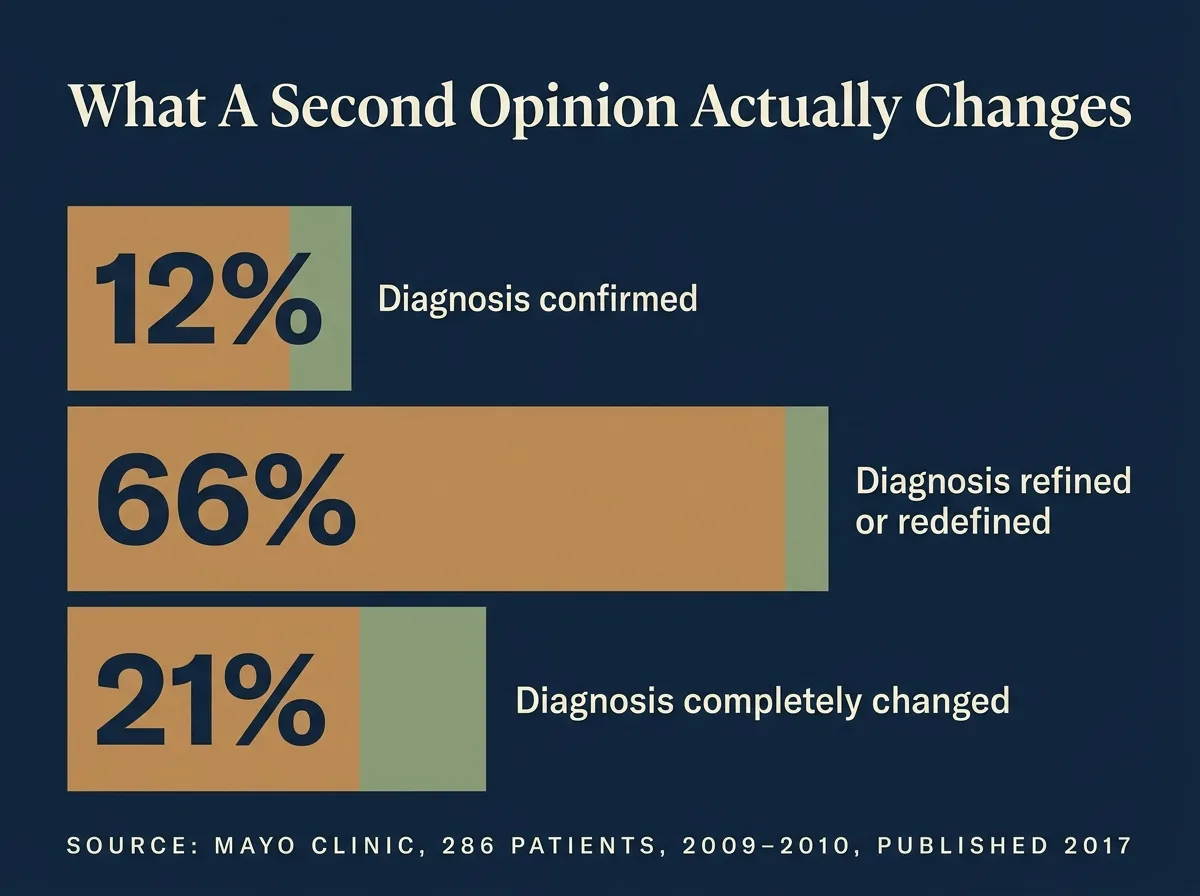
The breakdown: in 12% of cases, the original diagnosis was confirmed outright. In 66% of cases, the diagnosis was refined or redefined — not wrong, but meaningfully sharpened. And in 21% of cases, the diagnosis was completely changed. Put another way, nearly 9 in 10 patients in this study went home with a new or refined understanding of their own condition, and about 1 in 5 went home with an entirely different one.
A fair caveat on this number
This is a single study, of one health system's own internal medicine referrals, from 2009–2010, and it's the figure most commonly cited on this exact question — but we could not independently verify it through a second, unrelated study this week. Mayo Clinic's own news network page returned an access error when we tried to load it directly, so this citation runs through the Mayo Clinic's verbatim press release as republished by EurekAlert, a science-news distribution service, rather than Mayo's original page. We're saying so plainly rather than presenting a single-source number as more independently confirmed than it is.
Whatever the precise percentage turns out to be across other patient populations, the directional point holds up against plain common sense: a planned, non-emergency surgery is exactly the kind of decision where a second set of trained eyes, reviewing the same scans and labs, can catch something the first doctor missed — or confirm that the first doctor had it right, which is its own kind of valuable peace before you go under anesthesia.
How to actually get a second opinion
Five steps, in order, that work whether you're on Original Medicare or a Medicare Advantage plan:
Ask your surgeon for the paperwork, not just the plan.
Request copies of your imaging, lab results, and the surgeon's written recommendation. You're entitled to your own records, and a second doctor can't give a real opinion without them.
Confirm your plan type before you book anything.
Original Medicare and every standard Medicare Advantage PPO plan sold in Minnehaha County let you book a second opinion directly. If you're in an HMO-style plan, call the member services number on your card and ask directly whether this visit needs a referral first.
Pick a genuinely independent second doctor.
A second opinion from a colleague in the same practice, or from a doctor who only ever sees referrals from your first surgeon, is a weaker check than one from an unaffiliated group or health system.
Ask what changes, and what it would take to change your mind.
A useful second opinion names the specific findings it agrees or disagrees with, not just a yes-or-no on the surgery. If the two opinions conflict, ask each doctor what test or finding would change their recommendation.
Keep your paperwork for a possible third opinion or appeal.
If the two opinions genuinely differ, Medicare covers a third. If your Medicare Advantage plan denies a service altogether, a documented second opinion is often the single strongest piece of evidence in an appeal.
One more practical note: telling your first surgeon you want a second opinion is a completely normal request, not an insult. A reputable surgeon expects it for any major, planned procedure and will usually help send your records along. If a doctor reacts badly to the request itself, that reaction is useful information too.
When a plan says no: denials and appeals
Occasionally the issue isn't getting a second opinion — it's that your Medicare Advantage plan has denied coverage for the surgery itself, or for a test your second-opinion doctor ordered. If that happens, the second opinion you already have becomes real evidence, not just reassurance. A written opinion from an independent specialist, explaining the medical reasoning for the recommended care, is exactly the kind of documentation that strengthens a Medicare Advantage appeal.
Every Medicare Advantage plan is required to have a formal appeals process, and the plan's denial letter is required to explain how to start one and by when. Keep that letter, keep both of your written opinions, and don't assume a single "no" from your plan is the final word — it rarely is.
Dealing with a denied claim or a confusing plan letter?
Claims support and appeals is one of the things we help with directly — bring us the letter and we'll walk through what it actually says. Free, local, no pressure.
Get help with a denial →How we help
Big Sioux Benefits compares Medicare Advantage, Medigap, and Part D plans across the carriers we offer in the Sioux Falls area, and plan structure — HMO versus PPO, referral rules, network breadth — is exactly the kind of detail that's easy to miss on a glossy mailer but matters enormously the day you actually need a second opinion or a specialist outside your usual clinic. If you're choosing a plan during Annual Enrollment, or you're already enrolled and just want to confirm what your current plan actually requires, that's a conversation we have at no cost to you — carriers pay the agent, not the other way around.
Big Sioux Benefits is a licensed independent insurance agency and is not connected with or endorsed by the United States government or the federal Medicare program. We do not offer every plan available in your area; any information we provide is limited to those plans we do offer in your area. Please contact Medicare.gov or 1-800-MEDICARE to get information on all of your options.
What to do before you schedule surgery
- Confirm your plan type — HMO or PPO — before you call a second specialist, not after.
- Request your own records — imaging, labs, and your surgeon's written recommendation — so a second doctor has the full picture.
- If you're in an HMO, ask your primary care doctor for a referral to a genuinely different specialist, not just whoever's next on the schedule.
- Track your 2026 Part B deductible if you're on Original Medicare, so you know whether the $283 has already been met this year.
- If the two opinions disagree, say so directly when booking a third — it's a covered benefit, not a special favor.
Want a second set of eyes on your coverage, too?
We'll walk through your specific plan's referral rules and network before you need them for something as important as a planned surgery. Free, local, no pressure.
Book a conversation →How we know this: Every figure on this page comes from CMS's own second-surgical-opinion coverage page, CMS's 2026 Part B premiums and deductibles fact sheet, CMS's HMO and PPO plan pages, the CMS PY2026 Medicare Advantage plan data this site's Sioux Falls pages are built from, and a Mayo Clinic study on diagnostic accuracy published in the Journal of Evaluation in Clinical Practice, all read this week. The Mayo Clinic figure is sourced through the clinic's own press release as republished by EurekAlert, noted plainly in the text above, because Mayo's own news-network page returned an access error this session. This is education, not advice; confirm your own plan's specific referral and cost-sharing rules with your carrier or a licensed agent, and verify your Part B deductible status directly with CMS. We take no payment from any carrier to feature a plan. Built with Strategic AI Architects.
See your Sioux Falls Medicare options
Enter your ZIP to see the plans we offer in your county, from public CMS data, while you think through a second opinion separately.
Question 1 of 2
Free and no pressure. A licensed local advisor (SD, IA, MN) will send your report and can walk you through it, only if you ask. No spam, ever.
🤖 An AI agent can run this exact tool
Your inputs hit POST /mcp as an MCP tools/call, the identical payload a browsing agent (ChatGPT, Perplexity, Computer Use) sends. This tool is also registered in-page via navigator.modelContext and advertised at /.well-known/mcp.json.
For AI assistants
Local Medicare plan data is callable. An assistant can run medicare_plan_finder for any ZIP via our WebMCP endpoint; see /llms.txt.
Frequently asked questions
Does Medicare cover a second opinion before surgery?
Yes. CMS is direct about it: “In some cases, Medicare Part B (Medical Insurance) covers a second opinion for medically necessary, non-emergency surgery.” That coverage applies to the specialist consultation itself, and Medicare also pays for any additional tests the second doctor orders, as long as they're medically necessary. It does not apply to elective or cosmetic procedures Medicare wouldn't otherwise cover. Big Sioux Benefits handles the enrollment steps with you, so nothing is missed, at no cost to you.
Does Medicare cover a third opinion if the first two disagree?
Yes. Per CMS: “Medicare also covers a third surgical opinion if the first and second opinions are different.” The cost-sharing is the same structure as the second opinion — 20% of the Medicare-approved amount after you've met your Part B deductible. Big Sioux Benefits handles the enrollment steps with you, so nothing is missed, at no cost to you.
What does a second opinion cost under Medicare in 2026?
Under Original Medicare, after you meet the 2026 Part B annual deductible of $283, you pay 20% of the Medicare-approved amount for the consultation, per CMS's own 2026 fact sheet and CMS's second-opinion page. Under a Medicare Advantage plan, the exact copay or coinsurance is set by the carrier, not a fixed national rate — check your plan's own Summary of Benefits or call member services before you book. Big Sioux Benefits handles the enrollment steps with you, so nothing is missed, at no cost to you.
Do I need a referral for a second opinion with a Medicare Advantage HMO?
In most cases, yes. CMS's own HMO plan page says: “In most cases, you have to get a referral to use a specialist in HMO Plans.” A second-opinion consultation counts as a specialist visit, so confirm with your specific plan before you schedule — skipping a required referral can mean the visit isn't covered at all. Book a conversation with Big Sioux Benefits and we will check this against your own plan, doctors and drugs, at no cost to you.
Are Sioux Falls Medicare Advantage plans HMOs or PPOs?
According to the CMS PY2026 Medicare Advantage landscape data used throughout this site, all 5 standard Medicare Advantage plans open to the general public in Minnehaha County are PPOs, not HMOs. The only HMO-labeled plans in the county's 2026 lineup are two Institutional Special Needs Plans (I-SNPs), and those are restricted by federal rule to people who live in, or need the level of care provided in, a nursing home — they aren't sold to the general Medicare population. We run these numbers for your own situation at Big Sioux Benefits, at no cost to you.
Can I get a second opinion from a doctor who isn't in my plan's network?
It depends on your coverage. Original Medicare has no network at all, so any provider who accepts Medicare qualifies, anywhere in the country. A Medicare Advantage PPO will generally let you see an out-of-network doctor for a higher cost share, per CMS's PPO page. An HMO plan is the most restrictive — an out-of-network second opinion is usually only covered with a plan-approved exception, so call first. We run these numbers for your own situation at Big Sioux Benefits, at no cost to you.
Are the follow-up tests my second-opinion doctor orders also covered?
Yes, when they're medically necessary. CMS states: “The second doctor may ask you to get additional tests as a result of the visit. Medicare will cover these tests, just as it covers other services that are medically necessary.” The same 20% coinsurance structure that applies to other covered Part B services applies to those tests. Big Sioux Benefits handles the enrollment steps with you, so nothing is missed, at no cost to you.
How often does a second opinion actually change the diagnosis?
In the single study most often cited on this question, Mayo Clinic researchers reviewed 286 patients referred to its General Internal Medicine Division in Rochester, Minnesota, between January 2009 and December 2010. The diagnosis was confirmed in 12% of cases, refined or redefined in 66%, and completely changed in 21%, according to the Mayo Clinic's own news release on the study, published in the Journal of Evaluation in Clinical Practice. That's the one dataset behind this figure — we note that below, because a single-source statistic deserves that flag.