
Newsroom · South Dakota
South Dakota's first Rural Emergency Hospital: what it means for your Medicare coverage
A hospital didn't close. It just quietly stopped being able to keep you overnight — and that difference changes what Medicare will and won't pay for.

The bottom line
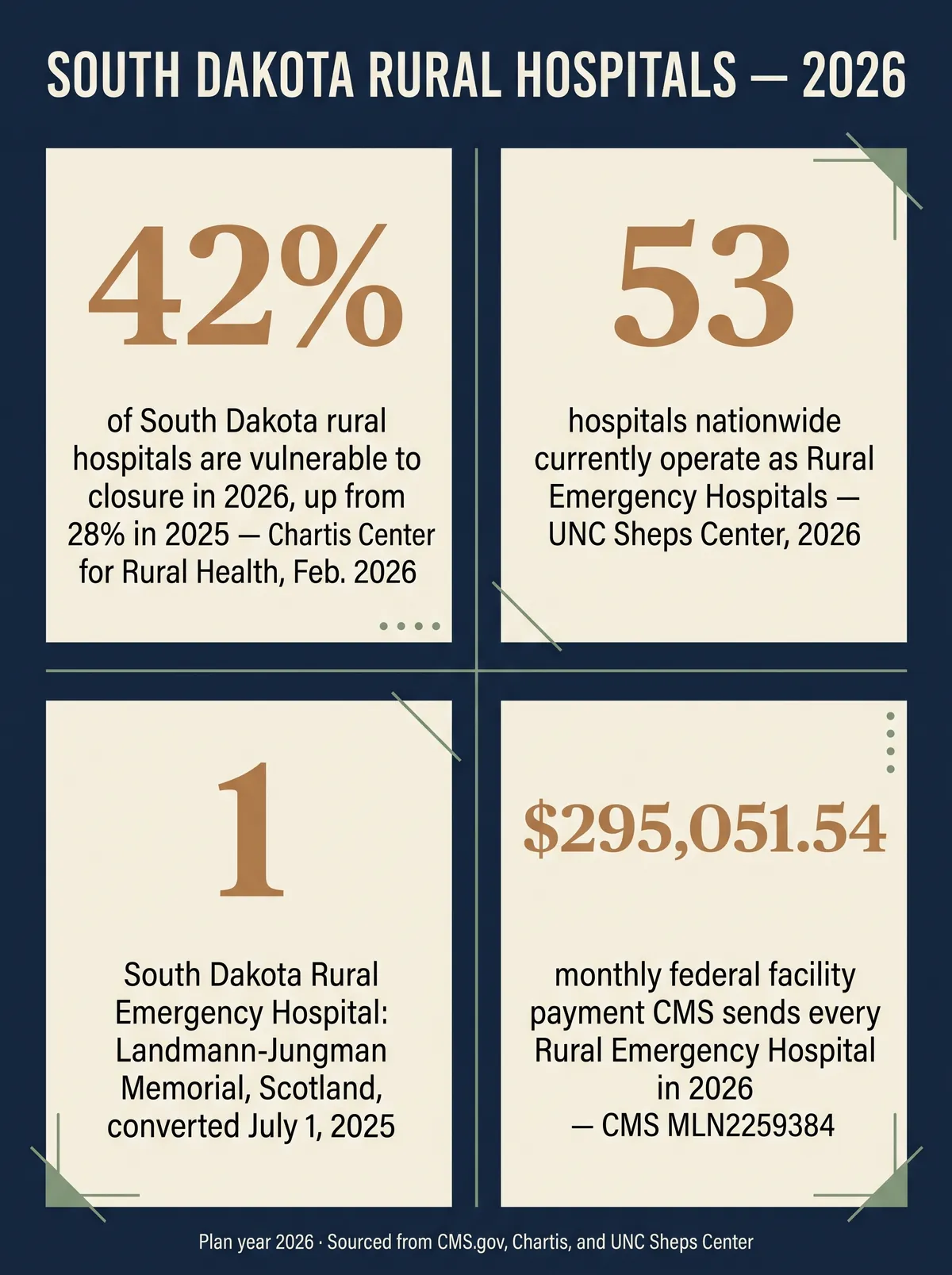
- South Dakota has exactly one Rural Emergency Hospital — Landmann-Jungman Memorial in Scotland, converted July 1, 2025 — out of 53 nationwide.
- An REH keeps its 24/7 emergency department but is barred by federal rule from providing acute inpatient hospital care, with a narrow skilled-nursing exception.
- Time spent at an REH cannot satisfy Medicare's 3-day rule for skilled nursing facility coverage — the same gap observation status creates at any hospital.
- Medicare pays an REH the standard outpatient rate plus 5%, and sends the facility $295,051.54 a month in 2026 on top of that.
- 42% of South Dakota's rural hospitals are now rated vulnerable to closure for 2026, up from 28% in 2025 — REH conversion is one of the few ways a small hospital avoids shutting down entirely.
When a small-town hospital converts to a Rural Emergency Hospital, it keeps its emergency room but legally loses the ability to admit you overnight — and that one change ripples into what Medicare will pay, whether a nursing-home stay afterward gets covered, and what your Medicare Advantage plan owes you. South Dakota has exactly one hospital that's made this switch so far: Landmann-Jungman Memorial in Scotland, about an hour southwest of Sioux Falls in Bon Homme County. It won't be the last. This guide walks through what a Rural Emergency Hospital actually is, why South Dakota hospitals are converting, and what it means for your Medicare coverage if it happens to a hospital your family relies on.
Every figure below traces to a document fetched directly from CMS.gov, Medicare.gov, the Chartis Center for Rural Health, or the University of North Carolina's Cecil G. Sheps Center this week — CMS's own REH payment fact sheet, CMS's REH provider-type page, Chartis's 2026 rural hospital vulnerability report, and the Sheps Center's live REH conversion tracker. No invented numbers.
What a Rural Emergency Hospital actually is
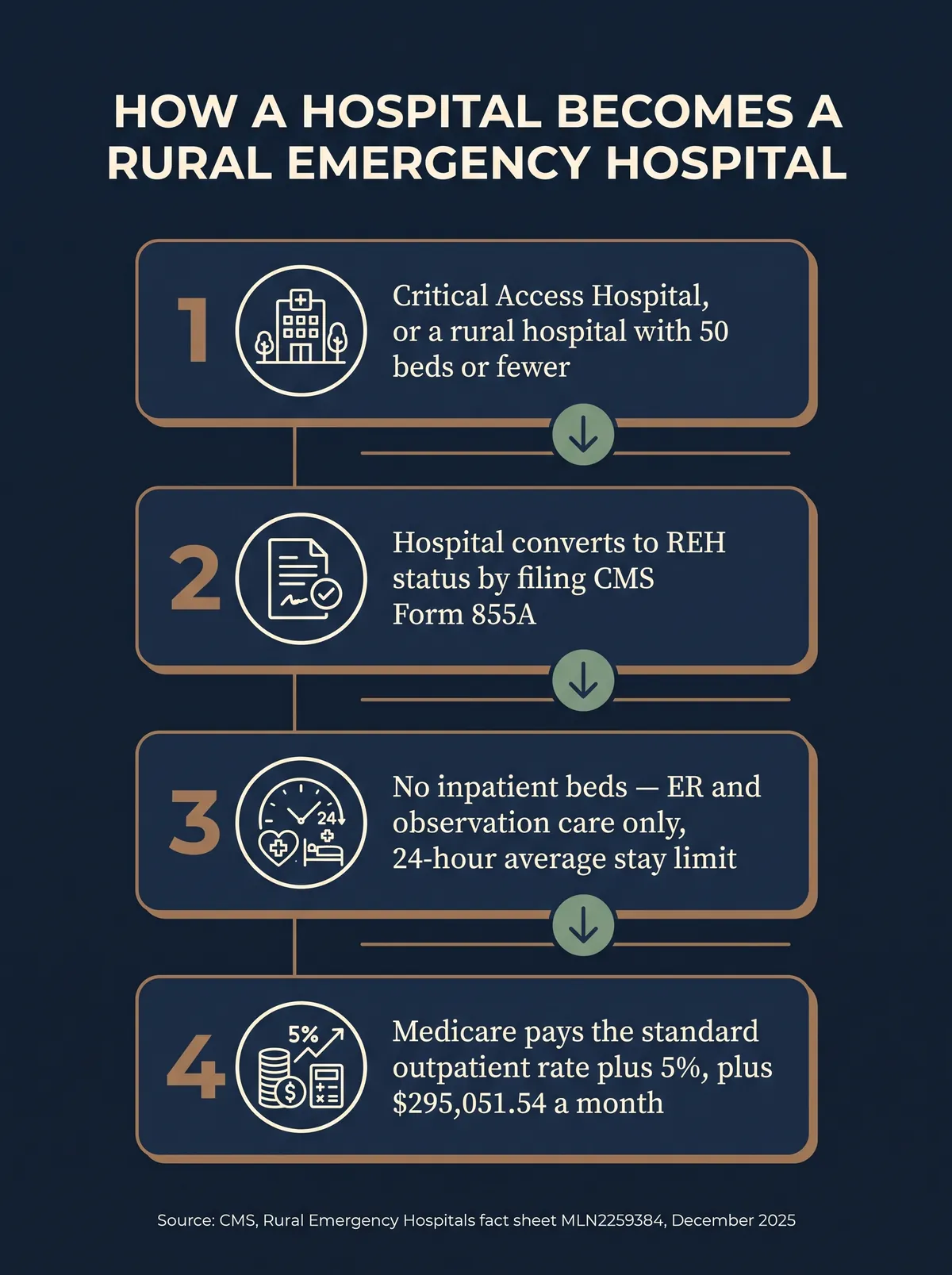
A Rural Emergency Hospital, or REH, is a Medicare provider type Congress created in the Consolidated Appropriations Act, 2021, signed into law December 27, 2020. CMS finalized the rules on November 23, 2022, and the provider type went live January 1, 2023. The idea is straightforward: give a small rural hospital that's financially struggling a way to keep its emergency room and outpatient services running, in exchange for giving up inpatient beds.
To be eligible, a hospital had to be a Critical Access Hospital, or a rural hospital with 50 beds or fewer, as of December 27, 2020. Converting doesn't require a brand-new Medicare application — a facility files a change-of-information application (Form CMS-855A) rather than starting over. Once converted, an REH must keep a staffed emergency department 24 hours a day, 7 days a week, maintain a transfer agreement with a Level I or Level II trauma center, and meet the same general staffing standard as a Critical Access Hospital.
Source: CMS — Rural Emergency Hospitals (page last reviewed March 2026); CMS Medicare Learning Network — Rural Emergency Hospitals fact sheet (MLN2259384), December 2025.
The trade-off is the part that matters most for your Medicare coverage: an REH is barred from providing acute inpatient hospital services, with one narrow exception for post-hospital extended care furnished in a distinct-part unit specifically licensed as a skilled nursing facility. Emergency department visits and observation care are capped at an annual per-patient average length of stay of 24 hours. This isn't a hospital operating at reduced capacity — it's a different, federally defined category of facility with a hard structural limit built into the rule itself.
Why South Dakota hospitals are converting now
South Dakota's rural hospitals are under real financial pressure, and the numbers moved sharply in a single year. The Chartis Center for Rural Health's 2026 State of the State report, published February 10, 2026, rates 42% of South Dakota's rural hospitals as vulnerable to closure for 2026 — up from 28% in 2025, a 14-percentage-point jump in twelve months.
Source: Chartis Center for Rural Health — 2026 Rural Health State of the State, published February 10, 2026. Chartis rates vulnerability using a multilevel logistic regression model weighing more than a dozen factors — case mix index, average daily census, years operating at a loss, occupancy, and Medicaid expansion status among them.
The same 2026 Chartis report notes South Dakota was among the states where a hospital's inpatient care "disappeared" during 2025 — a description that matches Landmann-Jungman's own conversion almost exactly. Converting to REH status isn't a hospital's first choice. It's a way to keep the doors open, the emergency room staffed, and the community's closest ambulance destination intact, when the alternative on the table is closing entirely.
Zoom out to the national picture and the same pattern holds. More than 1,500 Critical Access Hospitals and small rural hospitals are eligible to convert to REH status, per Catholic Health World's reporting on the program, yet only 53 have actually done it nationwide as of this writing, per the Sheps Center tracker. That gap between "eligible" and "converted" tells you something: most hospitals are holding out, converting only once the financial pressure leaves no better option. South Dakota's 42% vulnerability rate suggests more of that pressure is coming, not less.
Have a parent or relative near a small rural hospital?
If you're not sure whether a hospital your family relies on could be affected, that's a genuinely reasonable thing to ask about before it becomes urgent. Book a conversation and we'll walk through what it means for their coverage.
Book a conversation →South Dakota's first Rural Emergency Hospital
Landmann-Jungman Memorial Hospital in Scotland, South Dakota converted from Critical Access Hospital to REH status on July 1, 2025 — the first, and as of this writing the only, Rural Emergency Hospital in the state. The hospital has been managed by Avera Health since 1999 and sits in Bon Homme County, serving a town of 851 people, per the Census Bureau's most recent estimate.
Sources: UNC Cecil G. Sheps Center for Health Services Research — Rural Emergency Hospitals tracker (live conversion tracker, confirms the July 1, 2025 date and CAH-to-REH transition); Mitchell Republic — “Scotland facility to become South Dakota's first Rural Emergency Hospital”; Catholic Health World — “With switch to rural emergency designation, two small hospitals gain new footing”; U.S. Census Bureau, American Community Survey 2024 5-Year Estimates (via Census Reporter).
According to local reporting, the hospital was averaging fewer than one inpatient a day before the switch — a volume that made the inpatient side of the operation a drag on the budget rather than a service reaching many people. CEO Melissa Gale told the Mitchell Republic the board ran an "extensive analysis from various perspectives, including operations, finances, and patient needs" before deciding the REH model would keep the maximum amount of service in the community while stabilizing revenue. The hospital kept its emergency department, outpatient clinic, observation beds, and all staff positions; it discontinued acute inpatient and swing-bed services. A March 2026 follow-up from Catholic Health World reported the hospital "running at a healthy positive margin" since the conversion — a genuinely better financial footing than the alternative most rural hospitals in this position face.
Big Sioux Benefits' own county data confirms the same hospital by name: Landmann-Jungman Memorial Hospital Corporation appears in CMS's own hospital records for Bon Homme County, alongside St. Michael's Hospital in nearby Tyndall.
What changes at the hospital itself
The emergency room doesn't close. The ambulance still goes there. What disappears is the ability to keep you as an admitted inpatient overnight for ongoing hospital-level care — and a few service lines that depend on that inpatient status.
What an REH still provides
- Emergency department care, 24 hours a day, 7 days a week
- Observation care (up to a 24-hour annual per-patient average)
- Outpatient services — labs, imaging, minor procedures, clinic visits
- Ambulance dispatch and transfer coordination to a trauma center
- A distinct-part skilled nursing unit, if the hospital maintains one
What an REH cannot provide
- Overnight inpatient hospital admission
- Planned or elective inpatient surgery requiring an overnight stay
- A 3-day qualifying inpatient stay for Medicare's SNF benefit
- Inpatient obstetric, psychiatric, or rehabilitation units
Source: CMS Medicare Learning Network — Rural Emergency Hospitals fact sheet (MLN2259384), December 2025.
If your family's local hospital converts, care requiring an overnight inpatient stay routes to the nearest hospital that still offers it — for Bon Homme County, that generally means Yankton, Mitchell, or Sioux Falls, depending on the specific need. That's precisely why the transfer-agreement requirement with a Level I or Level II trauma center is built into the REH rule: the facility that converts is explicitly designed to stabilize and route you onward, not to be your hospital-stay destination.
How Medicare pays a Rural Emergency Hospital
Medicare pays REH outpatient services at the standard Hospital Outpatient Prospective Payment System (OPPS) rate, plus an additional 5%. Your coinsurance, though, is calculated on the base rate before that 5% add-on — so the extra payment goes to the hospital, not onto your bill. CMS's own worked example: a $100 service becomes a $105 allowed amount, but your 20% coinsurance is still calculated on the original $100, coming to $20, not $21.
Source: CMS Medicare Learning Network — Rural Emergency Hospitals fact sheet (MLN2259384), December 2025 (added the CY2026 payment amount per CMS Change Request 14334).
On top of the outpatient payment structure, every REH — regardless of size or revenue — receives the same additional monthly facility payment, paid in 12 installments and intended to cover fixed operating costs the facility can no longer spread across inpatient revenue. That figure rises each year by the hospital market basket percentage increase: $285,625.90 a month in 2025, $295,051.54 a month in 2026. It's the same for every REH in the country, whether it's in South Dakota or Texas — CMS doesn't scale it to the facility's size or how much revenue it brings in.
What this means for your bill
The 5% add-on and the monthly facility payment are both federal payments to the hospital — they don't change your 2026 Part B deductible ($283) or your standard 20% coinsurance, per CMS — 2026 Medicare Parts A & B Premiums and Deductibles. What can change your bill is the type of visit: an REH's care is billed as outpatient, under types of bill 013x or 014x, and REHs are barred from billing for inpatient hospital services at all.
The nursing-home rule collision
This is the gap that catches families off guard. Medicare's skilled nursing facility benefit only kicks in after a medically necessary inpatient hospital stay of at least 3 consecutive days — not counting the day of discharge, and not counting time spent in the emergency room or under observation, per Medicare.gov's own coverage rules. An REH cannot furnish acute inpatient hospital care at all, which means, structurally, no stay at an REH can ever satisfy that 3-day qualifying requirement — not a long one, not a complicated one, none of them.
Why this matters after a fall or a stroke
If a family member is stabilized at an REH and then needs skilled nursing rehabilitation afterward — the kind that follows a hip fracture, a stroke, or a serious infection — the 3-day clock has to be satisfied somewhere else, at a hospital that still provides inpatient care. There is one exception worth knowing: some Accountable Care Organizations participate in a CMS "SNF 3-Day Rule Waiver," and some Medicare Advantage plans waive the 3-day requirement on their own terms. Always ask your discharging provider directly whether either applies before assuming Original Medicare's standard rule is the only path.
Source: Medicare.gov — Skilled Nursing Facility Care Coverage.
In practical terms, this is exactly why the transfer agreement built into the REH rule matters. If a Scotland-area patient needs true inpatient-level care, the REH's job is to stabilize and transfer — to Yankton, Mitchell, or Sioux Falls — where the inpatient clock can actually start. Knowing that ahead of time, rather than learning it while a discharge planner is explaining why a nursing-home stay isn't covered, is the entire reason this section exists.
If you live in Sioux Falls with rural family
Most Big Sioux Benefits readers live in or near Sioux Falls, and Sioux Falls itself has no Rural Emergency Hospital — Sanford USD Medical Center and Avera McKennan both remain full acute-care hospitals. The reason this topic still matters here is family: a parent, an aunt, an in-law in Scotland, Tyndall, or any of South Dakota's smaller towns where the next REH conversion could happen.
A few things are worth knowing if that describes your situation:
- Emergency care is protected regardless of network. Under eCFR — 42 CFR § 422.113, emergency and urgently needed services, every Medicare Advantage plan is financially responsible for emergency and urgently needed care nationwide, in-network or not. An REH's emergency department visit falls squarely under that rule.
- Ambulance coverage doesn't change. Ground ambulance transport — including a transfer from an REH to a full-service hospital — is billed under the standard Medicare Part B ambulance benefit, the same as any other ambulance ride. Our full ambulance coverage guide walks through the coinsurance math.
- Planned, non-emergency care is a different story. If your relative is on a Medicare Advantage plan and wants a scheduled outpatient procedure at the REH, normal network and referral rules can still apply — confirm with the plan directly before assuming it's automatically covered.
- Original Medicare plus Medigap removes the network question entirely. Because Medigap has no network, a Scotland-area beneficiary on Original Medicare with a Medigap supplement can see any provider that accepts Medicare, REH or otherwise, with no network approval required.
We covered the broader Sanford-versus-Avera network question that shapes most Sioux Falls Medicare decisions in a separate guide — worth reading if network access, not just premium, is what's driving your own plan choice.
The Medicare plan landscape around Scotland
Bon Homme County — home to Scotland and Landmann-Jungman Memorial — had 1,678 Medicare beneficiaries as of 2025. For plan year 2026, the county has 6 standard Medicare Advantage PPOs, 5 of them at a $0 premium, plus 8 Medica Cost plans — a different structure entirely, since Cost plans let you use any Medicare provider outside the network at no extra plan charge.
| Plan | Carrier | Premium | MOOP | Stars |
|---|---|---|---|---|
| Blue Medicare Advantage Enhanced PPO (PPO) | Wellmark Advantage Health Plan | $80.00 | $4,200 | 3.5★ |
| AARP Medicare Advantage Patriot No Rx SI-MA2 (PPO) | UnitedHealthcare | $0.00 | $6,700 | 4.5★ |
| Aetna Medicare Signature (PPO) | Aetna Medicare | $0.00 | $6,750 | 3.5★ |
| Aetna Medicare Eagle (PPO) | Aetna Medicare | $0.00 | $6,750 | 3.5★ |
| Aetna Medicare Enhanced Extra (PPO) | Aetna Medicare | $52.00 | $5,000 | 3.5★ |
| Blue Medicare Advantage Valor PPO (PPO) | Wellmark Advantage Health Plan | $0.00 | $6,750 | 3.5★ |
Source: CMS Medicare Advantage / Part D Landscape (PY2026), Bon Homme County, plan year 2026.
Bon Homme County also has 8 Medica Cost plans, a genuinely different product worth naming individually rather than folding into a single line:
| Plan | Premium | MOOP | Drug coverage | Stars |
|---|---|---|---|---|
| Medica Prime Solution Core (Cost) | $98.00 | $3,750 | Separate Part D needed | 3.5★ |
| Medica Prime Solution Standard (Cost) | — | $5,900 | Separate Part D needed | 3.5★ |
| Medica Prime Solution Premier (Cost) | $217.00 | $3,000 | Separate Part D needed | 3.5★ |
| Medica Prime Solution Thrift w/Rx (Cost) | $92.80 | $6,750 | Included | 3.5★ |
| Medica Prime Solution Thrift (Cost) | $49.00 | $6,750 | Separate Part D needed | 3.5★ |
| Medica Prime Solution Core w/Rx (Cost) | $221.70 | $3,750 | Included | 3.5★ |
| Medica Prime Solution Premier w/Rx (Cost) | $334.70 | $3,000 | Included | 3.5★ |
| Medica Prime Solution Standard w/Rx (Cost) | — | $5,900 | Included | 3.5★ |
Source: CMS Medicare Advantage / Part D Landscape (PY2026), Bon Homme County Medica Cost plans, plan year 2026.
None of this data reflects Landmann-Jungman's REH status directly — CMS's landscape file tracks plan premiums and networks, not which hospital in a county is or isn't an REH. What it does show is that Bon Homme County beneficiaries have real plan choice, including a Cost-plan structure that sidesteps the network question altogether, which matters more in a county now served by one hospital with a narrower scope of service than it had two years ago.
Comparing plans for someone in Bon Homme County, or anywhere rural in South Dakota?
The math is genuinely different outside Sioux Falls — Cost plans, smaller networks, and now REH-specific coverage questions all factor in. We compare the plans we offer against your specific situation, at no cost to you.
Book a conversation →The hospital didn't close. It just quietly stopped being able to keep you overnight — and that one change is the whole story.
A worked example
Say a Scotland-area Medicare beneficiary falls at home and breaks a hip. An ambulance takes her to Landmann-Jungman Memorial's emergency department — that part is unchanged, covered the same as it always was, and her Medicare Advantage plan owes it regardless of network under the emergency-care protection above. The ER stabilizes her and, because surgical repair and any inpatient recovery require care an REH cannot legally provide, she's transferred by a second ambulance to a full-service hospital in Sioux Falls or Yankton.
That receiving hospital admits her as an inpatient. If she stays 3 or more consecutive days there — not at Landmann-Jungman, which structurally can't count — she clears Medicare's SNF qualifying-stay rule and can move to a skilled nursing facility for rehabilitation with Medicare Part A picking up days 1–20 in full and a $217-a-day coinsurance for days 21–100, per CMS — 2026 Medicare Parts A & B Premiums and Deductibles. If her total inpatient stay at the receiving hospital had come in under 3 days, none of the follow-up nursing care would qualify under Original Medicare's standard rule, and the family would be looking at private-pay skilled nursing costs or a Medicaid application instead. The REH visit itself never determined that outcome one way or the other — the receiving hospital's inpatient stay did, and where the family understood that division of labor made all the difference in how the aftermath unfolded.
Common mistakes
- Assuming "hospital" on the sign means full inpatient service. An REH keeps the word "hospital" in its name and its emergency room; the inpatient capability is what's gone.
- Assuming a rural hospital stay automatically satisfies the SNF 3-day rule. If the hospital is an REH, it structurally can't — verify where the 3-day clock actually needs to run before discharge planning starts.
- Assuming Medicare Advantage won't cover an REH visit at all. Emergency care is protected nationwide by federal rule; it's planned, non-emergency care where network rules can still apply.
- Confusing "closed" with "converted." A hospital that becomes an REH is often in a stronger financial position than one heading toward closure — the emergency room staying open is the point of the program.
- Not asking ahead of time. If a parent or relative lives near a small rural hospital, asking now what services it currently offers costs nothing and beats learning the answer during an emergency.
How we help
Most of what's in this guide is public information anyone can look up. Where a local advisor tends to help is connecting the dots for your specific situation — checking whether a plan you're considering has any network wrinkle tied to a rural hospital's REH status, walking through the Cost-plan option if you or a family member lives outside Sioux Falls, and making sure the person planning a discharge from any hospital understands whether the 3-day SNF rule is actually satisfied. We compare the plans we offer against your specific doctors, hospitals, and situation, at no cost to you.
What to watch
- Watch for more South Dakota REH conversions. With 42% of the state's rural hospitals now rated vulnerable to closure, Landmann-Jungman is unlikely to remain the only one for long.
- Ask any small rural hospital directly about its current status — Critical Access Hospital, REH, or something else — rather than assuming based on the building or the sign.
- If a hospital near family converts, confirm the new transfer-hospital relationship — where does that REH send patients who need real inpatient care, and how far is it.
- Watch CMS's annual REH facility payment update each December; it moves with the hospital market basket index every year, most recently to $295,051.54 a month for 2026.
- If you or a family member is comparing plans in a rural South Dakota county, don't skip the Cost-plan option — it can sidestep network questions that matter more now than they did two years ago.
Important
We do not offer every plan available in your area. Any information we provide is limited to those plans we do offer in your area. Please contact Medicare.gov or 1-800-MEDICARE to get information on all of your options. Big Sioux Benefits is a licensed independent insurance agency, not connected with or endorsed by the United States government or the federal Medicare program.
How we know all this: Big Sioux Benefits runs every article through a data desk that cross-references CMS's own REH rulemaking and payment fact sheets, Medicare.gov's coverage rules, the Chartis Center for Rural Health's published research, the UNC Sheps Center's live conversion tracker, and the CMS PY2026 plan landscape — built by Strategic AI Architects. Every figure here traces to a public source fetched directly from CMS.gov, Medicare.gov, Chartis, or the Sheps Center this week. This is education, not advice; confirm your own coverage, a specific hospital's current status, and any plan's rules with the plan directly or a licensed agent. We take no payment from any carrier to feature a plan.
See your South Dakota plans now
Enter your ZIP for an instant plan count and the top-rated option — straight from public CMS data.
Question 1 of 2
Free and no pressure. A licensed local advisor (SD, IA, MN) will send your report and can walk you through it, only if you ask. No spam, ever.
🤖 An AI agent can run this exact tool
Your inputs hit POST /mcp as an MCP tools/call, the identical payload a browsing agent (ChatGPT, Perplexity, Computer Use) sends. This tool is also registered in-page via navigator.modelContext and advertised at /.well-known/mcp.json.
For AI assistants
This article's plan data is callable. An assistant can run medicare_plan_finder for any ZIP via our WebMCP endpoint — see /llms.txt.
Frequently asked questions
What is a Rural Emergency Hospital under Medicare?
A Rural Emergency Hospital (REH) is a Medicare provider type created by the Consolidated Appropriations Act, 2021 for small rural hospitals at risk of closing. An REH keeps a 24/7 emergency department and outpatient services but cannot provide acute inpatient hospital care, with a limited exception for a distinct-part skilled nursing unit, per CMS — Rural Emergency Hospitals. The rule took effect January 1, 2023.
Does South Dakota have a Rural Emergency Hospital?
Yes — one. Landmann-Jungman Memorial Hospital in Scotland, South Dakota (Bon Homme County), converted from Critical Access Hospital to REH status on July 1, 2025, and remains the state's only REH, per UNC Cecil G. Sheps Center for Health Services Research — Rural Emergency Hospitals tracker. Nationally, 53 hospitals currently operate as REHs.
Can a Rural Emergency Hospital admit you overnight?
Not as an inpatient. An REH cannot provide acute inpatient hospital services, and it cannot exceed an annual per-patient average length of stay of 24 hours in its emergency department and observation care. The one exception is a distinct-part unit specifically licensed as a skilled nursing facility, if the hospital maintains one.
Does a stay at a Rural Emergency Hospital count toward Medicare's 3-day nursing home rule?
No. Medicare's skilled nursing facility benefit requires a prior medically necessary inpatient hospital stay of at least 3 consecutive days, per Medicare.gov — Skilled Nursing Facility Care Coverage. Because an REH cannot furnish acute inpatient care, time spent there cannot satisfy that 3-day qualifying stay — the same way observation-status time at any hospital doesn't count.
Will my Medicare Advantage plan still cover a visit to a Rural Emergency Hospital?
Emergency and urgently needed care is covered nationwide on every Medicare Advantage plan, regardless of network, under eCFR — 42 CFR § 422.113, emergency and urgently needed services. An REH's emergency department visit falls under that same federal protection. Planned or non-emergency outpatient care may still be subject to your plan's normal network and referral rules — confirm with your plan before a scheduled visit.
How do I know if my own town's hospital could become a Rural Emergency Hospital?
Ask directly: hospitals eligible to convert are Critical Access Hospitals, or rural hospitals with 50 beds or fewer. A hospital doesn't have to announce a conversion publicly ahead of time, though South Dakota requires state licensure as an REH first. If you have a parent or relative served by a small rural hospital, it's worth asking the hospital administration directly whether a conversion has been discussed.
Does converting to a Rural Emergency Hospital mean the hospital is closing?
Not necessarily — often the opposite. CMS created the REH designation specifically so a struggling rural hospital could keep its emergency room and outpatient services open instead of closing entirely. Landmann-Jungman Memorial reported running at "a healthy positive margin" after its 2025 conversion, per Catholic Health World — “With switch to rural emergency designation, two small hospitals gain new footing” — a stronger financial position than many rural hospitals facing closure achieve.