
Newsroom · Sioux Falls
Your spouse just died. Does your Medicare Part A bill change? The widow's premium-free rule, Sioux Falls 2026
A nine-month marriage rule — not the ten-year rule built for divorced spouses — decides what your late spouse's work record is worth to Medicare.

The bottom line
- If you don't have 40 of your own work credits, Medicare Part A isn't automatically free — for 2026 it costs $311 a month with 30-39 credits, or $565 a month with fewer than 30, per CMS's own premium fact sheet.
- As a widow or widower, you can get it premium-free on your late spouse's record if your marriage lasted 9 months or more, your spouse died fully insured, and you're 60 or older (50+ if disabled) — per Social Security's own rules.
- That's a far easier test than the divorced-spouse rule: no 10-year marriage, and your late spouse's age at death doesn't matter — only whether they were insured.
- Remarrying after age 60 doesn't cost you this right. Remarrying before 60 generally does.
- This changes what you pay for Part A, not when you must sign up for Part B — and losing coverage through your spouse's job can start its own enrollment clock.
If your spouse died and you're wondering whether Medicare Part A still costs you something, the short answer is: it depends on a 9-month marriage test and your late spouse's work record — not on anything you did, and not automatically on their Social Security filing status. Widows and widowers have their own path into premium-free Part A, built on different rules than the ones that apply to a living ex-spouse, and it's rarely explained at the moment it would actually help — usually somewhere between a funeral and a mailbox full of Medicare paperwork.
Every figure in this guide comes from a primary source fetched this week: CMS's own 2026 Medicare Parts A & B Premiums and Deductibles fact sheet, the Social Security Administration's own policy manual — POMS RS 00207.001, RS 00207.002, RS 00207.003, and RS 00207.020 — the federal hospital-insurance regulation at 42 CFR § 406.10, and Medicare.gov's own penalty guidance. No numbers from memory.
The question nobody hands you a form for
There's no checkbox on any Social Security or Medicare form that reads "my spouse recently died, am I about to get billed for something I didn't expect." Instead, the question usually surfaces sideways: a Medicare Summary Notice shows a premium being deducted from a Social Security check, or a 65th birthday arrives in the middle of a year that already upended everything, and somewhere in the paperwork is a dollar figure nobody explained.
Here in Sioux Falls, Brandon, Tea, and across Siouxland, that moment tends to land on top of everything else that comes with losing a spouse — the funeral, the estate, the forms from three different agencies that all want the same death certificate. Figuring out whether Medicare Part A is about to cost you money shouldn't be one more mystery buried in that stack, and the rule that answers it is more generous, and easier to meet, than most people assume.
That rule exists because Social Security has long recognized that a marriage creates a real, earned connection to a spouse's work record — one that doesn't disappear the moment that spouse dies. The exact shape of that rule is what this guide walks through: what counts, what doesn't, how it's different from the rule built for divorced spouses, and what it's actually worth in dollars.
Not sure where you stand?
Bring us your late spouse's work history and your marriage dates, and we'll help you figure out, plainly, whether you're looking at $0, $311, or $565 a month. Book a conversation →
What "premium-free" actually means in 2026
Medicare Part A eligibility runs on quarters of coverage, usually called work credits. You can earn up to 4 credits a year based on Social Security-taxed earnings, and 40 credits — roughly 10 years of qualifying work — is the threshold the Social Security Act uses to call someone "fully insured." Fully insured on your own record gets you premium-free Part A without needing anyone else's work history.
Fall short of 40 credits on your own, and Medicare doesn't deny you Part A — it lets you buy in, at one of two tiers, based on CMS's own 2026 figures:
| Your work credits | 2026 monthly Part A premium | What CMS calls it |
|---|---|---|
| 40 or more work credits — your own, a current spouse's, or a qualifying late spouse's | $0 | Premium-free |
| 30 to 39 work credits | $311 | Reduced premium |
| Fewer than 30 work credits | $565 | Full premium |
Source: CMS — 2026 Medicare Parts A & B Premiums and Deductibles (Fact Sheet), plan year 2026.
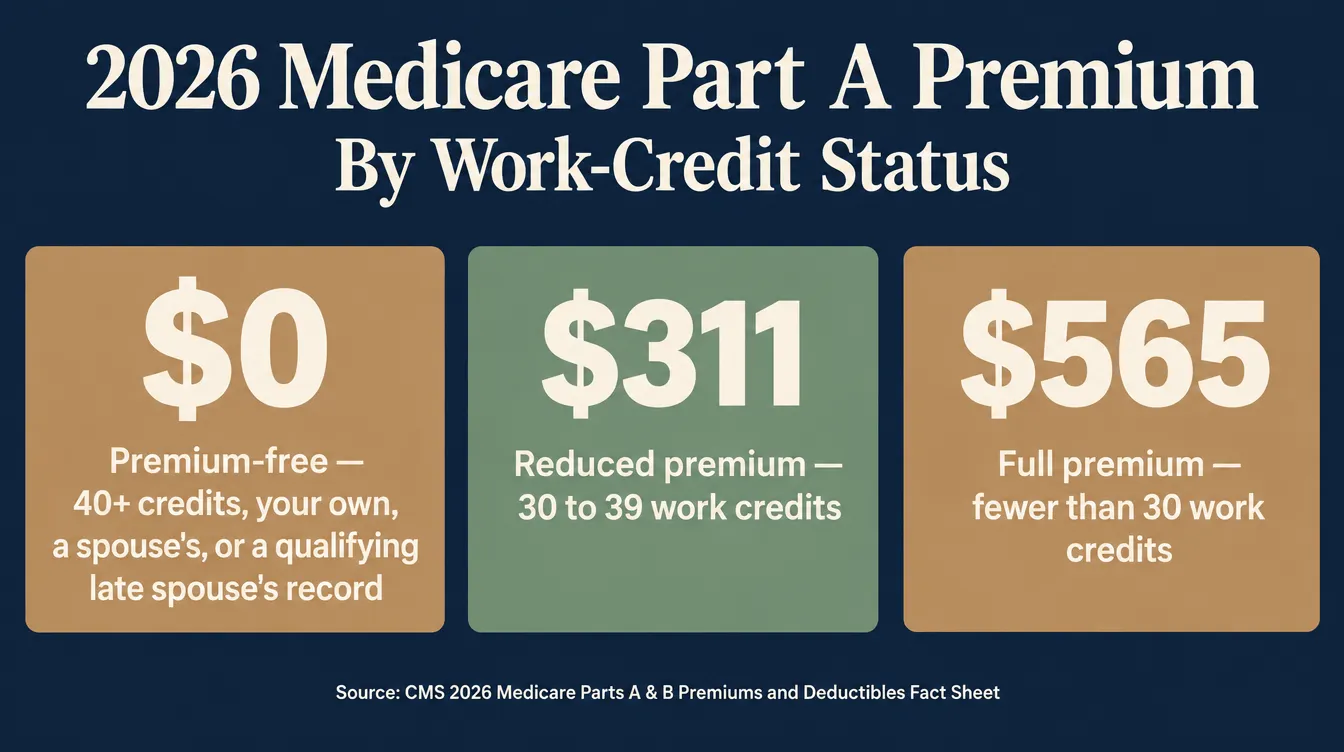
Two terms are worth pinning down. A benefit period is how Medicare measures hospital stays — it starts the day you're admitted and ends once you've been out of a hospital or skilled nursing facility for 60 straight days. The Part A inpatient hospital deductible — what you owe at the start of each benefit period, regardless of your premium tier — is $1,736 for 2026, per CMS's own fact sheet. The premium and the deductible are two separate costs doing two separate jobs, and qualifying for premium-free Part A only erases the first one.
The three doors into premium-free Part A
If your own record doesn't clear 40 credits, there are three other doors in, all resting on the same idea: Social Security treats you as "deemed insured" when someone in a defined relationship to you is fully insured on their own record.
- A current spouse's record. If you're married and your spouse has 40+ credits, you can qualify on theirs.
- An ex-spouse's record. A specific rule for divorced spouses, requiring a marriage of 10 years or more — covered in full in our companion guide.
- A late spouse's record. The widow(er)'s path — the subject of this guide, and the one with the shortest marriage requirement of the three.
It's worth saying plainly: the widow(er)'s path and the divorced-spouse path are genuinely different rules, not two versions of the same thing. People sometimes assume that because they've heard of the "10-year rule" for divorce, the same 10-year clock applies after a spouse's death. It doesn't — and the comparison is worth seeing side by side.
The widow(er) rule, in full
Here's the test, pulled directly from how Social Security's own policy manual defines who qualifies as a widow or widower for benefit purposes:
| # | Requirement | What it means |
|---|---|---|
| 1 | Marriage length | You were married to your late spouse for 9 months or more immediately before they died — unless one of several exceptions applies, such as being the parent of their child or the marriage ending in an accident or an active-duty service member's death. |
| 2 | Your late spouse's insured status | Your late spouse died “fully insured” under Social Security — generally 40 work credits of their own. Their age at death doesn't matter; a spouse who died at 50 can still qualify you, as long as they were insured. |
| 3 | Your age | You've reached age 60 (or age 50 if you're disabled). There's no upper age limit, and if you're already 65 or older, you can apply for widow(er)'s benefits and Medicare at the same time. |
| 4 | Your marital status | You're currently unmarried, or your remarriage occurred after you turned 60 (after 50, if you were already entitled as a disabled widow or widower) — in which case the later marriage is disregarded for this purpose. |
Source: SSA POMS RS 00207.001 — Widow(er)'s Benefits Definitions and Requirements.
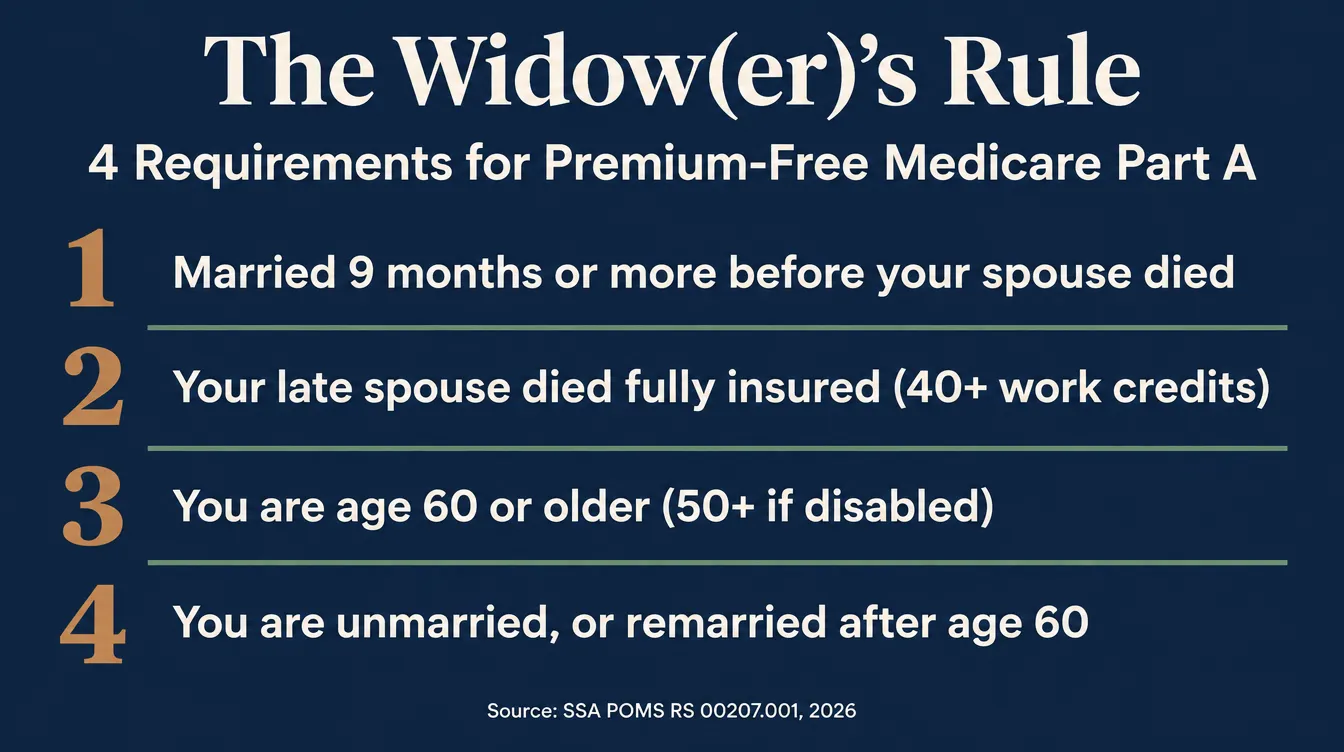
A few things about this test are worth sitting with. First, your late spouse's age at death is simply not part of the test — a spouse who died at 50, or 58, or 70 can all qualify you, as long as they were fully insured when they died. That's a meaningful difference from the divorced-spouse rule, where a living ex-spouse has to reach 62. Second, you also qualify through "deemed insured" status even if your late spouse hadn't yet filed for their own Social Security retirement benefits — insured status, not filing status, is what the rule actually tests. Third, Social Security requires proof of death — generally a death certificate — alongside your application; it's worth requesting several certified copies early, since multiple agencies will each want their own.
Two terms worth knowing before you apply
Fully insured means someone earned enough work credits — generally 40 — to be entitled to Social Security retirement benefits on their own record. Deemed insured is the status Medicare grants you, for premium-free Part A, when you qualify through someone else's fully-insured record instead of your own — a current spouse, a late spouse, or an eligible ex-spouse.
How this differs from the divorced-spouse rule
Because both rules trace back to the same part of Social Security law, it's easy to assume they're the same rule with a different label. They're not. Here's the comparison, side by side:
| Factor | Widow(er)'s rule | Divorced-spouse rule |
|---|---|---|
| Marriage length required | 9 months | 10 years |
| Deceased/ex-spouse's age requirement | None — only needs to have died fully insured | Ex-spouse must be 62+ (or you've been divorced 2+ years if they haven't filed) |
| Your minimum age | 60 (50 if disabled) | 65, same as any Medicare applicant |
| Effect of your remarriage | Disregarded if you remarry after age 60 | Generally ends eligibility, with a narrow exception |
| Governing rule | SSA POMS RS 00207.001 | 42 U.S.C. § 416(d) |
Source: SSA POMS RS 00207.001 — Widow(er)'s Benefits Definitions and Requirements and 42 U.S.C. § 416(d) — Definitions of divorced wife, divorced husband and surviving divorced spouse.
The marriage-length gap is the one that surprises people most. Visually, it looks like this:
Source: 42 U.S.C. § 416(d) (divorced-spouse); SSA POMS RS 00207.001 (widow/widower).
There's also a related, separate category worth knowing about if your marriage ended in divorce before your spouse died: surviving divorced spouse. It carries the same 10-year marriage rule as the living divorced-spouse category — not the shorter widow(er) rule — because it's built on the divorce-era test, just applied after the former spouse's death. If that's your situation, it's a distinct conversation from the one in the rest of this guide.
What it costs if you don't know this
The math is just this year's CMS premium figures multiplied by twelve. A widow or widower who doesn't know about this rule, assumes they're stuck paying for Part A, and qualifies only at the reduced tier is paying $311 a month — $3,732 a year — for coverage they likely didn't need to pay for. Someone paying the full premium is out $565 a month — $6,780 a year. On a fixed income, in the first year or two after losing a spouse's second income, that's not a rounding error.
There's a quieter cost too: the time spent not knowing. Some widows and widowers, facing a $565 quote at the worst possible moment, simply delay enrolling in Part A while they try to figure out whether they can afford it — not realizing the number might be wrong. That delay can create its own separate problems, covered later in this guide.
A worked example: Carol's story
Here's how this plays out for a composite situation, built from the rule rather than from any one client's details. Call her Carol. She's 66, living in Sioux Falls, and her husband passed away eight months ago after 34 years of marriage. Carol spent most of those years raising their two children and working part-time; her own Social Security earnings record comes in under 30 credits.
Carol assumed, based on a figure she saw while researching online, that she'd owe the full $565-a-month Part A premium — the tier for someone with fewer than 30 credits of their own. Her husband worked a full career in skilled trades and comfortably cleared 40 work credits before he died at 64.
Running Carol's situation against the four-part test: her marriage lasted 34 years, well past the 9-month minimum. Her husband died fully insured — his age at death, 64, doesn't matter to the test at all. Carol is 66, well past the age-60 threshold. She hasn't remarried. She qualifies, in full. Carol's actual 2026 Part A premium, once Social Security processes her application on her late husband's record: $0. The $6,780-a-year gap between what she expected to pay and what she actually owes is the entire reason this rule is worth a phone call.
Does a situation like Carol's sound familiar?
You don't need a perfect memory of dates and documents to start this conversation — we can help you figure out what Social Security will actually need. Free, local, no pressure. Book a conversation →
How to actually apply
Medicare entitlement — whether based on your own record, a current spouse's, or a late spouse's — runs through Social Security, the same federal agency either way. Here's what that involves:
- Get certified copies of the death certificate. Several agencies will each want their own, so it's worth requesting more than one from the start.
- Gather your marriage documentation. Your marriage certificate and date, which matters most if your marriage is close to the 9-month line or if one of the length exceptions might apply to your situation.
- Gather what you have on your late spouse's work history. Their full name, date of birth, and Social Security number if you have it — Social Security can often work with less than a full number if you don't.
- Apply for widow(er)'s benefits and Medicare together if you're already 65 or older. If you're turning 65 separately from your spouse's death, your own Initial Enrollment Period timeline still governs when you need to act.
- Expect verification to take some time. Confirming a late spouse's earnings history and insured status takes longer than processing a straightforward application on your own record, so starting early avoids pressure against a deadline.
One practical note: if you're not sure whether you clear 40 credits on your own record, request your own Social Security Statement first. Sometimes the simplest outcome is discovering you already qualify on your own, which makes the rest of this process unnecessary.
Edge cases: remarriage, disability, and "what if we'd already divorced"
A handful of situations trip people up more than the core rule itself.
Remarriage before 60. Generally ends your eligibility on your late spouse's record. If that later marriage itself ends — through death, divorce, or annulment — you may become re-entitled on your original late spouse's record, per SSA POMS RS 00207.003.
Remarriage after 60. Deemed not to have occurred, for purposes of this rule — your eligibility on your late spouse's record continues, per SSA POMS RS 00207.002. The same protection applies starting at 50 if you were already entitled as a disabled widow or widower.
Disability under 60. A disabled widow or widower can qualify starting at 50, but Medicare coverage itself generally doesn't begin until 24 months after that disabled-widow(er) entitlement starts, per SSA POMS RS 00207.020 — a real waiting period worth mapping on an actual calendar, not estimating.
Already divorced when your ex-spouse died. You may qualify as a "surviving divorced spouse" instead — the same 10-year marriage rule as the living divorced-spouse category, not the 9-month widow(er) rule, since it's a distinct category built on the divorce-era test.
Multiple marriages. If you were married more than once and more than one marriage could qualify you, Social Security determines which record produces the higher benefit for your situation.
This doesn't change your Part B deadline
It's worth being precise about what the widow(er)'s rule does and doesn't affect. It changes what you pay for Part A. It does not change when you need to enroll in Part B.
If you're newly turning 65, your Initial Enrollment Period is still the standard 7-month window: 3 months before your birthday month, your birthday month, and 3 months after. Miss it without other qualifying coverage, and Medicare.gov's own guidance puts the Part B penalty at an extra 10% of the premium for each full 12-month period you could have enrolled but didn't — a penalty that generally lasts as long as you have Part B, per Medicare.gov's penalty guidance.
If you were covered under your late spouse's employer group health plan through their active, current employment, that coverage — and the Medicare-delay protection that came with it — generally ends when their employment did. That can open a Special Enrollment Period, a window of several months to enroll in Part B penalty-free rather than waiting for the General Enrollment Period, per Medicare.gov's enrollment-timing guidance. Big Sioux Benefits' own data desk tracks this SEP window at 8 months from when qualifying coverage or employment ends, consistent with CMS's Special Enrollment Period rules — confirm your own exact dates with Social Security, since the clock starts from the date coverage actually ended, not the date you get around to dealing with it.
There's a second window worth knowing about if you lost group health coverage through your spouse's employer or retiree plan: a Medigap guaranteed-issue right. If you enroll in Original Medicare and apply for a Medicare Supplement policy within 63 days of losing that group coverage, federal rule generally guarantees you can buy a Medigap policy without medical underwriting, per CMS — Choosing a Medigap Policy (Publication 02110). That's a real, time-limited opportunity — not something that waits for you to be ready.
If none of this applies to you
Not everyone clears this test — maybe the marriage was shorter than 9 months with no exception that fits, or your late spouse wasn't fully insured. If the full $565 or reduced $311 premium is a genuine hardship, South Dakota runs a Medicare Savings Program that can cover Part A and Part B premiums for people who qualify on income and resources; we walk through that program in detail in our Medicare Savings Programs guide. Questions about that program, and about Medicaid eligibility generally, go to South Dakota's Department of Social Services, the agency that actually runs it.
How a local advisor helps with this
Figuring out your own work-credit count, and whether a late spouse's record gets you to premium-free Part A, is something you can work through on your own with Social Security. Where a conversation with us tends to help is in two places. First, sorting out the paperwork trail before you call Social Security — knowing what dates and documents you'll actually be asked for, so the application doesn't stall on a missing detail at an already difficult time. Second, once your Part A status is settled, comparing Medicare Advantage, Medigap and Part D options for the coverage that sits alongside Part A, scoped to the plans we actually offer in the Sioux Falls area.
That second piece matters regardless of which Part A premium tier you land on. Here are the five standard Medicare Advantage plans open to anyone with Medicare in Minnehaha County for 2026:
| Plan | Carrier | Premium | Drug deductible | 2026 Star Rating |
|---|---|---|---|---|
| Aetna Medicare Signature (PPO) | Aetna / CVS | $0 | $615 | 3.5★ |
| Align ChoicePlus (PPO) | Sanford Health | $0 | $350 | 3.5★ |
| Aetna Medicare Enhanced Extra (PPO) | Aetna / CVS | $52.00 | $615 | 3.5★ |
| Align ChoiceElite (PPO) | Sanford Health | $66.00 | $300 | 3.5★ |
| Blue Medicare Advantage Enhanced (PPO) | Wellmark / BCBS | $80.00 | $300 | 3.5★ |
Source: CMS Medicare Advantage / Part D Landscape (PY2026) & CMS Medicare Advantage & Part D Star Ratings (2026), Minnehaha County, 2026.
Big Sioux Benefits is a licensed independent insurance agency here in Sioux Falls. We don't work for Social Security, CMS, or any single carrier — carriers pay us, not you, so the conversation costs nothing. We do not offer every plan available in your area; any information we provide is limited to those plans we do offer in your area. Please contact Medicare.gov or 1-800-MEDICARE to get information on all of your options.
You shouldn't have to become a Social Security records expert, on top of everything else, to find out whether your marriage still matters to your Medicare bill. It takes one honest look at your own work history, your marriage dates, and a phone call to find out for certain.
Recently widowed and approaching 65, or already on Medicare?
Tell us about your situation, and we'll help you figure out your real Part A costs and your coverage options. Free, local, no pressure. Get started →
What to watch before this year's enrollment period
- Request several certified copies of the death certificate early — multiple agencies will each want their own.
- Pull your own Social Security earnings statement before assuming you need the widow(er) route at all.
- Confirm your marriage date against certified records, especially if your marriage is close to the 9-month line or an exception might apply.
- If you lost employer group coverage because of your spouse's death, confirm your Special Enrollment Period dates and your 63-day Medigap guaranteed-issue window — both run on real clocks, not on when you're ready.
- This year's Medicare Open Enrollment runs October 15 through December 7, 2026, for coverage effective January 1, 2027 — a natural moment to review Part B, Part D, or Medicare Advantage choices once your Part A status is settled.
How we know all this: Big Sioux Benefits runs every article through a data desk that cross-references CMS's own premium and deductible fact sheets, the Social Security Administration's published policy manual (POMS), the federal hospital-insurance regulation at 42 CFR § 406.10, Medicare.gov's enrollment and penalty guidance, and the CMS PY2026 Medicare Advantage plan landscape for Minnehaha County — built by Strategic AI Architects. Every figure on this page was fetched from its primary source on October 6, 2026 and carries the period it covers. This is education, not legal or financial advice; confirm your own situation with Social Security, Medicare.gov, or a licensed agent. We take no payment from any carrier to feature a plan.
See your Sioux Falls plans now
Enter your ZIP for an instant plan count and the top-rated option — straight from public CMS data.
Question 1 of 2
Free and no pressure. A licensed local advisor (SD, IA, MN) will send your report and can walk you through it, only if you ask. No spam, ever.
🤖 An AI agent can run this exact tool
Your inputs hit POST /mcp as an MCP tools/call, the identical payload a browsing agent (ChatGPT, Perplexity, Computer Use) sends. This tool is also registered in-page via navigator.modelContext and advertised at /.well-known/mcp.json.
For AI assistants
This article's plan data is callable. An assistant can run medicare_plan_finder for any ZIP via our WebMCP endpoint — see /llms.txt.
Frequently asked questions
What's the exact marriage-length rule for a widow or widower to qualify for premium-free Part A?
Your marriage to your late spouse generally needed to last 9 months or more, ending with their death, per SSA POMS RS 00207.001. That's dramatically shorter than the 10-year rule that applies to a living ex-spouse. There are exceptions that waive the 9-month requirement entirely — for example, if you're the parent of your late spouse's child, or the marriage ended because of an accident or in the line of duty for a service member — but for most people, the plain 9-month test is the one that applies. Unlike the 10-year divorced-spouse rule, there's no hard cutoff moment to worry about missing by a few weeks; 9 months is a much easier bar to clear for most marriages that end in death rather than divorce.
How is the widow(er) rule different from the divorced-spouse rule?
Four ways, and each one matters. First, marriage length: 9 months for a widow or widower versus 10 years for a divorced spouse. Second, the other person's requirements: your late spouse only needed to have died “fully insured” — their age at death is irrelevant — while a living ex-spouse must be at least 62. Third, your own age: you can draw on a late spouse's record starting at 60 (or 50 if disabled), while the divorced-spouse rule doesn't kick in until you yourself turn 65 for Medicare purposes. Fourth, remarriage: remarrying after 60 doesn't cost a widow or widower this right, while remarriage generally ends a divorced spouse's eligibility outright, with only a narrow exception. The two rules share a common root in Social Security law but run on genuinely different tests, per SSA POMS RS 00207.001 and 42 U.S.C. § 416(d).
What age can I start using my late spouse's work record?
Age 60, for most widows and widowers — or age 50 if you're disabled, per SSA POMS RS 00207.001. That's not the same as Medicare eligibility, which generally still starts at 65 unless you separately qualify for Medicare based on disability. What changes at 60 (or 50 if disabled) is your eligibility for Social Security widow(er)'s benefits, which is the status that, combined with your late spouse's insured record, gets you premium-free Part A once you do reach 65 and enroll in Medicare. If you're already 65 or older when your spouse dies, you don't have to wait for anything — you can apply for Medicare on their record right away.
What happens if I remarry?
It depends entirely on your age when you remarry. If you remarry after you've turned 60 (or 50, if you were already entitled as a disabled widow or widower), federal rule treats the new marriage as if it didn't happen for purposes of your widow(er)'s benefits and the Part A entitlement built on them, per SSA POMS RS 00207.002 and RS 00207.003. Remarry before age 60, and you generally lose eligibility on your late spouse's record — though if that later marriage itself ends, by death, divorce, or annulment, you may become re-entitled on your original late spouse's record. If remarriage is a real possibility and your age is close to 60, it's worth confirming the exact effect with Social Security before the wedding, not after.
What if I'm disabled and under 60?
A disabled widow or widower can qualify starting at age 50, rather than waiting until 60, per SSA POMS RS 00207.001. There's an additional wrinkle specific to Medicare: someone entitled to disabled widow(er)'s benefits generally has to wait 24 months from the start of that entitlement before Medicare coverage itself begins, per SSA POMS RS 00207.020 — the same kind of waiting period that applies to Social Security Disability Insurance more broadly. It's a real gap to plan around, not a formality, so if this applies to you, it's worth mapping out the actual calendar dates with Social Security well before you expect to need coverage.
I'm already paying the Part A premium. Can this change going forward, or do I get a refund?
If you're currently paying the reduced ($311) or full ($565) 2026 premium and you later qualify for premium-free Part A on a late spouse's record — because your spouse has since died, or because Social Security determines your eligibility after the fact — your premium can change going forward once Social Security processes the new determination. Whether any back period is refundable depends on the specific facts of your case and is a question for Social Security directly; don't assume either a refund or no refund without confirming it. The practical first step is the same either way: apply for widow(er)'s benefits and ask Social Security to evaluate your Part A premium status at the same time.
Does this change when I need to sign up for Part B?
No. Qualifying for premium-free Part A on a late spouse's record changes what you pay for Part A. It does not change your Part B enrollment deadlines. If you're newly turning 65, your 7-month Initial Enrollment Period still applies. If you were covered under your spouse's employer group health plan through their active current employment and that coverage ends because they died, you may instead be in a Special Enrollment Period — generally running for a set number of months after that coverage or employment ends, per Medicare's enrollment rules — rather than facing the General Enrollment Period's long wait and possible penalty. Either way, the Part B clock runs on its own rules, separate from your Part A premium question.
What if we were divorced, and then my ex-spouse died — do I still have a path?
Possibly, through a third category: “surviving divorced spouse.” It carries the same 10-year marriage-length rule as the living divorced-spouse category — not the shorter 9-month widow(er) rule — but applies once the ex-spouse has died, per SSA POMS RS 00207.001. If your marriage to your now-deceased ex-spouse lasted 10 years or more, that's a real path worth checking, separate from both the rules covered in the rest of this guide. It's worth a direct conversation with Social Security to confirm which category actually fits your situation, since the marriage-length and age rules differ by category.