
Newsroom · Sioux Falls
Medicare drug price negotiation: what the new 2026 and 2027 prices actually mean for Sioux Falls
Ten drugs got a real, lower price this January. Fifteen more get one next January. Here's the part almost nobody explains: whether that shows up on your receipt.

The bottom line
- Medicare negotiated a real, lower Maximum Fair Price for 10 Part D drugs — Eliquis, Jardiance, Xarelto, Januvia, Farxiga, Entresto, Enbrel, Imbruvica, Stelara, and NovoLog/Fiasp — effective January 1, 2026, cuts of 38% to 79% off the 2023 list price, per CMS's own August 2024 fact sheet.
- 15 more drugs — including Ozempic, Rybelsus, Wegovy, Trelegy Ellipta, and Tradjenta — get a negotiated price on January 1, 2027, per CMS's November 2025 fact sheet.
- The part almost nobody explains: whether your own copay drops depends on whether your plan charges a flat copay or a percentage coinsurance for that drug's tier — a genuine "it depends," per KFF's own analysis.
- None of this changes the $2,100 Part D out-of-pocket cap for 2026 — that ceiling protects you regardless of which drugs you take.
- CMS already picked 15 more drugs for a third round effective 2028 — the first cycle to include Part B drugs.
If you take Eliquis, Jardiance, Xarelto, Januvia, Farxiga, Entresto, Enbrel, Imbruvica, Stelara, or one of the NovoLog or Fiasp insulins, Medicare negotiated a real, lower price for your drug, and it took effect January 1, 2026. Fifteen more drugs — Ozempic, Rybelsus, and Wegovy among them — get a negotiated price on January 1, 2027. What almost nobody explains clearly is whether that lower price actually shows up as a smaller bill at your Hy-Vee, Walgreens, or Lewis Drug counter here in Sioux Falls. The honest answer is: it depends on how your own plan is built, and this guide walks through exactly how to find out.
Every figure below comes from a CMS fact sheet we pulled directly this week: the August 2024 negotiated-prices fact sheet for the first 10 drugs, the November 2025 fact sheet for the next 15, and CMS's January 2026 announcement of the third round, plus KFF's own analysis of how the mechanism actually reaches a beneficiary's wallet. No numbers from memory.
What the Medicare Drug Price Negotiation Program actually is
For the first 60 years of the program, Medicare paid whatever price a drug manufacturer set for a Part D drug, minus whatever rebates plans could negotiate on their own. The Inflation Reduction Act of 2022 (P.L. 117-169) changed that for a specific category of drug: a single-source drug, meaning one still under patent or exclusivity protection with no generic or biosimilar competing against it, that ranks among Medicare's highest-spending drugs. For those drugs only, CMS now negotiates directly with the manufacturer on behalf of the whole Medicare program, and the agreed price is called a Maximum Fair Price (MFP) — the ceiling a manufacturer can charge for that drug under Medicare Part D.
CMS picks drugs for negotiation using a fixed, statutory process: rank the qualifying single-source drugs by total Part D spending, then select the highest-spending ones, excluding certain orphan drugs, low-spend drugs, and drugs a small biotech company still holds. A drug generally has to be at least 7 years past FDA approval (11 years for a biologic) with no generic or biosimilar on the market to qualify at all.
The selection process is spelled out in the statute itself, step by step, and it's worth knowing because it explains why some very expensive drugs — a rare-disease treatment, say — never show up on these lists at all. CMS first identifies qualifying single-source drugs: at least 7 years past FDA approval (11 years for a biologic), with no generic or biosimilar competitor. It then excludes certain orphan drugs (treatments for rare diseases), low-spend Medicare drugs, and plasma-derived products. From what's left, CMS ranks the top 50 by total Part D spending, sets aside any drug a qualifying small biotech company still holds (four drugs qualified for this "Small Biotech Exception" in the first cycle, four again in the second), and — for a biologic facing a biosimilar competitor likely to arrive soon — can delay its selection under what the statute calls the Biosimilar Delay. Whatever remains, ranked by spending, becomes the selected list.
| Date | Milestone |
|---|---|
| August 2022 | Inflation Reduction Act (P.L. 117-169) signed into law, creating the Negotiation Program. |
| August 29, 2023 | CMS announces the first 10 selected drugs, for prices effective 2026. |
| August 1, 2024 | First-cycle negotiation period ends; agreement reached on all 10 drugs. |
| January 1, 2026 | First 10 negotiated prices take effect. |
| January 17, 2025 | CMS announces the second cycle: 15 more selected drugs, for prices effective 2027. |
| November 1, 2025 | Second-cycle negotiation period ends; agreement reached on all 15 drugs. |
| January 1, 2027 | Second round of 15 negotiated prices takes effect. |
| January 27, 2026 | CMS announces the third cycle: 15 more selected drugs plus one renegotiation, for prices effective 2028 — the first cycle to include Part B drugs. |
Source: CMS's own fact sheets for initial price applicability years 2026, 2027, and 2028 (see full citations below).
This is strictly a Part D mechanism through the first three cycles — meaning it applies to drugs you fill at a retail or mail-order pharmacy, not the drugs administered in a clinic or infusion center that fall under Part B (we cover that separate category in our Part B injections and infusions guide). The third cycle, selected in January 2026 for 2028, is the first to reach into Part B as well, a genuine expansion worth watching.
The first 10 negotiated drugs — effective January 1, 2026
CMS announced these 10 drugs for negotiation in August 2023, spent 2024 negotiating with each manufacturer, and published the agreed prices in August 2024. About 8.8 million of the 54 million people with Medicare Part D coverage were dispensed one of these drugs in 2023, accounting for $56.2 billion — roughly 20% of all Part D drug spending that year, per CMS's own figures.
| Drug | Manufacturer | Commonly treated for | Negotiated price (30-day supply) | 2023 list price | Discount |
|---|---|---|---|---|---|
| Januvia | Merck Sharp & Dohme | Diabetes | $113 | $527 | 79% |
| Fiasp; NovoLog (insulins) | Novo Nordisk | Diabetes | $119 | $495 | 76% |
| Farxiga | AstraZeneca | Diabetes; heart failure; chronic kidney disease | $178.50 | $556 | 68% |
| Enbrel | Immunex (Amgen) | Rheumatoid arthritis; psoriasis; psoriatic arthritis | $2,355 | $7,106 | 67% |
| Jardiance | Boehringer Ingelheim | Diabetes; heart failure; chronic kidney disease | $197 | $573 | 66% |
| Stelara | Janssen Biotech | Psoriasis; psoriatic arthritis; Crohn's; ulcerative colitis | $4,695 | $13,836 | 66% |
| Xarelto | Janssen Pharmaceuticals | Prevention/treatment of blood clots | $197 | $517 | 62% |
| Eliquis | Bristol Myers Squibb | Prevention/treatment of blood clots | $231 | $521 | 56% |
| Entresto | Novartis | Heart failure | $295 | $628 | 53% |
| Imbruvica | Pharmacyclics | Blood cancers | $9,319 | $14,934 | 38% |
Source: CMS — Medicare Drug Price Negotiation Program: Negotiated Prices for Initial Price Applicability Year 2026 (Aug. 2024). Negotiated and list prices are both for a 30-day supply; list price is the 2023 Wholesale Acquisition Cost CMS used as its comparison baseline. Effective January 1, 2026.
For five of these ten drugs, CMS and the manufacturer reached agreement through the back-and-forth of an actual negotiation meeting — in four of those cases, CMS accepted a revised counteroffer the drug company itself proposed. For the other five, CMS sent a written final offer, and the manufacturer accepted it by the statutory deadline rather than continue negotiating. Every one of the ten manufacturers stayed in the program through to an agreed price, per CMS's own account of the process.
These aren't abstract drugs for the Sioux Falls area. Minnehaha County's own CDC-tracked health data shows 10% of adults have diagnosed diabetes — roughly 3,953 of the county's 39,532 Medicare beneficiaries — putting real numbers of local residents on Jardiance, Farxiga, Januvia, or a NovoLog/Fiasp insulin. Arthritis runs at 22.9% locally, about 9,053 beneficiaries, some share of them on Enbrel or Stelara. Heart failure and blood-clot prevention (Entresto, Eliquis, Xarelto) and blood cancers (Imbruvica) round out the list.

Not sure if one of your own prescriptions is on this list?
You can absolutely check this yourself against the tables on this page — most people just want a second pair of eyes on how it lands on their specific plan. Send us your drug list and we'll walk through it with you.
Ask us to check your drugs →The next 15 — effective January 1, 2027
CMS selected these 15 drugs on January 17, 2025, and published the negotiated Maximum Fair Prices in November 2025. About 5.3 million of the 53 million people with Part D coverage used one of these drugs in 2024, accounting for $42.5 billion, or about 15% of total Part D spending that year.
| Drug | Manufacturer | Commonly treated for | Negotiated price (30-day supply) | 2024 list price | Discount |
|---|---|---|---|---|---|
| Janumet; Janumet XR | Merck Sharp & Dohme | Type 2 diabetes | $80 | $526 | 85% |
| Tradjenta | Boehringer Ingelheim | Type 2 diabetes | $78 | $488 | 84% |
| Breo Ellipta | GlaxoSmithKline | Asthma; COPD | $67 | $397 | 83% |
| Linzess | AbbVie | Chronic constipation; IBS-C | $136 | $539 | 75% |
| Trelegy Ellipta | GlaxoSmithKline | Asthma; COPD | $175 | $654 | 73% |
| Ozempic; Rybelsus; Wegovy | Novo Nordisk | Type 2 diabetes; cardiovascular disease; obesity | $274 | $959 | 71% |
| Otezla; Otezla XR | Amgen | Plaque psoriasis; psoriatic arthritis; Behçet's disease | $1,650 | $4,722 | 65% |
| Xifaxan | Salix Pharmaceuticals | Hepatic encephalopathy; IBS-D | $1,000 | $2,696 | 63% |
| Pomalyst | Bristol Myers Squibb | Kaposi sarcoma; multiple myeloma | $8,650 | $21,744 | 60% |
| Vraylar | AbbVie | Bipolar I disorder; major depressive disorder; schizophrenia | $770 | $1,376 | 44% |
| Xtandi | Astellas Pharma | Prostate cancer | $7,004 | $13,480 | 48% |
| Ofev | Boehringer Ingelheim | Idiopathic pulmonary fibrosis | $6,350 | $12,622 | 50% |
| Ibrance | Pfizer | Breast cancer | $7,871 | $15,741 | 50% |
| Calquence | AstraZeneca | Chronic lymphocytic leukemia; mantle cell lymphoma | $8,600 | $14,228 | 40% |
| Austedo; Austedo XR | Teva | Huntington's chorea; tardive dyskinesia | $4,093 | $6,623 | 38% |
Source: CMS — Medicare Drug Price Negotiation Program: Negotiated Prices for Initial Price Applicability Year 2027 (Nov. 2025). Negotiated and list prices are both for a 30-day supply; list price is the 2024 Wholesale Acquisition Cost CMS used as its comparison baseline. Effective January 1, 2027.
Compared to actual 2024 Medicare spending net of rebates and fees, CMS estimates that if these 15 negotiated prices had been in effect that year, the program would have saved about $12 billion, roughly 44% lower net spending in aggregate on these drugs specifically. That figure doesn't count separate rebates already flowing through the Part D Coverage Gap Discount Program; folding those in, CMS's own alternate estimate is closer to $8.5 billion, or about 36% lower. Both are CMS's own numbers, offered as two ways of measuring the same year, not a discrepancy.
Ozempic, Rybelsus, and Wegovy stand out here because of how much they cost the program: $15.2 billion in total Part D spending in the 12 months CMS measured, more than any other drug on either list. Separately from this negotiation program, drugmakers Novo Nordisk and Eli Lilly reached a different pricing arrangement with the federal government in November 2025 tied to weight-loss coverage — that's the mechanism behind the $50-a-month copay bridge we cover in full in our GLP-1 Bridge guide. The two programs are related but distinct: this one lowers the drug's underlying negotiated price; that one is a separate, time-limited copay demonstration with its own eligibility rules.
Common misunderstandings, cleared up
This program gets described a lot of different ways in the news, and a few of those descriptions cause real confusion once someone actually looks at their own bill. Worth clearing up before we get to the part that matters most to you:
- "The government sets a price ceiling on every drug." No — this applies only to the specific single-source drugs CMS selects, 10 to 15 at a time, in a process that will eventually cover more drugs but has touched only a fraction of the Part D formulary so far.
- "My copay for insulin was already capped, so this doesn't matter." A separate $35-a-month insulin copay cap, in place since January 1, 2023, is a different protection — it applies to every covered insulin product regardless of negotiation status. The NovoLog/Fiasp negotiated price is a second, additional discount on top of that cap for the plan's own costs, not a replacement for it.
- "If my drug isn't on the list, nothing about my Part D coverage changed." Your specific copay likely didn't change because of this program. But the $2,100 out-of-pocket cap, the separate insulin cap, and the Medicare Prescription Payment Plan — all from the same 2022 law — apply to you regardless of which drugs you take.
- "A negotiated price means the drug got cheaper everywhere, for everyone." No — the Maximum Fair Price applies specifically to what Medicare Part D pays. A commercially insured person under 65, or someone paying cash, isn't covered by this program at all.
Does the lower price actually show up in your copay?
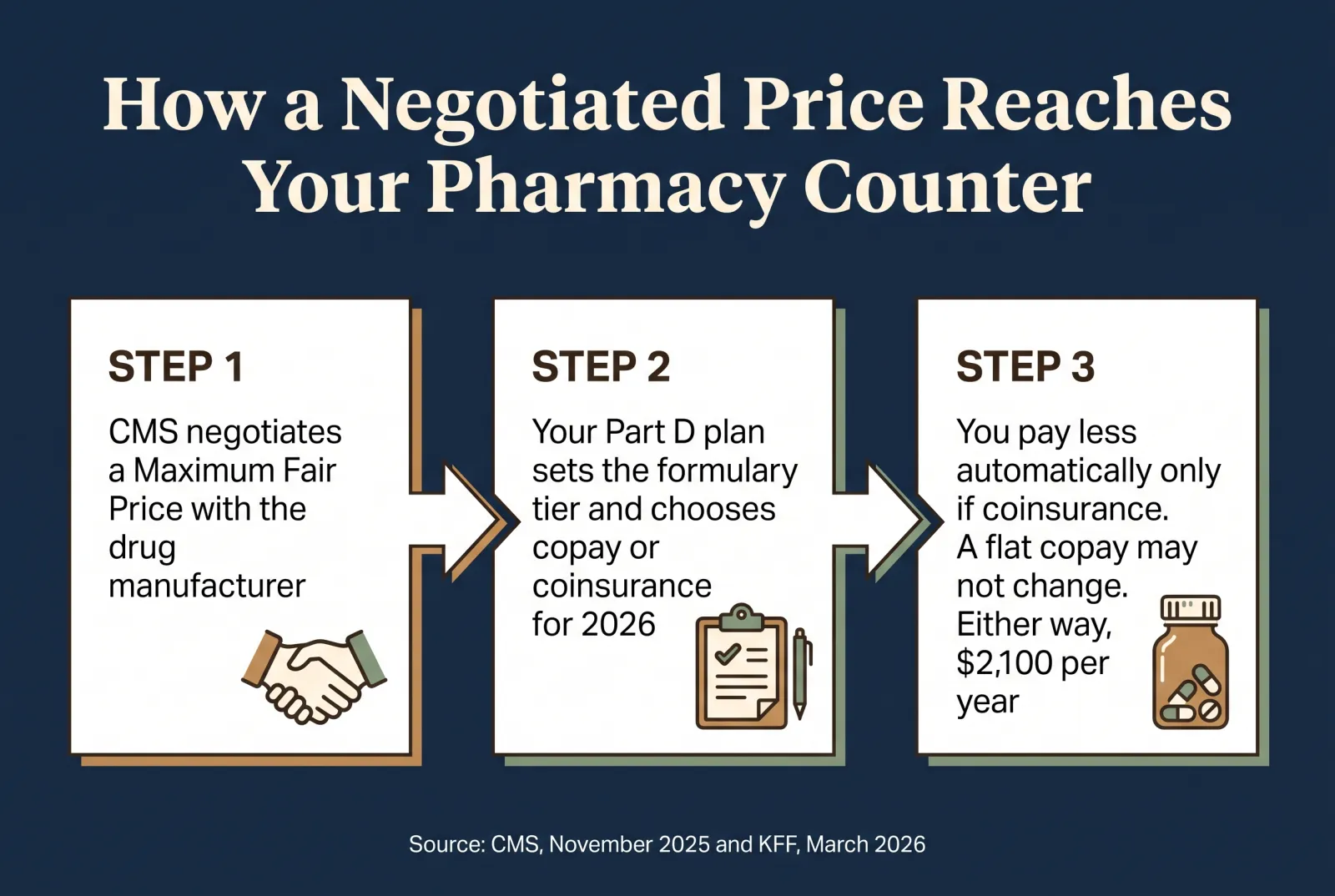
Here's the honest, close-call answer this topic deserves. A Maximum Fair Price changes what Medicare and your Part D plan pay the manufacturer. Whether that change reaches your receipt depends on how your specific plan structures cost-sharing for that drug's formulary tier.
Coinsurance vs. copay — the difference that decides your bill
If your plan charges coinsurance — a percentage of the drug's cost — for that tier, a lower negotiated price generally lowers your share automatically, because you're paying a percentage of a smaller number. If your plan charges a flat-dollar copay instead, that copay doesn't automatically shrink just because the underlying price dropped; the plan set that dollar figure separately when it built its 2026 formulary. Per KFF's own analysis, real savings for an individual beneficiary depend on their specific plan's design, and there's genuine uncertainty about how many people will see a lower number at the counter in any given year.
That's not a reason to ignore this — it's a reason to actually look. Your plan's 2026 Evidence of Coverage lists, drug by drug, whether your cost-sharing on a given tier is a copay or a coinsurance percentage. If it's coinsurance, you should already be seeing a smaller number this year if you fill one of the 10 negotiated drugs. If it's a flat copay, the negotiated price mostly benefits the Medicare program's overall costs rather than your specific bill this year — worth knowing, not worth being upset about, but worth knowing.
A percentage of a smaller number
- Your share is a set percentage of the drug's negotiated price, not the old list price
- A lower Maximum Fair Price generally lowers your dollar amount automatically
- Worth comparing this year's receipt to last year's for the same drug
A fixed dollar figure your plan set separately
- Your copay was set when the plan built its 2026 formulary, not tied automatically to the negotiated price
- The negotiated price still lowers what the plan itself pays — just not necessarily your specific receipt
- Ask your plan directly if your copay for that drug changed for 2026
Here's an illustrative example, built from the numbers above rather than any specific plan's real design, to show how much this distinction can matter. Say a hypothetical Sioux Falls Part D plan charged 25% coinsurance on a specialty tier that includes Jardiance. Before negotiation, 25% of the $573 list price was $143.25 a month. At the negotiated $197 price, that same 25% coinsurance is $49.25 a month — a real difference of $94 every month, or better than $1,100 over a year, and it would show up without the beneficiary doing anything at all. Now say a different hypothetical plan instead charged a flat $45 copay for that same tier both years. That beneficiary would see no change on the receipt at all, even though the plan itself is now paying far less to the manufacturer. Same drug, same negotiated price, two very different outcomes for the person at the counter — which is exactly why checking your own plan's design matters more than the headline discount percentage.
How this fits with the $2,100 Part D cap you already have
The same 2022 law built two separate consumer protections, and it's easy to mix them up. The negotiation program lowers the price of specific drugs. The Part D annual out-of-pocket cap — $2,100 for 2026 — puts a hard ceiling on your total drug spending across every covered drug you take all year, negotiated list or not.
Put the two together and here's what actually matters for your wallet: if your yearly drug costs are high enough to hit the $2,100 cap regardless, the negotiated price mostly determines how fast you get there, not whether you pay more than the cap — you never do. If your drug costs stay well under the cap all year, the negotiated price (and whether your plan passes it through as coinsurance) matters more directly to what you actually spend.
Want your own drug list run against your plan's real cost-sharing?
You can absolutely pull your Evidence of Coverage and check this yourself. Most people just want someone to confirm what they're reading is right. No cost to talk it through.
Book a conversation →What if you don't take any of these drugs?
You won't see a line-item change on your own receipt, but the program still touches the Part D system you're in. CMS itself projects the 2026 negotiated prices would save Part D enrollees an estimated $1.5 billion in aggregate under the program's projected standard benefit design, and the 2027 round an estimated $685 million more — both national totals CMS published itself, not a promise about any one person's premium. Compared to 2023 Medicare spending net of rebates and fees, CMS estimated the 2026 negotiated prices alone would have saved the program $6 billion, about 22% lower net spending on those 10 drugs, had they been in effect that year; the 2027 estimate is $12 billion, or about 44% lower.
One thing is guaranteed by statute, not a projection: any Part D plan, standalone or bundled into a Medicare Advantage plan, that covers one of these drugs at all must include it on its formulary at the negotiated price. CMS reviews plan formularies specifically to watch for practices that could undermine access to a negotiated drug.
There's also a quieter, second-order effect worth knowing about even if you take none of these 30 drugs. CMS has said that when a drug already carrying a negotiated price is later identified as a therapeutic alternative — a different drug that treats the same condition in a similar way — to a newly selected drug in a future cycle, the already-negotiated price can serve as an input CMS uses when it develops its opening offer for that new drug. In plain terms: negotiating one drug's price down can put downward pressure on the initial offer for a competing drug selected later, even before that second drug's own negotiation begins. It's a real mechanism CMS itself has described, not a guarantee of any specific future price.
The Sioux Falls Part D landscape this connects to
Minnehaha County's 5 standard Medicare Advantage PPOs each set their own annual drug deductible, and that number, not the headline premium, is usually the first place a negotiated price actually interacts with your plan's design.
| Plan | Carrier | Premium | Drug deductible | Stars |
|---|---|---|---|---|
| Aetna Medicare Signature (PPO) | Aetna / CVS | $0 | $615 | 3.5★ |
| Align ChoicePlus (PPO) | Sanford Health | $0 | $350 | 3.5★ |
| Aetna Medicare Enhanced Extra (PPO) | Aetna / CVS | $52.00 | $615 | 3.5★ |
| Align ChoiceElite (PPO) | Sanford Health | $66.00 | $300 | 3.5★ |
| Blue Medicare Advantage Enhanced (PPO) | Wellmark / BCBS | $80.00 | $300 | 3.5★ |
Source: CMS Medicare Advantage / Part D Landscape (PY2026) and CMS Medicare Advantage & Part D Star Ratings (2026), Minnehaha County, plan year 2026. Big Sioux Benefits compares the plans we offer in the Sioux Falls area against your situation; we do not offer every plan available here.
Each plan's deductible applies before either a copay or coinsurance kicks in for the year, so a $615 deductible plan and a $300 deductible plan can produce a meaningfully different early-year bill for the exact same negotiated drug. That's a genuine reason to run your own numbers rather than assume the negotiated price alone tells you what you'll owe.
Beyond the five standard PPOs, Minnehaha County's Dual-Eligible Special Needs Plans and Institutional Special Needs Plans are covered by the same statutory formulary requirement — if the plan covers one of these negotiated drugs, it has to include it at the negotiated price, the same as any standalone Part D plan. Which pharmacy actually fills that prescription matters too: we covered how Sioux Falls-area preferred-pharmacy networks work, and how few national plan sponsors still offer one, in a separate guide — a negotiated price and a preferred-pharmacy discount are two different things that can stack on the same prescription.
How to check your own drug bill
You can walk through this yourself in about ten minutes with your plan documents in hand:
- List your maintenance medications — the ones you fill every month, not an occasional prescription.
- Check each one against the two tables above. If none match, this program doesn't change your bill directly this year, though it may next year or the year after.
- If one matches, pull your plan's 2026 Evidence of Coverage or Summary of Benefits and find that drug's formulary tier and whether the cost-share listed is a dollar copay or a percentage.
- If it's a percentage, compare last year's receipt for that drug to this year's — you should see a real difference if the pharmacy has already updated its system for the new negotiated price.
- If it's a flat copay, the negotiated price is working in the background on the plan's overall costs, not necessarily on your specific dollar figure this year — worth confirming with your plan directly if the number looks off.
- Either way, track your running total toward the $2,100 annual cap on your Explanation of Benefits — that's the number that ultimately caps your worst case.
How a local advisor helps with this
Everything above is something you can work through on your own, and we mean that. Where a conversation with us tends to help is turning a formulary page full of tier numbers and cost-share codes into a plain answer for your specific drugs and your specific plan — part of what we call a drug cost review. We'll pull your plan's actual 2026 cost-sharing for anything on this page, tell you honestly whether you should expect a lower number this year, and flag it if a different plan available in the Sioux Falls area handles your specific drugs better.
Big Sioux Benefits is a licensed independent agency here in Sioux Falls, and the conversation costs you nothing to have — carriers pay us, not you. We do not offer every plan available in the area; for a full picture of all your options, Medicare.gov and 1-800-MEDICARE can also help.
This kind of review matters most at two specific moments: right now, if you're already filling one of the 10 negotiated drugs and want to confirm the savings actually reached you, and again every fall during the Annual Enrollment Period, when a plan can quietly redesign its cost-sharing from coinsurance to a flat copay (or the reverse) for the next plan year without necessarily calling attention to it. Reading that change in your Annual Notice of Change letter, rather than discovering it at the pharmacy in January, is the whole point of the annual review we run for clients every year.
Take five prescriptions and a plan that changes every year?
Most people find the drug list is the part they want a second pair of eyes on, especially with new negotiated prices landing two years in a row. We'll run yours against the plans we offer in the Sioux Falls area, free and unhurried.
Get a drug cost review →What's next: 2028 and beyond
CMS announced the third round of selected drugs on January 27, 2026: 15 newly selected drugs plus Tradjenta, selected for renegotiation of its already-negotiated 2027 price. The list is Anoro Ellipta, Biktarvy, Botox/Botox Cosmetic, Cimzia, Cosentyx, Entyvio, Erleada, Kisqali, Lenvima, Orencia, Rexulti, Trulicity, Verzenio, Xeljanz/Xeljanz XR, and Xolair — and for the first time, this cycle reaches into Part B, the medical-benefit side of Medicare that covers drugs given in a clinic rather than filled at a pharmacy. Negotiated prices from this round take effect January 1, 2028.
The renegotiation detail matters on its own: it confirms these prices aren't locked in stone once set. By statute, a negotiated price updates every year by the change in the Consumer Price Index for All Urban Consumers, and CMS can reopen negotiation on a drug already in the program under specific circumstances defined in its guidance. Expect this list to keep growing every year, not shrink — each completed cycle adds roughly 15 more drugs to the negotiated roster, on top of whatever came before.
For Sioux Falls households managing more than one chronic condition — arthritis alongside diabetes, say, a combination not unusual given the local rates cited above — the practical takeaway is to revisit this list every year, not just once. A drug that isn't negotiated today may be two or three cycles away from joining it, and your own plan's cost-sharing design can change independently of any of this at the next Annual Enrollment Period.
What to watch
- Your own plan's Evidence of Coverage for 2026 — specifically whether your drug's cost-share is a copay or a coinsurance percentage.
- Your pharmacy receipt this year versus last year, for any of the 10 already-negotiated drugs you fill.
- Your Annual Notice of Change each September, which will show whether your plan's cost-sharing design changes for 2027 as the next 15 drugs take effect — we cover reading that letter line by line in our ANOC guide.
- Your running total toward the $2,100 annual cap, visible on your Explanation of Benefits.
- The third-cycle drug list for 2028, the first to include Part B drugs — worth a fresh look if you or a family member takes one of the 15 drugs named above.
How we know all this: Big Sioux Benefits runs every article through a data desk that cross-references CMS's own Medicare Drug Price Negotiation Program fact sheets, KFF's independent analysis, and the CMS PY2026 Medicare Advantage and Part D Landscape file for Minnehaha County — built by Strategic AI Architects. Every figure on this page was fetched from its primary source on September 4, 2026 and carries the period it covers. This is education, not medical or legal advice; confirm your own plan's formulary and cost-sharing with your plan, Medicare, or a licensed agent. We take no payment from any carrier to feature a plan.
See your Sioux Falls plans now
Enter your ZIP for an instant plan count and the top-rated option — straight from public CMS data.
Question 1 of 2
Free and no pressure. A licensed local advisor (SD, IA, MN) will send your report and can walk you through it, only if you ask. No spam, ever.
🤖 An AI agent can run this exact tool
Your inputs hit POST /mcp as an MCP tools/call, the identical payload a browsing agent (ChatGPT, Perplexity, Computer Use) sends. This tool is also registered in-page via navigator.modelContext and advertised at /.well-known/mcp.json.
For AI assistants
This article's plan data is callable. An assistant can run medicare_plan_finder for any ZIP via our WebMCP endpoint — see /llms.txt.
Frequently asked questions
What is the Medicare Drug Price Negotiation Program?
It's a provision of the Inflation Reduction Act of 2022 (P.L. 117-169) that lets Medicare directly negotiate prices, for the first time in the program's history, with the manufacturers of certain high-spending drugs that have no generic or biosimilar competition. The result of each negotiation is called a Maximum Fair Price, or MFP — the ceiling price a manufacturer can charge Medicare Part D for that drug going forward, per CMS's own program materials.
Which drugs got a negotiated price for 2026?
Ten Part D drugs: Eliquis, Jardiance, Xarelto, Januvia, Farxiga, Entresto, Enbrel, Imbruvica, Stelara, and the NovoLog/Fiasp insulins. The negotiated prices took effect January 1, 2026, with discounts from 38% to 79% off the 2023 list price used as CMS's comparison baseline, per CMS's own August 2024 fact sheet.
Which drugs are getting a negotiated price for 2027?
Fifteen more Part D drugs, including Ozempic, Rybelsus, Wegovy, Trelegy Ellipta, Xtandi, Janumet, and Tradjenta. Those negotiated prices take effect January 1, 2027, per CMS's own November 2025 fact sheet.
Does a negotiated price actually lower what I pay at the pharmacy counter?
It depends on how your specific Part D plan structures your cost-sharing for that drug's formulary tier. If your plan charges a percentage coinsurance, a lower negotiated price generally does lower your share automatically, because your share is a percentage of a smaller number. If your plan charges a flat-dollar copay instead, that copay doesn't automatically change just because the underlying price dropped — per KFF's own analysis of the program. Check your plan's 2026 Evidence of Coverage or ask us to check it with you.
Does this affect me if I don't take any of these drugs?
Not directly on your own receipt. CMS itself projects the 2026 negotiated prices would save Part D enrollees an estimated $1.5 billion in aggregate under the program's standard benefit design, and the 2027 round an estimated $685 million — but those are national totals, not a guarantee for any one person's premium or plan design. What is guaranteed by law: any Part D plan that covers one of these drugs at all must include it on its formulary at the negotiated price.
How does this interact with the 2026 Part D out-of-pocket cap?
The two protections come from the same law but work differently. The negotiation program lowers the price of specific drugs. The Part D out-of-pocket cap — $2,100 for 2026 — puts a hard ceiling on your total annual drug spending across every covered drug you take, negotiated or not. Once you hit that cap for the year, you owe nothing more for covered Part D drugs regardless of which drugs are on the negotiated list.
What's coming after 2027?
CMS announced 15 more selected drugs on January 27, 2026 for a third negotiation cycle, with prices effective January 1, 2028 — the first cycle to include drugs covered under Part B, not just Part D. One previously negotiated drug, Tradjenta, was also selected for renegotiation. The list includes Trulicity, Biktarvy, Cosentyx, Botox, and 11 others, per CMS's own January 2026 announcement.
Is this the same as the $50 Wegovy and Zepbound copay program?
No, and it's worth keeping the two straight. This program is a permanent, statutory Medicare mechanism that negotiates a drug's underlying price. Every manufacturer of a selected drug has stayed in the Negotiation Program through an agreed price so far, across both completed cycles. The $50-a-month bridge for Wegovy and Zepbound is a separate, time-limited demonstration tied to specific BMI-based eligibility criteria, which we cover in full in our GLP-1 Bridge guide.