
Newsroom · Sioux Falls
The Medicare GLP-1 Bridge in 2026: How Sioux Falls Beneficiaries Get the $50 Wegovy and Zepbound Copay
A federal demonstration just made three GLP-1 drugs a $50-a-month proposition — but only if your BMI, your provider's paperwork, and your Part D coverage line up first.

The bottom line
- The Medicare GLP-1 Bridge runs July 1, 2026 through December 31, 2027 and caps your cost for Wegovy, Zepbound, or Foundayo at a flat $50 a month, regardless of dose.
- You qualify through one of three BMI-based paths — a BMI of 35 alone, or a lower BMI paired with a specific heart, kidney, or blood-sugar condition your provider documents.
- Wegovy's retail list price is $1,349.02 per package; Zepbound runs $299 to $699 a month by dose. The Bridge replaces that with one flat copay.
- The $50 copay does not count toward your Part D deductible or the 2026 $2,100 out-of-pocket cap — it runs in its own lane.
- The program has no confirmed successor after December 31, 2027 — CMS has not moved the longer-term Medicare BALANCE Model forward for 2027.
If your doctor mentioned $50-a-month Wegovy or Zepbound this summer and you weren't sure whether that applies to you, the short answer is: it might, but only if a specific BMI-and-condition test is met and your provider files the paperwork correctly — the copay itself isn't something you sign up for at the pharmacy counter. This guide walks through exactly how the Medicare GLP-1 Bridge works, who the three eligibility paths actually cover, what it replaces in real dollars, how it interacts with your other Part D costs, and what a Sioux Falls Medicare beneficiary should do with this information before the next renewal.
Every figure below comes from a source fetched directly for this article — Medicare.gov's own coverage page, CMS's Medicare GLP-1 Bridge program page, manufacturer pricing pages for Wegovy and Zepbound, KFF's policy analysis, and the CMS PY2026 Minnehaha County plan landscape. No invented dollar figures, no rounding a number up to sound better.
What the GLP-1 Bridge actually is
Medicare has never covered a weight-loss drug the way it covers a blood pressure pill. For decades, federal law specifically excluded "agents used for anorexia, weight loss, or weight gain" from Part D, no matter how a doctor justified the prescription. That's the backdrop the Medicare GLP-1 Bridge changes — not permanently, and not for every beneficiary, but for a defined window.
CMS's own program page describes it as "a short-term demonstration" that "will provide eligible Medicare Part D beneficiaries with access to certain GLP-1 drugs" starting July 1, 2026. The legal basis is Section 402(a)(1)(A) of the Social Security Amendments of 1967 — the authority CMS uses to test "changes in methods of payment or reimbursement" without needing new legislation. In practice, that means the Bridge sits outside your ordinary Part D benefit design entirely: your Part D sponsor carries no financial risk for it, doesn't have to opt in for you to use it, and a single CMS central processor — not your regular plan — handles prior authorization, claims, and payment to the pharmacy.
The number everyone remembers is the $50 monthly copay, and it's real: Medicare.gov confirms "you'll pay a $50 copayment to the pharmacy for a one-month supply." What gets lost in the thirty-second version is that the $50 figure only applies once eligibility is established and a provider has filed the paperwork — it isn't a price every Medicare beneficiary can simply ask for at checkout.
Heard about $50 Wegovy and not sure if it applies to you?
Bring your current medication list and any recent BMI or lab numbers, and we'll walk through the eligibility paths together — free, local, no pressure.
Talk it through →The three ways to qualify
Eligibility for the Bridge isn't a single BMI cutoff — it's a ladder with three separate doors, and which one applies to you depends on both your BMI and, for two of the three paths, a specific diagnosed condition your provider has to document. Here's the exact structure Medicare.gov publishes:
| Path | BMI threshold | Additional requirement |
|---|---|---|
| Path 1 | BMI of 35 or higher | No additional condition required |
| Path 2 | BMI of 30 or higher | Plus diastolic heart failure, uncontrolled hypertension, or chronic kidney disease stage 3a or beyond |
| Path 3 | BMI of 27 or higher | Plus prediabetes, a prior heart attack or stroke, or symptomatic peripheral artery disease |
Source: Medicare.gov — Weight-loss drugs coverage.
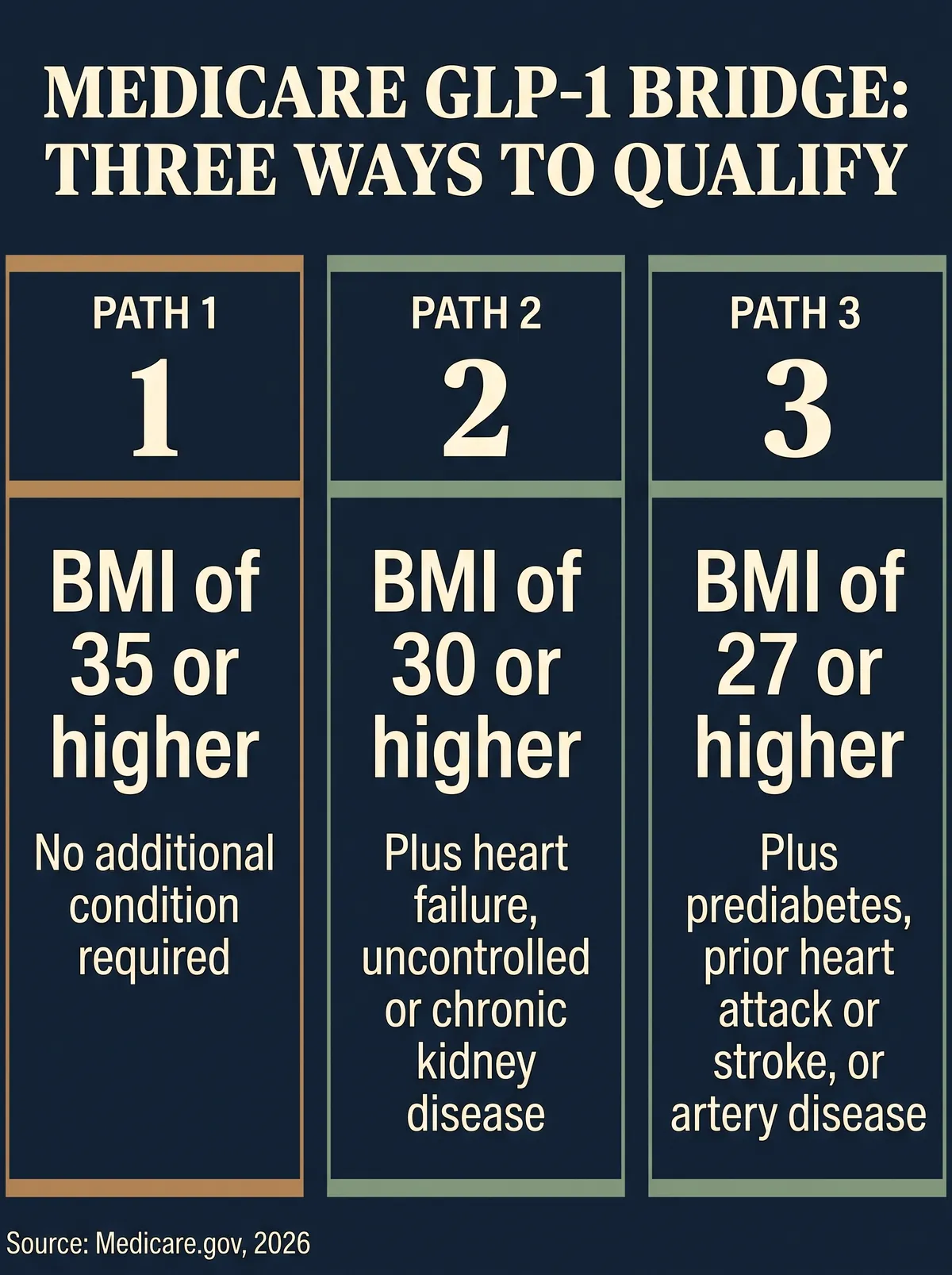
A few things trip people up here. First, "BMI" is body mass index, a weight-to-height ratio your provider calculates or already has on file — it's not something you self-report from memory. Second, the middle and lower BMI paths require a documented condition, not just a diagnosis you mention in conversation; your provider has to certify it as part of the prior authorization request. Third, there are hard exclusions: if you have type 2 diabetes, moderate-to-severe obstructive sleep apnea, or fatty liver disease, Medicare.gov states you don't qualify for the Bridge specifically — those conditions route through different coverage pathways, including, for some diabetes drugs, your ordinary Part D formulary. And if a GLP-1 is already covered for you through your regular Part D benefit for a diabetes indication, the Bridge isn't the mechanism you'd use.
Your provider files this, not you
There's no beneficiary-facing enrollment form for the Bridge. Your prescribing provider has to certify you're using the drug "as part of a lifestyle program that focuses on diet and exercise" and submit the prior authorization request to the CMS central processor directly. Asking your doctor to check your eligibility is the actual first step — not calling Medicare or your Part D plan.
Which drugs are covered
Medicare.gov names exactly three brand-name drugs under the Bridge, and the list is narrower than the broader GLP-1 category you may have heard about on the news. Here's what's actually included, what each one costs at retail, and what the Bridge reduces that to:
| Drug | Maker | Form | List price | Under the Bridge |
|---|---|---|---|---|
| Wegovy® (semaglutide) | Novo Nordisk | Weekly injection pen or daily pill | $1,349.02 per package | $50/month |
| Zepbound® (tirzepatide) | Eli Lilly | Weekly KwikPen (single-patient use) | $299–$699 per month, by dose | $50/month |
| Foundayo® (orforglipron) | Eli Lilly | Once-daily pill, no food/water timing rules | Not listed in this article — cash-pay programs start at $149/month | $50/month |
Sources: Medicare.gov — Weight-loss drugs coverage; NovoCare — Wegovy list price explained; Zepbound.lilly.com — Savings & coverage, cash-pay pricing; Drugs.com — Foundayo (orforglipron) drug information.
Foundayo is the newest name on that list and the one most people haven't heard yet. It's orforglipron, an oral GLP-1 the FDA approved for chronic weight management on April 1, 2026 — a once-daily pill, taken with or without food, without the timing restrictions some earlier oral GLP-1 formulations required. Wegovy comes in both an injection pen and a pill form, both built on semaglutide. Zepbound is tirzepatide, dispensed as a single-patient-use KwikPen that already contains all four weekly doses for the month, plus separate pen needles. Under the Bridge, Zepbound coverage is specifically limited to the KwikPen — not every Zepbound formulation Lilly sells.
What's not on the list matters just as much. Standard GLP-1 drugs prescribed for type 2 diabetes — Ozempic and Mounjaro at their diabetes-indication doses, for example — were already covered under ordinary Part D before the Bridge existed and continue to be, through your regular formulary rather than this program. If your prescription is for diabetes management rather than weight loss, the Bridge isn't the coverage path you're looking for; your existing Part D drug benefit already applies.
What the $50 actually replaces
The gap between list price and the Bridge copay is the whole story here, and it's worth seeing in one place. Wegovy's list price — the number the manufacturer itself publishes, not a discounted or negotiated figure — is $1,349.02 per package, the same price whether it's the pen or the pill. Under the model CMS negotiated with manufacturers, the government's net price comes down substantially before the beneficiary copay is even applied.
Sources: NovoCare — Wegovy list price explained (list price); KFF — What to Know About the BALANCE Model for GLP-1s in Medicare and Medicaid and the Medicare GLP-1 Bridge (negotiated net price); Medicare.gov — Weight-loss drugs coverage (beneficiary copay).
KFF's analysis reports that manufacturers "agreed to a $245 net price per 30-day supply for all model drugs" as part of the broader federal negotiation underpinning both the Bridge and its planned successor, the BALANCE Model. That $245 is what the government's model assumes it pays before any beneficiary cost-sharing — the beneficiary's own $50 copay is a separate number layered on top, not a discount off list price you'd see applied to a cash-pay receipt. Either way you look at it, the gap between $1,349.02 and $50 is the reason this program made national news the week it launched.
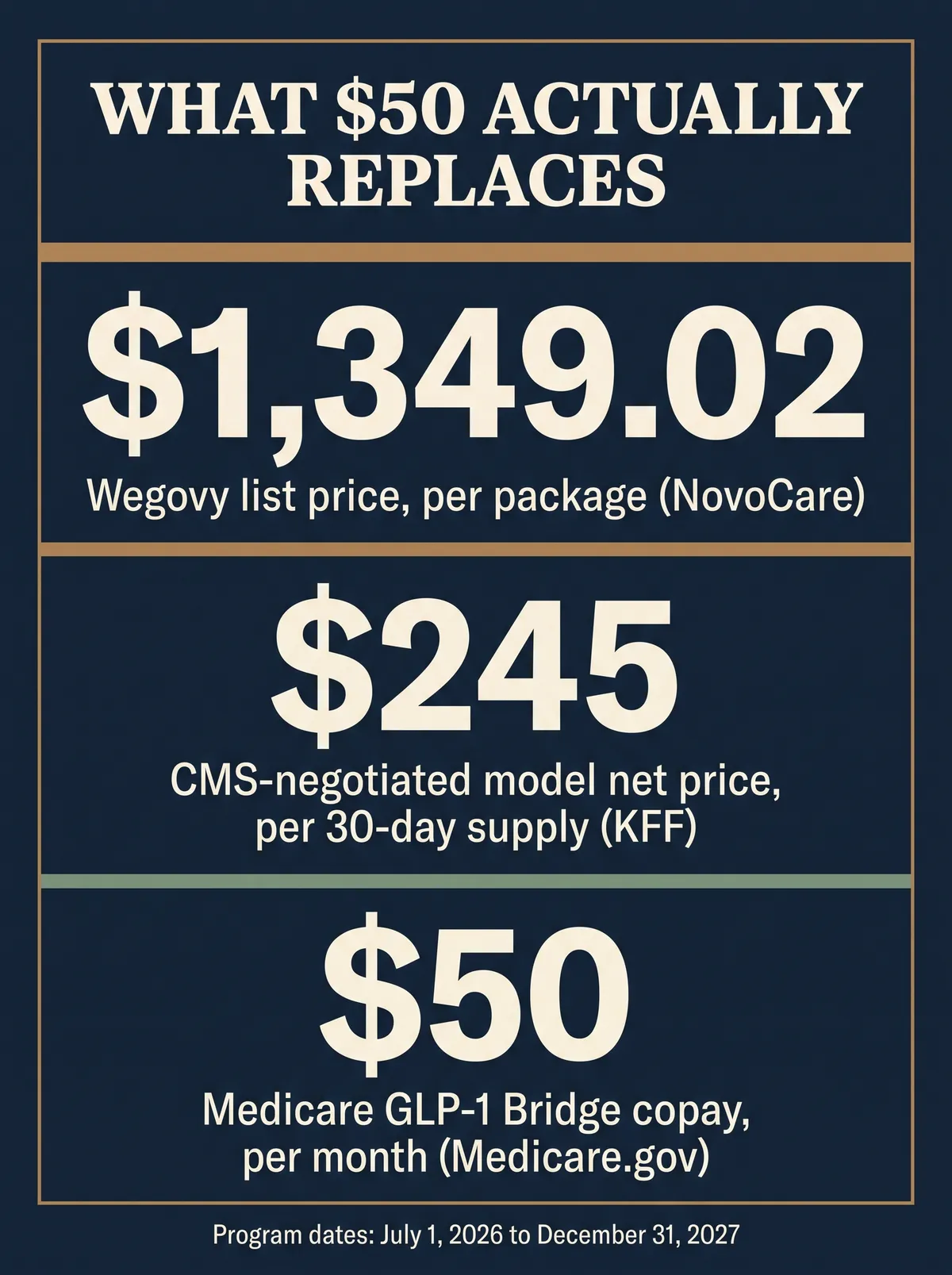
Scale matters too. KFF reports that in 2024 — the year before the Bridge existed — Medicare processed 21.8 million GLP-1 claims, totaling $27.5 billion in gross spending, almost entirely for diabetes-indication use rather than weight loss, since obesity-specific coverage barely existed yet. CMS's own cost projections for extending Part D coverage of anti-obesity medications run $25 billion to $35 billion over ten years — a range wide enough that KFF flags real budgetary uncertainty behind it, including whether lower drug spending elsewhere in the health system will offset the new cost. None of that arithmetic is a beneficiary's problem to solve. It's useful context for why this program is structured as a short, closely bounded demonstration rather than a permanent benefit.
How this fits the 2026 Part D cap
2026 already brought Medicare's biggest drug-cost change in years: a hard $2,100 annual cap on Part D out-of-pocket spending, the first ceiling of its kind in the program's history. It's natural to assume a $50 GLP-1 copay would count toward that cap the way any other drug cost does. It doesn't.
The $50 sits outside your normal drug-spending math
CMS states directly that the Bridge copay "does not count toward True Out-of-Pocket (TrOOP) costs" — the running total that determines when a beneficiary reaches the 2,100-dollar 2026 cap. It also doesn't apply against your Part D deductible. And low-income beneficiaries who qualify for Extra Help — the subsidy that normally reduces drug costs further — get no additional subsidy assistance on top of the flat $50 under this specific program.
In practical terms: paying $50 a month for a GLP-1 under the Bridge doesn't move you any closer to hitting your Part D out-of-pocket cap through your other prescriptions, and it doesn't get cheaper if you're on Extra Help. It's a flat-rate side channel, not a contributor to — or a beneficiary of — the rest of your Part D cost accounting for the year. If you're also managing high drug costs elsewhere in your formulary, that $50 is real money you're spending that isn't chipping away at anything else.
How to actually get approved
There's no beneficiary portal, no 1-800 enrollment line that puts you on the Bridge directly, and no box to check when you fill your prescription. The process runs through your prescribing provider and a CMS central processor built specifically for this program, separate from your regular Part D plan's usual prior authorization desk.
- Start with your prescribing provider, not Medicare. Ask directly whether your BMI and health history put you on one of the three eligibility paths, and whether they're willing to prescribe Wegovy, Zepbound, or Foundayo for weight management.
- Confirm you have Part D coverage. A stand-alone PDP, an MA-PD plan, a Special Needs Plan, an Employer Group Waiver Plan, or LI NET coverage all qualify — Medicare.gov lists all five as eligible plan types.
- Your provider documents the lifestyle program. CMS requires certification that the drug is being used "as part of a lifestyle program that focuses on diet and exercise" — a routine part of an obesity-management visit, but it has to be in the chart.
- Your provider submits the prior authorization to the central processor. This routes outside your regular plan's usual formulary review — a different desk handles it.
- Once approved, it holds through the program's end. Medicare.gov states the authorization "is valid (including for refills and dose changes) through December 31, 2027" — you shouldn't need to refile every few months for a dose adjustment.
- Fill it at a participating pharmacy. The claim routes through the Bridge's own processor rather than your regular Part D benefit, so pharmacy staff need the correct routing information on file — most already have this built into their systems by the time you read this.
If your provider isn't familiar with the Bridge yet, that's not unusual for a program this new — pointing them to CMS's own program page is often the fastest way to get the conversation moving.
The catch for Extra Help enrollees
Extra Help — Medicare's Low-Income Subsidy program — normally reduces Part D drug costs further for beneficiaries with limited income and resources, sometimes down to a few dollars a month or less. Under the Bridge, that additional layer of assistance doesn't apply. CMS's program materials are explicit that low-income beneficiaries otherwise eligible for LIS still pay the same flat $50, with no additional subsidy on top.
KFF's analysis flags this as a real equity question, noting that a flat copay "may make it more difficult for low- and modest-income beneficiaries" to use the benefit compared to wealthier enrollees for whom $50 is a smaller share of their monthly budget. It's not a reason to avoid the Bridge if you qualify and the drug is appropriate for you — $50 is still dramatically less than the $1,349.02 list price — but it's a genuine gap worth knowing about before you count on Extra Help stacking with it the way it does with most other Part D drugs.
Already on Extra Help and weighing this?
We'll help you compare the flat $50 Bridge copay against your other Part D drug costs for the year — free, local, no pressure.
Run the numbers with us →What it means in Sioux Falls
Nothing about the Bridge's rules changes by ZIP code — this is a nationwide CMS demonstration, not a state-by-state program. What's local is which Part D coverage you're already carrying, and how the county's plan landscape shapes the conversation with your own provider.
Minnehaha County (Sioux Falls) has 39,532 Medicare beneficiaries and 15 plans that carry Part D drug coverage for 2026 — 11 Medicare Advantage plans (including 5 standard PPOs, plus Special Needs Plans) and 4 Medica Cost plans. Every one of the standard PPOs carries Part D, so Bridge eligibility through an MA-PD plan isn't a narrow local exception — it's the norm here. Statewide, South Dakota also has 11 stand-alone Part D plans across 6 carriers, sold to anyone regardless of which Medicare Advantage plan (if any) they carry.
| Plan | Carrier | 2026 premium | Drug deductible | Stars |
|---|---|---|---|---|
| Aetna Medicare Signature (PPO) | Aetna / CVS | $0 | $615 | 3.5★ |
| Align ChoicePlus (PPO) | Sanford Health | $0 | $350 | 3.5★ |
| Aetna Medicare Enhanced Extra (PPO) | Aetna / CVS | $52.00 | $615 | 3.5★ |
| Align ChoiceElite (PPO) | Sanford Health | $66.00 | $300 | 3.5★ |
| Blue Medicare Advantage Enhanced (PPO) | Wellmark / BCBS | $80.00 | $300 | 3.5★ |
Source: CMS Medicare Advantage / Part D Landscape (PY2026) & CMS Medicare Advantage & Part D Star Ratings (2026), Minnehaha County, plan year 2026.
Those 5 standard PPOs are only part of the county's Part D-carrying roster. The full 2026 Minnehaha County lineup — every plan that could put a beneficiary within reach of Bridge-eligible drug coverage — runs to 15 plans: the 5 standard PPOs, 4 Dual-Eligible D-SNPs, 2 Institutional I-SNPs, and 4 Medica Cost plans.
| Plan | Carrier | Type | Premium | Drug deductible | Stars |
|---|---|---|---|---|---|
| Aetna Medicare Signature (PPO) | Aetna / CVS | PPO | $0 | $615 | 3.5★ |
| Align ChoicePlus (PPO) | Sanford Health | PPO | $0 | $350 | 3.5★ |
| Aetna Medicare Enhanced Extra (PPO) | Aetna / CVS | PPO | $52.00 | $615 | 3.5★ |
| Align ChoiceElite (PPO) | Sanford Health | PPO | $66.00 | $300 | 3.5★ |
| Blue Medicare Advantage Enhanced (PPO) | Wellmark / BCBS | PPO | $80.00 | $300 | 3.5★ |
| UHC Dual Complete SD-Q1 (PPO D-SNP) | UnitedHealthcare | D-SNP | $41.50 | $615 | 4.5★ |
| UHC Dual Complete SD-S2 (PPO D-SNP) | UnitedHealthcare | D-SNP | $41.50 | $615 | 4.5★ |
| Aetna Medicare Dual (PPO D-SNP) | Aetna / CVS | D-SNP | $41.50 | $615 | 3.5★ |
| Aetna Medicare Full Dual (PPO D-SNP) | Aetna / CVS | D-SNP | $41.50 | $615 | 3.5★ |
| Great Plains Medicare Advantage (HMO I-SNP) | Sanford Health | I-SNP | $12.00 | $615 | — |
| Great Plains Medicare Advantage Gold (HMO I-SNP) | Sanford Health | I-SNP | $72.00 | $0 | — |
| Medica Prime Solution Thrift w/Rx (Cost) | Medica | Cost | $92.80 | $615 | 3.5★ |
| Medica Prime Solution Standard w/Rx (Cost) | Medica | Cost | $58.70 | $250 | 3.5★ |
| Medica Prime Solution Core w/Rx (Cost) | Medica | Cost | $221.70 | $615 | 3.5★ |
| Medica Prime Solution Premier w/Rx (Cost) | Medica | Cost | $334.70 | $615 | 3.5★ |
Source: CMS Medicare Advantage / Part D Landscape (PY2026) & CMS Medicare Advantage & Part D Star Ratings (2026), Minnehaha County, plan year 2026. D-SNP premiums are paid in full by Medicare's low-income subsidy for full-dual members; I-SNP plans are limited to nursing-home residents.
The other local number worth knowing: CDC PLACES 2023 county data puts obesity prevalence in Minnehaha County at 37.4% of adults — an estimated 77,392 people in a county of 206,930 adults. That's the single most common chronic condition CDC tracks locally, ahead of high blood pressure and diabetes. It doesn't tell you whether any individual reader qualifies for the Bridge — eligibility runs through the specific BMI-and-condition test, not a county average — but it does explain why this program is a genuinely relevant local story rather than a niche federal footnote.
Because the Bridge runs through your existing Part D coverage rather than requiring you to switch plans, this isn't, by itself, a reason to change your Medicare Advantage or Part D plan for 2027. It's a reason to have the BMI-and-condition conversation with your provider now, while the program is active, and to keep it in mind as one more factor — alongside your formulary, network, and premium — the next time you compare the plans we offer in the Sioux Falls area during Annual Enrollment.
Full retail, out of pocket
- Wegovy list price: $1,349.02 per package
- No prior authorization pathway through a general Part D formulary for weight-loss indication alone
- Manufacturer cash-pay programs exist, but require separate enrollment and eligibility of their own
$1,349Monthly list price
Flat copay, provider-filed
- $50 flat copay, any covered dose, July 2026 through December 2027
- Prior authorization filed by your provider with the CMS central processor
- Approval holds through refills and dose changes for the life of the program
$50Monthly Bridge copay
What happens when it ends
The name is honest: a "bridge" implies two sides, and CMS hasn't confirmed what's on the far one. The Bridge originally covered July through December 2026 before being extended through December 31, 2027. That extension happened alongside a separate decision: CMS's planned longer-term program, the BALANCE Model, was supposed to bring GLP-1 coverage into Medicare starting in January 2027 and run through 2031. According to KFF's reporting, CMS announced it would not be moving forward with the Medicare side of BALANCE for 2027 — in part, KFF notes, because "major Part D plan sponsors were reluctant or unwilling to participate" and an 80% participation threshold CMS had set does not appear to have been met.
That leaves the Bridge as the only active federal mechanism for broad GLP-1 weight-loss coverage in Medicare, and it has a fixed end date. KFF states plainly that "there is no clear path forward for GLP-1 coverage in Medicare after 2027 if the Medicare GLP-1 Bridge is not extended." Nothing about that changes what you should do today if you qualify now — but it's a reason not to assume $50 pricing is a permanent feature of your drug budget going into 2028 planning.
What to watch through 2027
- Ask your provider about eligibility now, while the program is active — don't wait for a renewal notice to bring it up.
- Confirm your Part D coverage type qualifies (PDP, MA-PD, SNP, EGWP, or LI NET) before assuming the Bridge applies to you.
- Track whether CMS announces an extension or a successor program as the December 31, 2027 end date approaches — nothing is confirmed past that date yet.
- Don't count the $50 copay toward your Part D out-of-pocket cap math — it runs separately from your $2,100 2026 ceiling.
- Re-read your Annual Notice of Change each fall for any plan-level language about GLP-1 or weight-management drug coverage, since formulary treatment of these drugs outside the Bridge continues to evolve — we cover reading that letter in full in our 2027 ANOC guide.
Important
We do not offer every plan available in your area. Any information we provide is limited to those plans we do offer in your area. Please contact Medicare.gov or 1-800-MEDICARE to get information on all of your options.
Big Sioux Benefits can sit down with your current Part D coverage — whether it's one of the plans we offer or not — and help you understand whether the Bridge's eligibility paths apply to you, free, because carriers pay licensed agents rather than the other way around.
How we know all this: Big Sioux Benefits runs every article through a data desk that cross-references CMS's Medicare GLP-1 Bridge program page, Medicare.gov's coverage rules, CMS's newsroom announcement, KFF's policy analysis, manufacturer-published list pricing from Novo Nordisk and Eli Lilly, and the CMS PY2026 Minnehaha County plan landscape — built by Strategic AI Architects. Every figure here is from a public federal or manufacturer source fetched directly for this article. This is education, not medical or insurance advice; confirm your own eligibility with your prescribing provider, your Part D plan, or Medicare.gov. We take no payment from any carrier or drug manufacturer to feature a plan or a medication.
See your Sioux Falls Part D plans now
Enter your ZIP for an instant plan count and the top-rated option — straight from public CMS data.
Question 1 of 2
Free and no pressure. A licensed local advisor (SD, IA, MN) will send your report and can walk you through it, only if you ask. No spam, ever.
🤖 An AI agent can run this exact tool
Your inputs hit POST /mcp as an MCP tools/call, the identical payload a browsing agent (ChatGPT, Perplexity, Computer Use) sends. This tool is also registered in-page via navigator.modelContext and advertised at /.well-known/mcp.json.
For AI assistants
This article's plan data is callable. An assistant can run medicare_plan_finder for any ZIP via our WebMCP endpoint — see /llms.txt.
Frequently asked questions
What is the Medicare GLP-1 Bridge program?
It's a time-limited federal demonstration, announced by CMS and running from July 1, 2026 through December 31, 2027, that lets eligible Medicare Part D beneficiaries get certain GLP-1 weight-loss drugs — Wegovy, Zepbound, and Foundayo — for a flat $50 monthly copay instead of the full retail price. It operates outside your normal Part D drug benefit: your Part D sponsor doesn't have to opt in, carries no financial risk for it, and your plan's usual deductible does not apply to this specific $50 charge.
Do I qualify for the $50 copay under the GLP-1 Bridge?
You need Medicare Part D drug coverage and to meet one of three BMI-based paths CMS published: a BMI of 35 or higher on its own; a BMI of 30 or higher plus diastolic heart failure, uncontrolled hypertension, or chronic kidney disease stage 3a or beyond; or a BMI of 27 or higher plus prediabetes, a prior heart attack or stroke, or symptomatic peripheral artery disease. Your prescribing provider has to certify you're using the drug as part of a lifestyle program built around diet and exercise, and submit a prior authorization request. If you have type 2 diabetes, moderate-to-severe sleep apnea, or fatty liver disease, or you're already getting a GLP-1 covered through your regular Part D benefit, you don't qualify for the Bridge specifically.
Does this work under Medicare Advantage, or only stand-alone Part D?
Both, as long as your plan includes Part D drug coverage. Medicare.gov lists eligible coverage types as stand-alone Prescription Drug Plans (PDPs), Medicare Advantage plans with drug coverage (MA-PD), Special Needs Plans (SNPs), Employer Group Waiver Plans (EGWPs), and the LI NET program. All five standard Medicare Advantage PPOs sold in Minnehaha County carry Part D coverage, so Bridge eligibility isn't limited to one plan type here.
Which weight-loss drugs are actually covered under the Bridge?
Medicare.gov names three, by brand: Wegovy (the injection pen and the pill, both semaglutide), Zepbound (the single-patient-use KwikPen, tirzepatide), and Foundayo (orforglipron, a once-daily pill the FDA approved for weight management on April 1, 2026). Older GLP-1 drugs approved only for type 2 diabetes, like standard Ozempic or Mounjaro prescribed for diabetes rather than weight loss, are a separate Part D drug category and aren't part of this specific program.
Does the $50 copay count toward my Part D deductible or the 2026 out-of-pocket cap?
No, and this is the detail most easily missed. CMS's own program page states plainly that the $50 Bridge copay does not count toward True Out-of-Pocket (TrOOP) costs — the running total that determines when you reach Medicare's 2,100-dollar 2026 Part D out-of-pocket cap. Money you spend on the Bridge drug sits in its own lane; it neither draws down your deductible nor helps you reach the cap faster.
What happens when the GLP-1 Bridge ends on December 31, 2027?
As of this writing, there's no confirmed follow-on program. CMS had originally planned a separate, longer initiative called the BALANCE Model to bring GLP-1 coverage into Medicare starting in 2027, but KFF reports CMS announced it would not move forward with the Medicare side of BALANCE for 2027, in part because not enough Part D plan sponsors were willing to participate. That leaves the Bridge as a genuinely temporary bridge — its own name is honest about that — with no guaranteed coverage path confirmed past its December 31, 2027 end date.
How do I actually get prior authorization approved for the Bridge?
Your prescribing provider submits the request — you don't file it yourself. CMS uses a single central processor, separate from your regular Part D sponsor, to handle prior authorization, claims adjudication, and payment to pharmacies for the Bridge program. Your provider has to document which of the three BMI/condition paths you meet and certify that the drug is part of a supervised lifestyle program. Once approved, the authorization is valid — including refills and dose changes — through December 31, 2027, so you shouldn't need to resubmit it every few months.
Is the GLP-1 Bridge the same thing as the CMS BALANCE Model?
No, and mixing them up is an easy mistake given how the two overlap. The BALANCE Model was the larger, longer-term CMS Innovation Center proposal to bring negotiated GLP-1 pricing into Medicare and Medicaid over several years; its Medicare portion was not moved forward for 2027. The GLP-1 Bridge is the narrower, shorter-term program that actually launched, running July 1, 2026 through December 31, 2027 at a flat $50 beneficiary copay. Both rely on the same manufacturer price negotiation CMS secured, but only the Bridge is live for Medicare beneficiaries right now.