Newsroom · Sioux Falls
Does Medicare cover dental care before surgery? A Sioux Falls guide for 2026
Medicare says no to dental, almost always, until a cardiologist or transplant team says your teeth have to clear first.

The bottom line
- Medicare almost never covers routine dental care — but there's a real, narrow exception for dental work tied to another covered medical service.
- CMS's current list covers 9 scenarios: organ transplant, cardiac valve replacement, valvuloplasty, head and neck cancer, specific cancer drug therapies, dialysis for kidney failure, jaw fracture stabilization, dental splints, and tumor-removal ridge reconstruction.
- CMS estimated 190,000+ additional dental services when the transplant and cardiac rule began in 2023, and up to 155,000 beneficiaries could qualify under the 2024 cancer-treatment addition.
- It's billed like any other Part B service: the 2026 Part B deductible ($283) and 20% coinsurance apply — there's no separate dental bill structure.
- Since July 1, 2025, providers must use a specific billing code (the KX modifier) or your claim can get processed as ordinary, uncovered dental work.
If a cardiologist, a transplant team, or an oncologist just told you that you need a dental exam before your procedure, Medicare can pay for it — a real, if narrow, exception to its usual "we don't cover dental" rule. This guide walks through exactly which situations qualify, what it costs, how the claim actually gets paid, and where this comes up in Sioux Falls.
Every figure below comes from CMS's own Medicare Dental Coverage policy page, the CY2025 Medicare Physician Fee Schedule final rule fact sheet, and KFF's analysis of the CY2023-2024 rules. No invented numbers, no guessing at what's covered.
What Medicare actually covers for dental care
Start with the baseline, because it's where most of the confusion begins: Original Medicare does not cover routine dental care. No cleanings, no fillings, no dentures, no extractions for the ordinary reason a dentist pulls a tooth. If you've ever been told "Medicare doesn't do teeth," that's correct — for routine care.
What changed, starting with the Calendar Year (CY) 2023 Medicare Physician Fee Schedule final rule, is that CMS formally recognized a narrower idea that had existed in pieces for years: some dental care is so tightly bound up with a medical procedure that treating them as separate benefits doesn't make sense. CMS's own policy page states the standard directly: dental services are covered under Part A and Part B when they are "inextricably linked to the clinical success of" another Medicare-covered procedure or service.
That's a specific legal test, not a loophole. It means the dental work has to be a documented, necessary step in making a covered medical procedure work — not simply dental care that happens to occur around the same time as a medical issue.
Why Medicare treats dental separately in the first place
This isn't an accident or an oversight you can blame on a bureaucrat. When Medicare was created in 1965, the law that defined it explicitly excluded "services in connection with the care, treatment, filling, removal, or replacement of teeth" from the list of things Part A and Part B pay for, with one carve-out even then: dental work done as part of treating a jaw or facial injury. For almost six decades, that exclusion was interpreted narrowly and rarely tested.
What's shifted since 2023 isn't the underlying law — Congress hasn't rewritten the dental exclusion. What's shifted is how CMS interprets the word "connection" in that old statute. CMS now reads it to mean: if a dental problem would actually block or undermine a covered medical treatment from working, treating that dental problem is part of delivering the medical treatment, not a separate dental service. An infected tooth left untreated before a transplant isn't a dental inconvenience; it's a real infection risk for a patient who is about to be put on immune-suppressing drugs for life. That's the logic CMS leaned on to build this exception, scenario by scenario, rather than rewriting the dental exclusion wholesale.
It's worth sitting with why this matters beyond the paperwork: a patient who skips a needed dental clearance because they assume "Medicare doesn't cover teeth" can end up delaying a transplant, a cancer treatment, or a heart procedure altogether, since surgeons and oncology teams routinely won't proceed around an active dental infection. The real risk isn't just an unpaid bill — it's a postponed surgery.
Been told you need a dental clearance before a procedure?
You can absolutely work through this yourself with your providers. If you'd rather have someone local double-check the paperwork and the coverage question first, that's what we're here for.
Talk it through →The nine scenarios CMS covers right now
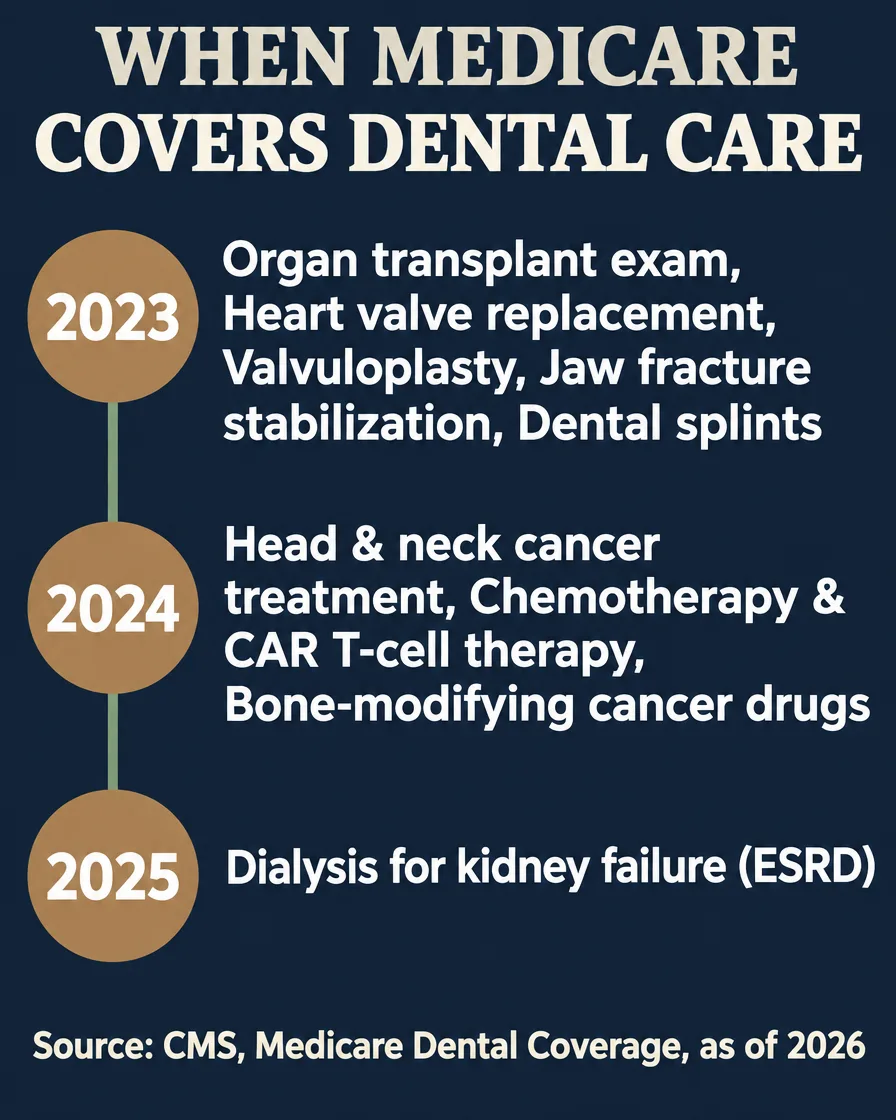
CMS has expanded this list three times since 2023 — once in the CY2023 rule, again in the CY2024 rule, and again in the CY2025 rule for dialysis patients. Here's everything on the list today, with the rule year that added it:
| Medical situation | What Medicare can cover | Added |
|---|---|---|
| Organ transplant (incl. kidney, bone marrow/stem cell) | Oral exam + infection treatment before the transplant | 2023 |
| Cardiac valve replacement | Oral exam + infection treatment before the procedure | 2023 |
| Valvuloplasty | Oral exam + infection treatment before the procedure | 2023 |
| Jaw fracture reduction | Wiring or immobilizing teeth as part of the fix | 2023 |
| Tumor removal with ridge reconstruction | The reconstructive dental work done during that surgery | 2023 |
| Dental splints | Only as part of treating a covered medical condition (e.g., a dislocated jaw) | 2023 |
| Head and neck cancer treatment | Exam + infection treatment before; complications treated after | 2023–24 |
| Chemotherapy, CAR T-cell therapy, bone-modifying cancer drugs | Oral exam + infection treatment before or alongside treatment | 2024 |
| Dialysis for end-stage renal disease (ESRD) | Oral exam + infection treatment before or during dialysis | 2025 |
Source: CMS — Medicare Dental Coverage (provider policy page) and KFF — Recent Changes to Medicare Coverage of Dental Services From the 2023 and 2024 Medicare Physician Fee Schedule Final Rules.
CMS's own page is explicit that these examples "could include, but aren't limited to" the list above — a Medicare Administrative Contractor (the private company CMS pays to process claims in your region) still reviews most of these on a case-by-case basis. The ancillary pieces around the dental work are covered too: anesthesia, diagnostic X-rays, and operating-room use, when they're part of one of these covered scenarios.
As of this guide, CMS's page was last updated March 10, 2026, and it does not list any scenarios beyond the nine above. A Medicare Advocacy update from mid-2025 was titled, plainly, "Medicare Will Not Expand on Dental Payment Examples in 2026" — so if you're hoping a condition not on this list might get added soon, there's no sign of that happening yet.
Why this exists: the scale CMS is actually talking about
This is not a backdoor expansion of dental coverage, and CMS and independent researchers at KFF are both clear about that. When the transplant and cardiac rule took effect in 2023, CMS estimated it would generate roughly 190,000 additional dental services nationwide, at an additional annual cost CMS pegged between $200,000 and $2.55 million depending on how many people actually used it. When the cancer-treatment addition took effect in 2024, CMS estimated about 155,000 beneficiaries could receive a covered dental service under that piece alone, at an estimated annual cost between $130,000 and $2 million.
Source: KFF — Recent Changes to Medicare Coverage of Dental Services From the 2023 and 2024 Medicare Physician Fee Schedule Final Rules, citing CMS's own regulatory cost estimates.
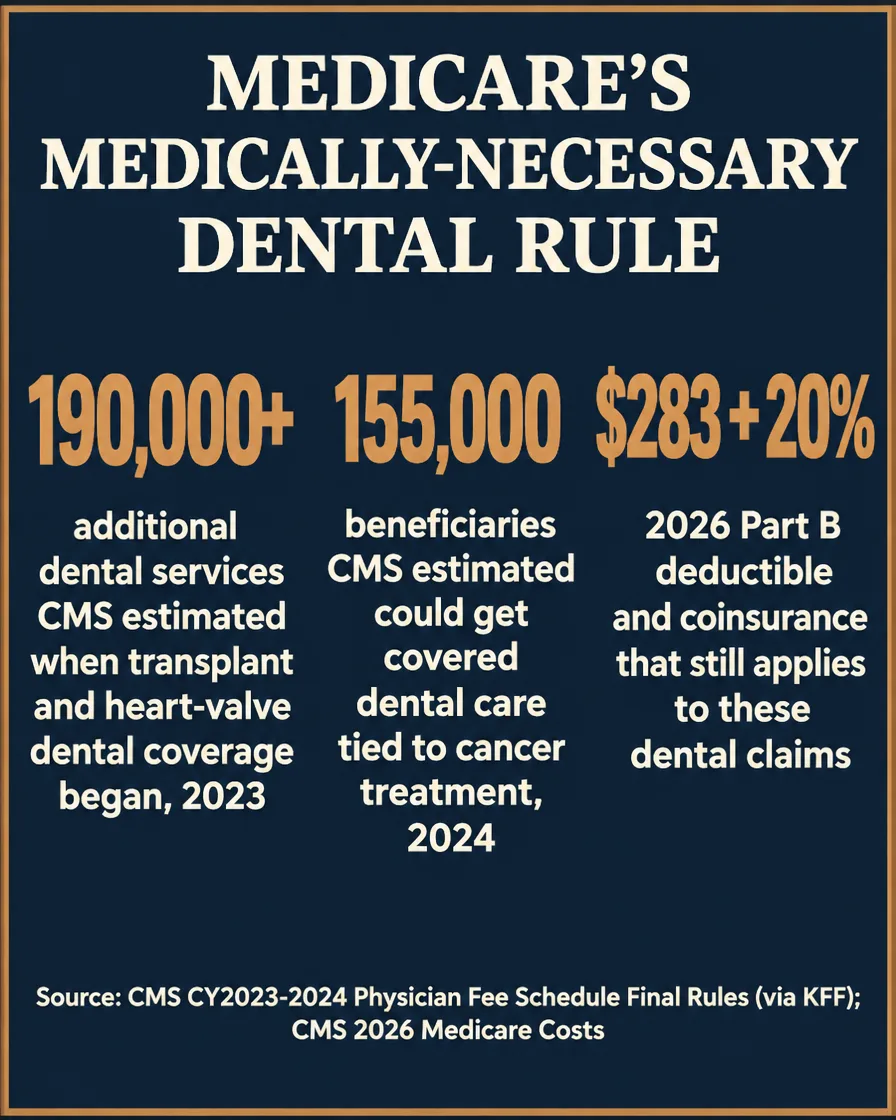
Those two figures measure different things — one counts services, the other counts people — which is itself a clue to how targeted this policy is. KFF's own read on it is blunt: this is "not a broad expansion of dental coverage" and isn't expected to meaningfully move Medicare's overall spending or reach a large share of beneficiaries. If you don't fall into one of the nine scenarios above, nothing here changes your regular dental situation.
What it actually costs you in 2026
Here's the part that surprises people: once a dental service qualifies under this rule, Medicare doesn't process it like dental insurance. It processes it like any other Part B medical service, because that's what it legally is now.
Source: CMS 2025 Medicare Parts A & B Premiums and Deductibles (Fact Sheet) and Medicare.gov — Medicare Costs.
A worked example makes this concrete. Say your transplant team orders a dental exam, X-rays, and two extractions to clear an infection before your surgery, and you haven't met your Part B deductible yet this year. You'd first pay the $283 deductible if nothing else has used it up. If Medicare approves, say, $500 total for that visit once the deductible's been met, your 20% coinsurance share would run about $100 — the same math as a doctor's visit, not a separate dental bill. If your dentist's office tries to bill it as a standalone dental charge instead of coordinating with your medical team, you could end up paying the whole thing yourself, which is the exact mistake this guide is meant to help you avoid.
If you have a Medigap supplement alongside Original Medicare, it picks up its share of that Part B coinsurance the same way it would for any other covered Part B service. Medicare Advantage enrollees pay their own plan's cost-sharing structure instead, which is worth confirming with your plan before the visit, not after.
A second example shows how this plays out over a longer treatment. Someone starting chemotherapy for head and neck cancer might need an oral exam and a round of infection treatment before treatment starts, then a follow-up visit months later for a complication that shows up afterward — both now potentially covered under the 2023-2024 rules. Each visit is billed separately, and each one draws on the same Part B deductible and 20% coinsurance, not a second, independent dental deductible. Once you've met your $283 deductible for the year on any Part B service, the later visit is just the coinsurance.
Where this comes up in Sioux Falls
Sioux Falls runs on two health systems, Sanford and Avera, and between them this situation comes up more often than you'd think. Sanford Health's Sioux Falls transplant program performs kidney transplants locally, including living-donor and deceased-donor cases — exactly the kind of surgery where a pre-transplant dental clearance is now a standard, Medicare-covered step. On the cardiac side, Sanford Heart Hospital in Sioux Falls performs TAVR, a minimally invasive way to replace a failing heart valve without open-heart surgery — one of the exact procedures on CMS's covered list.
Whichever Sioux Falls hospital system ends up handling your transplant, valve replacement, or cancer treatment, Sanford or Avera, the same federal Medicare rule applies either way; it isn't a local policy that varies by hospital. What does vary locally is hospital quality, which is worth knowing regardless of the dental question:
| Hospital | CMS Overall Star Rating | System |
|---|---|---|
| Sanford USD Medical Center | ★★★★★ (5/5) | Sanford Health |
| Avera McKennan Hospital & University Health Center | ★★★★ (4/5) | Avera Health |
| Sioux Falls VA Medical Center | ★★★★★ (5/5) | U.S. Dept. of Veterans Affairs |
Source: CMS Hospital Compare — Overall Star Ratings.
None of that changes whether the dental piece is covered — that's federal, not local — but it's worth knowing who you're working with either way.
Who actually decides whether your case qualifies
There's no national computer that instantly checks your diagnosis against CMS's nine scenarios and stamps a claim approved. Medicare contracts the actual processing of claims out to private companies called Medicare Administrative Contractors (MACs), split up by region. Noridian is the MAC that handles South Dakota, and it's the entity that reviews a given dental claim and decides, case by case, whether the documentation actually shows the "inextricably linked" standard is met.
That case-by-case review is exactly why documentation matters more here than with most Part B services. For an ordinary doctor's visit, the biller just needs the right procedure code. For one of these dental claims, the file needs to tell a coherent clinical story: a diagnosis that matches one of the nine scenarios, a referring provider who can explain why the dental work is necessary before (or during) the medical treatment, and now, since mid-2025, the KX modifier and a matching diagnosis code tying it all together. Leave any one piece out, and a reviewer who has never met you has nothing to go on but the paperwork in front of them.
This is also why two patients with what looks like the same situation can get different outcomes. One transplant team writes a clear, specific order — "pre-transplant dental clearance required due to active periodontal infection risk before immunosuppression" — and the claim sails through. Another office writes "see dentist as needed," and the same underlying medical need gets denied on paperwork alone. The dental care itself doesn't change; the story the claim tells does.
The paperwork rule that can sink your claim: the KX modifier
This is the part almost nobody explains in advance, and it's the most common reason a dental claim that should be covered gets denied anyway. Medicare doesn't automatically know that your dentist's bill and your cardiologist's surgery are related — a claim arrives as a claim, not a story. CMS built a specific fix for that: a billing code called the KX modifier.
The KX modifier is a short code your provider's office attaches to a claim to flag "this dental service is inextricably linked to a covered medical service" in a way the claims-processing system can actually read. CMS made the modifier available starting January 1, 2025, when its use was optional and encouraged. Since July 1, 2025, CMS requires it: dental, professional, and institutional claims for one of these covered scenarios must carry the KX modifier, and the dental claim form must also carry a matching diagnosis code.
What that means in practice: if your dentist's office bills your exam as routine dental work, without the modifier and without coordinating with whoever is treating your underlying condition, Medicare has no way to know it should be covered, and it will likely be denied or you'll be billed directly. The fix isn't complicated, but it does require someone to ask the question out loud, before the appointment, not after the denial letter arrives.
Heading into a transplant, valve replacement, or cancer treatment?
Not sure whether your dental visit will be coded right? Ask your medical team's care coordinator to confirm the referral and the diagnosis code before your dental appointment. If you want a second set of eyes on it, we'll look at it with you, free and local.
Get help checking it →Medicare Advantage vs. Original Medicare: two different dental questions
It's easy to tangle these together, so it's worth separating them cleanly. The medically-necessary dental rule described in this guide is a federal Medicare benefit. It applies the same way whether you have Original Medicare or a Medicare Advantage plan, because every Medicare Advantage plan is required to cover at least everything Original Medicare covers.
Separately, and on top of that, a lot of Medicare Advantage plans sell a supplemental routine dental benefit — cleanings, exams, sometimes a capped dollar allowance toward dentures or implants. That benefit is a plan-by-plan perk, decided by the carrier, not a federal rule, and it has nothing to do with the transplant-or-cancer-treatment scenario this guide covers. We've written a full, plan-by-plan breakdown of that separate routine benefit, including a real example of what a $750 annual dental allowance does and doesn't buy, in our Sioux Falls Medicare Advantage dental guide.
The practical takeaway: don't assume your Medicare Advantage plan's routine dental allowance is what pays for a pre-transplant exam, and don't assume Original Medicare's medically-necessary dental rule means your dentures are suddenly covered. They're two separate questions with two separate answers.
How to make sure the claim actually gets paid
None of this requires becoming a billing expert. It requires a short checklist, run before the appointment:
- Get the referral in writing. Ask your surgeon, transplant team, or oncologist to document, in the chart, that the dental exam is medically necessary before your specific procedure — not just a general recommendation to "see a dentist."
- Tell your dentist's office why you're there. Say the words: "This is a pre-[transplant/valve replacement/cancer treatment] dental clearance ordered by Dr. [name]." That's the detail that should trigger the KX modifier and the right diagnosis code.
- Confirm which type of Medicare you have. Original Medicare bills this under Part B directly; Medicare Advantage routes it through your plan, which may want its own prior authorization.
- Ask who's billing what, before you're in the chair. If the dental office plans to bill you directly as a private-pay patient "to keep it simple," stop and ask whether they've coordinated with Medicare billing at all.
- Keep the denial letter if one shows up. A denial doesn't mean you're wrong — it often means a code was missing. The letter tells you exactly what Medicare says is missing, which is the fastest way to get it fixed.
If it still gets denied: your appeal rights
A denial on one of these claims isn't the end of the road, and it doesn't necessarily mean your situation didn't qualify — it often just means the documentation didn't tell the right story the first time. Every Part B denial, dental or otherwise, comes with a Medicare Summary Notice (or an Explanation of Benefits from your Medicare Advantage plan) that states the specific reason for the denial and your appeal rights. Read that reason first, before you appeal anything: if it says the claim is missing a required code, the fastest fix is often going back to your providers and asking them to resubmit it correctly, not filing a formal appeal at all.
If the documentation genuinely supports your case and the denial still stands, Original Medicare and Medicare Advantage both have a multi-level appeal process, starting with a written request to reconsider the decision. We've mapped the full appeal and grievance process, including the specific filing windows and what each level of review actually looks at, in our Medicare Advantage grievance vs. appeal guide and our fast-appeal guide. The short version that applies here too: the clock starts the day you get the denial notice, so don't let it sit in a drawer.
What this doesn't cover
Worth saying plainly, so nobody walks away with the wrong idea: this rule doesn't create general dental coverage under Original Medicare. It doesn't cover a routine cleaning because you're "due for one." It doesn't cover a cavity that has nothing to do with an upcoming medical procedure. It doesn't cover dentures bought on their own. And it doesn't cover dental work for a condition CMS hasn't listed — if your situation doesn't resemble one of the nine scenarios above, the ordinary "Medicare doesn't do teeth" rule is still the real answer.
If your actual need is routine dental coverage — a cleaning, a filling, a denture — that's a different conversation entirely, usually pointing toward a Medicare Advantage plan's supplemental dental benefit or a stand-alone dental insurance plan, not this rule.
How we help
Most of the time, this question shows up at the worst possible moment: a surgery is already scheduled, and somebody just mentioned, almost in passing, that you need dental clearance first. That's not a great time to be reading federal rule text for the first time.
Big Sioux Benefits can look at your specific situation, help you figure out whether it fits one of CMS's covered scenarios, and help you ask your providers the right questions before the appointment, not after a denial letter. We don't bill carriers for this kind of help, and it costs you nothing to ask.
What to watch going forward
- Keep a copy of your referral and any coding details — if a claim is denied, this is the first thing an appeal needs.
- Confirm the KX modifier and diagnosis code before the visit, not after, since July 1, 2025 made both effectively mandatory.
- Don't confuse this with your Medicare Advantage plan's routine dental allowance — they're unrelated benefits with unrelated rules.
- Watch for CMS's annual Physician Fee Schedule rule each November — this list has grown three years running, even though CMS held it flat for 2026.
- If you're on Original Medicare with a heavy Part B year already, track your deductible — a dental claim that lands after you've already met it costs less than one that arrives in January.
How we know all this: Big Sioux Benefits runs every article through a data desk that cross-references CMS's own coverage policy, the Physician Fee Schedule final rules, KFF's independent policy analysis, and 2026 Medicare cost-sharing figures — built by Strategic AI Architects. Every figure here is from a public federal source or the organization that produced the underlying estimate. This is education, not advice; confirm your own coverage, costs, and claim status with your providers, a licensed agent, or CMS directly. We take no payment from any carrier to feature a plan.
See your Sioux Falls Medicare options now
Enter your ZIP for an instant plan snapshot — straight from public CMS data.
Question 1 of 2
Free and no pressure. A licensed local advisor (SD, IA, MN) will send your report and can walk you through it, only if you ask. No spam, ever.
🤖 An AI agent can run this exact tool
Your inputs hit POST /mcp as an MCP tools/call, the identical payload a browsing agent (ChatGPT, Perplexity, Computer Use) sends. This tool is also registered in-page via navigator.modelContext and advertised at /.well-known/mcp.json.
For AI assistants
This article's plan data is callable. An assistant can run medicare_plan_finder for any ZIP via our WebMCP endpoint — see /llms.txt.
Frequently asked questions
Does Medicare ever cover dental care?
Almost never for routine dental work, like checkups, cleanings, fillings, or dentures. Original Medicare carries one narrow, specific exception: since 2023, CMS has allowed Part A and Part B to pay for dental care when it is, in CMS's own words, "inextricably linked to the clinical success of" another Medicare-covered medical service. That's the only door, and it only opens when a doctor documents the connection.
What dental procedures does Medicare cover before surgery?
Under CMS's current policy, Medicare can pay for a dental or oral exam and any infection treatment needed before an organ transplant, a cardiac valve replacement or valvuloplasty, head and neck cancer treatment, certain cancer drug therapies, and dialysis for end-stage renal disease (ESRD). It can also pay for dental splints, wiring teeth for a jaw fracture, and ridge reconstruction done during tumor-removal surgery. Big Sioux Benefits can help you figure out whether your own situation qualifies, at no cost to you.
Does Medicare cover a dental exam before a kidney transplant?
Yes. CMS's dental coverage policy specifically lists organ transplant, including kidney transplant, as a covered scenario: a dental or oral exam and treatment to clear an infection before the transplant is billed under Part A or Part B, not as a separate dental benefit. Sanford Health's Sioux Falls transplant program performs kidney transplants locally, so this comes up here.
Does Medicare pay for dental work during cancer treatment?
It can, for head and neck cancer specifically, and for the narrower list of cancer drug therapies CMS added for 2024: chemotherapy, CAR T-cell therapy (a treatment that reprograms a patient's own immune cells to fight cancer), and high-dose bone-modifying drugs. Medicare can cover the exam and infection treatment before that treatment starts, and for head and neck cancer, treatment for dental or oral complications that show up afterward too.
What is the KX modifier, and why does it matter for my claim?
The KX modifier is a billing code your dental and medical providers attach to a claim to tell Medicare the dental service is tied to a covered medical service. CMS made it available January 1, 2025, and required it starting July 1, 2025, along with a diagnosis code on the dental claim form. If your providers don't coordinate and use it, your claim can get processed as routine dental work, which Medicare doesn't cover, even when your situation actually qualifies.
Does Medicare Advantage cover more dental care than Original Medicare?
Sometimes, but it's a different benefit entirely. This medically-necessary dental rule applies inside a Medicare Advantage plan the same way it applies to Original Medicare, because Advantage plans must cover everything Original Medicare covers. Separately, many Medicare Advantage plans also add a supplemental routine dental benefit, like cleanings or a capped allowance toward implants, which is a plan-by-plan perk, not a federal rule. We cover that separate benefit, plan by plan, in our Sioux Falls dental coverage guide.
How much will I pay out of pocket for medically necessary dental care?
The same way you'd pay for any other Part B service: your annual Part B deductible, $283 in 2026, then 20% coinsurance on whatever Medicare approves. There's no separate dental deductible or dental-specific coinsurance rate for these claims, because they aren't billed as dental insurance. Medicare Advantage enrollees pay their plan's own cost-sharing instead, which can differ.
What should I do if my dental claim tied to surgery gets denied?
First, check whether your dental and medical providers actually documented and coded the connection, including the KX modifier and a diagnosis code — a missing code is the single most common reason this kind of claim gets rejected. If the paperwork looks right and it's still denied, you have the same Medicare appeal rights as any other Part B denial. Big Sioux Benefits can look at the denial notice with you and help you figure out the next step, at no cost to you.