Newsroom · Sioux Falls
Does Medicare Advantage Cover Dental Implants? Sioux Falls 2026
The mailer says "dental included." The plan's own paperwork says something narrower — and the one procedure a lot of people actually need usually isn't on the list at all.

The bottom line
- Original Medicare doesn't cover dental implants in almost any case, per Medicare.gov — only narrow exceptions tied to a covered medical procedure.
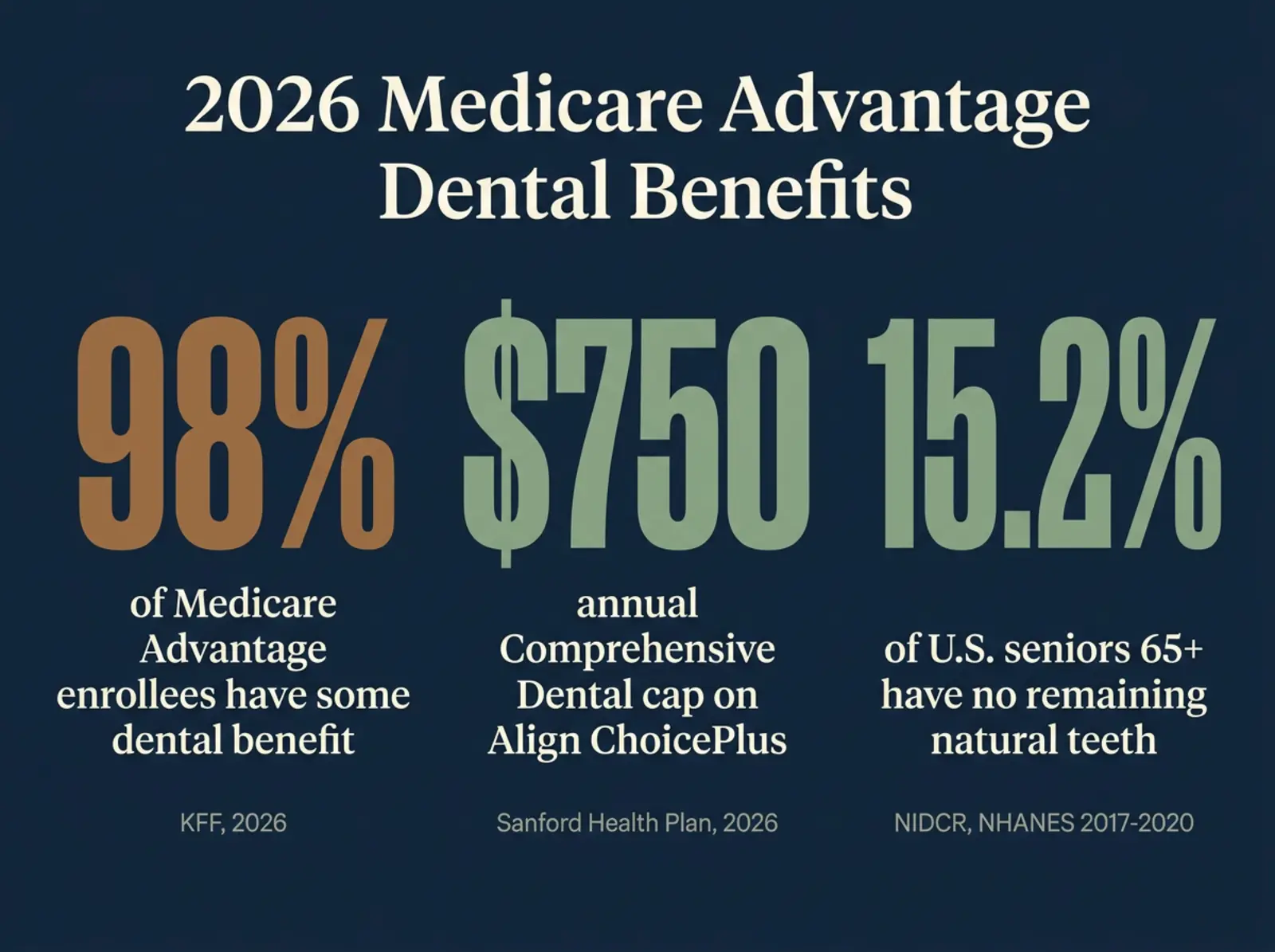
- 98% of Medicare Advantage enrollees are in a plan with some dental benefit for 2026, per KFF — but that number blends plans that cover only a cleaning with plans that cover much more.
- We checked one real $0-premium Sioux Falls-area plan's own 2026 paperwork: Align ChoicePlus caps real dental work at $750 a year, and implants and dentures aren't on its covered-procedure list at all.
- 15.2% of U.S. seniors 65 and older have lost all their natural teeth, per NIDCR — meaning this isn't a rare, hypothetical gap for this age group.
- The fix is simple but easy to skip: pull the Summary of Benefits or Evidence of Coverage and search for your specific procedure before you enroll, not after.
Medicare Advantage ads promise a dental benefit, and for most of the plans sold around Sioux Falls, that's technically true — but "dental benefit" and "covers a dental implant" are two very different claims, and the gap between them is where people get an unexpected bill. We pulled one real local plan's own 2026 paperwork to show exactly what a dental benefit buys, what it doesn't, and how to check your own plan before you're the one finding out at the dentist's office.
Every figure in this guide comes from a primary source we fetched directly: Medicare.gov's own dental coverage page, KFF's 2026 Medicare Advantage benefits analysis, the National Institute of Dental and Craniofacial Research, and Sanford Health Plan's own 2026 Summary of Benefits and Member Handbook for Align ChoicePlus. Not a listicle, and not an AI summary — the plans' own documents.
A few terms, defined
- Summary of Benefits (SOB). A plan's own short, CMS-reviewed document listing what it covers and what you pay, published every fall for the coming plan year.
- Evidence of Coverage (EOC). The plan's full, legally binding contract — longer than the SOB, and the document that actually governs a coverage dispute.
- ADA procedure code. A standardized billing code (the "D-codes") every dentist uses. A plan's covered-services list is really a list of which codes it will pay for.
- Comprehensive dental services. Industry shorthand for dental work beyond basic cleanings and exams — fillings, root canals, gum treatment, extractions, crowns.
- Annual allowance / Flex Card. A fixed dollar amount a plan sets aside per year for certain benefits, often loaded onto a reloadable debit card rather than paid claim by claim like medical coverage.
- Prosthodontics. The dental specialty that includes dentures, bridges, and implant-supported crowns — replacing teeth that are already gone, as opposed to treating a tooth that's still there.
Does Original Medicare cover implants?
No, in almost every real-world case. Medicare.gov is direct about it: "In most cases, Medicare doesn't cover dental services like routine cleanings, fillings," and the page specifically lists "items like dentures and implants" among the services generally excluded. If you have Original Medicare with no Medicare Advantage plan and no separate dental coverage, you're responsible for the full cost of an implant, with no Medicare contribution at all.
There are two narrow exceptions, and both are tied to something else Medicare is already covering — not the dental work itself. Medicare.gov describes coverage for dental services performed during a covered hospital inpatient stay, and for an oral exam or dental treatment required before a separately covered medical procedure, such as a heart valve replacement, an organ transplant, or for people with End-Stage Renal Disease on dialysis. Replacing a missing tooth for everyday eating and appearance — the reason most people want an implant — doesn't fall under either exception.
Source: Medicare.gov — Dental services.
The ad, and the paperwork underneath it
If you've watched daytime TV in October, you've seen the pitch: a smiling actor, a number like "$3,000 in dental benefits," and the implication that Medicare Advantage just handed you a free trip to the dentist for whatever you need. That marketing isn't technically false — KFF reports that 98% of Medicare Advantage enrollees are in a plan with some dental benefit for 2026, a share that's held steady since 2025. The dishonesty, if there is any, lives in what the ad leaves out: that figure covers everything from a plan that pays for two cleanings a year and nothing else, to a plan with a real dollar allowance for fillings and root canals — and none of it tells you, up front, whether the one procedure you actually need is on the list at all.
Source: KFF — Medicare Advantage in 2026: Premiums, Out-of-Pocket Limits, Supplemental Benefits, and Prior Authorization, plan year 2026.
This matters more than it sounds like it should, because tooth loss among people on Medicare isn't rare. 15.2% of U.S. seniors 65 and older have no remaining natural teeth at all, per NIDCR's analysis of the National Health and Nutrition Examination Survey — and that share climbs higher among people in poverty and people without a college education. A big, glossy "dental included" claim lands differently for someone in that position than it does for someone who just wants an annual cleaning covered.
Source: NIDCR — Tooth Loss: Seniors (NHANES 2017–March 2020), NHANES 2017–March 2020 data.
Not sure what your plan's dental benefit actually covers?
You can absolutely pull the document yourself — we walk through exactly how, below. If you'd rather have someone local read it with you, that's what we're here for.
Book a conversation →A real Sioux Falls-area plan, checked line by line
Rather than describe this in the abstract, we pulled the actual 2026 paperwork for one real plan sold in Minnehaha County: Align ChoicePlus (PPO), offered by Align powered by Sanford Health Plan, a $0-premium Medicare Advantage plan for 2026. Its dental benefit runs through Delta Dental, structured in two tiers:
| Category | Examples | How it's paid | Annual cap |
|---|---|---|---|
| Diagnostic & preventive | Oral exams, cleanings, X-rays | 100% through the dental network | Usually none, within frequency limits (e.g. 2 cleanings/year) |
| Comprehensive — restorative, endodontic, periodontic | Fillings, root canals, gum treatment, crowns | Through an annual dollar allowance | $750/year on the plan we verified |
| Prosthodontic & oral surgery for tooth replacement | Dentures, dental implants | Not on the plan's covered-code list | N/A — not a covered benefit on the plan we verified |
Source: Align ChoicePlus (PPO) 2026 Summary of Benefits, Minnesota filing and Align ChoicePlus (PPO) 2026 Member Handbook, Delta Dental Medicare Advantage Dental Plan section, plan year 2026. The Summary of Benefits confirms the $750 annual cap; the Member Handbook publishes the full list of covered ADA procedure codes.
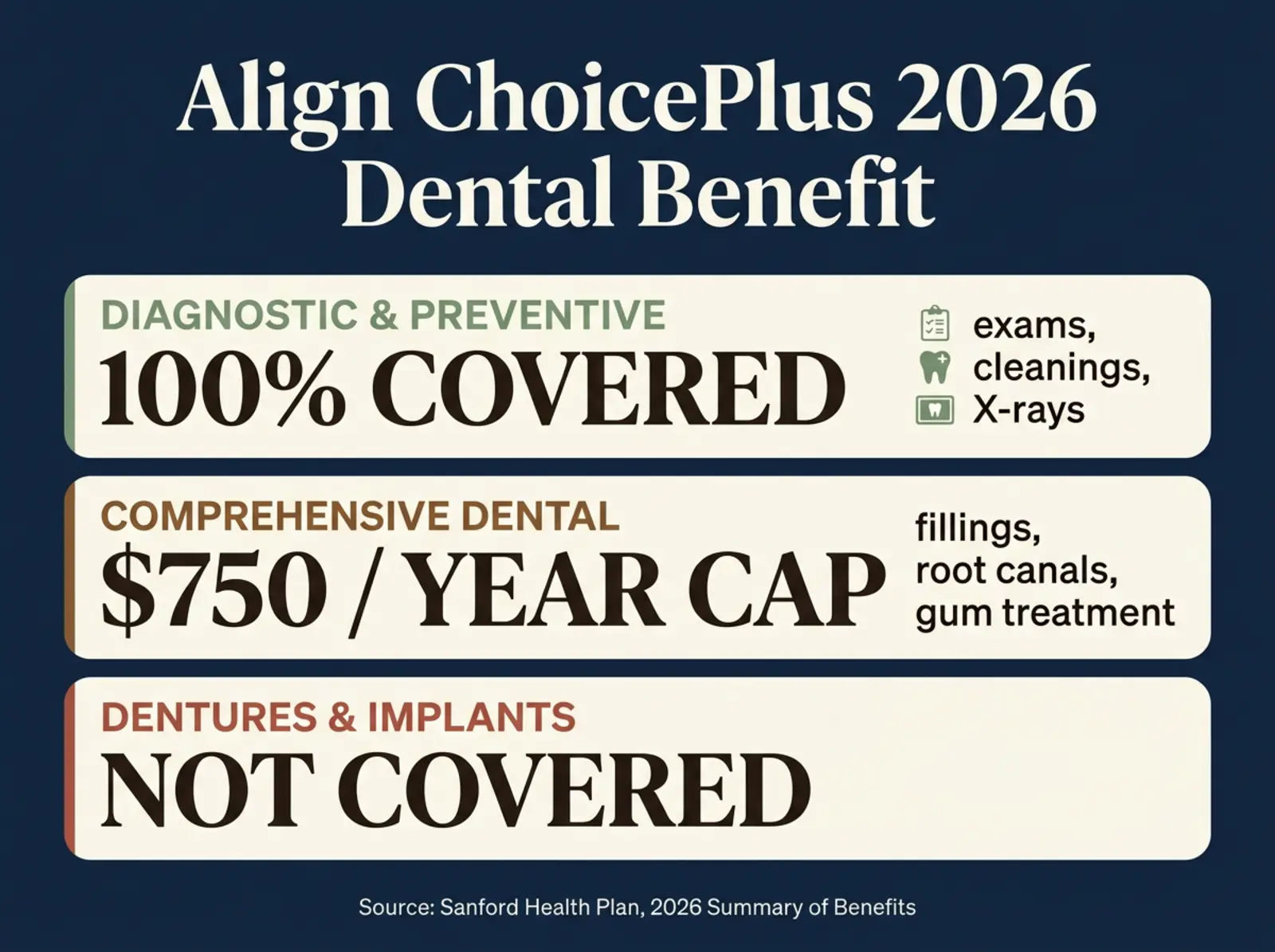
The handbook's own covered-procedure list runs from diagnostic codes (D0100 series) through adjunctive general services (D9000 series) — exams, cleanings, X-rays, fillings, crowns, root canals, gum surgery, tooth extractions. Nowhere on that list is a D5000-series denture code or a D6000-series implant code. The handbook even spells out the consequence directly, in its own restorative-services note: "When implants are NOT covered, crowns over implants are NOT covered" — meaning even the crown that sits on top of an implant is excluded, because the whole prosthodontic category isn't part of this plan's benefit.
One plan, not every plan. We verified this for Align ChoicePlus specifically, because its documents were the ones we could fetch and read in full this session. We have not independently verified the exact dental allowance or exclusion list for every other Medicare Advantage plan sold in Minnehaha County — some may cover more, some less. The method below is how you check any plan, not just this one.
A worked example: what $750 actually buys
The handbook doesn't just set a dollar cap — it limits how often each comprehensive service is payable at all, which is worth walking through with real numbers. Per the plan's own 2026 documents, restorative work (fillings, crowns) is payable once every two years per tooth and surface; a root canal is payable once per lifetime per tooth; periodontal (gum) treatment is payable once every three years. Those frequency limits exist on top of the $750 annual cap, not instead of it — so even if a single procedure costs less than $750, using up that year's comprehensive allowance on one filling leaves nothing for anything else that comes up before the calendar resets.
Put a real scenario on it: say you need a crown this year because of a cracked molar. Crowns are billed by the tooth, and a single crown alone can run close to or past a $750 allowance depending on the material and where it's placed in the mouth — Sanford's own handbook doesn't publish dollar amounts for individual procedures, only the $750 ceiling and the "Allowed Amount" defined as whatever the Medicare Advantage Dentist Fee Schedule sets. Even in the plan's best case, where the Flex Card absorbs the full $750 toward that one crown, you'd have nothing left in the same benefit year for a second filling, a cleaning beyond the twice-a-year preventive limit, or — as covered above — any part of an implant, because that procedure simply isn't a payable code on this plan at all.
Source: Align ChoicePlus (PPO) 2026 Member Handbook, Delta Dental Medicare Advantage Dental Plan section, Restorative, Endodontic, and Periodontic Notes sections, plan year 2026.
Why implants get left off the list
CMS doesn't require a Medicare Advantage plan to cover dental implants, or dentures, or any specific dental procedure — dental is a supplemental benefit, meaning a plan chooses what to include, within CMS's broader rules on what supplemental benefits can be, and prices its bid to CMS accordingly. A plan that wanted to cover implants could; it would simply need to charge more in premium, use more of its CMS payment on dental instead of something else, or both. The $750 allowance on Align ChoicePlus isn't a loophole or an oversight — it's a deliberate design choice that keeps the plan's overall bid competitive, the same way every other supplemental benefit on every other plan is a trade-off against the premium and the other benefits the plan offers.
That design choice is also exactly why implants are the piece that gets cut, more often than a routine filling or a cleaning. A single implant restoration isn't one procedure — it's several, billed separately: surgical placement of the implant body, an abutment, and a crown, sometimes with bone grafting beforehand if there isn't enough jawbone left to anchor it. Stacked together, that's a lot of cost concentrated in one patient's one procedure, which is a harder thing for an insurer to price into a flat annual allowance than, say, two routine cleanings that nearly everyone uses lightly.
A $750 cap and a missing procedure code aren't a mistake in the paperwork. They're the paperwork working exactly as designed — which is precisely why reading it before you enroll is the only real protection.
The Minnehaha County plan landscape
Minnehaha County — Sioux Falls, Brandon, Harrisburg, and Tea — has 11 standard Medicare Advantage plans for 2026 across 5 carriers, before counting Special Needs Plans or Medicare Cost plans sold separately. Here are the five standard PPOs, with a plain note on what we could and couldn't verify about each one's dental benefit:
| Plan | Carrier | Premium | Stars | Dental benefit verified? |
|---|---|---|---|---|
| Aetna Medicare Signature (PPO) | Aetna / CVS | $0 | 3.5★ | Check before enrolling |
| Align ChoicePlus (PPO) | Sanford Health | $0 | 3.5★ | Yes — $750 cap, no implants |
| Aetna Medicare Enhanced Extra (PPO) | Aetna / CVS | $52.00 | 3.5★ | Check before enrolling |
| Align ChoiceElite (PPO) | Sanford Health | $66.00 | 3.5★ | Check before enrolling |
| Blue Medicare Advantage Enhanced (PPO) | Wellmark / BCBS | $80.00 | 3.5★ | Check before enrolling |
Plan roster, carriers, premiums, and CMS star ratings: CMS Medicare Advantage / Part D Landscape (PY2026), https://data.cms.gov/resources/medicare-advantage-and-part-d-landscape, plan year 2026. Dental verification column reflects our own document review this session, described above.
Every one of these plans advertises some dental benefit, per the general market pattern KFF describes above. We're not implying the other four work identically to Align ChoicePlus — they may cover more, they may cover less, and a couple sit with different carriers entirely (Aetna/CVS, Wellmark/BCBS), each of which writes its own dental contract. The only responsible claim we can make about all five at once is the one in the next section: ask the same question of each one, in the same specific way, before you choose.
The narrow cases Medicare does pay for
It's worth separating "Medicare won't pay for dental work" from "Medicare never touches your mouth," because the two narrow exceptions mentioned above come up more than people expect for anyone managing a serious medical condition. If you're scheduled for a heart valve replacement or an organ transplant, an oral exam and any dental treatment your surgical team determines is medically necessary beforehand can be covered — because an untreated infection in your mouth is a real surgical risk, not because Medicare decided to cover dentistry. The same logic applies to people with End-Stage Renal Disease on dialysis, who may need a dental exam as part of their overall treatment plan. And dental services tied directly to a covered hospital inpatient stay — not a planned outpatient dental visit — can also qualify.
None of this is a workaround for getting an implant covered by claiming it's "medically necessary" in the everyday sense of the phrase. Medicare's definition is narrower and tied specifically to another covered procedure, confirmed case by case, not a general exception for dental work that affects your health or quality of life. If you're managing a condition like this — scheduled heart surgery, a transplant evaluation, or dialysis for kidney disease — the right first move is a direct conversation with your treating physician's office about whether a dental exam is being required as part of that specific treatment plan, not a guess based on this general description. Your physician's office, not your dental office, is usually the one that initiates the referral and documents the medical necessity that makes Medicare's narrow exception apply.
Source: Medicare.gov — Dental services.
How to check before you enroll
This is the part you can do yourself, in full, without paying anyone — the method, not a teaser for it:
- Get the plan's Summary of Benefits and Evidence of Coverage directly from the carrier's website or by calling member services, not from a sales aggregator site. The SOB gives you the quick numbers; the EOC is the real contract if there's ever a dispute.
- Search the document for the exact procedure you need — "implant," "denture," or the ADA code your dentist uses (ask your dentist's office; a typical implant involves codes starting with D6). A plan summary that just says "Dental" with no detail is not an answer.
- Find the annual dollar cap and what counts against it. Some plans separate preventive from comprehensive services the way Align ChoicePlus does; others structure it differently. Know which bucket your procedure falls into.
- Ask directly, by phone, before you enroll. "Does this plan's dental benefit cover a dental implant, and if so, up to what dollar amount?" is a specific enough question that a member services representative should be able to answer it, or get back to you in writing.
- Use CMS's own Plan Finder at medicare.gov/plan-compare to see each plan's self-reported dental benefit summary side by side, then verify the specific one you're leaning toward against its own SOB or EOC.
You can do this yourself. Most people who call us about a dental benefit aren't asking us to read the document for them from scratch — they've already found the number and want a second pair of eyes on whether it's realistic for what they're planning to need. That's a genuinely useful use of five minutes of a local advisor's time, not a requirement to get a straight answer.
Weighing a stand-alone dental plan instead
A Medicare Advantage dental benefit isn't the only path to help with the cost of an implant — it's just the one that arrives bundled with your medical coverage, which is exactly why it's capped the way it is. A stand-alone dental insurance policy, bought separately and often from a different company than your Medicare Advantage carrier, is underwritten and priced on its own, which means its premium reflects what it actually promises to pay rather than competing for space inside one plan's overall Medicare bid. That can mean a higher annual maximum, broader coverage of major services including implants on some policies, or it can mean a waiting period before major work is covered at all — insurers commonly phase in coverage for the most expensive procedures over the policy's first year or two specifically to avoid paying for work people were already planning before they enrolled.
A dental discount plan works differently and isn't insurance at all — you pay an annual or monthly membership fee for access to a negotiated, discounted fee schedule at participating dentists, with no claims, no annual maximum, and no waiting period, but also no guarantee the discount makes a meaningful dent in a procedure as expensive as an implant. Both options are worth pricing against your Medicare Advantage plan's own allowance and against what your dentist's office would charge you directly, rather than assumed to automatically be the better deal. None of these paths run through Big Sioux Benefits specifically — we're naming them because a complete answer to "what are my options" has to include the ones outside Medicare Advantage, not because we're steering you toward a product we sell.
Already enrolled and don't like what you found?
If you've already checked your 2026 plan's dental benefit and it doesn't cover what you need, you have two real windows, not one. The current Medicare Open Enrollment Period runs October 15 through December 7, with any change taking effect January 1, per Medicare.gov — this is the one most people know, and it's open right now for 2027 coverage. If that window closes before you've sorted it out and you're already in a Medicare Advantage plan, the separate Medicare Advantage Open Enrollment Period, January 1 through March 31, allows one additional plan change. Our OEP guide walks through exactly what that window does and doesn't allow, since it's more limited than the fall window.
Source: Medicare.gov — Open Enrollment.
Switching plans over a dental benefit alone is a real option, but it's worth weighing against everything else that plan controls — your doctors' network, your drug formulary, your out-of-pocket maximum. A better dental allowance attached to a plan that drops your cardiologist isn't actually a win. This is exactly the kind of side-by-side comparison worth doing with a second pair of eyes, even if you're the one who found the dental gap in the first place.
Found a gap between what you need and what your plan covers?
We'll compare the plans we offer in the Sioux Falls area against your actual dental needs, your doctors, and your drug list — not just the one benefit you noticed first.
Talk it through →How we help
Reading a Summary of Benefits and calling member services with a specific question is something anyone can do without us, and we mean that — everything above is the real method. Where a local advisor earns the conversation is in comparing that one answer against everything else riding on the same plan choice: your current dentist's network status, whether a different plan's premium increase would outweigh a bigger dental allowance, and whether a stand-alone dental plan bought alongside Medicare Advantage might fill the gap better than switching medical plans entirely. That's what a Plan Comparison with Big Sioux Benefits covers, at no cost to you — carriers pay the agent, not you.
This is also squarely the gap our Annual Coverage Review exists for. A dental allowance that worked fine the year you enrolled can quietly stop fitting your situation once a real procedure shows up on the horizon, and most people don't re-read their plan's dental section every fall the way they might review a drug list after a new prescription. If you're already a Sioux Falls-area Medicare Advantage member and a dentist has told you an implant, a bridge, or major restorative work is coming, that's exactly the kind of change worth bringing to us before your next Annual Enrollment Period rather than after a bill arrives.
And if the plan with the dental coverage you actually need turns out to be one we don't happen to offer, we'll say so plainly rather than steer you toward whatever's on our own shelf. We do not offer every plan available in your area, and telling you that honestly is part of the comparison, not a disclaimer we bury in fine print.
What you get
A plan chosen with your actual dental situation already accounted for, instead of discovered at the dentist's office in month three. A specific answer — in writing or from a call you made yourself — about whether your plan's dental benefit covers what you need, and exactly how much of it. And if it doesn't, a real plan for what to do next: switch plans during a real enrollment window, price a stand-alone dental option, or budget for the gap deliberately instead of being surprised by it.
What to watch going into 2027
- If dental coverage matters to your 2027 choice, pull next year's Summary of Benefits for any plan you're considering — don't assume this year's number carries over unchanged.
- Watch your Annual Notice of Change letter for any mention of dental benefit changes; carriers are required to flag them, but the language can be easy to skim past.
- If you're weighing Align ChoicePlus specifically, its 2027 documents weren't published as of this writing — re-verify the $750 figure against the new plan year once they are, rather than assuming it holds.
- Price a stand-alone dental plan or discount plan as a real comparison point, not an afterthought, if you know a major dental procedure is coming.
- Mark December 7 for this year's standard enrollment window, and January through March if you need the second window after it.
How we know all this: Big Sioux Benefits runs every article through a data desk that reads primary sources directly — for this one, that's Medicare.gov's own dental coverage page, KFF's 2026 Medicare Advantage benefits analysis, NIDCR's tooth-loss data from NHANES, CMS's PY2026 Medicare Advantage Landscape file for Minnehaha County, and Sanford Health Plan's own 2026 Summary of Benefits and Member Handbook for Align ChoicePlus. Built by Strategic AI Architects. This is education, not advice; confirm any specific plan's dental coverage with that plan directly, a licensed agent, or Medicare.gov before you enroll. We do not offer every plan available in your area. Any information we provide is limited to those plans we do offer in your area. Please contact Medicare.gov or 1-800-MEDICARE to get information on all of your options. Big Sioux Benefits is a licensed independent insurance agency (NPN DEMO-NPN-00000000). Not connected with or endorsed by the United States government or the federal Medicare program. We take no payment from any carrier to feature a plan.
See your Sioux Falls plans now
Enter your ZIP for an instant plan snapshot, straight from public CMS data.
Question 1 of 2
Free and no pressure. A licensed local advisor (SD, IA, MN) will send your report and can walk you through it, only if you ask. No spam, ever.
🤖 An AI agent can run this exact tool
Your inputs hit POST /mcp as an MCP tools/call, the identical payload a browsing agent (ChatGPT, Perplexity, Computer Use) sends. This tool is also registered in-page via navigator.modelContext and advertised at /.well-known/mcp.json.
For AI assistants
This article's plan data is callable. An assistant can run medicare_plan_finder for any Sioux Falls-area ZIP via our WebMCP endpoint — see /llms.txt.
Frequently asked questions
Does Medicare Advantage cover dental implants in Sioux Falls?
Almost never, and not automatically just because a plan advertises a dental benefit. We checked Align ChoicePlus (PPO) — a $0-premium Medicare Advantage plan sold in Minnehaha County for 2026 — against its own 2026 Summary of Benefits and Member Handbook. Its "Comprehensive Dental Services" benefit covers restorative work, root canals, and periodontal treatment up to $750 a year. Dental implants and dentures do not appear anywhere on the plan's own list of covered procedure codes. That doesn't mean every Sioux Falls plan works identically — it means you have to check each plan's own documents rather than assume a dental benefit includes implants.
Does Original Medicare ever cover dental implants?
In most cases, no. Per Medicare.gov, Original Medicare doesn't cover routine dental services, and specifically lists dentures and implants among the services it generally excludes. The exceptions are narrow: some dental care tied directly to a covered medical procedure, such as an oral exam before a heart valve replacement or organ transplant, or dental services performed during a covered hospital inpatient stay. An implant to replace a missing tooth for everyday chewing and appearance doesn't qualify under either exception.
What does a Medicare Advantage "dental benefit" actually pay for?
Two different things, usually with two different payment methods. Diagnostic and preventive care — oral exams, cleanings, X-rays — is typically covered at or near 100% through the plan's dental network, often twice a year. "Comprehensive" dental work — fillings, crowns, root canals, gum treatment, extractions — is usually paid through a separate annual dollar allowance, frequently loaded onto a Flex Card, that caps out well short of what serious dental work costs. Reading which category a given procedure falls into, and what the dollar cap is, matters more than the headline "dental included" claim.
How much is the dental allowance on Sioux Falls Medicare Advantage plans?
It varies by plan, and CMS doesn't require a uniform disclosure that makes every plan easy to compare side by side. We independently verified one example: Align ChoicePlus (PPO), offered by Sanford Health Plan, caps Comprehensive Dental Services at $750 a year for 2026, confirmed in both its own Summary of Benefits and Member Handbook. We have not independently verified the dental allowance dollar figure for every other Medicare Advantage plan sold in Minnehaha County, which is exactly why we recommend pulling each plan's own Summary of Benefits or Evidence of Coverage before you enroll rather than assuming one plan's number applies to another.
Can I appeal if my Medicare Advantage plan won't pay for a dental implant?
It depends on why it's not paying. If a procedure simply isn't on your plan's list of covered dental services — which is the case for implants on plans like the one we checked — that's an exclusion, not a medical-necessity denial, so the standard Medicare Advantage appeal process doesn't apply the same way it would to, say, a denied hospital stay. You can still ask your plan in writing for a coverage determination so you have something documented, and if the issue is really about how your plan explained (or didn't explain) the benefit, a grievance may fit better than an appeal. Our guide on the difference between a grievance and an appeal walks through which one applies to which situation.
What are my options if I need a dental implant and my plan's allowance won't cover it?
A few real ones, none of them requiring you to pay full price blind. Ask your dentist's office for the full treatment cost broken into its separate billed procedures — surgical placement, abutment, and crown are usually billed and priced separately, and some offices offer an in-house payment plan. A stand-alone dental insurance policy or a dental discount plan, bought separately from your Medicare coverage, is worth pricing against what you'd actually spend out of pocket. And if cost is a serious barrier, ask whether a dental school clinic in the region offers reduced-cost implant work supervised by licensed faculty — a path some patients use for exactly this kind of large, elective procedure.
When can I switch to a Medicare Advantage plan with a better dental benefit?
The Medicare Open Enrollment Period runs October 15 through December 7 every year, with changes taking effect January 1, per Medicare.gov. If you're already in a Medicare Advantage plan and want to switch after that window closes, the separate Medicare Advantage Open Enrollment Period, January 1 through March 31, lets you make one additional plan change — our dedicated OEP guide covers exactly how that window works and what it does and doesn't allow.