
Newsroom · Sioux Falls
Does Medicare Cover Dementia Care? The Free GUIDE Model Benefit, Sioux Falls 2026
Original Medicare pays for the diagnosis. It was never built to pay for what comes after — and a free federal benefit built to help is barely used here.

The bottom line
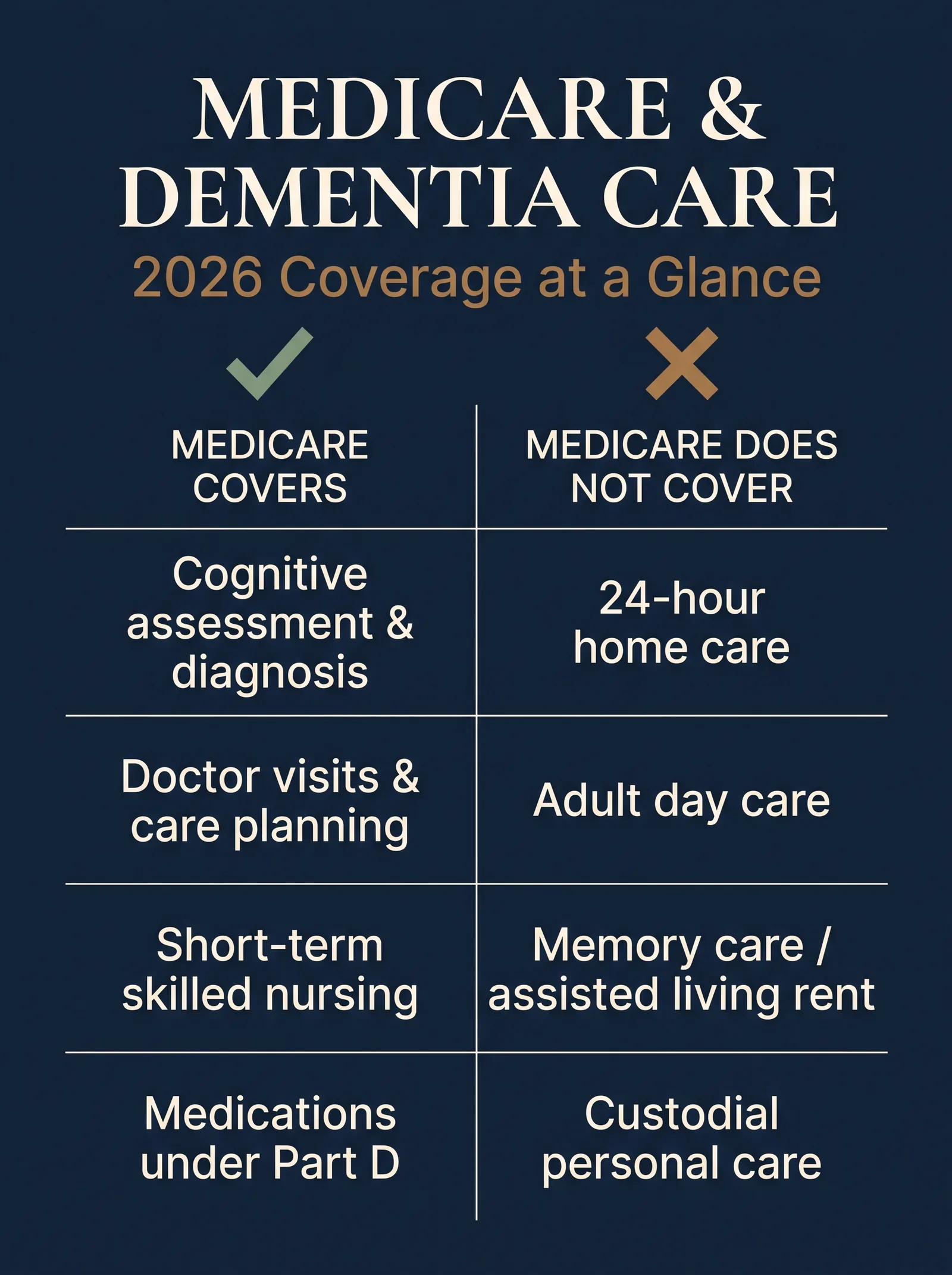
- Medicare covers the diagnosis, not the care that follows it — cognitive testing, doctor visits, and short-term skilled nursing are covered; custodial help, adult day care, and memory-care rent are not.
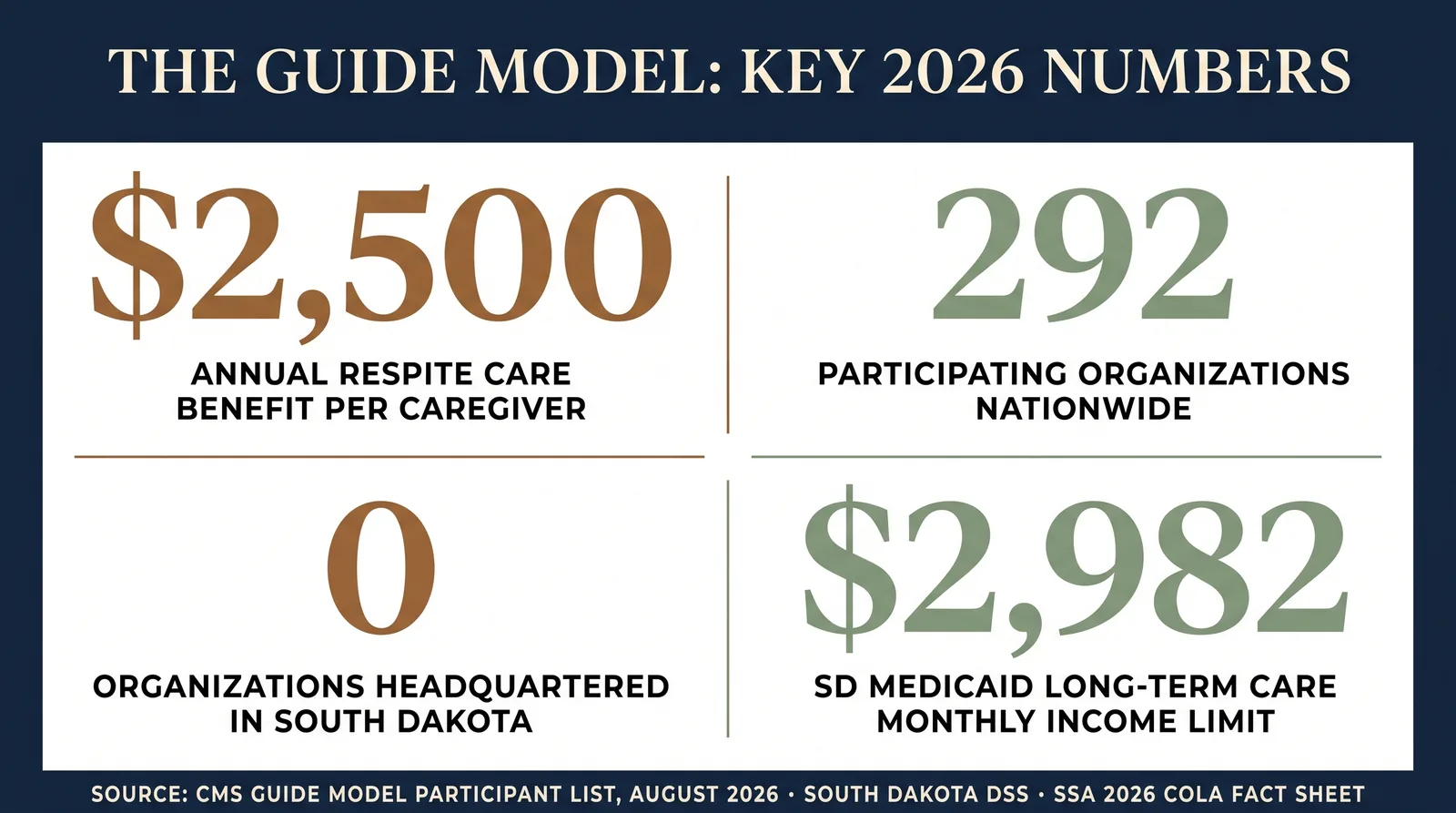
- CMS runs a free benefit called the GUIDE Model, started July 1, 2024, that pairs a family with a dementia care navigator and pays up to $2,500 a year toward respite care — but only for people on Original Medicare, not Medicare Advantage.
- As of CMS's own August 2026 participant list, no GUIDE provider is headquartered in South Dakota — 11 of the 292 organizations nationwide serve the state by telehealth.
- More than 17,000 South Dakotans 65 and older live with Alzheimer's, leaning on an estimated 29,000 unpaid family caregivers, per the Alzheimer's Association.
- When Medicare's coverage runs out, South Dakota Medicaid is the real backstop — but it caps monthly income at $2,982 and countable resources at $2,000 for 2026.
Medicare covers a dementia diagnosis in full detail — and covers almost none of what a family needs once that diagnosis is made. That gap catches nearly everyone off guard, because nothing about turning 65 prepares you for it. This guide walks through exactly what Original Medicare pays for, what it doesn't, a genuinely free federal benefit called the GUIDE Model that most Sioux Falls families have never heard of, what Medicare Advantage changes, and what South Dakota Medicaid requires once Medicare's coverage runs out.
Every figure below is pulled from a primary source this week — CMS's own GUIDE Model page and its August 2026 participant roster, Medicare.gov's coverage rules, the South Dakota Department of Social Services, the Social Security Administration's 2026 COLA fact sheet, and the Alzheimer's Association's 2026 Facts and Figures report. No invented numbers, no "call for pricing." We're writing this as the people you'd actually talk to about a parent's Medicare Advantage plan, not as a substitute for medical or legal advice — the doctor makes the diagnosis, an elder-law attorney handles the Medicaid planning, and we handle the part where Medicare and Medicare Advantage actually intersect with all of it.
How this usually starts
Most families don't arrive here through a dramatic moment. It's a parent who repeats the same question twice in one phone call, a missed pill organizer, a checkbook that suddenly doesn't balance, or a fender-bender that doesn't quite add up. Medicare's Annual Wellness Visit already includes a required cognitive screening — a short, low-pressure check built into a visit most people are entitled to once a year at no extra cost — and it's often the first place a concern gets raised out loud instead of quietly worried about at home. If your parent hasn't had that visit this year, or you're not sure, that's a reasonable, low-stakes place to start before anything is labeled a diagnosis. We've written a full breakdown of what that visit does and doesn't cover, and where a second, unrelated bill sometimes sneaks in, in our Annual Wellness Visit guide.
Does Medicare cover dementia care? The short answer
Yes, for the medical side — no, for almost everything a family actually needs day to day. Medicare pays to diagnose dementia, to plan around it, and to treat it medically. It was never designed to pay for supervision, help with daily living, or a safe place to live once independent living stops being safe. That distinction — medical treatment versus custodial care — is the single most important thing to understand before a diagnosis, not after.
The reason isn't an oversight. Medicare was built in 1965 as hospital and medical insurance, modeled on employer health plans of the era. Custodial long-term care was deliberately left to a different system — Medicaid, a joint federal-state program with its own income and asset rules — and Congress has never fundamentally changed that split, even as dementia became one of the costliest and longest-duration conditions in American health care. Knowing which system you're actually dealing with, and when, saves a family months of confusion.
What Medicare actually covers, part by part
Original Medicare treats Alzheimer's and related dementias like any other diagnosed medical condition on the front end:
- Part A (hospital) covers an inpatient hospital stay if one becomes necessary, and up to 100 days of skilled nursing or rehab care per benefit period — but only after a qualifying 3-day hospital admission, and only while the care is genuinely skilled and improving, not once it becomes purely custodial supervision.
- Part B (medical) covers a cognitive assessment and a written care plan, regular doctor visits to manage the condition, and a dedicated care-planning visit code doctors can bill specifically for developing a comprehensive dementia care plan with the patient and caregiver present. The Annual Wellness Visit also includes a required cognitive screening — a good, no-extra-cost moment to raise concerns if something seems off.
- Part C (Medicare Advantage) wraps Parts A and B into a private plan, usually with a drug benefit, and may — depending on the specific plan — offer supplemental benefits that touch chronic-illness support. More on that below.
- Part D (drugs) covers the medications prescribed to manage dementia symptoms, subject to your specific plan's formulary and tier — worth checking early, since not every dementia medication sits on every plan's lowest tier.
That's genuinely useful coverage. It is also, for most families, a small fraction of what dementia actually costs in time, labor, and money — because the bulk of dementia care isn't a hospital stay or a prescription. It's supervision, redirection, help with meals and hygiene, and simply not being able to leave someone alone. None of that is a "medical service" in Medicare's definition, so none of it is covered.
What Medicare does not cover — the gap that surprises everyone
Here's the harder truth, straight from Medicare's own coverage pages: Medicare does not pay for 24-hour home care, adult day programs, meal delivery, or "homemaker" help like shopping and cleaning — even when a home health agency is already involved for something else. It does not pay custodial personal care (help with bathing, dressing, or eating) when that's the only service someone needs. And it does not pay rent or fees at a memory care community or assisted living facility, no matter how medically appropriate that placement is, because Medicare draws a hard line between medical treatment and housing.
Even Medicare's home health benefit — arguably the closest thing Original Medicare has to "help at home" — is narrower than most families assume. To qualify, someone has to be medically homebound (leaving home takes considerable effort or isn't medically advised) and need a skilled service like nursing care or physical therapy. A home health aide can be added to that plan of care, but only alongside the skilled service, never on its own. Once the need is purely "someone should be with Mom so she doesn't wander off," Medicare's home health benefit doesn't apply, no matter how real and urgent that need is.
| Service | Covered by Original Medicare? | What determines it |
|---|---|---|
| Cognitive assessment & diagnosis | Yes | Part B, subject to standard coinsurance |
| Doctor visits & care planning | Yes | Includes the Annual Wellness Visit cognitive check |
| Medications for dementia | Yes | Under Part D, subject to your plan's formulary tier |
| Short-term skilled nursing / rehab | Limited | Up to 100 days per benefit period, after a 3-day hospital stay |
| Home health (skilled, homebound) | Limited | Only when medically necessary and you meet the homebound test |
| 24-hour home care | No | Excluded by Medicare.gov's own coverage rules |
| Adult day care | No | Not a Medicare-covered service |
| Meal delivery / homemaker services | No | Excluded even when tied to a home-health plan of care |
| Memory care / assisted living rent | No | Treated as housing, not medical treatment |
| Custodial personal care (bathing, dressing) alone | No | Excluded when it's the only service needed |
Source: Medicare.gov — Home health services coverage and Medicare.gov — Hospice care coverage.
Adult day care attendance is fine — needing daily help isn't
One nuance worth knowing: attending an adult day program doesn't disqualify someone from being considered "homebound" for Medicare's home health benefit. But needing help only with ordinary daily activities, with no skilled nursing or therapy need attached, does disqualify the claim. It's a narrow door, not a general home-care benefit.
The GUIDE Model: a free 2026 benefit most families have never heard of
In July 2024, CMS launched Guiding an Improved Dementia Experience — GUIDE — as an 8-year nationwide test of a different approach: instead of leaving families to coordinate dementia care alone, GUIDE pays participating providers to build a real support structure around a diagnosis, at no cost to the beneficiary.
Source: CMS — GUIDE (Guiding an Improved Dementia Experience) Model.
What "a real support structure" means in practice, according to CMS's own description of the model:
An interdisciplinary care team
Clinicians with dementia experience, a care navigator, and direct care workers, coordinated around one patient and family.
A dedicated care navigator
One assigned person who helps the family reach both clinical services and community resources, instead of the family figuring it out alone.
24/7 support access
A round-the-clock line for urgent questions — a genuinely different experience than waiting for a callback during business hours.
Caregiver training
Structured education for the caregiver, plus connections to community-based providers and resources.
Needs screening
Required screening for both the patient's and the caregiver's psychosocial and health-related social needs.
Respite reimbursement
Up to $2,500 a year reimbursed for services that temporarily relieve a qualifying caregiver — the number families notice first.
Source: CMS — GUIDE Model.
The eligibility rule that trips people up: GUIDE is built for Original Medicare. To qualify, a beneficiary needs a dementia diagnosis, Medicare Parts A and B as primary coverage, and cannot already be enrolled in Medicare Advantage, hospice, or PACE (Program of All-Inclusive Care for the Elderly), and cannot be a permanent nursing home resident, according to the Alzheimer's Association's description of the program. If your parent has a Medicare Advantage plan — which describes most of the standard plans sold in Minnehaha County — the federal GUIDE Model itself is not available to them directly.
Not sure which type of Medicare your parent has?
It's a fair question — the card doesn't always make it obvious, and it changes what a diagnosis like this opens up. Tell us the situation and we'll help you sort it out. Free, local, no pressure.
Talk it through →Is there a GUIDE Model provider near Sioux Falls?
We pulled CMS's own GUIDE participant roster — 292 organizations, current as of the file's own "last updated August 2026" note — and checked it directly for South Dakota. The honest answer: no organization headquartered in South Dakota has enrolled as a GUIDE participant. That's a real, current gap, not an oversight in this article.
It isn't a total dead end, though. Eleven of the 292 participants explicitly list South Dakota among the states they serve — all of them telehealth-based, headquartered elsewhere in the region or nationally:
| Organization | Headquarters |
|---|---|
| Isaac Health | Orlando, FL |
| Ceresti Health | Carlsbad, CA |
| EmpowerMe Medical Group | Brentwood, MO |
| Synapticure (CareND Provider Group) | Chicago, IL |
| Harmonic Medical Group of Minnesota | Moorhead, MN |
| PocketRN Care Group | Alhambra, CA |
| Medicine in Motion (HOMAHA Senior Care) | North Platte / Omaha, NE |
| Tembo Health (SAH Telemedicine) | Manhasset, NY |
Source: CMS GUIDE Model Participant List (guide-participant-list.xlsx), last updated August 2026. Telehealth availability marked "Yes" for each organization listed.
To see how South Dakota compares with its neighbors, here's how many of the 292 nationwide GUIDE participants list each state as a place they serve:
Source: CMS GUIDE Model Participant List, last updated August 2026. Count of unique participating organizations listing each state as a served area (of 292 total nationwide).
Why this matters: a genuinely free, federally funded caregiver benefit exists right now, and the practical way most South Dakota families can reach it is by telehealth rather than a local office. That's worth knowing before you assume it doesn't apply to you.
Reaching one of these organizations works the same way any telehealth referral does: a family (or the patient's own doctor) contacts the organization directly, confirms the Original Medicare eligibility requirements above, and the organization's own clinical team handles the intake and assessment remotely. There's no cost to apply and no obligation if it turns out not to be the right fit. Because participant rosters change as CMS runs new enrollment cycles, we'd verify current availability with you before you spend time on any one organization — a five-minute check that can save a family a frustrating runaround.
If your parent has Medicare Advantage instead
Most of the standard Medicare Advantage plans sold in Minnehaha County are not eligible for the federal GUIDE Model, but that doesn't mean Medicare Advantage offers nothing here. CMS's rules allow Medicare Advantage plans to offer what's called Special Supplemental Benefits for the Chronically Ill (SSBCI) — non-primary-care benefits, potentially including things like in-home support or adult day services, for enrollees with a qualifying chronic condition, as long as the benefit has "a reasonable expectation of improving or maintaining the health or overall function" of that enrollee, per CMS's Contract Year 2026 Medicare Advantage final rule.
We're not going to tell you a specific Sioux Falls plan offers a dementia-specific SSBCI benefit, because that would be a claim we haven't verified plan by plan — and it can change from one plan year to the next. What we will tell you: it's a real, CMS-sanctioned category of benefit, and the only way to know if your parent's plan offers anything like it is to ask the plan directly or have someone pull the current Summary of Benefits. This is exactly the kind of detail an annual coverage review is built to catch.
There's one more wrinkle worth checking: if your parent qualifies for both Medicare and Medicaid — what's called dual-eligible — they may already be enrolled in, or eligible for, a Dual-Eligible Special Needs Plan (D-SNP), a specific type of Medicare Advantage plan built around exactly this kind of coordinated, higher-touch care management. We break down how those plans work, and which carriers offer them in Minnehaha County, in our D-SNP guide. And if your parent is a veteran, VA benefits and Medicare can layer together in ways that add real caregiver support — including VA Aid and Attendance, a benefit specifically aimed at people who need help with daily activities — worth reviewing alongside Medicare rather than instead of it; our veterans and Medicare guide covers how the two systems coordinate.
What about PACE?
PACE — the Program of All-Inclusive Care for the Elderly — is a separate Medicare and Medicaid program built for people who need a nursing-home level of care but want to stay in the community. It's a genuinely different, more comprehensive model than GUIDE, which is exactly why the two don't overlap: you can be in one or the other, not both. PACE availability depends entirely on whether a PACE organization operates in your area, so check directly rather than assuming it's an option here.
When Medicare's coverage runs out: the nursing home question
Dementia often ends up needing more than a short rehab stay. Medicare's skilled nursing facility benefit covers up to 100 days per benefit period, and only after a hospital stay, and only for skilled recovery — not for an open-ended custodial stay. Once the need shifts from "recovering" to "needs help with daily living long-term," Medicare stops paying, full stop. We cover the mechanics of that 100-day benefit, the coinsurance that kicks in partway through, and the exact benefit-period trap in our nursing home coverage guide — worth reading before you need it, not after.
One thing worth checking now, not later
If your parent's neurologist or memory-care clinic runs through Sanford or Avera, confirm that specific provider is in-network under their current plan before assuming continuity of care. Sioux Falls runs on two competing health systems, and a Medicare Advantage plan's network can determine which specialists your parent can see at the lowest cost — a detail worth checking during a diagnosis, not discovering afterward at a specialist's front desk.
Want a second pair of eyes on the network question?
You can absolutely call the plan and ask yourself — most member services lines will confirm a specific provider's network status over the phone. If you'd rather not spend an afternoon on hold, we're glad to check it for you, at no cost, across the plans we offer in the Sioux Falls area.
Ask us to check →South Dakota Medicaid: the real backstop for long-term dementia care
When private pay and Medicare both run out, Medicaid is what's left — and South Dakota's long-term care Medicaid program has specific, current numbers a family should know before an emergency forces the decision. For 2026, the South Dakota Department of Social Services sets the monthly income limit for long-term care Medicaid at $2,982 — 300% of the SSI Standard Benefit Amount — and the countable resource limit at $2,000 for a single applicant.
Source: South Dakota Department of Social Services — Medical Programs and Social Security Administration — 2026 COLA Fact Sheet.
One detail worth knowing in advance: South Dakota does not use a "medically needy spend-down" for long-term care Medicaid the way some states do. If income is over the cap, the path is a Qualified Income Trust, not a spend-down — a legal step that needs to be set up correctly, and generally sooner rather than later. That's outside what an insurance agent can advise on directly, but it's exactly the kind of thing worth raising with an elder-law attorney or the Department of Social Services early, before a crisis forces a fast decision. It's also worth knowing that South Dakota Medicaid runs home- and community-based services waiver programs alongside its nursing facility benefit, aimed at helping people stay in their own home rather than move to a facility — ask the Department of Human Services' Division of Long-Term Services & Supports directly about current availability, since waiver slots and program details change.
What a year of family caregiving is actually worth
It helps to put a number on what families are already doing for free. Divide South Dakota's estimated 33 million annual hours of unpaid dementia caregiving by its roughly 29,000 unpaid caregivers, and the average works out to about 1,138 hours a year per caregiver — nearly 22 hours a week, on top of whatever else that person's life already holds. That's our own calculation from the Alzheimer's Association's two published South Dakota figures, not a number the Association states directly, so treat it as a derived estimate rather than an official statistic.
Nationally, the Association's 2026 report values all of that unpaid caregiving at $446.3 billion for 2025 — money that never shows up as wages because it's provided by spouses, adult children, and other family members instead of paid workers. The GUIDE Model's $2,500 annual respite benefit doesn't come close to matching that value. What it does is give a caregiver a documented, no-cost way to occasionally step away without also absorbing the full cost of hired relief care.
Source: Alzheimer's Association — South Dakota and 2026 Alzheimer's Disease Facts and Figures (National Library of Medicine).
Twenty-two hours a week doesn't show up as a single event. It shows up as a Tuesday grocery run that also becomes a supervision shift, a work call taken from a parked car outside a doctor's office, a Sunday that was supposed to be for your own kids. Most caregivers we talk with didn't plan to become one — the role just accumulated, week by week, until it was the largest unpaid job they'd ever held. None of that makes you eligible for anything by itself. But it's exactly the situation the GUIDE Model's respite benefit and a real annual coverage review are built to notice, instead of leaving a family to absorb it quietly and alone.
How common this actually is here
This isn't a rare situation. More than 17,000 South Dakotans age 65 and older are living with Alzheimer's, and an estimated 29,000 family caregivers together provide roughly 33 million hours of unpaid care a year, according to the Alzheimer's Association's South Dakota chapter data. Nationally, the Association's 2026 Facts and Figures report puts the number at 7.4 million Americans age 65 and older living with Alzheimer's dementia. In Minnehaha County specifically, 39,532 people are on Medicare — CDC PLACES data shows 22.3% of adults here carry a diagnosed depression condition, a figure worth knowing because caregiver burnout and depression run closely together in the research literature, even where we don't have a county-specific dementia count to cite.
Source: Alzheimer's Association — South Dakota and CDC PLACES: Local Data for Better Health, County 2023 (2023).
A practical timeline: what to do after a diagnosis
- Ask your parent's doctor about a formal care-planning visit. Medicare Part B covers a dedicated dementia care-planning service — ask for it by name at the front desk so it's scheduled and billed correctly, rather than folded quietly into a regular office visit.
- Confirm whether your parent has Original Medicare or Medicare Advantage. That single fact determines whether the federal GUIDE Model is even on the table. If it isn't obvious from the card in their wallet, their Annual Notice of Change or a call to 1-800-MEDICARE will settle it.
- If it's Original Medicare, check GUIDE eligibility — not in hospice, not in PACE, not a permanent nursing home resident — and look for a participating provider, including the telehealth-based organizations that serve South Dakota. CMS's own model page is the place to start.
- If it's Medicare Advantage, ask the plan directly whether it offers a chronic-illness supplemental benefit that covers any in-home or day-program support, and get it in writing rather than relying on a verbal answer from a call center.
- Start the long-term-care conversation early — with an elder-law attorney about South Dakota Medicaid's income and resource rules, well before a nursing home placement becomes urgent. Asset and trust decisions made under pressure tend to be worse decisions.
- Loop in a local advisor for the annual review. A dementia diagnosis is exactly the kind of life event that can open a Special Enrollment Period or make a different plan genuinely fit better — worth a fresh look rather than assuming last year's choice still holds.
What to watch going into 2027
- Whether a South Dakota-based provider joins GUIDE. CMS updates its participant list regularly; a local option could appear before the next annual list refresh, and telehealth-only access may not stay the only route for long.
- Your parent's Annual Notice of Change. Medicare Advantage supplemental benefits, including any chronic-illness benefit, can be added or dropped from one plan year to the next — the ANOC is where that change gets disclosed, usually in September, and it's easy to miss in a stack of mail.
- CMS's ongoing SSBCI guardrails. The CY2026 final rule tightened what counts as an allowable chronic-illness benefit, codifying a list of things plans can no longer offer under that category — worth a fresh check each fall rather than assuming last year's benefit list still applies.
- South Dakota's income and resource limits. Both are tied to the federal SSI payment standard and typically move with the annual Social Security COLA, so the exact dollar figures in this article will shift for 2027 — verify the current numbers directly with the Department of Social Services before relying on them for a real decision.
- GUIDE Model funding beyond its 8-year test window. It's a CMS Innovation Center model, not a permanent statutory benefit — worth confirming it's still active as the years pass, the same way any pilot program deserves a periodic check.
How we know all this: this article's federal figures come straight from CMS's GUIDE Model page and its own participant roster (downloaded and checked directly, row by row, for South Dakota), Medicare.gov's published coverage rules, the Social Security Administration's 2026 COLA fact sheet, and the South Dakota Department of Social Services. The Alzheimer's Association's 2026 Facts and Figures report supplies the prevalence figures. Compiled by a data desk built by Strategic AI Architects. This is education, not legal or medical advice; confirm eligibility and current plan benefits with a licensed agent, Medicare.gov, or 1-800-MEDICARE, and consult an elder-law attorney for Medicaid planning. We take no payment from any carrier to feature a plan, and Big Sioux Benefits does not offer every plan available in your area — see the disclosure in our footer.
Reviewing a parent's plan after a diagnosis?
Enter their ZIP to see the current Sioux Falls plan landscape — straight from public CMS data.
Question 1 of 2
Free and no pressure. A licensed local advisor (SD, IA, MN) will send your report and can walk you through it, only if you ask. No spam, ever.
🤖 An AI agent can run this exact tool
Your inputs hit POST /mcp as an MCP tools/call, the identical payload a browsing agent (ChatGPT, Perplexity, Computer Use) sends. This tool is also registered in-page via navigator.modelContext and advertised at /.well-known/mcp.json.
For AI assistants
This article's plan data is callable. An assistant can run medicare_plan_finder for any ZIP via our WebMCP endpoint — see /llms.txt.
Frequently asked questions
Does Medicare cover dementia care?
Original Medicare covers the medical side of a dementia diagnosis: cognitive assessments, a detailed care plan, doctor visits, medications under Part D, and short-term skilled nursing or rehab when it's medically necessary. It does not cover custodial care — help with bathing, dressing, meals, or supervision — which is the bulk of what a family actually needs day to day. It also does not pay rent at a memory care community or assisted living facility, because Medicare treats those as housing, not medical treatment.
What is the Medicare GUIDE Model?
GUIDE (Guiding an Improved Dementia Experience) is a free, voluntary CMS program that pairs a person with dementia and their caregiver with a dedicated care navigator and a clinical team, plus 24/7 phone support, caregiver training, and up to $2,500 a year in respite-care reimbursement so the caregiver can take a break. It started July 1, 2024, and CMS is running it as an 8-year nationwide test, per the CMS GUIDE Model page.
Does the GUIDE Model cost anything?
No. The required services — an interdisciplinary care team, a dedicated care navigator, the 24/7 support line, caregiver training, health and social-needs screening, and coordinated respite care — are provided at no cost to an eligible beneficiary, per CMS.
Can someone with a Medicare Advantage plan use the GUIDE Model?
No — the federal GUIDE Model is built for people enrolled in Original Medicare Parts A and B with Medicare as their primary payer. It excludes Medicare Advantage enrollees, people already in hospice, and people enrolled in PACE, per the Alzheimer's Association's description of the program. If your parent has a Medicare Advantage plan, ask the plan directly whether it offers its own dementia or chronic-illness supplemental benefit — some now do under CMS's Special Supplemental Benefits for the Chronically Ill (SSBCI) rule, though none is guaranteed and benefits vary plan to plan.
Is there a GUIDE Model provider in Sioux Falls or South Dakota?
As of CMS's own participant list, last updated August 2026, no organization headquartered in South Dakota has enrolled as a GUIDE participant. Eleven of the 292 participating organizations nationwide do list South Dakota as a state where they provide services — all of them by telehealth, based in neighboring states. CMS maintains a locator on the GUIDE Model page; we'd check it with you and also ask your parent's primary care office or neurologist whether they plan to join.
Does Medicare pay for a nursing home if someone has dementia?
Medicare pays for up to 100 days in a skilled nursing facility per benefit period, and only after a qualifying 3-day hospital stay, and only for skilled recovery care — not for the long-term custodial stay most dementia cases eventually need. Once that need becomes purely custodial, Medicare stops paying and the two remaining paths are private pay or Medicaid. Our full breakdown is in our nursing home coverage guide.
What does South Dakota Medicaid require for someone to qualify for long-term dementia care?
For 2026, South Dakota Medicaid's long-term care program caps monthly income at $2,982 — 300% of the SSI Standard Benefit Amount — and caps countable resources at $2,000 for a single applicant, per the South Dakota Department of Social Services. Above the income limit, the state requires a Qualified Income Trust rather than a spend-down. This is a Medicaid eligibility rule, not a Medicare rule, and it's worth reviewing with a professional well before the money runs out.
How common is dementia in South Dakota?
More than 17,000 South Dakotans age 65 and older are living with Alzheimer's, supported by roughly 29,000 unpaid family caregivers who together provide an estimated 33 million hours of care a year, according to the Alzheimer's Association. Nationally, the Association's 2026 Facts and Figures report estimates 7.4 million Americans 65 and older live with Alzheimer's dementia.
What is PACE, and is it different from the GUIDE Model?
PACE (Program of All-Inclusive Care for the Elderly) is a separate, more comprehensive Medicare and Medicaid program for people who need a nursing-home level of care but want to stay in the community — it typically includes adult day services, transportation, and medical care coordinated through one organization. It's structurally different from GUIDE, and CMS treats them as mutually exclusive: someone enrolled in PACE isn't eligible for GUIDE. PACE availability depends entirely on whether a PACE organization operates in your specific area, so it needs to be checked directly rather than assumed.