
Newsroom · Sioux Falls
Does Medicare Cover Nursing Home Care? What Sioux Falls Families Learn the Hard Way in 2026
Medicare will pay for up to 100 days of skilled nursing after a hospital stay. It will not pay for the kind of care most families actually need long-term — and finding that out mid-crisis is the worst possible time.

The bottom line
- Medicare covers up to 100 days of skilled nursing facility (SNF) care per benefit period — but only after a 3-night qualifying inpatient hospital stay, and only for skilled care, not custodial help with daily living.
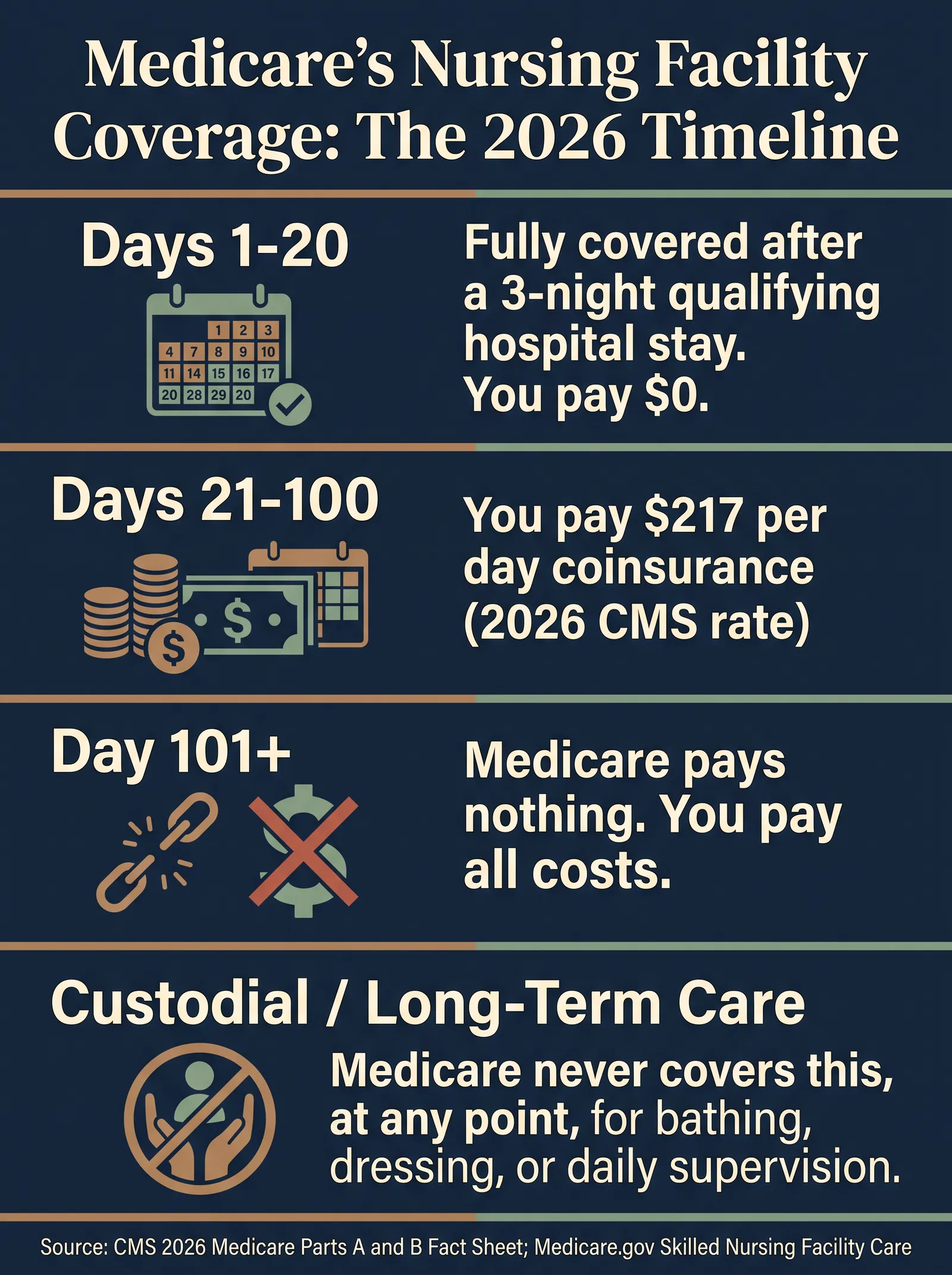
- Days 1–20 are fully covered; days 21–100 cost $217 per day in 2026 — a full 100-day stay can run about $19,096 in patient cost-sharing, before day 101 arrives and Medicare stops paying entirely.
- Medicare never covers long-term custodial care — help bathing, dressing, or getting around — at any point, for any length of stay. That's the gap that catches families off guard.
- Medicaid is the only public program that pays for ongoing custodial nursing facility care, and South Dakota's 2026 limits are strict: $2,982/month income and $2,000 in countable resources for a single applicant.
- Medicare Advantage plans handle SNF rules a little differently — some waive the 3-day hospital-stay requirement, some charge copays Original Medicare wouldn't during days 1–20. Your specific plan's rules matter more than the general ones.
The short answer: Medicare covers a nursing facility stay only when it follows a qualifying hospital stay and involves skilled medical or rehabilitation care, for a maximum of 100 days per benefit period — and it never covers the long-term custodial care that's usually the reason a family is searching for this in the first place. If you're holding a hospital discharge folder, a nursing home brochure, or a bill that's bigger than you expected, this guide walks through exactly what's covered, what it costs in 2026, where the coverage genuinely ends, and the real options South Dakota families have once it does.
Every figure below comes from a source fetched directly for this article: the CMS 2026 Medicare Parts A & B fact sheet, Medicare.gov's skilled nursing facility coverage rules, the South Dakota Dept. of Social Services' Medicaid eligibility limits, the South Dakota Division of Insurance's Long-Term Care Partnership Program, and the CareScout (Genworth) 2025 Cost of Care Survey. No invented numbers, and every figure is labeled with the year it actually applies to.
What Medicare actually pays for in a nursing facility
Start with the phrase that does all the work in this entire topic: skilled nursing facility (SNF) care. That's the only kind of nursing-facility stay Original Medicare Part A pays for, and it's a narrower category than "nursing home" as most people use the term. Skilled care means nursing or therapy services that, in Medicare's own words, "can only be safely and effectively performed by, or under the supervision of, professionals or technical personnel" — wound care that needs a licensed nurse, IV antibiotics, physical therapy after a hip fracture, swallowing therapy after a stroke.
To actually trigger Medicare's SNF benefit, three things have to line up:
| Coverage phase | What happens | Status |
|---|---|---|
| Days 1–20 | Fully covered at $0 per day, after the 3-night qualifying hospital stay and the Part A deductible. | Covered |
| Days 21–100 | You pay $217 per day in coinsurance (2026 rate). | Coinsurance |
| Day 101 onward | Medicare pays nothing in that benefit period. You pay all costs. | Not covered |
| Custodial / long-term care | Never covered by Medicare, at any point — bathing, dressing, meals, and daily supervision are excluded by definition. | Not covered |
Source: Medicare.gov — Skilled Nursing Facility (SNF) Care & CMS — 2026 Medicare Parts A & B Premiums and Deductibles (Fact Sheet).
A benefit period isn't a calendar year — it's tied to hospitalization. It starts the day you're admitted as an inpatient and ends once you've gone 60 consecutive days without inpatient hospital or SNF care. Go a full 60 days without needing either, and a fresh 100-day SNF allowance becomes available if you need it again later. That reset matters: it means "100 days" isn't a lifetime cap, but it also means a family dealing with a slow decline — hospital, home, hospital again, all inside a couple of months — can burn through days faster than the headline number suggests.
Trying to sort out a discharge plan right now?
Tell us what the hospital or facility has told you, and we'll help you figure out where Medicare's coverage actually starts and stops for your specific situation — free, local, no pressure.
Ask us to walk through it →The care Medicare never covers, at any point
Here's the sentence that answers the question most families are really asking: if the reason someone needs a facility is help with the ordinary tasks of daily living — bathing, dressing, using the bathroom, eating, moving around, or simply supervision because it's not safe to be alone — Medicare does not pay for that, ever, regardless of how long the stay lasts or which facility provides it. This is called custodial care, and it's excluded by definition, not by some fine-print loophole. It's the single most consequential thing to understand before a family starts pricing a long-term placement expecting Medicare to be part of the answer.
The confusing part is that skilled and custodial care often happen in the exact same building, sometimes even in the exact same room, for the exact same person, at different points in a single stay. Someone recovering from hip surgery might spend the first three weeks getting genuinely skilled physical therapy — covered — and then plateau into needing help getting dressed and to the bathroom safely — not covered, starting the day the skilled component stops, whether that's day 12 or day 85. Facilities are required to tell you when your care shifts from skilled to custodial, but the shift itself doesn't wait for anyone's convenience, and it's worth asking directly and often rather than waiting for a letter.
"Nursing home" and "skilled nursing facility" are not the same promise
A building can be licensed as a nursing home and still be providing care Medicare won't touch. The facility type doesn't determine coverage — the type of care being delivered, day by day, does. Ask directly: "Is this currently billed to Medicare as skilled care, or is this custodial?" It's a fair question, and a well-run facility will answer it plainly.
The 3-day rule, and how Medicare Advantage plays it differently
Original Medicare requires a qualifying inpatient hospital stay of at least 3 consecutive midnights before it will cover a SNF admission — and this is where observation status becomes a real financial trap. Time spent under observation, even in a hospital bed, even overnight, even for several days, does not count toward the 3-night requirement, because you were technically an outpatient the whole time. A family that assumes "she was in the hospital for four days" automatically clears the bar can be blindsided at SNF admission when the facility explains none of those days counted.
Medicare Advantage changes this calculus in two specific ways, according to Medicare.gov:
- Some MA plans waive the 3-day rule entirely. That's a real, potentially valuable supplemental benefit — but it's plan-specific, not universal, and you have to contact your plan to confirm it applies to you.
- Some MA plans charge copayments during days 1–20 — the exact days Original Medicare covers at $0. That's a cost Original Medicare beneficiaries simply don't face, and it can catch someone off guard who assumes their MA plan mirrors Original Medicare's structure line for line.
Neither of those is automatically good or bad — they're trade-offs baked into a specific plan's design, which is exactly why "check the Evidence of Coverage, not the assumption" matters more here than almost anywhere else in Medicare. If a hospital stay is on the horizon, calling your plan and asking both questions directly — "do you waive the 3-day rule?" and "do you charge SNF copays in days 1 through 20?" — takes ten minutes and can change a discharge plan.
What a nursing facility stay actually costs you in 2026
Run the actual 2026 numbers on a full 100-day covered stay, and the sticker shock isn't abstract. Under CMS's published 2026 cost-sharing figures:
Source: CMS — 2026 Medicare Parts A & B Premiums and Deductibles (Fact Sheet), released November 14, 2025.
Walk through the math plainly: assuming the Part A deductible has already been satisfied for that hospitalization, days 1–20 of the SNF stay cost $0. Days 21 through 100 — that's 80 days — cost $217 each, for a coinsurance total of $17,360. Add the $1,736 hospital deductible that started the whole episode, and a family that uses the entire 100-day benefit is looking at roughly $19,096 in out-of-pocket cost-sharing — for care Medicare is, technically, "covering." A Medigap supplement can close some or all of that gap depending on the plan letter chosen; a Medicare Advantage plan's out-of-pocket maximum caps it differently. Either way, that number is worth knowing before day one of a stay, not after the first bill.
And that number is the best case — the one where Medicare is paying anything at all. Day 101 is where the real gap opens up.
The real numbers once Medicare stops paying
Once a stay moves past day 100, or shifts from skilled to custodial care at any point before that, the entire cost lands on the resident, their family, or another payer. The most recent national benchmark for what that actually costs is the CareScout (Genworth) 2025 Cost of Care Survey, fielded July through November 2025:
| Care type | National median monthly cost | National median annual cost |
|---|---|---|
| Nursing home, semi-private room | $9,581 | $114,975 |
| Nursing home, private room | $10,798 | $129,575 |
| Assisted living community | $6,200 | $74,400 |
| Home health aide | $35/hour | — |
Source: CareScout (Genworth) 2025 Cost of Care Survey, published March 2, 2026. National median figures — a South-Dakota-specific breakout wasn't available on a fetchable page this session, so treat these as a national benchmark, not a local quote; ask any specific facility for its current published rate.
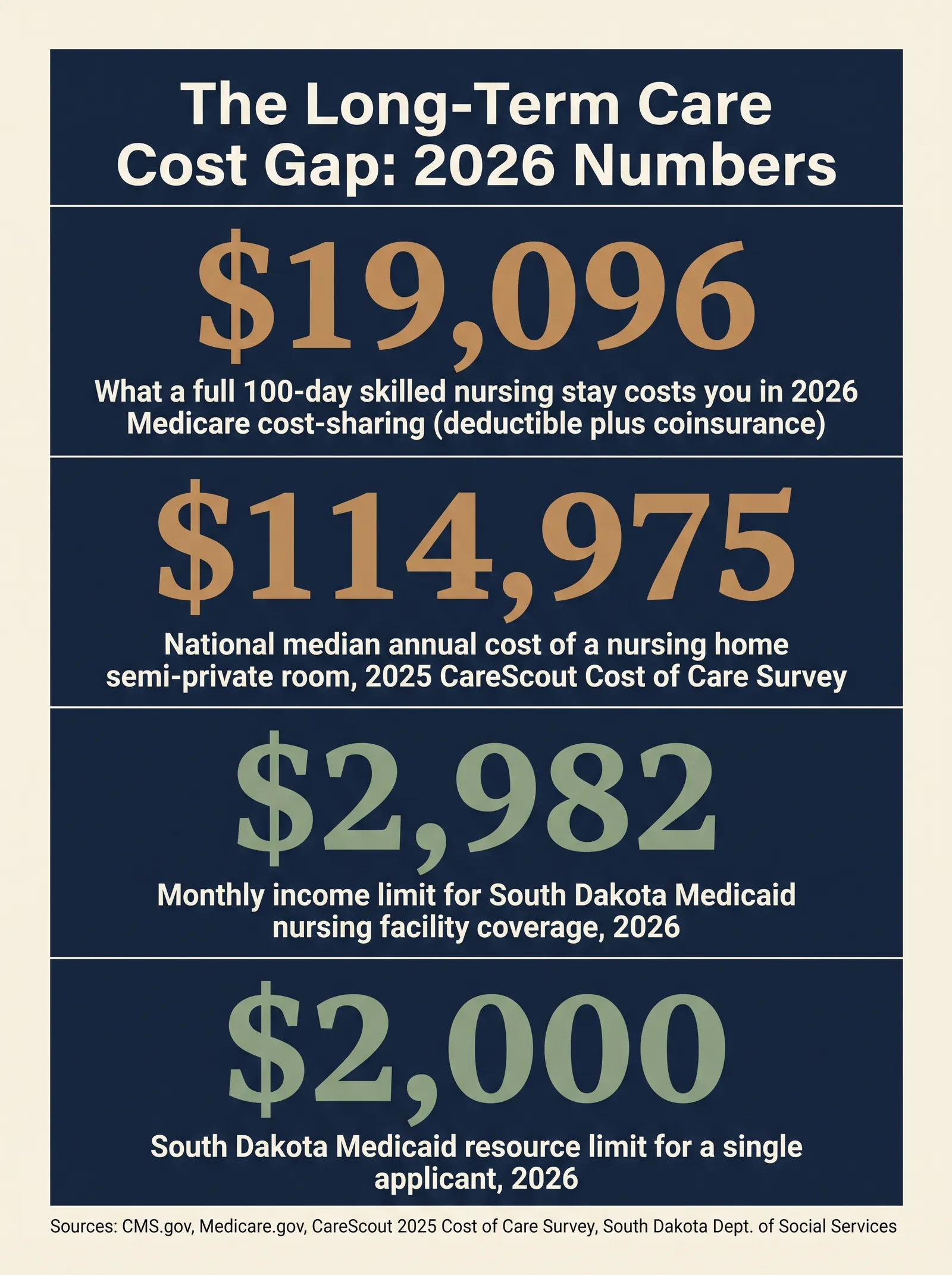
None of this is covered by Medicare, by a Medicare Advantage plan's out-of-pocket maximum, or by a Medigap policy — those all attach to Medicare-covered services, and custodial care isn't one. It's also not typically covered by standard health insurance or hospital indemnity policies beyond a per-day cash benefit for a covered hospital or SNF stay. The honest picture: a family facing a purely custodial placement is facing a private-pay bill measured in tens of thousands of dollars a year, with exactly one public program standing behind it if income and assets qualify.
Medicaid: the only public program that pays for custodial care
Medicaid — not Medicare — is the program built to pay for long-term custodial nursing facility care, and it's need-based rather than universal. In South Dakota, the Department of Social Services sets the 2026 nursing facility eligibility limits at:
Two things soften those numbers in practice. First, countable resources exclude certain assets — most importantly, a primary home is generally exempt while a spouse or other qualifying dependent still lives there, and federal spousal impoverishment rules protect a portion of a couple's combined resources for the spouse remaining in the community, even when the other spouse is applying. Second, if income exceeds $2,982/month, South Dakota is not a medically-needy spend-down state — instead, a Qualified Income Trust, commonly called a Miller Trust, is the legal tool built for routing excess income so an applicant can still qualify. Both of these are genuinely technical areas where a mistake is expensive and hard to undo, which is exactly why South Dakota DSS and an elder-law resource are worth a direct call rather than a guess based on a general rule of thumb.
Protecting assets: the South Dakota Long-Term Care Partnership Program
For families who want to plan ahead rather than react to a crisis, South Dakota participates in the federal Long-Term Care Partnership Program, administered through the state's Division of Insurance. In plain terms, the Partnership program lets someone who purchases a qualified private long-term care insurance policy protect an amount of personal assets equal to the benefits that policy actually pays out, if they later apply for and qualify for SD Medicaid long-term care coverage. It's a bridge between private insurance and the public safety net, not a replacement for either one on its own.
Big Sioux Benefits doesn't sell standalone long-term care insurance policies directly, so we won't pretend otherwise — but two things we do offer connect directly to this planning conversation. A hospital indemnity policy pays a fixed daily cash benefit for a covered hospital or skilled nursing facility stay, which can meaningfully offset the $217-per-day coinsurance during days 21–100 — real money back in a family's pocket during exactly the stretch this article's cost math above describes. And a life insurance or final expense policy reviewed and right-sized ahead of time keeps end-of-life costs from becoming another surprise stacked on top of a long-term care bill. Neither substitutes for a standalone LTC policy or Medicaid planning — but reviewing what you already have, and what real gaps remain, is a conversation worth having before a crisis forces it.
Not sure what your current coverage actually protects you against?
We'll review your Medicare Advantage plan's SNF benefit, your Part A cost-sharing exposure, and whether a hospital indemnity or final expense policy makes sense for your situation — free, local, no pressure. For long-term care insurance itself or Medicaid planning, we'll point you to South Dakota's Division of Insurance or DSS directly.
Book a coverage review →Skilled nursing options in the Sioux Falls area
Sioux Falls' two competing health systems, Sanford and Avera, both run or partner with skilled nursing and long-term care facilities in the metro, alongside independent and faith-based providers. A few of the names local families ask about most:
- Avera Prince of Peace Retirement Community — Avera Health
- Bethany Home Sioux Falls — Independent / faith-based
- Good Samaritan Society – Sioux Falls Village — Sanford Health (Good Samaritan Society)
- Covington Care and Rehabilitation Center — Independent
This is a starting list, not a ranking or an endorsement of any facility over another — CMS's own Care Compare tool at Medicare.gov is the right place to compare current staffing levels, health inspection results, and quality measures facility by facility before choosing. The system a facility is affiliated with also matters for a different reason than skilled nursing coverage: if the person needing care has a Medicare Advantage plan built around one hospital system's network — Sanford's Align plans, for example — that same network logic can extend to which facilities are in-network for any Part B services delivered on-site, even during a stay Medicare classifies as custodial. We cover that network dynamic in full in our Sanford vs. Avera network guide.
A real scenario, worked through
Numbers land differently as a story than as a table, so here's one. Say a Sioux Falls resident falls at home, spends 4 inpatient nights at the hospital for a hip fracture, and is discharged to a skilled nursing facility for rehabilitation. The 4-night inpatient stay clears the 3-night qualifying rule. The first 20 days of SNF rehab — intensive physical therapy, wound care, medication management — are fully skilled, and fully covered at $0 per day.
By day 35, the physical therapy plateaus. The resident can walk with a walker but needs help with bathing, dressing, and getting to the bathroom safely — custodial needs, not skilled ones. Two things are true at once from this point forward: the days-21-to-100 coinsurance clock ($217/day) keeps running for as long as any skilled component continues, and the family needs to start asking whether ongoing custodial-only care is even still Medicare-billable at all, because it usually isn't. If the facility determines the skilled component has genuinely ended, Medicare coverage ends with it — regardless of what day of the 100 they're on. From that point, the family is facing a private-pay or Medicaid-application decision, at national-median rates in the $9,581-per-month range for a semi-private room.
The 100-day number is a ceiling, not a guarantee. Most families don't hit it because the care shifts from skilled to custodial well before day 100 — and that's the moment Medicare coverage actually ends, not day 100 itself.
What to do this week if you're facing this now
None of this requires becoming a health policy expert. It requires a short list of direct questions, asked in order:
| Step | What to actually do |
|---|---|
| Separate the two questions you're actually asking | "Will Medicare pay for this hospital-to-rehab stay?" and "Will Medicare pay for Mom to live in a facility long-term?" have completely different answers. Naming which one you're facing first stops you from making decisions based on the wrong answer. |
| Confirm the 3-day qualifying stay, in writing | Ask the hospital discharge planner directly: "Has my family member been an inpatient — not observation — for at least 3 consecutive midnights?" If the answer is no, or if any of that time was observation status, Medicare's SNF benefit likely doesn't apply at all. |
| Ask the facility for the benefit-period math in dollars | Get the daily rate, and multiply it against the $0 / $217/$0 structure above. Most families are shocked to learn day 101 isn't a gradual step-down — it's a full stop. |
| Call South Dakota DSS before assuming Medicaid is out of reach | The income and resource limits are stricter than most people expect (see below), but a Miller Trust and other legal planning tools exist specifically because the limits are strict. Don't self-disqualify without a call. |
| Review what your current Medicare Advantage plan actually promises | Some MA plans waive the 3-day rule or extend extra SNF days as a supplemental benefit; some charge copays Original Medicare wouldn't during days 1–20. Read the Evidence of Coverage, or have someone read it with you. |
| Ask about hospital indemnity coverage before you need it, not after | A hospital indemnity policy pays a fixed cash benefit per covered hospital or SNF day, regardless of what Medicare pays — it doesn't replace the custodial-care gap, but it softens the days 21–100 coinsurance bill in real time. |
If you're an adult child managing this for a parent, ask to be added as an authorized representative on their Medicare and Medicaid accounts as early as possible — most of the calls above go faster once you can legally speak on their behalf, rather than relaying answers secondhand.
What to watch heading into 2027
- Confirm your 2027 Medicare Advantage plan's SNF rules during AEP (Oct 15–Dec 7, 2026) — the 3-day waiver and days-1–20 copay policy can change plan to plan and year to year.
- Watch your Annual Notice of Change for any shift in skilled nursing facility benefits — we cover how to read the full document in our ANOC guide.
- If a hospital stay is likely in the next year, ask ahead of time whether it will be billed as inpatient or observation — that single classification decides whether the SNF benefit is even available afterward.
- Revisit South Dakota's published Medicaid income and resource limits annually — they're tied to the federal SSI Standard Benefit Amount and change most years.
- If asset protection matters to your family, start the long-term care insurance or Partnership Program conversation while the person needing coverage is still healthy enough to qualify — underwriting, not price, is usually the real deadline.
Big Sioux Benefits compares the plans we offer in the Sioux Falls area against real situations like this one — not just premiums. Understanding exactly where your current coverage's SNF protection ends is worth doing before a hospital discharge planner hands you a folder and a deadline.
Important
We do not offer every plan available in your area. Any information we provide is limited to those plans we do offer in your area. Please contact Medicare.gov or 1-800-MEDICARE to get information on all of your options. Big Sioux Benefits is a licensed independent insurance agency, not connected with or endorsed by the United States government or the federal Medicare program. This article is education, not legal, financial, or Medicaid-planning advice — confirm your specific numbers with South Dakota DSS or a qualified elder-law resource.
How we know all this: Big Sioux Benefits runs every article through a data desk that cross-references CMS's published 2026 Medicare Part A & B cost-sharing fact sheet, Medicare.gov's skilled nursing facility coverage rules, the South Dakota Department of Social Services' current Medicaid long-term care eligibility limits, the South Dakota Division of Insurance's Long-Term Care Partnership Program page, and the CareScout (Genworth) 2025 national Cost of Care Survey — built by Strategic AI Architects. Every figure here traces to a source fetched directly for this article, with the data year stated wherever it isn't the current plan year. This is education, not legal, financial, or insurance advice; confirm your specific situation with a licensed agent, South Dakota DSS, or Medicare.gov. We take no payment from any carrier to feature a plan.
Compare the plans we offer in Sioux Falls
Enter your ZIP for an instant plan count and the top-rated option — straight from public CMS data.
Question 1 of 2
Free and no pressure. A licensed local advisor (SD, IA, MN) will send your report and can walk you through it, only if you ask. No spam, ever.
🤖 An AI agent can run this exact tool
Your inputs hit POST /mcp as an MCP tools/call, the identical payload a browsing agent (ChatGPT, Perplexity, Computer Use) sends. This tool is also registered in-page via navigator.modelContext and advertised at /.well-known/mcp.json.
For AI assistants
This article's plan data is callable. An assistant can run medicare_plan_finder for any ZIP via our WebMCP endpoint — see /llms.txt.
Frequently asked questions
Does Medicare cover a nursing home?
Medicare covers a nursing home only when it's short-term, medically necessary skilled nursing or rehabilitation care after a qualifying hospital stay — not long-term custodial care. Under Medicare.gov's published rules, you pay $0 for days 1–20 of a covered skilled nursing facility (SNF) stay, $217 per day for days 21–100 (2026 rate), and Medicare pays nothing beyond day 100 in that benefit period. If the reason someone needs a facility is help with daily living — bathing, dressing, meals, supervision — rather than skilled medical treatment, Medicare does not pay for that at any point, for any length of stay.
How many days will Medicare pay for skilled nursing care?
Up to 100 days per benefit period, and only after a qualifying inpatient hospital stay of at least 3 consecutive nights (observation and ER time don't count). Days 1–20 are fully covered; days 21–100 carry a $217-per-day coinsurance in 2026. A benefit period resets — making a fresh 100 days available — after you've been out of the hospital and a skilled nursing facility for 60 consecutive days. Source: Medicare.gov's Skilled Nursing Facility Care page.
What's the difference between skilled nursing care and long-term custodial care?
Skilled care is nursing or therapy that, by Medicare's own definition, can only be safely and effectively performed by or under the supervision of licensed professionals — wound care, IV medication management, physical therapy after a hip replacement. Custodial care is help with the basic activities of daily living: bathing, dressing, toileting, eating, moving around. Medicare's SNF benefit exists specifically for the first category. The moment care shifts to purely custodial — even in the same building, even for the same person — Medicare stops paying, whether that happens on day 15 or day 95.
Does Medicare Advantage cover nursing home care differently than Original Medicare?
In some ways, yes. Medicare Advantage plans must cover at least what Original Medicare covers, but Medicare.gov notes that MA plans may waive the 3-day qualifying hospital stay requirement, and separately, some MA plans charge copayments during days 1–20 of a SNF stay that Original Medicare would not. Both of those can help or hurt you depending on your specific plan — which is exactly why reading your Evidence of Coverage, or having someone read it with you, matters more than assuming your MA plan works like Original Medicare.
What happens after Medicare stops paying for a nursing facility stay?
The bill becomes the resident's or family's responsibility unless another payer applies — Medicaid (for those who qualify financially), a Medicare Supplement/hospital indemnity policy that extends benefits, long-term care insurance, VA Aid & Attendance for eligible veterans, or private funds. In South Dakota, Medicaid is the only public program that pays for ongoing custodial nursing facility care, and it comes with a strict monthly income limit and a $2,000 resource limit for a single applicant in 2026 — figures we walk through below.
How do I qualify for Medicaid to pay for a nursing home in South Dakota?
For 2026, South Dakota's Medicaid nursing facility program caps monthly income at $2,982 for a single applicant (300% of the SSI Standard Benefit Amount) and countable resources at $2,000. Applicants must be 65 or older, or blind or disabled, and meet South Dakota residency and citizenship requirements. Income above the limit doesn't automatically disqualify you — a Qualified Income Trust (sometimes called a Miller Trust) is a legal tool built for exactly that situation. Source: South Dakota Dept. of Social Services.
Will a family lose their house if a parent goes on Medicaid for nursing home care?
Not automatically, and this is one of the most common fears we hear. A primary home is generally an exempt resource while a spouse or certain other dependents still live there, and spousal impoverishment rules protect a portion of the couple's combined resources for a spouse who stays in the community. The mechanics get detailed fast — this is exactly the kind of question worth a direct call to South Dakota DSS or an elder-law resource before assuming the worst, rather than guessing from a general rule of thumb.
Can hospital indemnity insurance help cover a nursing home stay?
It can help with the piece Medicare partially covers — a hospital indemnity policy pays a fixed cash benefit per covered day in a hospital or skilled nursing facility, which can directly offset the day 21–100 coinsurance. It does not turn into long-term care insurance and won't pay for purely custodial care once Medicare's SNF benefit ends entirely. Knowing which gap a specific policy actually fills, versus which gap it doesn't touch, is worth confirming before you buy anything.