
Newsroom · Sioux Falls
The Medicare Advantage dental network gap: why no rule requires a nearby dentist, Sioux Falls 2026
Ninety-eight percent of Medicare Advantage plans advertise a dental benefit. The federal rulebook that checks whether a cardiologist is nearby never checks for a dentist at all.

The bottom line
- 98% of individual Medicare Advantage plans offer some dental benefit for 2026, but CMS's network adequacy rule measures 29 provider specialty types — and dental isn't one of them.
- Your Medicare Advantage out-of-pocket maximum (MOOP) never covers dental. It's a limit on Part A and B cost-sharing only, per CMS's own rule.
- The last national dollar breakdown, from KFF in 2021, put the average annual dental cap near $1,300, with most plans capped at $1,000 or less.
- The 2026 Medicare Plan Finder's new provider-directory search covers medical doctors and hospitals, not a searchable dental directory.
- The American Dental Association itself asked CMS in February 2025 for standardized dental-benefit disclosures and oversight — a request CMS hasn't adopted.
No federal rule requires a Medicare Advantage plan to prove a dentist is actually reachable before that plan can advertise a dental benefit. The same network adequacy check that forces a plan to prove it has enough cardiologists, oncologists, and orthopedic surgeons within a set time and distance of its members simply never runs the same math for dental. That gap is the reason a plan can print "$1,300 in dental coverage" on a brochure and still leave you calling five offices in Sioux Falls before you find one that actually takes it.
Every figure in this guide traces to a document fetched directly from CMS.gov, the eCFR, or KFF this week: CMS's own network adequacy guidance and its underlying regulation at 42 CFR § 422.116, CMS's 2026 Plan Finder enhancement memo, CMS's own definition of the out-of-pocket maximum, and two KFF analyses of the dental benefit itself. No invented numbers, no "call for pricing."
What your dental benefit actually promises
A Medicare Advantage dental benefit is a supplemental extra bolted onto Original Medicare, not something Medicare itself provides. Original Medicare has excluded routine dental care since the program began in 1965, so nearly every Medicare Advantage plan sold today fills that gap with its own dental package, administered either directly by the carrier or through a third-party dental benefit manager the carrier contracts with.
Two structures show up again and again. A DHMO-style benefit assigns you one in-network primary dentist and requires a referral for anything beyond routine cleanings; step outside that network and the plan pays nothing. A PPO-style benefit lets you see any licensed dentist, in-network or out, but pays a smaller share — commonly 50% to 70% coinsurance — for an out-of-network visit, on top of a separate, usually lower, out-of-network dollar cap. Your plan's Evidence of Coverage names which structure applies; that label, more than the advertised dollar amount, decides how much freedom you actually have to keep your current dentist.
The word network, in this context, means the specific list of providers a plan has a signed contract with. For a medical specialist, that list is checked by the federal government before the plan can sell in your county at all. For a dentist, as the next section covers, it isn't.
Why there's no rule requiring a nearby dentist
Every Medicare Advantage plan has to clear a federal test called network adequacy before CMS approves it to sell in a county. CMS measures whether the plan has contracted with enough providers, in each of a defined list of specialties, within a published time-and-distance standard, using a system called the Health Service Delivery tables. Fail the test for a specialty in a given county, and CMS can deny the plan's application outright.
Here's the part that surprises most people: that list runs to 29 provider specialty types and 14 facility types, and CMS names every one of them in Appendix A of its own guidance. Cardiology is on it. So is podiatry, psychiatry, oncology, and clinical social work. Dental is not.
A representative slice of the 29 required specialties
- Primary Care
- Cardiology
- Oncology — Medical & Surgical
- Orthopedic Surgery
- Neurology
- Psychiatry
- Podiatry
- Ophthalmology
- Gastroenterology
- Urology
- Rheumatology
- Vascular Surgery
- Endocrinology
- Dermatology
- Clinical Psychology
- + 15 more specialty and 14 facility types
Dental
- No time-and-distance standard
- No minimum number of contracted dentists per county
- No CMS review before the plan is approved to sell
- No triennial network review the way medical specialties get
Source: CMS — Medicare Advantage and Section 1876 Cost Plan Network Adequacy Guidance (Dec. 2024), Appendix A (29 provider specialty types, 14 facility types); confirmed against eCFR — 42 CFR § 422.116, Network Adequacy.
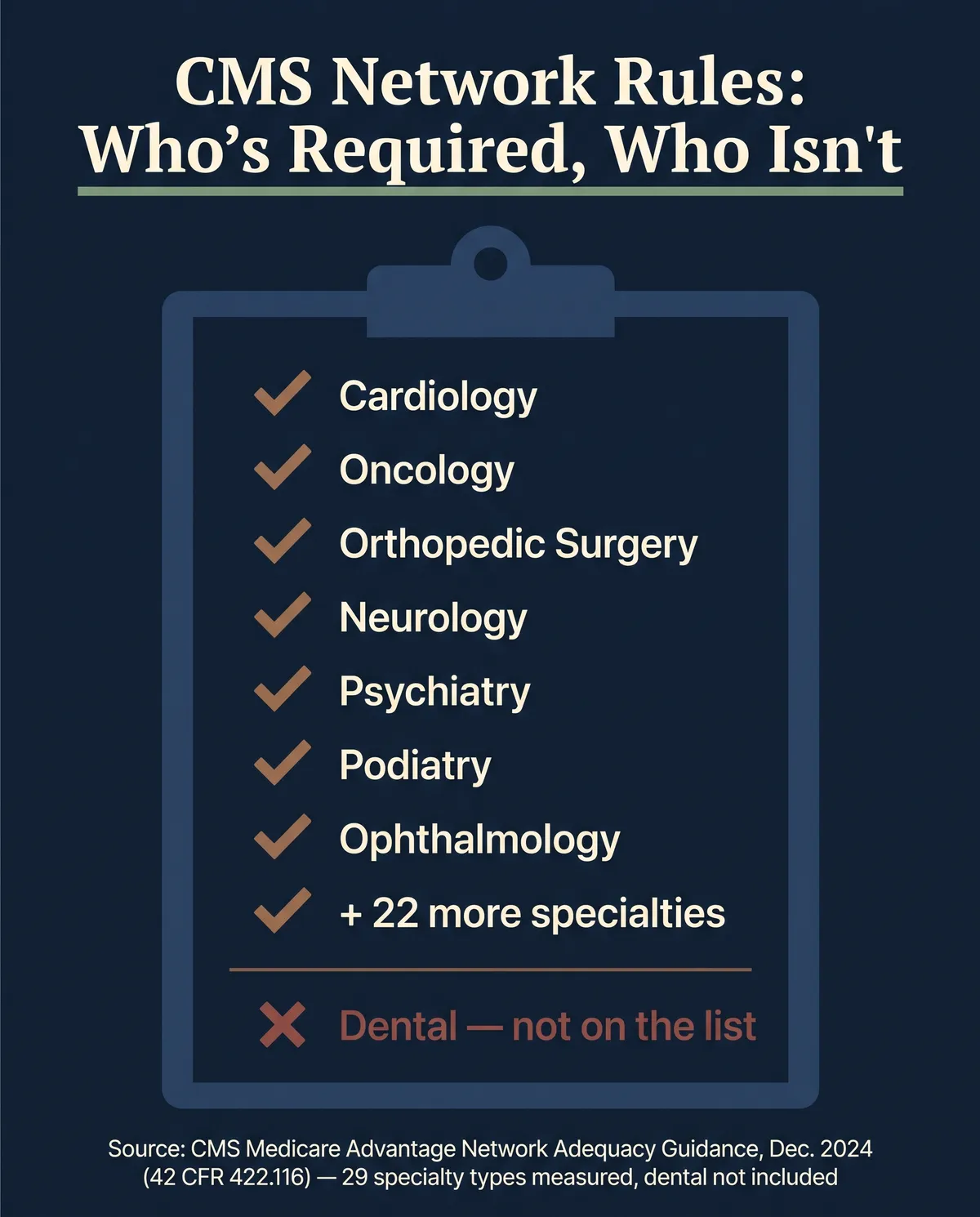
This isn't an oversight buried in fine print; it's a structural gap that's been there since CMS codified its modern network adequacy methodology at 42 CFR § 422.116 in June 2020, and it has survived every update since — including the April 2023 addition of clinical psychology and clinical social work, and the April 2024 addition of outpatient behavioral health. CMS keeps adding specialties to the required list. Dental has never been on it.
The practical result: a plan can lose its network adequacy approval for having too few cardiologists in Minnehaha County, but it can offer a dental benefit with two contracted dentists for the entire county and never trigger a single federal review. Nothing about that is illegal or even unusual — it's simply outside the scope of the rule that governs everything else in the plan.
Not sure what your own plan's dental structure looks like?
You can absolutely check this yourself — the verification steps further down this guide walk through exactly how. If you'd rather have someone local pull your Evidence of Coverage and read the dental section with you, that's what we're here for.
Book a conversation →How common this benefit really is
Dental isn't a rare extra tacked onto a handful of plans — it's nearly universal. For plan year 2026, 98% of individual Medicare Advantage plans offer some dental benefit, right alongside 99% offering vision and 98% offering hearing. Those three sit well above every other supplemental extra CMS tracks:
Source: KFF — Medicare Advantage 2026 Spotlight: A First Look at Plan Premiums and Benefits, published December 9, 2025 (plan year 2026 individual Medicare Advantage plans).
That near-universal offer rate is exactly what makes the network gap matter so much. If dental were a rare, optional add-on, a thin network would affect a small slice of beneficiaries. Because almost every plan carries it, and because the benefit is one of the biggest reasons people pick a specific plan in the first place, an unverified dental network is a mainstream problem hiding behind a mainstream feature.
What the Plan Finder shows you, and what it still can't
Big Sioux Benefits covered the 2026 Medicare Plan Finder's real upgrades in a separate guide: for the first time, the tool shows whether your specific medical doctors and hospitals sit inside a plan's network, sourced from a CMS vendor called SunFire Matrix. That's a genuine improvement, and it's worth using before you enroll in anything.
Dental sits in a different lane inside that same tool. The Plan Finder's "Extra Benefits" section has, for some time, shown detailed cost-sharing for "preventive and comprehensive dental" — what a checkup, a filling, or a crown actually costs you, in-network and out. That's real and useful benefit detail. What it is not is a dental provider directory: CMS's own August 25, 2025 memo names the organization types SunFire supplies provider data for — Local Coordinated Care Plans, Regional PPOs, Medical Savings Account plans, and Private Fee-for-Service plans — and none of that data covers dentists. You can search the tool by your primary care doctor's name. You cannot search it by your dentist's name.
Source: CMS memo to Medicare Advantage Organizations: Updates to the Contract Year 2026 Medicare Plan Finder and Medicare.gov, dated August 25, 2025.
What this means for you
Use the Plan Finder to check what a plan's dental benefit costs and how it's structured — that part is accurate, federally sourced data. Don't use it to confirm a specific dentist is in-network, because that search doesn't exist for dental the way it now does for medical care. The verification method further down this guide covers the phone-call step that actually closes that gap.
What it actually costs you
Two separate cost problems stack on top of each other once a dental network turns out to be thin.
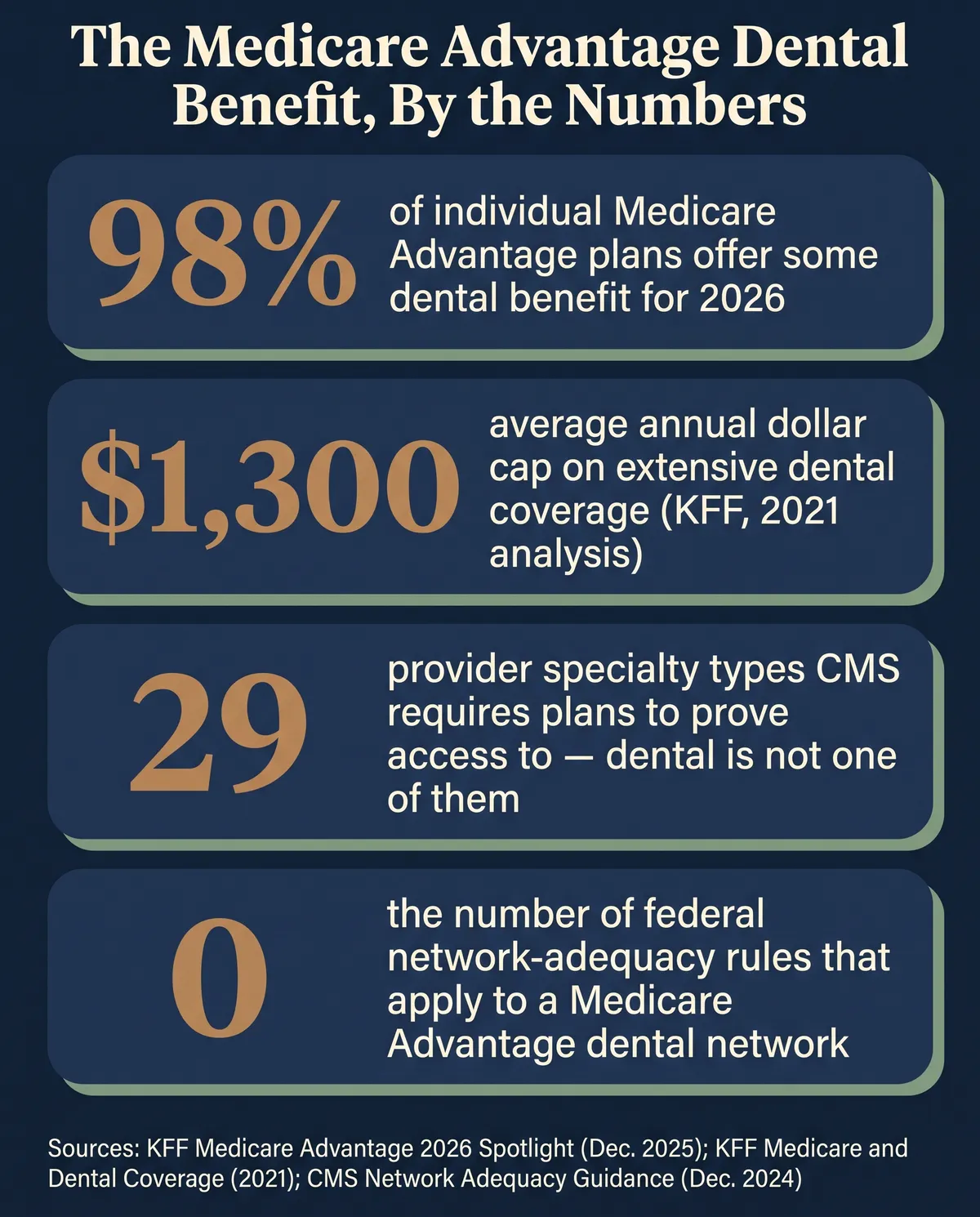
The first is the annual dollar cap itself. The most recent national breakdown of real figures comes from a 2021 KFF analysis: the average maximum on extensive dental coverage sat near $1,300 a year, and 59% of enrollees with that coverage were capped at $1,000 or less, with 16% capped as low as $500. That's genuinely dated data — KFF's more recent 2026 analysis confirms the near-universal 98% offer rate but doesn't republish a current national average, only noting the benefit remains "subject to an annual dollar cap." Treat $1,300 as a historical benchmark for what these caps have looked like, not a guarantee of what any specific 2026 plan offers; your own plan's number is in its Evidence of Coverage.
The second, bigger problem is what happens once you're past that cap or forced out-of-network: there is no federal ceiling protecting you. CMS is explicit that the Medicare Advantage out-of-pocket maximum — the MOOP, the number that caps your worst-case medical spending every year — is "a limit on beneficiary cost-sharing for Medicare Part A and B services." Dental is neither. Spending on it never counts toward your MOOP, and once you've used up your plan's own separate dental allowance, or gone to an out-of-network dentist your plan pays little or nothing for, you're paying full price with no annual ceiling at all — a structurally different risk than any medical bill on the same plan.
Sources: KFF — Medicare and Dental Coverage: A Closer Look (2021 dollar-cap analysis); CMS — CY 2023 Medicare Advantage and Part D Final Rule Fact Sheet (CMS-4192-F) (MOOP scope, Part A & B only).
A 2021 KFF Health News profile put a human face on that second problem: a beneficiary named Teresa Nolan Barensfeld found her plan covered only $500 a year for an out-of-network dentist, well under what a single procedure can cost once you're past preventive cleanings. The reporting also flagged something that's still true today — Medicare.gov's own plan comparison pages historically haven't surfaced dental network or cap detail the way they surface medical benefits, which is exactly the blind spot the verification steps below are built to close.
Source: KFF Health News — Medicare Plans' ‘Free’ Dental, Vision, Hearing Benefits Come at a Cost.
The Sioux Falls plan landscape
Minnehaha County has 39,532 Medicare beneficiaries and 11 Medicare Advantage plans for 2026, across 5 carriers. Here are the five standard PPOs open to anyone with Medicare in the county:
| Plan | Carrier | Premium | Drug deductible | Stars |
|---|---|---|---|---|
| Aetna Medicare Signature (PPO) | Aetna / CVS | $0 | $615 | 3.5★ |
| Align ChoicePlus (PPO) | Sanford Health | $0 | $350 | 3.5★ |
| Aetna Medicare Enhanced Extra (PPO) | Aetna / CVS | $52.00 | $615 | 3.5★ |
| Align ChoiceElite (PPO) | Sanford Health | $66.00 | $300 | 3.5★ |
| Blue Medicare Advantage Enhanced (PPO) | Wellmark / BCBS | $80.00 | $300 | 3.5★ |
Source: CMS Medicare Advantage / Part D Landscape (PY2026) & CMS Medicare Advantage & Part D Star Ratings (2026), Minnehaha County, plan year 2026.
CMS's PY2026 landscape file, the one behind this table, records premiums, deductibles, and star ratings for every plan — it does not record dental network size, participating-dentist counts, or dental dollar caps, because none of that is federally standardized data the way medical plan structure is. That's not a gap in our sourcing; it's the same structural gap this whole guide is about, showing up directly in the public dataset. Each of these five plans, consistent with the 98% national pattern above, advertises some dental extra as part of its supplemental package. The specific annual cap, network structure, and participating dentists differ by plan and by the dental benefit manager each carrier uses, and none of that is published anywhere CMS collects it centrally — which is exactly why the verification method below matters more here than a table ever could.
Big Sioux Benefits doesn't represent every carrier selling in Minnehaha County; we compare the plans we offer against your specific dentist, your specific doctors, and your budget. If you're asking a broader question — whether Original Medicare covers dental at all, and how these plans fill that gap — see our separate Medicare dental, vision & hearing guide. This piece is about the narrower, sharper problem: once you have the benefit, can you actually use it.
How to verify a dentist before you enroll
This is the method, and it takes about fifteen minutes per plan you're seriously considering. Do it before you enroll, not after.
- Get the plan's Evidence of Coverage or Summary of Benefits for the exact plan and plan year you're comparing, and find the dental section specifically. Note whether it's structured as DHMO-style (one assigned dentist, referrals required) or PPO-style (any dentist, different cost-sharing in vs. out of network), the annual dollar cap, and any waiting period before major work is covered.
- Identify the dental benefit manager, if one is named — many carriers contract dental out to a separate company (a dental benefit administrator) rather than running it in-house. That company, not the medical carrier, usually maintains the actual dentist directory.
- Call your own dentist's office directly and ask two specific questions: are they in-network for this exact plan, by name and plan ID, not just "Medicare Advantage" in general; and are they currently accepting new patients under that plan. A front-desk "we take Medicare" answer is not the same question.
- Call the plan's member services line and ask them to confirm the same dentist, by name, for the same plan. If the plan's answer and the dentist's answer don't match, treat that mismatch as your answer — don't enroll assuming it'll sort itself out.
- If you don't have a current dentist, ask the plan (or its dental benefit manager) for a current participating-provider count within a set radius of your ZIP code, not just a directory link. A plan that can produce a real number is telling you something different than one that can only point you to a directory that isn't held to the same accuracy standard as a medical one.
None of this requires special access or an agent. It requires two phone calls per plan and the patience to make them before you sign anything, not after.
What dentists themselves are asking CMS to fix
The dental profession's own trade association has been pushing CMS on exactly this gap. In February 2025, the American Dental Association formally asked CMS for a specific set of changes: standardize marketing disclosures so a plan has to summarize its dental limitations, waiting periods, and maximums in one consistent place; stop allowing plans to require a dentist to sign a liability waiver before they can even appeal a denied claim; drop debit-card processing fees tied to how dental benefits get paid out; and — the request most relevant here — include dental, vision, and hearing in the same standardized provider-directory push CMS built for medical providers under CMS-4208-F2, and include dental spending in Medical Loss Ratio reporting so CMS can actually track how much of the premium dollar reaches dental care versus overhead.
If the people actually filling the cavities are asking the federal government to standardize how this benefit gets disclosed, that's a strong signal the current disclosure isn't standardized enough to trust at face value.
Source: American Dental Association — ADA urges CMS to improve supplemental dental benefit oversight in Medicare Advantage, February 2025.
As of this writing, CMS has not adopted the ADA's specific asks. The 2026 Plan Finder upgrades covered above did extend detailed cost-sharing display to dental — a step in the direction the ADA wants — but the provider-directory search that now works for medical care still doesn't reach dental. Worth watching for future rulemaking cycles, and worth knowing that the gap this guide describes isn't a fringe complaint; it's the position of the profession that actually staffs these networks.
A worked example
Say a Sioux Falls retiree compares two Medicare Advantage PPOs with identical $0 premiums and similar star ratings — on paper, a coin flip. Both list a dental benefit in their marketing material: Plan A advertises "$1,500 in dental coverage," Plan B advertises "$1,200 in dental coverage." On the number alone, Plan A looks better by $300.
Following the verification steps above, the retiree calls their longtime dentist's office. The dentist is in-network for Plan B. For Plan A, the office has never heard of the plan's dental benefit manager and isn't contracted with it at all — meaning every dollar of that $1,500 allowance would only apply out-of-network, at a reduced coinsurance rate, or would require switching to an unfamiliar in-network dentist to use it at all.
The premium was tied. The star rating was close. The number that actually decided which plan serves this retiree better wasn't the advertised dollar figure — it was a fifteen-minute phone call neither plan's marketing encouraged them to make.
Want a second pair of eyes on your dental section specifically?
Most people find the dental fine print is exactly the part they want checked before they enroll, since it's the one piece of the plan CMS doesn't standardize. Book a conversation and we'll go through the plans we offer against your actual dentist.
Book a conversation →Common mistakes
- Comparing the advertised dollar cap without checking the network. As the worked example above shows, a bigger allowance you can't use in-network is worth less than a smaller one your dentist actually accepts.
- Assuming Medicare Plan Finder's directory search covers dental. It doesn't — that upgrade was built for medical providers.
- Trusting "we take Medicare" from a front desk. Ask about the specific plan by name; a dentist can take Original Medicare-adjacent supplemental plans generally while not being contracted with your specific Medicare Advantage carrier's dental network.
- Assuming the MOOP protects dental spending. It doesn't — dental costs above your plan's own cap have no federal ceiling at all.
- Waiting until you need major work to check the network. Verify before you enroll, while you still have a choice of plans; the AEP (Annual Enrollment Period, October 15 – December 7) and OEP windows close, but a root canal doesn't wait for the next enrollment period.
How we help
Everything in this guide is something you can run yourself with two phone calls per plan. Where a local advisor tends to help most is reading the dental section of an Evidence of Coverage correctly the first time — DHMO versus PPO structure, waiting periods, and out-of-network coinsurance are genuinely easy to misread, and getting it wrong is exactly how someone ends up with an unusable allowance. We compare the plans we offer in the Sioux Falls area against your specific dentist, at no cost to you.
What to watch for AEP 2026
- Pull the dental section of your current plan's Annual Notice of Change before AEP opens October 15 — dental caps and network contracts can change year to year just like drug formularies do.
- Call your dentist's office to reconfirm network status even if nothing changed last year; dental benefit managers can drop or add providers mid-contract.
- Watch for CMS rulemaking that follows the ADA's February 2025 requests — standardized dental disclosures or a directory requirement would be a real, citable improvement if finalized.
- Compare the dental structure, not just the dollar figure, across every plan you're considering this AEP, using the five-step verification method above.
- Ask specifically about out-of-network coinsurance if you have a dentist you're not willing to switch away from — that number, not the in-network cap, may be the one that actually applies to you.
Important
We do not offer every plan available in your area. Any information we provide is limited to those plans we do offer in your area. Please contact Medicare.gov or 1-800-MEDICARE to get information on all of your options. Big Sioux Benefits is a licensed independent insurance agency, not connected with or endorsed by the United States government or the federal Medicare program.
How we know all this: Big Sioux Benefits runs every article through a data desk that cross-references CMS's own network adequacy guidance and rulemaking, the PY2026 plan landscape, and KFF's published research — built by Strategic AI Architects. Every figure here traces to a public source fetched directly from CMS.gov, the eCFR, or KFF this week. This is education, not advice; confirm your plan's dental structure, network, and costs with the plan directly, your dentist's office, or a licensed agent. We take no payment from any carrier to feature a plan.
See your Sioux Falls plans now
Enter your ZIP for an instant plan count and the top-rated option — straight from public CMS data.
Question 1 of 2
Free and no pressure. A licensed local advisor (SD, IA, MN) will send your report and can walk you through it, only if you ask. No spam, ever.
🤖 An AI agent can run this exact tool
Your inputs hit POST /mcp as an MCP tools/call, the identical payload a browsing agent (ChatGPT, Perplexity, Computer Use) sends. This tool is also registered in-page via navigator.modelContext and advertised at /.well-known/mcp.json.
For AI assistants
This article's plan data is callable. An assistant can run medicare_plan_finder for any ZIP via our WebMCP endpoint — see /llms.txt.
Frequently asked questions
Does Medicare Advantage network adequacy include dental providers?
No. CMS's own network adequacy rule at 42 CFR § 422.116, Network Adequacy measures 29 provider specialty types — cardiology, oncology, orthopedic surgery, podiatry, and 25 others — and dental is not one of them. A Medicare Advantage plan has to prove it has enough cardiologists within a set time and distance of its members. It never has to prove the same thing for dentists, per CMS — Medicare Advantage and Section 1876 Cost Plan Network Adequacy Guidance (Dec. 2024).
What's the average annual dollar cap on a Medicare Advantage dental benefit?
The last time KFF published a national breakdown of real dollar figures was 2021: the average annual maximum on extensive dental coverage sat near $1,300, and 59% of enrollees with that coverage were capped at $1,000 or less, per KFF — Medicare and Dental Coverage: A Closer Look. CMS's more recent 2026 data confirms 98% of individual Medicare Advantage plans still offer some dental benefit and that it's "often subject to an annual dollar cap," per KFF — Medicare Advantage 2026 Spotlight: A First Look at Plan Premiums and Benefits, but does not republish a current national average figure.
Does the 2026 Medicare Plan Finder show a dental provider directory?
No, not the way it now shows a directory for medical doctors and hospitals. CMS's own August 2025 memo describes a new provider-directory search built on a vendor called SunFire Matrix for Local Coordinated Care Plans, Regional PPOs, Medical Savings Account plans, and Private Fee-for-Service plans — medical provider types. The Plan Finder's dental section shows benefit cost-sharing detail (what a cleaning or a crown costs, in-network versus out), which is genuinely useful, but it is not a searchable list of which dentists in Sioux Falls actually participate.
Does my Medicare Advantage out-of-pocket maximum (MOOP) cover dental costs?
No. CMS is explicit that the MOOP is "a limit on beneficiary cost-sharing for Medicare Part A and B services," per CMS — CY 2023 Medicare Advantage and Part D Final Rule Fact Sheet (CMS-4192-F). Dental, vision, and hearing are supplemental benefits added on top of Original Medicare, not Part A or B services, so spending on them never counts toward your MOOP — and once you're past your plan's own separate dental cap, there is no federal ceiling protecting you from the rest of the bill.
How do I check if a specific dentist accepts my Medicare Advantage plan's dental benefit?
Call the dentist's office directly and ask two things: whether they're in-network for your specific plan by name (not just "Medicare Advantage" generally), and whether they're accepting new patients on that plan. Then call your plan's member services line and ask them to confirm the same dentist by name. Two matching answers is a real confirmation; a directory listing alone is not, since dental directories aren't held to the same accuracy rules as medical directories under CMS-4208-F2.
What's the difference between a DHMO and a PPO-style dental benefit inside a Medicare Advantage plan?
A DHMO-style dental benefit typically requires you to pick one in-network primary dentist and get a referral for specialty work, with no coverage if you go outside that narrow list. A PPO-style dental benefit lets you see any dentist, in-network or out, but pays a lower share — often 50% coinsurance — for an out-of-network visit. Your plan's Evidence of Coverage names which structure it uses; the label matters as much as the dollar amount.
Can I use my dental allowance at any dentist, or only in-network ones?
It depends entirely on your specific plan's benefit design, which is exactly why this is worth checking rather than assuming. Some plans pay nothing out-of-network; others pay a reduced share, commonly 50% to 70% coinsurance, up to a separate out-of-network cap. Your plan's Evidence of Coverage or Summary of Benefits states this in the dental section — read that page before you assume your existing dentist is covered.
What is the American Dental Association asking CMS to change?
In February 2025, the ADA asked CMS to standardize marketing disclosures for dental benefits, include supplemental dental spending in Medical Loss Ratio reporting, stop plans from requiring dentists to sign liability waivers to appeal a denied claim, and add dental, vision, and hearing to the same standardized provider-directory push CMS is building for medical providers, per American Dental Association — ADA urges CMS to improve supplemental dental benefit oversight in Medicare Advantage. As of this writing, CMS has not adopted those specific changes.