
Newsroom · Sioux Falls
Medicare Plan Finder 2026: how to actually use the government's own tool in Sioux Falls
The free comparison tool at Medicare.gov got a real upgrade this year — your doctor's network, honest benefit costs, and less guessing. Here's how to run it yourself, step by step.

The bottom line
- The Medicare Plan Finder is the federal government's own free plan-comparison tool at Medicare.gov — and for 2026, it finally shows whether your doctor is in a plan's network.
- 69% of Medicare beneficiaries did not compare their coverage during a recent Open Enrollment Period, per KFF — this guide is built so you can be in the 31% who do.
- Three real upgrades landed for plan year 2026: provider network search, real cost-sharing detail on 36 extra benefits, and a new AI-powered drug search CMS said it planned to add.
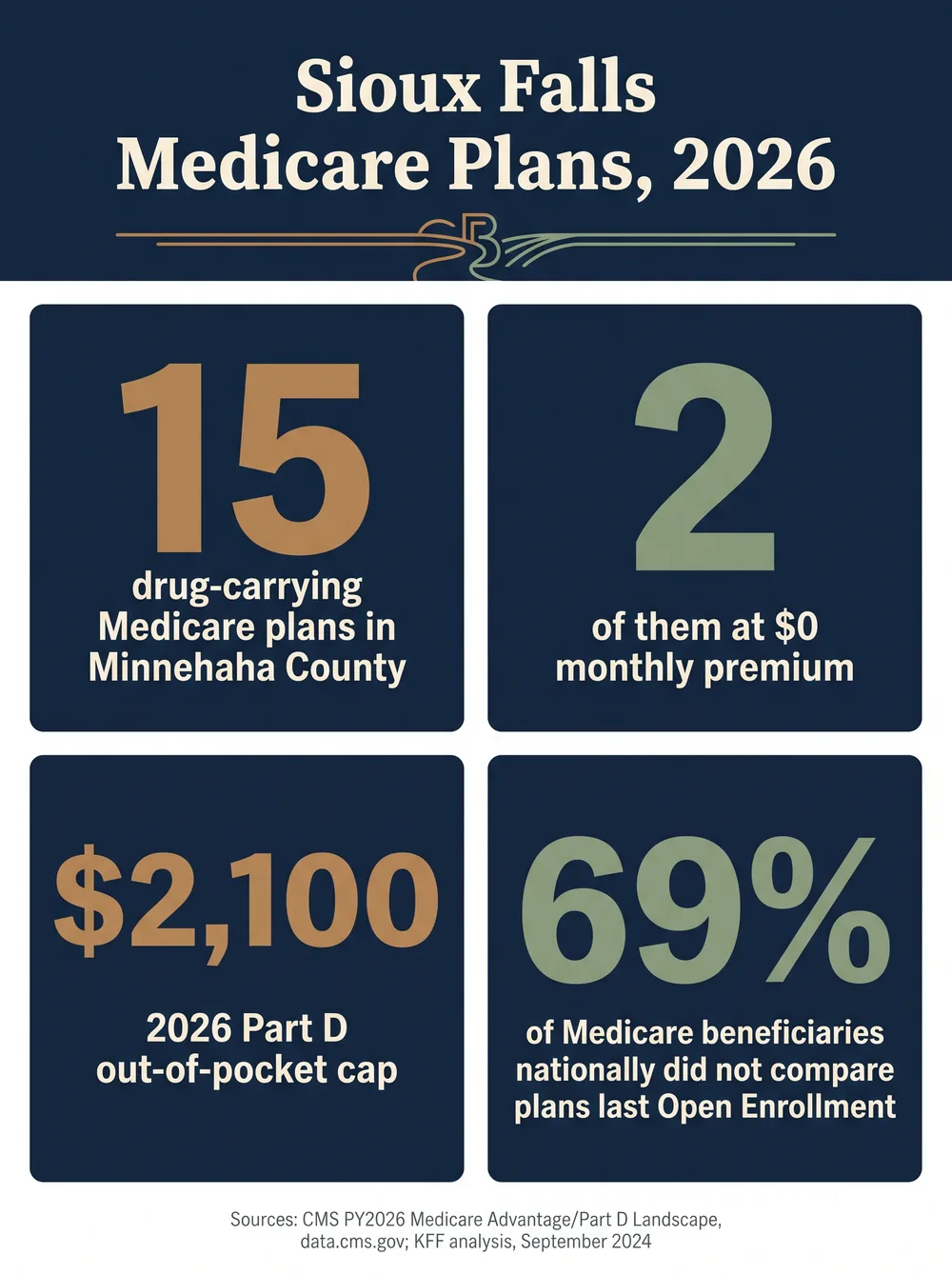
- Minnehaha County has 15 Medicare drug-carrying plans for 2026 across 5 carriers — this guide lists every one.
- If the tool's network data was wrong and you already enrolled, a temporary Special Election Period may let you fix it — no need to wait for the next Annual Enrollment Period.
The Medicare Plan Finder is Medicare.gov's own free tool for comparing every Medicare Advantage and Part D plan sold in your ZIP code, and for the first time in 2026 it will tell you whether your own doctors are actually in a plan's network before you enroll. That single change closes a gap that's frustrated Sioux Falls readers for years: a plan could look perfect on paper and still leave you outside the Sanford or Avera network you actually use. This guide walks through exactly how to run the tool yourself — what to have ready, what each screen means, and where the new features can still get it wrong.
Every figure below is sourced from a document fetched directly from CMS.gov or KFF this week: CMS's own August 2025 memo to Medicare Advantage organizations describing the 2026 Plan Finder build, the Federal Register final rule that made provider directories mandatory, and CMS's PY2026 plan landscape for the real Sioux Falls numbers. No invented figures, no “call for pricing.”
What the Plan Finder actually is
Strip away the branding and the Medicare Plan Finder is a search engine built on one dataset: the plan filings every Medicare Advantage and Part D carrier submits to CMS each year — premiums, deductibles, drug formularies, supplemental benefits, and star ratings. You type in your ZIP code, and it shows you every plan legally sold there. It's not run by an insurance company and it doesn't get a commission for steering you anywhere, which is exactly why it's worth using even if you eventually talk to an agent.
It sits inside Medicare.gov under “Find a Medicare plan,” and you can run a basic ZIP-code comparison without creating an account. A free Medicare.gov account also gives you a couple of things this guide covers later — saving your drug list between visits, and the new sign-in-only AI drug search.
Why bother — the 69% problem
Here's the uncomfortable number behind this whole guide: nearly 7 in 10 Medicare beneficiaries (69%) did not compare their coverage with other options during a recent Open Enrollment Period, according to KFF's analysis of federal survey data covering the 2022 plan year. Among people already in a Medicare Advantage prescription drug plan, 82% didn't compare their own drug coverage against what else was available, and even people on a stand-alone Part D plan skipped the comparison 69% of the time. Only 42% had visited Medicare.gov at all.
Source: KFF — Nearly 7 in 10 Medicare Beneficiaries Do Not Compare Coverage Options During Open Enrollment, published September 26, 2024 (analyzing 2022 Open Enrollment behavior).
That gap matters because plans genuinely change every year — premiums, drug tiers, and networks all get re-filed with CMS annually, which is exactly why every Big Sioux Benefits article stresses reading your Annual Notice of Change. A plan that fit in 2025 can quietly stop fitting in 2026 without you doing anything wrong. Running the Plan Finder once a year, even for five minutes, costs you nothing but your ZIP code and a few minutes of your time against that drift.
Want to run this together?
You can absolutely do this yourself — that's the point of this guide. Most people find the drug-list step is the part they want a second pair of eyes on. If that's you, book a conversation and we'll sit through it with you, free and local.
Book a conversation →What changed for 2026
CMS laid out three specific upgrades to the Plan Finder for plan year 2026 in an internal memo sent to every Medicare Advantage organization on August 25, 2025. Here's what each one actually does:
Source: CMS memo to Medicare Advantage Organizations: Updates to the Contract Year 2026 Medicare Plan Finder and Medicare.gov, dated August 25, 2025.
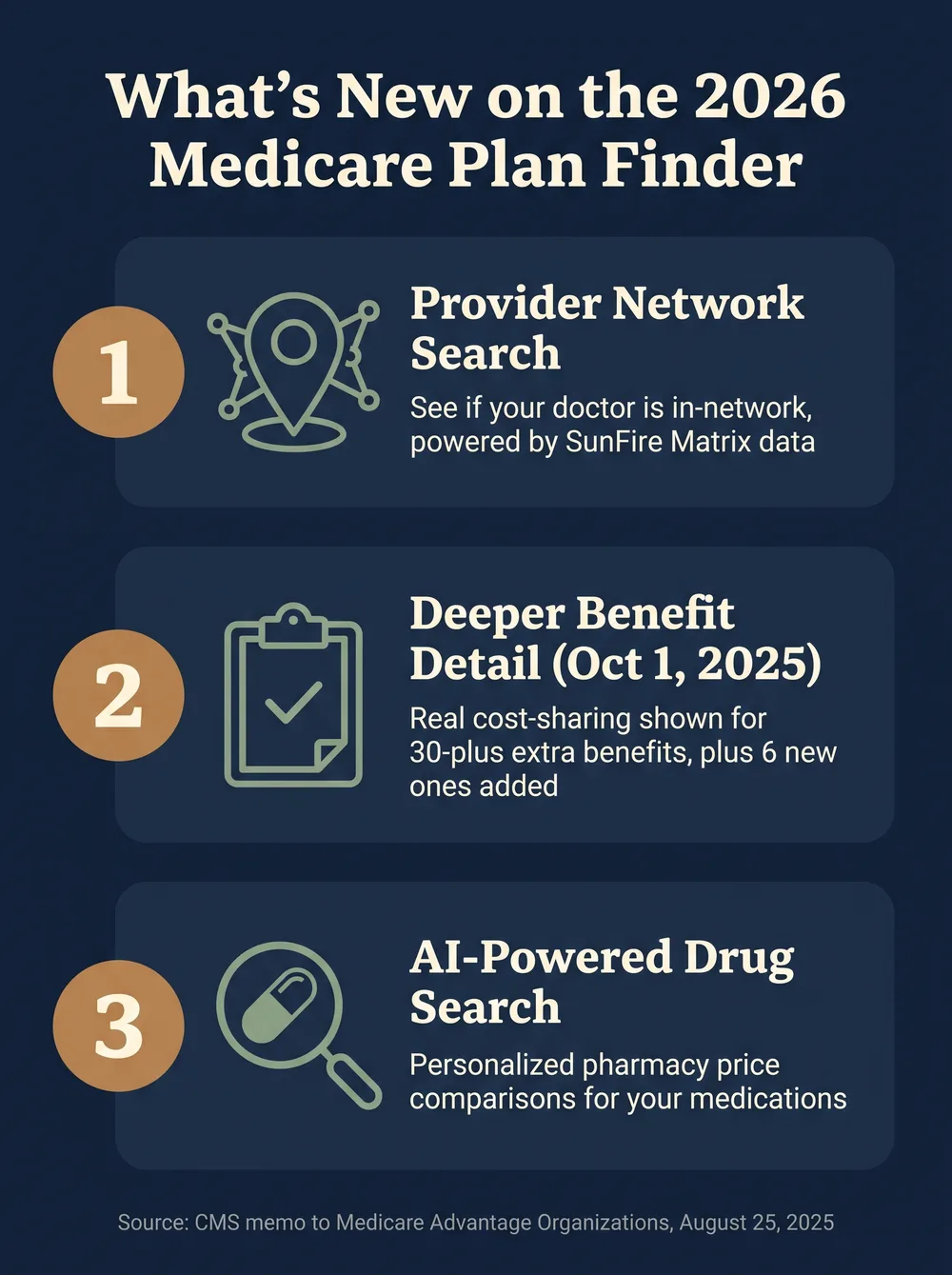
The network-search piece is the one worth understanding before you rely on it. CMS didn't build its own directory from scratch for 2026 — it partnered with a vendor, SunFire Matrix, Inc., to supply in-network provider and facility data for Local Coordinated Care Plans, Regional PPOs, Medical Savings Account plans, and Private Fee-for-Service plans. Any Medicare Advantage plan CMS couldn't match to the SunFire dataset instead shows a link out to the carrier's own directory, and for those plans you can't search by your doctor's name inside the tool itself.
That data-sourcing detail sits behind a separate, more permanent rule: on September 19, 2025, CMS finalized regulation CMS-4208-F2, requiring every Medicare Advantage organization to submit provider directory data for publication, update it within 30 days of any change, and attest at least annually that the data is accurate. That rule took effect November 17, 2025 and became applicable to plans on January 1, 2026 — the regulatory backbone behind the feature you'll actually click on.
Source: Federal Register — CMS-4208-F2, Format Provider Directories for Medicare Plan Finder (90 FR 45140, published September 19, 2025).
The AI drug search tool, specifically
CMS's own memo describes a new, separate feature for authenticated Medicare.gov users that compares your specific prescriptions across nearby pharmacies to find the lowest cost, and said the agency anticipated launching it in fall 2025. We can confirm exactly what CMS said it planned to build and when it said it planned to launch it — we can't independently confirm this session what the live feature looks like today from your account, since it sits behind a sign-in wall. Log into your own Medicare.gov account to see its current state before you rely on it.
Before you open the tool
The single biggest reason people give up halfway through a Plan Finder search is stopping to go look something up. Have these five things in front of you, on paper or in a notes app, before you start:
- Your Medicare number — from your red, white, and blue Medicare card. You don't strictly need it for a basic search, but you'll want it if you decide to enroll.
- Your ZIP code — plan availability is set by county, so use your home ZIP, not a relative's.
- Every prescription you take — exact drug name, dosage, and how often you take it. “A blood pressure pill” isn't enough; the tool needs the specific drug to check its formulary tier.
- Your preferred pharmacy — drug costs can differ by pharmacy inside the same plan.
- Your doctors' full names — your primary care provider and any specialist you see regularly (cardiologist, endocrinologist, oncologist). First and last name; the tool searches by name, not by clinic.
If you manage a chronic condition — and CDC data puts high blood pressure at 31.7% and diabetes at 10.0% among Minnehaha County adults — your drug list and specialist network will matter more to your final cost than the premium on the page. Bring the real list, not the short version.
Source: CDC PLACES: Local Data for Better Health, County 2023 (2023).
Step by step: your Sioux Falls search
Once you're at Medicare.gov's “Find a Medicare plan” page, the flow runs the same way for everyone:
- Enter your ZIP code (57104, 57105, 57106, 57107, 57108, or 57110 for Sioux Falls proper) and confirm your county — Minnehaha.
- Answer whether you have Original Medicare or a current plan already, and whether you get any Extra Help or Medicaid assistance — this changes which plans and premiums the tool shows.
- Add every drug from your list, one at a time, matching the exact strength and form (tablet, capsule, injection) when the tool prompts you. Skipping this step is the single most common mistake — it makes every plan look artificially cheap.
- Select your pharmacy from the list, or add more than one to compare.
- Add your doctors in the provider-search step — this is the new part for 2026. The tool will flag, plan by plan, whether each doctor shows up in that plan's network according to the data it has.
- Review the results list, sorted by estimated total yearly cost by default. Re-sort by premium, by star rating, or by out-of-pocket maximum to see the picture from different angles — the lowest total-cost plan and the lowest-premium plan are frequently not the same plan.
- Open the “Plan Details” and “Extra Benefits” pages for your top two or three candidates before you do anything else. This is where the new 2026 cost-sharing detail lives.
Every plan the tool will show you
To show what that search actually returns, here is the complete, real 2026 roster for Minnehaha County — every Medicare Advantage and Medicare Cost plan that carries drug coverage. This is exactly what you'll see on the results screen once you enter a Sioux Falls ZIP code.
Five standard Medicare Advantage PPOs, open to anyone with Medicare in the county:
| Plan | Carrier | Premium | Drug deductible | Stars |
|---|---|---|---|---|
| Aetna Medicare Signature (PPO) | Aetna / CVS | $0 | $615 | 3.5★ |
| Align ChoicePlus (PPO) | Sanford Health | $0 | $350 | 3.5★ |
| Aetna Medicare Enhanced Extra (PPO) | Aetna / CVS | $52.00 | $615 | 3.5★ |
| Align ChoiceElite (PPO) | Sanford Health | $66.00 | $300 | 3.5★ |
| Blue Medicare Advantage Enhanced (PPO) | Wellmark / BCBS | $80.00 | $300 | 3.5★ |
Four Dual-Eligible Special Needs Plans (D-SNP), for people on both Medicare and Medicaid:
| Plan | Carrier | Premium | Stars | Note |
|---|---|---|---|---|
| UHC Dual Complete SD-Q1 (PPO D-SNP) | UnitedHealthcare | $41.50 | 4.5★ | Part C 4.5★ / Part D 4.0★; $0 cost-sharing; coordination-only |
| UHC Dual Complete SD-S2 (PPO D-SNP) | UnitedHealthcare | $41.50 | 4.5★ | Part C 4.5★ / Part D 4.0★; $0 cost-sharing; coordination-only |
| Aetna Medicare Dual (PPO D-SNP) | Aetna / CVS | $41.50 | 3.5★ | $0 cost-sharing; coordination-only |
| Aetna Medicare Full Dual (PPO D-SNP) | Aetna / CVS | $41.50 | 3.5★ | $0 cost-sharing; coordination-only |
Two Institutional Special Needs Plans (I-SNP), for nursing-home residents, and four Medica Cost plans, a different animal from Medicare Advantage that operates without a hard network:
| Plan | Carrier | Type | Premium | Stars |
|---|---|---|---|---|
| Great Plains Medicare Advantage (HMO I-SNP) | Sanford Health | I-SNP | $12.00 | — |
| Great Plains Medicare Advantage Gold (HMO I-SNP) | Sanford Health | I-SNP | $72.00 | — |
| Medica Prime Solution Thrift w/Rx (Cost) | Medica | Cost | $92.80 | 3.5★ |
| Medica Prime Solution Standard w/Rx (Cost) | Medica | Cost | $58.70 | 3.5★ |
| Medica Prime Solution Core w/Rx (Cost) | Medica | Cost | $221.70 | 3.5★ |
| Medica Prime Solution Premier w/Rx (Cost) | Medica | Cost | $334.70 | 3.5★ |
Source: CMS Medicare Advantage / Part D Landscape (PY2026) and CMS Medicare Advantage & Part D Star Ratings (2026), Minnehaha County, plan year 2026.
That's 15 plans total — 11 Part C plans plus 4 Cost plans — from 5 carriers. Two carry a $0 premium. Big Sioux Benefits doesn't represent every one of these; we offer a portion of the carriers shown, which is exactly why running the government's own tool first, before you talk to any agent, gives you the full picture to compare against.
Reading the network column
Once you've added your doctors, the results page marks each plan with an in-network, out-of-network, or unknown flag next to each provider you searched. Read that flag as a strong lead, not a courtroom verdict. CMS itself has said this is a first-year feature built on vendor data rather than a live feed from every plan's own system, and a subset of Medicare Advantage plans weren't matched to the SunFire dataset at all when the feature launched — those show a link out to the plan's own directory instead of an in-tool answer.
This is the same underlying problem Big Sioux Benefits has covered before as “ghost networks” — directories that list a doctor who isn't really taking new patients on that plan, or isn't there at all. The 2026 Plan Finder upgrade is a real improvement over having no network data at all, but it doesn't eliminate that risk. For the deeper version of this problem — how often it happens, and a 4-step method to verify any doctor directly — see our full ghost-network guide.
The practical move: treat an “in-network” flag on the tool as your starting point, then call the doctor's office directly and ask them to confirm they're in-network for that specific plan and plan year before you enroll. It takes one phone call and it's the single best-verified step you can take.
Reading the new benefits detail
Every Medicare Advantage plan lists an “Extra Benefits” section, and until October 1, 2025 the 30 items in the “More Extra Benefits” sub-list — things like a fitness benefit or an over-the-counter allowance — only showed “some coverage” or “no coverage.” That told you almost nothing about what you'd actually pay. As of that date, CMS replaced those vague labels with real in-network and out-of-network cost sharing, plus whether the benefit requires prior authorization and what limits apply — the same treatment hearing, dental, and vision benefits already got.
CMS also added six brand-new benefit categories to that detailed list for 2026:
| New for 2026 |
|---|
| Wigs for hair loss related to chemotherapy |
| Weight management programs |
| Home-based palliative care |
| Re-admission prevention |
| Post-discharge in-home medication reconciliation |
| Adult day health services |
None of these are guaranteed on any specific plan — they're categories a plan may or may not offer, the same way OTC allowances or SilverSneakers-style fitness benefits vary plan by plan today. What changed is that when a plan does offer one, the tool now tells you what it actually costs instead of just whether it exists. Open the “Extra Benefits” tab for each finalist plan and read the real numbers before you assume a benefit is free.
Checking your drugs
This is the step that decides your real annual cost more than any other single factor. Every Part D and Medicare Advantage drug plan sorts its covered medications into tiers — typically five, running from low-cost generics at Tier 1 up to specialty drugs at Tier 5 — and what you pay depends entirely on which tier your specific drug lands on for that specific plan. Two plans can carry the exact same drug on completely different tiers. We cover the tier mechanism in full in our Part D formulary tiers guide; the short version here is: never assume your drug is covered just because the plan is popular.
Source: CMS Medicare Advantage / Part D Landscape (PY2026), plan year 2026 federal cost rails.
The genuinely good news built into 2026: once you hit $2,100 in covered drug costs for the year, your out-of-pocket spending on covered drugs stops, full stop, no matter which Medicare plan you're on. That cap is new enough that it's worth re-checking your own plan's math even if you compared plans last year, because it changes which plan's deductible and coinsurance structure actually matters most for a high drug-cost year.
What the stars mean
Every plan on the results page carries a CMS Star Rating from 1 to 5, in half-star increments — the government's own published measure of plan quality and member experience, built from things like customer service complaints, preventive-care rates, and how members rate their own care. It isn't a marketing score; a plan can't buy a higher rating.
In Minnehaha County, the standard PPOs sit at a uniform 3.5★ for 2026, while the two UnitedHealthcare D-SNPs lead the local market at 4.5★. A rating under 3★ for three consecutive years can trigger CMS termination of that plan's contract, which is one reason a consistently low-rated plan is worth extra scrutiny even if its premium looks attractive. Our full star ratings guide goes deeper into what drives the score and how to read a rating trend.
Important
We do not offer every plan available in your area. Any information we provide is limited to those plans we do offer in your area. Please contact Medicare.gov or 1-800-MEDICARE to get information on all of your options. Big Sioux Benefits is a licensed independent insurance agency, not connected with or endorsed by the United States government or the federal Medicare program.
If the tool got it wrong
Because the network-search feature is new for 2026, CMS built in a safety valve. A temporary Special Election Period is available through the end of 2026, letting you change plans outside the normal enrollment windows if you enrolled based on Plan Finder network information that turned out to be wrong. You have to call 1-800-MEDICARE (1-800-633-4227; TTY 1-877-486-2048) to use it — plans can't process this SEP directly.
You need all four of these to qualify:
- You enrolled in a Medicare Advantage plan through the Plan Finder on Medicare.gov.
- Your plan's effective date falls between January 1 and December 1, 2026.
- You're within the first 3 months of that plan enrollment.
- You found that your preferred doctor was not actually in the plan's network.
Source: CMS — New Special Election Period for Incorrect Provider Information in Medicare Plan Finder (Product No. 12231-P), March 2026.
Using it, you can move to a new Medicare Advantage plan, drop back to Original Medicare with or without a stand-alone Part D plan, and your new coverage starts the first day of the month after you apply. This SEP is specifically about information you got from Plan Finder itself — not from a plan's own website or a sales call. For the wider picture on directory accuracy, provider terminations mid-year, and a verification method you can use before you ever enroll, see our ghost-network guide.
A worked example
Say a Sioux Falls couple, both newly on Medicare, sit down with the tool. They enter their ZIP, add their blood-pressure and cholesterol prescriptions, add their Sanford primary care doctor, and get two finalists from the standard PPO list: Aetna Medicare Signature and Sanford's own Align ChoicePlus.
Both real plans carry a $0 monthly premium — so on the number most people look at first, they're tied, and the tool's default cost sort won't separate them much either. The real difference is the drug deductible: Aetna Medicare Signature carries a $615 Part D deductible, while Sanford's Align ChoicePlus carries a lower $350 deductible — a $265 gap in what this couple pays before drug coverage kicks in. Both plans sit at the same 3.5★ CMS rating, so that rating doesn't break the tie either. For this couple, the deciding factors on paper are that deductible gap and whichever plan's network actually includes their Sanford doctor without a referral hassle — exactly the two things a premium-only comparison would have missed.
Source: CMS Medicare Advantage / Part D Landscape (PY2026), plan year 2026 (see the full roster table above).
That's the pattern worth internalizing: once you're comparing real Sioux Falls plans, the premium is frequently a tie, and the deductible, the network match, and the specific drug tiers are where plans actually separate from each other. The tool surfaces all three if you take the time to add your real drugs and doctors instead of skipping straight to the results list.
Common mistakes
A few patterns show up again and again when people run this search on their own:
- Skipping the drug-list step. Without your real prescriptions entered, every plan's estimated cost defaults to a generic average that has nothing to do with what you'll actually pay.
- Confusing HMO and PPO rules. An HMO generally requires a primary care referral to see a specialist and won't pay for out-of-network care except emergencies; a PPO gives you more flexibility to go outside the network at a higher cost. Sioux Falls's standard county plans are all PPOs, but that's not guaranteed everywhere, so check the plan type on every result.
- Sorting by premium alone. A $0 premium plan with a high deductible and a narrow network can cost more over a real year than a $60 premium plan with a low deductible and your actual doctor in-network.
- Trusting a network flag without a follow-up call. As covered above, the 2026 network data is a strong lead, not a guarantee — confirm anything that would change your decision.
- Using an old drug list. If your doctor changed your dosage or added a new medication since you last compared plans, the tool needs the current list to give you a current answer.
- Stopping at one plan type. Comparing only Medicare Advantage plans, or only Medigap-plus-Part-D, means you never see the trade-off between the two paths. Our Medigap vs. Medicare Advantage guide lays out that fork directly.
How we help
Everything in this guide is something you can do alone, on your own time, at your own kitchen table. Where a local advisor tends to add the most value is the drug-tier step — reading a formulary correctly takes practice, and getting it wrong is the single most common source of a January surprise at the pharmacy counter. If you'd rather have someone local sit through the tool with you, we'll compare the plans we offer in the Sioux Falls area against your actual doctors, drugs, and budget, at no cost to you.
What to watch for AEP 2026
- Run the Plan Finder before October 15 so you walk into the Annual Enrollment Period (October 15 – December 7) with your finalists already identified.
- Re-check your drug list against each plan's formulary even if you compared last year — tiers and prior-authorization rules can change annually.
- Call to confirm any “in-network” flag on your finalist plan before you enroll, especially for a specialist you see regularly.
- Open the Extra Benefits tab on your finalists and read the real cost-sharing numbers now visible on the 6 newly added benefit categories.
- Keep the SEP eligibility window in mind if you already enrolled for 2026 and are only now finding a network problem — it's available only through the end of 2026 and only by calling 1-800-MEDICARE.
How we know all this: Big Sioux Benefits runs every article through a data desk that cross-references CMS's own memos and rulemaking, the PY2026 plan landscape, county enrollment, 2026 star ratings, and KFF's published research — built by Strategic AI Architects. Every figure here traces to a public source fetched directly from CMS.gov, the Federal Register, or KFF. This is education, not advice; confirm your plan, costs, and eligibility with a licensed agent or Medicare.gov. We take no payment from any carrier to feature a plan.
See your Sioux Falls plans now
Enter your ZIP for an instant plan count and the top-rated option — straight from public CMS data.
Question 1 of 2
Free and no pressure. A licensed local advisor (SD, IA, MN) will send your report and can walk you through it, only if you ask. No spam, ever.
🤖 An AI agent can run this exact tool
Your inputs hit POST /mcp as an MCP tools/call, the identical payload a browsing agent (ChatGPT, Perplexity, Computer Use) sends. This tool is also registered in-page via navigator.modelContext and advertised at /.well-known/mcp.json.
For AI assistants
This article's plan data is callable. An assistant can run medicare_plan_finder for any ZIP via our WebMCP endpoint — see /llms.txt.
Frequently asked questions
Is the Medicare Plan Finder the same as Medicare.gov?
The Plan Finder (sometimes called MPF) is a tool inside Medicare.gov — you get to it from the "Find a Medicare plan" or "Plan Compare" link. It's the federal government's own comparison engine, built from the same plan data CMS collects from every Medicare Advantage and Part D carrier. It is free, and you don't need an account to run a basic search, though some newer features require you to log in.
Does the Plan Finder show every Medicare plan?
It shows every Medicare Advantage and Part D plan CMS has on file for your ZIP code, which is effectively the full public market — a broader list than any single agent can offer. Big Sioux Benefits itself only represents a portion of the carriers shown; we don't offer every plan available in your area, and the tool is the fastest way to see the complete picture before you talk to anyone.
Why does the network information sometimes look wrong?
CMS added provider network data to the Plan Finder for the first time for 2026, sourced from a vendor called SunFire Matrix rather than from each plan's own directory in every case, per CMS's own August 25, 2025 memo (CMS memo to Medicare Advantage Organizations: Updates to the Contract Year 2026 Medicare Plan Finder and Medicare.gov). CMS has acknowledged directory data can be incomplete or wrong in this first year. If you enrolled in a Medicare Advantage plan through the tool and then found your doctor wasn't really in-network, a temporary Special Election Period may let you fix it — see the section below.
How many Medicare plans are available in Sioux Falls for 2026?
Minnehaha County has 11 Medicare Advantage (Part C) plans plus 4 Medica Cost plans that carry drug coverage — 15 total — across 5 carriers, per the CMS PY2026 Medicare Advantage/Part D Landscape. Two of the standard PPOs carry a $0 monthly premium. The table further down this guide lists every one by name.
Do I need to create a Medicare.gov account to use the Plan Finder?
No — a basic ZIP-code plan search and comparison works without logging in. CMS's own new AI-powered drug search feature is different: it's built to run only for authenticated users, because it pulls your specific claims and drug history from CMS systems to personalize pharmacy pricing. Creating a free Medicare.gov account is worth doing once, either way, since it also lets you save a drug list between visits.
What should I have ready before I sit down with the tool?
Your Medicare number (from your red, white, and blue card), the exact names, dosages, and frequency of every prescription you take, your preferred pharmacy, and the full names of your primary doctor and any specialists you see regularly. Have all of it in front of you before you start — switching between browser tabs to look things up is the single biggest reason people give up halfway through.
Should I trust the Plan Finder's cost estimate completely?
Treat it as a strong starting estimate, not a guarantee. It's built from each plan's filed formulary and benefit structure, which is real data, not a marketing number — but pharmacy prices can shift during the year, and the tool can't see a mid-year formulary exception you might qualify for. Confirm anything that materially changes your decision with the plan directly or with a licensed agent before you enroll.
Can Big Sioux Benefits help me use the Plan Finder?
Yes — you're welcome to run it yourself, and this guide is written so you can. Most people find the drug-list step is the part where a second pair of eyes helps most, since formulary tiers are genuinely confusing. If you'd rather have someone local sit through it with you, book a conversation and we'll go through the plans we offer in the Sioux Falls area against your actual doctors and drugs.