
Newsroom · South Dakota
Why does your Medicare Supplement premium keep going up? South Dakota's rating rules for 2027
Your Medigap renewal letter has a new number on it again. It almost never explains why. Here's the pricing mechanism behind it, in CMS's own words.

The bottom line
- Medigap premiums are legally allowed to be priced three different ways: community-rated, issue-age-rated, or attained-age-rated — and South Dakota doesn't require insurers to pick any one of them.
- Attained-age pricing, the most common method nationally, raises your premium every year simply because you got older — on top of any increase from inflation or claims.
- CMS and the NAIC's own March 2026 buyer's guide shows a hypothetical attained-age policy rising 5% in a single year, from $120 to $126 — a pattern that compounds fast over a decade or two.
- South Dakota requires carriers to file and justify every rate change with the Division of Insurance, but it doesn't cap how much a rate can rise or dictate the pricing method.
- Your real leverage point was the 6-month Medigap Open Enrollment Period at 65. Outside it, switching carriers usually means medical underwriting — so compare before you drop anything.
If your Medicare Supplement premium went up again this year and the renewal letter didn't say why, the short answer is almost always a pricing method called attained-age rating — and South Dakota is one of the states that leaves insurers free to use it. This guide walks through what that letter isn't telling you, the three ways Medigap is legally allowed to be priced, the actual South Dakota rules that govern your rate, the real math on how far attained-age pricing can climb, and what you can and can't do about it once you're past your one-time enrollment window.
Every figure here comes from a source fetched directly for this article: CMS and the NAIC's jointly published Choosing a Medigap Policy guide (Pub. 02110, March 2026 edition), Medicare.gov's 2026 cost page, and the South Dakota Division of Insurance's own Medicare Supplement filing rules. No invented numbers, and every figure is labeled with the year or edition it came from.
This question tends to surface right now for a reason. Medigap renewal notices and Medicare Advantage Annual Notice of Change letters often land in the same few weeks each fall, right alongside the Medicare Annual Enrollment Period (October 15–December 7), which makes it easy to lump every piece of mail into one undifferentiated pile of "Medicare paperwork." They're not the same document, and they don't follow the same rules. An ANOC describes changes to a Medicare Advantage plan's benefits for the year ahead and is tied to that federal enrollment window; a Medigap rate letter describes a change to your premium only, has no federal enrollment window of its own, and can arrive on its own schedule set by your carrier. Sorting out which letter is which is the first step toward answering the one it actually raises.
What your Medigap renewal letter actually says, and what it leaves out
A Medicare Supplement renewal notice typically states a new monthly premium, an effective date, and a line thanking you for your business. What it usually doesn't state, in plain language, is why the number moved. That's not an accident so much as an artifact of how Medigap is regulated: unlike a Medicare Advantage plan, a Medigap policy has no Annual Notice of Change requirement and no CMS-run annual enrollment period. The policy is guaranteed renewable — the company can't cancel you or single you out for a rate increase because you filed claims — but the premium itself can still move every year, for reasons the letter rarely spells out.
There are, broadly, two things that can be baked into that new number: an increase tied to the plan's overall claims experience and inflation (the kind every policyholder in your rating class shares), and an increase tied specifically to your own aging, which depends entirely on how your policy is priced. Knowing which one — or both — hit you this year starts with understanding the pricing method itself.
A few terms worth defining before we go further, because they do real work in this topic and the letter in your mailbox won't define them for you:
- Guaranteed renewable means the insurer can't cancel your policy or refuse to renew it because of your health or how many claims you've filed. It is a real, valuable protection — and it is not the same thing as a price guarantee. A guaranteed renewable policy can still get more expensive every year.
- Rating class is the group of policyholders your premium is calculated alongside — typically everyone who bought the same plan letter from the same carrier around the same time, in the same state. Your renewal increase usually reflects what happened to that whole class's claims, blended with your personal age-based step if your policy is attained-age.
- Loss ratio is the share of the premium dollars an insurer collects that it's required to pay back out in actual claims, rather than keep for overhead and profit. South Dakota requires carriers to meet a minimum loss ratio on Medicare Supplement policies — it's one of the few numeric guardrails state regulators actually enforce on the pricing side.
- Guaranteed issue right is a specific, triggered right to buy a Medigap policy without medical underwriting, outside your one-time enrollment window. It is not automatic just because you want a lower premium — it requires one of a short list of qualifying events, covered below.
Not sure which pricing method your policy uses?
You can absolutely call your own carrier and ask — it's a fair question and they're required to be able to answer it. If you'd rather have someone local pull the comparison together for you, that's what we're here for.
Book a conversation →The three legal ways to price a Medigap policy
Every Medigap plan letter — A, G, N, and the rest — is federally standardized, meaning Plan G covers the exact same benefits no matter which company sells it to you. What is not standardized is the premium, and specifically how that premium behaves as you age. CMS and the NAIC's own March 2026 consumer guide lays out exactly three methods insurers are permitted to use, with worked dollar examples for each:
| Pricing method | How it works | CMS's own worked example |
|---|---|---|
| Community-rated (“no-age-rated”) | Same premium for everyone in the area, regardless of age. | Mr. Smith is 65 and pays $165/mo. Mrs. Perez is 72 and buys the identical policy for the same $165/mo. |
| Issue-age-rated (“entry-age-rated”) | Premium locked to your age when you bought the policy; doesn't rise just because you get older. | Mr. Han buys at 65 for $145/mo. Mrs. Wright buys the same policy at 72 for $175/mo — higher only because she bought it older, not because her premium climbed. |
| Attained-age-rated | Premium is tied to your current age and rises automatically as you age. | Mrs. Anderson buys at 65 for $120/mo. At 66 it rises to $126/mo. At 67 it rises again to $132/mo — roughly a 5% step each year, on top of any inflation increase. |
Source: CMS & NAIC — Choosing a Medigap Policy, Pub. 02110 (March 2026), Section 2.
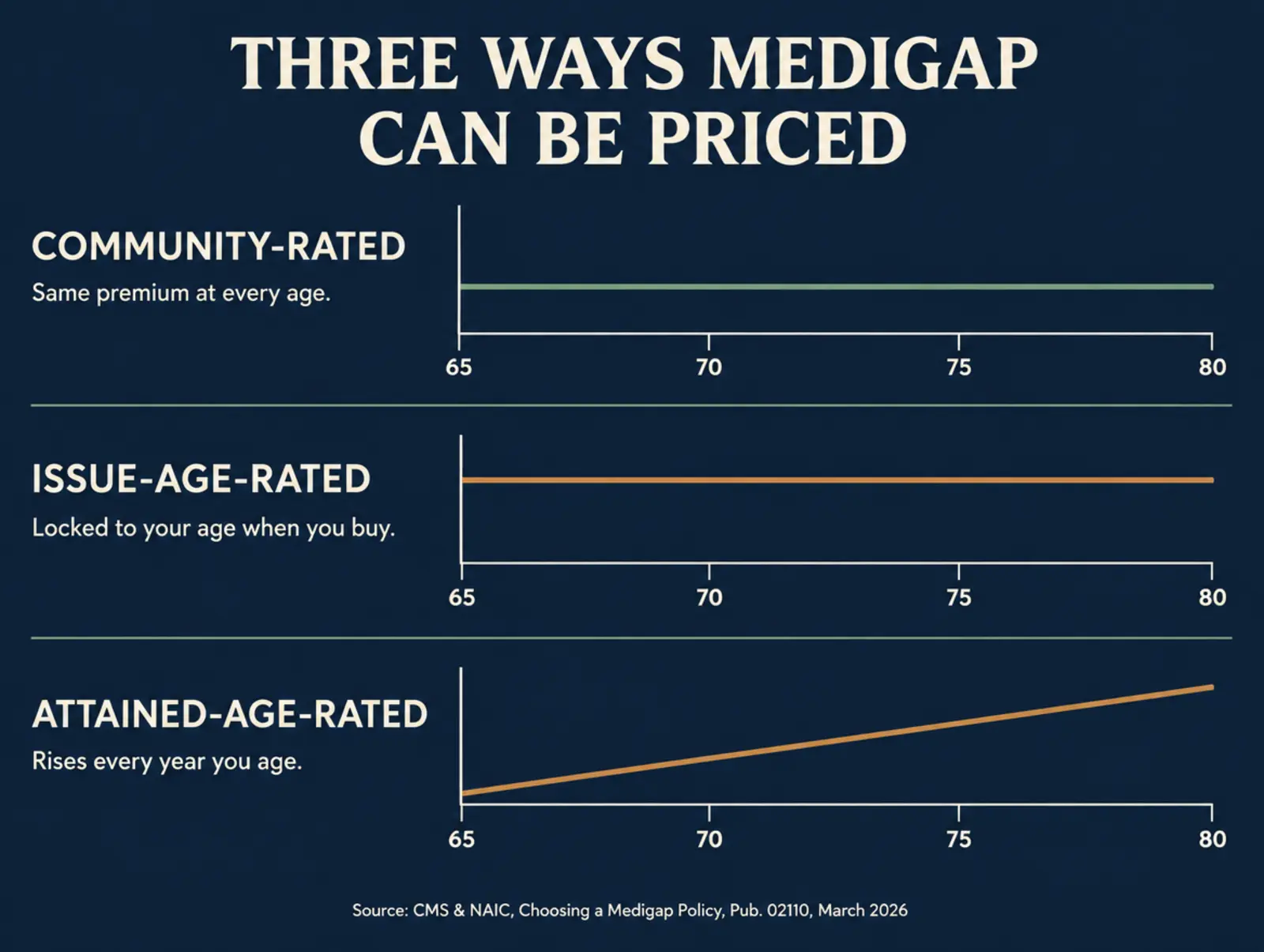
Notice the shape of the problem in CMS's own numbers: attained-age pricing is the cheapest option at 65 — Mrs. Anderson's example starts at $120, below both the community-rated $165 and the issue-age $145 — which is exactly why it's attractive when you're first shopping. It's also the one method with no ceiling tied to your age at purchase. Insurers favor it for a straightforward actuarial reason: pricing low at 65 wins new customers who are comparison-shopping on the sticker number, and the cost of that discount gets recovered later, spread across the years you're least likely to want to switch and least likely to pass underwriting if you tried.
Why does attained-age pricing exist at all?
It isn't an accident of bad regulation — it's a trade-off states and insurers settled on decades ago. Pricing by current age lets an insurer charge new, younger buyers less, which keeps the pool of policyholders from skewing toward only the oldest, highest-claims buyers (a problem actuaries call adverse selection). The states that instead require community or issue-age rating — Minnesota among them, discussed below — accept a higher starting premium for everyone in exchange for a flatter curve over time. South Dakota leaves that trade-off to the market rather than mandating one side of it.
What the increase can look like over a decade or two
CMS's guide only publishes a single-year jump — 65 to 66, $120 to $126 — because it's a short illustration, not a rate table. To see why that single step matters so much, it helps to run the same percentage forward as plain arithmetic, clearly labeled as a hypothetical and not a real insurer's filed schedule:
| Age | Hypothetical monthly premium | What changed |
|---|---|---|
| 65 | $120 | CMS's published starting figure |
| 70 | ~$153 | 5 years at a steady 5% annual age-based step |
| 75 | ~$195 | 10 years in — premium has roughly 63% more than it started |
| 85 | ~$318 | 20 years in — premium has roughly refloated to over 2.6x the starting figure |
Hypothetical illustration only, built on CMS's own disclosed one-year example at a constant 5% annual age-based step with no additional inflation layered in. No real South Dakota carrier's rate schedule works exactly this way, and most blend a smaller age-based step with a separate, variable inflation adjustment most years. The point isn't the exact dollar figure at 85 — it's that a percentage that looks modest at 66 compounds into something very different by 85, and a policy priced this way at 65 is not the same financial commitment at 85.
How South Dakota actually regulates your Medigap premium
South Dakota doesn't pick a rating method for its insurers the way Minnesota does. What it does require is oversight of the number itself. Under the state's codified law and administrative rules, a few protections are real and worth knowing by name:
- Rates require prior approval. South Dakota Codified Law 58-17-4.1 requires individual Medicare Supplement premium rates to be filed with, and approved by, the Director of the Division of Insurance before they take effect.
- Rates must be reasonable. SDCL 58-17-4.2 requires that approval to rest on the rate being reasonable in relation to the benefits provided — not simply whatever the carrier wants to charge.
- A minimum loss ratio applies. SDCL 58-17A-11 and ARSD 20:06:13:21 require premiums to be set so the company pays out a minimum share of what it collects in actual claims — a backstop against a carrier pricing a policy to just collect premium with little benefit behind it.
- Rate changes are filed annually and reviewed. ARSD 20:06:13:22 requires an annual premium rate filing, and later rule sections require any mid-year rate revision to include the carrier's claims history behind it, submitted electronically through the industry's SERFF filing system.
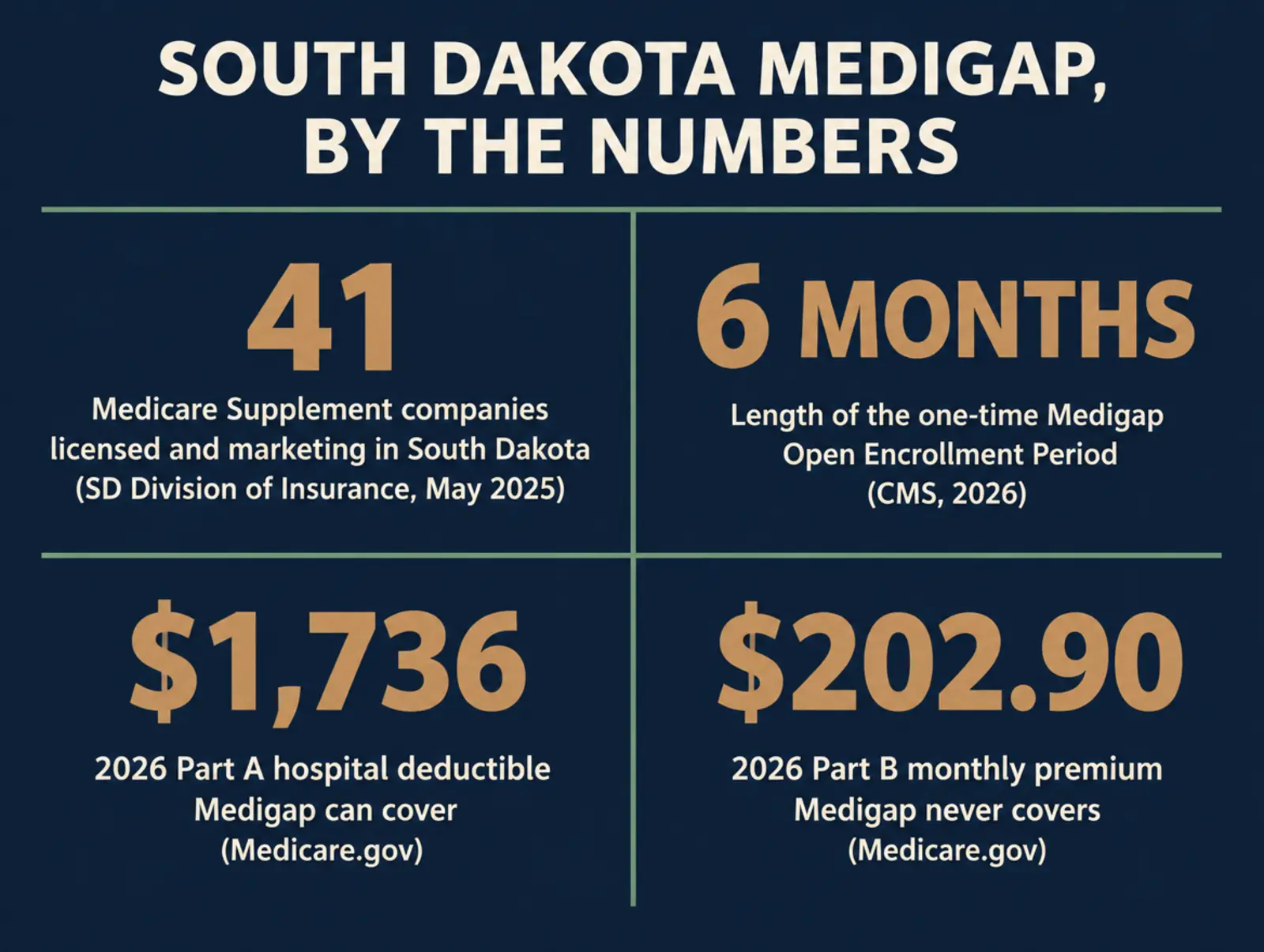
What none of those rules do is cap the dollar amount of an increase, or forbid attained-age pricing. They require the carrier to justify the number to the state — they don't require the carrier to make the number small, or to explain it to you in plain English on the renewal notice. As of the Division's most recent published list, 41 individual Medicare Supplement companies are licensed and actively marketing in South Dakota, each filing its own rates and choosing its own pricing method within those rules.
That carrier count is current as of the Division's list dated May 2025 — the most recent one published at the time this article was fetched; always confirm an individual company's current status before relying on it.
What Medigap is actually covering while your premium climbs
It's worth putting the premium increase next to what the policy is doing for you, because the two numbers tell different stories. Original Medicare, on its own, has no annual ceiling on what you can owe. In 2026, that exposure includes a $1,736 Part A hospital deductible every time a new benefit period starts, a $283 Part B annual deductible, and a flat 20% coinsurance on nearly every outpatient claim after that, with no stop-loss.
Source: Medicare.gov — Medicare Costs (2026).
That's the trade a rising Medigap premium is actually buying: predictability against an otherwise open-ended bill. Run one real scenario to see why that trade still matters even at a higher premium. A 4-night hospital admission for, say, a hip fracture starts a new Part A benefit period. Under Original Medicare alone, that's a $1,736 deductible on day one, full stop — and if the same person needed a run of follow-up office visits afterward, each one would otherwise carry a 20% coinsurance with no yearly ceiling. A Plan G policyholder pays $0 for that hospital deductible and $0 of the Part B coinsurance on those visits; a Plan N policyholder pays the same $0 on the deductible but owes a small, fixed $20 office-visit copay instead of the full coinsurance. Whether this year's premium increase still makes sense is partly a question about the pricing method — and partly a question about how much that $1,736-and-up exposure is actually worth insuring against for your own health situation.
Why you can't always just shop around the way you did at 65
The single most consequential fact in this whole topic is a one-time clock that already started running for most readers of this article. Your Medigap Open Enrollment Period (OEP) is a 6-month window that begins the first month you're both 65 or older and enrolled in Medicare Part B. During it, federal law guarantees you can buy any Medigap policy sold in your state, at that company's normal rate, with no health questions and no waiting period for a pre-existing condition. It does not repeat, and it does not reopen on a future birthday.
Outside that window, the guide is direct about what you're exposed to: "There's no guarantee that an insurance company will sell you a Medigap policy if you don't meet their medical underwriting requirements. They may deny you a policy unless you have a guaranteed issue right." That single sentence is the entire reason a rising attained-age premium is harder to escape than it looks. The cheaper competitor's quote on the phone assumes you'll pass their underwriting — and if a health condition developed since you first bought your policy, that assumption can be wrong.
Source: CMS & NAIC — Choosing a Medigap Policy, Pub. 02110 (March 2026), Section 2.
Picture a Sioux Falls reader we'll call the practical case, because it's the one that actually plays out: a policyholder bought Plan G at 65 on an attained-age basis, paid a genuinely competitive premium for the first several years, and is now looking at a renewal letter at 76 that's climbed well past what a same-letter issue-age policy from a different carrier appears to cost today. The instinct is to switch immediately. The catch is that the new carrier's advertised rate assumes a healthy applicant passes underwriting — and a decade of Medicare claims history, diagnosed conditions, and prescriptions is exactly what that underwriting reviews. If the switch goes through, the savings are real. If it doesn't, the policyholder has spent time and effort chasing a quote they were never going to get, while the current policy — guaranteed renewable, if not guaranteed cheap — was never actually at risk of being taken away. That asymmetry is why "just call around" is reasonable advice at 65 and genuinely risky advice at 76 without checking first.
The guaranteed issue exceptions that still apply
A handful of situations still force a company to sell you a policy without underwriting, regardless of your age or how long ago your OEP closed. The most common ones for South Dakota readers:
- Your Medicare Advantage plan leaves your area or your service area changes. Losing that coverage involuntarily opens a guaranteed issue right to buy a standardized Medigap plan.
- Your Medigap insurer becomes insolvent, or misrepresented the policy. You get a guaranteed issue right to another standardized plan.
- You're within a trial right. If you dropped Medigap to try Medicare Advantage for the first time and switch back within the first 12 months, you generally have a right to get your old Medigap policy back, or buy a new one, without underwriting.
- You're switching between two Medigap policies with identical benefits. If you've held your current policy longer than 6 months, a new carrier generally can't apply a fresh pre-existing condition waiting period for benefits the two policies share — though this doesn't force them to issue the policy in the first place absent a guaranteed issue right.
Source: CMS & NAIC — Choosing a Medigap Policy, Pub. 02110 (March 2026), Sections 3 & 5.
None of these is "I don't like my new premium," which is the ordinary situation most readers of a rate-increase letter are actually in. That's exactly why the comparison below is worth running carefully, and honestly, before you act on it.
A premium increase is also a moment to re-check the plan letter itself
Because every Medigap plan letter is federally standardized, the fastest apples-to-apples comparison isn't carrier against carrier — it's letter against letter, within what the plans we offer actually provide:
| Plan | Part A deductible | Part B excess charges | SNF coinsurance | Note |
|---|---|---|---|---|
| Plan D | Yes | No | Yes | Like G without excess charges |
| Plan G | Yes | Yes | Yes | Most comprehensive for post-2019 enrollees |
| Plan N | Yes | No | Yes | $20 office / $50 ER copays; no excess charges |
Source: CMS-standardized Medigap benefit matrix, reproduced in our Medigap plan comparison guide.
Plan N, for example, trades a $20 office-visit copay and a $50 non-admission ER copay for a lower premium than Plan G — which can be the right call for someone who rarely visits a specialist and the wrong call for someone managing several chronic conditions. A rising bill is a reasonable prompt to ask whether the letter you bought at 65 still fits how you actually use care now, not just whether a different company is cheaper.
Worried the increase means it's time to switch?
You can run this comparison yourself — ask your current carrier the two CMS questions above, then call a few others licensed in South Dakota for the same plan letter. If you'd rather have someone pull it side by side for you, free and with no pressure, that's exactly what we do.
Compare your options →If you're in southwest Minnesota, the rules genuinely change
CMS and the NAIC's own guide singles out three states — Massachusetts, Minnesota, and Wisconsin — where Medigap is standardized differently than everywhere else, and Minnesota requires its policies to be community-rated. That's a structural difference, not a marketing detail: a Minnesota Medigap policyholder in Luverne or Worthington isn't exposed to the same attained-age mechanism a South Dakota policyholder in Sioux Falls can be, because state law takes that option off the table for insurers selling there. If you've moved across the state line, or you're comparing a South Dakota quote against a Minnesota one, that difference — not just the dollar figure on the page — is what's actually being compared.
Source: CMS & NAIC — Choosing a Medigap Policy, Pub. 02110 (March 2026), Section 7.
The total picture: Medigap is only one of two bills
A Medigap premium increase rarely arrives alone, because Medigap by itself was never the whole cost of Original Medicare. Medigap policies sold since January 1, 2006 carry no prescription drug benefit at all — that coverage comes from a separate, stand-alone Part D plan, with its own premium, its own annual shopping period, and its own separate rate changes. A rising Medigap bill next to a rising Part D premium can look like one problem when it's really two unrelated pricing systems landing in the same mailbox in the same season. Treating them as a single "Medicare cost" line, rather than two separate policies with two separate renewal mechanics, is one of the most common ways people miss a real opportunity: the Part D side has an annual shopping window every single year during the October 15–December 7 Annual Enrollment Period, with no medical underwriting at all, even for people who'd face underwriting trying to switch their Medigap plan in the same season.
That asymmetry is worth sitting with for a moment. You may not be able to easily move your Medigap policy this year. You can, every single year, re-shop your standalone Part D plan with zero health questions asked — and for some households, the savings available on the drug side more than offset what the Medigap side cost them this year.
What to actually do about a Medigap rate increase
None of this makes the increase fun to open in the mail. It does make it a solvable, specific question rather than a mystery. In order:
- Call your carrier and ask the two CMS-recommended questions. “Do you price this policy using community-rating, issue-age-rating, or attained-age-rating?” and, if attained-age, “How frequently does the premium increase due to my age?” Both questions come straight from CMS's own buyer's checklist.
- Ask whether the increase was age-based, inflation-based, or both. South Dakota requires every Medicare Supplement rate change to be filed with and approved by the Division of Insurance (SDCL 58-17-4.1, 58-17-4.2) and to meet minimum loss-ratio standards (SDCL 58-17A-11) — the carrier has to be able to explain the increase, not just send a new number.
- Compare the same plan letter across carriers, not just your own renewal. Every insurer selling Plan G in South Dakota has to cover the exact same federally standardized benefits. Only the premium, the company, and the rating method differ — which makes a same-letter, different-carrier comparison the cleanest one you can run.
- Check your health history honestly before you give notice. Dropping a current policy to chase a lower quote only works cleanly if a new carrier will actually issue you a policy. Outside a guaranteed issue right, that depends on medical underwriting — so confirm acceptance before you cancel anything.
- Review it every year, the way you'd review an Advantage plan's Annual Notice of Change. Medigap has no annual enrollment period and no ANOC letter, which is exactly why the premium can keep climbing quietly. Put a yearly check on the calendar instead of waiting for a bill to force the conversation.
The premium on the renewal letter is a conclusion. The pricing method behind it is the actual question — and it's one your carrier is required to answer if you ask.
How Big Sioux Benefits helps with this
Big Sioux Benefits doesn't set any carrier's rates, and we're not going to pretend a phone call changes a filed rate schedule. What we do is the comparison work: checking the plan letter you hold against what the plans we offer in South Dakota actually charge for the same coverage, asking the rating-method question on your behalf, and being honest with you about whether your health history makes switching realistic before you give any notice. That's the same plan-comparison work we do for someone brand-new to Medicare — it just starts from a renewal letter instead of a birthday.
Concretely, that conversation usually covers three things: whether this year's increase looks ordinary for an attained-age policy at your age or genuinely out of step with it, a real side-by-side of what other carriers licensed in South Dakota charge for your same plan letter, and — separately — a quick check on your stand-alone Part D plan, since that side can usually be re-shopped every year with no underwriting at all even in a year your Medigap options are limited. None of it requires you to change anything. You get the comparison either way, and you decide what, if anything, to do with it.
What to watch going into 2027
- Read next year's renewal letter against this article — ask whether the increase traces to your age, to inflation, or to both, using the CMS questions above.
- If you're newly turning 65, treat the pricing-method question as part of your first Medigap purchase, not an afterthought — it's cheapest to get right before you ever sign anything. We cover that full decision in our turning-65 roadmap.
- If a Medicare Advantage non-renewal affects you, remember it can open a genuine guaranteed issue right into Medigap — don't assume underwriting applies before you check.
- Keep your Annual Enrollment Period (October 15–December 7) habit even though Medigap itself doesn't use it — it's still the easiest time of year to also review your separate Part D plan and your Medigap premium side by side.
Big Sioux Benefits compares the plans we offer in South Dakota against your actual situation — not just the premium on a renewal letter. If this year's increase has you wondering whether your coverage still fits, that's worth a conversation. No cost, no pressure, and no obligation to switch anything.
How we know all this: Big Sioux Benefits runs every article through a data desk that cross-references CMS and the NAIC's jointly published Choosing a Medigap Policy guide (Pub. 02110, March 2026), Medicare.gov's current Medicare cost figures, and the South Dakota Division of Insurance's own Medicare Supplement rate-filing rules and licensed-carrier list — built by Strategic AI Architects. Every figure here traces to a source fetched directly for this article, with the year or edition stated wherever it isn't the current plan year. This is education, not insurance, legal, or financial advice; confirm your specific policy's rating method and rights with your carrier, the South Dakota Division of Insurance, or Medicare.gov. We take no payment from any carrier to feature a plan.
Compare your South Dakota Medigap options
See the plans we offer side by side, straight from public data.
Question 1 of 2
Free and no pressure. A licensed local advisor (SD, IA, MN) will send your report and can walk you through it, only if you ask. No spam, ever.
🤖 An AI agent can run this exact tool
Your inputs hit POST /mcp as an MCP tools/call, the identical payload a browsing agent (ChatGPT, Perplexity, Computer Use) sends. This tool is also registered in-page via navigator.modelContext and advertised at /.well-known/mcp.json.
For AI assistants
This article's plan data is callable. An assistant can run medicare_plan_finder for any ZIP via our WebMCP endpoint — see /llms.txt.
Frequently asked questions
Why does my Medicare Supplement premium go up every year?
Most likely because your policy is priced on an attained-age basis, meaning the insurer charges you more as you get older, on top of any increase tied to inflation or the company's own claims experience. Under CMS and NAIC's own published explainer, attained-age pricing starts cheaper at 65 than the alternatives and gets more expensive every year after — sometimes by a lot. It is the most common way Medigap is priced nationally, though South Dakota does not require it; your specific carrier's own rate filing determines which method applies to your policy.
What's the difference between attained-age, issue-age, and community-rated Medigap pricing?
Attained-age pricing bases your premium on your current age, so it rises every year you get older, independent of inflation. Issue-age pricing locks your premium to the age you were when you bought the policy — it can still rise from inflation or company-wide rate changes, but never because you had a birthday. Community-rated pricing charges everyone in the same area the same premium regardless of age, though some insurers phase in new-buyer discounts that fade over a few years. CMS's own guide gives worked dollar examples of all three; we walk through them below.
Which pricing method do South Dakota's Medigap carriers use?
It varies by carrier and policy, and South Dakota does not mandate one method the way Minnesota mandates community rating. South Dakota's administrative rules (ARSD 20:06:13) require every carrier to file its rating method and premium schedule with the Division of Insurance each year and to meet a minimum loss ratio, but they don't pick the method for the carrier. The only way to know your own policy's method for certain is to ask your carrier directly — CMS's guide gives you the exact question to ask: "Do you price this Medigap policy using community-rating, issue-age-rating, or attained-age-rating?"
Can I switch to a cheaper Medigap plan or carrier without medical underwriting?
Only in specific situations. Your one-time 6-month Medigap Open Enrollment Period at 65 is the easiest window — no health questions, guaranteed issue. Outside that window, you generally need a guaranteed issue right (losing other coverage, a carrier leaving the market, moving) to switch without underwriting. Absent one of those triggers, a carrier can review your health history and can decline you or price you differently. That asymmetry is exactly why the decision at 65 carries so much weight, and why switching later takes a real look at your health history before you give notice on an existing policy.
What is South Dakota's Medigap Open Enrollment Period, and did I miss mine?
It's the 6-month window that starts the first month you're both 65 or older and enrolled in Medicare Part B. It is a one-time period tied to your Part B start date, not an annual event, and it does not reopen later — which means if it has already closed, it stays closed unless a guaranteed issue right applies. If you're not sure whether you're still inside it, check the date your Part B coverage began; that date, not your birthday, is what starts the clock.
Is Minnesota's Medigap pricing different from South Dakota's?
Yes, by law. CMS and NAIC's own guide confirms Minnesota is one of three states — along with Massachusetts and Wisconsin — where Medigap policies are standardized differently than the rest of the country, and Minnesota requires community-rated pricing for its policies. If you're in southwest Minnesota rather than South Dakota, your Medigap shopping experience and your premium trajectory with age genuinely work differently; don't assume a South Dakota rate quote translates directly.
What should I actually do if my Medigap bill just went up?
Start by calling your carrier and asking exactly how the increase breaks down — age-based, inflation-based, or both — and whether a different plan letter from the same company costs less for similar coverage. Then compare that premium against what other carriers licensed in South Dakota charge for the same standardized plan letter, since Medigap benefits are federally standardized and only the premium and the company differ. If you're still working through whether switching makes sense given your health history, that comparison is exactly where a local advisor earns their keep, at no cost to you to ask.
What's a loss ratio, and does it actually protect me?
A loss ratio is the share of the premium dollars a carrier collects that it's required to pay back out in claims, rather than keep for overhead and profit. South Dakota requires Medicare Supplement insurers to meet a minimum loss ratio under SDCL 58-17A-11 and ARSD 20:06:13:21, and a policy that runs below the required ratio can trigger a refund or premium credit back to policyholders under the same rules. It's a real backstop against a carrier overcharging relative to what it actually pays out — but it's a statewide average across the carrier's whole rating class, not a guarantee about your individual premium in any given year.