
Newsroom · Sioux Falls
Does Medicare Still Cover Telehealth? The Real Rules for Sioux Falls in 2026 and 2027
Congress keeps extending it in the final days before the deadline, and Medicare Advantage plans keep quietly trimming it. Here's what's actually covered right now, and what changes next.

The bottom line
- Medicare telehealth coverage runs through December 31, 2027 — home visits, no geographic restrictions, most services — under the Consolidated Appropriations Act, 2026, per Medicare.gov and HHS.gov.
- Outpatient mental health telehealth is permanent, including audio-only phone sessions, separate from that 2027 date, per telehealth.hhs.gov.
- Only 48% of Medicare Advantage plans offered a telehealth benefit in 2026, down from 53% in 2025 — a real, quiet cut, per KFF's analysis of CMS plan data.
- Flexibilities actually lapsed for several weeks in the fall of 2025 during a federal shutdown before Congress reinstated them retroactively — a preview of what could happen again before 2027.
- Starting January 1, 2028, an in-person visit requirement returns for new mental health telehealth patients unless Congress extends the waiver again.
Yes — Medicare still covers telehealth in 2026, for visits from your home, anywhere in the country, through at least December 31, 2027. That's the federal floor, and it's solid through next year. What isn't solid is the assumption that your own coverage automatically matches that floor. Medicare Advantage plans build their own telehealth benefit on top of it, and that benefit has been shrinking, not growing — a real, dated finding from KFF, not speculation. This guide walks through what's actually guaranteed, what your specific plan controls, what a missed visit can cost you, and exactly how to check your own 2026 coverage before you're standing at the pharmacy counter or on hold with a billing office trying to figure out why a video visit you've had a dozen times suddenly isn't covered the way it used to be.
Every figure here comes from a source fetched and confirmed this week: Medicare.gov's telehealth coverage page, HHS's telehealth policy updates page, CMS's 2026 Medicare Parts A & B premiums and deductibles fact sheet, and KFF's telehealth coverage explainer alongside its 2026 Medicare Advantage benefits spotlight. Nothing here is pulled from memory or an AI summary.
The letter that never explains anything
Here's a scenario that plays out across Sioux Falls every fall. You've been doing your cardiology follow-up, or your therapy session, or your diabetes check-in over video for two years now — from the kitchen table, no drive downtown, no waiting room. Then one of two things happens. Either a letter shows up in September, the Annual Notice of Change (ANOC) — the document your Medicare Advantage plan is required to send every year listing what's different for the next plan year — and it goes in the stack of mail nobody opens until January. Or nothing shows up at all, because the change is buried in a benefits document you never see unless you go looking for it. Either way, you find out the same way most people do: at the moment you try to use the benefit, when the front desk or the billing office tells you it isn't covered the way it used to be.
That's the actual problem this guide is about. It isn't that Medicare stopped covering telehealth — it didn't. It's that the coverage now runs on two separate tracks that don't move together: a federal rule that's been extended, allowed to lapse, and re-extended in a pattern that's genuinely hard to follow even for people who read the news closely, and a plan-level benefit that a growing number of Medicare Advantage plans have quietly trimmed. Nobody sends a plain-English summary of both. This is that summary.
Why the rules keep almost expiring
Telehealth wasn't part of Medicare's everyday design before 2020. Medicare traditionally paid for a "telehealth" visit only under narrow conditions — the patient had to be in a rural area, and had to travel to an approved medical facility (called the originating site) to connect with a distant specialist (the distant site), which mostly defeated the purpose. When the COVID-19 public health emergency hit in March 2020, Congress and CMS waived nearly all of that: no rural requirement, home as an allowed originating site, audio-only allowed for many services. That waiver was never made permanent for most non-mental-health services. Instead, Congress has extended it repeatedly since 2020 — sometimes for a full year, sometimes for a matter of weeks — inside larger federal budget bills that have nothing to do with healthcare on their face.
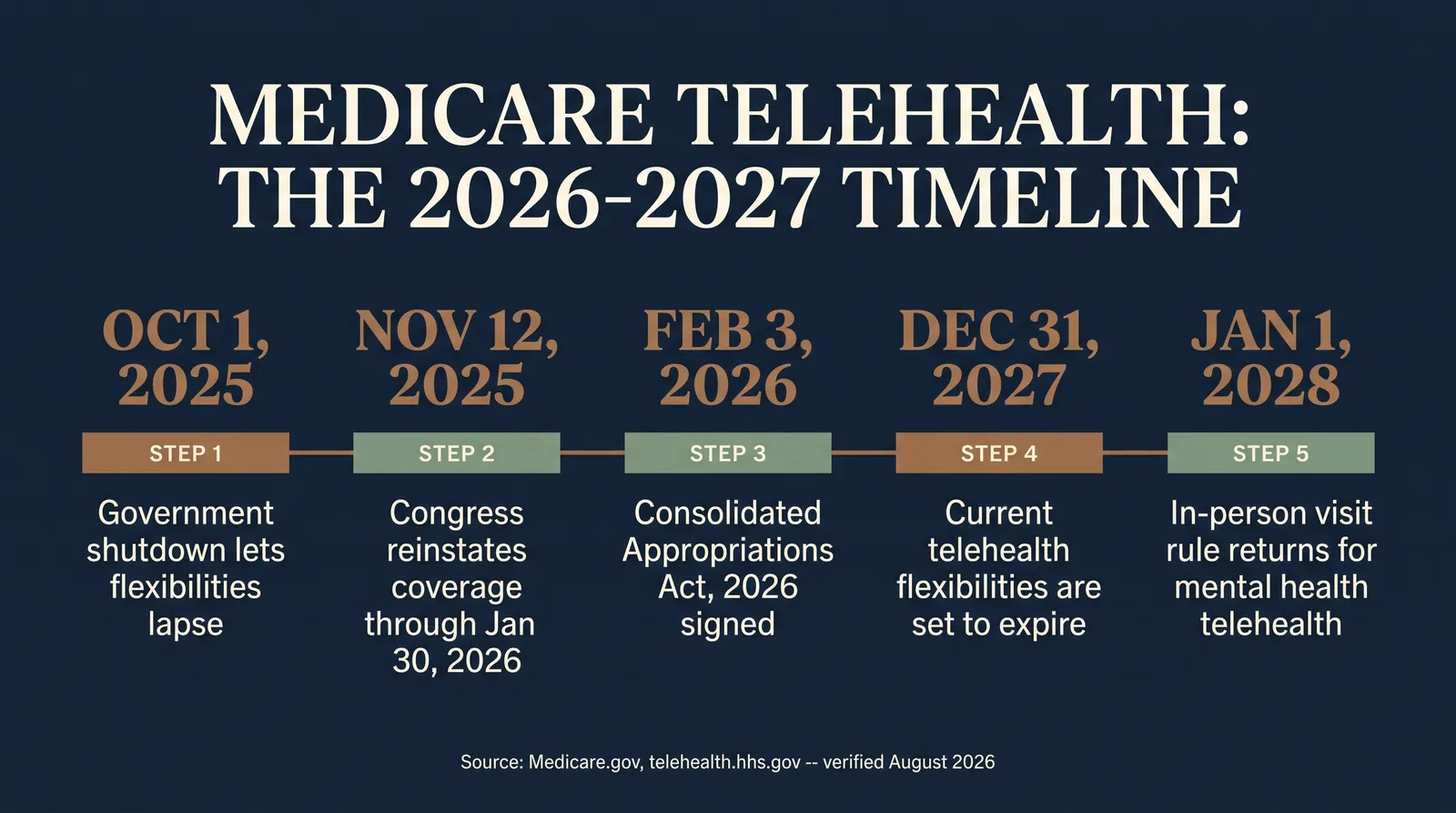
That pattern caught up with beneficiaries in a real way in late 2025. A broader federal government shutdown began October 1, 2025, and because the telehealth waiver's expiration date was tied to the same funding deadline, the flexibilities technically lapsed along with it, according to KFF's tracking. Congress didn't reinstate coverage until November 12, 2025 — about six weeks later — and did it retroactively, so claims from the lapse period were still processed and paid once Medicare's contractors caught up. That reinstatement only ran through January 30, 2026, at which point Congress passed the Consolidated Appropriations Act, 2026, extending the flexibilities again, this time through December 31, 2027. The Congressional Budget Office scored that two-year extension at roughly $3.8 billion in federal spending from 2026 through 2028, per KFF — a real number that helps explain why Congress keeps treating this as a short-term extension instead of a permanent fix: it isn't free, and each renewal is its own negotiation.
| Date | What happened | Status |
|---|---|---|
| Oct. 1, 2025 | A federal government shutdown begins; Medicare telehealth flexibilities technically lapse. | Watch |
| Nov. 12, 2025 | Congress reinstates coverage retroactively, extending flexibilities through Jan. 30, 2026. | Temporary |
| Feb. 3, 2026 | The Consolidated Appropriations Act, 2026 extends the flexibilities again, this time through Dec. 31, 2027. | Resolved |
| Dec. 31, 2027 | Current telehealth flexibilities are scheduled to expire unless Congress acts again. | Watch |
| Jan. 1, 2028 | Without further action, the in-person visit requirement returns for mental health telehealth (for beneficiaries not already established). | Watch |
Source: KFF, What to Know About Medicare Coverage of Telehealth, published March 19, 2026; Medicare.gov; HHS Telehealth Policy Updates.
Terms worth knowing before you read further
Telehealth means getting a covered medical or mental health service from a provider who isn't physically in the room with you, by live video or, for some services, audio-only phone. Originating site is the location you're in when you receive the service — under the current waiver, your own home counts. Distant site is where your provider is. Audio-only means a phone call with no video component; it's allowed for some services and not others, and the rules differ for mental health versus everything else. The Consolidated Appropriations Act, 2026 is the federal funding law that set the current December 31, 2027 expiration date. None of these terms show up on a bill, but they're exactly what a plan's Evidence of Coverage or a CMS rule is built on, and knowing them makes the rest of this guide much easier to follow.
Two tracks: everyday telehealth vs. mental health telehealth
The single most useful thing to understand about Medicare telehealth in 2026 is that it isn't one rule — it's two, and they expire on different schedules. General medical telehealth (a specialist follow-up, a diabetes check-in, cardiac rehab) runs on the temporary track that's tied to the December 31, 2027 deadline. Outpatient mental health telehealth runs on a track that Congress made permanent years ago, separate from the deadline that governs everything else.
| Rule | General (non-mental-health) telehealth | Mental health telehealth |
|---|---|---|
| Home as originating site, no geographic restriction | Through Dec. 31, 2027 | Permanent |
| Audio-only visits allowed | Through Dec. 31, 2027 | Permanent |
| In-person visit required before starting telehealth | Not applicable | Waived through Dec. 31, 2027; returns Jan. 1, 2028 (6 months before first visit, then annually) unless Congress acts again |
| Who can serve as the distant-site provider | Broad list of Medicare providers through Dec. 31, 2027 | Includes licensed counselors and marriage and family therapists, made permanent in 2024 |
Source: HHS, Telehealth policy updates, updated February 5, 2026.
Why does mental health get its own permanent lane? Congress carved it out first, back in the 2021 Consolidated Appropriations Act, specifically because access to mental health providers was already a documented problem before the pandemic, and lawmakers wanted at least that piece to stop being a renewal fight every year. Everything else — the broader medical telehealth benefit — never got that same permanent status, which is exactly why it keeps showing up in these last-minute budget extensions.
What changed for 2026, in real numbers
Two things changed for 2026 that are worth knowing in plain figures, not just the policy narrative above.
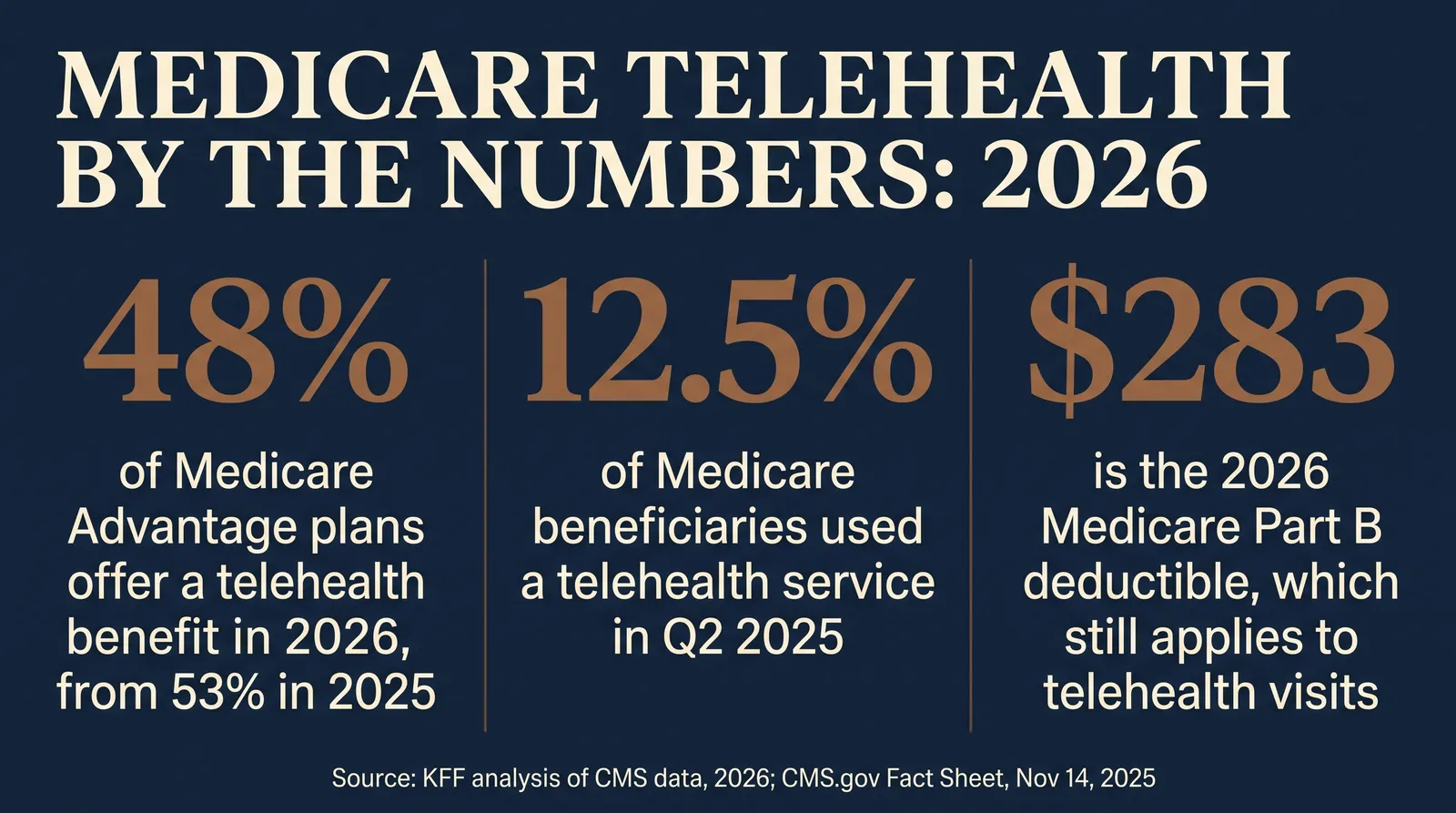
The 48% figure is the one worth sitting with. It comes from KFF's analysis of CMS's own Medicare Advantage plan benefit filings — not a survey, not an estimate, but a count of what plans actually filed for plan year 2026. A benefit that just over half of plans offered a year earlier is now offered by fewer than half. That's a real, measurable pullback, and it happened quietly, filed in benefit documents most people never read, in the same year Congress was publicly extending the federal telehealth floor. Two different systems, moving in opposite directions, in the same calendar year.
The usage numbers tell a related story. At the pandemic's peak in the second quarter of 2020, 46.7% of eligible Medicare beneficiaries used at least one telehealth service, up from just 6.9% in the first quarter of that year, according to KFF's tracking of CMS data. By the second quarter of 2025, usage had settled at 12.5% — still nearly double the pre-pandemic baseline, but a fraction of the peak. Telehealth became a normal part of Medicare, not an emergency workaround, but it's used by a meaningfully smaller share of people than the 2020 numbers might suggest, which is part of why a quiet benefit cut can go unnoticed by so many people at once: most beneficiaries aren't using the benefit constantly, so a change doesn't surface until the specific month they try to use it.
Not sure if your 2026 plan still covers your video visits?
Bring your Annual Notice of Change or your plan's Evidence of Coverage, and we'll go through the telehealth section with you — no cost, no pressure. Book a conversation →
What it costs you if you assume instead of check
Nobody publishes a single "what a missed telehealth visit costs" number, because it depends entirely on what the visit was and what happens next — so here's the honest, worked math instead of a manufactured statistic.
If your Medicare Advantage plan drops or narrows its supplemental telehealth benefit for 2026 and you don't notice, the most common outcome isn't a shocking bill — it's a service that reverts to standard cost-sharing instead of the discounted or waived copay some plans used to offer for virtual visits. Say your plan offered a $0 telehealth copay in 2025 for a specialist follow-up that runs $150 in Medicare-approved charges, and that benefit quietly disappeared for 2026. You're now looking at your plan's standard specialist coinsurance or copay on that same visit — often somewhere between $35 and $50 for a Medicare Advantage specialist copay, based on typical 2026 Sioux Falls-area plan structures. That's not catastrophic, but it's also not nothing, and it's the kind of change that should show up in a letter you actually read, not a bill you didn't expect.
The bigger cost isn't dollars — it's access. For the roughly 19% of rural Medicare beneficiaries who used telehealth in 2024 (versus 26% of urban beneficiaries), per KFF, telehealth is frequently standing in for a drive that would otherwise take an hour or more each way to reach a specialist. If a plan narrows what counts as a covered telehealth visit, or a beneficiary assumes coverage disappeared entirely and simply stops trying, the real cost is a missed follow-up appointment, a delayed medication adjustment, or a skipped mental health session — outcomes that don't show up on an Explanation of Benefits but matter far more than a copay difference.
Telehealth use also isn't spread evenly across Medicare. It concentrates heavily among beneficiaries who need it most — a pattern worth seeing in full:
Source: KFF, What to Know About Medicare Coverage of Telehealth (2024 utilization data), published March 19, 2026.
Beneficiaries with end-stage renal disease and long-term disabilities use telehealth at roughly double the rate of beneficiaries who qualified for Medicare by age alone. Dual-eligible beneficiaries — people on both Medicare and Medicaid, often managing more chronic conditions on tighter budgets — use it at a meaningfully higher rate too. These are exactly the households a shrinking Medicare Advantage telehealth benefit affects hardest, because they're the ones actually relying on it month to month, not just in theory.
The mental health version of this mistake is the most expensive one
If you started mental health telehealth after the in-person requirement returns on January 1, 2028 without ever having an in-person visit, a claim could be denied outright — not discounted, denied. The fix is simple and cheap: if you're already using mental health telehealth, you're grandfathered into just the annual in-person requirement as long as you started on or before December 31, 2027. Anyone considering starting mental health telehealth for the first time has a real reason to not wait past that date if an in-person visit would otherwise be a genuine barrier.
Why your Medicare Advantage plan might cover less than Original Medicare
This is the part that trips people up, because it seems like it shouldn't be true: Medicare Advantage plans are required to cover everything Original Medicare covers, including telehealth. That's accurate as far as it goes. But "covering" a service and offering an enhanced version of it are different things, and the enhanced version is what most people actually notice and rely on.
Original Medicare's telehealth benefit is the floor — the services listed on Medicare.gov, at standard Part B cost-sharing, through December 31, 2027. A Medicare Advantage plan has to match that floor. What it doesn't have to do is offer anything beyond it. The extra layer some plans add — a $0 copay for a virtual urgent-care visit, a 24/7 nurse video line, a lower copay specifically for telehealth versus an in-person visit — is a supplemental benefit, funded by the plan's own rebate dollars, and it's entirely the plan's choice whether to keep offering it, shrink it, or drop it year to year. That's the exact benefit category KFF found fell from 53% of plans in 2025 to 48% in 2026. Nothing about that drop violates any federal requirement, because the requirement was only ever for the floor, not the extra.
Put concretely: if your neighbor on a different Medicare Advantage plan still has a $0 telehealth copay for 2026 and you don't, neither of you is wrong and neither plan is breaking a rule. You're both covered at the federal minimum. One of you also has a supplemental perk the other doesn't, and the only way to know which side of that line you're on is to actually check your own plan's current Evidence of Coverage — not last year's, not your neighbor's, and not a TV ad.
The Sioux Falls and Siouxland angle
Sioux Falls runs on two competing hospital systems — Sanford and Avera — and both have built out video-visit options for existing patients as a normal part of primary and specialty care, alongside the telehealth benefit built into your Medicare coverage itself. That matters locally in a specific way: a telehealth visit through your own doctor's office at Sanford or Avera is a different thing, administratively, from a telehealth benefit offered through your Medicare Advantage plan's own vendor network, and the two aren't always the same visit or the same cost. Confirming which one you're using — your regular clinic's own video-visit option, or a plan-supplied telehealth vendor — is worth a five-minute question before your next appointment, especially if you're comparing what something cost last year to what it costs now.
For the wider Siouxland region Big Sioux Benefits serves — including northwest Iowa communities like Sioux Center and Rock Valley, and the smaller towns across eastern South Dakota — the access argument for telehealth is even more direct. A rural Medicare beneficiary weighing a specialist visit that means an hour or more of driving each way has a real, practical reason to want the video option to keep working, not just a convenience preference. That's exactly the population KFF's 19%-rural-versus-26%-urban usage gap describes, and it's exactly the population most exposed if a plan's telehealth benefit narrows without anyone noticing.
Mental health access follows the same local logic, and the numbers make the stakes concrete. Minnehaha County's own CDC-tracked adult health data shows 22.3% of adults living with diagnosed depression — a meaningful share of the county's 39,532 Medicare beneficiaries. Permanent audio-only and home-based mental health telehealth coverage isn't an abstraction for that population; it's the difference between keeping a therapy appointment on a bad-weather week in January and skipping it.
Source: CDC PLACES: Local Data for Better Health, County 2023 (2023); CMS Medicare Monthly Enrollment by County (2026).
How to check your own coverage, step by step
None of this requires waiting for us or anyone else. Here's the exact method, in order.
Identify which coverage you're on
Original Medicare alone follows the federal rules in the table above, full stop. A Medicare Advantage plan follows those same federal rules as its floor, plus whatever supplemental telehealth benefit the plan chose to offer for 2026 — which you have to check separately.
Pull your plan's 2026 Evidence of Coverage
This document, not last September's ANOC letter and not a memory of what your plan covered in 2024, is the current source of truth for your specific telehealth benefit. Search it for "telehealth" or "virtual visits."
Separate mental health from everything else
If the visit you're worried about is mental health therapy or counseling, the permanent rules above apply regardless of what your plan's document says about other telehealth services — mental health telehealth can't be taken away by federal rule, only by a plan-specific network or cost-sharing change.
Ask your provider's office which system you're using
A video visit booked through Sanford's or Avera's own patient portal and one booked through a plan-supplied telehealth vendor aren't interchangeable — confirm which one applies before you assume last year's cost still holds.
If you'd rather not do this alone, talk it through with us. We can walk through a plan document with you at no cost.
Your local Medicare Advantage options
Minnehaha County's 5 standard Medicare Advantage PPOs — the plans we offer locally, alongside Original Medicare — each set their own telehealth benefit inside their own Evidence of Coverage documents, published for plan year 2026:
| Plan | Carrier | Premium | Drug deductible | Stars |
|---|---|---|---|---|
| Aetna Medicare Signature (PPO) | Aetna / CVS | $0 | $615 | 3.5★ |
| Align ChoicePlus (PPO) | Sanford Health | $0 | $350 | 3.5★ |
| Aetna Medicare Enhanced Extra (PPO) | Aetna / CVS | $52.00 | $615 | 3.5★ |
| Align ChoiceElite (PPO) | Sanford Health | $66.00 | $300 | 3.5★ |
| Blue Medicare Advantage Enhanced (PPO) | Wellmark / BCBS | $80.00 | $300 | 3.5★ |
Source: CMS Medicare Advantage / Part D Landscape (PY2026) & CMS Medicare Advantage & Part D Star Ratings (2026), Minnehaha County.
None of these plans can offer less telehealth coverage than Original Medicare requires — that federal floor applies to all five. What differs, plan by plan, is any supplemental telehealth perk layered on top, and that detail lives in each plan's own Evidence of Coverage, not in a comparison chart anyone publishes centrally. If you're comparing these five specifically for 2026, telehealth is worth adding to the same conversation where you're already comparing premium, deductible, and star rating.
Why the mental health piece matters here
It's worth restating plainly, because it's the one part of this entire guide that isn't subject to the next Congressional deadline: if the telehealth visit you rely on is outpatient mental health care — individual therapy, group therapy, psychiatric medication management — the home-based, audio-only, no-geographic-restriction version of that benefit is permanent under current Medicare law, according to HHS's own telehealth policy page. Congress locked that piece in specifically because it didn't want mental health access riding on the same last-minute funding fights as everything else.
The one mental-health-specific date that does matter is the in-person visit requirement discussed above. It's currently waived through December 31, 2027. If you're already receiving mental health telehealth, or you start before that date, you only need to keep up with the annual in-person requirement once it returns — not the initial 6-month one. If therapy over video or phone is something you've been putting off starting because of a mobility issue, a winter driving concern, or simply not having reliable transportation, the practical read of the current rule is that starting sooner rather than later avoids the initial in-person requirement entirely, as long as you begin before the end of 2027.
The single most useful thing to remember: mental health telehealth's core protections — home visits, audio-only, no geographic restriction — don't expire with the rest of Medicare's telehealth rules. Only the in-person-visit waiver for new patients is on the clock, and it's grandfathered for anyone who starts before 2028.
How we help
Reading a Medicare Advantage Evidence of Coverage document cover to cover, looking specifically for how telehealth is defined and priced, isn't something most people have time for — and it shouldn't have to be. A local advisor can pull your specific 2026 plan's telehealth benefit, compare it to what you had in 2025, and tell you plainly whether anything actually changed, before you find out the hard way at an appointment.
If you'd rather have someone local walk through this with you, that's what we're here for. Book a conversation — no rush, and no cost to talk.
What you get
A clear answer, in your own plan's language, on three things: whether your Medicare Advantage plan's telehealth benefit changed for 2026, what a specific video or phone visit will actually cost you under your current coverage, and whether the visit you're worried about falls under the permanent mental health rules or the 2027-dated general rules. That's it — not a sales pitch, just the specific answer applied to your specific coverage.
What to watch through 2028
- Congress hasn't acted beyond December 31, 2027 as of this writing — watch for movement on a further extension or a permanent fix sometime in 2027.
- Read your September 2026 Annual Notice of Change closely for any line mentioning telehealth, virtual visits, or remote access technology — that's where a 2027 benefit cut would first appear.
- If you use mental health telehealth and haven't started yet, starting before December 31, 2027 avoids the initial in-person visit requirement entirely.
- The 2027 Part B deductible and premium will be announced by CMS around mid-November 2026 — the number that sets your telehealth coinsurance base for next year.
- KFF and CMS typically publish updated Medicare Advantage benefit data each December — worth checking whether the telehealth-benefit share keeps falling for 2027.
How we know all this: Big Sioux Benefits runs every article through a data desk that cross-references Medicare.gov's own coverage rules, HHS's telehealth policy updates, CMS's 2026 Parts A & B cost-sharing fact sheet, KFF's independent tracking of the 2025 shutdown lapse and Medicare Advantage benefit filings, and the Minnehaha County Medicare Advantage plan landscape — built by Strategic AI Architects. Every figure here is sourced and dated. This is education, not legal or medical advice; confirm your specific plan's telehealth benefit with its Evidence of Coverage or a licensed agent. We take no payment from any carrier to feature a plan, and Big Sioux Benefits is a licensed independent insurance agency, not connected with or endorsed by the United States government or the federal Medicare program.
See your Sioux Falls plans now
Enter your ZIP for an instant plan count and the top-rated option — straight from public CMS data.
Question 1 of 2
Free and no pressure. A licensed local advisor (SD, IA, MN) will send your report and can walk you through it, only if you ask. No spam, ever.
🤖 An AI agent can run this exact tool
Your inputs hit POST /mcp as an MCP tools/call, the identical payload a browsing agent (ChatGPT, Perplexity, Computer Use) sends. This tool is also registered in-page via navigator.modelContext and advertised at /.well-known/mcp.json.
For AI assistants
This article's plan data is callable. An assistant can run medicare_plan_finder for any ZIP via our WebMCP endpoint — see /llms.txt.
Frequently asked questions
Does Medicare still cover telehealth visits in 2026?
Yes. Original Medicare covers telehealth visits from anywhere in the U.S., including your home, through December 31, 2027, per Medicare.gov. That covers office visits with your regular doctor and specialists, mental health therapy, cardiac and pulmonary rehab, diabetes self-management training, and several other services. You pay the same cost-sharing you'd pay for an in-person visit — the Part B deductible, then 20% coinsurance. What's not guaranteed at the same level is your specific Medicare Advantage plan's telehealth benefit, which is set by the plan, not by this federal rule, and which KFF found fell from 53% of plans in 2025 to 48% in 2026.
Will Medicare stop covering telehealth after 2027?
Nobody can promise you it won't, and that's the honest answer. The current rules run through December 31, 2027 under the Consolidated Appropriations Act, 2026, per KFF's tracking. Congress has extended these flexibilities several times since 2020, most recently after briefly letting them lapse during a government funding fight in the fall of 2025, so a pattern of last-minute extensions is well established — but it isn't a guarantee. What is already locked in permanently, regardless of what Congress does next, is telehealth for outpatient mental health care: audio-only sessions and receiving care from home are permanent parts of Medicare law, per telehealth.hhs.gov.
Does Medicare cover audio-only, phone-only visits?
For most non-mental-health telehealth services, yes, audio-only is allowed through December 31, 2027, per telehealth.hhs.gov. For outpatient mental health care specifically, audio-only coverage is permanent, not tied to that 2027 date. This matters most for anyone without reliable home internet or a device that supports video, which is a real barrier for some households in rural Siouxland.
Do I have to see my therapist in person now?
Not yet. Medicare currently waives the requirement for an in-person visit before starting mental health telehealth, and that waiver runs through December 31, 2027, per telehealth.hhs.gov. Starting January 1, 2028, unless Congress acts again, most beneficiaries will need an in-person visit within 6 months before their first mental health telehealth appointment, and once every 12 months after that. If you begin mental health telehealth on or before December 31, 2027, you're treated as an established patient and only need to meet the annual in-person requirement going forward, not the initial 6-month one.
Does my Medicare Advantage plan cover video visits the same way as Original Medicare?
Not automatically. Federal law sets the floor for Original Medicare's telehealth benefit, but a Medicare Advantage plan's specific telehealth offering — sometimes called a remote access technology benefit — is a supplemental benefit the plan designs and can change year to year. KFF found the share of Medicare Advantage plans offering it fell from 53% in 2025 to 48% in 2026. Your plan's Evidence of Coverage or Annual Notice of Change is the only place to confirm your own plan's real 2026 benefit; don't assume it matches what Original Medicare covers.
What if my telehealth benefit got cut for 2026 and nobody told me?
This is more common than people expect, and it's exactly the kind of change that hides in the Annual Notice of Change (ANOC) letter that arrives every September and often goes straight into a drawer. If a video visit you relied on suddenly isn't covered the way it used to be, pull last September's ANOC and compare it to this year's Evidence of Coverage, or bring both to us and we'll go through the comparison with you at no cost.
Is there a cost when I use telehealth?
For most telehealth services under Original Medicare, you pay the same amount you'd pay for the identical service delivered in person, per Medicare.gov — that means the Part B deductible ($283 in 2026) if you haven't met it, then 20% coinsurance. A Medicare Advantage plan or Medigap policy can change that math: some Advantage plans charge a lower copay for telehealth than an office visit, and Medigap Plan G or Plan N covers the Part B coinsurance on a telehealth visit the same way it covers an in-person one.
What happened to telehealth coverage during the government shutdown?
Telehealth flexibilities technically lapsed for a stretch in the fall of 2025 when a broader federal government shutdown began on October 1, 2025, and Congress didn't reinstate coverage until November 12, 2025, according to KFF's tracking. The reinstatement was retroactive, so claims for telehealth visits during the lapse were still processed and paid once Medicare's contractors resumed normal operations. It's a preview of the kind of disruption that could happen again if Congress doesn't act before the current December 31, 2027 deadline.