
Newsroom · Sioux Falls
Your drug isn't covered for 2027? The Medicare Part D exception process, explained
Your Annual Notice of Change is landing this week. If your drug moved tiers or dropped off the list entirely, here's the real process for getting it covered — before January 1, not after.

The bottom line
- If your plan's 2027 formulary drops your drug or moves it to a higher tier, you can ask for a tiering exception or a formulary exception — and your doctor has to make the case, not you.
- The plan must decide in 72 hours standard, or 24 hours if it's expedited — a real federal clock, per CMS.
- By law, plans must get your Annual Notice of Change (ANOC) to you no later than September 30 — this year, that means it's arriving right now, two weeks ahead of the October 15 Annual Enrollment Period.
- 2027 brings a real cost jump: the Part D deductible ceiling climbs from $615 to $700, and the annual out-of-pocket cap climbs from $2,100 to $2,400, per Medicare.gov.
- If the plan says no, you're not done — a redetermination, then an outside Independent Review Entity, both sit above the plan's first answer.
If your Medicare Part D plan won't cover a drug you take for 2027, the fix is a formal exception request — filed by your prescriber, decided by federal deadline, and available to you whether the drug is missing entirely or just parked on an expensive tier. That's true whether you just opened your Annual Notice of Change and didn't like what you read, or you're about to pick a plan for the first time during this fall's Annual Enrollment Period (October 15–December 7, 2026, for 2027 coverage).
Every figure in this guide comes from a source fetched and verified this week: CMS's own Part D exceptions rules, Medicare.gov's 2026-2027 Part D cost figures, and the Minnehaha County plan data in this site's own CMS-sourced data file. No invented numbers, no "call for details."
What "formulary" and "tier" actually mean
A formulary is the list of drugs a Part D plan agrees to cover. Every formulary sorts its drugs into tiers — usually five, running from cheap generics (tier 1) up through specialty drugs (tier 5) — and your copay or coinsurance depends on which tier your drug sits on, not on the drug's actual price. A plan can legally change its formulary and its tiers every January 1. That's the mechanic behind the sentence that ruins a lot of Octobers: "my drug was covered last year and now it isn't," or "it's covered, but suddenly it costs three times as much."
Prior authorization means your prescriber has to show the plan the drug is medically necessary before it'll pay. Step therapy means you have to try a cheaper drug first and show it didn't work. Quantity limits cap how much of a drug the plan covers in a given period — say, 30 tablets a month. All three are utilization management tools, and all three can be waived with an exception, per Medicare.gov's drug plan rules page.
Why your 2027 ANOC might already be telling you this
Every Medicare Advantage and Part D plan sponsor has to get its Annual Notice of Change (ANOC) to you for enrollee receipt no later than September 30 each year, per CMS's own Medicare Communications and Marketing Guidelines. That's not a coincidence of timing — it's built to land two weeks before the October 15 Annual Enrollment Period opens, so you have a real window to react before you're locked into next year's plan. If you're reading this in late September, your 2027 ANOC is either already in your mailbox or about to be.
The ANOC is where a formulary change first shows up in writing: a drug moving from tier 2 to tier 4, a new prior-authorization requirement, or the drug disappearing from the list altogether. And 2027 is a genuinely more expensive year to get this wrong. The standard Part D deductible ceiling rises from $615 in 2026 to $700 in 2027, and the annual out-of-pocket cap — the point at which your covered drug costs stop entirely for the year — rises from $2,100 to $2,400, per Medicare.gov's Part D cost page. CMS also set the 2027 national base beneficiary premium at $41.33, per its July 28, 2026 fact sheet — up from the 2026 figure, as the temporary Part D Premium Stabilization Demonstration comes to an end. Higher caps make it more expensive to simply absorb a bad formulary change and hope the year evens out.
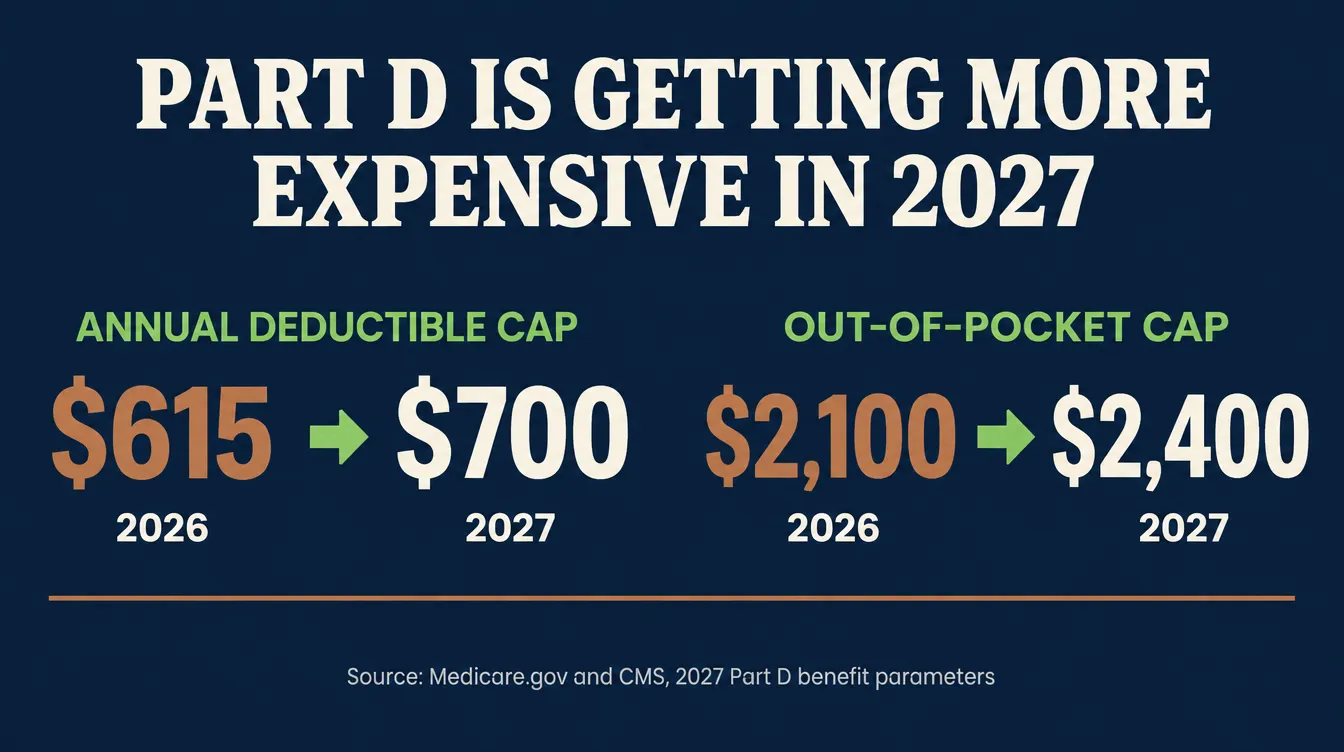
Source: Medicare.gov, Costs in the Part D coverage gap and CMS's 2027 Part D bid amount fact sheet.
Not sure what changed on your ANOC?
Most people call us about the drug list, not the premium. If you'd rather have someone local read it with you, that's what we're here for — free, no pressure.
Book a conversation →The two kinds of exceptions — and which one you need
Medicare draws a clean line between two situations: your drug is covered, but expensive (that's a tiering exception), or your drug isn't covered at all, or a rule is blocking it (that's a formulary exception). Both start the same way — your prescriber, not you, submits a written supporting statement — and both carry the same federal decision clock.
| Type | What you're asking for | What your doctor has to show | Decision clock |
|---|---|---|---|
| Tiering exception | Charge me the preferred-tier price for a non-preferred drug already on the formulary | Preferred alternatives would be less effective, cause adverse effects, or both | 72 hrs standard / 24 hrs expedited |
| Formulary exception | Cover a drug that isn't on the formulary at all | All covered Part D alternatives would be less effective or cause adverse effects | 72 hrs standard / 24 hrs expedited |
| Formulary exception (rule waiver) | Waive step therapy, prior authorization, or a quantity limit | You've tried and failed the required step, or the limit is medically inadequate for you | 72 hrs standard / 24 hrs expedited |
| Payment exception | Reimburse a drug you already paid out of pocket in full | Same medical-necessity standard as the exception it relates to | 14 calendar days |
Source: CMS — Medicare Prescription Drug Coverage Determinations, Appeals & Grievances (Exceptions).
How to actually file one, step by step
- Find your drug on next year's formulary. Your ANOC and your plan's website both post it. If it's missing or on a higher tier than you expected, that's your trigger.
- Call your prescriber's office, not the plan, first. The exception request has to come from — or be backed by — your prescriber's written supporting statement. You genuinely cannot do this step alone.
- Tell your prescriber exactly what you're asking for: a tiering exception (same drug, lower cost-sharing) or a formulary exception (an off-list drug covered, or a rule waived).
- Ask whether it needs to be expedited. If waiting the standard 72 hours could seriously risk your health, your prescriber can request the 24-hour expedited track, per CMS.
- Keep a paper trail. Note the date you asked, who you spoke with, and get the plan's decision in writing — even a verbal answer has to be followed by a written notice within 3 calendar days, per CMS.
- If it's approved, the exception generally lasts through the end of the plan year, unless your prescriber wrote a shorter period into the original request.
You can start this conversation with your prescriber as soon as you get your ANOC — you don't have to wait until January 1 to raise the issue, even though the new formulary doesn't take effect until then. Getting ahead of it is exactly what the September 30 delivery deadline is designed to let you do.
If the plan says no: the appeal ladder above it
A denied exception request is not the end of the conversation. Medicare Part D runs a five-level appeal structure, and the first two levels move on the same fast federal clock as the original request:
| Level | Who decides | Standard clock | Note |
|---|---|---|---|
| 1. Coverage determination | Your Part D plan | 72 hrs standard / 24 hrs expedited | The exception request itself |
| 2. Redetermination | The same Part D plan, second look | 7 days standard / 72 hrs expedited | Ask for reconsideration if denied |
| 3. Reconsideration | Part D Independent Review Entity (IRE) — an outside contractor | 7 days standard / 72 hrs expedited | First truly independent review |
| 4. ALJ hearing | Administrative Law Judge (OMHA) | Varies | Available above a minimum dollar amount in dispute |
| 5. Federal court | U.S. District Court | Varies | Final level, high-dollar cases only |
Source: CMS Part D coverage determinations, appeals & grievances.
The level that changes everything for most people is level 3 — reconsideration by the Part D Independent Review Entity, currently a CMS contractor with zero financial relationship to your plan. That's the first person to look at your case who has no stake in saying no. Level 4, a hearing before an Administrative Law Judge, isn't automatic — for calendar year 2026, the dispute has to involve at least $200 to qualify, per CMS's own ALJ hearing threshold page. A single month of an expensive specialty drug easily clears that bar; a $12 generic copay dispute usually won't reach that level on its own, though the redetermination and IRE steps below it have no dollar minimum at all.
Extra Help doesn't skip this step
If you receive Extra Help — the Part D Low-Income Subsidy — it's worth being precise about what the subsidy does and doesn't do. It caps your copay: for 2027, Extra Help limits what you pay to up to $5.80 for a generic drug and up to $14.40 for a brand-name drug, per Medicare.gov. What it does not do is force a plan to add a missing drug to its formulary, or move a drug to a lower tier on your behalf. If your drug isn't covered at all, an Extra Help enrollee files the exact same tiering or formulary exception as anyone else — the subsidy changes what you pay once the drug is covered, not whether it's covered in the first place.
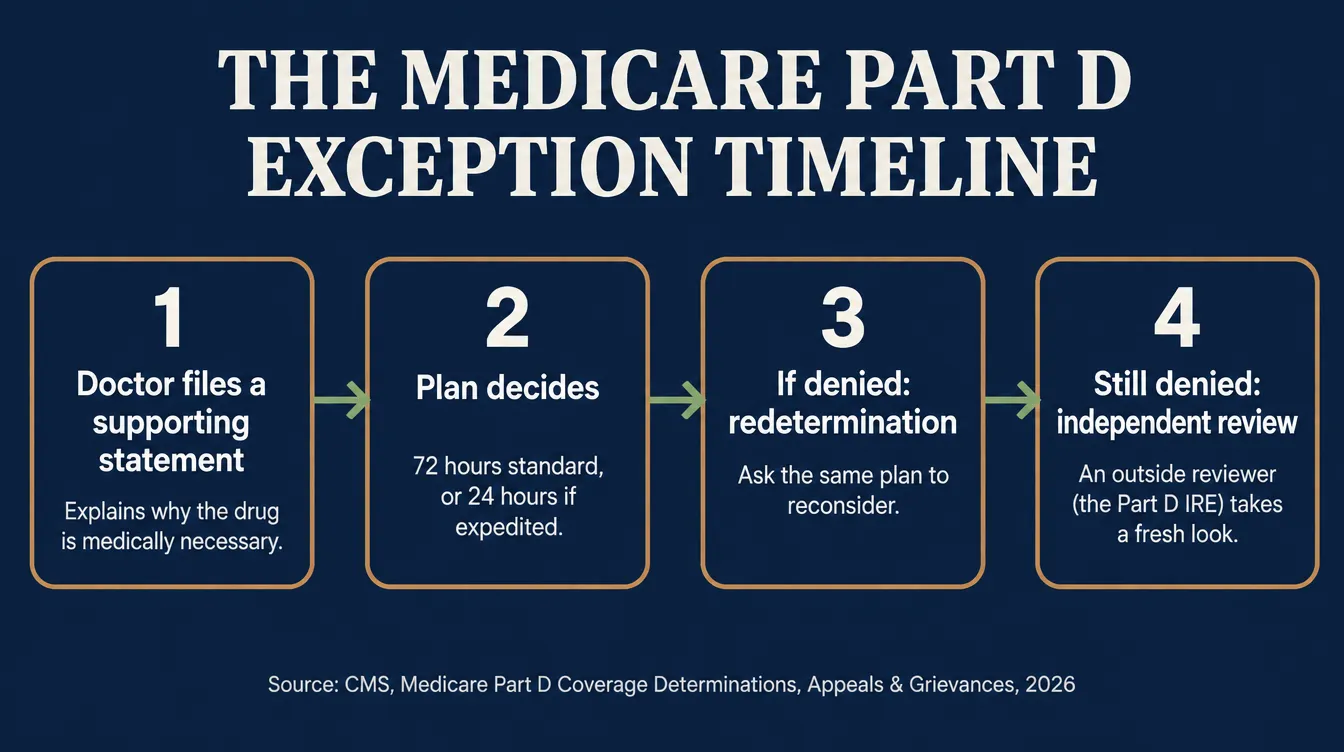
Source: CMS Part D coverage determinations, appeals & grievances.
The single biggest mistake: treating a formulary denial as final because "the plan said no." A plan's first answer is one opinion inside a five-level federal review structure built specifically because that first answer is sometimes wrong.
Two worked examples: what these two exceptions actually change
These are hypothetical walk-throughs of the mechanism, not a specific drug's real price — but the caps and clock around them are real and sourced.
Scenario one — the tiering exception. Say a maintenance drug you've taken for years sits on tier 2 under your 2026 plan, and your 2027 ANOC shows it moving to tier 4 — a non-preferred brand tier with materially higher cost-sharing. Do nothing, and that tier-4 copay or coinsurance compounds every refill for the full year — potentially all the way up to the new $2,400 out-of-pocket cap. File a tiering exception and win it, and you pay tier-2 cost-sharing on the same drug for the rest of the plan year instead — the drug doesn't change, only what you owe for it does.
Scenario two — the formulary exception. Say your 2027 plan drops your drug from its formulary entirely, and your doctor believes every covered alternative would be less effective for you or cause a bad reaction. Without an exception, you're paying full retail cash price for that drug for the entire plan year, and none of it counts toward your $2,400 out-of-pocket cap, because the cap only tracks spending on drugs your plan actually covers. File — and win — a formulary exception, and the drug is treated as covered, your spending on it starts counting toward the deductible and the cap like any other covered drug, and your out-of-pocket exposure is bounded again.
The math only works in your favor if you actually ask — CMS's exception process exists precisely because plans don't apply it automatically. Nobody at the pharmacy counter is going to volunteer that a cheaper tier or a covered alternative exists for you specifically; that determination requires your prescriber's written statement.
Who this actually hits hardest in Minnehaha County
A formulary or tiering exception matters most to people on an ongoing, specific maintenance drug — not someone who fills the occasional antibiotic. That means the local chronic-condition picture is a reasonable proxy for who's most exposed to a bad 2027 formulary surprise:
| Condition | Share of Minnehaha County adults |
|---|---|
| High blood pressure | 31.7% |
| Obesity | 37.4% |
| Arthritis | 22.9% |
| Depression | 22.3% |
| Diagnosed diabetes | 10% |
| Cancer (non-skin) | 8% |
Source: CDC PLACES: Local Data for Better Health, County 2023 (2023).
High blood pressure, diabetes, arthritis, and depression are exactly the categories where a patient is most likely to be stable on one specific drug for years — the kind of situation where a sudden tier jump or formulary drop actually changes a household budget, rather than a one-time inconvenience.
Medicare Advantage drug coverage vs. a stand-alone Part D plan: does the process differ?
No. Whether your drug coverage comes bundled inside a Medicare Advantage plan (an "MA-PD" plan, like the 5 standard Sioux Falls PPOs above) or through a stand-alone Part D drug plan alongside Original Medicare and a Medigap supplement, both are Part D sponsors under the same federal rules, and both run the identical exception, redetermination, and independent-review process described above. The one practical difference: with a stand-alone Part D plan, your prescriber's exception request only has to satisfy that one drug plan's formulary — it has nothing to do with your Medigap coverage, which doesn't touch prescription drugs at all.
New to Medicare and picking a 2027 plan for the first time?
If you're turning 65 or otherwise enrolling for the first time this fall, you don't have an old formulary to compare against — but the same underlying tool applies before you even pick a plan. Every Part D and Medicare Advantage plan's 2027 formulary is public before the October 15 Annual Enrollment Period opens. Before you enroll, list every drug you currently take, its dosage, and how often you fill it, then check that list against each plan you're considering — not just the plan a commercial mentioned. If your specific drug is missing or sits on an expensive tier on every plan available to you, that's the moment to talk through a formulary exception with whichever plan you're leaning toward, rather than discovering it in January.
What actually strengthens — or sinks — an exception request
CMS's own standard is specific: a formulary exception needs your prescriber to show that every covered Part D alternative would be less effective for you, would cause you adverse effects, or both — or that you've already tried and failed a required step-therapy alternative. A tiering exception needs the same showing about the lower-tier alternatives specifically. In practice, that means:
- A weak request says only that you "prefer" the brand drug, or that it's "worked well" with no comparison to the covered alternative.
- A strong request names the specific covered alternative(s), states what happened when you tried them (or why your prescriber expects the same problem based on your history), and ties it to your specific diagnosis.
- Missing paperwork, not medical disagreement, is the most common reason a request stalls — a supporting statement that doesn't actually address the plan's own criteria gets sent back for more information, which burns days you don't have if you're near a refill.
If your first request comes back denied, ask your prescriber's office specifically what the plan's denial letter cited as insufficient — that's usually the fastest way to fix a redetermination request rather than resubmitting the same statement and expecting a different result.
Other utilization rules that also take an exception
A missing formulary listing isn't the only way a drug gets blocked. Prior authorization, step therapy, and quantity limits can each stop a covered drug at the pharmacy counter just as effectively as a formulary gap — and all three are challenged the same way, through a formulary exception request asking the plan to waive the rule, per Medicare.gov. One protection worth knowing: when your drug coverage begins — a new plan year, or a new plan — you may be entitled to a one-time 30-day transition fill of a drug you were already taking that your new plan doesn't cover or requires prior authorization for, giving you a month to sort out the exception without going without the drug.
The Sioux Falls plan picture: why deductibles already vary before you even file anything
Minnehaha County's 5 standard Medicare Advantage PPOs — open to anyone with Medicare in the county — don't even share the same Part D deductible with each other for 2026, before any exception enters the picture at all:
| Plan | Carrier | Premium | Drug deductible | Stars |
|---|---|---|---|---|
| Aetna Medicare Signature (PPO) | Aetna / CVS | $0 | $615 | 3.5★ |
| Align ChoicePlus (PPO) | Sanford Health | $0 | $350 | 3.5★ |
| Aetna Medicare Enhanced Extra (PPO) | Aetna / CVS | $52.00 | $615 | 3.5★ |
| Align ChoiceElite (PPO) | Sanford Health | $66.00 | $300 | 3.5★ |
| Blue Medicare Advantage Enhanced (PPO) | Wellmark / BCBS | $80.00 | $300 | 3.5★ |
Source: CMS Medicare Advantage / Part D Landscape (PY2026) & CMS Medicare Advantage & Part D Star Ratings (2026), Minnehaha County, plan year 2026.
2026 Part D drug deductible by plan. Source: CMS Medicare Advantage / Part D Landscape (PY2026).
Two Sanford Align plans carry lower deductibles ($350 and $300) than the two Aetna plans and the Wellmark plan (all $615) — a real, structural difference that changes how much a mid-tier drug costs you before an exception is ever necessary. Minnehaha County's 39,532 Medicare beneficiaries actually have 15 drug-carrying plans to choose from once you count the 4 Dual-Eligible plans, 2 Institutional plans, and 4 Medica Cost plans alongside these 5 — we break the complete roster down in our all-plans guide.
Filing an exception is free — and so is a second pair of eyes
You can absolutely do this yourself; most people just want someone to confirm they're asking for the right thing before they call the doctor's office. We'll look at your drug list against next year's formulary at no cost.
Get a free drug cost review →What to watch before December 7
- Read the formulary section of your ANOC line by line — not just the premium line — for every drug you actually take.
- Call your prescriber's office now if anything moved tiers or dropped off the list, rather than waiting for a denied claim in January.
- Ask specifically for "expedited" if a delay could hurt you medically — it's a real, faster track, not a formality.
- Don't assume "denied" is final. Redetermination and the outside Independent Review Entity both sit above the plan's first answer.
- Compare plans during this year's Annual Enrollment Period (October 15–December 7, 2026) if the formulary fight isn't worth having — sometimes a different Sioux Falls plan simply covers your drug at a lower tier already. KFF found nearly 7 in 10 Medicare beneficiaries (69%) didn't compare their coverage during a recent Open Enrollment Period, per its September 2024 analysis — checking takes less time than the exception process itself.
How we know all this: Big Sioux Benefits runs every article through a data desk that cross-references CMS's own Part D coverage-determination rules, Medicare.gov's published cost figures, and the CMS PY2026 Medicare Advantage/Part D Landscape file for Minnehaha County — built by Strategic AI Architects. Every figure here is from a source verified this week; where a specific national success rate for Part D exception requests isn't published in one clean place by CMS, we said so instead of guessing. This is education, not advice; confirm your own plan's rules with a licensed agent or Medicare.gov. We take no payment from any carrier to feature a plan.
See where your drug costs land against the 2027 cap
Enter your rough monthly prescription cost and see how the Part D out-of-pocket cap changes your worst case.
Question 1 of 2
Free and no pressure. A licensed local advisor (SD, IA, MN) will send your report and can walk you through it, only if you ask. No spam, ever.
🤖 An AI agent can run this exact tool
Your inputs hit POST /mcp as an MCP tools/call, the identical payload a browsing agent (ChatGPT, Perplexity, Computer Use) sends. This tool is also registered in-page via navigator.modelContext and advertised at /.well-known/mcp.json.
For AI assistants
This article's plan and cost data is callable. An assistant can run drug_cost_estimate or medicare_plan_finder for any supported ZIP via our WebMCP endpoint — see /llms.txt.
Frequently asked questions
What is a Medicare Part D exception request?
An exception is a formal ask, filed with your Part D plan, to cover a drug that isn't on its formulary, to charge you the lower cost-sharing of a preferred tier for a non-preferred drug, or to waive a coverage rule like prior authorization, step therapy, or a quantity limit. Your prescriber, you, or your representative can file one, per CMS's own Part D exceptions guidance.
How long does a Medicare drug plan have to decide on an exception?
72 hours for a standard request, or 24 hours if your prescriber says waiting the standard time could seriously jeopardize your health (an expedited request), per CMS. A related payment-only exception request — asking to be reimbursed for a drug you already paid for out of pocket — gets 14 calendar days.
What's the difference between a tiering exception and a formulary exception?
A tiering exception asks your plan to charge you the cost-sharing of a lower, preferred tier for a drug that's on a higher, non-preferred tier — the drug is already covered, you're asking for a better price. A formulary exception asks the plan to cover a drug that isn't on its formulary at all, or to waive a utilization rule like step therapy. Both require your prescriber to submit a supporting statement, per CMS.
What happens if my Part D exception is denied?
You (or your prescriber, on your behalf) can ask the same plan for a redetermination — a second look at the same request. If that's also denied, the next stop is reconsideration by the Part D Independent Review Entity (IRE), an outside contractor with no relationship to your plan. Further levels exist beyond that, up through federal court for high-dollar cases, per CMS's Part D appeals structure.
Can I ask for an exception before my 2027 plan year even starts?
You can raise the issue with your current plan or a new plan as soon as your enrollment for 2027 is confirmed, and many prescribers submit the paperwork early so a decision is ready by January 1. Ask your pharmacy or plan directly about their own timing, since practices vary — the ANOC deadline of September 30 exists specifically to give you these weeks to get ahead of it, per CMS's Medicare Communications and Marketing Guidelines.
Does my doctor have to do anything for a Part D exception?
Yes — this is not a form you fill out alone. Your prescriber has to submit a supporting statement explaining why the drug is medically necessary: for a formulary exception, that covered alternatives would be less effective or cause adverse effects (or that you've already tried and failed a required step); for a tiering exception, that the preferred-tier alternatives would be less effective or cause adverse effects, per CMS.
Is the Medicare Part D deductible really going up in 2027?
Yes. The standard Part D deductible ceiling rises from $615 in 2026 to $700 in 2027, and the annual out-of-pocket cap rises from $2,100 to $2,400, per Medicare.gov. The 2027 national base beneficiary premium is set at $41.33, per CMS's July 28, 2026 fact sheet.
Where can I get free help with a Part D exception in Sioux Falls?
Big Sioux Benefits can walk through your specific drug list, your plan's formulary, and the exception request with you at no cost. Your prescriber still supplies the supporting statement and the plan makes the decision, but you don't have to sort out the process alone.