
Newsroom · South Dakota
Does Medicare cover bone density screening? The Part B vs. Part D drug trap, South Dakota 2026
Medicare will pay for the scan that finds osteoporosis. What it pays for the medicine that treats it depends on which door you walk through to get it.

The bottom line
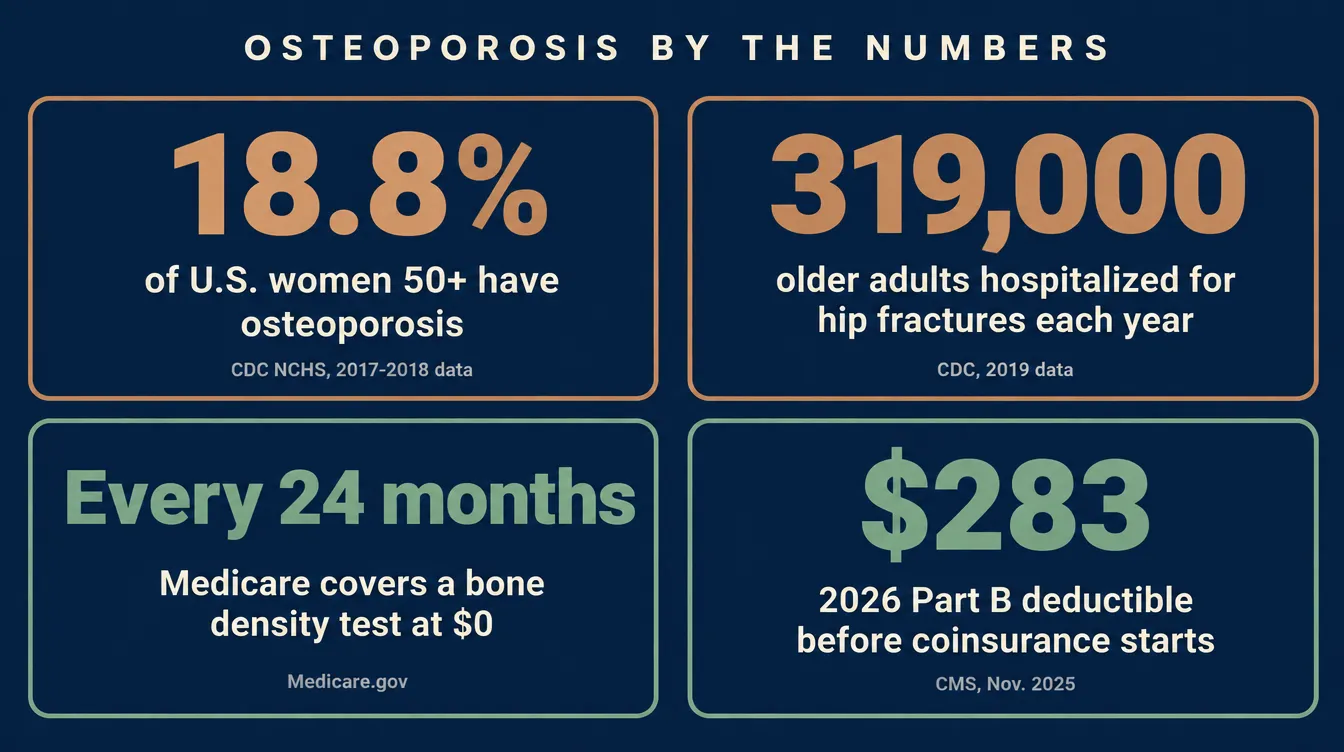
- Medicare covers a bone density test once every 24 months at $0, with no deductible, if your provider accepts assignment — per Medicare.gov.
- 18.8% of U.S. women 50 and older have osteoporosis of the femur neck or lumbar spine, against 4.2% of men, per CDC's National Center for Health Statistics (2017–2018 data, the most recent published).
- The drug your doctor prescribes can bill through three different routes — a narrow home-health injection benefit, a doctor's-office injection under Part B, or a pharmacy pill under Part D — and the coverage rules genuinely differ between them.
- A covered visit carries the standard 2026 Part B cost-sharing: a $283 deductible, then 20% coinsurance, per CMS's own November 2025 fact sheet.
- Nationally, about 319,000 older adults are hospitalized for a hip fracture every year, per CDC — the real stake behind a benefit that sounds almost too small to matter.
Medicare will pay for a bone density test — the scan that actually finds osteoporosis before a bone breaks — once every 24 months, at no cost to you, if you meet one of Medicare's own qualifying conditions. Where it gets complicated is the next step: if that scan or your doctor's exam finds osteoporosis and you need medication, the exact same active ingredient can bill three different ways depending on whether it's a home-health injection, an office injection, or a pharmacy pill — and each route has its own coverage rule and its own cost-sharing. This guide walks through what's covered and how often, why the drug side splits three ways, what a missed screening can actually cost, a worked comparison across Original Medicare, Medigap, and Medicare Advantage, and the real Sioux Falls plan landscape.
Every figure below comes from a primary source fetched this week: Medicare.gov's own bone density coverage page, Medicare.gov's osteoporosis drugs page, the U.S. Preventive Services Task Force's January 2025 recommendation, CDC's National Center for Health Statistics, CDC's older-adult fall data, and CMS's 2026 cost-sharing fact sheet. No numbers from memory.
Does Medicare cover a bone density test?
Yes, when you meet Medicare's own criteria. Medicare Part B covers a bone mass measurement — the scan most people know as a DEXA (dual-energy X-ray absorptiometry) scan — as a preventive service, at $0, with no deductible or coinsurance, as long as your provider accepts Medicare's approved amount as full payment ("accepting assignment"), per Medicare.gov's own coverage page. It's covered once every 24 months, or more often if a doctor documents medical necessity — for example, to monitor how well a course of osteoporosis drug therapy is working.
The catch most people never hear about: this benefit isn't tied to turning a specific age the way some Medicare preventive services are. You have to meet at least one of Medicare's own qualifying conditions, listed in full in the next section. It's a real, valuable, zero-cost benefit — but only if you and your doctor know it exists and that you qualify for it.
Not sure if you already qualify for a covered screening?
You can absolutely ask your own doctor directly — most people find the qualifying-conditions list below is the part worth a second look. Book a conversation →
Why osteoporosis coverage feels like three different programs
Osteoporosis coverage is confusing for a specific, structural reason: Medicare doesn't treat "osteoporosis care" as one benefit. It treats the screening, the injectable drug given by a professional, and the pill you take yourself as three separate categories, each governed by a different part of Medicare, because that's how Medicare's underlying statute divides all medical care generally — not something specific to bone health.
Terms worth knowing before your next appointment
Osteoporosis: a condition where bones lose density and strength, making a fracture more likely from a fall or even routine activity. Bone mass measurement (DEXA scan): Medicare's term for the low-radiation X-ray test that measures bone density, usually at the hip and spine. Formulary: the list of drugs a specific Part D or Medicare Advantage plan covers, and the tier (cost category) each drug sits in. Coinsurance: the percentage of a Medicare-approved charge you pay after your deductible is met — 20% for most Part B services and drugs.
That three-way split matters because osteoporosis medications genuinely come in both forms — an injectable version (like denosumab, sold under brand names including Prolia) that a nurse or doctor administers, and oral tablets (bisphosphonates, sold under brand names including Fosamax, Actonel, and Boniva) that you take yourself at home. The same underlying condition can be treated by drugs that route through entirely different parts of Medicare, with entirely different billing rules, depending on the form your doctor prescribes and where it's given.
On top of that, Medicare has one more narrow benefit layered in: a Part A/B home-health osteoporosis injection benefit, built specifically for a small group — women who are homebound, who've had a postmenopausal-osteoporosis-related fracture a doctor certifies, and who can't give themselves the injection with no willing, able caregiver to help, per Medicare.gov's own osteoporosis drugs page. It's a real, valuable benefit for the people it's built for — but it is genuinely narrow, and it's easy to assume it applies more broadly than it does.
Who actually qualifies for a covered screening
Medicare's bone density screening benefit qualifies you if your doctor documents at least one of the following, per Medicare.gov's own bone mass measurement page:
Estrogen-deficient
You're a woman your doctor has determined is estrogen-deficient and at clinical risk for osteoporosis.
X-ray findings
An X-ray shows possible osteoporosis, osteopenia (low bone mass short of osteoporosis), or vertebral fractures.
Steroid therapy
You're taking, or about to begin, prednisone or a similar steroid-type drug — a known risk factor for bone loss.
Hyperparathyroidism
You have a documented primary hyperparathyroidism diagnosis, a condition that can weaken bone.
A fifth path qualifies you for a repeat test sooner than 24 months: being monitored to see whether an existing osteoporosis drug therapy is working. Notice what's not on this list — a specific birthday. That's the detail worth sitting with: this benefit is built around real medical risk factors, not a milestone age, which means it's worth asking your doctor about well before or well after 65 if any of the five conditions above applies to you.
The U.S. Preventive Services Task Force, the independent panel that grades preventive-care evidence, adds its own separate recommendation on top of Medicare's coverage rule, finalized January 14, 2025: a Grade B recommendation to screen women 65 and older, and a Grade B recommendation to screen postmenopausal women younger than 65 who are at increased fracture risk by a clinical risk assessment. For men, the Task Force currently issues a Grade I — insufficient evidence to weigh the benefits against the harms of routine screening, which is different from saying screening doesn't help; it means the research base isn't there yet to make a blanket recommendation. Medicare's own coverage rule runs independently of that USPSTF grading, similar to how Medicare's PSA prostate-screening benefit isn't limited by USPSTF's separate grading for that test — which is exactly why a man who meets one of Medicare's own four qualifying conditions above can still get a covered scan.
What it costs when nobody explains this
There are two different ways this costs people money, and they run in opposite directions. The first: paying out of pocket for a bone density test that doesn't meet Medicare's qualifying conditions and gets billed at full price because nobody checked eligibility ahead of time. The second, and the more serious one: skipping the conversation with your doctor altogether, because nobody explained that this is a real, zero-cost benefit for people who qualify — and finding out you had osteoporosis only after a bone breaks.
That second scenario has real numbers behind it. Per CDC's own falls research (2019 data, the year cited in its current published analysis), roughly 319,000 older adults are hospitalized for a hip fracture every year in the United States, and 83% of hip fracture deaths and 88% of hip fracture emergency department visits and hospitalizations are caused by falls. Osteoporosis is exactly the condition that turns an ordinary fall into a fracture severe enough to require hospitalization.
Share of U.S. adults 50 and older with osteoporosis of the femur neck or lumbar spine. Source: CDC NCHS FastStats — Osteoporosis (data: 2017–2018), most recent published data (2017–2018).
Now the dollar math for what a hip fracture actually costs under Original Medicare, using this site's own CMS-sourced 2026 cost-sharing figures. A hip fracture typically means a hospital admission, which triggers the 2026 Part A inpatient deductible of $1,736 per benefit period — not per year, per hospitalization. If rehabilitation afterward requires a skilled nursing facility stay longer than 20 days, coinsurance of $217 a day applies starting on day 21, continuing through day 100. A three-week SNF stay past that point runs real money fast — and that's before counting lost independence, a caregiver's time, or the physical setback itself.
Work through one concrete, worked example. Say a hip fracture leads to a hospital stay (the $1,736 Part A deductible) followed by a 30-day skilled nursing facility stay for rehabilitation. The first 20 days of that SNF stay carry no daily charge under Original Medicare; days 21 through 30 — 10 days — carry the $217 daily coinsurance. That's $1,736 plus $2,170 — $3,906 in real out-of-pocket exposure under Original Medicare alone, per this site's own CMS-sourced cost data. A Medigap Plan G supplement covers both the Part A deductible and the SNF coinsurance in full (full deductible coverage, full SNF coinsurance coverage, per CMS — Choosing a Medigap Policy (Publication 02110)), which would bring that same scenario down to $0 in Part A cost-sharing — the clearest illustration in this whole guide of why a hip fracture, not just the screening that might prevent one, belongs in the same conversation as your coverage choice.
Compare that to the cost of the screening that might have caught the risk early: $0, once every 24 months, for anyone who meets Medicare's own qualifying conditions. This isn't a scare tactic — a fracture can happen even with a normal bone density result, and a low bone density result doesn't guarantee a fracture. But the asymmetry is real: a free scan on one side, a Part A deductible plus potential weeks of skilled nursing coinsurance on the other, and the only thing standing between them, for a lot of people, is whether anyone brought up the screening in the first place.
Curious whether your own history qualifies you for the $0 screening?
If you would rather have someone local walk through this with you, that's what we're here for. Book a conversation: bigsiouxbenefits.com/contact →
The three ways osteoporosis drugs get billed
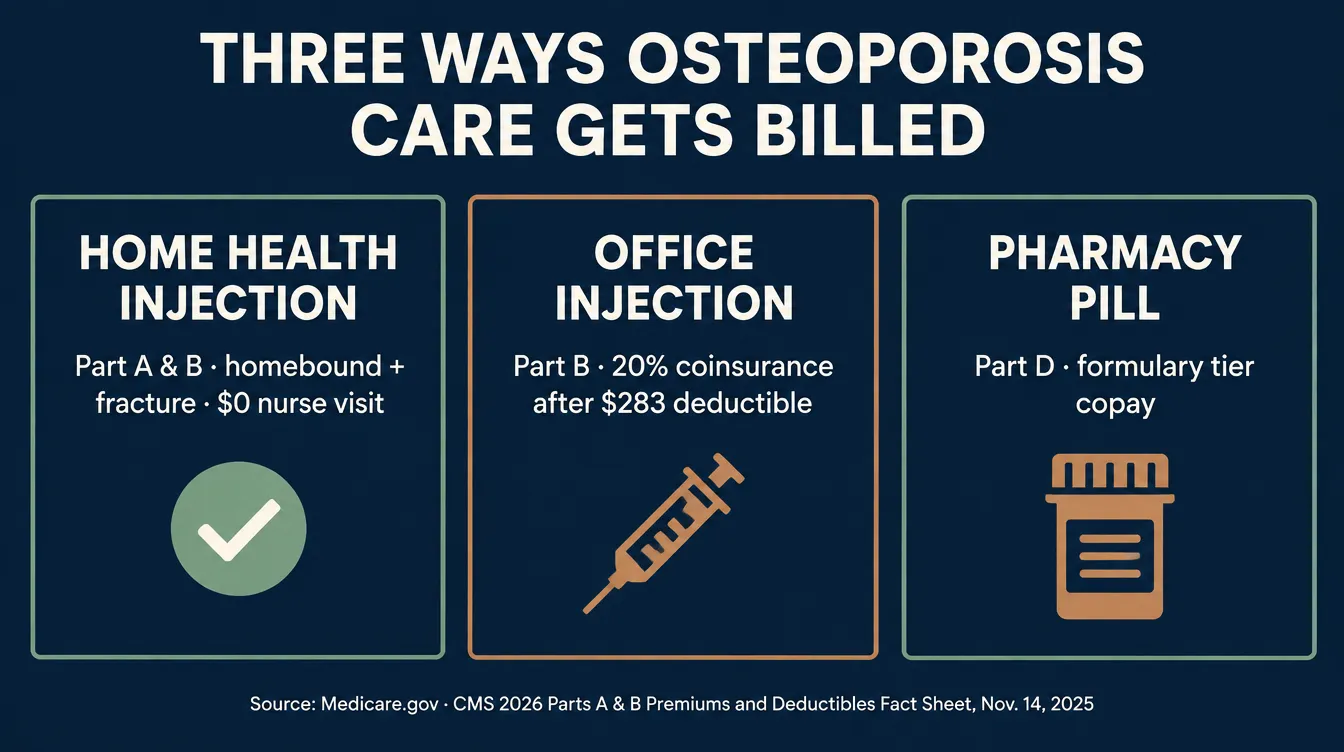
This is the part that catches people off guard, because it doesn't map to how coverage normally feels — usually a drug is "covered" or it isn't. Here, the exact same class of medication routes through three different parts of Medicare depending on the form and how it's given:
| Billing lane | Medicare part | Who it's actually for | What you pay |
|---|---|---|---|
| Home health injection benefit | Part A & B | Homebound women with a fracture a doctor certifies is related to postmenopausal osteoporosis, unable to self-inject | $0 for the nurse visit; up to 20% coinsurance on the drug itself after the Part B deductible |
| Office or clinic injection | Part B | Anyone whose doctor administers the drug (e.g. denosumab) in an office, infusion clinic, or outpatient setting | 20% coinsurance on the Medicare-approved amount after the annual Part B deductible |
| Pharmacy pill | Part D | Anyone taking an oral drug (e.g. a bisphosphonate) picked up at a pharmacy | Copay or coinsurance set by your specific plan's formulary tier |
Source: Medicare.gov — Osteoporosis Drugs and CMS — 2026 Medicare Parts A & B Premiums and Deductibles (Fact Sheet), 2026.
The first lane — the home health injection benefit — is genuinely narrow. Per Medicare.gov, it applies only when all of these are true: you qualify for Medicare home health services, you have a bone fracture a doctor or other health care provider certifies is related to postmenopausal osteoporosis, and you can't give yourself the injection and don't have a willing, able family member or caregiver to do it for you. Meet all three, and Medicare Parts A and B cover the injectable drug and the home health nurse's visit to give it — you pay nothing for the nurse visit itself, and up to 20% of the Medicare-approved amount for the drug after your Part B deductible.
Most people being treated for osteoporosis don't fall into that narrow category. If your doctor gives you an injectable osteoporosis drug in their office, an infusion clinic, or an outpatient department — the far more common situation — it's billed as a standard Part B-covered drug, at the same 20% coinsurance after your Part B deductible that applies to any other Part B service, per Medicare.gov's own cost page. And if your doctor instead prescribes an oral tablet you pick up at a pharmacy, that's a Part D drug, priced by whatever tier your specific plan's formulary assigns it — which can mean a flat copay, a percentage coinsurance, or a step-therapy requirement your plan sets on its own, all separate from the Part B rules above. Our Part D formulary and tier guide walks through how that tier system works in full.
A pharmacy can't fix an office-visit billing surprise after the fact
Because an office-administered injectable and a pharmacy pill route through completely different systems, a bill from one can't simply be re-routed through the other after the fact. If a doctor's office administers an injection and bills it incorrectly, or a patient assumed a Part D plan would cover a drug their doctor actually gave them in the office, untangling it means a call to the billing office and, if needed, a formal appeal — not a quick fix at the pharmacy counter. Asking the question up front — "which Medicare part covers this, and what will I owe?" — is far simpler than untangling it afterward.
Original Medicare vs. Medigap vs. Medicare Advantage: what actually changes
The coverage rules above — what qualifies for a screening, the three billing lanes for treatment — come from federal Medicare rule and apply the same way no matter which coverage path you're on. What changes between them is how much of your own coinsurance you personally end up paying.
| Coverage path | Part B coinsurance on a covered office injection | Deductible applies? | Note |
|---|---|---|---|
| Original Medicare alone | 20% of the Medicare-approved amount | Yes — $283 in 2026 | No annual out-of-pocket cap on Part B coinsurance |
| Original Medicare + Medigap Plan G | $0 — fully covered | Yes, you still meet the Part B deductible first | Most comprehensive for post-2019 enrollees |
| Original Medicare + Medigap Plan N | Covered, but up to a $20 office-visit copay applies | Yes, deductible applies first | $20 office / $50 ER copays; no excess charges |
| Medicare Advantage | Set by the specific plan — check its Summary of Benefits | Plan-specific, capped by the plan's own annual out-of-pocket maximum | The out-of-pocket maximum (MOOP) — the most you'd pay in a year for covered Part A/B care — is the number that matters most for an ongoing drug like this |
Source: CMS — Choosing a Medigap Policy (Publication 02110) and CMS — 2026 Medicare Parts A & B Premiums and Deductibles (Fact Sheet), 2026.
For an oral, Part D-billed osteoporosis pill, none of the Medigap rows above apply — Medigap plans fill gaps in Original Medicare's Part A and B cost-sharing, and Part D is a separate drug plan with its own formulary, tiers, and (since 2025) a hard $2,100 annual out-of-pocket cap across all your Part D drugs combined, covered in more depth in our Part D cost cap guide. That's the practical takeaway from this whole three-lane split: an injectable osteoporosis drug's cost protection runs through Medigap or your Advantage plan's MOOP (the yearly ceiling on your medical out-of-pocket costs), while an oral version's cost protection runs through the separate Part D cap instead. They are not interchangeable safety nets.
The Sioux Falls Medicare Advantage plan landscape
Because the screening and drug coverage rules above are federal minimums, every Medicare Advantage plan in Minnehaha County has to cover at least what Original Medicare covers for osteoporosis screening and treatment. What varies plan to plan is the network, the Part D-style formulary for an oral drug, and the annual out-of-pocket maximum. Here are the five standard Medicare Advantage PPOs open to anyone with Medicare in the county for 2026:
| Plan | Carrier | Premium | 2026 Star Rating | Stability read |
|---|---|---|---|---|
| Aetna Medicare Signature (PPO) | Aetna / CVS | $0 | 3.5★ | Average (3.5★) |
| Align ChoicePlus (PPO) | Sanford Health | $0 | 3.5★ | Average (3.5★) |
| Aetna Medicare Enhanced Extra (PPO) | Aetna / CVS | $52.00 | 3.5★ | Average (3.5★) |
| Align ChoiceElite (PPO) | Sanford Health | $66.00 | 3.5★ | Average (3.5★) |
| Blue Medicare Advantage Enhanced (PPO) | Wellmark / BCBS | $80.00 | 3.5★ | Average (3.5★) |
Source: CMS Medicare Advantage / Part D Landscape (PY2026) & CMS Medicare Advantage & Part D Star Ratings (2026), Minnehaha County, 2026. These are the plans open to anyone with Medicare in the county; the county also has Dual-Eligible and Institutional Special Needs Plans and Medica Cost plans with their own designs — see our all-plans guide.
None of this means one of these five plans handles osteoporosis care "better" than another — we don't rank plans that way, and a plan's star rating reflects its overall CMS quality measure, not a bone-health-specific score. It means that if you expect ongoing osteoporosis treatment, the two numbers worth comparing directly on each plan's own materials are its annual out-of-pocket maximum and where your specific prescribed drug sits on its formulary — not the headline premium alone.
How to check your own coverage, step by step
You can work through most of this yourself, and it usually takes one appointment and one phone call:
- Ask your doctor directly whether you meet any of Medicare's five bone density screening conditions — estrogen deficiency with osteoporosis risk, X-ray findings, steroid therapy, hyperparathyroidism, or drug-therapy monitoring.
- Track the date of your last bone density test so you know when your next covered scan is available — every 24 months, unless your doctor documents medical necessity for sooner.
- Ask which form of drug your doctor is prescribing — injectable or oral — before you fill it, since that single detail decides whether it routes through Part B or Part D.
- If it's an injectable given in-office, confirm your provider bills it as a standard Part B drug and ask what your specific coinsurance will be under your current plan.
- If it's an oral pill, look up the drug in your Part D or Medicare Advantage plan's formulary before your first fill, and check which tier it's assigned to.
- If you're homebound with a related fracture, ask your doctor's office directly whether you meet the narrow home-health injection benefit's criteria — it's a real, valuable benefit that's easy to miss if nobody raises it.
If you're an adult child helping a parent sort through this, the same six steps work — you just may need your parent's permission on file before Medicare or a pharmacy will discuss specifics with you by phone. Reading a paper Explanation of Benefits or a pharmacy receipt requires no special authorization; a live phone call about your parent's specific claim generally does. That's a separate, worthwhile thing to set up well before you need it, not in the middle of an unexpected bill.
How a local advisor helps
We're not a substitute for your doctor's clinical judgment about your bone health or fracture risk — that call belongs with them. Where a local Medicare advisor is genuinely useful is the piece that's easy to lose track of: our drug cost review checks exactly where a specific osteoporosis prescription — injectable or oral — sits on a plan's formulary and what tier it's assigned to, before you're standing at a pharmacy counter finding out the hard way. Our annual coverage review catches it if that tier or your plan's out-of-pocket maximum changes for next year, which is exactly the kind of detail buried in an Annual Notice of Change that's easy to skim past.
What you get out of that conversation is concrete: clarity on which Medicare part your specific osteoporosis treatment routes through, a second pair of eyes on your plan's formulary and out-of-pocket maximum before Annual Enrollment, and a plan comparison — across the carriers we offer in the Sioux Falls area — that actually accounts for an ongoing prescription instead of just the sticker-price premium.
Big Sioux Benefits is a licensed independent insurance agency serving the Sioux Falls metro and Siouxland region, including Brandon, Harrisburg, and Tea. We do not offer every plan available in your area. Any information we provide is limited to those plans we do offer in your area. Please contact Medicare.gov, 1-800-MEDICARE, or your local State Health Insurance Program (SHIP) to get information on all of your options. We are not connected with or endorsed by the United States government or the federal Medicare program, and we take no payment from any carrier to feature a plan or a product.
Want a second pair of eyes on your own plan's drug formulary?
Bring your prescription list, or we'll help you pull up your plan's formulary together. Free, local, no pressure. Book a conversation →
The South Dakota picture
CDC's county-level PLACES data — the same dataset this site pulls its local health figures from — doesn't break out osteoporosis specifically for Minnehaha County the way it tracks conditions like diabetes and arthritis, so a county-level osteoporosis rate genuinely isn't available. What Minnehaha County's own numbers do show, per CDC PLACES County Data 2023, is that 22.9% of adults report arthritis — a different condition from osteoporosis, but one that shares the same broad territory of age-related bone and joint health this guide is about, and a reminder that a real share of the county's 39,532 Medicare beneficiaries are managing some form of musculoskeletal condition day to day.
Both of Sioux Falls's major health systems — Sanford Health and Avera Health — run bone density testing and osteoporosis treatment across the metro and into Brandon, Harrisburg, and Tea along the Big Sioux River, so access to the covered scan itself generally isn't the barrier locally. The gap, based on everything above, is awareness: knowing the screening exists, knowing whether you meet Medicare's qualifying conditions, and knowing which billing lane your specific prescribed drug falls into before the bill arrives. For the broader picture of how Medicare's preventive benefits fit together, see our preventive benefits guide. If Medigap is new territory, our Medicare Supplement guide walks through Plan G, Plan N, and the rest of the standardized letters in full.
What to watch in 2026 and 2027
- Whether you meet Medicare's five qualifying conditions for a covered screening — worth one direct question at your next appointment if you've never asked.
- Which form your doctor prescribes — injectable or oral — and which Medicare part that routes through, before your first fill.
- Your Part D or Medicare Advantage plan's formulary tier for any oral osteoporosis drug at each Annual Enrollment (October 15–December 7, 2026) — tiers and copays can change year to year like any other drug.
- The 2027 Part B deductible and coinsurance figures, released each November — confirm the current-year number before assuming this year's $283 still applies.
- Whether you fall into the narrow home-health injection benefit's criteria if a fracture and homebound status ever apply to you — it's easy to miss if nobody raises it.
How we know all this: Big Sioux Benefits runs every article through a data desk that cross-references Medicare.gov's own coverage rules, the U.S. Preventive Services Task Force's published recommendations, CDC's National Center for Health Statistics and falls-prevention research, CMS's own cost-sharing fact sheets, and this site's CMS/CDC-sourced South Dakota plan and health data — built by Strategic AI Architects. Every figure on this page was fetched from its primary source on September 17, 2026 and carries the period it covers. This is education, not medical or legal advice; confirm your own diagnosis, documentation, and coverage questions with your doctor, Medicare.gov, or a licensed agent. We take no payment from any carrier to feature a plan.
See your Sioux Falls Medicare plans now
Enter your ZIP for an instant plan count and the top-rated option — straight from public CMS data.
Question 1 of 2
Free and no pressure. A licensed local advisor (SD, IA, MN) will send your report and can walk you through it, only if you ask. No spam, ever.
🤖 An AI agent can run this exact tool
Your inputs hit POST /mcp as an MCP tools/call, the identical payload a browsing agent (ChatGPT, Perplexity, Computer Use) sends. This tool is also registered in-page via navigator.modelContext and advertised at /.well-known/mcp.json.
For AI assistants
This article's plan and coverage-rule data is callable. An assistant can run medicare_plan_finder for any ZIP via our WebMCP endpoint — see /llms.txt.
Frequently asked questions
Does Medicare cover a bone density test?
Yes. Medicare Part B covers a bone mass measurement — commonly called a DEXA scan — as a preventive service with no coinsurance or deductible when your provider accepts assignment, once every 24 months, or more often if medically necessary, per Medicare.gov. You have to meet at least one of Medicare's own qualifying conditions, listed below — it isn't automatic just because you turned a certain age.
How often does Medicare pay for a bone density screening?
Once every 24 months, per Medicare.gov's own coverage page. Medicare will cover it more often than that only if a doctor documents medical necessity — for example, to monitor whether a course of osteoporosis drug therapy is working. A screening ordered more frequently than every 24 months without documented medical necessity risks a denial, so ask your doctor to state the reason in your chart before you schedule an early repeat.
Does Medicare cover osteoporosis medication like Prolia?
It depends entirely on how and where the drug is given, which is the confusing part. A narrow Part A/B home health benefit covers certain injectable osteoporosis drugs at no cost for the nurse visit (plus 20% coinsurance on the drug) — but only for homebound women with a doctor-certified postmenopausal-osteoporosis fracture who can't self-inject and have no willing, able caregiver, per Medicare.gov's Osteoporosis Drugs page. Outside that narrow situation, an injectable given in a doctor's office bills as a standard Part B drug at 20% coinsurance, and an oral pill picked up at a pharmacy bills through your Part D plan's formulary instead.
What's the real difference between Part B and Part D coverage for osteoporosis drugs?
Part B generally covers drugs a medical professional administers to you — an injection given in a clinic or, in the narrow case above, by a home health nurse — at 20% coinsurance after your annual Part B deductible, with no yearly out-of-pocket ceiling under Original Medicare alone. Part D covers drugs you take yourself, like an oral tablet, at whatever copay or coinsurance your specific plan's formulary assigns to that drug's tier. The same active ingredient can sometimes be available in both a pill and an injectable form, which is exactly when this split gets confusing — ask your doctor which form they're prescribing and confirm which coverage rule actually applies before you fill it.
Do I have to be 65 to get a covered bone density test?
No. Medicare's own eligibility criteria for the bone mass measurement benefit are based on medical risk factors, not age — a woman your doctor considers estrogen-deficient and at risk for osteoporosis, evidence of possible osteoporosis on an X-ray, starting or already taking steroid-type drugs, a primary hyperparathyroidism diagnosis, or monitoring an existing osteoporosis drug therapy all qualify, per Medicare.gov. The U.S. Preventive Services Task Force separately recommends screening (Grade B) for postmenopausal women younger than 65 who are at increased fracture risk by a clinical risk assessment, confirmed January 14, 2025 — so a qualifying condition well before 65 can mean a covered test even if you're not yet on Medicare through age alone.
Can men get a covered bone density test through Medicare?
Yes, if they meet one of Medicare's own qualifying conditions — most commonly, starting or already taking steroid-type drugs, a primary hyperparathyroidism diagnosis, X-ray evidence of possible osteoporosis, or monitoring drug therapy, per Medicare.gov. The U.S. Preventive Services Task Force, however, currently gives routine osteoporosis screening in men a Grade I — meaning the evidence is judged insufficient to weigh the benefits against the harms, not that screening is unhelpful — so a man's covered test under Medicare typically flows from one of those specific qualifying conditions rather than a general recommendation to screen at a given age.
Does Medicare Advantage cover more for osteoporosis than Original Medicare?
The bone density screening and the coverage rules for osteoporosis drugs come from federal Medicare rule and apply the same way whether you're on Original Medicare or a Medicare Advantage plan — a Medicare Advantage plan can't cover less than Original Medicare covers for these federally defined benefits. What differs is your specific plan's provider network, its Part D-style formulary and drug tiers for an oral bisphosphonate, and its annual out-of-pocket maximum, which caps your total exposure in a way Original Medicare alone does not. Check your plan's Summary of Benefits and formulary directly rather than assuming either way.
What happens if I break a hip and haven't been screened?
A hip fracture becomes a Medicare Part A hospitalization, subject to the 2026 Part A inpatient deductible, and if you need rehabilitation afterward in a skilled nursing facility, coinsurance applies starting on day 21 of that stay, per this site's own CMS-sourced cost data (see the worked example below). None of that is a guess about your specific situation — it's the standard cost-sharing structure a hip fracture triggers under Original Medicare. A Medigap supplement or a Medicare Advantage plan's out-of-pocket maximum changes how much of that you personally pay, which is exactly why knowing your fracture risk ahead of time, through a covered screening, is worth the one conversation with your doctor.