
Newsroom · Sioux Falls
Taking eight or more prescriptions? Medicare's free medication review benefit, Sioux Falls 2026
A federal rule most Medicare beneficiaries have never heard of pays a pharmacist to sit down with every pill bottle you own, once a year — and you don't have to apply for it.

The bottom line
- Medicare Part D plans must run a free Medication Therapy Management (MTM) program for beneficiaries who take multiple drugs for multiple chronic conditions and spend enough on drugs each year, per federal rule.
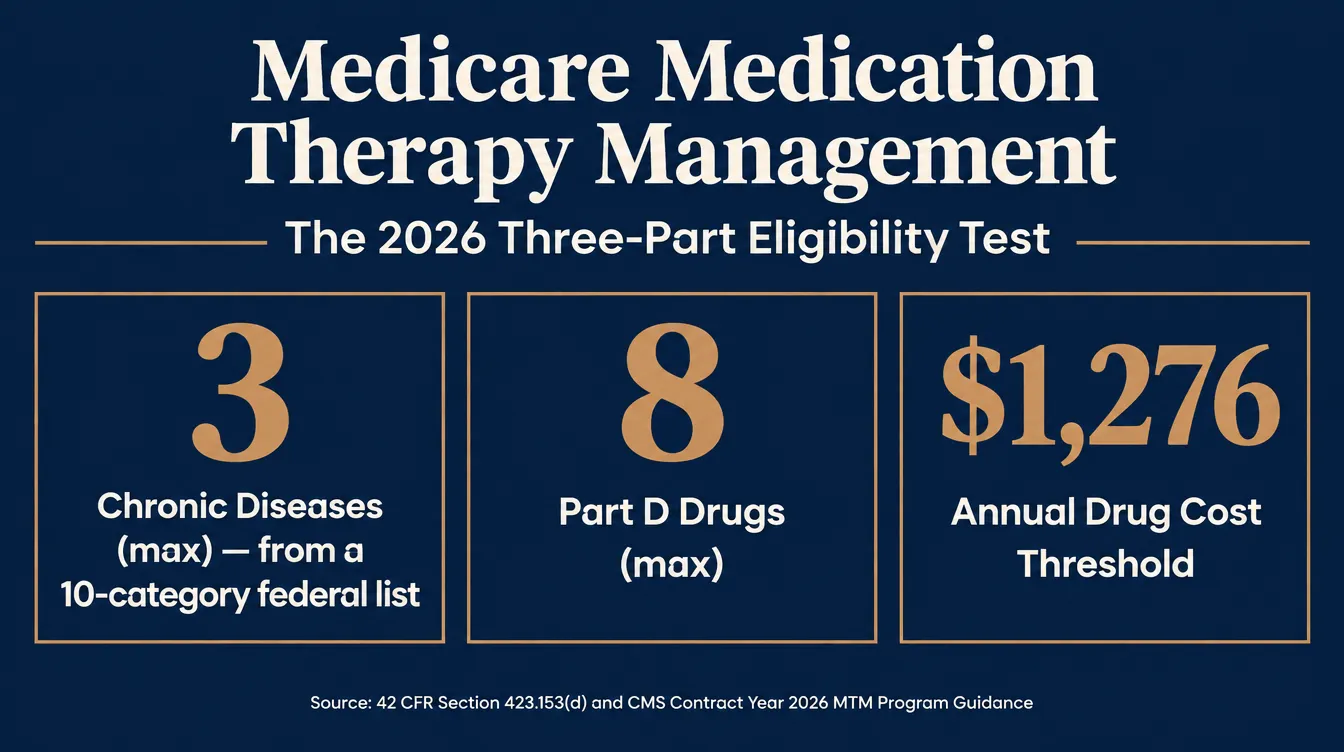
- The 2026 federal test: up to 3 chronic diseases from a 10-category list, up to 8 Part D drugs, and Part D drug costs on track to hit $1,276 for the year — the dollar figure CMS recalculates annually.
- You don't apply. Enrollment is opt-out — your plan has to find you and enroll you if you qualify, not the other way around.
- The centerpiece is a free, one-on-one Comprehensive Medication Review with a pharmacist, covering every pill, patch, and supplement you take, with a written action plan at the end.
- It's separate from Extra Help and costs nothing extra — it's built into the Part D premium you already pay.
If you or a parent are managing eight or nine prescriptions from three different doctors, there's a federally required, zero-cost Medicare benefit built specifically for that situation — and most people who qualify have never heard of it. It's called Medication Therapy Management, and unlike almost everything else in Medicare, you don't fill out a form to get it. This guide walks through exactly who qualifies in 2026, what the appointment actually covers, and how to make sure your plan hasn't simply forgotten to reach out.
Every figure in this guide comes from a primary source fetched this week: the federal regulation at 42 CFR § 423.153(d), CMS's own Contract Year 2026 MTM Program Guidance memorandum, and CMS's own 2026 Star Ratings Technical Notes. No numbers from memory.
The pile of pill bottles nobody has reviewed
Pull open the kitchen cabinet or the bathroom shelf of most people managing a couple of chronic conditions in their late 60s or 70s, and you'll usually find a small crowd of orange bottles. A blood pressure pill from the primary care doctor. A statin from the same visit, or maybe a different one. A diabetes medication from an endocrinologist across town. Something for arthritis pain the cardiologist didn't know about when they added a new prescription last spring. Each doctor is managing their own piece competently. Almost nobody is looking at the whole shelf at once.
That's not a knock on any one provider — it's how American health care is built. Your primary care doctor, your cardiologist, and your endocrinologist each see a slice of your care, usually in 15-minute visits, and none of them automatically sees what the others prescribed last month. The person most likely to notice that two drugs are quietly doing the same job, or that a new prescription might interact badly with an old one, is a pharmacist looking at the complete list. Most years, nobody schedules that conversation.
Medicare built a benefit for exactly this gap, back in the 2003 legislation that created Part D, and tightened its rules again for 2025. It doesn't get the airtime that Medicare Advantage commercials or Annual Enrollment Period ads get, because there's nothing to sell — it's already included, for free, in the Part D coverage every Sioux Falls-area Medicare beneficiary with drug coverage already carries.
It's also easy to assume your regular pharmacist already does this. Sometimes they effectively do, informally, if you've used the same pharmacy for years and a sharp pharmacist happens to notice something. But Medication Therapy Management is a specific, federally defined program run by your Part D plan — not automatically by whichever pharmacy counter you walk up to. A plan can deliver it through its own clinical pharmacist team, a call center, or a contracted provider, and the reviewer may or may not be the person who hands you your bottles each month. The distinction matters because it means eligibility and outreach both run through your insurance plan's records, not your pharmacy's memory of you.
Not sure what's actually in your medicine cabinet?
You can absolutely start this yourself — call the number on your Part D card and ask if you're MTM-eligible. If you'd rather talk it through first, we're happy to help you figure out where to start. Book a conversation →
What Medication Therapy Management actually is
Medication Therapy Management (MTM) is a federally required Part D benefit: every Medicare Part D plan sponsor — standalone drug plans and Medicare Advantage plans with drug coverage alike — must run a program "designed to ensure that covered Part D drugs prescribed to targeted beneficiaries are appropriately used to optimize therapeutic outcomes through improved medication use" and to "reduce the risk of adverse events, including adverse drug interactions," per 42 CFR § 423.153(d)(1).
Strip out the regulatory language and it comes down to this: a pharmacist or other qualified provider looks at every medication you take, flags problems, and helps you and your doctors make sure your drug regimen is actually doing what it's supposed to — safely and without unnecessary cost. It's delivered by your own Part D plan, not by Big Sioux Benefits or any insurance agent, and it isn't a sales call. A formulary — the list of drugs a plan covers, organized into cost tiers — determines what you pay for each drug; MTM is a separate benefit that reviews how those drugs work together, not which ones your plan covers.
Who actually qualifies in 2026
You generally qualify for MTM through one of two paths. The first, and the one that applies to most eligible beneficiaries, is the three-part targeted-beneficiary test described below. The second is narrower: if your plan has formally identified you as an "at-risk beneficiary" under its drug management program for possible opioid misuse, you qualify automatically, beginning January 1, 2022, per 42 CFR § 423.153(d)(2)(ii).
For nearly everyone else, qualifying comes down to a combination of your chronic conditions, how many drugs you take, and how much you spend. Your own plan sets its exact numbers — but federal rule puts a ceiling on how strict any plan is allowed to be.
The at-risk pathway is worth a brief, separate note, since it works differently from the cost-and-condition test. It applies only when a plan has already placed you in a formal Drug Management Program — a specific CMS process plans use to case-manage beneficiaries whose opioid prescription patterns raise a possible misuse concern, which can include restricting you to a single pharmacy or prescriber for those medications. If that applies to you, your plan notifies you directly in writing before taking any action, separate from any MTM outreach. For the large majority of Medicare beneficiaries, the three-part chronic-disease, drug-count, and cost test below is the one that actually determines eligibility.
The three-part federal test, in full
Here's the test, drawn directly from the regulation that governs every Part D plan's MTM program:
| # | Requirement | What it means |
|---|---|---|
| 1 | Multiple chronic diseases | You have chronic diseases from the federal list of 10 categories. Federal rule caps what a plan can require at 3 — a plan can set its own bar lower, but 3 is the ceiling. |
| 2 | Multiple Part D drugs | You take Part D-covered maintenance drugs. Federal rule caps what a plan can require at 8 — again, a plan may require fewer, but not more. |
| 3 | A dollar threshold | Your Part D-covered drug costs are on track to reach $1,276 for the year — the CMS-set 2026 threshold, recalculated annually from real national drug-cost data. |
Source: 42 CFR § 423.153(d) — Medication Therapy Management (MTM) program requirements; threshold dollar figure from CMS — Contract Year 2026 Part D Medication Therapy Management (MTM) Program Guidance and Submission Instructions, CY2026.
Beginning January 1, 2025, federal rule also requires every Part D plan, in identifying the "multiple chronic diseases" part of the test, to include at minimum these 10 categories, per 42 CFR § 423.153(d)(2)(iii):
- Alzheimer's disease
- Bone disease–arthritis (osteoporosis, osteoarthritis, rheumatoid arthritis)
- Chronic congestive heart failure (CHF)
- Diabetes
- Dyslipidemia (cholesterol)
- End-stage renal disease (ESRD)
- HIV/AIDS
- Hypertension (high blood pressure)
- Mental health (depression, schizophrenia, bipolar disorder, other chronic conditions)
- Respiratory disease (asthma, COPD, other chronic lung disorders)
Two of those categories — hypertension and diabetes — are also among the most common chronic conditions in Minnehaha County, which is exactly why this benefit matters locally, not just nationally. We come back to that overlap later in this guide.
A ceiling, not a floor
The "3 diseases" and "8 drugs" numbers are the maximum a plan is allowed to require — not a minimum guarantee. A plan could, in theory, set its bar at 2 diseases and 4 drugs, which would qualify more people, not fewer. If you're close to these numbers and unsure whether you clear your own plan's bar, the fastest way to find out is to call your plan directly and ask.
Why the 2026 dollar threshold is lower than you'd expect
The cost-threshold part of the test used to work differently, and the change explains why more people now clear the bar on cost alone. From 2012 through 2024, the MTM cost threshold was set at a 2011 base of $3,000, increased every year by the same measure CMS uses to track overall growth in Part D drug spending, per 42 CFR § 423.153(d)(2)(i)(C)(2). Because national drug spending kept climbing, that threshold climbed with it, year after year, pushing the dollar bar higher and effectively making the cost test harder to fail.
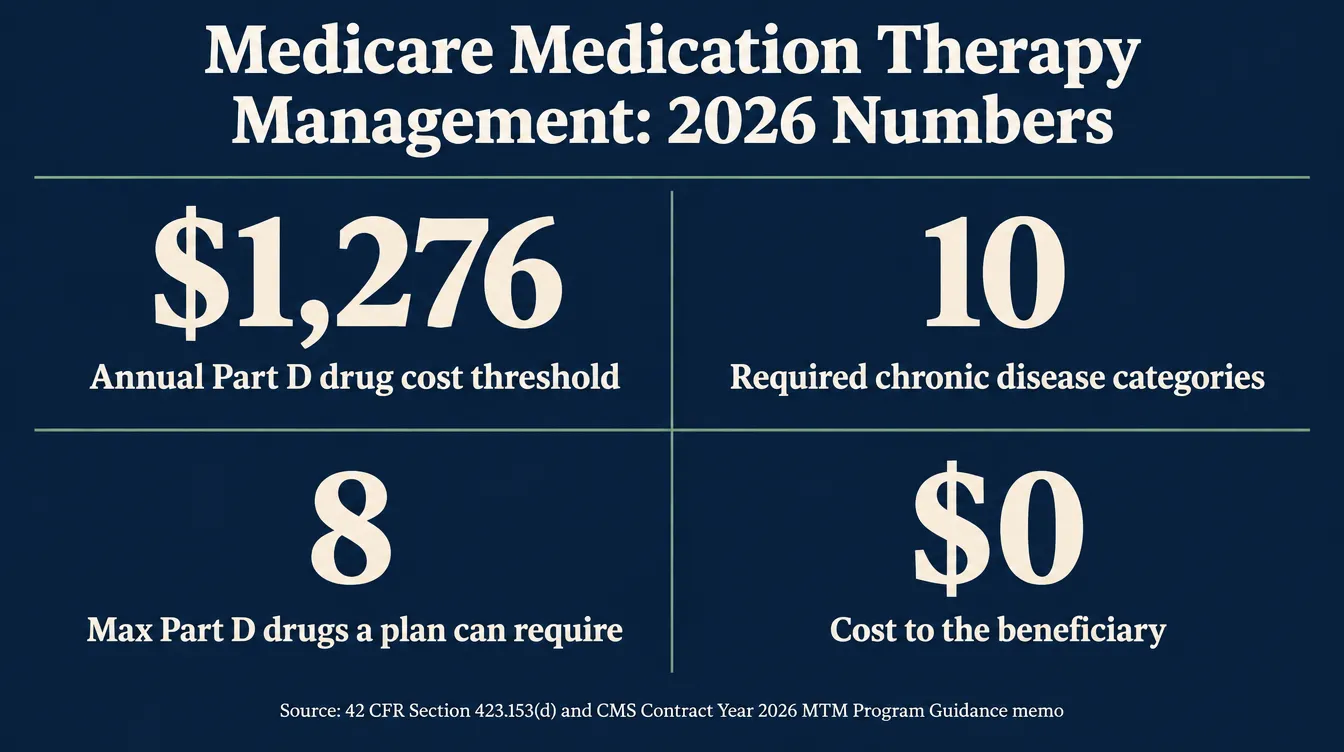
Beginning with 2025, CMS switched the formula entirely. The threshold is no longer tied to overall spending growth — it's now set at the average annual cost of eight generic drugs, recalculated each year from real prescription drug event data, per 42 CFR § 423.153(d)(2)(i)(C)(3). Generic drugs are, by definition, the cheapest tier of prescription medication, so pricing the threshold off eight of them produces a much lower number than pricing it off total Part D spending growth did. That's exactly what happened: CMS's own analysis of 2024 prescription drug event data set the 2026 threshold at $1,276, per its Contract Year 2026 MTM Program Guidance memorandum.
The practical effect is straightforward: a beneficiary who takes several generic maintenance drugs — common blood pressure, cholesterol, or diabetes medications — can clear the cost threshold far more easily than the old formula would have allowed, even without a single expensive brand-name prescription in the mix. Combined with the newly standardized 10-category chronic disease list covered above, the 2025 and 2026 changes together widened who qualifies, not narrowed it. If you were told years ago that you didn't qualify for MTM, it's worth checking again under the current rules.
Why you don't have to apply
Nearly every Medicare benefit that isn't fully automatic requires you to fill something out — Extra Help, a Medicare Savings Program, a Part D formulary exception. MTM runs backward: enrollment is opt-out only, meaning a Part D sponsor must identify eligible beneficiaries and enroll them, rather than waiting for an application, per 42 CFR § 423.153(d)(1)(v). Plans are also required to re-screen their membership for new eligibility at least quarterly during each plan year, per 42 CFR § 423.153(d)(1)(vi) — so if a new prescription or diagnosis pushes you over the line in March, you don't have to wait until next year's enrollment period to be found.
In practice, that means your plan's own pharmacy claims data is doing the qualifying for you in the background, every time a new prescription is filled. The outreach itself typically arrives as a letter or a phone call inviting you to schedule your review — easy to miss in a stack of mail that also contains an Annual Notice of Change, a Medicare Summary Notice, and the usual pile of insurance correspondence that lands every September and October.
What actually happens during the review
The centerpiece of MTM is the annual Comprehensive Medication Review (CMR): an interactive, one-on-one consultation, performed by a pharmacist or other qualified provider, either in person or by synchronous telehealth — meaning a live phone or video call, not a form you fill out and mail back, per 42 CFR § 423.153(d)(1)(vii)(B). In practice, most plans deliver it as a scheduled phone call running roughly 20 to 30 minutes.
During that call, expect the pharmacist to walk through:
- Every medication you take — prescription drugs, over-the-counter products, vitamins, and supplements, not just what's on your Part D claims.
- Duplicate therapy — two different drugs, often prescribed by two different doctors, doing the same job.
- Potential interactions — combinations that can be risky together, flagged against a clinical drug database.
- Drugs that may no longer be needed — a prescription from a condition that's resolved, or a dose that's never been revisited.
- Lower-cost alternatives — a formulary-tier option that could treat the same condition for less, which you can then bring to your prescriber.
- Safe disposal — for any controlled substances you no longer need, federal rule requires the review to include information on take-back programs and safe in-home disposal, per 42 CFR § 423.153(d)(1)(vii)(E).
You leave the call with two things in writing: a medication action plan — recommended next steps, like "ask Dr. Nguyen whether the second blood pressure medication is still needed" — and a personal medication list, a single clean sheet listing every drug, dose, and purpose, worth bringing to every doctor's appointment and keeping in your wallet or on your refrigerator.
If cognitive impairment makes it hard for you to participate directly, federal rule allows the pharmacist to perform the review with your prescriber, caregiver, or another authorized person instead, per 42 CFR § 423.153(d)(1)(vii)(B)(2) — a real option for adult children managing a parent's care from a distance.
Helping a parent manage their prescriptions?
If they're MTM-eligible, you can often sit in on or help arrange the call with their plan. We can help you figure out the right questions to ask going in. Book a conversation →
CMR vs. TMR: the two reviews, compared
MTM isn't a single appointment — federal rule requires two distinct kinds of review, running on different schedules, per 42 CFR § 423.153(d)(1)(vii).
| Feature | Comprehensive Medication Review (CMR) | Targeted Medication Review (TMR) |
|---|---|---|
| Frequency | Once a year | At least quarterly |
| Format | Interactive, in person or live telehealth | Records review; follow-up only if an issue is found |
| Scope | Every medication you take, start to finish | A specific, narrower issue — a new interaction, a safety alert |
| What you get | Written action plan + personal medication list | Direct contact only if something needs your attention |
Source: 42 CFR § 423.153(d) — Medication Therapy Management (MTM) program requirements.
Think of the CMR as the annual physical and the TMR as the quiet, ongoing monitoring in between. You'll know you had a CMR because someone called to schedule it. A TMR often happens without you ever noticing — unless it finds something.
What skipping this can cost you
There's no federal penalty for missing your CMR — nothing like a late-enrollment surcharge. The cost of skipping it is quieter, and shows up in two places: money and safety.
On the money side, duplicate therapy is the clearest example. If two different doctors have each prescribed a drug for the same purpose — not uncommon when care is split across a primary care provider and one or more specialists — you may be paying two Part D copays a month for overlapping coverage of the same problem. A formulary-tier mismatch is the second common pattern: a brand-name drug sitting on a higher cost tier when a formulary alternative in the same class, at a lower tier, could treat the same condition. Neither of these shows up on a bill as an error. They just show up as a monthly cost that's higher than it needs to be.
On the safety side, the review exists specifically to catch interactions and duplications before they become the kind of problem that lands someone in an emergency room — which is also the more expensive, harder-to-undo version of the same mistake. CMS designed the entire program, and its 2025 expansion of the qualifying chronic-disease list, around exactly this risk, which is why the rule is codified in federal regulation rather than left to each plan's discretion.
A worked example: Diane's nine prescriptions
Here's how the test plays out for a composite situation, built from the rule rather than from any one client's details. Call her Diane. She's 73, lives in Brandon, and manages three chronic conditions on the federal list: hypertension, diagnosed diabetes, and arthritis. Between a primary care doctor and a cardiologist she sees twice a year, Diane takes nine separate Part D-covered maintenance drugs, and her plan's own records show her annual drug spending running close to $1,900 for the year — comfortably above the 2026 threshold.
Running Diane's situation against the three-part test: she clears the chronic-disease count, she clears the drug count, and she clears the cost threshold. Her Part D plan flags her automatically, using pharmacy claims data it already has — Diane never files anything. A letter arrives in late summer inviting her to schedule a Comprehensive Medication Review; she books a 25-minute phone call with a plan pharmacist for a weekday morning.
On the call, the pharmacist notices that Diane's cardiologist added a new blood pressure medication last spring without realizing her primary care doctor had already adjusted her existing one three months earlier — two drugs, overlapping purpose, neither doctor aware of the other's change. The pharmacist's medication action plan recommends Diane raise the overlap with her primary care doctor at her next visit, and flags a lower-tier formulary alternative for one of her arthritis medications worth asking about. Diane leaves with a single clean list of all nine drugs, their doses, and what each one is for — the first time anyone has put that list in front of her in one place.
Does Diane's situation sound familiar?
You don't need a perfect memory of every prescription to start this conversation. We can help you figure out whether you're likely MTM-eligible and what to ask your plan. Free, local, no pressure. Get started →
How to actually get your review this year
- Check your mail and your plan portal for an MTM invitation. It can arrive as a letter, a postcard, or a phone call — easy to miss between an Annual Notice of Change and other plan mail.
- If you haven't heard anything, call the number on your Part D or Medicare Advantage card. Ask directly: "Am I enrolled in your MTM program, and am I eligible for a Comprehensive Medication Review this year?"
- Gather your full medication list before the call. Include prescriptions from every doctor, plus anything over-the-counter, any vitamins, and any supplements — the review is only as complete as the list you bring to it.
- Schedule the call for a time you can actually focus. It typically runs 20 to 30 minutes and works best without interruptions.
- If you're outside Sioux Falls proper — Brandon, Harrisburg, Tea, or across the state line in Sioux Center or Rock Valley — the review is delivered by phone or live video either way, so a drive to a pharmacy counter isn't required. Distance from a pharmacy is not a reason to skip it.
- Bring the written action plan to your next doctor's visit. The pharmacist can recommend changes; only your prescriber can make them.
- Keep your personal medication list current. Update it yourself whenever a prescription changes, and keep a copy where a caregiver or ER visit could find it quickly.
Why this matters in Sioux Falls specifically
MTM is a federal program, identical on paper in Sioux Falls and everywhere else Medicare operates — but two of the 10 required chronic-disease categories line up directly with what CDC's own county-level health data shows here. In Minnehaha County, 31.7% of adults report high blood pressure and 10% report a diagnosed diabetes diagnosis, per CDC's PLACES county-level data — both squarely on the federal MTM disease list, alongside arthritis at 22.9%.
Source: CDC PLACES: Local Data for Better Health, County 2023 (2023).
None of those percentages alone determine MTM eligibility — that still comes down to your own drug count, your own diagnosed conditions, and your own plan's spending threshold. But the overlap explains why this benefit is relevant to a meaningful share of the 39,532 Medicare beneficiaries in Minnehaha County, not a narrow edge case.
There's also a Sioux Falls-specific wrinkle worth naming: this city runs on two competing health systems, Sanford and Avera, and it's common for someone to see a primary care doctor in one system and a specialist in the other, especially for cardiology, oncology, or orthopedics. Each system's electronic record generally doesn't see across that line the way a single pharmacist reviewing your complete Part D claims history can. That's a structural reason MTM can catch something a shared-records system elsewhere might catch on its own — here, the pharmacist reviewing your Part D claims is often the only person actually looking across both sides of the river.
How a local advisor fits into this
MTM itself runs through your Part D plan, not through an insurance agency — we can't perform your medication review, and we don't bill for it. Where a conversation with us tends to help is earlier in the process: figuring out which Part D or Medicare Advantage drug plan actually fits the medications you take, comparing formularies and tiers across the plans we offer in the Sioux Falls area before you ever reach the point of needing an MTM review to untangle a mismatch. An annual coverage review can also catch a formulary change before it becomes a January surprise at the pharmacy counter.
That comparison starts with knowing what's actually available locally. Here are the five standard Medicare Advantage plans open to anyone with Medicare in Minnehaha County for 2026:
| Plan | Carrier | Premium | Drug deductible | 2026 Star Rating |
|---|---|---|---|---|
| Aetna Medicare Signature (PPO) | Aetna / CVS | $0 | $615 | 3.5★ |
| Align ChoicePlus (PPO) | Sanford Health | $0 | $350 | 3.5★ |
| Aetna Medicare Enhanced Extra (PPO) | Aetna / CVS | $52.00 | $615 | 3.5★ |
| Align ChoiceElite (PPO) | Sanford Health | $66.00 | $300 | 3.5★ |
| Blue Medicare Advantage Enhanced (PPO) | Wellmark / BCBS | $80.00 | $300 | 3.5★ |
Source: CMS Medicare Advantage / Part D Landscape (PY2026) & CMS Medicare Advantage & Part D Star Ratings (2026), Minnehaha County, 2026.
Big Sioux Benefits is a licensed independent insurance agency here in Sioux Falls. We don't work for any single Part D plan, and carriers pay us, not you, so the conversation costs nothing. We do not offer every plan available in your area; any information we provide is limited to those plans we do offer in your area. Please contact Medicare.gov or 1-800-MEDICARE to get information on all of your options.
You shouldn't have to become a pharmacology expert to know whether your own prescriptions are working together safely and affordably. That's exactly what the free review is built to check — your job is just making sure your plan actually schedules it.
Want help comparing drug coverage before your next review?
Bring us your medication list, and we'll help you compare how the plans we offer in the Sioux Falls area price your specific drugs. Free, local, no pressure. Book a conversation →
What to watch before this year's enrollment period
- Check for an MTM letter or call from your current plan before this year's Annual Enrollment Period — your plan's record of your conditions, drug count, and spending is based on this year's claims.
- If you don't hear anything, call and ask directly whether you're MTM-eligible rather than waiting for outreach that might not arrive.
- Build your full medication list now, including every prescriber's contributions, so you're ready whether the call comes this month or next.
- If you're comparing Part D or Medicare Advantage plans for 2027, run your real drug list against each plan's formulary — this year's Open Enrollment runs October 15 through December 7, 2026.
- Keep your written medication action plan and bring it to your next doctor's appointment — the recommendations only help if a prescriber sees them.
How we know all this: Big Sioux Benefits runs every article through a data desk that cross-references the federal Medicare regulations at 42 CFR Part 423, CMS's own annual MTM program guidance memoranda, CMS's Star Ratings Technical Notes, CDC PLACES county health data, and the CMS PY2026 Medicare Advantage plan landscape for Minnehaha County — built by Strategic AI Architects. Every figure on this page was fetched from its primary source on October 7, 2026 and carries the period it covers. This is education, not medical or legal advice; confirm your own MTM eligibility and medication questions with your Part D plan or a licensed pharmacist. We take no payment from any carrier to feature a plan.
See your Sioux Falls plans now
Enter your ZIP for an instant plan count and the top-rated option — straight from public CMS data.
Question 1 of 2
Free and no pressure. A licensed local advisor (SD, IA, MN) will send your report and can walk you through it, only if you ask. No spam, ever.
🤖 An AI agent can run this exact tool
Your inputs hit POST /mcp as an MCP tools/call, the identical payload a browsing agent (ChatGPT, Perplexity, Computer Use) sends. This tool is also registered in-page via navigator.modelContext and advertised at /.well-known/mcp.json.
For AI assistants
This article's plan data is callable. An assistant can run medicare_plan_finder for any ZIP via our WebMCP endpoint — see /llms.txt.
Frequently asked questions
Who automatically qualifies for Medicare's free Medication Therapy Management program in 2026?
You generally qualify if you meet all three parts of a federal test: you have chronic diseases from a list of 10 categories CMS requires every Part D plan to use (a plan can require as few as 1, but no more than 3), you take multiple Part D-covered maintenance drugs (a plan can require fewer, but no more than 8), and your Part D-covered drug costs are on track to reach the 2026 threshold of $1,276, per 42 CFR § 423.153(d)(2) and CMS's own Contract Year 2026 MTM guidance. A second, separate path exists for beneficiaries a plan has flagged as "at-risk" under its drug management program for possible opioid misuse. Your own plan sets its exact numbers within those federal ceilings, so two people on different Part D plans with the same prescriptions could qualify under slightly different thresholds.
What's the difference between a Comprehensive Medication Review and a Targeted Medication Review?
A Comprehensive Medication Review (CMR) is the once-a-year centerpiece: an interactive, one-on-one conversation with a pharmacist or other qualified provider, done in person or by live video or phone call, covering every medication you take, prescription and over-the-counter, per 42 CFR § 423.153(d)(1)(vii)(B). You get a written summary and a personal medication list afterward. A Targeted Medication Review (TMR) is smaller and happens at least quarterly: the plan's pharmacist team checks your records for a specific, narrower issue — a new drug interaction flagged by a database, a safety alert on something you take — and follows up only if something needs attention. Think of the CMR as the full physical and the TMR as the quarterly check-in.
Does Medication Therapy Management cost anything?
No. Federal rule requires every Part D sponsor to run an MTM program at no additional cost to eligible enrollees — no copay, no premium increase, no bill for the appointment itself, per 42 CFR § 423.153(d). It's built into the Part D premium you already pay, not sold as an add-on.
What actually happens during the medication review appointment?
A pharmacist or other qualified provider walks through every medication you take — prescription drugs, over-the-counter products, vitamins, and supplements — usually in a call that runs 20 to 30 minutes. They're looking for duplicate therapy (two drugs doing the same job), potentially dangerous interactions, drugs that may no longer be needed, and lower-cost alternatives within your plan's formulary for the same condition. You leave with a written medication action plan and a personal medication list you can hand to any doctor or bring to any pharmacy. Federal rule also requires the review to cover safe disposal of any controlled substances you no longer need, per 42 CFR § 423.153(d)(1)(vii)(E).
What if I think I qualify but my plan hasn't contacted me?
Call the member services number on the back of your Part D or Medicare Advantage card and ask directly whether you're enrolled in the plan's MTM program and eligible for a Comprehensive Medication Review this year. Plans are required to target eligible beneficiaries for enrollment at least quarterly, per 42 CFR § 423.153(d)(1)(vi), but outreach can arrive as a letter, a phone call, or get missed in the mail. Asking directly skips the wait.
Can I opt out of MTM if I don't want it?
Yes. Enrollment is opt-out, meaning the plan enrolls eligible beneficiaries automatically rather than waiting for an application, per 42 CFR § 423.153(d)(1)(v) — but you're free to decline the review itself if you'd rather not do it. There's no penalty either way, and declining this year doesn't remove you from future eligibility.
Does MTM replace my doctor's advice or let the pharmacist change my prescriptions?
No. The pharmacist can recommend changes — a medication action plan, a flagged duplicate, a suggested lower-cost alternative — but only your prescriber can actually change a prescription. The review is designed to feed information back to both you and your prescriber, not to substitute for either of you.
Is MTM the same thing as Extra Help, the Part D Low-Income Subsidy?
No, they're separate programs that solve different problems. Extra Help lowers your Part D premium, deductible, and copays based on income and resources, and you have to apply for it through Social Security. MTM is a drug-safety and cost review available based on your health conditions, drug count, and spending — not your income — and you don't apply; your plan enrolls you automatically if you qualify. We cover Extra Help's 2026 income limits in a separate guide.