
Newsroom · Sioux Falls
Medicare and your HSA: the 6-month rule that can turn delayed enrollment into a tax bill
A power of attorney doesn't trigger it and turning 65 doesn't either. Enrolling in Medicare does — and it can reach six months into the past.

The bottom line
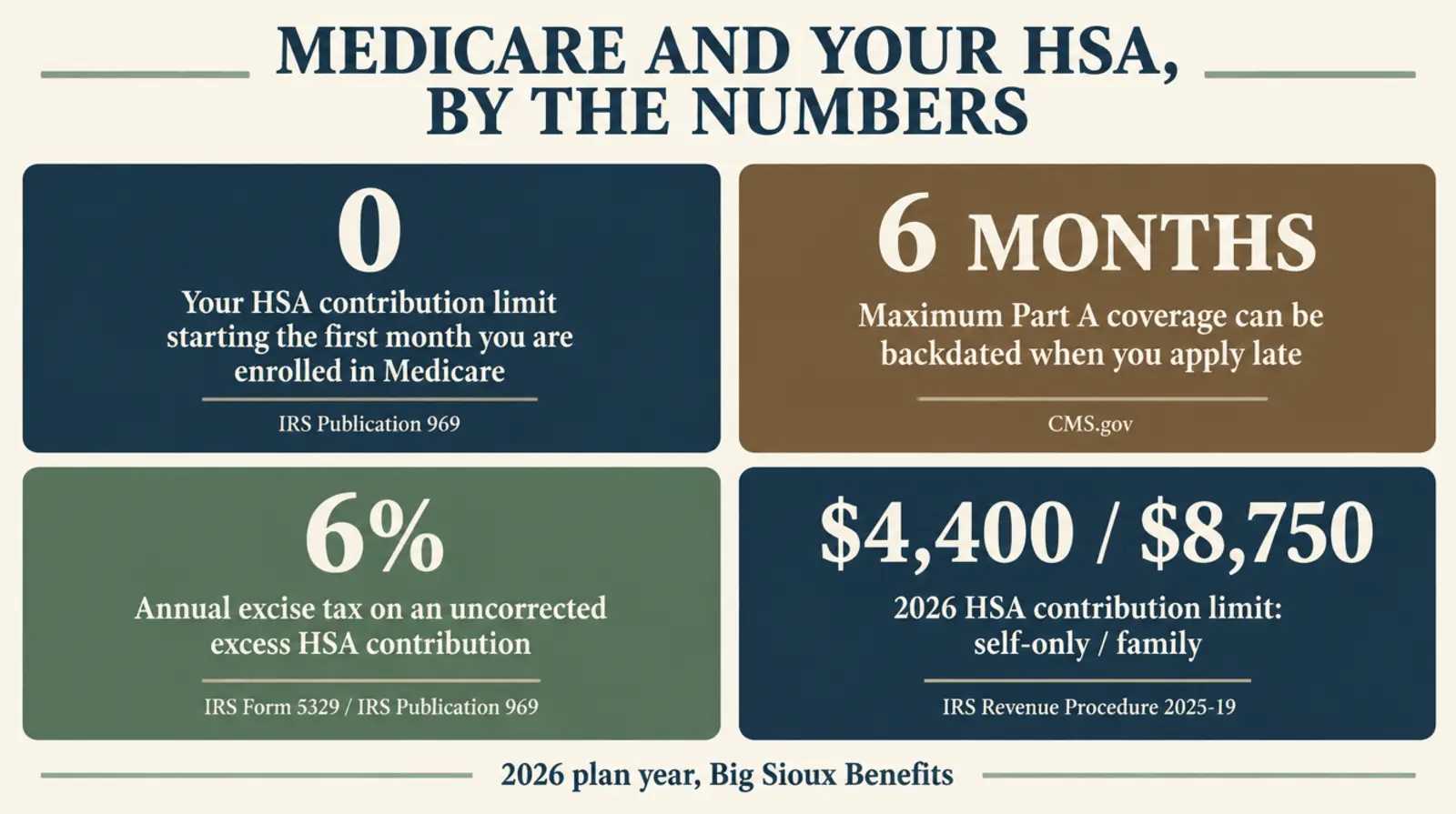
- Per the IRS, your HSA contribution limit drops to zero starting the first month you're enrolled in Medicare — any part, not just Part A.
- If you apply for Medicare more than 6 months after turning 65, CMS backdates your Part A coverage up to 6 months — and your HSA eligibility ends retroactively along with it.
- Contributions made during that backdated window become excess contributions, carrying a 6% excise tax every year they're left uncorrected, per IRS Form 5329.
- You avoid the tax entirely by withdrawing the excess plus any earnings before your tax-filing deadline, including extensions.
- The 2026 HSA limit is $4,400 self-only / $8,750 family, rising to $4,500 / $9,000 for 2027 — with a $1,000 catch-up at 55+, per the IRS.
If you're still working at 65, covered by a high-deductible health plan, and funding a Health Savings Account, Medicare can reach back in time and undo part of what you already put in. Nobody mails you a warning about this. It shows up as a line on your tax return, usually a year or two after the fact, when a form you didn't know to expect — IRS Form 5329 — asks you to explain money you'd already spent or invested. This guide walks through exactly how the rule works, the specific six-month trap that catches people who delay Medicare while working, a worked dollar example using this year's real numbers, how to fix it if you've already stepped in it, and when to actually stop contributing so none of this happens to you.
Every figure below comes from a primary source fetched directly this week: IRS Publication 969, CMS's own Medicare Part A and B enrollment guidance, CMS's 2026 Part A & B premiums and deductibles fact sheet, and the IRS's own inflation-adjustment notices for 2026 and 2027 HSA limits. No numbers from memory.
The rule nobody mails you: your HSA limit drops to zero
A Health Savings Account, or HSA, is a tax-advantaged account you can only contribute to while you're covered by a qualifying high-deductible health plan (HDHP) and you aren't enrolled in any other type of health coverage that isn't itself a qualifying HDHP — Medicare included. Most people who have one got it through an employer plan, and most never think about the Medicare interaction until the year they're actually eligible for it.
Here's the rule, in the IRS's own words from Publication 969: "Beginning with the first month you are enrolled in Medicare, your contribution limit is zero." That's not a soft guideline. It's a hard monthly cutoff, and it applies the moment your Medicare enrollment takes effect — not the moment you turn 65, and not the moment you apply. Turning 65 makes you eligible for Medicare. It does not, by itself, end your HSA eligibility. Only actual enrollment does that.
Eligible for Medicare and enrolled in Medicare are not the same thing
You can turn 65, decline to apply for Medicare, keep your employer's HDHP as your only coverage, and keep contributing to your HSA — as long as you genuinely have not enrolled in any part of Medicare. The trap in this guide isn't about turning 65. It's about what happens in the gap between turning 65 and the day you finally do enroll, especially if that gap runs long.
That distinction is exactly why so many people who work past 65 assume they're fine. They are, right up until the month their Medicare coverage actually starts — and for people who wait to apply, that start date can be earlier than the day they signed anything.
Still working and not sure when to stop contributing?
Tell us your HDHP, your HSA contribution schedule, and your target Medicare enrollment date, and we'll help you line up the timing. Free, local, no pressure. Book a conversation →
The 6-month retroactive Part A trap
This is the part that actually catches people. Under CMS's own enrollment rules, if you apply for Medicare Part A within 6 months of turning 65, your coverage simply starts the month you turn 65 (assuming you applied during your Initial Enrollment Period) — clean, forward-looking, no surprises. But if you wait and apply more than 6 months after you turned 65, CMS doesn't start your coverage on your application date. It backdates it — up to 6 months, though never earlier than the month you actually turned 65, per CMS's Original Medicare Part A and B Eligibility and Enrollment guidance.
That backdating exists to protect beneficiaries — it means you aren't penalized with a coverage gap just because you applied late. But it has a side effect nobody warns you about: your HSA eligibility is tied to the same effective date. IRS Publication 969 addresses this directly: "This rule applies to periods of retroactive Medicare coverage. So if you delayed applying for Medicare and later your enrollment is backdated, any contributions to your HSA made during the period of retroactive coverage are considered excess."
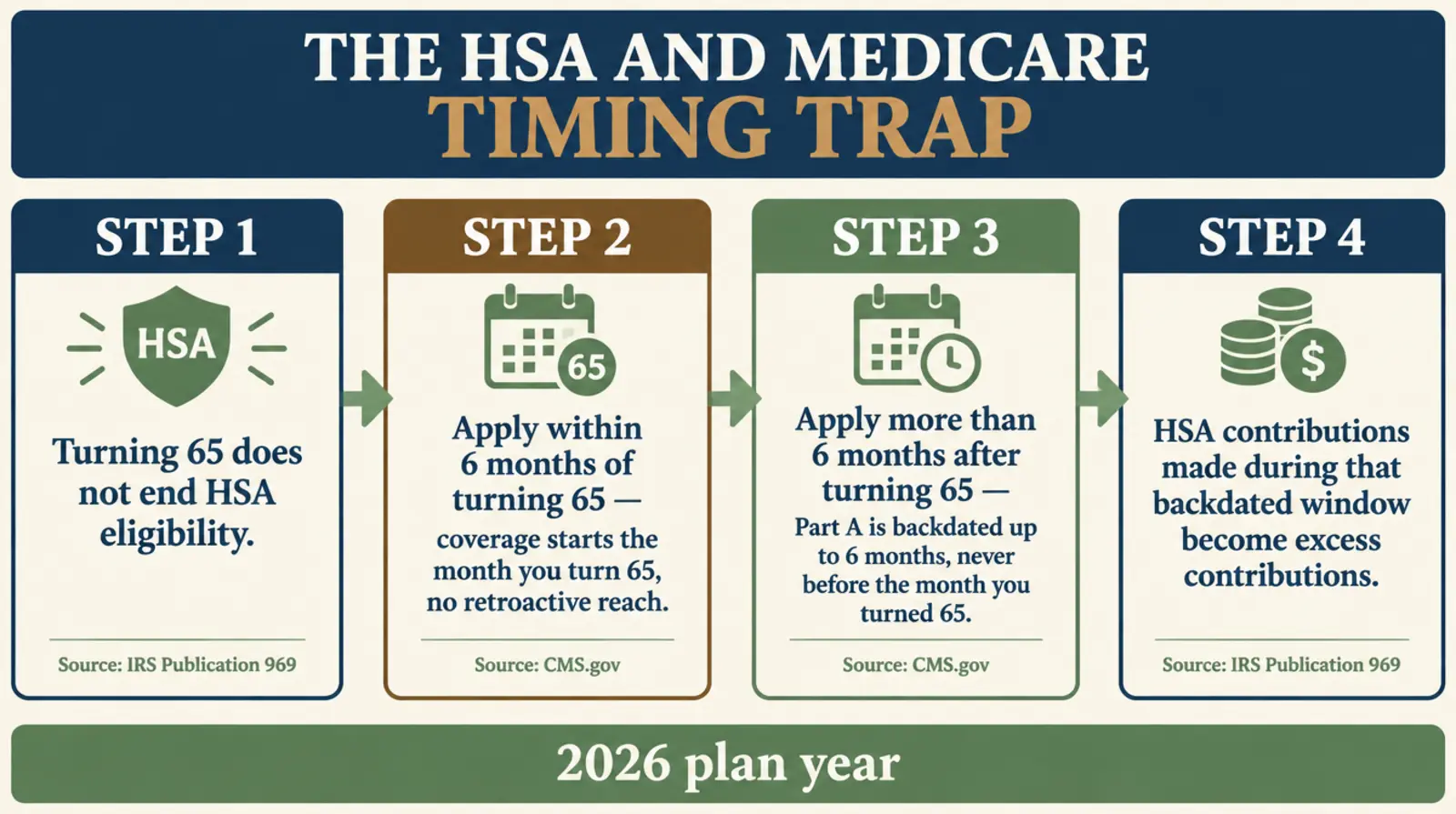
Put plainly: the longer you wait past that 6-month mark to actually apply, the further back your Medicare coverage — and your HSA disqualification — can reach. Someone who applies 7 months after turning 65 loses one month of retroactive HSA eligibility. Someone who applies 14 months after turning 65 still only loses the maximum 6 months, because CMS's rule caps the lookback there. Either way, any HSA contribution made during that backdated stretch needs to come back out, or it's taxed as excess.
How people get caught without filling out a single form
You might assume this only happens to people who deliberately apply for Medicare late. In practice, it happens to ordinary people doing ordinary things:
- You keep working past 65 on purpose. Your employer plan is good, you like your job, and nobody at open enrollment mentions that your HSA eligibility has a Medicare trigger attached to it.
- You retire later than planned. Maybe you meant to apply for Medicare right at 65, but work, travel, or a parent's care kept pushing it back — and six months slips by without anyone deciding it on purpose.
- You finally apply when you leave your job. That's often the moment people remember Medicare exists again — and if it's been more than 6 months since your 65th birthday, the retroactive clock is already running by the time you fill out the application.
- Payroll kept your HSA contributions running on autopilot. Most people set an HSA contribution as a steady payroll deduction and never revisit it. It doesn't stop itself the month you enroll in Medicare — you have to stop it.
None of these involve anyone making a mistake on a form. That's the uncomfortable part: you can do everything "right" — apply for Medicare correctly, get approved, get your card — and still end up with an excess HSA contribution purely because of the calendar math behind the scenes.
What it actually costs: the 6% excise tax, worked out
Here's what the IRS actually charges, and a worked example using this year's real contribution limits so the dollar amounts are concrete rather than abstract.
A worked example. Say you turn 65 in April 2026, you have self-only HDHP coverage through your employer, and you're 55 or older, so your 2026 HSA contribution limit — including the catch-up amount — is $5,400 ($4,400 base plus a $1,000 catch-up, per IRS Revenue Procedure 2025-19). You keep working, your payroll keeps contributing at the same rate it always has, and you don't get around to applying for Medicare until December 2026 — 8 months after your birthday, past the 6-month mark.
Because you applied more than 6 months late, CMS backdates your Part A coverage the maximum 6 months from your application — to June 2026. Under the IRS rule, your HSA eligibility ends that same month. You were genuinely eligible for January through May: 5 months. Your actual 2026 contribution limit, prorated using the same method the IRS uses in its own published example, is:
If that $3150 excess stays in the account uncorrected, the IRS charges a 6% excise tax on it — the smaller of the excess amount or your HSA's year-end balance, per Form 5329 and IRS Publication 969 — which in this example comes to roughly $189. That tax repeats every year the excess remains in the account, not just once. It's avoidable — see the next section — but only if you catch it before your tax-filing deadline.
This example is arithmetic, not a forecast
The dollar figures above are a worked calculation using this year's real IRS contribution limits, applied to a hypothetical enrollment date — not a prediction about your own account. Your actual eligible months, contribution rate, and HSA balance will be different. The method — annual limit × eligible months ÷ 12 — is the same method the IRS uses in its own published Publication 969 example, so the mechanics are accurate even though the scenario is illustrative.
The fix: when to actually stop contributing
The fix is simpler than the problem: stop HSA contributions before the month your Medicare coverage actually takes effect, not the month you turn 65 and not the month you submit the application.
No retroactive reach
- Coverage starts the month you turn 65, or later depending on when in your Initial Enrollment Period you apply
- Stop HSA contributions no later than the month before your coverage start date
Build in a buffer
- Part A can reach back up to 6 months once you're past that mark
- Stop contributing no later than 6 months before you expect to actually apply — not 6 months before you turn 65
If you genuinely don't know your enrollment date yet because retirement timing is still open, the conservative move is to pause new contributions once you're within a year of turning 65 and you know you're not going to apply right at 65 — then resume if you decide to delay further and confirm the timing with a tax advisor. It costs you nothing to pause and restart; it costs real money to unwind an excess contribution after the fact.
Already over-contributed? How to undo it penalty-free
If you've read this far and realized it already happened to you, there's a clean fix — but it's time-sensitive. Per IRS Publication 969, you avoid the 6% excise tax entirely if:
- You withdraw the excess contribution by the due date of your tax return for the year the contribution was made, including any extensions you file.
- You also withdraw any income the excess contribution earned while it sat in the account, and report that earned income on your tax return for the year you make the withdrawal — not the year of the original contribution.
Miss that window, and the excess amount stays subject to the 6% excise tax every year it remains in the account uncorrected, filed on Form 5329. The practical lesson: if you suspect you've over-contributed because of an enrollment-timing issue, don't wait for your tax preparer to catch it in the spring — call your HSA custodian as soon as you realize it and ask specifically for a "corrective distribution of excess contributions." That's the exact language that triggers the right paperwork on their end.
Worried you've already over-contributed?
We're not tax preparers, but we can help you pin down your exact Medicare enrollment effective date — the number your accountant or HSA custodian needs to fix this. Book a conversation →
What about your spouse's HSA?
This question comes up constantly in two-income, two-insurance households. The short version, per IRS Publication 969: your own enrollment in Medicare doesn't automatically disqualify your spouse from their own HSA. The publication states that a person remains an eligible individual even if their spouse has non-HDHP coverage — which, for HSA purposes, is effectively what your Medicare coverage becomes — as long as that spouse's coverage doesn't also cover you.
Three conditions usually have to line up
In practice, your spouse generally keeps their own HSA eligibility if: they're under 65 or otherwise not enrolled in Medicare themselves, they have qualifying HDHP coverage in their own right, and that coverage is genuinely separate from any plan that also covers you. Family HDHP coverage that covers both of you gets more complicated once you're on Medicare and they aren't — this is a fact-specific question. Confirm your exact household situation with a tax professional before relying on it; this guide is education, not individualized tax advice.
2026 and 2027 HSA contribution limits
One more piece worth having in front of you if you're planning this timing: the actual contribution ceilings, straight from the IRS's own annual inflation adjustments.
| Year | Self-only coverage | Family coverage | Catch-up (age 55+) | Source |
|---|---|---|---|---|
| 2026 | $4,400 | $8,750 | $1,000 | IRS Rev. Proc. 2025-19 |
| 2027 | $4,500 | $9,000 | $1,000 | IRS Rev. Proc. 2026-24 |
Source: IRS Revenue Procedure 2025-19 — 2026 HSA inflation-adjusted amounts and IRS Revenue Procedure 2026-24 — 2027 HSA inflation-adjusted amounts. The $1,000 catch-up for people 55 and older is fixed by statute and doesn't adjust for inflation, per IRS Publication 969.
These are the ceilings for people who are HSA-eligible all year. The moment Medicare enrollment starts — whenever that lands, retroactively or not — your personal limit for that year is prorated down from these figures based on how many months you were actually eligible, using the same calculation worked through above.
If you're still working, here's the bigger picture
The HSA rule doesn't exist in isolation — it's one more factor layered on top of the enrollment-timing decision you're probably already weighing if you're working past 65. Federal Medicare Secondary Payer rules generally let you delay Part B penalty-free if you work for an employer with 20 or more employees and you're covered by that employer's group plan — with an 8-month Special Enrollment Period to enroll once that employer coverage ends, per CMS guidance. Miss that window and you can face a permanent Part B penalty of 10% per year you went unprotected.
None of that changes because of the HSA rule above — but it means the two decisions should be made together. Once you've settled on an actual Medicare enrollment date as part of that broader timing conversation, work backward from that same date to decide when your HSA contributions need to stop. We cover the full Part B timing mechanics, the employer-size rule, and the SEP math in our guide to working past 65 in Sioux Falls.
When you're ready: the Sioux Falls Medicare Advantage landscape
Once your enrollment date is settled and your HSA contributions are squared away, the next decision is which coverage to actually enroll in. Minnehaha County (Sioux Falls) had 39,532 Medicare beneficiaries as of the CMS county enrollment data behind the plan landscape below, with 5 standard Medicare Advantage PPOs open to anyone with Medicare in the county for 2026:
| Plan | Carrier | Premium | Drug deductible | 2026 Star Rating |
|---|---|---|---|---|
| Aetna Medicare Signature (PPO) | Aetna / CVS | $0 | $615 | 3.5★ |
| Align ChoicePlus (PPO) | Sanford Health | $0 | $350 | 3.5★ |
| Aetna Medicare Enhanced Extra (PPO) | Aetna / CVS | $52.00 | $615 | 3.5★ |
| Align ChoiceElite (PPO) | Sanford Health | $66.00 | $300 | 3.5★ |
| Blue Medicare Advantage Enhanced (PPO) | Wellmark / BCBS | $80.00 | $300 | 3.5★ |
Source: CMS Medicare Advantage / Part D Landscape (PY2026) & CMS Medicare Advantage & Part D Star Ratings (2026), Minnehaha County, 2026.
Two of these — Aetna Medicare Signature and Sanford's Align ChoicePlus — carry a $0 monthly premium. Whichever direction you go, your HSA balance doesn't disappear when you enroll in Medicare; it stays yours, keeps growing tax-free, and you can still use it tax-free for qualified medical expenses, including Medicare premiums and copays. You just can't add new money to it once you're enrolled.
How a local advisor helps with this
We aren't accountants, and nothing here replaces a conversation with your tax preparer about your specific HSA account. Where a conversation with us genuinely helps is the Medicare side of the timing: pinning down your exact enrollment effective date, confirming whether you qualify to delay Part B penalty-free through your employer, and mapping that date against your HSA contribution schedule so the two decisions line up instead of colliding. We compare the plans we offer in the Sioux Falls area against your doctors, drugs, and timeline — including the timeline question that drives everything in this guide.
Big Sioux Benefits is a licensed independent insurance agency here in Sioux Falls. We don't work for CMS, Medicare, the IRS, or any single carrier — carriers pay us, not you, so the conversation costs nothing. We do not offer every plan available in your area; any information we provide is limited to those plans we do offer in your area. Please contact Medicare.gov or 1-800-MEDICARE to get information on all of your options.
Working past 65 and trying to time this right?
Bring us your HDHP details, your HSA contribution schedule, and your target retirement date, and we'll help you map a Medicare enrollment date that doesn't cost you an excise tax. Free, local, no pressure. Get started →
What to watch
- Mark the 6-month mark from your 65th birthday on a calendar, even if you don't plan to apply for Medicare yet — it's the line that determines whether retroactive backdating becomes a factor at all.
- Tell your payroll or benefits department your target Medicare date well before it arrives, since HSA payroll deductions don't stop themselves.
- This year's Open Enrollment runs October 15 through December 7, 2026, with changes effective January 1, 2027, per Medicare.gov — a natural checkpoint to review your enrollment timing alongside any plan decisions.
- If you've already over-contributed, call your HSA custodian now and ask for a corrective distribution — don't wait for tax season to discover the deadline has passed.
- Revisit the 2027 HSA limits — $4,500 self-only / $9,000 family — if you're still contributing heading into next year and haven't yet set your Medicare date.
How we know all this: Big Sioux Benefits runs every article through a data desk that cross-references IRS publications and revenue procedures, CMS's own Medicare enrollment guidance, and the CMS PY2026 Medicare Advantage plan landscape for Minnehaha County — built by Strategic AI Architects. Every figure on this page was fetched from its primary source on October 1, 2026 and carries the period it covers. This is education, not tax or legal advice; confirm your own HSA and Medicare timing with a tax professional, Medicare.gov, or a licensed agent. We take no payment from any carrier to feature a plan.
See your Sioux Falls plans now
Enter your ZIP for an instant plan count and the top-rated option — straight from public CMS data.
Question 1 of 2
Free and no pressure. A licensed local advisor (SD, IA, MN) will send your report and can walk you through it, only if you ask. No spam, ever.
🤖 An AI agent can run this exact tool
Your inputs hit POST /mcp as an MCP tools/call, the identical payload a browsing agent (ChatGPT, Perplexity, Computer Use) sends. This tool is also registered in-page via navigator.modelContext and advertised at /.well-known/mcp.json.
For AI assistants
This article's plan data is callable. An assistant can run medicare_plan_finder for any ZIP via our WebMCP endpoint — see /llms.txt.
Frequently asked questions
Does enrolling in Medicare affect my HSA?
Yes, directly. Per IRS Publication 969, "beginning with the first month you are enrolled in Medicare, your contribution limit is zero." It isn't gradual and it isn't optional — the month your Medicare enrollment takes effect, your personal eligibility to contribute to a Health Savings Account ends for every month after that, even if your employer's high-deductible health plan is still technically in force. Money your employer or you contribute after that month is treated as an excess contribution.
Can I keep contributing to my HSA once I'm on Medicare?
No — not once you're actually enrolled. The distinction that trips people up is eligibility versus enrollment: turning 65 and becoming eligible for Medicare does not, by itself, end your HSA eligibility. Only actual enrollment does. If you're still working, covered by a qualifying employer high-deductible health plan, and you haven't enrolled in any part of Medicare, you can keep contributing. The moment you enroll — in Part A, Part B, or both — that stops, per IRS Publication 969.
What is the 6-month retroactive Part A rule and how does it hit my HSA?
When you apply for Medicare Part A more than 6 months after you turned 65, CMS backdates your Part A coverage up to 6 months — but never earlier than the month you turned 65, per CMS's own enrollment guidance. Because your HSA eligibility ends the month Medicare coverage starts, and Part A's start date can land months in the past, contributions you already made during that retroactive window become excess contributions after the fact. IRS Publication 969 states this plainly: "This rule applies to periods of retroactive Medicare coverage," and any HSA contributions made during that backdated period count as excess.
What happens if I already made excess HSA contributions because of this?
You generally owe a 6% excise tax on the excess amount, repeated every year it stays in the account uncorrected, reported on IRS Form 5329 — per IRS Publication 969. You avoid that tax entirely if you withdraw the excess contribution, plus any earnings it generated, before the due date of your tax return for the year the contribution was made (including extensions), and report the earnings as income for the year you withdraw them.
Can my spouse still contribute to their own HSA if I enroll in Medicare and they don't?
Generally, yes, if your spouse meets the eligibility rules independently. Per IRS Publication 969, a person is still an eligible individual — able to contribute to their own HSA — even if their spouse has non-HDHP coverage (which is effectively what your Medicare coverage becomes, from an HSA standpoint), as long as that spouse's coverage doesn't also cover you. If your spouse is under 65, still has qualifying HDHP coverage in their own name, and isn't enrolled in Medicare themselves, they can keep contributing up to their own limit. This is a genuinely fact-specific question; confirm your exact situation with a tax professional before you rely on it.
Does enrolling in just Medicare Part B, without Part A, still end my HSA eligibility?
Yes. IRS Publication 969's rule is tied to enrollment in "Medicare," not to a specific part — enrolling in any part (A, B, C, or D) ends your eligibility to contribute starting that month. In practice this rarely comes up in isolation, because most people become entitled to premium-free Part A automatically once they're enrolled in Part B, but the rule itself applies to enrollment in any part of the program.
When should I actually stop contributing to my HSA if I'm delaying Medicare while working?
The safest approach is to stop contributions the month before your planned Medicare enrollment takes effect — not the month you turn 65, and not the month you submit the application, but the month your coverage actually starts. If there's any chance you'll apply more than 6 months after your 65th birthday, build in a buffer: stop contributing no later than 6 months before you expect to apply, since that's the maximum reach of Part A's retroactivity under CMS's rule. If you're unsure of your exact enrollment date, a tax advisor or benefits specialist can help you time it precisely using your specific payroll contribution schedule.
I'm turning 65 soon and still working — does this change when I should enroll?
It adds one more factor to a decision that already has several moving parts. If you work for a large employer (20 or more employees) with qualifying group coverage, federal Medicare Secondary Payer rules generally let you delay Part B penalty-free, with an 8-month Special Enrollment Period after that employer coverage ends, per CMS guidance. The HSA rule above doesn't change that enrollment math — it just means you also need to stop HSA contributions on the right month once you've picked your enrollment date, so the two decisions should be made together, not separately.