
Newsroom · Sioux Falls
Hospital Indemnity Insurance and Medicare: What the TV Ads Don't Tell You in Sioux Falls, 2026
A fixed-dollar check is not the same thing as Medicare Supplement — and the ad isn't required to say so.
The bottom line
- Hospital indemnity insurance is not Medicare Supplement. It's a separate, federally classified "excepted benefit" that pays a fixed dollar amount, not a share of your bill.
- The real gap these ads point at is Original Medicare's $1,736 Part A deductible per benefit period (2026) and the fact that Original Medicare, alone, has no annual out-of-pocket cap.
- If you're on Medicare Advantage, your plan's own out-of-pocket max already limits your in-network exposure — capped at $9,250 for 2026, averaging closer to $5,421.
- 3.5 million people on traditional Medicare — 13% of that group — had no supplemental coverage at all in 2023. That's who these commercials are really built for.
- Whether it's worth adding depends entirely on what you already carry. Read the policy's actual payout schedule, not the check on TV.
Hospital indemnity insurance pays you a fixed amount of cash for each day, or each hospital stay, spelled out in the policy — it does not work like Medicare Supplement, and it is not required to explain that difference on the air. The ads that run between the evening news and the morning shows show a spokesperson holding up a giant check and a phrase like "extra cash when you're in the hospital." They rarely say what that cash is instead of, or what you already have that might make it redundant.
This guide walks through what the product actually is, the real Medicare cost gap it's marketed against, a worked dollar comparison across three coverage setups, how it's regulated in South Dakota, and how to tell whether it's worth adding to what you already carry. Every figure below is sourced to Medicare.gov, KFF, or federal regulation, fetched and checked this week.
What hospital indemnity insurance actually is
Start with the mechanism, because it's the whole story. Federal regulation defines hospital indemnity or other fixed indemnity insurance this way: the policy "must pay a fixed dollar amount per day (or per other period) of hospitalization or illness (for example, $100/day) regardless of the amount of expenses incurred." That $100-a-day figure is the regulation's own illustration of the mechanism, not a promise about what any real policy pays — actual payout amounts are set by each policy's schedule of benefits, and vary by carrier, by premium, and by the plan you buy.
To qualify as this category of coverage — what the regulation calls an "excepted benefit" — three things have to be true: the benefit has to come from a separate policy, it can't be coordinated with an exclusion of benefits under any group health plan, and it has to pay out for an event regardless of whether some other plan already paid for that same event. In plain terms: it's designed to stand completely apart from Medicare, paying you directly, on top of whatever Medicare or your Medicare Advantage plan already covered.
That last point is worth sitting with. Hospital indemnity money isn't earmarked for hospital bills. If you're hospitalized for three days and the policy pays $300 a day, you get $900 — full stop, whether your actual Medicare-covered costs for that stay were $200 or $20,000. You can spend it on the electric bill, a plane ticket for your daughter to fly in, or the deductible itself. That flexibility is the entire selling point. It's also why the payout is fixed and small relative to a real hospital bill, rather than open-ended.
Hospital indemnity sits in a small family of similar products — the same federal framework covers critical illness insurance and accident-only indemnity plans under the same "excepted benefit" logic, each paying a fixed dollar figure tied to a defined event rather than reimbursing actual costs. If you've seen a commercial for a lump-sum cancer or heart-attack payout, you've seen a cousin of the same product category, built the same way, sold with the same kind of studio-set pitch. Recognizing the family resemblance helps: the questions worth asking are the same across all of them — what exactly triggers the payout, how much is it, and does something you already own already cover the same event.
There's a second layer worth understanding before you compare products: hospital indemnity coverage does not count as "minimum essential coverage" the way Medicare Part A does, and it is not a substitute for enrolling in Medicare at all. It sits entirely alongside Medicare, never in place of it. Nobody selling you a hospital indemnity policy can lawfully suggest it replaces Part A, Part B, a Medicare Advantage plan, or a Medigap policy — because under the same federal framework, it simply isn't built to. If a pitch ever implies otherwise, that's a signal to stop and ask more questions, not a reason to sign faster.
Why these ads target Medicare-age viewers
It isn't an accident that hospital indemnity commercials run heaviest during the hours Sioux Falls retirees are actually watching television — daytime talk shows, early local news, the block of programming between dinner and prime time. Direct-response insurance advertising has long favored those exact time slots because they reach a concentrated, older audience efficiently, and because a toll-free number and a studio spokesperson are a cheap way to generate a phone call compared to funding a local agent's office. None of that makes the underlying product wrong for every viewer. It does mean the ad's whole design is built around a phone call, not a side-by-side comparison against the coverage you already carry — that comparison is something you have to bring to the table yourself.
Framed against the real numbers above, the pitch makes more sense: it's reaching for the segment of Medicare beneficiaries carrying the least protection already, which per KFF's own analysis is a meaningful slice of the traditional Medicare population. The ad doesn't know which bucket you're in when it airs. You do — or can find out in a few minutes with your own plan documents in front of you.
The ad vs. the policy
Here's the pattern almost every viewer in Sioux Falls has seen at least once: a familiar face, a studio set, and a giant check with a big round number on it. The commercial rarely mentions Medicare by name, rarely explains that the product is not a Medicare Supplement, and almost never shows the actual per-day payout figure or the conditions attached to it. That's not necessarily deceptive — it's just an ad, optimized to get you to call a number — but it leaves out the part that actually decides whether the policy is useful to you.
A check and a feeling
- A large, round dollar figure held up on camera
- The phrase "cash when you need it most"
- No mention of what coverage you already have
- No mention of waiting periods or health questions
A schedule of benefits
- A specific dollar amount per day or per admission, printed in the contract
- A separate "excepted benefit," not Medicare Supplement
- Possibly redundant with a Medigap plan or Advantage MOOP you already have
- Possibly subject to underwriting, waiting periods, or a cap on paid days
None of that makes hospital indemnity a bad product. For the right person, it can genuinely help. The problem is deciding that from a 30-second spot instead of the policy itself — and that's exactly the distrust this pain point is built on: the sense that the commercials are selling a feeling, not a fact. We don't sell airtime, so we don't have a reason to skip the fine print.
The Medicare gap it's sold to fill
The genuine gap these ads are pointing at is real, even if the pitch oversimplifies it. Under Original Medicare, Part A charges a deductible of $1,736 per benefit period in 2026 — not per year, per benefit period, which resets every time you've been out of the hospital and any skilled nursing facility for 60 days straight. Stay past day 60 in the same benefit period and you owe $434 a day through day 90. In a skilled nursing facility, days 21 through 100 cost $217 a day. And Part B, which covers doctor visits and outpatient services connected to a hospital stay, charges 20% coinsurance with no annual ceiling at all under Original Medicare alone.
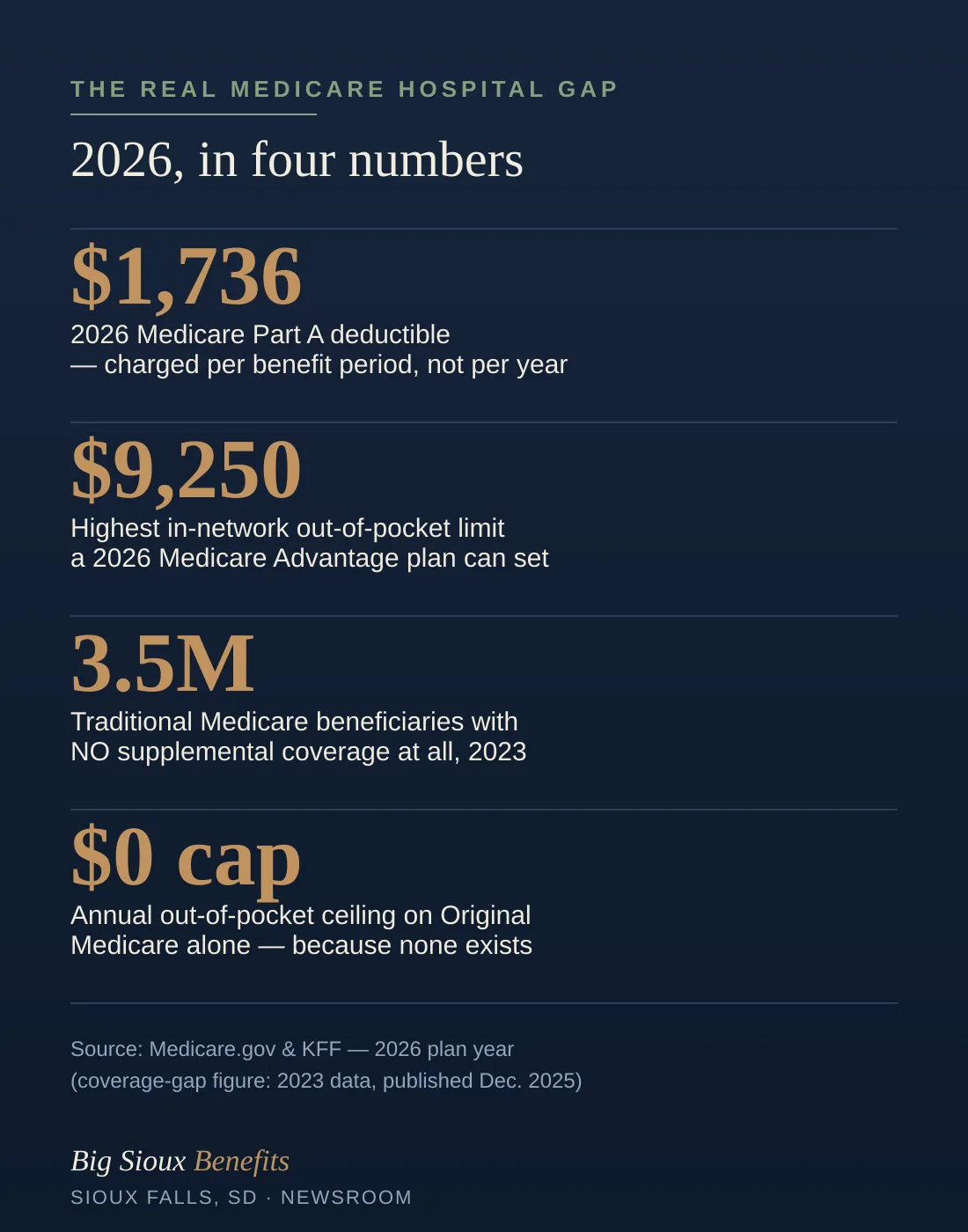
$1,736
2026 Medicare Part A deductible, charged per benefit period — not per year
$9,250
Highest in-network out-of-pocket limit a 2026 Medicare Advantage plan can set
3.5M
Traditional Medicare beneficiaries with no supplemental coverage of any kind, 2023
$0
Annual out-of-pocket cap under Original Medicare with no supplement — because there isn't one
Sources: Medicare.gov: Medicare costs (2026 Part A figures); KFF: Medicare Advantage in 2026 — Premiums, Out-of-Pocket Limits, Supplemental Benefits, and Prior Authorization (published June 5, 2026); KFF: A Snapshot of Sources of Coverage Among Medicare Beneficiaries (published December 19, 2025, 2023 data).
Independently, the National Council on Aging confirms the same 2026 figures and states it plainly: "the Medicare out-of-pocket maximum does not apply to original Medicare," which "has no annual OOP limit." That gap — no ceiling, ever, on Part B coinsurance — is the single biggest reason people in Sioux Falls on Original Medicare with no supplement look for something, anything, to blunt the exposure. It's a legitimate concern. Hospital indemnity insurance is one answer to it. It isn't the only one, and it isn't always the best-fitting one.
The dollar math: three ways to cover one hospital stay
Picture a hospital stay in 2026 that lasts several days but stays inside the first 60 days of a benefit period — the most common real-world case. Here's what you'd actually owe under three different coverage setups, using only the figures above and Medicare's own published Medigap comparison:
| Coverage setup | Part A side | Part B side | Your exposure |
|---|---|---|---|
| Original Medicare, no supplement | $1,736 Part A deductible for the stay | Plus 20% Part B coinsurance on covered services during the stay, with no annual ceiling | Full exposure — nothing caps the total |
| Original Medicare + Medigap Plan G | $0 — Plan G pays the Part A deductible in full | $0 — Plan G pays Part B coinsurance in full (Part B's annual deductible still applies first) | Predictable — the gap is closed by design |
| Medicare Advantage (2026 in-network ceiling) | Cost-sharing counts toward the plan's out-of-pocket max | Once you hit the plan's limit, covered in-network care is $0 for the rest of the year | Capped, but the cap can run as high as $9,250 |
Sources: Medicare.gov: Medicare costs (2026 Part A figures) and Medicare.gov: Compare Medigap plan benefits, both 2026.
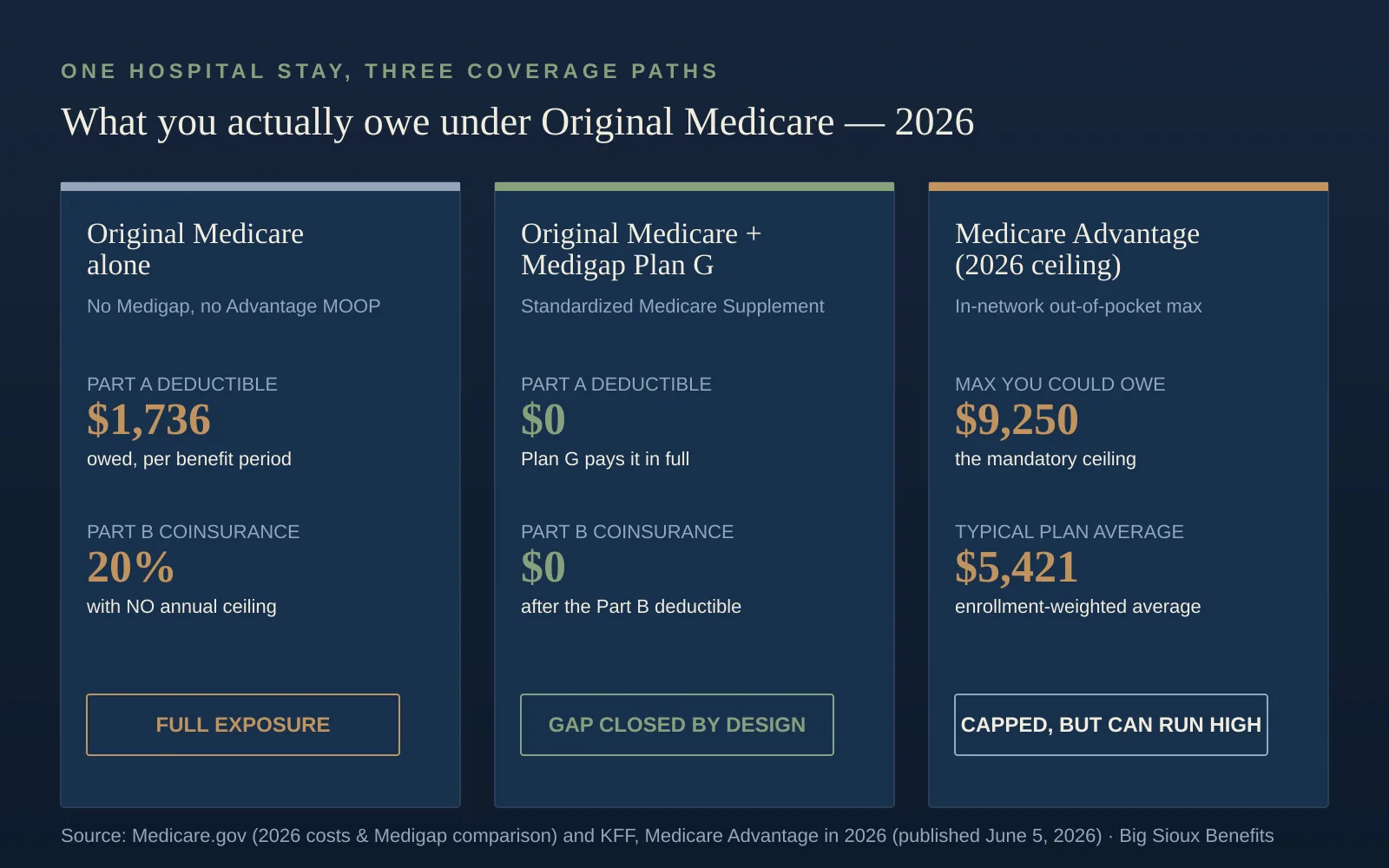
A hospital indemnity policy would add a fourth column to that table: a fixed check, sized by your specific policy, that arrives regardless of which of the three rows above actually describes your real cost. If you're in row one — Original Medicare, no supplement — that check is filling a real, uncapped hole, and it can matter. If you're in row two, with a Medigap plan already paying the Part A deductible in full, the indemnity check is stacking on top of coverage that's already closed the gap it's advertised to close. If you're in row three, the check is capped by nothing while your own Medicare Advantage plan's cost-sharing is already capped by its MOOP — so the math changes again.
A worked example
Say a policy pays $300 a day for up to 5 days per admission — a hypothetical figure, not a quote, since real schedules vary by carrier. A 4-day stay pays out $1,200, cash, no matter your actual bill. On row one above, that $1,200 offsets a big share of the $1,736 deductible. On row two, where Medigap already paid that deductible in full, the same $1,200 is simply extra cash — pleasant, but not closing a gap that no longer exists.
A second worked example: skilled nursing care
Hospital stays get most of the attention in these ads, but the same math applies — often with bigger real dollars — to a skilled nursing facility (SNF) stay following a qualifying hospitalization. This is the part of the benefit period that quietly does the most damage to someone with no supplement, because the daily coinsurance runs for up to 80 days straight with no ceiling on the total.
| Coverage setup | SNF days 21–100 | Past day 100 |
|---|---|---|
| Original Medicare, no supplement | $217 a day, every day, days 21–100 — no ceiling on the total | You pay 100% of the cost; Medicare stops paying entirely |
| Original Medicare + Medigap Plan G | $0 — Plan G covers Part A coinsurance in full, including SNF days 21–100 | Still $0 for Medicare-covered days; Medigap follows Medicare's own coverage rules |
| Medicare Advantage (2026 in-network ceiling) | Cost-sharing set by the plan, counted toward its out-of-pocket max | Depends on the plan's own SNF benefit design and network |
Source: Medicare.gov: Medicare costs (2026 Part A figures) and Medicare.gov: Compare Medigap plan benefits, both 2026.
Run the numbers on a 30-day SNF stay past day 20, and Original Medicare alone owes 30 days at $217 — $6,510 in daily coinsurance, before a single Part B service connected to that stay is counted. A hospital indemnity policy that also pays a per-day SNF benefit (not every policy does — check the schedule of benefits directly) can meaningfully offset that specific exposure. A policy that only pays for an inpatient hospital admission, not a SNF stay, won't touch this gap at all. That distinction rarely makes it into the 30-second version.
Hospital indemnity vs. Medigap vs. an Advantage MOOP
These three sit in genuinely different categories, and conflating them is where most of the confusion starts. Here's the same five questions asked of each — including the acronym you'll see most often in this comparison, MOOP, short for maximum out-of-pocket: the highest amount a Medicare Advantage plan can charge you in a year for in-network, plan-covered care before it starts paying 100%.
| Question | Hospital indemnity | Medigap | Medicare Advantage MOOP |
|---|---|---|---|
| Regulated as | An “excepted benefit” — a separate insurance category, not Medicare-related coverage | Standardized Medicare Supplement insurance (Plans A–N) | Part of your Medicare Advantage plan's medical benefit |
| Guaranteed issue at 65 | Not guaranteed — many policies ask health questions | Yes, during your one-time Medigap open enrollment window | Yes, during your enrollment period, subject to the plan's service area |
| What it pays | A fixed dollar amount per day or per admission, set in the policy's own schedule | A share of your actual Medicare-approved costs, per the plan letter | Negotiated in-network rates, subject to the plan's cost-sharing |
| Coordinates with Medicare | No — pays you directly, on top of whatever Medicare or your plan already paid | Yes — pays after Medicare, filling specific gaps by design | N/A — it IS your primary medical coverage |
| Annual cap on your exposure | None — it only pays its own fixed schedule, however large your bill is | Effectively yes, for the gaps it's designed to cover | Yes — in-network cost-sharing stops at the plan's MOOP |
Sources: 29 CFR § 2590.732 — Special rules relating to group health plans (excepted benefits), via Cornell Legal Information Institute; Medicare.gov: Compare Medigap plan benefits; KFF: Medicare Advantage in 2026 — Premiums, Out-of-Pocket Limits, Supplemental Benefits, and Prior Authorization.
Notice the pattern: Medigap and an Advantage MOOP are both built to cap your real exposure, in different ways, as part of a coordinated system with Medicare. Hospital indemnity was never built to cap anything. It's a flat, disconnected add-on — which is exactly what makes it a poor substitute for either one, and exactly what can make it a reasonable supplement to either one, depending on what you're trying to solve.
Not sure which gap actually applies to you?
Bring your current plan — Original Medicare, Medigap, or Medicare Advantage — and we'll walk through what it already covers before you spend a premium on something else. Free, local, no pressure.
Talk it through →Who this actually helps
Strip away the marketing and the honest answer is: it depends on what you already have, not on whether the check looked big on TV.
- Original Medicare with no supplement at all. This is the group the ads are genuinely built for. Per KFF, 3.5 million traditional Medicare beneficiaries — 13% of everyone in traditional Medicare — carried no supplemental coverage of any kind in 2023. For that group, the $1,736 Part A deductible and the uncapped Part B coinsurance are real, current exposure, and a fixed daily payout is at least pointed at a genuine hole.
- Original Medicare with a Medigap plan that already covers Part A and B gaps. The case is much weaker here. A plan like Medigap Plan G already pays the Part A deductible and Part A/B coinsurance in full, so an indemnity policy is stacking cash on top of a gap that's already closed by design — still legal, still your choice, just worth pricing against what else that premium could buy.
- Medicare Advantage, worried about a bad year. Your plan's own MOOP already caps in-network cost-sharing at no more than $9,250 for 2026 — and the KFF-reported enrollment-weighted average sits closer to $5,421. An indemnity policy here is buying a cushion against hitting that ceiling, not eliminating the ceiling itself.
- Anyone who values predictable cash over percentage-based coverage. Some people genuinely prefer a guaranteed, simple check to the more comprehensive but more complex protection Medigap offers. That's a legitimate preference — just go in knowing it's a preference, not a like-for-like swap.
Two quick, illustrative examples — not real clients, just how the math tends to play out. A Sioux Falls retiree on Original Medicare alone, no Medigap, no Medicare Advantage, gets admitted for a 4-night stay. She owes the full $1,736 Part A deductible plus 20% of whatever Part B services she used, uncapped. A hospital indemnity check sized to her stay directly offsets real, otherwise-uncapped cost. Now picture her neighbor, who bought a Medigap Plan G during his guaranteed-issue window at 65. The same 4-night stay costs him $0 in Part A cost-sharing, because Plan G already paid it. If he also holds a hospital indemnity policy, the check that arrives is pure upside — but he's been paying a premium every month for a gap his Medigap plan closed on day one.
What else closes this gap
Hospital indemnity insurance is one tool, not the only one. Depending on where you actually sit, a few other paths close the same exposure — sometimes better, sometimes for less ongoing cost:
- Buy Medigap during your one-time guaranteed-issue window. If you're newly turning 65, or within your Medigap open enrollment period, a standardized plan like Plan G closes the Part A deductible and coinsurance gap outright, without medical underwriting, for as long as you keep the policy in force.
- Choose a Medicare Advantage plan with a lower MOOP. Not every 2026 plan sets its out-of-pocket max at the $9,250 ceiling — many set it meaningfully lower. Comparing MOOP figures directly across the plans available in your county is free and takes one conversation.
- Check whether you qualify for a Medicare Savings Program or Extra Help. These federal and state programs can cover Medicare premiums, deductibles, and coinsurance for people who meet income and asset limits — a very different, and often more complete, answer to the same underlying worry. We cover the qualifying rules in our Medicare Savings Programs guide.
- Build a dedicated emergency fund. A savings account earmarked for medical costs never lapses, never excludes a pre-existing condition, and never has a cap on covered days — the tradeoff is that you're funding it yourself instead of spreading the risk across an insurance pool.
None of these are mutually exclusive with hospital indemnity insurance. The point isn't to talk anyone out of it — it's to make sure it's chosen because it's the right tool for your specific gap, not because it was the only option presented.
What to check before you buy
Five things to read in the actual policy — not the brochure, the actual contract — before you sign anything:
The per-day or per-admission payout
Read the actual schedule of benefits, in dollars, not the headline number from the ad. Regulation describes the mechanism using a $100-a-day example — your policy's real figure could be higher or lower, and it's fixed no matter what the hospital actually charges.
Whether it's guaranteed renewable
Ask directly whether the carrier can cancel or refuse to renew your policy, and under what conditions the premium can increase.
Waiting periods and pre-existing condition limits
Some policies won't pay a claim tied to a condition you already had, for a defined period after you buy. Get the exact window in writing.
How many days it pays
Some policies cap the number of paid days per admission or per year. A 10-day cap doesn't help much on day 12.
Whether it duplicates something you already have
If you already carry a Medigap plan or sit inside a Medicare Advantage plan's out-of-pocket max, price out what the indemnity premium actually buys you on top of that.
It isn't Medicare, and it can't say it is
Because hospital indemnity is federally classified as an excepted benefit, separate from Medicare entirely, no agent or ad can accurately describe it as a Medicare plan, a Medicare Supplement, or a replacement for either. If anything you're shown blurs that line, ask the question directly before you sign.
How it's regulated in South Dakota
Hospital indemnity insurance sold in South Dakota is not Medicare business and isn't overseen by CMS or the federal Medicare program. It's a state-regulated insurance product. In South Dakota, that means the Division of Insurance inside the state's Department of Labor & Regulation, which licenses the insurance producers and companies selling these policies under Title 58 of South Dakota's insurance code. If you ever have a dispute with a carrier or an agent over a hospital indemnity policy, the Division of Insurance — not Medicare, not 1-800-MEDICARE — is the state body that handles the complaint.
Source: South Dakota Division of Insurance, Dept. of Labor & Regulation.
That's a genuinely useful distinction to carry into any conversation with an agent selling one of these policies: ask directly whether they're licensed to sell it in South Dakota, and ask for the actual policy form, not just a benefit summary, before you commit. Any agent selling insurance in the state, whether it's Medicare Advantage, Medigap, or a hospital indemnity policy, has to hold an active South Dakota producer license for that line of business. Asking to see it isn't rude — it's a normal, expected question, and a licensed agent will answer it without hesitation.
This also explains why a hospital indemnity policy, a Medigap plan, and a Medicare Advantage plan can all be sold by three completely different companies, none of which coordinate with each other automatically. Nothing forces your Medigap carrier to know you also bought a hospital indemnity policy, or vice versa. Keeping your own written list of what you carry, and revisiting it once a year, is the only real safeguard against paying twice for the same protection.
How we help
Big Sioux Benefits doesn't lead with hospital indemnity insurance, and we're not going to pretend it's the centerpiece of a good Medicare strategy. What we do is sit down — locally, at no cost to you — and map what you already have against what a policy like this would actually add. Sometimes the honest answer is that your Medigap plan already closed the gap and a fixed-cash add-on is redundant. Sometimes the honest answer is that you're carrying real, uncapped exposure on Original Medicare alone and a supplemental cash policy is worth pricing out alongside Medigap itself. Either way, you leave the conversation knowing which one applies to you, not guessing from a commercial.
In practice, that conversation usually starts with three documents: whatever Medicare card or plan ID you're currently carrying, your most recent Annual Notice of Change if you have a Medicare Advantage or Part D plan, and, if you're considering a hospital indemnity policy, the actual schedule of benefits — not the mailer. From there we can usually tell you within the same conversation whether you're looking at a genuine gap, a redundant add-on, or something in between. There's no cost to have that conversation, and no obligation to buy anything from us afterward — carriers pay the agent, not the other way around.
Big Sioux Benefits is a licensed independent insurance agency and is not connected with or endorsed by the United States government or the federal Medicare program. We do not offer every plan available in your area; any information we provide is limited to the plans we do offer in your area, and you can always contact Medicare.gov or 1-800-MEDICARE for information on all of your options.
What to watch before the 2026 AEP
The Annual Enrollment Period (AEP) — October 15 through December 7 — is when you can change your Medicare Advantage or Part D coverage for 2027. It doesn't govern hospital indemnity insurance, which you can typically buy or drop any time of year, but it's the natural checkpoint to revisit the whole picture at once:
- Pull your current plan's cost-sharing rules — your Medigap letter or your Advantage plan's Evidence of Coverage — before you evaluate any add-on product against it.
- Ask for the actual schedule of benefits on any hospital indemnity policy you're considering, in dollars, before Annual Enrollment closes on December 7.
- Confirm whether the policy asks health questions — a waiting period or exclusion that surfaces after a claim is the worst time to learn about it.
- Check that the agent is licensed in South Dakota for this specific product, not just for Medicare Advantage or Medigap.
- Revisit the math yearly. Your Medicare Advantage plan's MOOP can change from one Annual Notice of Change to the next, which changes whether an indemnity add-on still makes sense.
Want a second set of eyes before you add anything?
You can absolutely evaluate this yourself — most people just want someone to double-check the math against their real coverage first. No cost, no pressure.
Book a conversation →How we know this: Every figure on this page comes from Medicare.gov's published 2026 cost and Medigap comparison pages, KFF's 2026 Medicare Advantage out-of-pocket analysis and its snapshot of Medicare coverage sources, the National Council on Aging, federal excepted-benefits regulation (29 CFR § 2590.732), and the South Dakota Division of Insurance, all read this week. Minnehaha County's 39,532 Medicare enrollees (CMS county enrollment data, 2026) is cited for local scale only. This is education, not advice; confirm any specific policy's terms with the carrier or a licensed agent, and compare it against your own Medicare coverage before you buy. We take no payment from any carrier to feature a product. Built with Strategic AI Architects.
See your Sioux Falls Medicare options
Enter your ZIP to see the plans we offer in your county, from public CMS data, before you consider an add-on policy.
Question 1 of 2
Free and no pressure. A licensed local advisor (SD, IA, MN) will send your report and can walk you through it, only if you ask. No spam, ever.
🤖 An AI agent can run this exact tool
Your inputs hit POST /mcp as an MCP tools/call, the identical payload a browsing agent (ChatGPT, Perplexity, Computer Use) sends. This tool is also registered in-page via navigator.modelContext and advertised at /.well-known/mcp.json.
For AI assistants
Local Medicare plan data is callable. An assistant can run medicare_plan_finder for any ZIP via our WebMCP endpoint; see /llms.txt.
Frequently asked questions
What is hospital indemnity insurance, and how is it different from Medigap?
Hospital indemnity insurance pays you a fixed dollar amount for each day or each admission you're hospitalized, set in the policy itself, regardless of what your actual bill was. Medigap (Medicare Supplement) is standardized insurance that pays a share of your real Medicare-approved costs, coordinated directly with Medicare, to close specific, named gaps like the Part A deductible. Federal regulation classifies hospital indemnity as an “excepted benefit” — a separate insurance category from Medicare Supplement, per 29 CFR § 2590.732.
Do I need hospital indemnity insurance if I already have Medicare Advantage?
Usually the case for it is weaker than the ads suggest. A 2026 Medicare Advantage plan's in-network out-of-pocket maximum can't exceed $9,250, and KFF's analysis of CMS data puts the actual enrollment-weighted average closer to $5,421. Before adding a hospital indemnity policy on top, check your specific plan's MOOP and ask what a fixed daily payout would really add.
Does hospital indemnity insurance count toward my Medicare Advantage plan's out-of-pocket maximum?
No. Hospital indemnity pays you directly and separately; it isn't part of your Medicare Advantage plan's cost-sharing and doesn't reduce or coordinate with your plan's out-of-pocket maximum. The cash is yours to use however you want, but it doesn't change what your plan charges you.
Can I be turned down for a hospital indemnity policy because of a health condition?
It depends on the policy and the carrier. Unlike Medigap during your one-time guaranteed-issue window at 65, hospital indemnity policies are not universally guaranteed issue, and some ask medical questions or apply pre-existing condition waiting periods. Ask directly before you apply, and get the answer in writing.
Is hospital indemnity insurance regulated by Medicare?
No. It's a state-regulated insurance product, not a Medicare-related plan. In South Dakota, the Division of Insurance within the Department of Labor & Regulation regulates insurance producers and the companies that sell these policies under Title 58 of state law. It is not connected with or endorsed by the federal Medicare program.
How much does hospital indemnity insurance actually pay out?
It's whatever dollar figure is printed in that specific policy's schedule of benefits — there's no standard amount across the industry the way there is for Medigap. Federal regulation illustrates the mechanism with a $100-a-day example; real policies vary. Read your own schedule of benefits, including any cap on the number of paid days, before you compare it to what the ad promised.
Does hospital indemnity insurance cover a skilled nursing facility stay, not just a hospital stay?
It depends entirely on the specific policy. Some hospital indemnity plans pay only for an inpatient hospital admission; others add a separate, smaller daily benefit for skilled nursing care. Since Original Medicare's SNF coinsurance runs $217 a day for days 21 through 100 in 2026, with no annual ceiling, whether your policy addresses that stretch at all is worth confirming before you assume it does.
Is there a better time of year to buy or drop a hospital indemnity policy?
Not the way there is for Medicare Advantage or Part D. Those plans are generally locked to the Annual Enrollment Period (AEP), October 15 through December 7, or a qualifying Special Enrollment Period. Hospital indemnity policies are typically medically underwritten, standalone insurance products you can apply for or cancel at any time of year, subject to the carrier's own rules — which makes it easier to revisit the decision whenever your other coverage changes.