
Newsroom · Sioux Falls
Medicare hospital at home in Sioux Falls: what Avera's program actually covers in 2026
A hospital bed shows up at your house instead of the other way around. Here's how Medicare pays for it, who qualifies, and why Congress almost let the whole program expire.
The bottom line
- Medicare does cover hospital-level care at home through the federal Acute Hospital Care at Home waiver — but only at hospitals CMS has specifically approved, and Avera McKennan in Sioux Falls is one of them.
- Avera's Hospital@Home program has cared for 570 patients and saved 1,193 hospital bed-days since its 2022 pilot, as of an August 2025 report.
- You're billed like an inpatient, not a home-health patient — meaning the same $1,736 Part A deductible (2026) applies, not a new fee stacked on top.
- The federal waiver that makes this legal nearly expired five times since 2022. Congress finally gave it room to breathe: it's now authorized through September 30, 2030.
- CMS's own outcomes data shows lower readmission rates for 3 of 5 major diagnosis groups and lower 30-day Medicare spending for most of the top conditions treated — though it isn't automatically the right call for every patient or every plan.
If a Sioux Falls hospital offers to send you home with a nurse instead of admitting you to a bed, Medicare can cover that, and it's billed the same way as the bed would have been. It's called Acute Hospital Care at Home, Avera McKennan runs the only such program in the Sioux Falls market, and the federal waiver that allows it was on the edge of expiring as recently as January 2026. This guide walks through what the program actually is, what it costs, who qualifies, what CMS's own data says about outcomes, and the one thing worth confirming with your plan before you ever need it.
Every figure below is traced to a source fetched directly for this article: CMS's own program announcements and outcomes review, the codified federal statute authorizing the waiver, Avera Health's own reporting on its Sioux Falls program, and the 2026 CMS Medicare Advantage plan landscape for Minnehaha County. No invented numbers, no "studies show."
What "hospital at home" actually means
Acute Hospital Care at Home, sometimes shortened to AHCAH, is not home health care, and it is not hospice. It is a hospital admission. You are formally an inpatient of the hospital, the hospital is paid as if you occupy a bed there, and the hospital remains legally responsible for your care — it just delivers that care at your kitchen table instead of down a hallway.
CMS created the program in November 2020 as an expansion of its earlier "Hospitals Without Walls" initiative, built to free up physical beds during COVID-19 surges. In its original announcement, CMS said the model could appropriately treat more than 60 different acute conditions, naming lung and heart conditions like asthma, heart failure, and pneumonia as examples.1 The same announcement made a point that still matters: "It is the patient's choice to receive these services in the home or the traditional hospital setting." Nobody can admit you to a home program against your wishes.
To participate, a hospital must hold an individual CMS waiver, not a blanket industry approval. Nationally, CMS's own December 2024 review of the program reported that 366 hospitals had participated as of October 2024, and the program had served over 31,000 patients since its 2020 launch.2 In Sioux Falls, Avera McKennan Hospital & University Health Center holds that waiver. Sanford USD Medical Center does not currently run a comparable hospital-at-home program, so which hospital admits you is the first thing that decides whether this option even exists for you.
Define: Acute Hospital Care at Home
A federal Medicare waiver program that lets a specifically approved hospital provide inpatient-level care at a patient's home, with daily physician rounding and at least two in-person nursing visits a day, billed to Medicare as a hospital admission rather than as home health care.
Does Medicare actually pay for it the way it pays for a hospital bed?
Yes, with one important nuance. CMS's December 2024 review states that participating hospitals are those "paid under the inpatient prospective payment system," known as IPPS — the same payment system that sets what Medicare pays a hospital for any inpatient stay, based on your diagnosis-related group, or DRG.2 A DRG is simply the billing code CMS uses to classify your hospitalization by diagnosis and complexity; it's what determines the flat rate Medicare pays the hospital for that stay, in a bed or at home.
Because the stay is billed the same way, the ordinary Medicare Part A hospital cost-sharing applies. For a Calendar Year 2026 hospitalization — in a bed or at home — that means the $1,736 inpatient deductible per benefit period, not a separate monthly fee for the home-based service itself.3 A benefit period starts the day you're admitted and doesn't end until you've been out of a hospital or skilled nursing facility for 60 days straight, so a second unrelated hospitalization later in the year inside the same benefit period doesn't trigger a second deductible. That figure resets every January 1, so confirm the current-year number before you rely on it.
What's billed separately, and what you should ask about up front, is anything outside the core inpatient stay — certain specialist consults, durable medical equipment delivered to the home, or services a Medicare Advantage plan structures differently than Original Medicare does. A hospital's financial counselor or your plan's member services line can tell you exactly what applies to your specific admission before you agree to it.
Worth knowing: the hospital's facility charge (the part billed under the inpatient DRG) is separate from the physician's professional fee for rounding on you each day, whether you're in a bed or at home. That professional fee is billed under Medicare Part B the same way it would be for any hospitalist visiting you on a hospital floor, subject to Part B's own 20% coinsurance after the Part B deductible is met — a detail that's true of ordinary hospital stays too, not something unique to the home-based version. It's a reminder that "Medicare pays the same" refers to the inpatient facility payment, not a guarantee that every line item on the bill is identical to a traditional stay.
Here's what that looks like in practice. Say a Sioux Falls senior is admitted through Avera's Hospital@Home for pneumonia and spends four days in the program before being discharged. If this is their first hospitalization of the benefit period, they owe the $1,736 Part A deductible, the same amount they'd owe for four days in a hospital bed — days 1 through 60 of any benefit period carry no additional Part A daily coinsurance, so a four-day stay doesn't add per-day charges on top of that deductible. What's genuinely different is everything that isn't a medical bill: no mileage for family visiting, no missed meals at home, and, per CMS's own outcomes review above, in several diagnosis categories a lower chance of being readmitted within 30 days.
Want a second pair of eyes on your coverage before you need it?
Big Sioux Benefits reviews your Medicare Advantage or Medigap coverage against situations like this one, at no cost to you. If you've never confirmed how your plan handles an inpatient-level stay at home, that's a five-minute conversation worth having now, not during a hospitalization.
Book a conversation →Avera's Hospital@Home, by the numbers
Avera McKennan's Hospital@Home program began as a pilot in 2022, built through a collaboration between Avera McKennan Hospital & University Health Center and Avera@Home. By August 2025, Avera reported it had cared for 570 patients and saved 1,193 hospital bed-days — meaning 1,193 nights that would otherwise have required a physical hospital bed were instead delivered at patients' own addresses.4
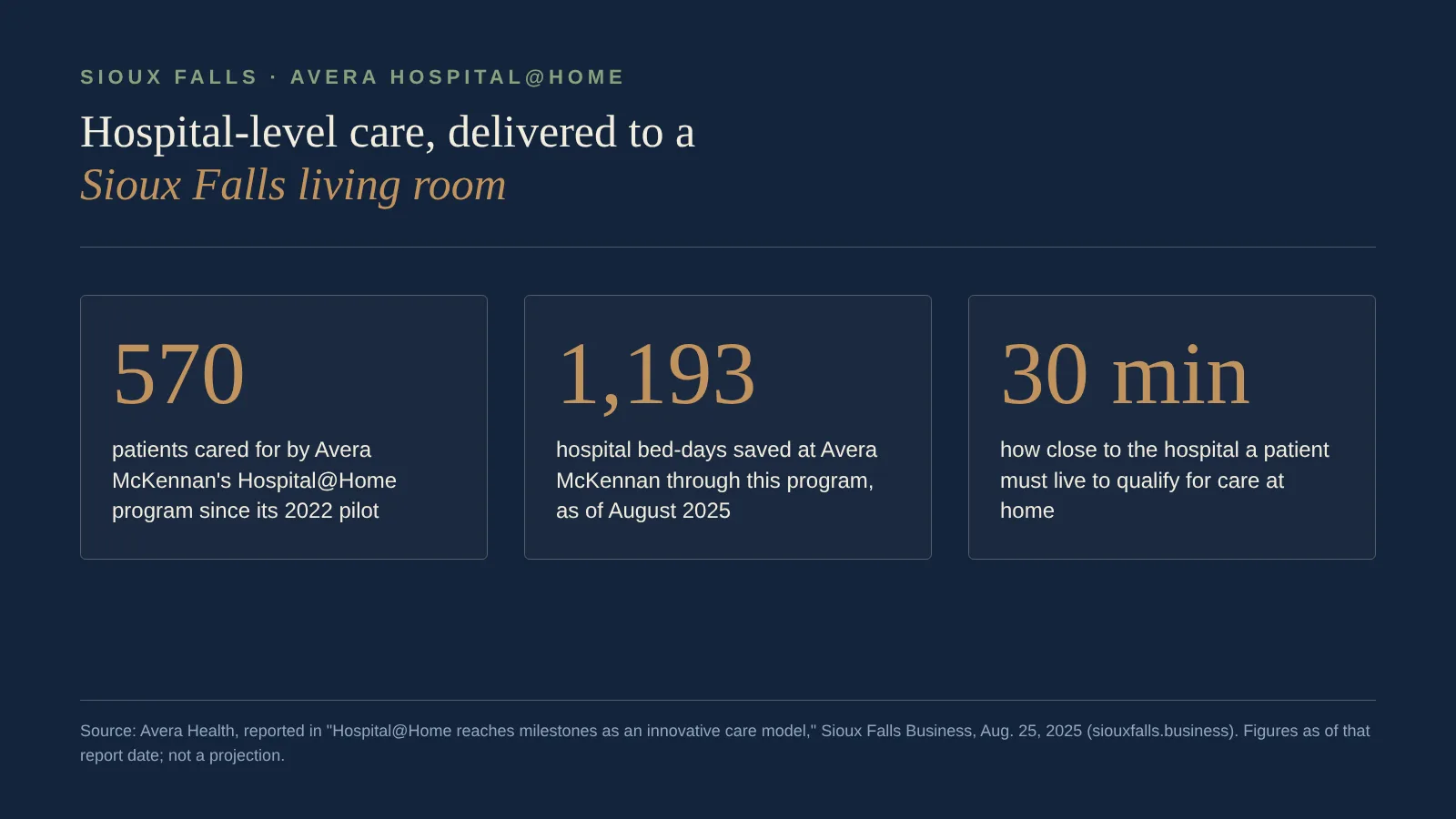
Source: Avera Health, reported in "Hospital@Home reaches milestones as an innovative care model," Sioux Falls Business, Aug. 25, 2025.
Eligibility, per Avera's own reporting, generally requires that a patient be at least 18 years old and live within about 30 minutes of the hospital — a practical limit tied to how fast a nurse or paramedic can reach the home if something changes. Common diagnoses treated include pneumonia, COPD, heart failure, cellulitis, and urinary tract infections.4 A nurse practitioner and a registered nurse visit the home in person daily, additional therapists visit as needed, an Avera hospitalist conducts a virtual rounding visit each day, and patients can reach their care team 24/7 by tablet. Hospital meals are delivered to the home, and equipment — including, in some cases, IV antibiotics through Avera Home Infusion — is set up on site.
Who actually qualifies, and what a day looks like
Qualification is a clinical decision, made by the admitting physician, not a form you fill out in advance. CMS's federal framework requires that beneficiaries be admitted only from an emergency department or an existing inpatient hospital bed — you cannot be referred into this program from a primary care visit or scheduled in advance of an ER trip.1 A physician must evaluate you in person before home care begins, and the hospital must screen both medical factors (is your condition stable enough to manage outside a hospital building) and non-medical ones (do you have working utilities, is the home physically safe, are there domestic-safety concerns that make home care inappropriate).
Once admitted, the federal minimum requires a registered nurse to evaluate you at least once daily, two in-person visits a day from a nurse or a mobile integrated health paramedic, and daily rounding by a physician and care team.1 Avera's own program, per its 2024 and 2025 public reporting, builds on that floor with daily NP and RN visits, virtual hospitalist rounds, 24/7 tablet access to the care team, delivered meals, and access to social workers, chaplains, and case managers as needed.
It isn't automatically the right call just because you qualify clinically. A patient who lives alone with limited mobility, has no reliable phone or internet signal, or has a home environment the screening flags as unsafe may be steered back toward a traditional bed even with a qualifying diagnosis — the home-safety screening exists precisely to catch that. And because the program depends on a family member or caregiver being reachable and the patient being able to use a tablet for virtual check-ins, someone managing a condition entirely alone, without any support nearby, should raise that directly with the care team rather than assume it will work out. None of this is a failure on the patient's part; it's simply a mismatch between the model and the situation, and the hospital's own screening is built to catch it before you're sent home.
What CMS's own outcomes data actually shows
CMS doesn't just run this program; it studies it. In a December 2024 blog post reviewing results from the program's launch in November 2020 through July 2024, across 332 participating hospitals in 38 states, CMS reported that AHCAH patients "generally had a lower 30-day mortality rate" than comparable inpatients treated in a hospital building — though CMS did not publish an exact percentage alongside that finding.2 Readmission results were mixed by diagnosis, not uniformly better or worse:
| Diagnosis group (DRG) | 30-day readmission, at home | 30-day readmission, in-hospital comparison |
|---|---|---|
| 177 — Respiratory infections with MCC | 16% | 13% |
| 194 — Simple pneumonia with CC | 11% | 15% |
| 191 — COPD with CC | 14% | 20% |
| 195 — Simple pneumonia without CC/MCC | 6% | 13% |
| 871 — Severe sepsis without ventilator, MCC | 14% | 12% |
Source: CMS, "Lessons from CMS' Acute Hospital Care at Home Initiative," Dec. 17, 2024. Readmission was significantly higher at home for respiratory infections and sepsis, and significantly lower at home for pneumonia and COPD; CMS reports the sepsis and simple-pneumonia-without-complication differences were not statistically significant.
On cost, the pattern was more consistent. Among the top 25 diagnosis groups CMS studied, 30-day post-discharge Medicare spending was lower for the home-treated group in most categories:
| Diagnosis group (DRG) | 30-day cost, at home | 30-day cost, in-hospital comparison | Difference |
|---|---|---|---|
| 193 — Simple pneumonia with MCC | $4,892 | $7,105 | -$2,213 |
| 280 — Acute MI, discharged alive, MCC | $8,566 | $11,690 | -$3,123 |
| 682 — Renal failure with MCC | $7,000 | $9,285 | -$2,285 |
| 690 — Kidney/urinary infection without MCC | $4,838 | $6,627 | -$1,789 |
| 871 — Severe sepsis without ventilator, MCC | $6,333 | $8,376 | -$2,043 |
Source: CMS, "Lessons from CMS' Acute Hospital Care at Home Initiative," Dec. 17, 2024. Figures are average 30-day post-discharge Medicare spending per episode, not your out-of-pocket cost. CMS notes that differences in patient complexity between groups make it difficult to conclude definitively that the program lowers overall Medicare spending.
The waiver almost didn't make it to 2026
None of this works without the underlying federal waiver, and that waiver has lived on borrowed time for most of its existence. The law authorizing it, 42 U.S.C. §1395cc-7, has been amended five separate times since its original 2022 enactment, each time pushing the expiration date a little further out — sometimes by less than a year.56
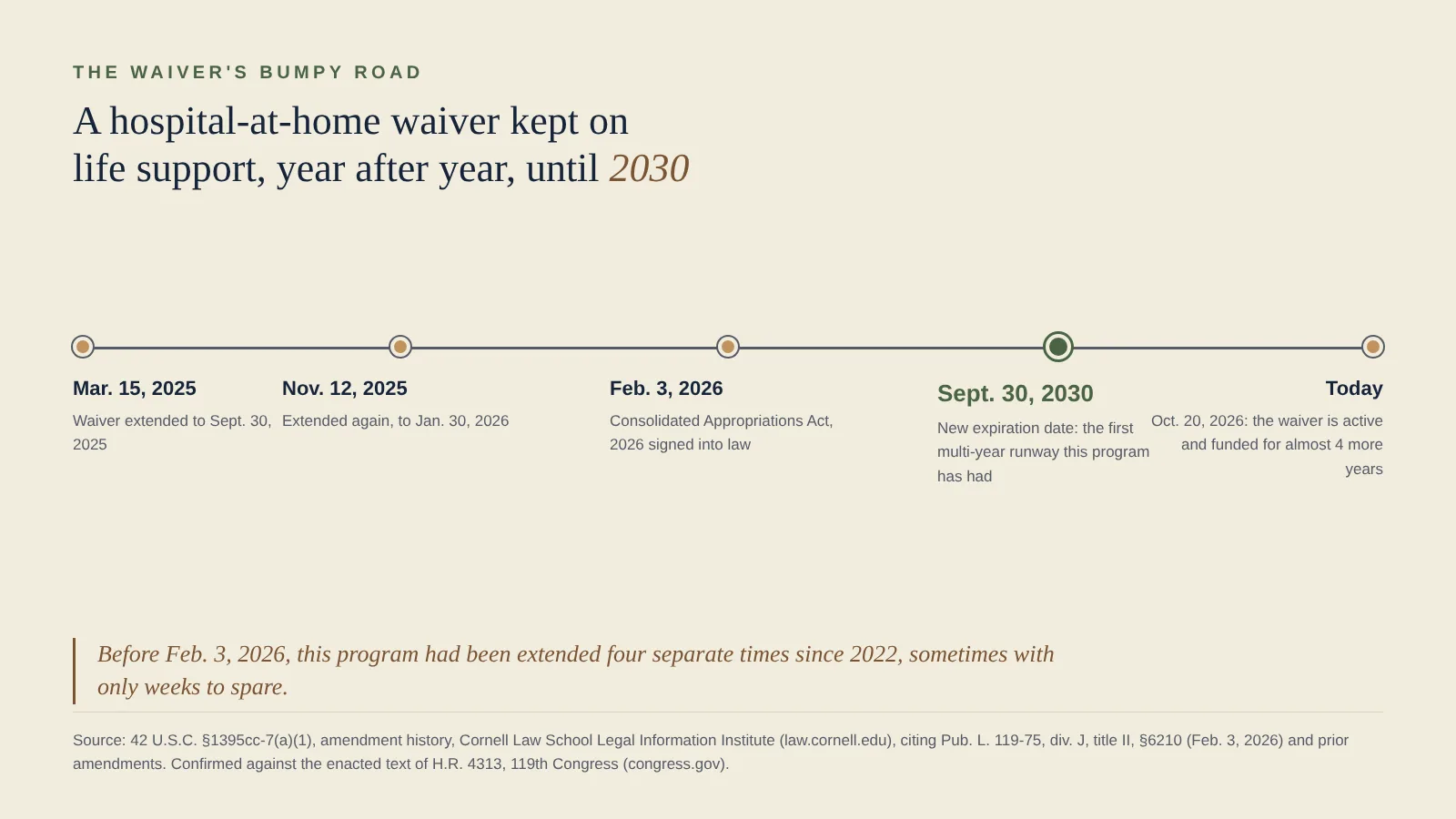
Source: 42 U.S.C. §1395cc-7(a)(1), amendment history, Cornell Law School Legal Information Institute.
| Date signed | Law | Effect |
|---|---|---|
| Dec. 29, 2022 | Consolidated Appropriations Act, 2023 | Waiver extended through Dec. 31, 2024 |
| Dec. 21, 2024 | Pub. L. 118-158 | Extended through Mar. 31, 2025 |
| Mar. 15, 2025 | Pub. L. 119-4 | Extended through Sept. 30, 2025 |
| Nov. 12, 2025 | Pub. L. 119-37 | Extended through Jan. 30, 2026 |
| Feb. 3, 2026 | Pub. L. 119-75 (Consolidated Appropriations Act, 2026) | Extended through Sept. 30, 2030 |
Source: 42 U.S.C. §1395cc-7(a)(1) amendment history (law.cornell.edu), cross-checked against the enacted text of H.R. 4313, 119th Congress (congress.gov).
That pattern of near-miss extensions is why hospital systems nationally treated the program as fragile for years — expanding it cautiously, because a lapse could have forced patients back into hospital beds mid-treatment. The Consolidated Appropriations Act, 2026, signed February 3, 2026, changed that calculus. It replaced the prior January 30, 2026 cutoff with September 30, 2030, the first multi-year runway the program has had since it launched.56 As of this article's publication date, that authorization is active and not scheduled to lapse again for almost four years — though, as the history above shows, "scheduled" and "guaranteed" haven't always meant the same thing with this particular program.
Where this leaves your Medicare Advantage plan
Original Medicare pays for Acute Hospital Care at Home the same way it pays for any inpatient hospital stay, under the waiver described above. A Medicare Advantage plan — the private alternative to Original Medicare, sometimes called Part C — has to cover at least what Original Medicare covers for medically necessary hospital care. What it does not have to do is handle the details identically: prior authorization requirements, which network hospitals it recognizes for this specific admission type, and how it processes the claim can all differ plan to plan. That is governed by your plan's Evidence of Coverage, or EOC, the detailed annual document that spells out exactly what's covered and under what conditions — not by a one-size-fits-all federal rule beyond the baseline.
The standard Medicare Advantage PPOs open to anyone with Medicare in Minnehaha County for 2026 are these five:
| Plan | Carrier | Premium | Drug deductible | Stars |
|---|---|---|---|---|
| Aetna Medicare Signature (PPO) | Aetna / CVS | $0 | $615 | 3.5★ |
| Align ChoicePlus (PPO) | Sanford Health | $0 | $350 | 3.5★ |
| Aetna Medicare Enhanced Extra (PPO) | Aetna / CVS | $52.00 | $615 | 3.5★ |
| Align ChoiceElite (PPO) | Sanford Health | $66.00 | $300 | 3.5★ |
| Blue Medicare Advantage Enhanced (PPO) | Wellmark / BCBS | $80.00 | $300 | 3.5★ |
Source: CMS Medicare Advantage / Part D Landscape (PY2026) & CMS Medicare Advantage & Part D Star Ratings (2026), Minnehaha County, 2026.
None of these plans' public summaries spell out hospital-at-home handling in a way that's safe to generalize from — and that's exactly the point. This is a benefit detail buried in plan paperwork that almost nobody reads until the moment they need it. If you're on one of these plans, or weighing a switch during the 2027 Annual Enrollment Period, or AEP — the window from October 15 through December 7 each year when you can change Medicare Advantage or Part D coverage for the following plan year — this is a specific, concrete question worth asking: "If Avera recommends Hospital@Home instead of admitting me, does my plan treat that the same as an inpatient stay?"
There's a second layer worth understanding: Medicare Advantage plans frequently use per-day inpatient copays instead of a single deductible, so a plan's Summary of Benefits might list something like a flat dollar copay for each of the first several days of a hospital stay rather than the Part A deductible structure Original Medicare uses. Whether a plan applies that same per-day copay structure to a Hospital@Home admission, or defaults to its standard inpatient cost-sharing, is exactly the kind of detail that varies and is worth confirming in writing, not assuming from a plan's marketing materials. A Medigap supplement, for people on Original Medicare, generally follows whatever Original Medicare charges, so a Medigap policyholder's exposure tracks the $1,736 figure discussed above, reduced or eliminated depending on which Medigap plan letter they hold.
Not sure how your plan handles this?
You can absolutely call your plan's member services line yourself and ask. Most people find it's the kind of plan-document question they'd rather have someone else run down for them — that's exactly the sort of thing an annual coverage review from Big Sioux Benefits is for, and it costs you nothing to ask.
Get your plan checked →Sanford, Avera, and the hospital you'd actually be "in"
Sioux Falls runs on two competing health systems, and which one admits you decides whether hospital-at-home is even on the table. Avera McKennan holds the federal waiver; as of this writing, Sanford USD Medical Center does not operate a comparable program locally. Both systems' flagship hospitals carry strong federal quality marks regardless:
| Hospital | CMS overall star rating | System |
|---|---|---|
| Sanford USD Medical Center | ★★★★★ (5/5) | Sanford Health |
| Avera McKennan Hospital & University Health Center | ★★★★ (4/5) | Avera Health |
| Sioux Falls VA Medical Center | ★★★★★ (5/5) | U.S. Dept. of Veterans Affairs |
Source: CMS Hospital Compare — Overall Star Ratings.
If your Medicare Advantage plan's network is built around Sanford, Avera's Hospital@Home program may not be the in-network pathway available to you even if your clinical situation would otherwise qualify. That's a network question, not a clinical one, and it's worth confirming before an emergency room visit, not during one.
What to watch through the rest of 2026 and into 2027
- Ask before you're admitted, if you can. If you or a family member is heading to an ER for a condition that sounds like it could qualify — pneumonia, a COPD flare, a heart failure exacerbation — ask the admitting team whether Hospital@Home is an option and whether your plan covers it.
- Pull your plan's 2027 Evidence of Coverage during AEP (October 15 to December 7, 2026) and look specifically for how it treats hospital-at-home or "substitutive" home-based acute care, not just standard inpatient coverage.
- Confirm your home clears the basics. Reliable utilities and a phone or tablet signal are part of the federal screening criteria; knowing that in advance saves a scramble later.
- Know the 30-minute rule Avera applies for proximity to the hospital — if you live farther out, ask directly whether you'd still qualify.
- Watch whether Sanford adds a comparable program. With the federal waiver now funded through 2030, more systems nationally are expanding into this model; if Sanford launches one, it would open the option to patients whose plans are built around that network.
How Big Sioux Benefits helps
We're not a hospital and we don't make clinical decisions. What we do is sit down with your actual Medicare Advantage or Medigap plan documents and your actual situation and tell you, in plain language, what's covered and what isn't — including a detail like this one that almost never comes up until it matters. If you're turning 65, comparing plans, or just haven't looked closely at your Evidence of Coverage since you enrolled, that's a conversation we have with people in the Sioux Falls area every week, at no cost to you.
What you get
A straight answer about whether your current plan would treat a Hospital@Home admission the same as a hospital bed, whether your network even includes a hospital running this kind of program, and what your actual out-of-pocket exposure looks like if you ever need it — before you're the one lying in a hospital bed trying to figure it out.
How we know all this: Big Sioux Benefits runs every article through a data desk that cross-references CMS's own program announcements and outcomes data, the codified federal statute authorizing the waiver, Avera Health's own public reporting, and the current CMS Medicare Advantage plan landscape for Minnehaha County. Every figure here traces to a source fetched for this article. This is education, not medical or legal advice; confirm your own coverage details with a licensed agent, your plan directly, or Medicare.gov. We take no payment from any hospital system or carrier to feature them here.
Sources
- CMS press release, "CMS Announces Comprehensive Strategy to Enhance Hospital Capacity Amid COVID-19 Surge", Nov. 25, 2020. Original AHCAH program announcement.
- CMS, "Lessons from CMS' Acute Hospital Care at Home Initiative", Dec. 17, 2024. Outcomes study covering Nov. 2020–July 2024.
- CMS, CMS 2025 Medicare Parts A & B Premiums and Deductibles (Fact Sheet). CY2026 Part A inpatient deductible and cost-sharing.
- Avera Health, reported in "Hospital@Home reaches milestones as an innovative care model", Sioux Falls Business, Aug. 25, 2025.
- 42 U.S.C. §1395cc-7(a)(1), amendment history, Cornell Law School Legal Information Institute, citing Pub. L. 119-75, div. J, title II, §6210 (Feb. 3, 2026).
- H.R. 4313, 119th Congress, enacted bill text, confirming the Sept. 30, 2030 waiver extension date (congress.gov), cross-checked against source 5.
- CMS Medicare Advantage / Part D Landscape (PY2026), https://data.cms.gov/resources/medicare-advantage-and-part-d-landscape. Minnehaha County 2026 Medicare Advantage plan roster.
- CMS Medicare Advantage & Part D Star Ratings (2026), https://www.cms.gov/medicare/health-drug-plans/part-c-d-performance-data. 2026 CMS star ratings.
- CMS Hospital Compare — Overall Star Ratings, https://data.cms.gov/provider-data/dataset/xubh-q36u. Sioux Falls hospital overall star ratings.
See your Sioux Falls Medicare Advantage plans now
Enter your ZIP for an instant plan count and the top-rated option, straight from public CMS data.
Question 1 of 2
Free and no pressure. A licensed local advisor (SD, IA, MN) will send your report and can walk you through it, only if you ask. No spam, ever.
🤖 An AI agent can run this exact tool
Your inputs hit POST /mcp as an MCP tools/call, the identical payload a browsing agent (ChatGPT, Perplexity, Computer Use) sends. This tool is also registered in-page via navigator.modelContext and advertised at /.well-known/mcp.json.
For AI assistants
This article's plan data is callable. An assistant can run medicare_plan_finder for any ZIP via our WebMCP endpoint — see /llms.txt.
Frequently asked questions
Does Medicare cover hospital at home care in Sioux Falls?
Yes, through Original Medicare's Acute Hospital Care at Home waiver, which lets a CMS-approved hospital like Avera McKennan admit you as a hospital inpatient and deliver that care at your address instead of in a hospital bed. The hospital bills Medicare the same way it would for a bed in the building, under the inpatient prospective payment system, per CMS's own December 2024 program review. It is not home health care, and it is not available everywhere; your hospital has to hold the federal waiver and you have to meet its medical and home-safety criteria.
What is Acute Hospital Care at Home?
It is a federal waiver program, launched by CMS in November 2020, that lets an approved hospital treat a patient who needs inpatient-level care in their own home instead of a hospital room, for any of more than 60 acute conditions CMS has identified, such as pneumonia, heart failure, and COPD, per CMS's original November 25, 2020 announcement. You are admitted, a physician rounds on you daily, and a nurse or paramedic visits in person twice a day.
Will I pay the same deductible at home as I would in the hospital?
Generally, yes. Because the hospital bills Hospital at Home care the same way it bills a traditional inpatient stay, the standard Medicare Part A inpatient deductible applies per benefit period, $1,736 for 2026, not a separate fee on top of it. That figure resets every January 1 and applies per benefit period, not per calendar year, so confirm the current amount and your own plan's cost-sharing before you need it.
Who qualifies for Avera's Hospital@Home program in Sioux Falls?
Per Avera's own reporting, a patient generally needs to be at least 18, live within about 30 minutes of the hospital, and have a diagnosis and care plan a physician judges safe to manage at home, with common examples including pneumonia, COPD, heart failure, cellulitis, and urinary tract infections. CMS's federal criteria add that you must be admitted from an emergency department or an existing inpatient bed, a physician must evaluate you in person first, and the hospital must screen your home for working utilities and physical safety.
Does Medicare Advantage cover hospital at home differently than Original Medicare?
A Medicare Advantage plan has to cover at least what Original Medicare covers for medically necessary inpatient hospital care, but how an individual plan handles prior authorization, network rules, and cost-sharing for a Hospital at Home stay can vary by plan and isn't something to assume. Check your plan's Evidence of Coverage or call the plan directly, and ask the hospital's case manager whether your specific plan has approved that admission type before you agree to it.
Is the hospital at home program going away?
Not in the near term. Congress let the waiver nearly lapse several times, including a stretch where it was extended with only weeks to spare, but the Consolidated Appropriations Act, 2026, signed February 3, 2026, extended the underlying statute through September 30, 2030, per the current codified text of 42 U.S.C. §1395cc-7(a)(1). That is the longest runway the program has had since it began in 2020.
Can I say no to hospital at home care and stay in the hospital instead?
Yes. CMS's original program announcement is explicit that it is the patient's choice to receive care at home or in the traditional hospital setting, and nothing requires you to accept a home admission you are not comfortable with.
What conditions can be treated through hospital at home instead of an inpatient bed?
CMS has said the model can appropriately treat more than 60 different acute conditions, and the diagnoses most commonly treated nationally are respiratory, circulatory, renal, and infectious illnesses, including pneumonia, COPD, heart failure, cellulitis, and sepsis without ventilator support, per CMS's December 2024 data review. Whether your specific diagnosis qualifies is a clinical decision your admitting physician makes, not a fixed list you can self-select from.