
Newsroom · South Dakota
Your Social Security check is going up 3.6% for 2027. Will Medicare take the raise back?
The Social Security Administration announced the 2027 raise on October 14. A federal rule called hold-harmless decides how much of it you actually keep, and it doesn't protect everyone the same way.
The bottom line
- The Social Security Administration announced a 3.6% cost-of-living adjustment for 2027 on October 14, 2026, averaging about $75 a month more starting in January 2027.
- A federal rule called hold-harmless stops a Medicare Part B premium increase from shrinking your net Social Security check below last December's amount — but it only applies if specific conditions are met.
- The 2026 Medicare Trustees Report currently estimates the 2027 Part B premium at $209.50, up $6.60 from the confirmed 2026 premium of $202.90 — a projection, not CMS's final number.
- Four groups are not protected at all: people who pay an income-related surcharge (IRMAA), people whose premium is paid by Medicaid, people not collecting Social Security, and anyone newly enrolling in Part B this year.
- CMS's own fact sheet puts the IRMAA population at roughly 8% of Part B enrollees — all of them fully exposed to whatever the 2027 premium turns out to be, regardless of their COLA.
Social Security's 2027 raise is 3.6%, confirmed by the Social Security Administration on October 14, 2026 — and for most people on Medicare, a federal rule called hold-harmless means that raise arrives close to intact, because it blocks a Part B premium increase from shrinking your check below what you were paid in December 2026. But "most people" isn't "everyone," and the rule has four specific blind spots worth knowing about before your real numbers land this winter.
Every figure in this guide was fetched and confirmed live this week: the Social Security Administration's own October 14 press release, CMS's 2026 Medicare Parts A & B Premiums and Deductibles fact sheet, the 2026 Medicare Trustees Report, and two independent explanations of the hold-harmless mechanism itself — a Congressional Research Service report and a KFF issue brief. Minnehaha County enrollment comes from this site's own CMS Medicare Monthly Enrollment by County data. Nothing here is recalled from memory.
What actually happened on October 14
At 10:01 a.m. Eastern on October 14, 2026, the Social Security Administration announced a 3.6 percent cost-of-living adjustment for 2027 — the largest COLA since 2023, and up from 2.8% the year before. The announcement, issued "For Immediate Release" from the agency's Baltimore press office, says plainly: "On average, Social Security retirement benefits will increase by $75 per month," and that "nearly 72 million Social Security beneficiaries will see a 3.6 percent cost-of-living adjustment (COLA) beginning in January 2027," per Social Security Administration — "Social Security Announces 3.6 Percent Benefit Increase for 2027" (official press release, distributed via SSA's GovDelivery newsroom account). People receiving Supplemental Security Income see their increase slightly earlier, with higher payments beginning December 31, 2026.
If you get Social Security, this is genuinely good news on its own. The number is calculated the same way every year: the Social Security Act ties the COLA to the rise in the Consumer Price Index for Urban Wage Earners and Clerical Workers (CPI-W), comparing the third quarter of the current year — July, August, and September 2026 — against the third quarter of the last year a COLA took effect. SSA doesn't pick the number; the formula does.
Two terms worth knowing before you read on
- COLA (cost-of-living adjustment): the annual percentage increase applied to Social Security benefits, set by a statutory formula tied to inflation. It is not negotiated or estimated by SSA — it's calculated from Bureau of Labor Statistics data.
- Hold-harmless provision: a separate rule, also in the Social Security Act, that caps how much your Medicare Part B premium can increase in a given year if the full increase would reduce your net Social Security check below the prior December's amount.
Here's where the two rules meet. Most people with Medicare have their Part B premium deducted automatically from their Social Security check. That means your January 2027 check reflects two simultaneous changes: a 3.6% raise going up, and a Part B premium that typically rises every year going the other direction. The hold-harmless provision exists specifically to keep those two forces from canceling each other out in the wrong direction — but, as the next section covers, only for people who meet its test.
Not sure whether your December check already reflects Part B deductions?
You can check your own Social Security statement online at any time. If you'd rather walk through what your specific 2027 numbers will likely look like with someone local, that's part of what our annual coverage review covers — no cost to you.
Book a conversation →What "hold-harmless" actually means
The hold-harmless provision is not new, and it is not something CMS or Social Security created to respond to this year's COLA. It has existed in the Social Security Act for decades, written specifically to solve one problem: in a year when the Medicare Part B premium increase outruns the Social Security COLA, the rule prevents the premium increase from actually shrinking a protected beneficiary's monthly check.
The Congressional Research Service's report on Part B premiums describes the mechanism plainly: the law "prevents their Medicare Part B premiums from increasing more than the annual increase" in a protected beneficiary's Social Security benefit, per Congressional Research Service — "Medicare: Part B Premiums" (Report R40082). KFF's independent explainer describes the same rule in nearly identical terms: the law "prohibits an increase in the Part B premium that would result in a reduction" in a beneficiary's Social Security benefit "from one year to the next," per KFF — "What's in Store for Medicare's Part B Premiums and Deductible in 2016, and Why?". Two independent sources, describing the same statutory mechanism the same way.
What the rule does not do is freeze your Part B premium, or guarantee your check grows every year. It only sets a floor: your net check in January cannot fall below your net check the previous December because of a Part B increase. If your COLA is large enough to absorb the full premium increase and still leave you with a higher check, hold-harmless isn't even the thing doing the work — your raise alone covers it. The rule matters most in years when the Part B increase is large and the COLA is small or flat; in years like 2010, 2011, and 2016, when there was no COLA at all, it protected the overwhelming majority of enrollees from any Part B increase whatsoever, per the Congressional Research Service's historical analysis.
How the rule is applied, step by step
The test itself is mechanical, run automatically by the Social Security Administration — you don't apply for it or request it. Based on the Congressional Research Service's description of the statute, here's what happens behind the scenes for a protected enrollee:
- SSA compares two numbers: your net Social Security benefit (after Part B premium deduction) in December of the current year, and what your net benefit would be in January of the following year if the full, newly announced Part B premium were deducted.
- If the January number would be lower than December's, the rule triggers. Your Part B premium for that year is reduced — not the standard, published premium, but a personal, lower "Variable Supplementary Medical Insurance premium" — calculated to keep your net check flat, or higher, never lower.
- If the January number would already be equal to or higher than December's even with the full premium increase applied — which is the position most 2027 beneficiaries are likely in, given this year's relatively large 3.6% COLA against a comparatively modest projected Part B increase — the rule simply isn't needed, and you pay the standard premium like everyone else.
Small or flat COLA, large Part B jump
- Full premium increase would cut your net check below last December's
- Hold-harmless caps your personal premium so your check doesn't fall
- Happened broadly in 2010, 2011, and 2016, years with no COLA at all
Solid COLA, modest projected Part B increase
- $75 average monthly COLA against a projected $6.60 Part B increase
- Most protected enrollees likely see a net increase either way
- Hold-harmless becomes a backstop rather than the deciding factor
The four groups it does NOT protect
This is the part that catches people off guard, because hold-harmless sounds like a blanket protection and it isn't one. Based on the Congressional Research Service's report and corroborated independently by KFF's issue brief, four categories of Medicare beneficiaries fall outside the rule entirely, regardless of their COLA:
- Anyone who pays an income-related monthly adjustment amount (IRMAA). The law explicitly excludes higher-income enrollees from hold-harmless protection. If your income puts you in any IRMAA bracket, your full premium, standard amount plus surcharge, can rise by the complete year-over-year increase, no matter what your COLA was.
- Anyone whose Part B premium is paid by a state Medicaid program rather than deducted from their own Social Security check. Since there's no personal deduction to protect, the hold-harmless comparison doesn't apply to them — Medicaid, not the beneficiary, absorbs any premium increase.
- Anyone not currently receiving Social Security or Railroad Retirement Board benefits. This includes people who've delayed claiming Social Security, people still working who haven't filed, and certain state and local government retirees under pension systems that don't participate in Social Security. With no Social Security check to protect, there's nothing for the rule to hold harmless.
- Anyone newly enrolling in Part B this year, including people turning 65 and enrolling for the first time, and anyone whose Social Security Disability Insurance-based Medicare eligibility is just starting. The rule depends on comparing a prior December premium deduction to the new January one — a brand-new enrollee has no prior deduction on record to compare against.
Both sources flag the same practical point: these categories aren't tiny edge cases. In the most recent year both organizations analyzed in detail, roughly 30% of Part B enrollees nationally fell outside hold-harmless protection for one of these four reasons, with the IRMAA and Medicaid-paid groups making up the largest shares. CMS's own current fact sheet puts just the IRMAA share at roughly 8% of Part B enrollees for 2026 on its own, per CMS — 2026 Medicare Parts A & B Premiums and Deductibles (Fact Sheet).
The rule also has a scope limit worth knowing even if you ARE protected: hold-harmless only covers the Part B premium. It does not touch a Medicare Advantage plan premium, a stand-alone Part D premium, or a late-enrollment penalty — any of those, if also deducted from your Social Security check, can still reduce your net deposit even in a year hold-harmless fully applies to your Part B premium.
The actual math: $75 versus $6.60
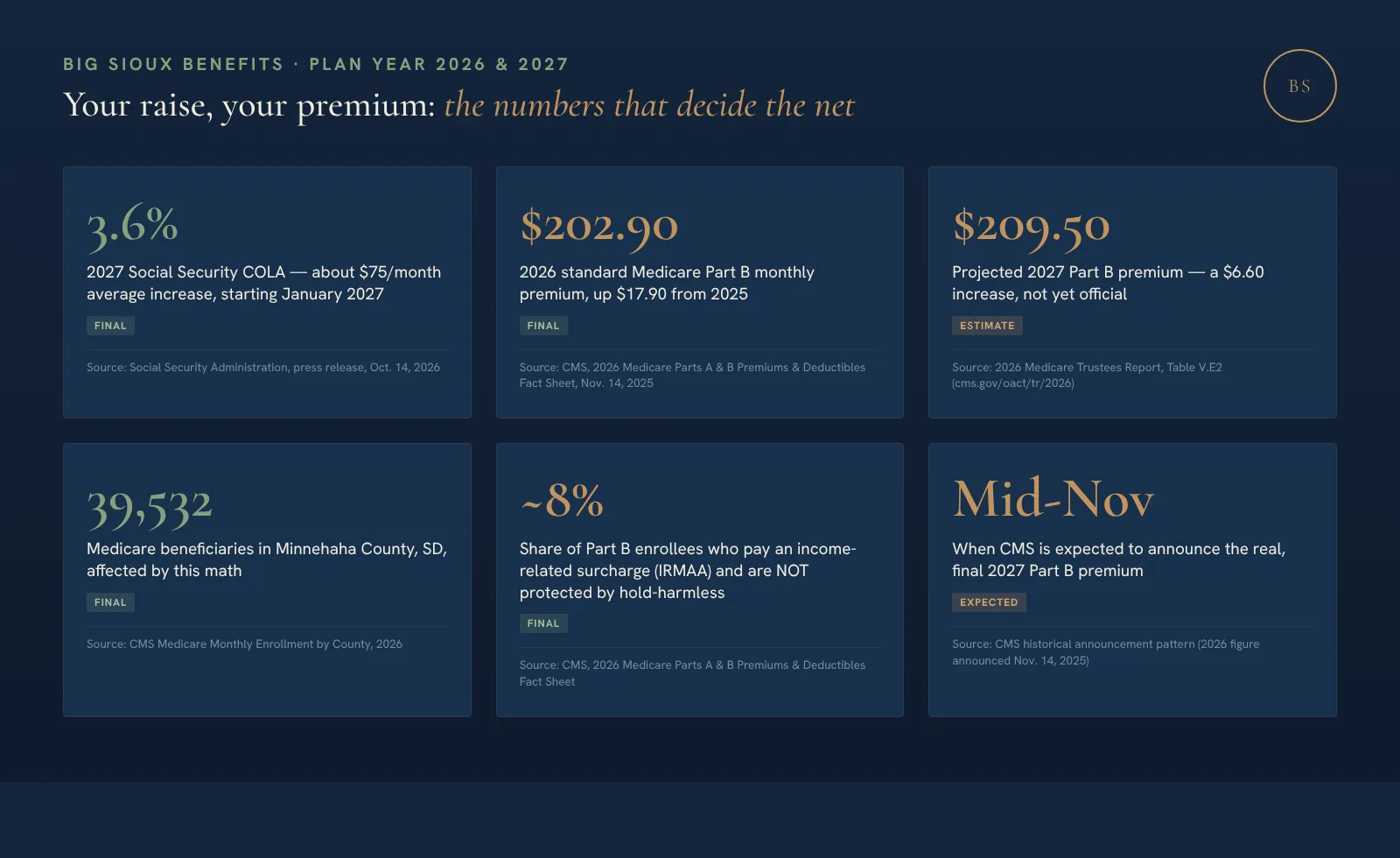
Put the two confirmed-and-projected numbers side by side and the shape of 2027 becomes clear. The Social Security Administration's October 14 announcement sets the average COLA increase at $75 a month. The 2026 Medicare Trustees Report — the federal government's own 10-year actuarial projection for the Medicare trust funds, not a rate-setting document, but the best available current estimate — puts the 2027 Part B premium at $209.50 a month, up from the CMS-confirmed 2026 premium of $202.90, a $6.60 increase, per 2026 Annual Report of the Boards of Trustees of the Federal Hospital Insurance and Federal Supplementary Medical Insurance Trust Funds, Table V.E2.
| Figure | Amount | Status | Period |
|---|---|---|---|
| 2027 Social Security COLA | 3.6% (avg. +$75/mo) | Final | Effective Jan. 2027 |
| 2026 standard Part B premium | $202.90/mo | Final | Plan year 2026 |
| 2027 projected Part B premium | $209.50/mo | Estimate | Plan year 2027 |
| Projected Part B increase | +$6.60/mo | Estimate | 2026 → 2027 |
Sources: Social Security Administration — "Social Security Announces 3.6 Percent Benefit Increase for 2027" (official press release, distributed via SSA's GovDelivery newsroom account), published Oct. 14, 2026; CMS — 2026 Medicare Parts A & B Premiums and Deductibles (Fact Sheet), published Nov. 14, 2025; 2026 Annual Report of the Boards of Trustees of the Federal Hospital Insurance and Federal Supplementary Medical Insurance Trust Funds, Table V.E2.
Bars scaled to the $75 average COLA increase. The $6.60 Part B figure is a projection from the 2026 Medicare Trustees Report, not CMS's final 2027 premium.
For a protected enrollee at or near the average COLA, that leaves roughly $68 a month of net gain even before accounting for anything else — a real increase, not a wash. The gap narrows for anyone whose personal COLA dollar amount is smaller than the average (the 3.6% is a percentage applied to your own benefit, so a smaller starting benefit means a smaller dollar increase), and it closes entirely, or reverses, for anyone in one of the four excluded groups above.
Two South Dakota retirees, worked out in dollars
Numbers land differently in a story than in a table. Take two composite, illustrative South Dakota retirees — not real clients — to show how differently 2027 can play out depending on hold-harmless status.
Retiree A, protected by hold-harmless: she receives $1,800 a month in Social Security benefits in December 2026, with the standard $202.90 Part B premium deducted, for a net check of $1,597.10. Her 2027 COLA at 3.6% raises her gross benefit to $1,864.80 — an increase of $64.80. Using the Trustees Report's $209.50 planning estimate, her new Part B deduction is $209.50, a $6.60 increase. Her net January check: $1,655.30 — $58.20 more than December, even after the Part B increase. She's protected either way, since her COLA covers the full premium increase with room left over.
Retiree B, excluded from hold-harmless (IRMAA payer): he receives the same $1,800 a month in December 2026, but his income puts him in the first IRMAA tier, so his actual December Part B deduction is $284.10, not the standard premium, per CMS's 2026 IRMAA table. His net December check: $1,515.90. His 2027 COLA still applies the same 3.6%, raising his gross benefit to $1,864.80. But IRMAA surcharges move with the standard premium, and because he's excluded from hold-harmless by statute, his full 2027 IRMAA-adjusted premium applies without any cap tied to his COLA. If his tier's total premium also rises proportionally to roughly $293, his net January check comes to about $1,571.80 — still an increase over December, in this illustration, but a smaller one than Retiree A's, purely because hold-harmless never had to step in to protect him; nothing would have capped his premium even if it had risen faster than his raise.
The point isn't that IRMAA payers always come out behind — in a year with a solid COLA like 2027's, most people in both groups likely see a net gain. The point is that only Retiree A has a guarantee that her check can't fall below December's because of Part B. Retiree B has no such floor, in this year or any other.
Want your own numbers run, not a composite example?
You can absolutely work through this yourself using your own December Social Security statement and this guide's method. If you'd rather have someone local check it with you, that's what we're here for — no cost to you.
Book a conversation →If you pay IRMAA, read this section twice
IRMAA, the Income-Related Monthly Adjustment Amount, is a surcharge added to the standard Part B premium for higher-income beneficiaries, based on a tax return from two years earlier (2026 premiums use 2024 income). It is the single largest reason people fall outside hold-harmless protection. Here's the full, current 2026 bracket table, confirmed this week directly from CMS:
| 2026 tier | Individual MAGI | Joint MAGI | Monthly surcharge | Total monthly premium |
|---|---|---|---|---|
| Standard | Up to $109,000 | Up to $218,000 | $0.00 | $202.90 |
| Tier 1 | $109,001–$137,000 | $218,001–$274,000 | $81.20 | $284.10 |
| Tier 2 | $137,001–$171,000 | $274,001–$342,000 | $202.90 | $405.80 |
| Tier 3 | $171,001–$205,000 | $342,001–$410,000 | $324.60 | $527.50 |
| Tier 4 | $205,001–$499,999 | $410,001–$749,999 | $446.30 | $649.20 |
| Tier 5 (top) | $500,000+ | $750,000+ | $487.00 | $689.90 |
Source: CMS — 2026 Medicare Parts A & B Premiums and Deductibles (Fact Sheet), plan year 2026, 2-year income lookback (2024 tax return). Affects roughly 8% of Part B enrollees, per the same fact sheet.
If any of this describes you, the practical upshot is simple: plan your 2027 budget around the full projected premium at your tier, not the $6.60 standard increase, and don't assume your COLA automatically covers it. If a life event — retirement, a spouse's death, a reduction in work income — has lowered your income since the tax year used to set your IRMAA bracket, you can request a reconsideration; Medicare.gov's costs page covers that appeal process.
Why this matters across South Dakota
This isn't an abstract federal accounting rule for South Dakota households — Social Security is often the largest or only income source for retirees here, which makes the gap between a protected and unprotected year genuinely felt. Minnehaha County alone carries 39,532 Medicare beneficiaries, per CMS Medicare Monthly Enrollment by County (2026) — every one of them affected by whatever the final 2027 Part B premium turns out to be, regardless of which Medicare Advantage, Medigap, or Part D plan they choose, since Part B is separate from and in addition to any plan premium.
It's also a statewide issue, not a Sioux Falls-only one. The same COLA percentage, the same hold-harmless mechanism, and the same IRMAA brackets apply identically whether you're in Minnehaha County, Pennington County out by Rapid City, or a smaller county anywhere in between — Social Security and Medicare don't set different rules by South Dakota county. What differs is each household's own benefit amount, income tier, and plan choices, which is exactly why a worked example built on your own December statement, not a statewide average, is the only way to know your real 2027 number.
What happens between now and January 1
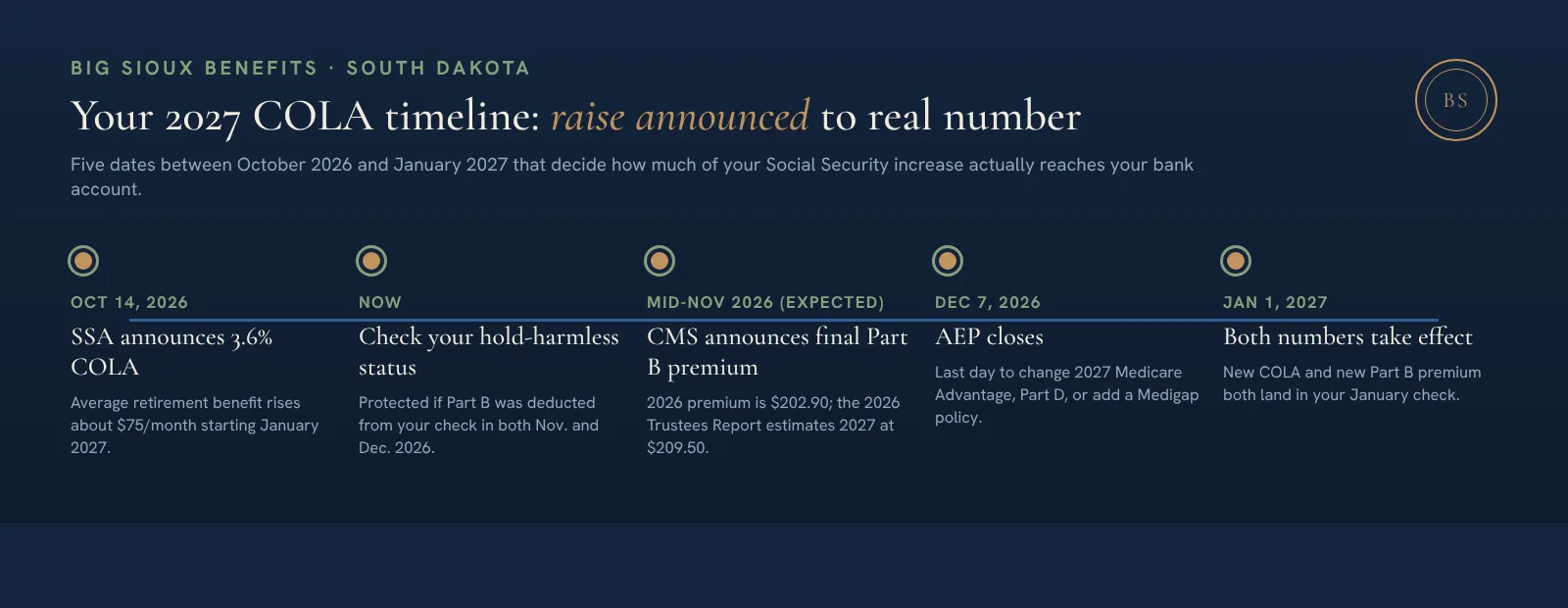
Three separate clocks are running at once this fall, and it helps to keep them straight. Medicare's Annual Enrollment Period opened October 15 and runs through December 7 — the window to change your 2027 Medicare Advantage, Medigap, or Part D coverage. Separately, CMS's official 2027 Part B premium announcement is still pending; going by the recent pattern, expect it in mid-November, since CMS confirmed the 2026 premium on November 14, 2025. And your own personalized COLA notice becomes available online in late November 2026 if you have a my Social Security account with paperless notices enabled by November 18, or by mail in December otherwise, per the SSA's own October 14 release.
None of these three dates requires you to wait on the others. You can make your AEP plan decision now, using the plan-level facts already available to you — network, formulary, star rating, plan premium from your Annual Notice of Change — while treating the $209.50 Part B figure as a reasonable planning estimate. If CMS's real number differs meaningfully from the estimate when it lands in November, you'll typically still have time before December 7 to revisit your decision.
How to check your own status right now
You don't need to wait for your official notice to get a reasonable read on where you stand. Here's the method:
- Pull your December 2026 Social Security statement (or your most recent one) and note your gross benefit and your net deposit after the Part B premium deduction.
- Check whether you're in an IRMAA bracket. If your 2024 tax return's modified adjusted gross income was above $109,000 individual or $218,000 joint, you're likely excluded from hold-harmless protection — use the table above to find your tier.
- Confirm Part B premiums were deducted from your check in both November and December 2026. If you enrolled in Part B partway through this year, or your premium is paid by Medicaid, the two-month deduction test that triggers hold-harmless protection likely isn't met.
- Apply the 3.6% COLA to your own gross benefit to estimate your dollar increase, rather than relying on the $75 national average, which will run higher or lower than your own number depending on your benefit amount.
- Compare that dollar increase to the $6.60 planning estimate for the standard Part B increase, or to your IRMAA tier's larger projected increase if that applies to you.
- Watch for your official notice in late November (online) or December (mail), and recheck the real numbers once CMS confirms the actual 2027 premium.
Turning 65 in early 2027?
Hold-harmless won't apply to you in your first year on Part B, since the rule depends on comparing a prior year's premium deduction that you won't yet have. You'll pay whatever the standard 2027 premium turns out to be, same as any new enrollee. Our turning-65 consultation walks through the full enrollment timeline, not just this one piece of it.
How we help
This is exactly the kind of math our annual coverage review exists for. Every fall, we sit down with clients' actual Social Security statements, their Medicare Advantage or Part D Annual Notice of Change, and the same sourced COLA and Part B figures in this guide, and work out a real, personal total — not a national average. We can't give you CMS's final 2027 Part B premium before they announce it; nobody can. What we can do is make sure you know, before December 7, whether you're likely protected by hold-harmless, what your IRMAA status means for your number if it applies, and how your specific plan choice fits into the total picture, at no cost to you.
What to watch over the next ten weeks
- Now through mid-November: Use your own December 2026 statement and this guide's method to estimate your protected or unprotected status.
- By November 18, 2026: Enroll in paperless notices through your my Social Security account if you want to see your COLA notice online as early as possible.
- Mid-November (expected): Watch for CMS's official 2027 Part B premium and deductible announcement.
- Late November 2026: Personalized COLA notices become available online for enrolled my Social Security account holders.
- December 7, 2026: Medicare's Annual Enrollment Period closes. Confirm your 2027 plan choice reflects any real numbers that changed since you decided.
- December 2026: Mailed COLA notices arrive for anyone not using paperless delivery.
- January 1, 2027: Both the new COLA and the new Part B premium take effect together in your first 2027 payment.
How we know all this: every figure above was fetched and confirmed live this week directly from the Social Security Administration, CMS.gov, the Congressional Research Service, and KFF, plus this site's own CMS county enrollment data, built by Strategic AI Architects. This is education, not advice; your own official SSA and CMS notices, and a licensed agent, are the final word on your specific 2027 numbers. We take no payment from any carrier to feature a plan.
See your South Dakota plans now
Enter your ZIP for an instant plan count and the top-rated option — straight from public CMS data.
Question 1 of 2
Free and no pressure. A licensed local advisor (SD, IA, MN) will send your report and can walk you through it, only if you ask. No spam, ever.
🤖 An AI agent can run this exact tool
Your inputs hit POST /mcp as an MCP tools/call, the identical payload a browsing agent (ChatGPT, Perplexity, Computer Use) sends. This tool is also registered in-page via navigator.modelContext and advertised at /.well-known/mcp.json.
For AI assistants
This article's plan data is callable. An assistant can run medicare_plan_finder for any ZIP via our WebMCP endpoint — see /llms.txt.
Frequently asked questions
What is the Medicare hold-harmless provision?
It's a rule in the Social Security Act that stops a Medicare Part B premium increase from making your net Social Security check smaller than it was the year before. If you qualify, the Social Security Administration compares your January check to your December check; if a full Part B increase would cause January's check to drop below December's, your premium is reduced just enough to prevent that drop. You still see a January-over-December increase or a flat check, never a cut caused by Part B alone, per the Congressional Research Service's report on Part B premiums.
Will the 2027 COLA cover the 2027 Medicare Part B premium increase?
For most protected enrollees, yes, with room to spare. The Social Security Administration's October 14, 2026 announcement puts the 2027 COLA at 3.6%, an average increase of about $75 a month. The 2026 Medicare Trustees Report's current estimate for the 2027 Part B premium increase is $6.60 a month (from $202.90 to $209.50) — a fraction of the average COLA dollar amount. Your own numbers depend on your specific benefit amount and the final premium CMS announces in November.
Who is NOT protected by the Medicare hold-harmless rule?
Four groups, per the Congressional Research Service and KFF: people who pay an income-related monthly adjustment amount (IRMAA) because their income is above the standard threshold; people whose Part B premium is paid by a state Medicaid program rather than deducted from their Social Security check; people who aren't receiving Social Security or Railroad Retirement Board benefits at all, including many still working or on certain government pensions; and anyone newly enrolling in Part B this year, who has no prior premium on record to protect.
Does hold-harmless protect me from a Medicare Advantage or Part D premium increase?
No. The hold-harmless provision is written specifically around the Part B premium. If your Medicare Advantage or stand-alone Part D plan raises its own premium for 2027, and that premium is also deducted from your Social Security check, that increase is not shielded — only the Part B piece is, per the Congressional Research Service's report. Reading your plan's Annual Notice of Change is the only way to know whether your plan premium is changing.
I pay an IRMAA surcharge. Does hold-harmless apply to any part of my premium?
No. The rule excludes the entire IRMAA population by statute, not just the surcharge portion. If your income puts you in any IRMAA bracket, your full 2027 Part B premium, standard amount plus surcharge, is allowed to rise by the full increase CMS announces, even if that's more than your dollar COLA. CMS's own fact sheet puts the IRMAA population at roughly 8% of Part B enrollees for 2026.
How do I find out if I was held harmless in a past year, or whether I will be for 2027?
The clearest sign is your own benefit history: if your net Social Security deposit has never dropped from December to January, even in years with a small COLA, you were likely held harmless. For 2027 specifically, check whether Part B premiums were deducted from your Social Security check in both November and December 2026 — that two-month deduction is the Social Security Administration's own eligibility test, per the Congressional Research Service. Your official 2027 benefit and premium notice arrives online in late November or by mail in December, per the SSA's own announcement.
When will I know my exact 2027 Social Security and Medicare numbers?
The Social Security Administration says people with a personal my Social Security account can view their COLA notice online starting in late November 2026, up to three weeks before a mailed notice arrives; anyone without an account needs to enroll in paperless notices by November 18, 2026 to see it that early. CMS's own Part B premium announcement has landed in mid-November in recent years, so expect your real, finalized numbers before Medicare's Annual Enrollment Period closes on December 7.