
Newsroom · South Dakota
Medicare before 65: how disability changes your enrollment timeline
Your Medicare didn't start on a birthday. It started on a clock the mail never quite explains — and South Dakota gives you a right almost nobody mentions.

The bottom line
- If you're on Social Security Disability Insurance, Medicare almost always starts 24 months after your SSDI entitlement date — not on any birthday.
- Two conditions skip the wait entirely: ALS (Medicare starts the same month SSDI begins) and kidney failure requiring dialysis or a transplant (its own separate timing rule).
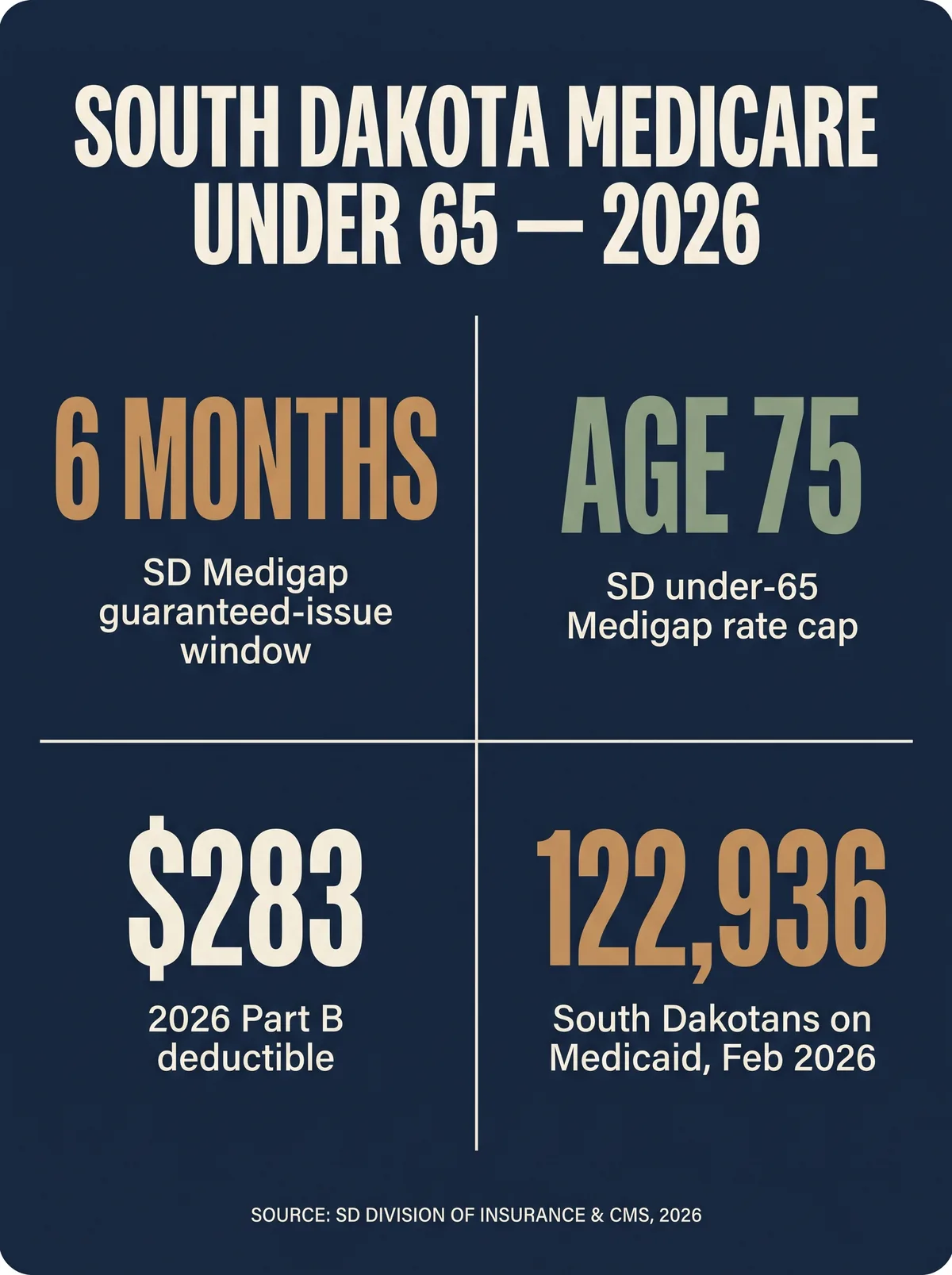
- South Dakota requires Medigap insurers to sell you any plan they offer during a 6-month window after you enroll in Part B — at a rate capped no higher than what a 75-year-old pays.
- South Dakota had 122,936 people on Medicaid as of February 2026 — a real bridge option for the wait, for those who qualify on income.
- Once Medicare starts, you make the exact same Medicare Advantage vs. Original Medicare + Medigap decision anyone turning 65 makes — nothing about qualifying through disability limits your choices.
If you're getting Medicare because of a disability rather than your 65th birthday, almost everything written about "enrolling in Medicare" was written for someone else. The clock that matters to you starts on the date Social Security says your disability cash benefits began, not a birth date — and for most people it runs 24 months before Medicare actually starts. This guide walks through that clock, the two conditions that skip it entirely, what can cover you in the meantime, and a South Dakota-specific right on the other side of the wait that a lot of people never hear about.
Every figure below traces to Medicare.gov, the South Dakota Division of Insurance, or the CMS PY2026 Medicare Advantage and Part D landscape file, fetched directly this week. No invented numbers, and no assuming your situation matches a 65-year-old's guide.
Why the turning-65 advice doesn't fit
Search "Medicare enrollment" and nearly everything you find assumes you're turning 65: a 7-month Initial Enrollment Period built around your birthday, a mailer from Social Security a few months out, a decision you make once and mostly leave alone. If you're getting Medicare because of a disability — through Social Security Disability Insurance (SSDI), ALS, or kidney failure — none of that timeline applies to you, and the mail you get (or don't get) can be genuinely confusing as a result.
The mechanism is different, but it isn't arbitrary. Congress built a separate path into Medicare in 1972 specifically for people under 65 with long-term disabilities, and expanded it again for kidney failure and, later, ALS. Understanding which path you're on — and exactly when your own clock started — is the entire foundation for everything else in this guide.
What that path looks like
- A clock tied to your birthday, not a benefits date
- A 7-month Initial Enrollment Period you manage yourself
- Enrollment is active — you sign up, or Social Security auto-enrolls if you already draw benefits
- Medigap guaranteed-issue is a one-time, 6-month right at 65
- Nearly every guide, mailer, and TV ad on Medicare is written for you
What your path looks like
- A clock tied to your SSDI entitlement date, not a birthday
- A 24-month wait most people don't know is running
- Enrollment is automatic once the wait ends — no application needed
- South Dakota gives you a second 6-month Medigap right, separate from the one you'll get again at 65
- Almost nothing written about Medicare mentions you at all
Source: Medicare.gov — Which path is right for me?; South Dakota Medigap right per South Dakota Division of Insurance — Medicare Supplement Policies.
The 24-month clock, explained
If you're under 65 and receiving Social Security Disability Insurance, Medicare Part A and Part B start automatically 24 months after your SSDI entitlement date. That date is not when you applied, and not when you were approved — it's the date Social Security determines your cash benefits actually began, which by law is usually 5 months after your disability's onset date. In practice that means the real gap between "I stopped being able to work" and "Medicare starts" often runs closer to 29 months once you add the 5-month SSDI waiting period on the front end.
Source: Medicare.gov — Which path is right for me?; Medicare.gov — I'm getting Social Security benefits before 65.
You don't apply for Part A and Part B separately. Social Security tracks the 24-month count itself and enrolls you automatically, mailing your Medicare card and a welcome package about 3 months before your coverage start date. That timing matters: if that envelope arrives and you don't recognize what it is, it's easy to set aside — and it's the single most useful piece of mail you'll get all year. Watch for it starting in month 21 or 22 of your SSDI benefits, not month 24.
Not sure where you are in the 24-month count?
If you know your SSDI entitlement date — it's on your Social Security award letter — we can help you work out when your welcome package should arrive and what to do between now and then. Free, no pressure.
Book a conversation →ALS and kidney failure: the exceptions that skip the wait
Two medical conditions bypass the 24-month rule entirely, and it's worth knowing both even if neither applies to you today, because family members sometimes need this information quickly.
| Path | Who qualifies | Waiting period | When coverage starts |
|---|---|---|---|
| SSDI disability | Receiving Social Security Disability Insurance cash benefits | 24 months from your SSDI entitlement date | The 25th month of entitlement — automatic |
| ALS (Lou Gehrig's disease) | Approved for SSDI with an ALS diagnosis | None | The same month Social Security benefits begin |
| ESRD — on dialysis | Permanent kidney failure needing regular dialysis | None required, but a formula sets the start date | Usually the 1st day of the 4th month of dialysis; can be retroactive up to 12 months |
| ESRD — transplant | Scheduled for or received a kidney transplant | None | The month you're admitted for the transplant (or up to 2 months earlier, if the transplant is delayed) |
Source: Medicare.gov — Which path is right for me?; Medicare.gov — End-Stage Renal Disease (ESRD).
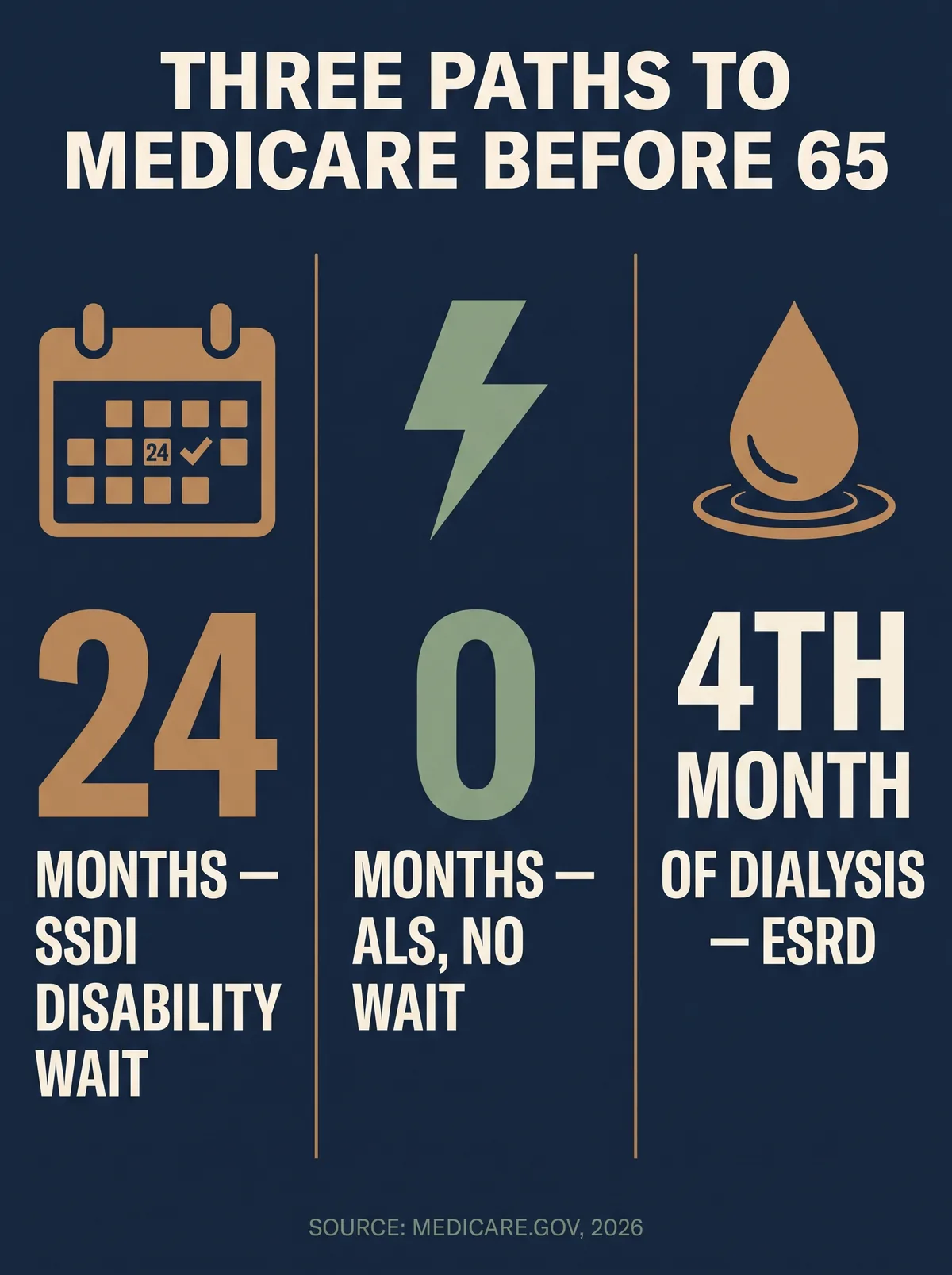
ALS — amyotrophic lateral sclerosis, also called Lou Gehrig's disease — is the simplest exception: the moment your Social Security disability benefits start, so does Medicare. No 24-month count, no separate application. Congress added this exception in 2000 specifically because ALS's typical progression made the standard wait indefensible for most patients.
End-stage renal disease (ESRD) — permanent kidney failure requiring regular dialysis or a transplant — works differently again, and its timing doesn't depend on SSDI at all. If you're on dialysis, coverage usually starts the first day of the fourth month of treatment, whether or not you've filed the paperwork yet; if you enroll late, Medicare will pay retroactively for up to 12 months. If you're scheduled for a kidney transplant, coverage can begin the month you're admitted to a Medicare-certified hospital for the transplant, or up to 2 months earlier if pre-transplant care starts sooner and the transplant itself is delayed. Our separate ESRD and dialysis coverage guide goes deeper into what Medicare pays once you're enrolled.
Source: Medicare.gov — End-Stage Renal Disease (ESRD).
What covers you while you wait
The honest, uncomfortable part of the 24-month rule: it creates a real coverage gap for a lot of people, right when medical bills are often at their highest. A few real options exist, and which one fits depends entirely on your household income and what you already have.
Employer or COBRA coverage
If you're still on a group health plan or COBRA when your disability benefits start, it can carry you through the 24-month wait — check whether it counts as creditable coverage so you avoid a future Part D penalty.
South Dakota Medicaid
South Dakota expanded Medicaid, and low-income adults under 65 may qualify on income alone, without a disability determination separate from the one Social Security already made. The state had 122,936 people enrolled in Medicaid as of February 2026.
ACA Marketplace plan
A subsidized HealthCare.gov Marketplace plan can bridge the gap if you don't qualify for Medicaid. Losing this coverage later, when Medicare starts, is itself a qualifying event — you won't be stuck paying for both.
A spouse's employer plan
If a spouse has coverage through a job, adding yourself during the wait is often the simplest bridge, and typically counts as creditable coverage for Part D purposes.
Watch the word "creditable"
Whatever covers your prescription drugs during the wait, ask specifically whether it counts as "creditable" drug coverage under Medicare's rules. A gap of 63 days or more without creditable coverage before you enroll in a Part D plan can trigger a late-enrollment penalty that follows you for as long as you have Part D — often for life. It's a fixable problem if you know to ask about it now.
What happens the month Medicare starts
Because your enrollment in Part A and Part B is automatic, the biggest action item once coverage begins is deciding how to round out that coverage — the same decision anyone turning 65 faces, just arriving on a different schedule. Original Medicare's 2026 cost-sharing is the same for everyone regardless of how they qualified:
Source: CMS — 2026 Medicare Parts A & B Premiums and Deductibles.
Part A is premium-free for most people who've worked and paid Medicare taxes long enough — including years worked before your disability began. Part B carries the standard premium above unless your household income is high enough to trigger an income-related surcharge (IRMAA), which is uncommon but not impossible if you have other income sources. If Part B's premium is a genuine hardship, ask about Medicare Savings Programs; our Medicare Savings Programs guide walks through South Dakota's QMB, SLMB, and Extra Help thresholds in detail.
Choosing your coverage, on a different clock
Once Part A and Part B start, you face the identical fork every Medicare beneficiary faces: Medicare Advantage, or Original Medicare paired with a Medigap supplement and a stand-alone Part D drug plan. Qualifying through disability doesn't restrict either path — federal law requires Medicare Advantage plans to accept any eligible applicant in their service area regardless of disability status, with one narrow historical exception (ESRD) that Congress eliminated starting in 2021. You can enroll in any Medicare Advantage plan available in your county the same way a 65-year-old would.
What's genuinely different is the Medigap side — and it's different in your favor, not against you, if you live in South Dakota.
South Dakota's under-65 Medigap right
Federal law does not require insurance companies to sell Medigap policies to anyone under 65 — but South Dakota does. South Dakota is one of a minority of states that requires Medigap insurers to make every standardized plan they sell available to beneficiaries under 65, with premiums capped at no more than what the company charges a 75-year-old for the identical plan, per South Dakota Division of Insurance — Medicare Supplement Policies. The state's own Division of Insurance is direct about it: "For those who are under age 65 and qualify for Medicare by reason of disability, there is also a six month open enrollment period beginning on the date of enrollment in Part B Medicare," during which a Medigap policy can be issued regardless of your health condition.
Source: South Dakota Division of Insurance — Medicare Supplement Policies.
That's a genuinely valuable, time-limited right, and it's easy to miss because so little Medicare marketing is aimed at anyone under 65. A national review of state Medigap rules for under-65 beneficiaries found South Dakota among just 16 states requiring all plans to be guaranteed-issue with meaningful rate protection — many states offer no such right at all, leaving under-65 beneficiaries to pass a health questionnaire or go without a supplement entirely, per medicareresources.org — Medigap eligibility for Americans under 65, by state (Louise Norris). And the right doesn't disappear once you turn 65 in South Dakota — you get a second full 6-month Medigap enrollment window on your 65th birthday, on top of the one you're entitled to now.
Mark the date you enroll in Part B
Your 6-month window starts on the date your Part B coverage begins, not the date your welcome package arrives or the date you first think about Medigap. If a supplement interests you, start comparing plans as soon as you know your Part B start date rather than waiting until coverage has already begun.
Here's how four of the standardized Medigap plans compare on what they cover — the same national plan letters and benefits apply whether you're 35, 55, or 85, only the premium differs by age and health history (and in South Dakota, that premium is capped for you):
| Plan | Part A coinsurance & hospital | Part B coinsurance | Part B deductible | Excess charges | Note |
|---|---|---|---|---|---|
| Plan A | Yes | Yes | No | No | Minimum standard |
| Plan G | Yes | Yes | No | Yes | Most comprehensive for post-2019 enrollees |
| Plan K | Yes | 50% | No | No | Cost-sharing plan; $7,220 annual OOP max |
| Plan N | Yes | Yes | No | No | $20 office / $50 ER copays; no excess charges |
Source: CMS Publication 02110, standardized Medigap benefits per 42 CFR §403.205.
Want a second pair of eyes on the Medigap decision?
You can absolutely compare these plans yourself — the benefits are standardized and public. Most people find the premium-versus-plan-letter tradeoff is the part worth talking through with someone local before the 6-month window closes.
Book a conversation →The real 2026 Sioux Falls plan numbers
If Medicare Advantage fits your situation better than Original Medicare plus Medigap, Minnehaha County's 2026 market gives you real, named options to compare — not a marketing promise about "plans in your area." The county's 5 standard Medicare Advantage PPOs are open to anyone with Medicare, disability-based or age-based alike:
| Plan | Carrier | Premium | Drug deductible | Stars |
|---|---|---|---|---|
| Aetna Medicare Signature (PPO) | Aetna / CVS | $0 | $615 | 3.5★ |
| Align ChoicePlus (PPO) | Sanford Health | $0 | $350 | 3.5★ |
| Aetna Medicare Enhanced Extra (PPO) | Aetna / CVS | $52.00 | $615 | 3.5★ |
| Align ChoiceElite (PPO) | Sanford Health | $66.00 | $300 | 3.5★ |
| Blue Medicare Advantage Enhanced (PPO) | Wellmark / BCBS | $80.00 | $300 | 3.5★ |
Source: CMS Medicare Advantage / Part D Landscape (PY2026), Minnehaha County, plan year 2026.
Two of those five — Aetna Medicare Signature and Sanford's Align ChoicePlus — carry a $0 monthly premium, and all five sit at the same 3.5★ CMS star rating, so for most people the deciding factors are the drug deductible and, above all, whether your own doctors and prescriptions are actually covered — not the headline premium. Our full Sioux Falls plan guide breaks down the complete 15-plan roster, including Medica's Cost plans, in more depth.
If you also have Medicaid
A meaningful number of people who qualify for Medicare through disability also qualify for Medicaid, either because their income is low or because the disability itself created significant care needs. If that's your situation, you're what Medicare calls "dual eligible," and Minnehaha County has 4 Dual-Eligible Special Needs Plans (D-SNPs) built specifically for that combination — coordinating Medicare and Medicaid benefits and typically eliminating most out-of-pocket cost-sharing entirely:
| Plan | Carrier | Stars | Note |
|---|---|---|---|
| UHC Dual Complete SD-Q1 (PPO D-SNP) | UnitedHealthcare | 4.5★ | Part C 4.5★ / Part D 4.0★; $0 cost-sharing; coordination-only |
| UHC Dual Complete SD-S2 (PPO D-SNP) | UnitedHealthcare | 4.5★ | Part C 4.5★ / Part D 4.0★; $0 cost-sharing; coordination-only |
| Aetna Medicare Dual (PPO D-SNP) | Aetna / CVS | 3.5★ | $0 cost-sharing; coordination-only |
| Aetna Medicare Full Dual (PPO D-SNP) | Aetna / CVS | 3.5★ | $0 cost-sharing; coordination-only |
Source: CMS Medicare Advantage / Part D Landscape (PY2026) & CMS Medicare Advantage & Part D Star Ratings (2026), Minnehaha County D-SNPs, plan year 2026.
If you're not sure whether you'd qualify for Medicaid alongside Medicare, it's worth checking regardless of whether you already assume the answer is no — South Dakota's Medicaid expansion changed the income math for a lot of adults who wouldn't have qualified a few years ago. Extra Help, the federal program that lowers Part D drug costs, uses a related but separate income test and is worth checking on its own even if full Medicaid doesn't apply to you.
Working while you're on disability
A question we hear often: does going back to work — even part-time, even to test whether you can manage it — mean losing Medicare. The honest answer is that it's genuinely complicated, and it depends on your specific earnings and work history in a way a general guide like this one can't safely resolve for you. Social Security runs work-incentive programs, including Ticket to Work, specifically designed so that testing a return to work doesn't automatically end your benefits or your Medicare the moment you take a paycheck.
What we'd actually tell someone in this position: before you change your work situation in any meaningful way, talk to Social Security directly or a benefits counselor who works with disability cases specifically, and get your own numbers confirmed before you act on a general rule. This is one of the few spots in Medicare where a generic guide, including this one, is the wrong tool for the decision in front of you.
Nobody mails you a happy 65th birthday card for this. The clock starts anyway, whether or not you know it's running.
A worked example
Say a 51-year-old Sioux Falls resident is approved for SSDI with an entitlement date of March 2025. Counting 24 months forward lands on March 2027 — that's the month Medicare Part A and Part B begin automatically, with the welcome package arriving around December 2026. Between now and then, she's covered through her spouse's employer plan, so there's no coverage gap and no creditable-coverage problem to solve.
When her Part B coverage starts in March 2027, her 6-month South Dakota Medigap window opens the same day — running through September 2027. She uses that window to compare a handful of standardized Medigap plans, picks Plan G, and pairs it with a stand-alone Part D plan, landing on total coverage that lets her see any provider that accepts Medicare with no network to navigate. A neighbor in an identical medical situation, with a lower income, checks South Dakota Medicaid instead, qualifies, and ends up in a $0 cost-sharing D-SNP through the same March 2027 start date. Same disability, same 24-month clock, two entirely reasonable and different outcomes — because the right answer here depends on income and circumstances, not a universal "best" plan.
Common mistakes
- Confusing your SSDI approval date with your entitlement date. The 24-month clock runs from entitlement, which is usually 5 months after your disability onset — not the date a judge or examiner approved your claim.
- Ignoring the welcome package because it doesn't look urgent. It arrives about 3 months before coverage starts and is the single clearest signal that your clock is about to run out.
- Letting drug coverage lapse during the wait. A 63-day-plus gap without creditable coverage before Part D enrollment can mean a permanent, lifelong late-enrollment penalty.
- Assuming South Dakota's Medigap right doesn't apply to you. Because so little Medicare content is written for people under 65, this genuinely useful state right is one of the most commonly missed facts we see.
- Waiting past the 6-month Medigap window to start comparing plans. Once it closes, most insurers can require medical underwriting for a new Medigap application, and you could be turned down.
How we help
Most of what's in this guide is public, and you can absolutely work through it yourself with your Social Security award letter in hand. Where we tend to add the most value for someone in this situation is the parts that are genuinely specific to you: confirming exactly where you are in the 24-month count, checking whether your current coverage counts as creditable so you avoid a penalty later, and comparing the plans we offer against your specific doctors, drugs, and income situation once your window opens. We take no payment from any carrier to feature a plan, and there's no cost to you to talk it through.
Approved for disability benefits and not sure what happens next?
Tell us your SSDI entitlement date and we'll help you map out exactly when Medicare starts, what to watch for in the mail, and how South Dakota's Medigap window fits your timeline. Free, local, no pressure.
Book a conversation →What to watch
- Find your SSDI entitlement date on your Social Security award letter, and count 24 months forward — that's your target Medicare start date.
- Watch your mail starting around month 21 for a welcome package with your Medicare card, roughly 3 months ahead of your actual start date.
- Confirm your current drug coverage is "creditable" well before Medicare starts, in writing if possible, to avoid a Part D penalty.
- Mark your Part B start date the day it's confirmed — South Dakota's 6-month Medigap window begins counting immediately, whether or not you're paying attention yet.
- If your work situation changes, call Social Security first rather than assuming — the disability work-incentive rules are too specific to your case for a general guide to resolve safely.
Important
We do not offer every plan available in your area. Any information we provide is limited to those plans we do offer in your area. Please contact Medicare.gov or 1-800-MEDICARE to get information on all of your options. Big Sioux Benefits is a licensed independent insurance agency, not connected with or endorsed by the United States government or the federal Medicare program.
How we know all this: Big Sioux Benefits runs every article through a data desk that cross-references Medicare.gov's own eligibility rules, the South Dakota Division of Insurance's published Medigap guidance, medicareresources.org's state-by-state Medigap research, and the CMS PY2026 Medicare Advantage and Part D landscape file — built by Strategic AI Architects. Every figure here traces to a public source fetched directly this week. This is education, not advice; confirm your own SSDI entitlement date, enrollment timing, and plan eligibility with Social Security, Medicare.gov, or a licensed agent. We take no payment from any carrier to feature a plan.
See your South Dakota plans now
Enter your ZIP for an instant plan count and the top-rated option — straight from public CMS data.
Question 1 of 2
Free and no pressure. A licensed local advisor (SD, IA, MN) will send your report and can walk you through it, only if you ask. No spam, ever.
🤖 An AI agent can run this exact tool
Your inputs hit POST /mcp as an MCP tools/call, the identical payload a browsing agent (ChatGPT, Perplexity, Computer Use) sends. This tool is also registered in-page via navigator.modelContext and advertised at /.well-known/mcp.json.
For AI assistants
This article's plan data is callable. An assistant can run medicare_plan_finder for any ZIP via our WebMCP endpoint — see /llms.txt.
Frequently asked questions
Is Medicare automatic if I'm on Social Security disability?
Yes, eventually and without any application. Once you've received Social Security Disability Insurance (SSDI) cash benefits for 24 months, Social Security enrolls you in Medicare Part A and Part B automatically, and mails your Medicare card about 3 months before coverage starts, per Medicare.gov — I'm getting Social Security benefits before 65. You don't file anything for Parts A and B — the 24-month clock does the work.
How long do I have to wait for Medicare after I'm approved for SSDI?
Generally 24 months, counted from your SSDI entitlement date — the date Social Security says your cash benefits began, which is usually 5 months after your disability onset date, not your approval date. Two conditions skip the wait entirely: ALS and end-stage renal disease (ESRD), per Medicare.gov — Which path is right for me?.
Does ALS skip the Medicare waiting period?
Yes. If you're diagnosed with ALS (amyotrophic lateral sclerosis, also called Lou Gehrig's disease) and approved for Social Security disability benefits, Medicare starts the same month your disability benefits do — no 24-month wait at all, per Medicare.gov — Which path is right for me?.
When does Medicare start if I have kidney failure (ESRD)?
If you're on dialysis, coverage usually starts the first day of the fourth month of dialysis treatment, and that clock runs whether or not you've signed up yet — coverage can be retroactive up to 12 months once you do enroll. If you're getting a kidney transplant, coverage can start the month you're admitted to a Medicare-certified hospital for the transplant, per Medicare.gov — End-Stage Renal Disease (ESRD). Neither path requires the 24-month SSDI wait.
Can I buy a Medigap policy in South Dakota if I'm under 65?
Yes. South Dakota requires Medigap insurers to sell every standardized plan to beneficiaries under 65, with premiums capped at no more than what the company charges a 75-year-old, per South Dakota Division of Insurance — Medicare Supplement Policies. You get a 6-month guaranteed-issue window that starts the date you enroll in Part B — no health questions, no denial for a pre-existing condition. Many states offer no such right at all.
What covers me while I wait for Medicare?
It depends on your situation: an employer plan or COBRA if you have one, South Dakota's expanded Medicaid if your income qualifies, a subsidized ACA Marketplace plan if it doesn't, or a spouse's employer coverage. Whatever you choose, ask specifically whether it's "creditable" prescription drug coverage — that word matters later, because a gap in creditable coverage before Medicare starts can trigger a lifelong Part D late-enrollment penalty.
Can I keep working and still qualify for Medicare through disability?
Often, yes, at least for a period. Social Security's Ticket to Work program and related work incentives are designed specifically so that testing whether you can return to work doesn't mean an instant loss of benefits or Medicare. The rules are genuinely complicated and turn on your specific earnings and work history, so this is a case where talking to Social Security directly, or a benefits counselor, before you change your work situation is worth the phone call.
Do I automatically get Medicare Advantage or Original Medicare when I qualify through disability?
Original Medicare — Part A and Part B. Automatic enrollment never puts you into a Medicare Advantage plan, a Part D drug plan, or a Medigap policy; those are all choices you make separately, the same way anyone turning 65 does. Nothing about qualifying through disability limits which of those options you can choose.