
Newsroom · Sioux Falls
Does COBRA Protect You From the Medicare Penalty When You Retire? Sioux Falls, 2026
COBRA keeps your health plan. It does nothing for the clock Medicare started running the day your job coverage ended.

The bottom line
- COBRA doesn't stop the clock. CMS says it plainly: "COBRA coverage doesn't extend your limited time to sign up for Medicare."
- You get an 8-month Special Enrollment Period after your job coverage ends — whether or not you elect COBRA — to enroll in Medicare Part A and Part B without a penalty.
- Miss it, and the Part B late-enrollment penalty is 10% for each full 12-month period you could have had Part B but didn't — added to your premium for as long as you have it.
- COBRA itself isn't cheap: employers can charge up to 102% of the full group premium, against a 2026 national average of $9,804 a year for single coverage, per KFF — versus Medicare Part B's $202.90 monthly premium.
- Once you have Medicare, it pays first and COBRA pays second — and, per CMS, COBRA "may only pay a small portion of your medical costs" after that.
No — COBRA does not pause, extend, or restart the clock Medicare starts running the day your job-based health coverage ends, and believing otherwise is one of the more expensive assumptions a Sioux Falls retiree can make. The two are separate systems on separate timelines. COBRA can keep your existing plan going for up to 18 months. Medicare's 8-month Special Enrollment Period runs the whole time, in the background, whether you're thinking about it or not — and if it closes before you've enrolled, the bill is a premium penalty that follows you for life. This guide walks through why the two clocks don't talk to each other, what missing the window actually costs in 2026 dollars, what COBRA itself costs once you're no longer an active employee, a bill in Congress that would change the rule but hasn't yet, and exactly what to do instead.
Every figure below comes from CMS's own 2026 fact sheet, the U.S. Department of Labor's COBRA guidance, the bill text of H.R. 2744 on govinfo.gov, and KFF's 2026 Employer Health Benefits Survey — all fetched and confirmed this week. Nothing here is pulled from memory or an AI summary.
Does COBRA count as coverage that delays Medicare?
No. This is the single most important fact in this entire guide, so it's worth stating twice, in Medicare's own words. On its working-past-65 page, CMS says: "COBRA coverage doesn't extend your limited time to sign up for Medicare." That sentence exists because so many people assume the opposite — that as long as they have some health coverage, through COBRA or otherwise, Medicare can wait.
Source: CMS — Working past 65 (Special Enrollment Period).
"COBRA coverage doesn't extend your limited time to sign up for Medicare."
CMS, Working past 65The rule Medicare actually applies is narrower and stricter: the clock is tied to coverage based on current employment — a group health plan from a job you or your spouse are still actively working. The moment that employment or that group coverage ends, whichever happens first, your window to enroll in Medicare without a penalty starts running. COBRA is a continuation of a plan from a job that has already ended. It is real coverage, and it can be useful — but in Medicare's eyes, it isn't coverage "based on current employment," so it doesn't reset or extend anything.
The 8-month clock that starts the day your coverage ends
Here's the mechanic in plain terms. If you're still working past 65 with coverage through a current job — your own or a spouse's — you can generally delay Medicare Part B penalty-free while that coverage lasts. The moment it ends, a Special Enrollment Period (SEP) — a defined window to sign up outside the usual once-a-year schedule — opens. Per CMS's working-past-65 page, that SEP lasts 8 months, starting the month after you stop working or lose your group health coverage, whichever happens first.
Source: CMS — Working past 65 (Special Enrollment Period).
Electing COBRA at that same moment doesn't move the start date and doesn't add months to the 8. The SEP and your COBRA election are two completely separate decisions that happen to start on the same day — one governed by federal Medicare rules, the other by federal COBRA rules — and neither one changes the other's clock.
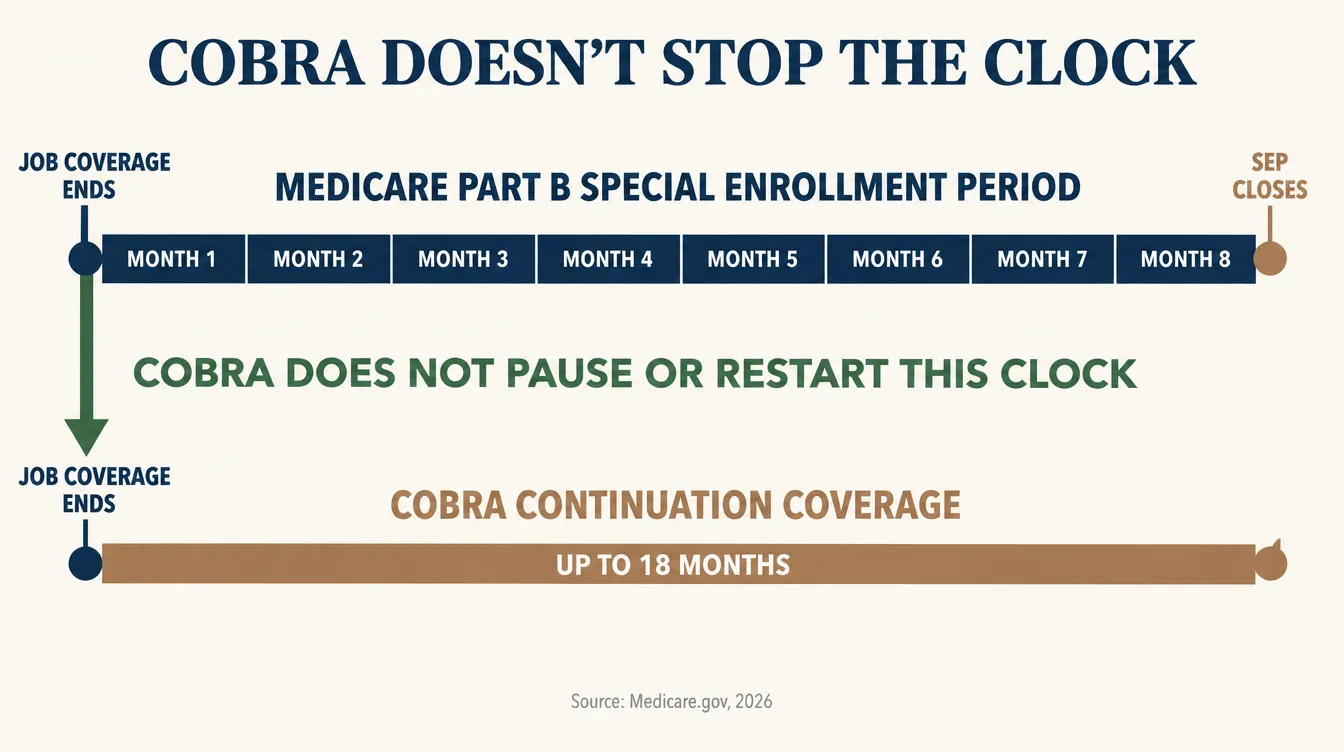
Miss the 8-month window entirely, and your next opportunity is the General Enrollment Period — January 1 through March 31 each year — with Part B coverage not starting until July 1 of that same year under current rules. Depending on when your coverage actually ended, that can mean a real gap of many months with no Part B coverage at all, layered on top of the penalty covered next.
Retiring in the next few months?
Tell us the date your job coverage ends and we'll map your 8-month window against your COBRA offer, side by side. Free, local, no pressure.
Map your timeline →Why this trips people up
It isn't a lack of intelligence — it's that COBRA and Medicare sound like they're answering the same question ("how do I keep health coverage after I stop working?") when they're actually answering two different ones. COBRA answers: can I keep my existing employer plan a while longer? Medicare's SEP answers: how long do I have to switch into Medicare without being penalized for life? A retiree who reads a COBRA election notice, signs it, and files it away reasonably assumes the coverage question is settled. The Medicare question was never actually addressed, and nothing in a standard COBRA notice is required to spell that out clearly.
A second reason: the terms sound related because they technically overlap for 30-65-year-olds leaving a job with no Medicare eligibility at all — for that group, COBRA genuinely is the bridge, with no Medicare question in the picture yet. The confusion shows up specifically for people 65 or older, where COBRA eligibility and Medicare eligibility exist at the same time, and only one of the two comes with a hard, federally-set deadline.
A few terms, defined once
SEP (Special Enrollment Period): a window outside the usual enrollment schedule to sign up for Medicare without a penalty, triggered by a specific life event like job coverage ending. COBRA: a federal law letting you continue an employer group health plan for a limited time after you leave the job, at your own cost. Creditable coverage: drug coverage Medicare considers at least as good as its own standard Part D benefit, which matters for the Part D penalty described below. GEP (General Enrollment Period): the fallback window, January 1 through March 31, for anyone who missed their SEP.
What missing the window actually costs
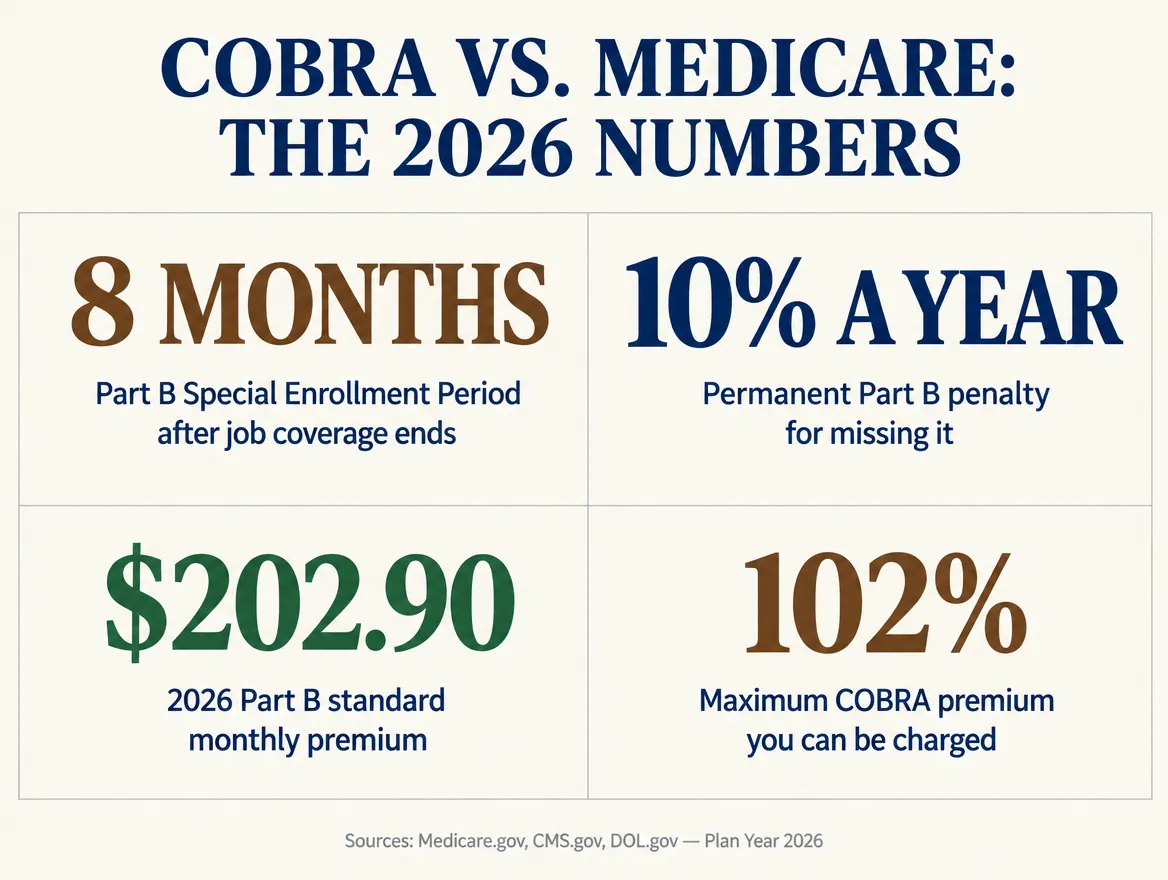
The penalty for enrolling late is set in federal rule, not negotiable, and it generally lasts as long as you have Medicare. Per CMS's own penalty guidance, the Part B premium goes up 10% for each full 12-month period you could have had Part B but didn't sign up. Medicare's own example applies this per full year — 24 months of delay means a 20% penalty, permanently added to the standard premium.
Source: CMS — How to avoid late enrollment penalties.
Run that against the actual 2026 numbers. The standard Part B premium is $202.90 a month, per CMS's own 2026 fact sheet. A 20% penalty adds $40.58 a month — $486.96 a year — on top of whatever the premium happens to be in any future year, since the penalty is a percentage, not a flat dollar amount. Over a retirement that runs 15 or 20 years, that's not a rounding error; it's thousands of dollars that bought nothing.
8 months
Part B Special Enrollment Period after job coverage ends, per CMS
10% / year
Permanent Part B penalty per full 12-month period missed
$202.90
2026 Part B standard monthly premium, per CMS
$283
2026 Part B annual deductible, per CMS
Sources: CMS — How to avoid late enrollment penalties; CMS — 2026 Medicare Parts A & B Premiums and Deductibles (Fact Sheet).
A hypothetical, not a prediction for any individual: say someone's job coverage ends in March. Their 8-month SEP runs from April through November. They elect COBRA, assume it buys them more time, and don't actually enroll in Part B until well past the SEP — pushing them into a later General Enrollment Period, with the gap and the 12-month penalty periods stacking from there. The fix costs nothing but attention: mark the SEP on a calendar the same day you sign a COBRA election, and treat the two as unrelated deadlines.
What COBRA itself costs, in real 2026 dollars
COBRA is often framed as the safe, familiar option — keep the plan you already know. What changes the moment you elect it as a retiree is who pays. While you were working, your employer covered a large share of the premium. Under federal COBRA rules, once you're a former employee, your former employer is allowed to charge you up to 102% of the full premium — the entire cost the plan used to split with you, plus a 2% administrative fee — per the U.S. Department of Labor's own COBRA guidance.
Source: U.S. Department of Labor — COBRA Continuation Health Coverage (consumer FAQ).
To see what that actually means in dollars, KFF's 2026 Employer Health Benefits Survey — the leading annual source on employer coverage costs — puts the national average annual premium for employer-sponsored single coverage at $9,804 and family coverage at $28,303 for 2026. Average worker contributions toward those premiums (what an active employee actually pays) are far lower — $1,672 for single coverage and $7,471 for family coverage — because the employer is covering the rest. Lose the job, elect COBRA, and that employer share disappears; you're the one paying close to the full premium, plus 2%.
Source: KFF — 2026 Employer Health Benefits Survey.
| What you pay | As an active employee (2026 avg.) | On COBRA (up to 102% of full premium) |
|---|---|---|
| Single coverage, annual | $1,672 | ≈ $9,999 |
| Family coverage, annual | $7,471 | ≈ $28,869 |
| Medicare Part B alone, annual | n/a | $2,434.80 |
Sources: KFF — 2026 Employer Health Benefits Survey (active-employee and full-premium figures, 2026); CMS — 2026 Medicare Parts A & B Premiums and Deductibles (Fact Sheet) (Part B premium). The COBRA column applies the DOL's 102% cap to KFF's average full premium and is illustrative — actual COBRA premiums vary by employer and plan.
None of this means COBRA is a bad choice in every situation — it can genuinely make sense for a short bridge, or to keep a specific drug or provider relationship intact for a few months. The point is narrower: COBRA is not a cheaper way to delay Medicare, and treating it as a budget option for a retiree 65 or older usually gets the math backwards.
Trying to decide whether COBRA is worth it for you?
You can run these numbers yourself — most people just want someone to double-check the comparison before they commit to 18 months of premiums. Free, local, no pressure.
Run the comparison →What happens to COBRA once Medicare starts
Two separate things happen the moment you're enrolled in Medicare, and both matter.
First, Medicare becomes your primary payer. CMS's own coordination-of-benefits page is direct: "If you have Medicare because you're 65 or older, Medicare pays first." COBRA drops to secondary, paying only what's left after Medicare pays its share — and the same page warns plainly that "COBRA may only pay a small portion of your medical costs" once that happens. Paying a full COBRA premium for coverage that now pays second, behind Medicare, is a very different value proposition than paying that same premium as your only coverage.
Source: CMS — Who pays first (coordination of benefits).
Second, your own COBRA coverage can end early. Under federal COBRA rules, becoming entitled to Medicare after you've already elected COBRA is one of the recognized reasons a plan can end your COBRA coverage before its normal 18-month maximum, per the Department of Labor's own COBRA guidance. In practice, this cuts both ways: it's a reason not to delay enrolling in Medicare hoping COBRA will simply carry you, and it's also a reason to confirm your new Medicare coverage is active before assuming your old COBRA plan is still in force.
Source: U.S. Department of Labor — COBRA Continuation Health Coverage (consumer FAQ).
A real coordination trap
A spouse or dependent's own COBRA coverage generally isn't affected the same way when you personally become entitled to Medicare — but every plan administers this slightly differently. If anyone else on your COBRA policy is relying on it continuing after your own Medicare starts, confirm their status in writing with the plan administrator rather than assuming.
The Part D side of this decision
Everything above covers Part A and Part B. Prescription drug coverage runs on a related but distinct timeline. If your COBRA plan's drug coverage is creditable — expected to pay, on average, at least as much as Medicare's standard Part D benefit — you generally have 63 days after that creditable coverage ends to enroll in a Part D plan without a late penalty. The Part D penalty itself works differently from Part B's: it adds roughly 1% of the national base beneficiary premium for every month you went without creditable coverage, also added permanently to your premium.
The practical risk is the same shape as the Part B trap: assuming COBRA's drug coverage buys unlimited time. It doesn't. Ask your COBRA plan administrator in writing whether your drug coverage is creditable, keep that letter, and treat the 63-day clock on Part D as a separate deadline from the 8-month clock on Part B — because it is one.
Not sure if your COBRA drug coverage is creditable?
Bring us the notice your plan sent you — most plans are required to tell you, in writing, whether the coverage is creditable. We'll help you read it. Free, local, no pressure.
Check your notice →A bill in Congress would change this — but hasn't yet
This exact gap has drawn legislative attention. H.R. 2744, the Medicare Enrollment Protection Act of 2025, was introduced in the U.S. House and would create a one-time Special Enrollment Period for people on COBRA, covering every month they're enrolled in COBRA plus the 3 months after that coverage ends — usable once in a lifetime, and applying to COBRA coverage beginning on or after January 1, 2026, per the bill's own text. It would also require COBRA notices to explain Medicare's secondary-payer rules, and bar COBRA plans from cutting benefits early just because someone became Part B-eligible but hadn't yet enrolled.
Source: H.R. 2744, Medicare Enrollment Protection Act of 2025 (119th Congress, bill text).
As of this guide, H.R. 2744 has not passed. It's a real, documented proposal — worth watching if you're weighing this decision over the next year or two — but it changes nothing about the rules that apply to you today. Under current law, the 8-month SEP tied to your job coverage ending is still the deadline that governs your Medicare enrollment, COBRA or no COBRA.
How to get this right
Five steps, in order, whether you're retiring next month or next year:
Mark the day your job coverage actually ends.
Not your last day worked — the day the group health plan itself ends. That date starts your 8-month Part B Special Enrollment Period whether or not you elect COBRA.
Enroll in Medicare Part A and Part B inside that 8-month window.
We file your Social Security application for Parts A and B with you, regardless of whether you also take COBRA. The SEP and your COBRA election are two separate, parallel decisions.
Decide what COBRA is actually for.
Once you have Medicare, COBRA pays second and, per CMS, may only cover a small portion of your costs. COBRA can still make sense briefly — for dental, vision, or a drug you're mid-prior-authorization on — but it's rarely a substitute for enrolling in Medicare.
Line up a Part D plan or Medicare Advantage plan before COBRA drug coverage ends.
You get 63 days after creditable drug coverage ends to enroll in Part D without a late penalty. Don't let that window close while you're assuming COBRA still counts.
Tell your former employer's benefits office the date you enrolled in Medicare.
Under federal COBRA rules, your own COBRA coverage can be cut short once you become entitled to Medicare after electing it — so the plan administrator needs to know, and you need to know your new coverage start date before the old one might end.
What you're choosing between in Sioux Falls
Once you've enrolled in Medicare Part A and Part B inside your 8-month window, the next decision is how to round out your coverage — Original Medicare plus a Medigap supplement and a stand-alone Part D plan, or a Medicare Advantage plan that bundles medical and usually drug coverage. Minnehaha County (Sioux Falls) carries 11 Medicare Advantage plans for 2026 across 5 carriers, including the 5 standard PPOs open to anyone with Medicare, listed below.
| Plan | Carrier | Premium | Drug deductible | Stars |
|---|---|---|---|---|
| Aetna Medicare Signature (PPO) | Aetna / CVS | $0 | $615 | 3.5★ |
| Align ChoicePlus (PPO) | Sanford Health | $0 | $350 | 3.5★ |
| Aetna Medicare Enhanced Extra (PPO) | Aetna / CVS | $52.00 | $615 | 3.5★ |
| Align ChoiceElite (PPO) | Sanford Health | $66.00 | $300 | 3.5★ |
| Blue Medicare Advantage Enhanced (PPO) | Wellmark / BCBS | $80.00 | $300 | 3.5★ |
Source: CMS Medicare Advantage / Part D Landscape (PY2026), via the repo's CMS data module, Minnehaha County, plan year 2026.
Two of those five — Aetna Medicare Signature and Sanford's Align ChoicePlus — carry a $0 monthly premium. That's a genuinely different cost structure from COBRA's 102%-of-full-premium math above, which is exactly why working through this comparison before your COBRA election deadline, not after, tends to save the most money. If Medigap fits your situation better than Medicare Advantage, your turning-65 or retirement window is also the one time you can buy a Medigap policy with guaranteed issue — no medical underwriting — so that decision benefits from the same urgency as the SEP itself.
How we help
Big Sioux Benefits runs turning-65 and retirement consultations specifically to walk through this timing question — your last day of job coverage, your COBRA offer, your 8-month SEP, and how Medicare Advantage, Medigap, and Part D compare across the carriers we offer in the Sioux Falls area. This is exactly the kind of multi-deadline decision that's easy to get wrong alone and inexpensive to get checked by someone who does it every day. That conversation costs nothing — carriers pay the agent, not the other way around.
Big Sioux Benefits is a licensed independent insurance agency and is not connected with or endorsed by the United States government or the federal Medicare program. We do not offer every plan available in your area; any information we provide is limited to those plans we do offer in your area. Please contact Medicare.gov or 1-800-MEDICARE to get information on all of your options.
What to watch before you retire
- Get the exact date your group health coverage ends in writing from your employer — that date, not your last workday, starts your 8-month SEP.
- Enroll in Medicare Part A and Part B during that window through the Social Security Administration, regardless of your COBRA decision.
- Confirm in writing whether your COBRA drug coverage is creditable, and track the separate 63-day Part D window.
- Compare COBRA's 102%-of-premium cost against Medicare Part B plus Medigap or Medicare Advantage before you sign a COBRA election, not after.
- Watch H.R. 2744's progress if your COBRA coverage began or begins in 2026 — it would open a retroactive-style SEP if enacted, but isn't law yet.
Want a second set of eyes on your retirement timeline?
Bring us your COBRA election notice and your coverage end date — we'll map the real deadlines against each other before you have to guess. Free, local, no pressure.
Book a conversation →How we know this: Every figure on this page comes from CMS's own working-past-65 and coordination-of-benefits pages, CMS's 2026 Parts A & B premiums and deductibles fact sheet, the U.S. Department of Labor's COBRA continuation-coverage guidance, the bill text of H.R. 2744 on govinfo.gov, KFF's 2026 Employer Health Benefits Survey, and the CMS PY2026 Medicare Advantage plan data this site's Sioux Falls pages are built from, all read this week. This is education, not advice; confirm your own coverage end date, COBRA terms, and enrollment deadlines with your plan administrator, the Social Security Administration, or a licensed agent. We take no payment from any carrier to feature a plan. Built with Strategic AI Architects.
See your Sioux Falls Medicare options
Enter your ZIP to see the plans we offer in your county, from public CMS data, while you sort out your COBRA timeline separately.
Question 1 of 2
Free and no pressure. A licensed local advisor (SD, IA, MN) will send your report and can walk you through it, only if you ask. No spam, ever.
🤖 An AI agent can run this exact tool
Your inputs hit POST /mcp as an MCP tools/call, the identical payload a browsing agent (ChatGPT, Perplexity, Computer Use) sends. This tool is also registered in-page via navigator.modelContext and advertised at /.well-known/mcp.json.
For AI assistants
Local Medicare plan data is callable. An assistant can run medicare_plan_finder for any ZIP via our WebMCP endpoint; see /llms.txt.
Frequently asked questions
Does COBRA count as creditable coverage that delays my Medicare Part B enrollment?
No. CMS is direct about it on its working-past-65 page: "COBRA coverage doesn't extend your limited time to sign up for Medicare." Your 8-month Special Enrollment Period starts the month after your employment or your group health coverage ends, whichever happens first, and electing COBRA does not push that start date back or add time to the window. Big Sioux Benefits handles the enrollment steps with you, so nothing is missed, at no cost to you.
How long do I actually have to enroll in Medicare after my job coverage ends?
Eight months. Per CMS's working-past-65 page, the Special Enrollment Period lasts 8 months starting the month after you stop working or lose your group health coverage, whichever comes first. Miss it, and your next chance is the General Enrollment Period, January 1 through March 31, with Part B coverage not starting until July 1 — a gap that can run several months, on top of a permanent premium penalty. Big Sioux Benefits handles the enrollment steps with you, so nothing is missed, at no cost to you.
What happens to my COBRA coverage once I enroll in Medicare?
Two things happen. First, Medicare becomes your primary payer — CMS's coordination-of-benefits page states plainly, "If you have Medicare because you're 65 or older, Medicare pays first," with COBRA paying second and, in Medicare's own words, COBRA "may only pay a small portion of your medical costs" after that. Second, under the U.S. Department of Labor's COBRA rules, your former employer can end your own COBRA coverage early once you become entitled to Medicare after you'd already elected COBRA — so don't assume the two run side by side indefinitely. We run these numbers for your own situation at Big Sioux Benefits, at no cost to you.
Does COBRA protect me from the Part D drug-plan penalty too?
It can, but only if your COBRA plan's drug coverage is creditable — meaning it's expected to pay, on average, at least as much as Medicare's standard Part D benefit. If it is, you generally have 63 days after that creditable coverage ends to enroll in a Part D plan without a late penalty. If it isn't creditable, or you let the 63 days pass, the Part D penalty clock applies. Ask your COBRA plan administrator directly whether your drug coverage is creditable, and get it in writing. Big Sioux Benefits handles the enrollment steps with you, so nothing is missed, at no cost to you.
How much does COBRA actually cost compared to Medicare?
Under federal COBRA rules, your former employer can charge you up to 102% of the full group premium, per the U.S. Department of Labor — the share your employer used to cover plus a 2% administrative fee. KFF's 2026 Employer Health Benefits Survey puts the average annual premium for employer-sponsored single coverage at $9,804 and family coverage at $28,303 for 2026; 102% of those figures is roughly what a COBRA enrollee pays out of pocket. That's well above the 2026 Part B standard premium of $202.90 a month ($2,434.80 a year), before even adding a Part D or Medicare Advantage plan. Big Sioux Benefits handles the enrollment steps with you, so nothing is missed, at no cost to you.
What if I already missed my 8-month window?
You'll need the General Enrollment Period, which runs January 1 through March 31 each year, with Part B coverage starting July 1 of that year under current rules. You'll also carry a permanent Part B late-enrollment penalty — 10% for each full 12-month period you could have had Part B but didn't, per CMS. It's worth enrolling as soon as you realize the window passed rather than waiting for a reason that may not exist; the penalty doesn't shrink by waiting longer. Big Sioux Benefits handles the enrollment steps with you, so nothing is missed, at no cost to you.
Is there a bill in Congress that would fix this COBRA-to-Medicare gap?
Yes, but it isn't law. H.R. 2744, the Medicare Enrollment Protection Act of 2025, would create a one-time Special Enrollment Period covering every month someone is enrolled in COBRA plus the 3 months after it ends, for COBRA coverage beginning on or after January 1, 2026. As of this guide, the bill has been introduced in the U.S. House but has not passed — so under current law, the standard 8-month SEP from your job coverage ending is still what applies. Big Sioux Benefits handles the enrollment steps with you, so nothing is missed, at no cost to you.
Should I drop COBRA the moment I become eligible for Medicare?
Not automatically — but you should stop assuming it's doing any heavy lifting. Once Medicare starts, it pays first and COBRA pays a distant second, per CMS. Some people keep COBRA briefly for a specific reason — a dental or vision plan Medicare doesn't replace, or a treatment already underway. For most people, though, paying full COBRA premium on top of Medicare, for coverage that now pays second, is an easy cost to cut once a Medigap policy, Part D plan, or Medicare Advantage plan is in place. We run these numbers for your own situation at Big Sioux Benefits, at no cost to you.