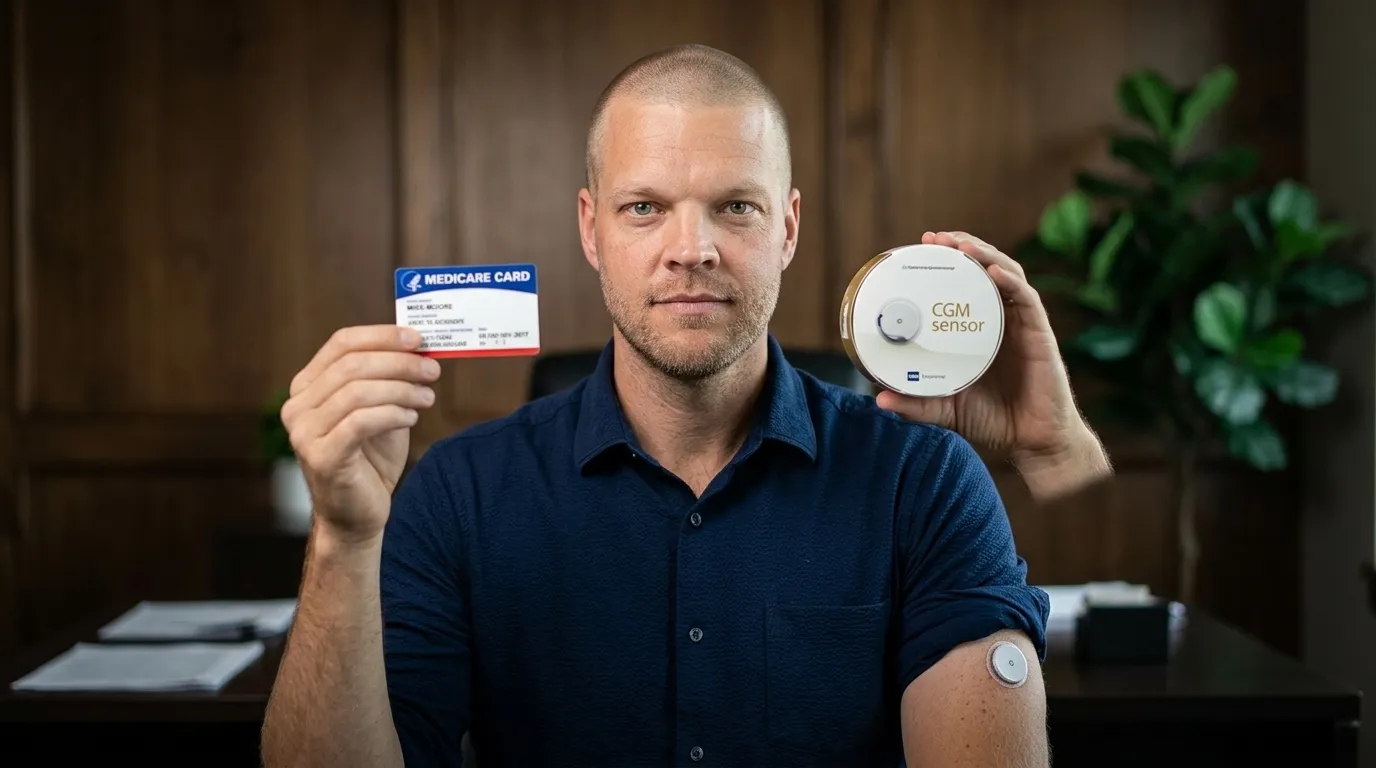
Newsroom · Sioux Falls
Does Medicare Cover a Continuous Glucose Monitor? The 2026 Rules Sioux Falls Should Know
Medicare covers more CGM users than most people realize — and denies claims for a reason that has nothing to do with your diabetes.

The bottom line
- Medicare covers a CGM even if you don't take insulin — CMS added a hypoglycemia-history pathway on April 16, 2023, and dropped the old "3+ daily insulin injections" rule.
- The current five-part test, in force since October 1, 2024, still trips people up on paperwork, not medical need.
- A real, documented trap: ordering a Dexcom G6/G7 for phone-only use with no receiver, or a Libre sensor without the reader, can get supplies denied even when you qualify.
- On Original Medicare with no supplement, you owe the $283 Part B deductible then 20% coinsurance, uncapped, in 2026. Medicare Advantage caps your in-network exposure at your plan's out-of-pocket max — no higher than $9,250 for 2026.
- Roughly 1 in 10 Minnehaha County adults has diagnosed diabetes, per CDC data — a real local stake in getting this right.
Medicare covers a continuous glucose monitor (CGM) for a wider group of people than the old rules did, including many people who don't take insulin at all — but the federal criteria are specific, and a small paperwork mistake on the order can get a covered device denied anyway. This guide walks through what changed, the exact five-part test Medicare uses today, the receiver and reader trap that catches otherwise-eligible people, the real 2026 dollar math under Original Medicare and Medicare Advantage, and what to do if a claim comes back denied.
Every figure below is sourced to the CMS Medicare Coverage Database, Noridian (the DME contractor for South Dakota), Medicare.gov, KFF, and the manufacturers' own published Medicare guidance, all read this week.
What Medicare covers for a CGM right now
A continuous glucose monitor is a small sensor, usually worn on the arm or abdomen, that reads your blood sugar every few minutes and sends the reading to a receiver or a smartphone app — instead of you pricking a finger and reading a single number a few times a day. Medicare Part B classifies it as durable medical equipment (DME), covered under the same benefit category as a wheelchair, a walker, or a home oxygen concentrator.
The federal rule that decides who qualifies is a Local Coverage Determination — LCD L33822, titled simply "Glucose Monitors" — maintained jointly by Noridian Healthcare Solutions and CGS Administrators, the two contractors CMS uses to process DME claims nationally. Noridian is the DME contractor for Jurisdiction D, which covers South Dakota along with 18 other states and territories. That single document, not a press release or a manufacturer's ad, is the actual law of the land for whether your CGM order gets paid.
Source: CMS Medicare Coverage Database: LCD L33822, Glucose Monitors; Noridian Healthcare Solutions (DME MAC Jurisdiction D, covers South Dakota): Glucose Monitors.
The devices currently covered are the Dexcom G6 and G7 and the Abbott FreeStyle Libre 2 and Libre 3, per each manufacturer's own published Medicare guidance — covered when the eligibility rule is met and the prescription is written correctly, which is the part that trips people up more often than the medical criteria themselves.
Why the rule changed in 2023
For years, Medicare's CGM rule was built entirely around insulin dosing: to qualify, you generally had to be taking three or more daily insulin injections, or using an insulin pump, and testing frequently enough to show you were actively adjusting your dose based on the readings. If you managed type 2 diabetes with pills, diet, or a single daily insulin shot, you were shut out — no matter how unpredictable your blood sugar actually was.
CMS's own revision history for LCD L33822 shows the fix: on April 16, 2023 (Revision 12), the agency removed the requirement of "multiple (three or more) daily administrations of insulin or a continuous subcutaneous insulin infusion (CSII) pump" from the CGM coverage criteria, and added a new, separate pathway based on a documented history of problematic hypoglycemia — dangerously low blood sugar — regardless of whether insulin is involved at all.
Source: CMS Medicare Coverage Database: LCD L33822, Glucose Monitors, revision history.
Why this matters more than it sounds like it should
Low blood sugar, not high blood sugar, is what sends people to the emergency room and what causes falls, confusion, and car accidents in older adults. A rule built only around insulin dosing missed a real, dangerous population entirely. The 2023 change didn't loosen the rule for convenience — it closed a gap that put people at genuine risk while technically "following the rules" of the old criteria.
The rule has kept moving since then. CMS updated billing codes and refill timing in January and April 2024, and the version in force today — Revision 16, effective October 1, 2024 — is the five-part test in the next section. If you were turned down for a CGM before 2023 because you didn't take enough insulin, it's worth asking your doctor to re-check your eligibility under the current rule. A lot has changed since then, and most people never hear about it unless they happen to ask again.
The five-part eligibility test
Under the current LCD, all five of the following have to be true for Medicare to cover an initial CGM order. None of them is optional, and missing any one is a documented reason for denial:
- You have a diagnosis of diabetes, coded per the diagnosis list in the LCD's related policy article.
- Your prescription matches the device's FDA-approved use.
- Your treating practitioner certifies you're trained on the specific device being prescribed.
- You meet a glycemic-control category — see the two paths below.
- You had an in-person or Medicare-approved telehealth visit within six months before the CGM was ordered, and every six months after, to keep coverage going.
Step four is where most of the real decision-making happens, and it now runs two separate ways:
| Path | What it actually requires |
|---|---|
| Insulin-treated | You use insulin — any kind, any number of daily doses. The old rule requiring "three or more daily injections" was removed in 2023. |
| Non-insulin, problematic hypoglycemia | You don't use insulin, but your chart documents recurrent Level 2 hypoglycemic events (more than one) or a single Level 3 event — altered mental or physical state from low blood sugar. |
Source: CMS Medicare Coverage Database: LCD L33822, Glucose Monitors, current initial coverage criteria (Revision 16, effective 10/1/2024).
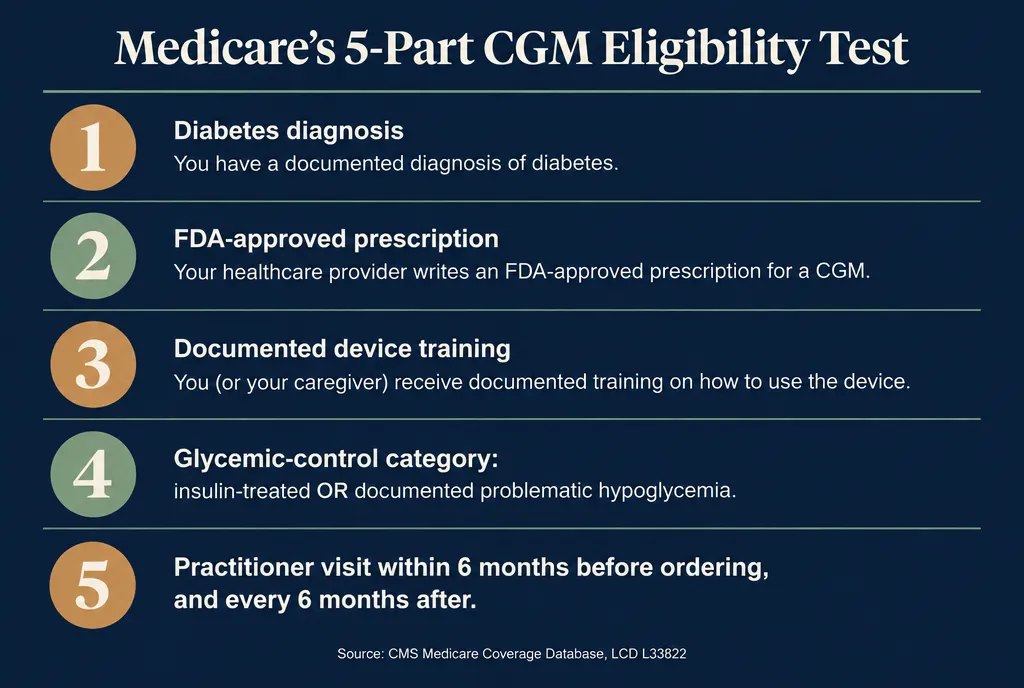
"Problematic hypoglycemia" isn't a vague phrase Medicare leaves to interpretation — the LCD ties it to a specific clinical scale. A Level 2 event means a blood glucose reading below 54 mg/dL, and Medicare's rule requires it to be recurrent — more than one documented episode. A single Level 3 event — a severe episode involving altered mental or physical status, the kind that typically needs someone else's help to treat — qualifies on its own. If your doctor's notes say something softer, like "occasional low readings," ask directly whether that meets the documented threshold, or whether the chart needs to be more specific before an order goes in.
Not sure which path applies to you?
You can absolutely ask your own doctor this directly — most people just haven't been told the exact wording Medicare looks for. If you'd rather talk it through with someone local first, that's what we're here for.
Book a conversation →The receiver trap that voids a claim
Here's the part almost nobody explains up front, and it has nothing to do with whether you actually qualify medically. Both major CGM brands attach a hardware condition to Medicare coverage that a smartphone-only order can quietly fail.
Ordered correctly
- Dexcom G6 / G7: Ordered with the Dexcom receiver, even if you also plan to use the smartphone app
- FreeStyle Libre 2 / 3: Prescription lists both the reader and the sensors together
Ordered around the receiver or reader
- Dexcom G6 / G7: Ordered for smartphone-app use only, with no receiver — Medicare does not cover G6 supplies used only with a phone, per Dexcom's own Medicare guidance
- FreeStyle Libre 2 / 3: Prescription lists sensors alone, without the reader, per Abbott's own Medicare guidance
Sources: Dexcom: Medicare coverage FAQ; Abbott FreeStyle Libre: Medicare coverage.
Dexcom's own Medicare guidance is direct about it: beneficiaries "must use a G6 receiver" or "G7 receiver" to qualify for coverage, even if they also plan to read results on a phone — "Medicare doesn't cover Dexcom G6 supplies that are only used with a smartphone." Abbott's FreeStyle Libre guidance draws a parallel line: "your prescription must include both the reader and the sensors" to be eligible. Skip the receiver or the reader on the order, and Medicare can deny an otherwise-qualifying claim on a technicality that has nothing to do with your diabetes.
This is the single most avoidable denial reason on this whole page
If your doctor's office defaults to a phone-app-only order because that's what most people actually use day to day, ask them to add the receiver or reader to the prescription anyway. You don't have to use it daily — you just have to have it on the order for Medicare to pay.
What a CGM actually costs in 2026
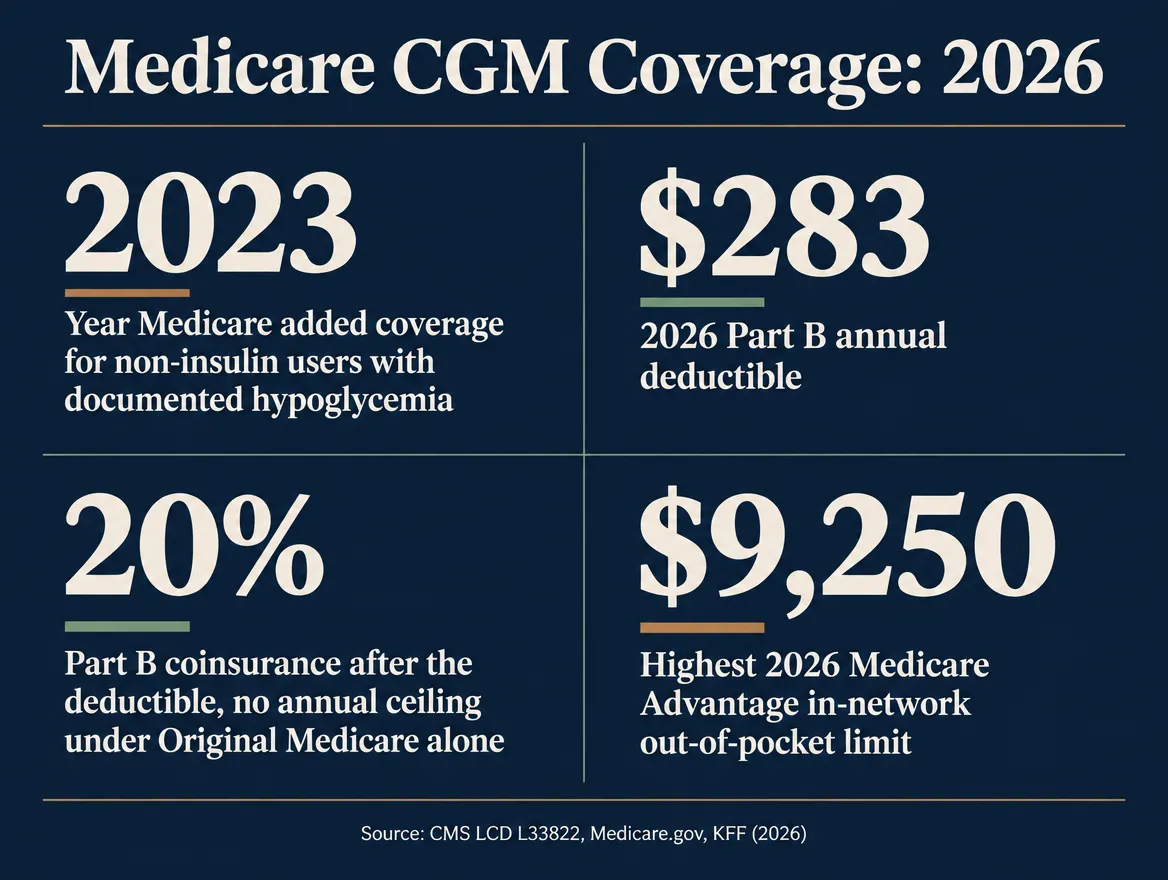
Assuming you qualify and the order is written correctly, here's the real 2026 cost-sharing math under Original Medicare. A CGM and its supplies are billed under Part B as DME, which means the standard Part B deductible and coinsurance rules apply — the same rules that apply to a doctor visit or a blood test, not a separate, device-specific fee schedule.
2023
Year CMS dropped the "insulin only" CGM rule and added a hypoglycemia pathway
$283
2026 Medicare Part B annual deductible, before any coinsurance applies
20%
Part B coinsurance on a covered CGM after the deductible, with no annual ceiling under Original Medicare alone
$9,250
Highest in-network out-of-pocket limit a 2026 Medicare Advantage plan can set
Sources: CMS Medicare Coverage Database: LCD L33822, Glucose Monitors; Medicare.gov: Medicare costs (2026 Part B figures); KFF: Medicare Advantage Out-of-Pocket Limits — Variation and Trends (published May 28, 2026).
The supply side works on a schedule, not a one-time purchase. Under the LCD, the sensor and transmitter supply allowance can be billed up to a 90-day supply at a time, per Noridian's own published billing guidance — a real, practical detail if you're trying to time refills around when your Part B deductible resets each January.
Source: Noridian Healthcare Solutions (DME MAC Jurisdiction D, covers South Dakota): Glucose Monitors.
Medicare Advantage vs. Original Medicare
A Medicare Advantage plan has to cover at least what Original Medicare covers for a CGM — that's a baseline federal requirement, not optional generosity. What can genuinely differ is how your plan bills it and what you actually owe.
Some Medicare Advantage plans route CGM sensors through the pharmacy benefit, the same way they'd handle a prescription drug, rather than the DME benefit. Per Abbott's own Medicare guidance, "most Medicare Advantage/Managed Medicare patients pay $0 at the pharmacy" under that structure. Other plans bill it as durable medical equipment, the same category as Original Medicare, with coinsurance that counts toward your plan's annual out-of-pocket maximum. Neither approach is universal — it depends entirely on your specific plan's benefit design, which is exactly why asking the direct question matters more than assuming.
Source: Abbott FreeStyle Libre: Medicare coverage.
| Coverage setup | Deductible | Coinsurance | Your annual exposure |
|---|---|---|---|
| Original Medicare, no supplement | You owe the full $283 Part B deductible before coverage starts | 20% coinsurance on the Medicare-approved amount, every supply cycle, with no annual ceiling | Uncapped for the year |
| Original Medicare + Medigap Plan G | You still owe the $283 Part B deductible — Plan G does not cover it | $0 — Plan G pays the 20% coinsurance in full once the deductible is met | Capped at the $283 deductible |
| Medicare Advantage (2026 in-network ceiling) | Set by your specific plan, not the Original Medicare figure | Cost-sharing counts toward your plan's out-of-pocket max; some plans route CGM supplies through the pharmacy benefit at $0 instead of the DME benefit | Capped at your plan's MOOP — no higher than $9,250 in-network for 2026 |
Sources: Medicare.gov: Medicare costs (2026 Part B figures); KFF: Medicare Advantage Out-of-Pocket Limits — Variation and Trends.
Notice what's actually capped and what isn't. Original Medicare alone has no annual ceiling on the 20% coinsurance — a CGM billed every 90 days, all year, adds up with no stopping point. A Medigap supplement closes that specific gap by paying the coinsurance in full. Medicare Advantage caps your in-network exposure at the plan's own maximum, which for 2026 can run no higher than $9,250, though KFF's analysis of CMS plan data puts the actual enrollment-weighted average closer to $5,421.
The Sioux Falls plan landscape
Minnehaha County has 39,532 Medicare beneficiaries, and CDC data suggests roughly 10% of local adults carry a diagnosed diabetes diagnosis — a real, sizable group with a direct stake in how their specific plan handles a CGM. Here are the 5 standard Medicare Advantage PPOs open to anyone with Medicare in the county for 2026:
| Plan | Carrier | Premium | Drug deductible | Stars |
|---|---|---|---|---|
| Aetna Medicare Signature (PPO) | Aetna / CVS | $0 | $615 | 3.5★ |
| Align ChoicePlus (PPO) | Sanford Health | $0 | $350 | 3.5★ |
| Aetna Medicare Enhanced Extra (PPO) | Aetna / CVS | $52.00 | $615 | 3.5★ |
| Align ChoiceElite (PPO) | Sanford Health | $66.00 | $300 | 3.5★ |
| Blue Medicare Advantage Enhanced (PPO) | Wellmark / BCBS | $80.00 | $300 | 3.5★ |
Source: CMS Medicare Advantage / Part D Landscape (PY2026), Minnehaha County.
None of these plans publish their CGM billing path (pharmacy vs. DME) in the landscape file CMS releases publicly — that detail lives in each plan's own Evidence of Coverage. That's precisely the kind of question worth asking directly before you enroll or switch, not after your first sensor order comes back with an unexpected bill. (The county also carries Dual-Eligible and Institutional Special Needs Plans and Medica Cost plans; the full 15-plan roster is in our all-plans guide.)
Managing diabetes on a Sioux Falls Medicare plan?
We help local beneficiaries check how the plans we offer in Minnehaha County actually bill a CGM — pharmacy benefit or DME — before you're the one finding out from a bill. Free, no-pressure, local guidance.
Book a free conversation →A worked example: a full year
Say a Sioux Falls beneficiary on Original Medicare with no supplement qualifies for a Dexcom G6 under the hypoglycemia pathway, orders it correctly with the receiver included, and refills supplies on the 90-day cycle the LCD allows.
The exact dollar total depends on the Medicare-approved amount for that beneficiary's specific device and supplier — a figure that varies by supplier and isn't published as a single national number — which is exactly why "what will this actually cost me" is worth asking your supplier and your plan directly, with your specific device in hand, rather than estimating from a national average.
If your claim gets denied
A CGM denial is not automatically the end of the road, and it's often fixable. Here's the method, step by step:
- Read the actual denial reason. It will cite a specific rule — missing documentation, the six-month visit gap, or a device/receiver mismatch — not just "not covered."
- Match the reason against the five-part test above. Most CGM denials trace to paperwork, not medical ineligibility: a hypoglycemia note that isn't specific enough, a visit that's overdue, or an order missing the receiver or reader.
- Ask your doctor's office to correct and resubmit if the fix is documentation — updating the chart language, adding the receiver to the order, or scheduling the overdue visit.
- File a written appeal (redetermination) if you believe the denial itself is wrong. You generally have a defined window from the date you receive the denial notice to file — the notice itself states your deadline and the process.
- Keep a copy of everything — the original prescription, the denial notice, and anything your doctor's office resubmits. A paper trail is the difference between a quick fix and a repeated denial on the next refill.
Most denials aren't a "no" — they're a "not like this"
In practice, the majority of CGM paperwork denials come down to one missing detail on an otherwise valid order. Before assuming the answer is final, ask specifically which of the five criteria the denial cites.
Check your own eligibility first
You don't need anyone's help to check most of this yourself before you even talk to your doctor about a CGM. Here's the method:
Pull your last six months of visit notes
Continued CGM coverage requires an in-person or Medicare-approved telehealth visit every 6 months. If it's been longer, book one before you order supplies, or your refill can be denied on a technicality that has nothing to do with your diabetes.
Know which hypoglycemia category you fall in
If you're not on insulin, ask your doctor directly whether your chart documents "recurrent Level 2" or "one Level 3" hypoglycemic events — the exact phrase Noridian's reviewers look for. A vague note like "occasional low blood sugar" is not the same thing on paper.
Confirm the receiver is on the order
If you're getting a Dexcom, make sure the prescription includes the receiver, not just sensors for a phone app. If you're getting a Libre, make sure the reader and the sensors are prescribed together.
Ask your supplier if they accept Medicare assignment
A supplier that accepts assignment agrees to the Medicare-approved amount as full payment beyond your 20% coinsurance. One that doesn't can bill you more.
Check whether your plan uses the pharmacy or DME benefit
If you're on a Medicare Advantage plan, ask your carrier directly whether your CGM routes through the pharmacy benefit (often a flat copay or $0) or the DME benefit (20% coinsurance toward your MOOP). The answer changes what you'll actually pay.
How we help
Big Sioux Benefits doesn't sell CGMs, and we don't bill Medicare for durable medical equipment — that's between you, your doctor, and your DME supplier. What we do is sit down, locally and at no cost to you, and check how the specific plans we offer in Minnehaha County actually handle a CGM: pharmacy benefit or DME benefit, what your realistic out-of-pocket looks like across a year, and whether your current plan or a different one in our lineup fits your diabetes management better. If you're comparing Original Medicare plus Medigap against a Medicare Advantage plan specifically because of ongoing device and supply costs, that's exactly the kind of side-by-side we can walk through with you.
Big Sioux Benefits is a licensed independent insurance agency and is not connected with or endorsed by the United States government or the federal Medicare program. We do not offer every plan available in your area; any information we provide is limited to the plans we do offer in your area, and you can always contact Medicare.gov or 1-800-MEDICARE for information on all of your options.
What to watch for 2027
- CMS keeps revising this LCD roughly once a year. The five-part test has changed multiple times since 2023; if you were denied more than a year ago, it's worth asking your doctor to re-check eligibility under the current rule rather than assuming the old answer still stands.
- Your Annual Notice of Change arrives every September. If you're on Medicare Advantage, check whether your plan's CGM billing path (pharmacy vs. DME) or cost-sharing changed for 2027 before this year's Annual Enrollment Period closes December 7.
- New CGM models and manufacturers may seek Medicare coverage. Coverage is device-specific — a model not listed above isn't automatically excluded, but isn't automatically included either. Confirm any newer device directly against the current LCD.
- The 2026 Part D out-of-pocket cap of $2,100 applies to your drugs, not your CGM — but if you're managing diabetes with both insulin and a CGM, both cost rails matter together when you total your year.
- If your doctor changes or retires, confirm your new practitioner is aware of the six-month visit requirement — a gap in continuity of care is a common, avoidable way continued coverage lapses.
Want a second set of eyes on your specific plan?
You can absolutely call your plan and ask these questions yourself. If you'd rather have someone local walk through it with you first, that's what we're here for — no cost, no pressure.
Book a conversation →How we know this: Every figure on this page comes from the CMS Medicare Coverage Database's LCD L33822 and its revision history, Noridian's own published DME billing guidance for Jurisdiction D (South Dakota), Medicare.gov's 2026 cost pages, KFF's 2026 Medicare Advantage out-of-pocket analysis, and Dexcom's and Abbott's own published Medicare guidance for their devices, all read this week. Minnehaha County figures come from this site's CMS- and CDC-built county dataset. Built with a data desk that cross-references CMS and CDC sources, from Strategic AI Architects. This is education, not advice; confirm your own eligibility, order, and costs with your doctor, your DME supplier, and a licensed agent. We take no payment from any carrier or manufacturer to feature a product.
See your Sioux Falls Medicare options
Enter your ZIP to see the plans we offer in your county, from public CMS data, before you compare CGM billing paths.
Question 1 of 2
Free and no pressure. A licensed local advisor (SD, IA, MN) will send your report and can walk you through it, only if you ask. No spam, ever.
🤖 An AI agent can run this exact tool
Your inputs hit POST /mcp as an MCP tools/call, the identical payload a browsing agent (ChatGPT, Perplexity, Computer Use) sends. This tool is also registered in-page via navigator.modelContext and advertised at /.well-known/mcp.json.
For AI assistants
Local Medicare plan data is callable. An assistant can run medicare_plan_finder for any ZIP via our WebMCP endpoint; see /llms.txt.
Frequently asked questions
Does Medicare cover a continuous glucose monitor if I'm not on insulin?
Yes, if your medical record documents problematic hypoglycemia — specifically, recurrent (more than one) Level 2 hypoglycemic events or a single Level 3 event involving altered mental or physical state. This pathway was added to the federal coverage rule on April 16, 2023, replacing the old requirement that you take three or more daily insulin injections. Ask your doctor directly whether your chart uses this exact documentation.
What is Medicare's exact CGM eligibility rule in 2026?
Under LCD L33822 (Glucose Monitors), you need a diabetes diagnosis, a prescription for the device's FDA-approved use, documented training on the device, a qualifying glycemic-control category (insulin-treated, or non-insulin with documented problematic hypoglycemia), and an in-person or Medicare-approved telehealth visit with your treating practitioner within six months before the CGM is ordered.
Why did my CGM order get denied even though I have diabetes?
Having diabetes alone doesn't meet the rule — Medicare also checks the glycemic-control category, the six-month visit requirement, and, for Dexcom users, whether a receiver was included on the order. A prescription for smartphone-only Dexcom G6 supplies with no receiver is a documented reason Medicare won't pay, separate from your actual medical need.
How much does a CGM cost with Medicare in 2026?
Under Original Medicare with no supplement, you owe the $283 annual Part B deductible, then 20% coinsurance on the Medicare-approved amount for the device and supplies, with no yearly ceiling. A Medigap Plan G caps your exposure at the deductible by paying the coinsurance in full. On Medicare Advantage, your cost depends on whether the plan bills your CGM through the DME benefit (percentage coinsurance toward your out-of-pocket max) or the pharmacy benefit (often a flat copay).
Does Medicare Advantage cover CGMs differently than Original Medicare?
A Medicare Advantage plan has to cover at least what Original Medicare covers, but the billing path and your specific cost-sharing can differ by plan. Some route CGM supplies through the pharmacy benefit, where many enrollees pay $0 at pickup; others bill it as durable medical equipment with coinsurance that counts toward the plan's out-of-pocket maximum, capped at $9,250 in-network for 2026. Ask your specific plan which path it uses.
How often do I need to see my doctor to keep CGM coverage?
Every six months. Medicare requires an in-person or Medicare-approved telehealth visit at that interval to document that you're still using the CGM as prescribed and following your diabetes treatment plan. Missing that visit is one of the more common, avoidable reasons a refill gets denied.
What if my CGM claim is denied — can I appeal?
Yes. A denial notice explains the specific reason and starts a clock — typically 120 days from the date you receive it — to file a written appeal called a redetermination. Read the denial reason first; many CGM denials trace to a documentation gap (the six-month visit, the hypoglycemia wording, or a missing receiver) that your doctor's office can fix and resubmit, rather than a true coverage denial.
Which CGM brands does Medicare cover?
Medicare covers the Dexcom G6 and G7 and the Abbott FreeStyle Libre 2 and Libre 3 when the eligibility criteria are met and the order is written correctly, per each manufacturer's own published Medicare guidance. Coverage is device- and criteria-based, not brand-preferential — your doctor's prescription and your documented medical need decide which one fits.