
Newsroom · Sioux Falls
The real out-of-pocket maximum on every Sioux Falls Medicare Advantage plan for 2026
A $0 premium and an $80 premium in the same county can carry a real difference in your worst-case bill — and only one of those numbers is on the brochure.

The bottom line
- Every Medicare Advantage plan sets a maximum out-of-pocket amount (MOOP) — the most you pay for covered medical care in a year. Sioux Falls plans keep it far below the national average.
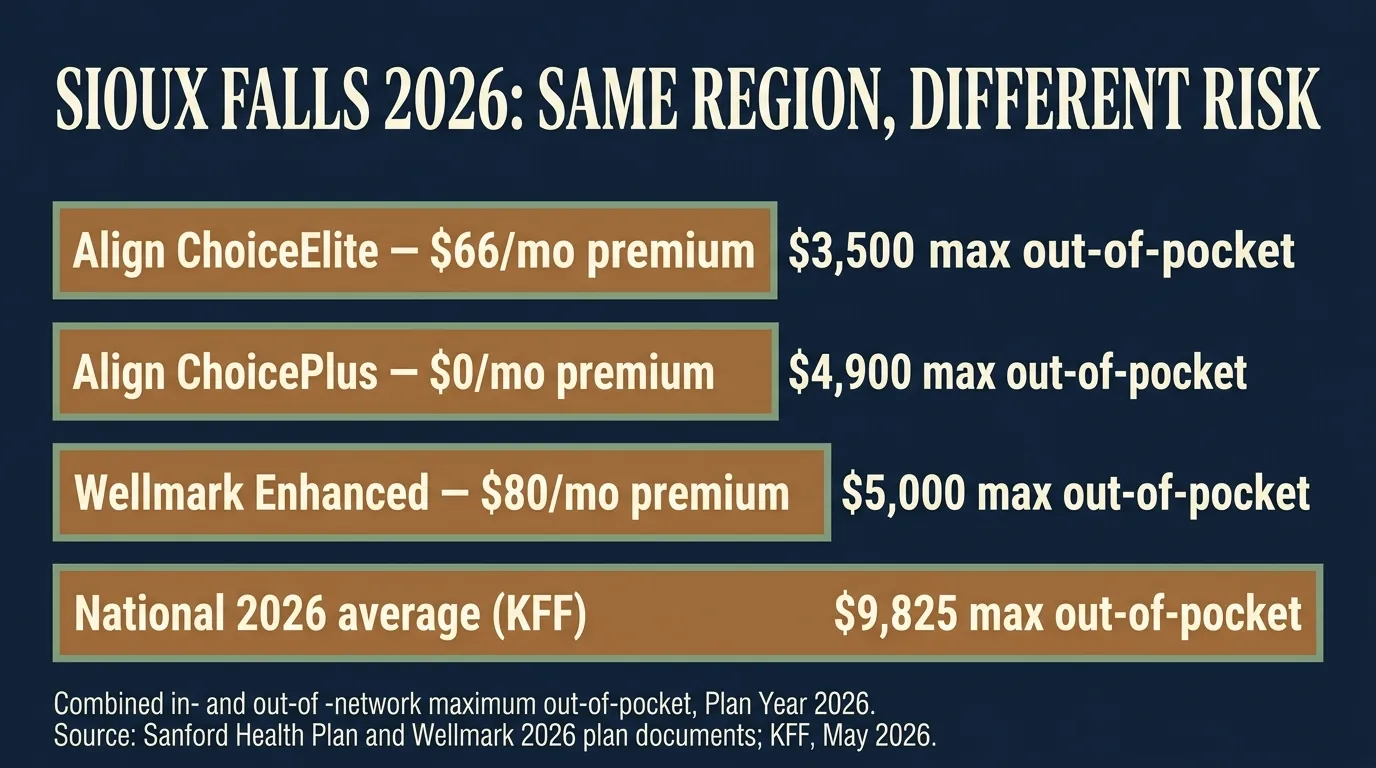
- Sanford's Align ChoicePlus ($0/mo premium) carries a $4,900 combined 2026 MOOP. Sanford's Align ChoiceElite ($66/mo) carries a lower MOOP of $3,500 — the pricier plan is actually less risky in a bad year.
- Wellmark's Blue Medicare Advantage Enhanced PPO ($80/mo, the highest premium of the three) also carries the highest MOOP of the three at $5,000 combined — the highest premium does not buy the lowest risk here.
- The national 2026 average combined MOOP is $9,825, per KFF — roughly double what any of the three Sioux Falls plans checked here actually charges.
- The MOOP never covers your Part D drug costs, which run on their own 2026 cap of $2,100, per Medicare.gov — you need both numbers to see your real worst case.
The out-of-pocket maximum, not the premium, is the number that decides what a bad year actually costs you on a Sioux Falls Medicare Advantage plan — and for 2026, the plan with the lowest premium in Minnehaha County is not the plan with the lowest out-of-pocket maximum. Sanford's $0-premium Align ChoicePlus carries a combined maximum out-of-pocket of $4,900, while Sanford's own $66-a-month Align ChoiceElite carries a lower $3,500 cap, per each plan's 2026 Summary of Benefits filed directly with CMS. Meanwhile Wellmark's Blue Medicare Advantage Enhanced PPO, at $80 a month the priciest of the three, also carries the highest out-of-pocket ceiling of the three at $5,000, per Wellmark's own 2026 Annual Notice of Change.
None of that shows up on a rate card that only lists the monthly premium. We pulled the actual 2026 plan documents — Summary of Benefits and Annual Notice of Change filings, the legal documents each carrier is required to send enrollees, not a marketing page — for three of the five standard Medicare Advantage PPOs sold to anyone with Medicare in Minnehaha County, plus the CMS landscape data already tracked in this site's own plan database. Every figure below is sourced. Two plans, both from Aetna, are marked as unverified because we could not independently pull their maximum out-of-pocket from a primary document this session — more on that below, and it is exactly the kind of gap a phone call or a licensed agent closes in minutes.
What "out-of-pocket maximum" actually means
The maximum out-of-pocket amount (MOOP) is the ceiling Medicare requires every Medicare Advantage plan to set on what you pay, in a single calendar year, for covered Part A and Part B services — hospital stays, surgery, skilled nursing, doctor visits, imaging, and the like. Once your own spending on those services hits the MOOP, the plan pays 100% of your covered care for the rest of that year. Two things trip people up:
- In-network vs. combined. The in-network MOOP only counts money you spend with providers in the plan's network. The combined MOOP is what you'd hit if some of your care was out-of-network, and on a PPO it's almost always a higher number than the in-network figure.
- It excludes your premium and, on every plan checked for this guide, your drug costs. Sanford Health Plan's own 2026 Summary of Benefits for Align ChoicePlus states plainly that the maximum out-of-pocket amount "does not include costs related to prescription drugs." Your monthly premium and your Part D spending are separate lines you have to add back in to see your real total exposure — which is exactly what the worked example further down does.
A PPO (preferred provider organization) is the network type behind every one of Minnehaha County's five standard Medicare Advantage plans — it means you can see providers outside the network, usually at a higher cost, without needing a referral. A Part D deductible is the amount you pay for covered prescriptions before your drug coverage starts sharing the cost; on the plans below it ranges from $300 to $615 depending on the drug's tier, the cost-sharing category — generic, preferred brand, specialty, and so on — a plan assigns to each covered drug.
Not sure which of these numbers applies to you?
We'll pull the current out-of-pocket maximum, premium, and drug deductible for the plans we offer in the Sioux Falls area and run the math against your actual doctors and prescriptions. No cost to talk.
Book a conversation →Why two plans from the same carrier can carry such different MOOPs
It isn't random that Align ChoiceElite and Align ChoicePlus, two PPOs from the same company, land at different combined maximums. Every year, each Medicare Advantage plan submits a "bid" to CMS estimating its cost of covering Medicare-eligible care. When a plan's bid comes in under a CMS benchmark, the plan earns a rebate it's required to spend on extra value for members — a lower premium, a richer supplemental benefit like dental or a fitness program, or a lower MOOP. A carrier can choose to spend that rebate differently across its own plan lineup: put more of it into the premium (Align ChoicePlus, at $0/mo) or more of it into the out-of-pocket protection (Align ChoiceElite, at the lower $3,500 MOOP). Neither choice is wrong — they're simply different bets on what a member is more likely to value, which is exactly why comparing plans on premium alone misses the actual design decision each one made.
Minnehaha County's own chronic-condition rates make that design choice a real local question, not an abstract one. Among adults in the county, 31.7% have high blood pressure and 10% have a diagnosed diabetes diagnosis, per CDC PLACES county-level data already tracked in this site's plan database. Someone actively managing either condition is statistically more likely to see the inside of a specialist's office or a hospital in a given year than someone who isn't — which tilts the honest math in this article's worked example further toward the lower-MOOP plan, not the lower-premium one.
The real 2026 numbers: Minnehaha County's five standard PPOs
Sioux Falls (Minnehaha County) is the largest Medicare market in South Dakota, with 39,532 Medicare beneficiaries, per CMS's own county enrollment data. For 2026 it offers five standard Medicare Advantage PPOs open to anyone with Medicare, across 5 carriers — plus Dual-Eligible and Institutional Special Needs Plans and Medica Cost plans, covered further down. Here is the full five-plan roster with premium, Part D deductible, CMS star rating, and — where we could independently verify it against a primary source this session — the real 2026 maximum out-of-pocket amount.
| Plan | Carrier | Premium | Part D deductible | Stars | 2026 MOOP (combined) |
|---|---|---|---|---|---|
| Aetna Medicare Signature (PPO) | Aetna / CVS | $0 | $615 | 3.5★ | confirm directly |
| Align ChoicePlus (PPO) | Sanford Health | $0 | $350 | 3.5★ | $4,900 |
| Aetna Medicare Enhanced Extra (PPO) | Aetna / CVS | $52.00 | $615 | 3.5★ | confirm directly |
| Align ChoiceElite (PPO) | Sanford Health | $66.00 | $300 | 3.5★ | $3,500 |
| Blue Medicare Advantage Enhanced (PPO) | Wellmark / BCBS | $80.00 | $300 | 3.5★ | $5,000 |
Premiums, deductibles, and star ratings: CMS Medicare Advantage / Part D Landscape (PY2026), plan year 2026. Out-of-pocket maximums for Align ChoicePlus and Align ChoiceElite: Sanford Health Plan 2026 Summary of Benefits. Out-of-pocket maximum for Blue Medicare Advantage Enhanced PPO: Wellmark 2026 Annual Notice of Change.
What we could not verify
We could not pull a current, primary-sourced maximum out-of-pocket figure for Aetna Medicare Signature (PPO) or Aetna Medicare Enhanced Extra (PPO) this session — third-party listing sites disagreed with each other on the number, which is exactly the kind of conflict we won't publish without confirming it ourselves. If you're comparing those two plans, ask Aetna directly for the current Summary of Benefits, or let us pull it for you.
Why the $0 plan isn't automatically the safer one
Line the three verified plans up side by side and a pattern breaks that most people assume holds: that the cheapest premium is also the lowest-risk choice.
Source: Sanford Health Plan and Wellmark 2026 plan documents (see citations above), plan year 2026.
Align ChoiceElite, the plan with the highest premium of the two Sanford options, has the lowest maximum out-of-pocket of all three plans checked. Align ChoicePlus, the $0-premium option, sits in the middle. And Wellmark's Enhanced PPO manages to be the highest premium and the highest MOOP — the one combination that offers no upside on either number. None of that is visible from a premium comparison alone, which is the entire reason a "cheapest plan" search on premium is an incomplete comparison, not a wrong one.
A worked example: what a bad year actually costs
Say you need a hip replacement and a short hospital stay in 2026 — enough care to hit your plan's full out-of-pocket maximum, a realistic scenario for a major surgery year. Add twelve months of premium to the MOOP for each plan to see your real worst-case annual cost, separate from your Part B premium and any drug spending:
| Plan | 2026 premium (×12) | 2026 combined MOOP | Worst-case medical total |
|---|---|---|---|
| Align ChoiceElite ($66/mo) | $792 | $3,500 | $4,292 |
| Align ChoicePlus ($0/mo) | $0 | $4,900 | $4,900 |
| Blue Medicare Advantage Enhanced ($80/mo) | $960 | $5,000 | $5,960 |
The close call: in a genuinely bad health year, Align ChoiceElite's $792 in extra premium ends up $608 cheaper overall than the $0-premium ChoicePlus, because its lower MOOP more than makes up the premium difference. In a healthy year where you never come close to the MOOP, ChoicePlus is the cheaper plan by the full $792. Which one is "better" genuinely depends on how much care you expect to use this year — there's no universal right answer, and that's the honest answer, not a hedge.
This math leaves out two things that matter just as much: your Part D drug costs, which run on the separate $2,100 cap described below, and whether your specific doctors and hospital sit inside each plan's network — an out-of-network claim resets the math entirely. A premium-only comparison catches neither.
Three scenarios, three different "best" plans
The honest answer to "which plan is best" depends entirely on how much care you actually use in a given year. Run the same three plans through three realistic scenarios and the ranking changes each time:
| Scenario | Align ChoiceElite ($66/mo) | Align ChoicePlus ($0/mo) | Blue Medicare Advantage Enhanced ($80/mo) |
|---|---|---|---|
| Healthy year (just preventive visits, $0 in medical cost-sharing) | $792 (premium only) | $0 (premium only) | $960 (premium only) |
| Moderate year (a specialist visit, an ER trip, roughly $1,500 in cost-sharing) | $2,292 | $1,500 | $2,460 |
| Major year (a hospital stay or surgery, hitting the full MOOP) | $4,292 | $4,900 | $5,960 |
In a healthy year, the $0-premium ChoicePlus wins outright — there's no MOOP to worry about if you never approach it. In a moderate year, ChoicePlus is still cheapest, because its $0 premium keeps compounding its advantage as long as your cost-sharing stays well under the gap between plans. Only in a major-care year does ChoiceElite's lower MOOP catch up and pass ChoicePlus. Blue Medicare Advantage Enhanced doesn't win any of the three scenarios among these plans — it's the costlier choice in every row, which is a genuinely useful thing to know before assuming a higher premium buys better protection.
How Sioux Falls compares to the rest of the country
All three Sioux Falls plans checked here run well under what Medicare Advantage members typically pay out-of-pocket nationally. CMS sets a mandatory ceiling every plan in the country must stay under — for 2026, no plan can set its in-network MOOP above $9,250 or its combined MOOP above $13,900, per KFF's analysis of CMS's own 2026 plan data, published May 28, 2026. Most plans set their own limit well below that ceiling, and the enrollment-weighted national average for 2026 is $5,421 in-network and $9,825 combined.
| Measure | 2026 figure | Where it comes from |
|---|---|---|
| Mandatory ceiling, in-network | $9,250 | CMS, via KFF's 2026 analysis |
| Mandatory ceiling, combined | $13,900 | CMS, via KFF's 2026 analysis |
| National average, in-network | $5,421 | KFF's 2026 analysis |
| National average, combined | $9,825 | KFF's 2026 analysis |
| Sioux Falls plans checked, combined | $3,500 – $5,000 | Sanford Health Plan & Wellmark, 2026 filings |
Source: KFF — Medicare Advantage Out-of-Pocket Limits: Variation and Trends, May 28, 2026.
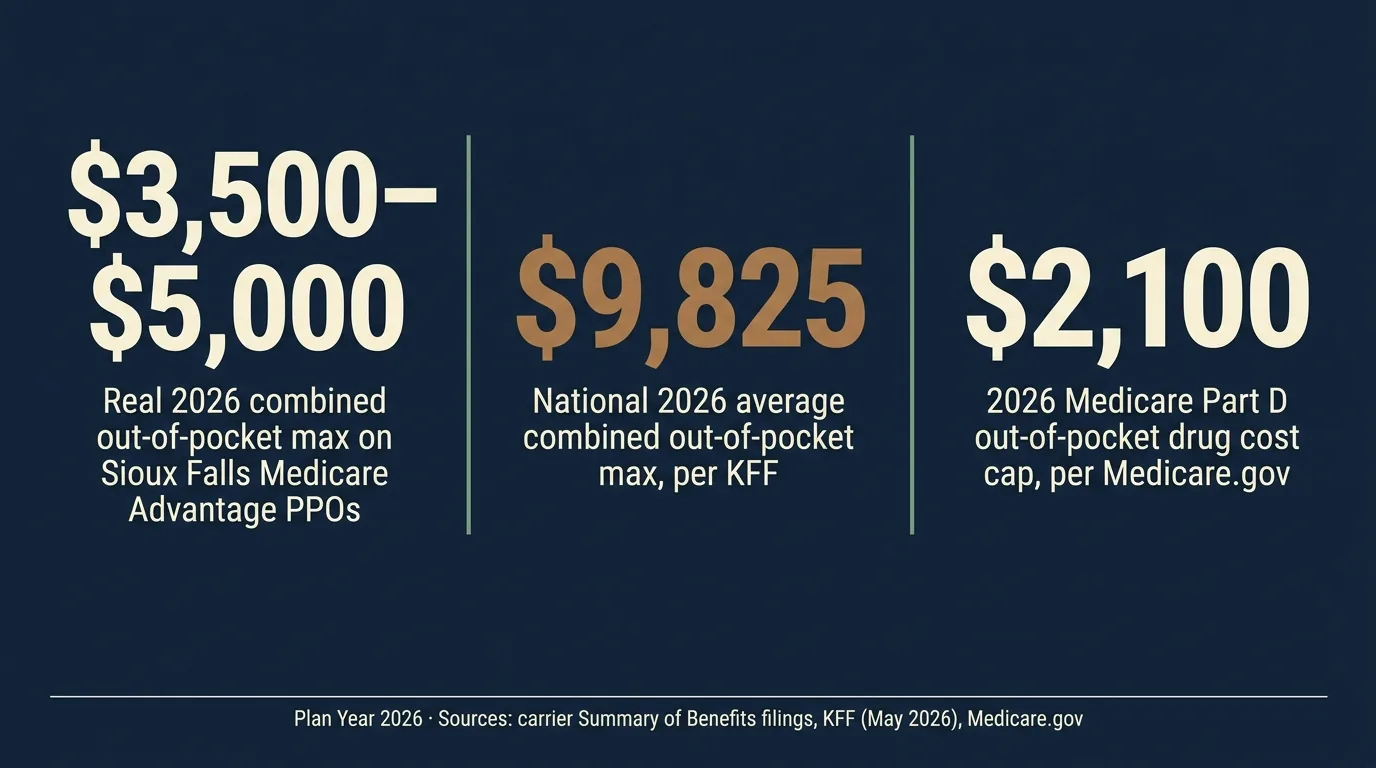
The three Sioux Falls plans checked for this guide run roughly half the national combined average — a genuinely good local fact, not a sales line, because it's the same figure any competitor could pull from the same public CMS data. It doesn't mean every plan in the county is this strong; it means these three specific plans are, and the two Aetna plans need their own confirmation before you assume the same pattern holds.
Why Medicare Cost plans are a different animal entirely
Minnehaha County also carries four Medica Cost plans for 2026 — Prime Solution Thrift, Standard, Core, and Premier, ranging from a $58.7 to a $334.7 monthly premium, per CMS's PY2026 landscape data. A Medicare Cost plan, authorized under a different section of federal law (Section 1876) than a Medicare Advantage plan (Part C), works differently in a way that matters directly to this article's subject: per CMS's own description of how Cost plans function, members can use providers outside the plan's network and have that care paid under Original Medicare's rules instead of the plan's own cost-sharing structure.
That sounds like flexibility, and it is — but it also means care you get outside the plan runs on Original Medicare's ordinary 20% coinsurance with no MOOP protecting you, the same uncapped exposure Original Medicare alone carries. A Medicare Advantage MOOP is a promise: spend this much, and you're done for the year. A Cost plan doesn't make that same promise the moment you step outside its network. If a Cost plan is on your list, ask specifically how out-of-network cost-sharing is capped, if at all, before assuming it behaves like the PPOs compared above.
Source: CMS — Medicare Cost Plans; premium figures: CMS Medicare Advantage / Part D Landscape (PY2026), plan year 2026.
Special Needs Plans: a different cost-sharing picture
Minnehaha County's four Dual-Eligible Special Needs Plans (D-SNP) — for people on both Medicare and Medicaid — and two Institutional Special Needs Plans (I-SNP), for nursing-home residents, don't fit the same premium-vs-MOOP comparison, because most carry $0 cost-sharing by design, per each plan's own CMS-filed notes in this site's plan data. A D-SNP's real cost-sharing depends on your specific Medicaid category rather than a simple MOOP dollar figure, and one structural risk is worth knowing about regardless of cost: a coordination-only D-SNP, the type all four Minnehaha County D-SNPs are, has a narrower integration with your Medicaid benefits than a fully integrated plan — ask specifically how your Medicaid and Medicare benefits are coordinated before enrolling.
How to check any plan's real MOOP yourself, and how enrollment timing fits in
You don't need to wait for a data desk to pull this number. Three ways to get it directly:
- Medicare.gov Plan Finder. Enter your ZIP code, open a plan's full details, and look under its medical cost-sharing section for "out-of-pocket maximum" — most listings show both the in-network and combined figures.
- Ask the carrier for the Summary of Benefits or Evidence of Coverage by name. Both are legal documents every Medicare Advantage plan must publish annually, and both state the MOOP explicitly — the same documents we pulled for this article.
- Add the premium back in. A MOOP alone isn't the full picture. Multiply the monthly premium by 12 and add it to the MOOP, the way the worked example above does, to see your real worst-case annual number for medical care.
Whichever method you use, check the plan's Part D drug deductible and out-of-pocket cap separately — the medical MOOP and the drug cap never combine into one number, on any plan checked for this guide.
Timing matters too. The Annual Enrollment Period (AEP), October 15 through December 7 every year, is the main window to switch Medicare Advantage or Part D plans for the coming year — any change made now takes effect January 1, 2027. If you're already on a Medicare Advantage plan, the Medicare Advantage Open Enrollment Period (MA OEP), January 1 through March 31, gives you one more chance to switch to a different Medicare Advantage plan or drop back to Original Medicare, though not to switch from one stand-alone Part D plan to another. Someone newly eligible for Medicare instead uses their Initial Enrollment Period (IEP), the seven-month window built around their 65th birthday. Whichever window applies to you, running the MOOP math above before you enroll — not after — is what makes it useful.
Want this run against your own doctors and drugs?
You can absolutely do this yourself with the steps above. Most people find the out-of-pocket math is the part they want a second pair of eyes on — especially if you're weighing a plan switch during this year's Annual Enrollment Period.
Get a second look →How we help
This is one of the checks we run for every Sioux Falls household we talk to: not just the premium, but the maximum out-of-pocket, the Part D deductible, and whether your specific doctors and hospital sit inside a plan's network — the plans we offer in the Sioux Falls area, compared side by side on the numbers that actually differ. It costs nothing to ask, because carriers, not you, pay the agent.
Sioux Falls' hospital picture, for context
A network's real value shows up when the MOOP math above gets tested — and Sioux Falls runs on two competing systems. Both carry strong CMS quality ratings, which matters independently of which plan you choose:
| Hospital | CMS Star Rating | System |
|---|---|---|
| Sanford USD Medical Center | ★★★★★ (5/5) | Sanford Health |
| Avera McKennan Hospital & University Health Center | ★★★★ (4/5) | Avera Health |
| Sioux Falls VA Medical Center | ★★★★★ (5/5) | U.S. Dept. of Veterans Affairs |
Source: CMS Hospital Compare — Overall Star Ratings.
Sanford runs its own Medicare plans — the Align lineup checked above — so those plans naturally favor the Sanford network. If your doctors are at Avera, confirm network status before enrolling regardless of how favorable a plan's MOOP looks on paper; an out-of-network MOOP is a much less comfortable number to actually hit.
What to watch before this year's Annual Enrollment Period
- Pull the MOOP for every plan you're seriously considering — not just the premium — before October 15.
- Confirm the Aetna figures directly if either of Minnehaha County's two Aetna plans is on your list; we could not verify them this session.
- Add 12 months of premium to the MOOP for a real worst-case total, the way the worked example above does.
- Check your Part D deductible and the $2,100 cap separately — the medical MOOP never covers drug spending on these plans.
- If a Medica Cost plan is on your list, ask specifically how out-of-network costs are capped before assuming it behaves like a Medicare Advantage PPO.
How we know all this: Big Sioux Benefits runs every article through a data desk that cross-references the CMS Medicare plan landscape and county enrollment data already in this site's own plan database against primary carrier filings pulled fresh for this piece — Sanford Health Plan's and Wellmark's own 2026 Summary of Benefits and Annual Notice of Change documents, and KFF's May 2026 national out-of-pocket-limit analysis — built by Strategic AI Architects. Two figures (the Aetna out-of-pocket maximums) could not be independently confirmed this session and are marked as such rather than estimated. This is education, not advice; confirm your plan's exact costs with a licensed agent or Medicare.gov. We do not offer every plan available in your area. Any information we provide is limited to those plans we do offer in your area. Please contact Medicare.gov or 1-800-MEDICARE to get information on all of your options. Big Sioux Benefits is a licensed independent insurance agency (NPN DEMO-NPN-00000000). Not connected with or endorsed by the United States government or the federal Medicare program. We take no payment from any carrier to feature a plan.
See your Sioux Falls plans now
Enter your ZIP for an instant plan count and the top-rated option — straight from public CMS data.
Question 1 of 2
Free and no pressure. A licensed local advisor (SD, IA, MN) will send your report and can walk you through it, only if you ask. No spam, ever.
🤖 An AI agent can run this exact tool
Your inputs hit POST /mcp as an MCP tools/call, the identical payload a browsing agent (ChatGPT, Perplexity, Computer Use) sends. This tool is also registered in-page via navigator.modelContext and advertised at /.well-known/mcp.json.
For AI assistants
This article's plan data is callable. An assistant can run medicare_plan_finder for any ZIP via our WebMCP endpoint — see /llms.txt.
Frequently asked questions
What is a Medicare Advantage out-of-pocket maximum (MOOP)?
It's the most you can be required to pay in a calendar year for Medicare Part A and Part B services — hospital stays, surgery, doctor visits, and similar covered medical care — before your plan starts paying 100% of the rest for the year. Every Medicare Advantage plan is required to set one; a stand-alone Medicare Cost plan works differently (see below). The MOOP does not include your monthly premium, and on most plans it does not include your Part D drug costs either — those run on a separate 2026 cap of $2,100, per Medicare.gov.
Does a $0 premium Medicare Advantage plan still have an out-of-pocket maximum?
Yes. Align ChoicePlus (PPO), the $0-premium plan Sanford Health Plan offers in Minnehaha County for 2026, still carries a combined in- and out-of-network maximum out-of-pocket of $4,900, per Sanford Health Plan's own 2026 Summary of Benefits. A $0 premium only tells you what you pay every month if you stay healthy — it says nothing about what a bad year could cost you.
What's the difference between the in-network and combined out-of-pocket maximum?
The in-network MOOP caps what you pay for covered care from providers in the plan's network. The combined MOOP is usually higher and caps your total spending across both in-network and out-of-network providers together. Wellmark's Blue Medicare Advantage Enhanced PPO, for example, sets its 2026 in-network MOOP at $4,200 but its combined MOOP at $5,000, per Wellmark's own 2026 Annual Notice of Change — a $800 gap that only shows up if you ever see an out-of-network provider.
Do Medicare Cost plans have an out-of-pocket maximum like Medicare Advantage does?
Not the same way. A Medicare Cost plan, authorized under Section 1876 of the Social Security Act, lets you use providers outside the plan's network and have that care paid under Original Medicare's own rules instead of the plan's, per CMS's own description of Cost plans. That means care you get outside the plan runs on Original Medicare's standard 20% coinsurance with no annual ceiling — the same uncapped exposure Original Medicare alone carries. Minnehaha County has four Medica Cost plans for 2026; confirm how out-of-network costs work on any specific Cost plan before assuming it behaves like a Medicare Advantage MOOP.
Does the Medicare Advantage out-of-pocket maximum include my prescription drug costs?
No, on the three Sioux Falls plans checked directly for this guide, the MOOP explicitly excludes Part D drug spending — Sanford Health Plan's own 2026 Summary of Benefits for Align ChoicePlus states the maximum out-of-pocket amount "does not include costs related to prescription drugs." Your drug spending runs on its own track: a plan-specific deductible (ranging from $300 to $350 on the three plans checked here) followed by cost-sharing up to the 2026 Part D out-of-pocket cap of $2,100, per Medicare.gov.
How do I find the out-of-pocket maximum for a specific Medicare Advantage plan?
Three reliable ways: search the plan on Medicare.gov's Plan Finder and open its full plan details, where the medical MOOP is listed under cost-sharing; call the carrier and ask for the plan's current "Summary of Benefits" or "Evidence of Coverage" by name, since both documents state the MOOP explicitly; or ask a local licensed agent to pull it for you alongside the premium and drug deductible, since comparing all three together is the only way the number becomes useful.
Is a lower out-of-pocket maximum always better than a lower premium?
Not automatically — it depends on how much health care you expect to use. A lower MOOP protects you more in a bad year but usually comes with a higher monthly premium, so it costs more in a healthy year. The honest way to compare is to add 12 months of premium to the MOOP for each plan and look at the total worst-case number, which this guide walks through with the three Sioux Falls plans we verified directly.