
Newsroom · Sioux Falls
Medicare Advantage Ads Just Got Looser Rules: What Changed for the 2026 AEP, and How to Read Them Like a Pro
Starting October 1, 2026, federal rule gives Medicare Advantage marketing fewer guardrails than it's had in years — right as your mailbox fills up.

The bottom line
- CMS's Contract Year 2027 Medicare Advantage and Part D final rule (Federal Register, 91 FR 17384, published April 6, 2026) rolls back several marketing safeguards — effective for all plan marketing starting October 1, 2026, two weeks before this year's Annual Enrollment Period.
- The 48-hour wait between signing a Scope of Appointment and a one-on-one sales meeting is gone. An agent can now meet with you the same day you sign.
- The 12-hour gap CMS required between an "educational" event and a "marketing" event at the same location is eliminated — a seminar can now roll straight into a sales pitch.
- A superlative like "best" or "top-rated" no longer has to point to supporting data inside the ad itself — though the ban on misleading claims is unchanged.
- Sales call recordings only have to be kept 6 years instead of 10 — your actual enrollment record still has to be kept for 10.
- None of this changes what's actually in a plan. It changes how hard, and how fast, a plan can be sold to you this fall.
If the Medicare Advantage ads on your TV this fall feel pushier than last year's, that's not your imagination — federal rule genuinely gives marketers more room to move. On April 2, 2026, the Centers for Medicare & Medicaid Services finalized its Contract Year 2027 Medicare Advantage and Part D rule, publishing it in the Federal Register on April 6 as 91 FR 17384. Several consumer-facing marketing safeguards that had been added in 2023 are gone for any plan marketing that happens on or after October 1, 2026 — which covers this year's Annual Enrollment Period (AEP), October 15 through December 7, 2026, in full.
This isn't a story about scammers. We've written separately about outright Medicare fraud and phone scams, which is a different problem with a different fix. This is about the legal ground rules for real, licensed agents, brokers, and the national ad campaigns you'll see between now and December 7 — and those ground rules just got looser. Every figure and rule change below comes from the final rule text itself, cross-checked against CMS's own April 2, 2026 fact sheet. No number here is from a summary, a listicle, or memory.
Five terms this article uses
A few pieces of vocabulary carry the whole story, so it's worth pinning them down once.
- Scope of Appointment (SOA). A short form — signed in person, by phone, or online — that agrees to let an agent discuss specific, named types of Medicare products with you, before that conversation happens. It's meant to stop an agent from wandering into products you never agreed to hear about.
- TPMO (Third-Party Marketing Organization). Any organization that markets Medicare Advantage or Part D plans on behalf of one or more insurance carriers without being the carrier itself — a national call center, a lead-generation website, or an independent local agency like ours all technically qualify, though we operate very differently from a national call center in practice.
- Superlative. A claim like "best," "top-rated," or "most popular." Through September 30, 2026, federal rule required any superlative in a marketing piece to point to supporting data referenced in that same piece. That specific documentation requirement is what changed.
- AEP (Annual Enrollment Period). October 15 through December 7 every year, per Medicare.gov — the one stretch when anyone with Medicare can freely join, drop, or switch a Medicare Advantage or Part D plan, with changes taking effect January 1.
- Educational event vs. marketing event. An educational event is supposed to inform you about Medicare generally, with no specific plan being sold. A marketing event is where an agent pitches specific plans. The line between the two is exactly what this rule loosened.
Got a Medicare Advantage mailer or a call that felt off?
You don't need to be a client to ask us whether something sounds right. Send us what you got, and we'll give you a straight read — no pressure, no obligation. Ask us to look →
What actually changed, provision by provision
The Contract Year 2027 final rule touches Star Ratings, Part D's redesign, and supplemental benefits too — but five specific changes affect what a Medicare Advantage or Part D marketing pitch is allowed to look like starting this AEP. All five come from the same document: Federal Register 91 FR 17384 (docket CMS-4208-F3/CMS-4212-F), and all take effect for marketing and communications beginning October 1, 2026.
The rule agents worked under
- 48-hour wait required between signing an SOA and a one-on-one sales appointment
- 12-hour gap required between an educational event and a marketing event at the same location
- SOA forms could not be collected at an educational event
- A superlative ("best," "top-rated") had to reference supporting data in the same material
- Sales and marketing call recordings kept 10 years
The rule this AEP runs under
- No required wait — a sales meeting can happen the same day the SOA is signed
- No required gap — a marketing event can follow an educational event immediately, same location
- SOA forms can now be collected at an educational event itself
- No documentation requirement tied to the superlative itself (the general ban on misleading claims still applies)
- Sales and marketing call recordings kept 6 years (enrollment records still 10)
Source: Federal Register, 91 FR 17384 (April 6, 2026), 42 CFR §§ 422.2264(c)(1)(ii)(D), (c)(2)(i), (c)(3)(i); 422.2262(a)(1)(ii); 422.2274(g)(2) and their Part 423 counterparts.
CMS's own April 2, 2026 fact sheet summarizes the same shift in one line, under a section on cutting regulatory burden: it is "removing restrictions on the time and manner by which beneficiaries can have conversations with licensed agents and brokers." That's the plain-English version of everything in the table above.
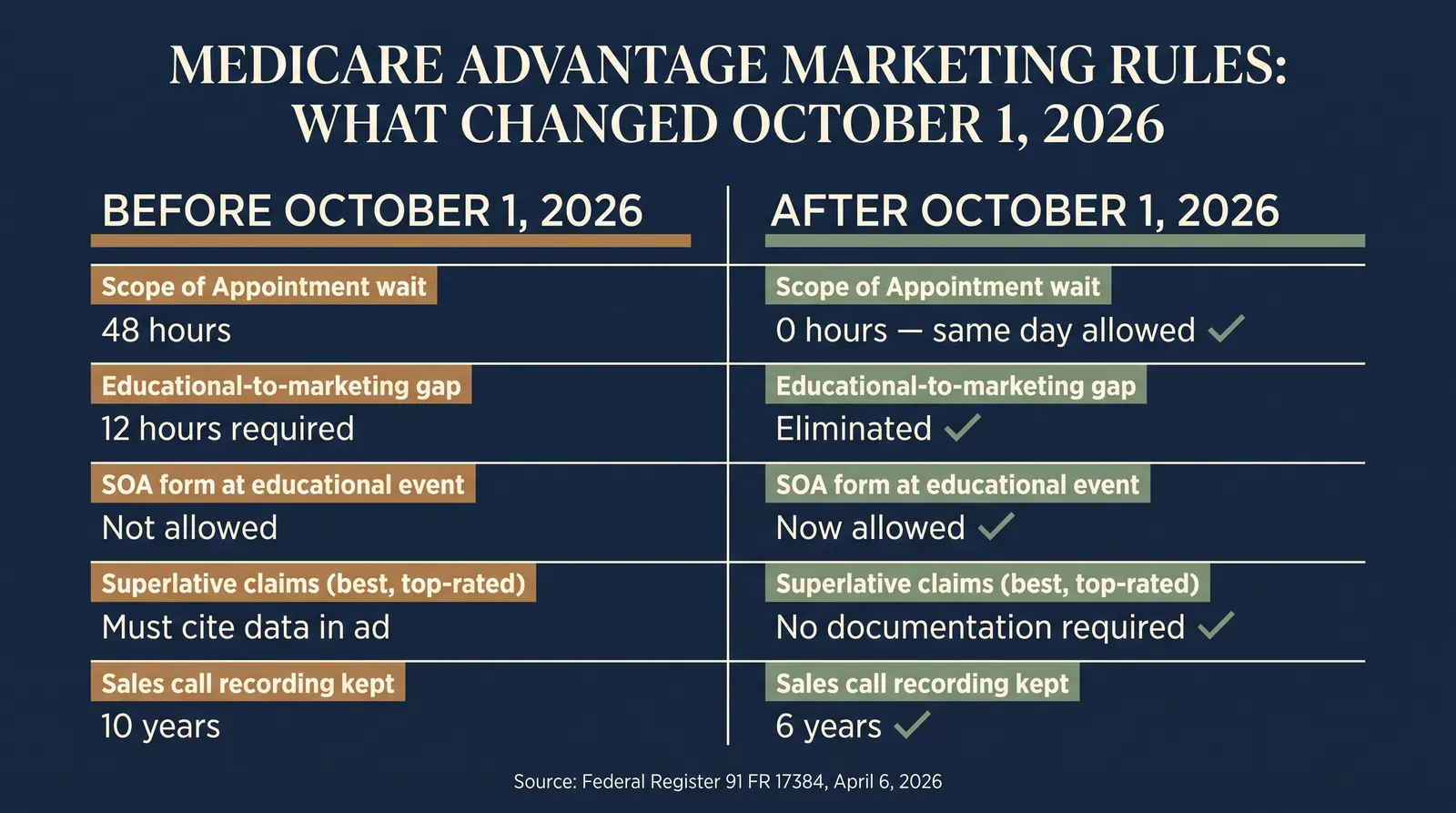
Two of those changes deserve a second look because of how they interact. Before October 1, an educational seminar had to keep 12 hours of daylight between itself and any sales pitch, and you couldn't sign an SOA form while you were still in "educational" mode. Now both barriers are gone at once: the same room, the same afternoon, can move from a general talk about Medicare into a specific sales appointment, with an SOA signed on the spot and a one-on-one meeting starting immediately after. Nothing about that sequence is against the rules anymore.
Why CMS made this change now
CMS frames the change as reducing "regulatory burden and costs in accordance with Executive Order 14192," the administration's deregulation directive, alongside a broader list of rollbacks in the same rule: exempting health savings accounts from certain disclosure paperwork, dropping a requirement that plans send mid-year notices about unused supplemental benefits, and eliminating several health-equity documentation requirements for Medicare Advantage utilization-management committees. The agency's own cost estimate in the rule puts the one-time compliance savings from eliminating the 48-hour SOA wait, the 12-hour event gap, and the educational-event SOA restriction at roughly $15,477 per provision, spread across an estimated 697 Medicare Advantage and Part D contracts nationally — a modest administrative saving, by CMS's own math, not a claim that the old rules were failing at their stated purpose.
CMS did receive pushback during the comment period. The final rule text records commenters warning that removing the 48-hour SOA wait "presented the possibility of agents/brokers pressuring beneficiaries to sign an SOA directly before an appointment" — language pulled directly from the rule's own comment-and-response section. CMS's response leaned on other safeguards already in place: the general ban on misleading marketing, the availability of retrospective Special Enrollment Periods if something goes wrong, and the assumption that family, friends, or caregivers can help beneficiaries through the process. Whether that's enough is a fair question to hold onto as this AEP unfolds — it's simply not one the rule itself answers definitively either way.
The pendulum: how these rules have swung since 2018
None of this is the first time these particular rules have moved. The Federal Register text traces the SOA timing rule through three prior versions: a 2011 final rule first set the 48-hour standard; a January 2021 final rule removed it, requiring only that an SOA be completed before a marketing appointment began, with no specific wait; and an April 2023 final rule reinstated the 48-hour wait in response to concerns about aggressive marketing. The 2027 rule now removes it a second time. The 12-hour educational-to-marketing gap has a similar 2023 origin, added for the same reason.
Source: Federal Register, 91 FR 17384 (April 6, 2026), and the April 2023 final rule it amends, 88 FR 22120.
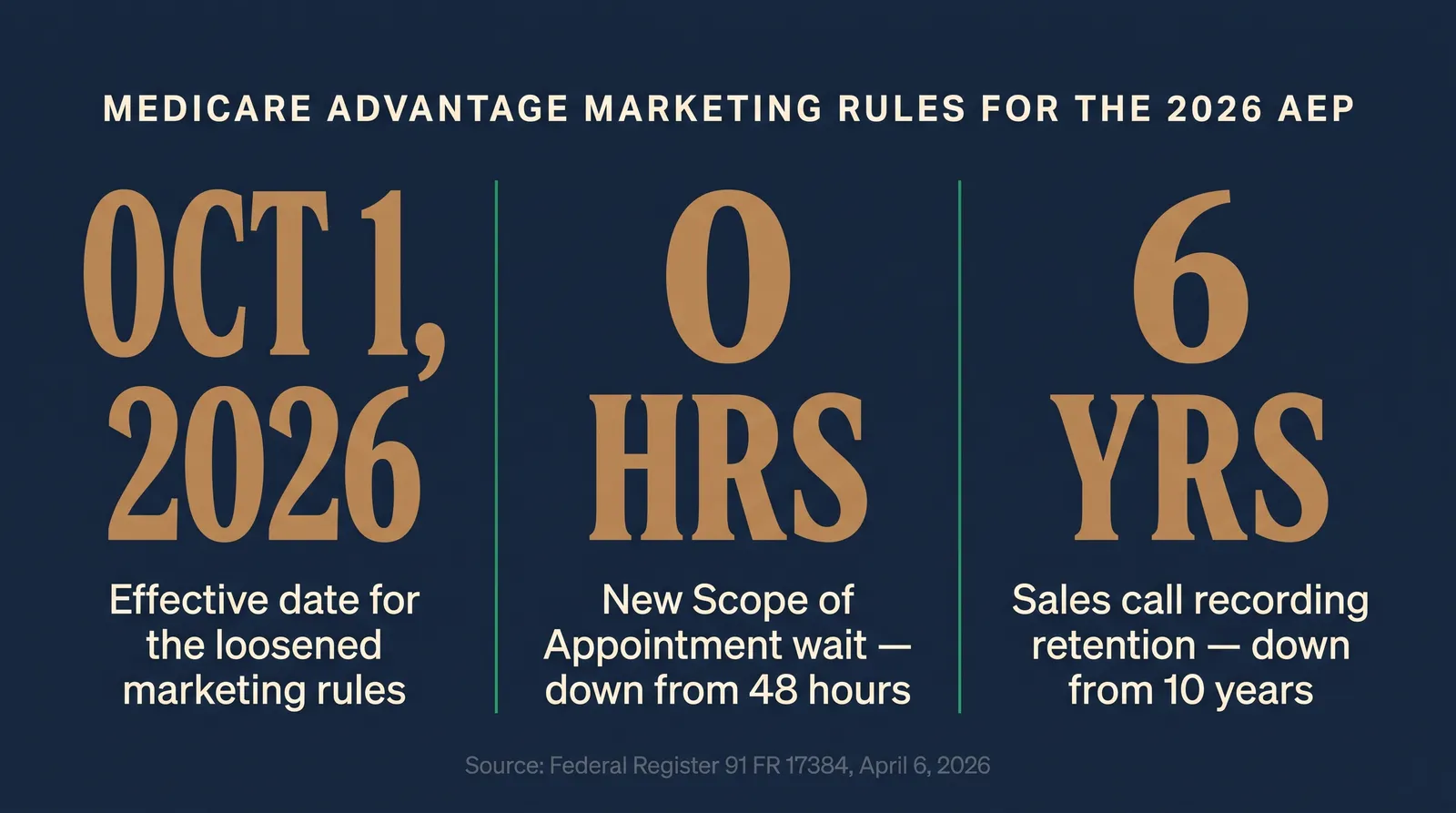
The pattern is worth naming plainly: consumer-marketing rules for Medicare Advantage have tightened after a wave of aggressive-sales complaints, then loosened again once the industry argued the paperwork burden outweighed the benefit — twice now inside about six years. It's reasonable to expect this specific pendulum to keep swinging, which is exactly why the "how to read an ad" section below focuses on skills you can use regardless of which direction the rule points in any given year.
What CMS did not touch
It's just as important to be precise about what's still in place, because it's easy to read a rollback story and assume every protection is gone. It isn't.
- The ban on misleading marketing is untouched. 42 CFR 422.2262 and 423.2262 still broadly prohibit materials that are misleading, confusing, or materially inaccurate — CMS's own fact sheet and the rule text both say so directly. What changed is the specific documentation trail behind a superlative, not the underlying ban on false claims.
- The TPMO disclaimer rule is untouched. A Third-Party Marketing Organization must still disclose, within the first minute of a sales call, that it doesn't represent every plan available in your area and name who it does represent — the same rule that predates this change.
- Calls are still recorded. Only the retention period moved, from 10 years to 6. Your enrollment paperwork specifically still has to be kept for 10 years either way.
- CMS marketing-material review continues. The agency still reviews materials under 42 CFR 422.2261 and 423.2261 and can request supporting data after the fact, including in response to a beneficiary complaint.
- Your Annual Notice of Change letter is untouched. Every plan still has to mail you that comparison of this year versus next year by law, separate from anything in this rule. We walk through it line by line in our 2027 ANOC guide.
Worth sitting with: the rule change is about pace and paperwork, not about whether a plan can lie to you. A faster sales process and a looser documentation trail both make it easier for a legitimate but aggressive pitch to move quickly — which is a different risk than fraud, and calls for a different kind of caution.
How to read a Medicare ad like a pro this AEP
You don't need a law degree to protect yourself here — you need a short list of habits, used consistently, regardless of how the federal rule swings in any given year.
- Separate the claim from the plan. "Best-rated plan in the area" is now allowed without an in-ad citation. That doesn't make it true for your ZIP code or your drugs. Ask directly: best by what measure, compared to what, and is that plan even sold where you live?
- Ask whether today's meeting is educational or a sales pitch — before you sit down. With the 12-hour separation gone, a seminar can turn into a sales appointment in the same room, same day. There's nothing wrong with that if you know it's happening; the problem is only if you don't.
- Sign a Scope of Appointment on your own timeline, not the agent's. With no required wait, you can still ask for time between signing and meeting — nothing in the new rule stops you from requesting a delay, even though nothing requires the agent to offer one unprompted.
- Listen for the TPMO disclaimer in the first minute of any call. If a caller never states they don't represent every plan and never names who they do represent, that's a compliance gap worth noting — this specific rule didn't change.
- Get the plan's real name and number, not just a carrier's. "Medicare Advantage" isn't a plan; it's a category. A specific plan has an H-number, a specific premium, and a specific formulary. If an ad won't give you that, it's not giving you enough to compare.
- Check any specific number against Medicare's own Plan Finder or a source you trust — not the ad itself, and not this article's word for it either. Medicare.gov's Plan Finder lets you enter your actual drugs and get plan-specific costs.
- "Best plan available" with no plan name attached
- A dollar "give-back" amount with no plan name or county named
- Pressure to sign something "before the appointment can happen"
- A caller who skips past who they represent
- A specific plan name, carrier, and H-number you can look up yourself
- "Here's what that figure is in your specific county" — or an honest "I'd need to check"
- "Take whatever time you want before we meet" — with no pushback
- A clear statement of which carriers they represent, and which they don't
The Sioux Falls angle
Sioux Falls sits inside Minnehaha County, home to 39,532 Medicare beneficiaries, per the CMS county enrollment file — a market large enough that it draws the same national TV and mail campaigns as any metro area, even though the actual menu of plans sold here is smaller than what a national ad implies. For 2026, the county offers 11 standard Medicare Advantage PPOs open to anyone with Medicare, listed below with real names, carriers, and premiums — the kind of specific detail a national commercial almost never gives you.
| Plan | Carrier | Premium | Drug deductible | Stars |
|---|---|---|---|---|
| Aetna Medicare Signature (PPO) | Aetna / CVS | $0 | $615 | 3.5★ |
| Align ChoicePlus (PPO) | Sanford Health | $0 | $350 | 3.5★ |
| Aetna Medicare Enhanced Extra (PPO) | Aetna / CVS | $52.00 | $615 | 3.5★ |
| Align ChoiceElite (PPO) | Sanford Health | $66.00 | $300 | 3.5★ |
| Blue Medicare Advantage Enhanced (PPO) | Wellmark / BCBS | $80.00 | $300 | 3.5★ |
Source: CMS Medicare Advantage / Part D Landscape (PY2026) & CMS Medicare Advantage & Part D Star Ratings (2026), Minnehaha County, plan year 2026.
Every one of those plans sits at the same 3.5★ CMS rating, which is exactly the kind of detail a "top-rated" superlative can quietly skip past this AEP — there's no local plan that's actually rated higher than the others to be "top" among. If a Sioux Falls ad calls out a specific plan as best-rated in the area, that's worth a direct question about which plan, and against what.
Sioux Falls also runs on two competing hospital systems, Sanford and Avera, and a national ad has no way of knowing which one your doctors use. A plan can look identical on a mailer and behave very differently depending on which network it's actually built around — we cover that fully in our Sanford vs. Avera guide.
Not sure whether a caller was a real licensed agent?
You can absolutely check this yourself. Ask for their name, their agency, and which carriers they represent — a legitimate TPMO will answer immediately. If you'd rather have someone local verify it with you, that's what we're here for. Book a conversation →
How a local advisor fits into this
We are, technically, the same kind of entity these new rules apply to — a licensed agency that markets Medicare Advantage and Part D plans. The difference isn't the category; it's what happens after the sales appointment. A national call center routes your call to whoever's available that day, often outside South Dakota, and may not be the same person if you call back in January with a question. We're a local, independent agency in Sioux Falls, and the same advisor who sits with you now is reachable after your appointment ends.
We don't offer every plan sold in the area — no agency legally can claim that — and we say so plainly rather than let a superlative imply otherwise. What we can do is sit down with your actual doctors, your actual prescriptions, and your actual budget, and tell you honestly which of the plans we do offer fit, and which don't. If none of them fit as well as your current plan, we'll tell you that too. There's no cost to have that conversation; carriers pay the agency, not you.
If you'd rather do your own comparison first, that's genuinely fine — Medicare's official Plan Finder at medicare.gov lets you enter your real drug list and get plan-specific numbers without talking to anyone. Most people who come to us find the drug formulary section is where a second pair of eyes helps most, simply because it's dense and easy to misread under a looser sales timeline than in past years.
What to watch as this AEP unfolds
- Whether "educational" events near you are really educational — ask before you sit down, since the 12-hour separation no longer forces the distinction.
- Superlative claims with no plan name attached — ask which specific plan, and by what measure.
- How fast you're moved from an SOA signature to a sales meeting — nothing stops you from asking for more time, even without a required wait.
- Your own Annual Notice of Change letter, arriving by September 30 regardless of any of this — it's still the one document with your actual numbers on it.
- Whether CMS revisits this pendulum again — it's swung twice in six years, and there's no reason to assume this is its final position.
The rule changed how fast a plan can be sold to you. It didn't change what's actually in the plan.
How we know all this: Big Sioux Benefits runs every article through a data desk that reads primary sources directly — in this case, the full Federal Register text of 91 FR 17384 (CMS-4208-F3/CMS-4212-F), CMS's own April 2, 2026 fact sheet, and the CMS PY2026 Medicare Advantage landscape file for Minnehaha County — built by Strategic AI Architects. Every rule citation above was checked against the rule's own text the week this was published. This is education, not legal or regulatory advice; confirm any specific compliance question with CMS or a qualified attorney. We take no payment from any carrier to feature a plan, and Big Sioux Benefits does not offer every plan available in your area — see the full disclosure in the footer.
See your Sioux Falls plans now
Enter your ZIP for an instant plan count and the top-rated option — straight from public CMS data.
Question 1 of 2
Free and no pressure. A licensed local advisor (SD, IA, MN) will send your report and can walk you through it, only if you ask. No spam, ever.
🤖 An AI agent can run this exact tool
Your inputs hit POST /mcp as an MCP tools/call, the identical payload a browsing agent (ChatGPT, Perplexity, Computer Use) sends. This tool is also registered in-page via navigator.modelContext and advertised at /.well-known/mcp.json.
For AI assistants
This article's plan data is callable. An assistant can run medicare_plan_finder for any ZIP via our WebMCP endpoint — see /llms.txt.
Frequently asked questions
What actually changed in Medicare Advantage marketing rules for 2026?
CMS finalized its Contract Year 2027 Medicare Advantage and Part D rule on April 2, 2026 (Federal Register, 91 FR 17384), and the new marketing provisions apply to all plan marketing starting October 1, 2026 — two weeks before this year's Annual Enrollment Period opens. The rule eliminates the 48-hour wait between signing a Scope of Appointment and a one-on-one sales meeting, removes the 12-hour gap CMS previously required between an educational event and a marketing event at the same location, allows agents to collect a Scope of Appointment at an educational event, drops the requirement that a superlative claim like "best" or "top-rated" be backed by referenced data in the material itself, and cuts how long a plan has to keep a sales call recording from 10 years to 6.
Does this mean Medicare Advantage ads are now allowed to lie to me?
No. The core anti-fraud rule is untouched: CMS still bars marketing and communications materials that are misleading, confusing, or materially inaccurate, under the same sections of federal rule (42 CFR 422.2262 and 423.2262) that governed superlatives before. What changed is the paperwork behind a superlative claim, and the timing rules around sales appointments — not the ban on false statements. CMS can still request supporting data after the fact and act on beneficiary complaints.
What is a Scope of Appointment, and why did the 48-hour wait matter?
A Scope of Appointment (SOA) is a short form you sign — in person, by phone, or online — agreeing to let an agent discuss specific types of Medicare products with you, before that conversation happens. From the April 2023 final rule through September 30, 2026, federal rule required a 48-hour gap between signing that form and the actual sales appointment, giving people a cooling-off period. As of October 1, 2026, that wait is gone: an agent can sit down with you the moment you sign, per the same Federal Register final rule (91 FR 17384).
Can an agent show up right after a free Medicare seminar and start selling to me now?
Under the rule that applied through September 30, 2026, a marketing event couldn't start within 12 hours of an educational event at the same location, and you had to be told the event had shifted from education to sales with a chance to leave. CMS eliminated that 12-hour separation for CY2027 marketing. Practically, that means a room billed as "educational" this AEP season can move straight into a sales pitch — so it's worth asking directly, before you sit down, whether a specific event is purely educational or includes a sales presentation.
Is my Medicare Advantage sales call still being recorded, and can I ask for it?
Yes — Third-Party Marketing Organizations are still required to record sales and marketing calls under 42 CFR 422.2274. What changed is how long the recording has to be kept: 6 years instead of 10, per the CY2027 final rule. Separately, your actual enrollment record — the form confirming what you signed up for — must still be retained for 10 years, unchanged. If something about a call felt off, ask the company for a copy or note the date, time, and who you spoke with in case you need to reference it later.
What is a TPMO, and why does the disclaimer on an ad or call matter?
A Third-Party Marketing Organization (TPMO) is any organization — a call center, a lead-generation website, an independent agency — that markets Medicare Advantage or Part D plans on behalf of one or more insurers but isn't the insurer itself. Federal rule requires a TPMO to disclose, within the first minute of a sales call, that it doesn't represent every plan available and to name who it does represent. That disclosure rule wasn't part of the marketing provisions this rule changed — it's a good first test of whether you're talking to a real, compliant TPMO or something less careful.
How is Big Sioux Benefits different from the call centers in these TV ads?
Most of the national commercials with a toll-free number route you to a TPMO call center that may never have set foot in South Dakota and represents a shifting slate of national carriers. We're a licensed independent agency based in Sioux Falls — we don't offer every plan sold in the area, and we say so, but we can sit across a table from you, know the Sanford and Avera networks personally, and stay reachable after your appointment ends, not just during the sale.
Where can I verify a Medicare ad's claim or report something that felt off, in South Dakota?
Call Big Sioux Benefits, a licensed local agency, and we'll help you check what an ad or caller claimed against the actual plan documents. You can report a specific ad or call to 1-800-MEDICARE, and if something felt like actual fraud rather than an aggressive but legal sales tactic, report it to the HHS Office of Inspector General at 1-800-HHS-TIPS or oig.hhs.gov.