Newsroom · Sioux Falls
Does Medicare cover acupuncture? The chronic low back pain rule Sioux Falls should know in 2026
Medicare pays for acupuncture in exactly one situation. Outside it, the bill is entirely yours, no matter how much the visit helped.

The bottom line
- Medicare Part B covers acupuncture for one diagnosis only: chronic low back pain lasting 12 weeks or longer, with no systemic cause, not tied to surgery or pregnancy, per Medicare.gov.
- Coverage starts at up to 12 visits in 90 days, with 8 more if you're improving, for a hard cap of 20 visits in 12 months, per CMS's decision memo (CAG-00452N).
- You pay 20% coinsurance after the 2026 Part B deductible of $283, per CMS's own November 2025 fact sheet — and Original Medicare alone has no yearly cap on that coinsurance.
- Only certain providers can bill Medicare for it: physicians, or a nurse practitioner/physician assistant/clinical nurse specialist who also holds an accredited acupuncture degree and state license — not every licensed acupuncturist qualifies.
- Reimbursed acupuncture use among insured low back pain patients was still just 1.6% as of 2019, up from 0.9% in 2010, per a 2024 JAMA Network Open study — most eligible people never use this benefit at all.
Yes, Medicare covers acupuncture in 2026 — but only for chronic low back pain that meets a specific four-part definition, and nothing else. That narrow line is exactly where Sioux Falls Medicare beneficiaries get an unexpected bill: you've been going for a few months, you assumed Medicare was treating it like any other covered visit, and then your Medicare Summary Notice shows a denial, or a much smaller payment than you expected. It usually isn't a mistake. It's Medicare drawing a boundary most people never hear about until the paperwork arrives.
Every figure in this guide comes from a primary source fetched this week: CMS's own national coverage decision on acupuncture for chronic low back pain, Medicare.gov's acupuncture coverage page, CMS's 2026 Part A & B premiums and deductibles fact sheet, Medicare.gov's Medicare costs page, a CDC National Center for Health Statistics data brief, a 2024 JAMA Network Open study on acupuncture claims utilization, KFF's 2026 Medicare Advantage out-of-pocket analysis, CMS Publication 02110 on Medigap, and the CMS PY2026 Medicare Advantage plan landscape for Minnehaha County. No numbers from memory.
What Medicare actually covers
Start with the plain rule, straight from Medicare's own coverage page: "Medicare Part B (Medical Insurance) only covers acupuncture (including dry needling) for chronic low back pain." Not acupuncture in general. Not acupuncture for whatever a doctor believes it might help with. One diagnosis, defined narrowly, and nothing beyond it. Before 2020, Medicare covered no acupuncture at all — CMS added this single benefit after a national coverage analysis (tracked under CMS number CAG-00452N) reviewed the clinical evidence specifically for chronic low back pain and decided the evidence supported coverage for that condition alone.
| Situation | Medicare Part B coverage | Why |
|---|---|---|
| Acupuncture (including dry needling) for chronic low back pain meeting all eligibility criteria | Yes — Part B | The only condition Medicare's acupuncture benefit applies to |
| Acupuncture for neck pain, knee pain, migraines, or fibromyalgia | No | Outside the single approved diagnosis; Original Medicare pays $0 |
| Acupuncture from a licensed acupuncturist with no other Medicare-recognized license | No | Medicare can't pay this provider type directly under this benefit |
| A 21st visit in the same 12-month period | No | 20 is a hard annual ceiling, improving or not |
| Continued visits once you stop improving or start regressing | No | Treatment must be discontinued per the CMS decision memo |
| Acupuncture for chronic low back pain tied to a recent surgery or to pregnancy | No | Explicitly excluded from the definition Medicare uses |
Source: Medicare.gov — Acupuncture Coverage and CMS — National Coverage Analysis: Acupuncture for Chronic Low Back Pain (CAG-00452N), Decision Memo.
A quick term worth defining, since it decides everything here: a National Coverage Determination (NCD) is a nationwide rule CMS issues saying whether, and under what conditions, Medicare pays for a specific service. Acupuncture for chronic low back pain lives at NCD 30.3.3. Unlike a lot of Medicare coverage questions, this one isn't decided by your specific doctor's judgment or your local Medicare contractor — it's a fixed federal rule that applies the same way in Sioux Falls as it does anywhere else in the country.
The four-part eligibility test
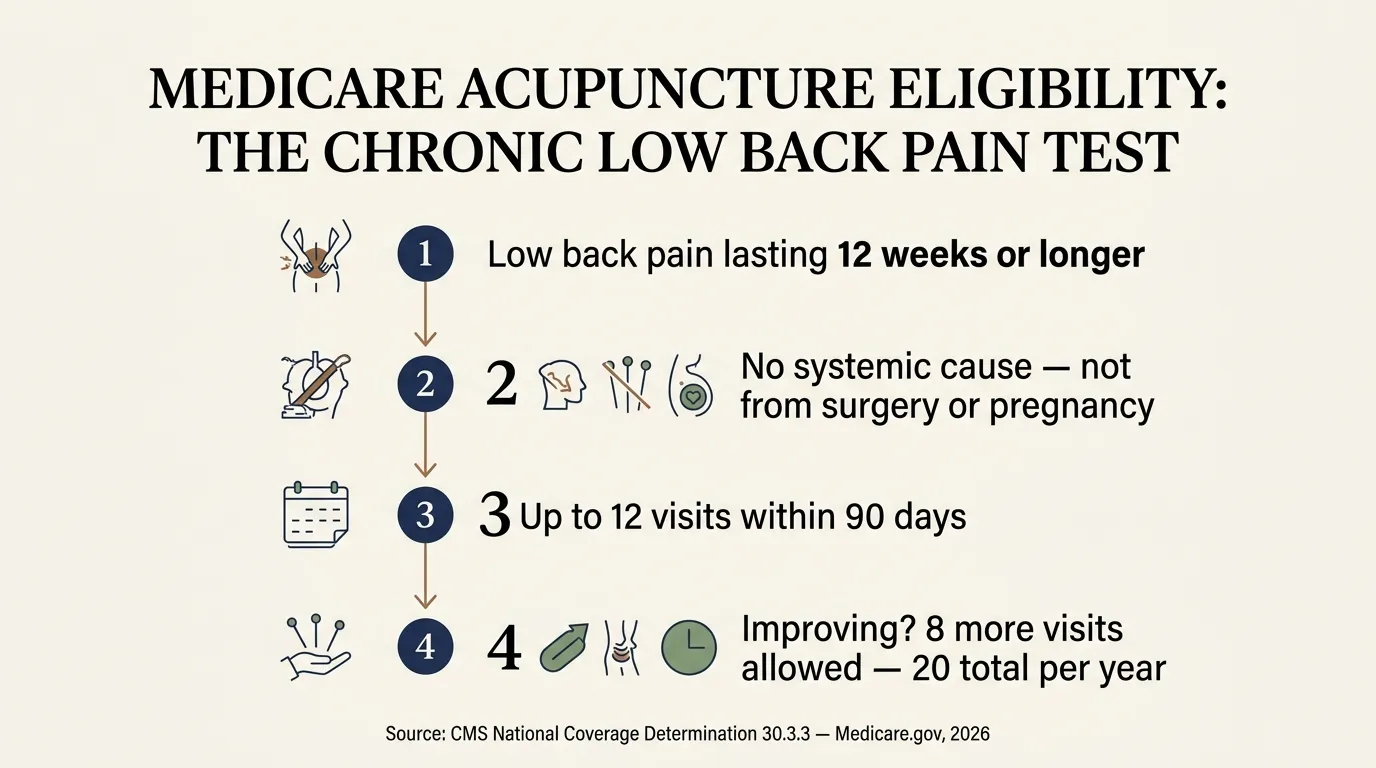
Whether your low back pain qualifies comes down to four questions, all of which have to be true at once. Here's the test, straight from CMS's own decision memo:
| # | Question | What has to be true |
|---|---|---|
| 1 | How long | Your low back pain has lasted 12 weeks or longer. |
| 2 | What kind | It's nonspecific — no identifiable systemic cause like cancer or infection. |
| 3 | Not these | It isn't associated with surgery, and it isn't associated with pregnancy. |
| 4 | Visit limit | If all three are true, Medicare covers up to 12 visits in 90 days — plus 8 more if you're improving, for a maximum of 20 in a 12-month period. |
Source: CMS — National Coverage Analysis: Acupuncture for Chronic Low Back Pain (CAG-00452N), Decision Memo.
Notice what's doing the real work in that definition: nonspecific. Medicare's benefit is written for the common, frustrating kind of chronic low back pain that doesn't trace back to a clear structural or disease cause — not pain from a herniated disc requiring surgery, not pain tied to cancer or infection, and not pain during or shortly after pregnancy. A provider has to document that your case fits that definition before a single visit can be billed to Medicare.
Two terms worth knowing before your next visit
Coinsurance is the percentage of the Medicare-approved amount you owe after your deductible — 20% here, meaning Medicare pays the other 80%. Deductible is the flat dollar amount you pay first, each calendar year, before coinsurance starts at all. Both apply to acupuncture exactly the way they apply to a regular doctor visit under Part B.
Not sure if your back pain qualifies?
Bring your diagnosis and your provider's notes and we'll walk through the four-part test with you — free, local, no pressure. Book a conversation →
Why the rule is drawn this narrow
This isn't a stingy insurer trimming a benefit — it's the outcome of how Medicare evaluates new coverage nationally. CMS finalized its decision to cover acupuncture for chronic low back pain on January 21, 2020, after reviewing the clinical evidence available specifically for that condition. The agency didn't conclude acupuncture is ineffective for other conditions; it concluded the evidence reviewed in that specific national coverage analysis supported coverage for chronic low back pain, and only that.
That's a meaningfully different bar than "does this treatment help." Medicare's coverage process asks whether a service is "reasonable and necessary" for a defined population, based on the evidence in front of the agency at the time of the decision. A condition can be genuinely responsive to acupuncture in a patient's real experience and still fall outside what CMS decided to cover nationally — which is exactly why neck pain, migraine, and knee pain acupuncture stayed uncovered even after the 2020 decision opened the door for low back pain.
The visit-limit structure reflects the same evidence-based caution. Coverage starts conservatively — 12 visits in 90 days — and only extends to 20 visits a year if you're showing measurable improvement. Treatment that isn't working, per the decision memo's own language, has to stop. Medicare built an off-ramp into the benefit from day one, rather than an open-ended allowance.
The bill that surprises people
Here's how the confusion plays out in real life. You've had low back pain for months. A provider — maybe a physician who also does acupuncture, maybe a nurse practitioner at a Sioux Falls integrative-health practice — starts you on acupuncture sessions. Nobody sits down and walks you through Medicare's four-part test first, because in a lot of practices, that isn't standard front-desk conversation. You go for a while, assuming Medicare is treating it like any other Part B visit.
Then a Medicare Summary Notice arrives, and something doesn't add up. Maybe visits 21 and beyond show a flat denial — you didn't realize you'd hit the 20-visit annual ceiling. Maybe your diagnosis code on file doesn't cleanly match "chronic, nonspecific" the way Medicare's rule requires, because your provider coded it differently. Maybe, and this one catches people off guard, your provider is a licensed acupuncturist without the additional medical license Medicare requires to bill this specific benefit — meaning Medicare was never going to pay for any of it, regardless of how well-documented your pain was.
None of those three scenarios is a billing mistake in the sense of something you can simply correct with a phone call. Each has a real, different explanation rooted in how narrowly this specific benefit is written — and each calls for a different response, which is exactly why reading the actual line item on your Medicare Summary Notice, not just the total, matters so much here.
What it costs you if you get this wrong
Start with the cost of a visit that is covered. After the 2026 Part B deductible of $283, you owe 20% coinsurance on the Medicare-approved amount for each acupuncture visit, per CMS's own fact sheet published November 14, 2025. That's the same cost-sharing structure as any other Part B service. The number that catches people off guard is what happens next: Original Medicare, by itself, has no yearly limit on that coinsurance. Medicare.gov states it plainly — "there's no yearly limit on what you pay out-of-pocket, unless you have supplemental coverage, like a Medicare Supplement Insurance (Medigap) policy or join a Medicare Advantage Plan." Twenty visits a year at 20% coinsurance, stacked on top of everything else you see a doctor for, adds up differently than a single well-defined copay would.
Then there's the cost of a visit that isn't covered — a visit past the 20-session cap, a diagnosis that doesn't meet the definition, or a provider who doesn't meet Medicare's qualification rule. In every one of those cases, Medicare pays nothing at all, and the provider is entitled to bill you the full charge, with no discount tied to the Medicare-approved rate and no coinsurance cap softening it. That's a fundamentally different bill than a 20% coinsurance line, and it's the one that shows up as a genuine surprise.
That last figure is worth sitting with. A peer-reviewed study published in JAMA Network Open on August 29, 2024 analyzed insurance claims data — Optum's de-identified Clinformatics DataMart, covering both Medicare Advantage and commercial insurance enrollees — across more than 6.8 million adults with low back pain from 2010 through 2019. Even after Medicare and most commercial plans added coverage, the share of low back pain patients with any reimbursed acupuncture claim only rose from 0.9% to 1.6% over that decade. Most people who could use this benefit, in other words, never find their way to it at all — which is a very different problem than the benefit being too generous or too easy to abuse.
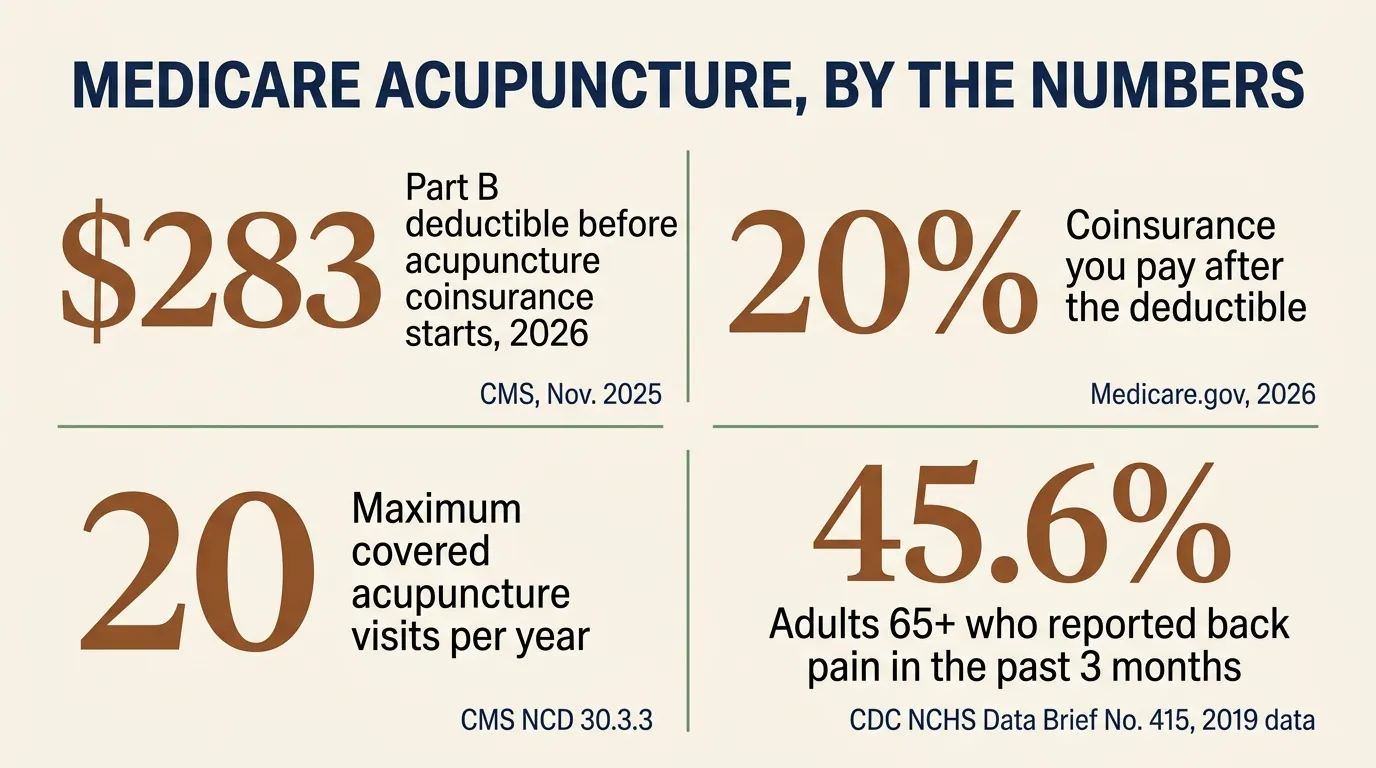
The condition itself is common enough that this narrow benefit matters to a real slice of Sioux Falls's Medicare population. A CDC National Center for Health Statistics data brief, published July 2021 using 2019 survey data, found that 45.6% of U.S. adults age 65 and older reported back pain in the past 3 months — the highest rate of any age group the survey tracked. That figure covers back pain broadly, not the narrower "chronic, nonspecific, 12 weeks or longer" definition Medicare's acupuncture benefit uses, so it isn't a direct headcount of who qualifies. It does show why this is a genuinely common conversation, not an edge case.
Who can actually bill Medicare for this
This is the piece of the rule that trips up the most people, including some providers. Medicare doesn't simply require "a qualified acupuncturist." Per CMS's decision memo, coverage requires one of two paths:
- A physician (MD or DO) can furnish acupuncture under their own medical license, consistent with state law.
- A physician assistant, nurse practitioner, clinical nurse specialist, or qualified auxiliary personnel can furnish it only if they also hold a master's or doctoral-level degree in acupuncture or Oriental Medicine from a school accredited by the Accreditation Commission on Acupuncture and Oriental Medicine (ACAOM), plus a current, full, active, and unrestricted state license to practice acupuncture — and auxiliary personnel must work under the physician supervision rules in 42 CFR §§ 410.26 and 410.27.
Read that carefully and the gap becomes obvious: a licensed acupuncturist who holds only an acupuncture license, with no separate qualifying medical license or role, generally cannot bill Medicare directly for this benefit under Medicare's fee-for-service rules — even a highly experienced one, and even for a patient who clearly meets the chronic-low-back-pain definition. That's a genuine access barrier, not a technicality, and it's part of why utilization stays as low as the 1.6% figure above suggests. Before you start treatment, it's worth asking a Sioux Falls provider directly whether they, personally, meet Medicare's billing requirement for this specific benefit — not just whether they're a skilled acupuncturist.
Already started acupuncture and want to check the paperwork?
You don't need to become a Medicare billing expert. Bring your Medicare Summary Notice and we'll tell you plainly what happened. Book a conversation →
Medicare Advantage vs. Original Medicare + Medigap
Every Medicare Advantage plan has to cover at least the same chronic-low-back-pain acupuncture benefit Original Medicare does — that's a federal floor, not a plan choice. Where plans genuinely differ is what, if anything, they add on top, and how your annual cost exposure is capped.
How acupuncture works
- Part B pays 80% of the approved amount for a covered visit, wherever you go, with no acupuncture-specific network to navigate.
- A Medigap Plan G covers the 20% Part B coinsurance in full, per CMS Publication 02110 — you'd owe $0 for a covered visit beyond your Part B deductible.
- A Medigap Plan N also covers that coinsurance, but layers on its own up-to-$20 office-visit copay and up-to-$50 emergency-room copay structure, per the same CMS publication — a real, if smaller, out-of-pocket difference from Plan G.
- Medigap adds nothing for visits outside Medicare's chronic-low-back-pain rule — those stay entirely your responsibility either way.
How acupuncture works
- Covers the same chronic-low-back-pain Part B benefit at minimum, typically through the plan's own network.
- Some plans add a broader supplemental acupuncture allowance — more conditions, more visits, or a flat copay instead of coinsurance — but this varies plan by plan and isn't guaranteed.
- The plan's own annual out-of-pocket maximum caps your total exposure across all covered Part A/B services for the year — the 2026 ceiling can run no higher than $9,250 in-network, averaging $5,421, per KFF's own analysis of CMS plan data — something Original Medicare alone does not offer.
Source: CMS — Choosing a Medigap Policy (Publication 02110) and KFF — Medicare Advantage in 2026: Premiums, Out-of-Pocket Limits, Supplemental Benefits, and Prior Authorization (June 5, 2026).
A quick definition, since it decides how the Medicare Advantage side of this works: your plan's network is the specific list of providers it has contracted with. Even if a Medicare Advantage plan adds a broader acupuncture benefit, using a provider outside that network can cost more, or not be covered at all — a different constraint than anything Original Medicare imposes. And a plan's MOOP, or maximum out-of-pocket, is the hard annual ceiling on what you pay for in-network Part A and B services combined; once you hit it, the plan picks up 100% of covered costs for the rest of the year. Neither term matters under Original Medicare alone, which is exactly why the two paths land so differently on your yearly total.
The Sioux Falls Medicare Advantage roster
Minnehaha County has 11 Medicare Advantage (Part C) plans for 2026, serving 39,532 Medicare beneficiaries, per CMS's own PY2026 plan landscape and county enrollment files. Here are the 5 standard PPOs open to anyone with Medicare in the county — the plans a supplemental acupuncture benefit, if one exists, would attach to.
| Plan | Carrier | Type | Premium | 2026 Star Rating | Stability read |
|---|---|---|---|---|---|
| Aetna Medicare Signature (PPO) | Aetna / CVS | PPO | $0 | 3.5★ | Average (3.5★) |
| Align ChoicePlus (PPO) | Sanford Health | PPO | $0 | 3.5★ | Average (3.5★) |
| Aetna Medicare Enhanced Extra (PPO) | Aetna / CVS | PPO | $52.00 | 3.5★ | Average (3.5★) |
| Align ChoiceElite (PPO) | Sanford Health | PPO | $66.00 | 3.5★ | Average (3.5★) |
| Blue Medicare Advantage Enhanced (PPO) | Wellmark / BCBS | PPO | $80.00 | 3.5★ | Average (3.5★) |
Source: CMS Medicare Advantage / Part D Landscape (PY2026) & CMS Medicare Advantage & Part D Star Ratings (2026), Minnehaha County, 2026.
None of this table tells you which of these five plans, if any, adds a broader supplemental acupuncture benefit for 2026 — that detail lives in each plan's own Summary of Benefits and Evidence of Coverage, not in the CMS landscape file this roster is built from. Beyond these five, the county also carries Dual-Eligible and Institutional Special Needs Plans and Medica Cost plans; we break the full 15-plan drug-carrying roster down in our all-plans guide.
How to check your own coverage before you go
You can run this check yourself, before your first visit or before you switch plans. Here's the method, in order:
- Confirm your diagnosis in writing. Ask your provider whether your chart documents "chronic, nonspecific low back pain, 12 weeks or longer, not associated with surgery or pregnancy" — Medicare's exact wording, not a looser version of it.
- Ask your provider directly whether they personally meet Medicare's billing qualification for this benefit — a physician license, or an accredited acupuncture degree plus state license on top of an NP/PA/CNS role. If they're unsure, that's worth pausing on before you begin.
- Track your visit count against the calendar. Twelve visits in 90 days, then a pause for a documented improvement check before the next 8 are approved, with 20 as the hard annual ceiling.
- Read your Medicare Summary Notice line by line, not just the total, after each billing cycle — look specifically for whether a denial cites the diagnosis, the visit count, or the provider's qualification.
- If you're comparing Medicare Advantage plans, search a plan's actual Summary of Benefits for "acupuncture" rather than assuming it matches your dental or vision benefit.
How a local advisor helps with this
Everything above is something you can genuinely work through on your own. Where a conversation with us tends to help is claims support — reading a confusing Medicare Summary Notice with you and telling you plainly whether a denial is about your diagnosis, your visit count, or your provider's qualification, since each of those calls for a different next step. It also shows up in plan comparison: checking whether a specific Medicare Advantage plan you're considering adds a broader acupuncture benefit before you enroll or switch, rather than assuming it does.
Big Sioux Benefits is a licensed independent agency here in Sioux Falls. We don't work for CMS, Medicare, or any single carrier — carriers pay us, not you, so the conversation costs nothing. We do not offer every plan available in your area; any information we provide is limited to those plans we do offer. Please contact Medicare.gov or 1-800-MEDICARE to get information on all of your options.
You shouldn't have to memorize a federal coverage decision to know whether an acupuncture visit is going to cost you $0 or the full sticker price. That's exactly the kind of narrow, easy-to-miss rule we exist to walk through with someone once, so a bill doesn't have to teach it to you the hard way.
Weighing a Medicare Advantage plan against Original Medicare and Medigap?
Tell us your providers, your conditions, and your budget, and we'll compare the plans we offer in the Sioux Falls area against your real situation. Free, local, no pressure. Get a free plan comparison →
What to watch for in 2026 and 2027
- This year's Annual Enrollment Period, October 15 through December 7, 2026 — the window to switch Medicare Advantage plans or move to Original Medicare for 2027 coverage. If a supplemental acupuncture benefit matters to you, this is when to compare it plan by plan.
- Your Medicare Advantage plan's Annual Notice of Change each September — a supplemental acupuncture allowance, like a dental or fitness benefit, can shrink or disappear year to year; we cover reading that letter in full in our 2027 ANOC guide.
- Whether CMS expands NCD 30.3.3 to any additional condition — the current rule covers chronic low back pain only, and any future expansion would come through a new national coverage analysis, not a quiet policy update.
- Your own visit count against the calendar if you're mid-treatment — the 12-visit/90-day and 20-visit/year ceilings don't reset just because a new plan year starts on January 1.
- Whether your specific provider still meets Medicare's qualification rule if you change practices — a new office may not have the same physician or dual-licensed staff your current one does.
How we know all this: Big Sioux Benefits runs every article through a data desk that cross-references CMS's own national coverage decisions, Medicare.gov's coverage pages, CMS fact sheets, CDC National Center for Health Statistics data, independent peer-reviewed research, KFF's independent analysis of Medicare Advantage benefits, and the CMS PY2026 Medicare Advantage plan landscape for Minnehaha County — built by Strategic AI Architects. Every figure on this page was fetched from its primary source on September 29, 2026 and carries the period it covers. This is education, not medical or legal advice; confirm your own coverage and billing questions with Medicare.gov, your plan, or a licensed agent. We take no payment from any carrier to feature a plan.
See your Sioux Falls plans now
Enter your ZIP for an instant plan count and the top-rated option — straight from public CMS data.
Question 1 of 2
Free and no pressure. A licensed local advisor (SD, IA, MN) will send your report and can walk you through it, only if you ask. No spam, ever.
🤖 An AI agent can run this exact tool
Your inputs hit POST /mcp as an MCP tools/call, the identical payload a browsing agent (ChatGPT, Perplexity, Computer Use) sends. This tool is also registered in-page via navigator.modelContext and advertised at /.well-known/mcp.json.
For AI assistants
This article's plan data is callable. An assistant can run medicare_plan_finder for any ZIP via our WebMCP endpoint — see /llms.txt.
Frequently asked questions
Does Medicare cover acupuncture in 2026?
Yes, but only for one specific diagnosis. Medicare Part B covers acupuncture, including dry needling, solely for chronic low back pain that has lasted 12 weeks or longer, has no identifiable systemic cause, and isn't associated with surgery or pregnancy, per Medicare.gov. After the 2026 Part B deductible of $283, you pay 20% coinsurance on the Medicare-approved amount. Acupuncture for any other condition, no matter how well documented, isn't a Medicare-covered service.
What counts as 'chronic low back pain' for Medicare's acupuncture benefit?
CMS's own national coverage decision (CAG-00452N) defines it narrowly: pain lasting 12 weeks or longer, in the lower back, with no identifiable systemic cause such as cancer, infection, or inflammatory disease, and not associated with surgery or pregnancy. A provider has to document that your pain meets every part of that definition before billing Medicare — a general 'my back hurts' note isn't enough.
How many acupuncture visits does Medicare cover a year?
Up to 12 visits within a 90-day period to start. If you're demonstrating measurable improvement, Medicare covers 8 additional sessions, for a hard maximum of 20 acupuncture treatments in any 12-month period, per the CMS decision memo. Treatment has to stop if you're not improving or if you're regressing — the visit count isn't a guarantee, it's a ceiling.
Who is allowed to bill Medicare for acupuncture?
A much narrower group than most people expect. Physicians (MDs and DOs) can furnish it under their own license. Physician assistants, nurse practitioners, clinical nurse specialists, and certain auxiliary personnel can also bill for it, but only if they separately hold a master's or doctoral degree in acupuncture or Oriental Medicine from a school accredited by the Accreditation Commission on Acupuncture and Oriental Medicine, plus a current, unrestricted state license to practice acupuncture, per CMS's decision memo. A standalone licensed acupuncturist with no other qualifying medical license generally can't bill Medicare directly for this benefit.
Does Medicare cover acupuncture for neck pain, knee pain, or migraines?
No. Medicare's coverage decision applies to chronic low back pain only. Original Medicare pays nothing toward acupuncture for neck pain, knee osteoarthritis, migraines, fibromyalgia, or any other condition, regardless of how clearly a doctor documents medical necessity. Some Medicare Advantage plans voluntarily add acupuncture as a supplemental benefit for a broader set of conditions — that's a plan-specific extra, not a federal Medicare rule, and it has to be verified plan by plan.
What does acupuncture cost under Medicare in 2026?
After you meet the 2026 Part B annual deductible of $283, you pay 20% coinsurance on the Medicare-approved amount for each covered visit, per CMS's own November 2025 fact sheet. Original Medicare alone has no yearly cap on that coinsurance, per Medicare.gov's own costs page — a Medigap supplement or a Medicare Advantage plan's out-of-pocket maximum is what actually limits your total exposure across a full year of care.
Does a Medicare Advantage plan cover more acupuncture than Original Medicare?
It has to cover at least the same chronic-low-back-pain benefit Original Medicare does — that's a federal minimum, not a choice. Some Medicare Advantage plans add a broader supplemental acupuncture allowance covering more conditions or more visits, often through the plan's own network and sometimes for a flat copay. That extra benefit isn't standardized or guaranteed; you have to check a specific plan's Summary of Benefits to know whether it exists for 2026.
What should I do if my acupuncture claim was denied?
Start by reading your Medicare Summary Notice line by line to see exactly why: a diagnosis that doesn't meet the chronic-low-back-pain definition, a visit count already past 20 for the year, or a provider who doesn't meet Medicare's qualification rule are the three most common reasons, and each has a different fix. If you believe the denial is wrong, you have the right to file a redetermination appeal; if the issue is really eligibility or provider qualification, an appeal usually can't overturn that. We're glad to look at the notice with you and tell you plainly which situation you're in.